Overview
Viewpoint hierarchy is a critical analytical framework in LSAT Reading Comprehension that requires test-takers to identify, distinguish, and rank the various perspectives presented within a passage. Unlike simpler passages that present a single author's perspective, LSAT passages frequently incorporate multiple voices: the author's own position, views of scholars or experts cited in the passage, historical perspectives, opposing theories, and critiques of various positions. Understanding the lsat viewpoint hierarchy means recognizing which viewpoint holds primary authority in the passage, which perspectives are subordinate or merely referenced, and how the author positions themselves relative to these competing voices.
This topic represents one of the most sophisticated skills tested in reading comprehension on the LSAT. The exam writers deliberately construct passages with layered perspectives to assess whether test-takers can navigate complex argumentative structures. A passage might present Theory A, explain why some scholars support it, introduce Theory B as an alternative, cite criticisms of both theories, and then reveal the author's own nuanced position that synthesizes or rejects elements of both. Students who cannot track this hierarchy will misattribute claims, confuse the author's view with cited sources, and ultimately select incorrect answer choices that reflect this confusion.
Within the broader context of viewpoints and argumentation, viewpoint hierarchy serves as the organizational backbone that structures how arguments unfold in LSAT passages. It connects directly to identifying main points, understanding the author's attitude, recognizing the function of different passage components, and evaluating the strength of various claims. Mastering viewpoint hierarchy enables students to answer not only direct "author's attitude" questions but also inference questions, function questions, and application questions that require understanding whose perspective supports which conclusion.
Learning Objectives
- [ ] Identify how Viewpoint hierarchy appears in LSAT questions
- [ ] Explain the reasoning pattern behind Viewpoint hierarchy
- [ ] Apply Viewpoint hierarchy to solve LSAT-style problems accurately
- [ ] Distinguish between the author's primary viewpoint and secondary viewpoints cited within a passage
- [ ] Construct a mental map of viewpoint relationships while reading LSAT passages
- [ ] Recognize language markers that signal shifts between different perspectives
- [ ] Evaluate answer choices by matching them to the correct level in the viewpoint hierarchy
Prerequisites
- Basic passage structure recognition: Understanding how LSAT passages are organized into introduction, body, and conclusion helps identify where different viewpoints typically appear
- Argument identification skills: Recognizing claims, evidence, and conclusions is necessary before determining whose viewpoint each element represents
- Author's tone and attitude awareness: Distinguishing neutral reporting from evaluative language helps separate the author's views from cited perspectives
- Reading for main purpose: Understanding why an author wrote a passage provides context for how they position various viewpoints hierarchically
Why This Topic Matters
In legal practice, attorneys must constantly navigate multiple perspectives: their client's position, opposing counsel's arguments, precedent cases, statutory interpretations, and their own strategic analysis. The LSAT tests this skill through viewpoint hierarchy because it mirrors the analytical demands of law school and legal practice. Understanding whose perspective supports which claim is fundamental to constructing persuasive arguments and identifying weaknesses in opposing positions.
Viewpoint hierarchy appears in approximately 60-70% of LSAT Reading Comprehension passages, making it one of the most frequently tested concepts. It manifests in several question types: "The author's attitude toward X can best be described as..." questions directly test viewpoint identification; "According to the passage, proponents of Theory Y believe..." questions test whether students can attribute claims to the correct source; "The author mentions Scholar Z primarily in order to..." questions test understanding of how different viewpoints function within the passage's argumentative structure.
Common manifestations include passages about scientific debates (presenting competing theories and the author's evaluation), legal or philosophical arguments (contrasting different schools of thought), historical analyses (comparing contemporary and modern interpretations), and literary criticism (presenting various critical approaches to a text). The LSAT particularly favors passages where the author's viewpoint is subtle or emerges gradually, requiring careful tracking of perspective markers throughout the passage.
Core Concepts
The Primary-Secondary-Tertiary Framework
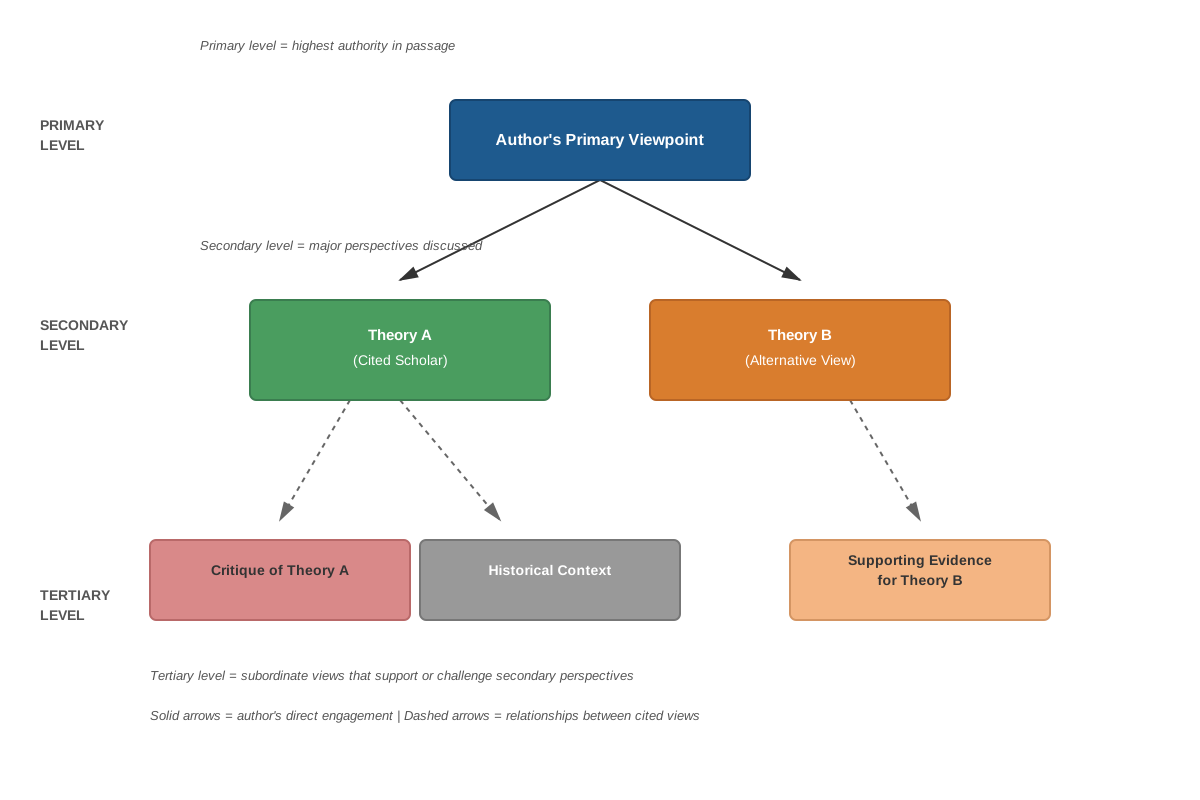
The viewpoint hierarchy operates on a tiered system where perspectives hold different levels of authority and prominence within a passage. The primary viewpoint is typically the author's own perspective—the lens through which the entire passage is filtered and the position that ultimately determines how other views are presented and evaluated. This primary viewpoint may be explicitly stated or may emerge implicitly through the author's selection of evidence, tone, and organizational choices.
Secondary viewpoints are perspectives that the author discusses substantively but does not personally endorse. These might include prevailing theories in a field, positions held by scholars or experts, historical perspectives, or alternative explanations for phenomena. The author presents these views with enough detail that they form significant content in the passage, but maintains analytical distance through language markers like "proponents argue," "according to this theory," or "some scholars believe."
Tertiary viewpoints receive only brief mention, often appearing as contrasts, historical background, or dismissed alternatives. These perspectives might be introduced with phrases like "traditionally, it was thought that..." or "an outdated view held that..." The author dedicates minimal space to these views, using them primarily to contextualize more important perspectives or to demonstrate the evolution of thought on a topic.
Language Markers and Attribution Signals
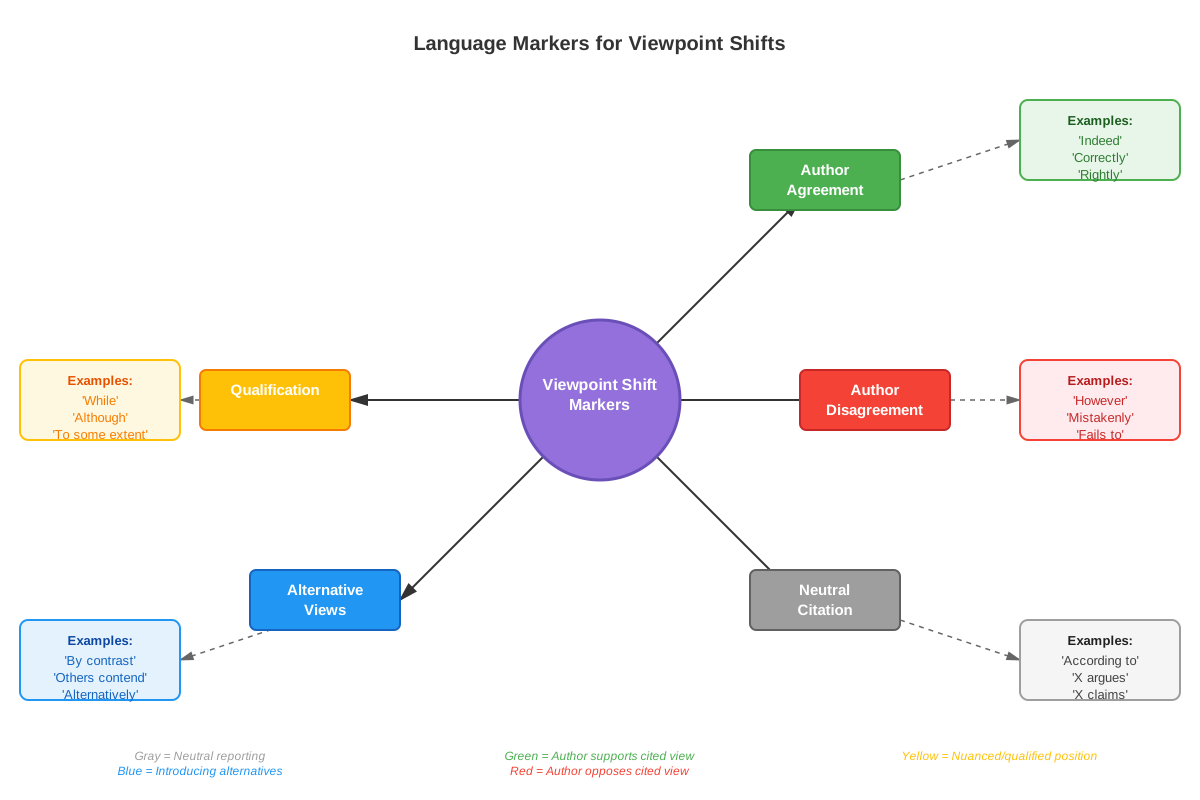
Identifying viewpoint hierarchy depends heavily on recognizing attribution signals—linguistic markers that indicate whose perspective is being presented. Direct attribution uses explicit phrases: "The author argues," "Smith contends," "Critics maintain," "The traditional view holds." These clear signals leave no ambiguity about the source of a claim.
Indirect attribution requires more sophisticated reading. Modal verbs like "may," "might," "could," or "would" often signal that the author is presenting a possibility rather than endorsing a claim. Hedging language like "appears to," "seems to," or "suggests" indicates tentative positioning. Conversely, definitive language like "demonstrates," "proves," or "clearly shows" typically signals stronger commitment to a viewpoint.
Evaluative language reveals the author's attitude toward different viewpoints. Positive evaluation markers include "convincingly," "persuasively," "insightfully," or "importantly." Negative evaluation markers include "unfortunately," "problematically," "fails to account for," or "overlooks." Neutral presentation uses "describes," "explains," "outlines," or "presents" without evaluative coloring.
Structural Positioning and Viewpoint Hierarchy
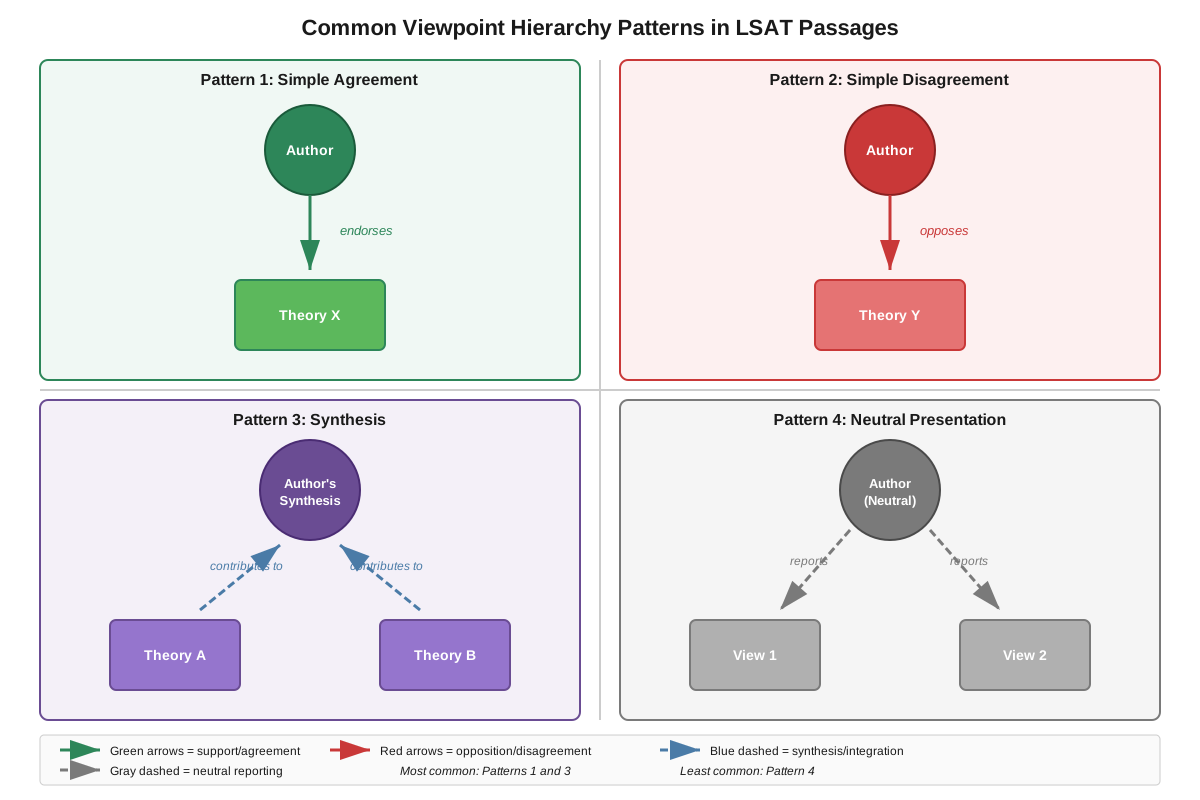
The physical location of viewpoints within a passage often reflects their hierarchical importance. LSAT passages frequently follow predictable structural patterns:
Pattern 1: Progressive Refinement
- Paragraph 1: Introduce traditional/prevailing view (secondary)
- Paragraph 2: Present challenges or limitations to that view (secondary/tertiary)
- Paragraph 3: Introduce author's preferred alternative or synthesis (primary)
- Paragraph 4: Elaborate on implications of author's view (primary)
Pattern 2: Comparative Analysis
- Paragraph 1: Establish the debate or question at issue (neutral framing)
- Paragraph 2: Present Position A with supporting arguments (secondary)
- Paragraph 3: Present Position B with supporting arguments (secondary)
- Paragraph 4: Author evaluates both and stakes a position (primary)
Pattern 3: Critical Examination
- Paragraph 1: Introduce a theory or claim (secondary)
- Paragraphs 2-3: Explain the theory's development and support (secondary)
- Paragraph 4: Present author's critique or qualification (primary)
Understanding these patterns helps predict where the author's primary viewpoint will emerge and how secondary viewpoints function within the argumentative structure.
The Author's Implicit Viewpoint
The most challenging aspect of viewpoint hierarchy involves passages where the author never explicitly states "I argue" or "I believe" but instead reveals their perspective through implicit positioning. The author's viewpoint emerges through:
- Selection and emphasis: Which theories receive detailed explanation versus brief mention signals what the author considers important
- Evidence presentation: Whether evidence is presented as "supporting" or "allegedly supporting" a claim reveals the author's assessment
- Organizational structure: Placing a viewpoint in the concluding paragraph often signals its privileged status
- Tone and word choice: Describing a theory as "elegant" versus "simplistic" reveals evaluation even without explicit endorsement
- Concession patterns: When the author acknowledges limitations of their preferred view, this paradoxically confirms it as their position
Viewpoint Complexity and Nuance
Advanced LSAT passages present complex viewpoint relationships that resist simple categorization. An author might:
- Partially endorse a viewpoint: agreeing with its conclusions but questioning its methodology
- Synthesize multiple perspectives: combining elements from competing theories into a novel position
- Conditionally support a claim: endorsing it within certain contexts while rejecting broader applications
- Distinguish between different versions of a theory: supporting a refined version while criticizing earlier formulations
These nuanced positions require careful attention to qualifying language and scope limitations. An author might write, "While Smith's critique successfully identifies problems with the traditional approach, her proposed alternative fails to account for recent empirical findings." This sentence positions the author as agreeing with Smith's negative assessment but disagreeing with her positive proposal—a hierarchical relationship that cannot be reduced to simple agreement or disagreement.
Concept Relationships
Viewpoint hierarchy serves as the foundational structure upon which other reading comprehension skills build. The relationship flows as follows:
Viewpoint Hierarchy → Main Point Identification: Understanding which viewpoint holds primary authority enables accurate identification of the passage's main point, which typically reflects the author's primary perspective rather than secondary viewpoints discussed in the passage.
Viewpoint Hierarchy → Function Questions: Recognizing the hierarchical relationship between viewpoints allows students to answer questions about why the author mentions specific details, theories, or scholars. A secondary viewpoint might function to provide context, establish a contrast, or serve as a foil for the author's preferred position.
Viewpoint Hierarchy → Inference Questions: Valid inferences must align with the appropriate viewpoint level. An inference about "what the author believes" must derive from the primary viewpoint, while an inference about "what proponents of Theory X would likely conclude" must derive from the secondary viewpoint representing Theory X.
Viewpoint Hierarchy → Attitude Questions: These questions directly test viewpoint hierarchy by asking students to characterize the author's stance toward various positions, requiring precise understanding of evaluative language and implicit positioning.
The prerequisite skills of argument identification and tone recognition feed into viewpoint hierarchy: students must first identify what claims are being made (argument identification) and how they're being presented (tone recognition) before determining whose perspective each claim represents (viewpoint hierarchy). This hierarchical skill then enables more sophisticated analysis of passage structure and argumentative strategy.
Quick check — test yourself on Viewpoint hierarchy so far.
Try Flashcards →High-Yield Facts
⭐ The author's primary viewpoint most commonly appears in the final paragraph or final sentences of LSAT passages, though sophisticated passages may establish it earlier through implicit positioning.
⭐ Attribution phrases like "according to," "proponents argue," and "critics contend" always signal secondary viewpoints, never the author's own position, even when the author agrees with the cited perspective.
⭐ When the author uses "however," "yet," "but," or "nevertheless" after presenting a viewpoint, the content following these contrast markers typically represents the author's own perspective or a viewpoint the author privileges.
⭐ Questions asking what "the passage suggests" or "the passage indicates" typically seek the author's primary viewpoint, while questions asking what "is stated" or "according to the passage" may reference any viewpoint level.
⭐ The viewpoint receiving the most detailed explanation is not necessarily the author's preferred position; LSAT passages often extensively explain theories the author ultimately critiques.
- Evaluative language (convincingly, problematically, unfortunately) always reveals the author's attitude toward the viewpoint being discussed, making it a reliable marker of the primary perspective.
- When multiple scholars or theories are mentioned, the one discussed last often represents the author's preferred position, following the rhetorical pattern of progressive refinement.
- Passages presenting "traditional" or "conventional" views in early paragraphs typically do so to establish a contrast with the author's alternative perspective introduced later.
- The author's viewpoint may align with one of the secondary viewpoints presented; agreement doesn't eliminate the hierarchical distinction between author and cited source.
- Questions containing the phrase "the author's primary purpose" require identifying the main function of the author's primary viewpoint, not merely summarizing passage content.
- Comparative passages (Passage A and Passage B) require tracking viewpoint hierarchy within each passage separately before analyzing the relationship between the two authors' perspectives.
- When an author presents a viewpoint without explicit attribution or evaluation, assume neutral reporting of a secondary viewpoint unless context suggests otherwise.
Common Misconceptions
Misconception: The viewpoint presented first in a passage is the author's primary viewpoint.
Correction: LSAT passages frequently begin with traditional, prevailing, or opposing views to establish context before introducing the author's own perspective. The opening viewpoint often represents what the author will critique or refine.
Misconception: If the author explains a theory in detail, they must endorse it.
Correction: Detailed explanation serves multiple rhetorical purposes: establishing context, demonstrating thorough understanding before critique, or showing why a theory gained acceptance despite its flaws. Length of discussion does not correlate with author endorsement.
Misconception: Phrases like "the passage states" and "the author argues" are interchangeable in answer choices.
Correction: "The passage states" can refer to any viewpoint presented anywhere in the passage, including secondary and tertiary perspectives. "The author argues" specifically references the author's primary viewpoint. This distinction is frequently tested.
Misconception: The author's viewpoint is always explicitly stated with first-person language or direct attribution.
Correction: LSAT passages typically maintain academic objectivity, revealing the author's perspective through implicit markers: organizational structure, evaluative language, evidence selection, and tone. Explicit statements like "I argue" rarely appear.
Misconception: When the author presents both sides of a debate equally, they hold no viewpoint of their own.
Correction: Even seemingly balanced presentations contain subtle markers of the author's position through word choice, emphasis, concession patterns, and structural positioning. True neutrality is rare on the LSAT; the author almost always privileges one perspective.
Misconception: All scholars or experts mentioned in a passage represent the same level of viewpoint hierarchy.
Correction: The author may align closely with some cited scholars while distancing from others. Each mentioned expert occupies a distinct position in the hierarchy based on how the author frames their contribution.
Worked Examples
Example 1: Scientific Theory Passage
Passage Excerpt:
"For decades, the prevailing explanation for the extinction of megafauna in North America centered on climate change at the end of the Pleistocene epoch. Proponents of this theory pointed to the correlation between rising temperatures and species disappearance. However, recent archaeological evidence has complicated this straightforward narrative. Martin's overkill hypothesis, which attributes megafaunal extinction primarily to human hunting pressure, has gained considerable support from dated kill sites and population modeling. While climate certainly played some role, the temporal and geographic patterns of extinction align more closely with human migration routes than with climate shifts. This suggests that anthropogenic factors were the primary driver of these extinctions, with climate change serving as a contributing but not determinative factor."
Analysis:
Step 1: Identify all viewpoints present
- Traditional climate change theory (secondary viewpoint)
- Martin's overkill hypothesis (secondary viewpoint)
- Author's synthesis position (primary viewpoint)
Step 2: Map attribution signals
- "prevailing explanation" = signals traditional view, not author's
- "Proponents of this theory pointed" = explicit attribution to secondary viewpoint
- "However" = contrast marker signaling shift toward author's perspective
- "has gained considerable support" = positive evaluation suggesting author's alignment
- "While climate certainly played some role" = concession pattern
- "This suggests" = author's interpretive conclusion
Step 3: Determine hierarchical relationships
The author presents the climate theory as historically dominant but now insufficient (secondary, partially rejected). Martin's hypothesis receives positive evaluation and detailed support (secondary, endorsed). The author's primary viewpoint synthesizes both: human hunting was primary, climate was contributory. This represents a nuanced position that doesn't fully align with either cited theory.
Step 4: Predict question types
- "The author's attitude toward the climate change theory can best be described as..." → Answer: qualified skepticism or partial rejection
- "According to the passage, proponents of the climate change theory believe..." → Answer must reference only what's attributed to that specific viewpoint
- "The author mentions Martin's overkill hypothesis primarily to..." → Answer: support the author's argument about anthropogenic factors
Example 2: Legal Philosophy Passage
Passage Excerpt:
"Legal formalists maintain that judicial decision-making should derive exclusively from the logical application of existing legal rules to case facts, without reference to policy considerations or social consequences. This view, dominant in the early twentieth century, treats law as a self-contained system of principles. Critics have long argued that this approach is both descriptively inaccurate and normatively undesirable. They point out that judges inevitably exercise discretion when rules conflict or prove ambiguous, and that pretending otherwise merely conceals the value judgments that actually drive decisions. Yet the critics' alternative—explicit consideration of policy and consequences—raises its own concerns about judicial legitimacy and democratic accountability. Perhaps the most defensible position recognizes that while pure formalism is untenable, judges should exercise their inevitable discretion within constraints that preserve the rule of law's predictability and limit judicial policymaking to interstitial matters."
Analysis:
Step 1: Identify viewpoint hierarchy
- Legal formalism (secondary viewpoint, historically important)
- Critics of formalism (secondary viewpoint, opposing formalism)
- Author's balanced synthesis (primary viewpoint)
Step 2: Track evaluative language
- "maintain" = neutral attribution to formalism
- "Critics have long argued" = explicit attribution
- "Yet the critics' alternative...raises its own concerns" = author critiques the critics, signaling distance from both extremes
- "Perhaps the most defensible position" = author's explicit endorsement marker
- "untenable" = strong negative evaluation of pure formalism
- "should exercise their inevitable discretion within constraints" = author's prescriptive claim
Step 3: Recognize the rhetorical structure
The passage follows a dialectical pattern: thesis (formalism), antithesis (critics), synthesis (author's balanced position). The author rejects both extremes while incorporating insights from each. This represents sophisticated viewpoint hierarchy where the primary viewpoint emerges through critique of both secondary positions.
Step 4: Application to questions
- "Which one of the following best describes the organization of the passage?" → Answer: present a view, present criticism of that view, propose a synthesis
- "The author would most likely agree with which of the following?" → Answer must reflect the balanced synthesis, not pure formalism or unlimited discretion
- "The passage suggests that legal formalists would object to..." → Answer must derive from the formalist viewpoint specifically, not the author's or critics' perspectives
Exam Strategy
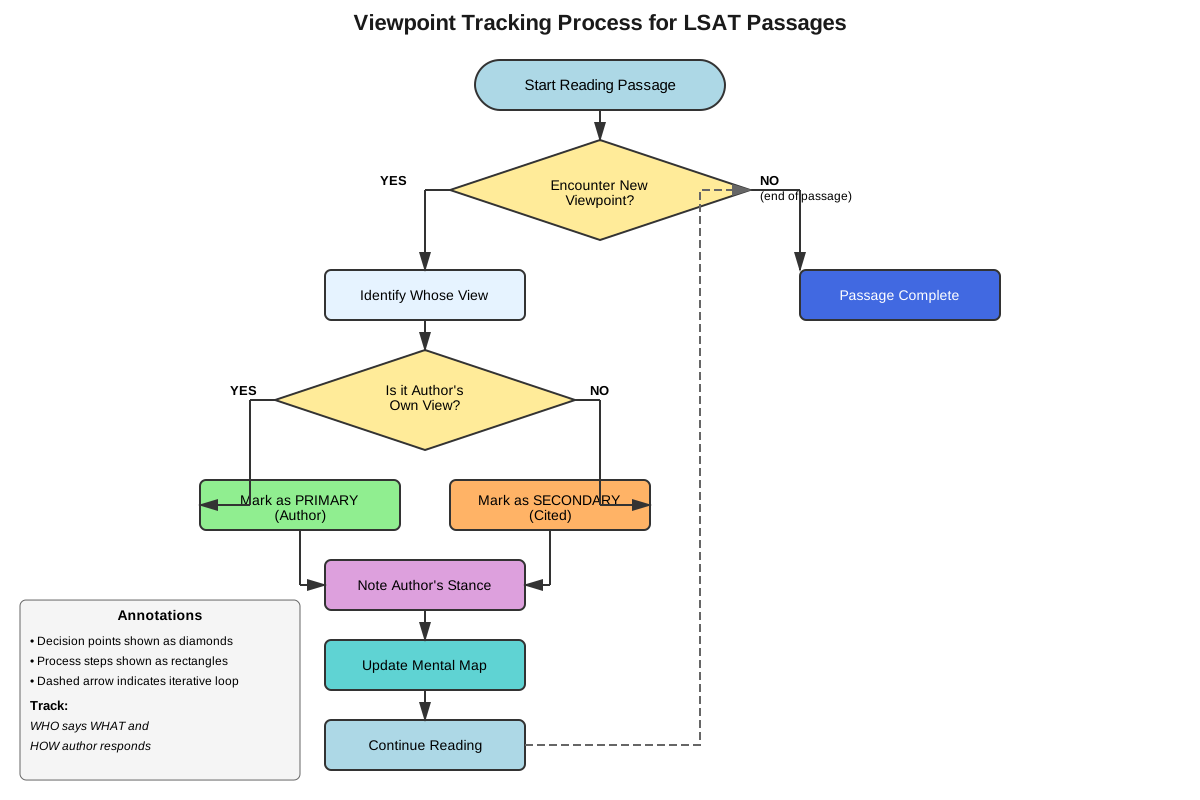
When approaching LSAT Reading Comprehension passages, implement a systematic viewpoint tracking strategy from the first sentence. As you read, actively annotate (mentally or on paper) whose perspective each paragraph or major claim represents. Use shorthand markers: "A" for author, "T" for traditional/prevailing view, "C" for critics, or specific names for identified scholars.
Trigger words for viewpoint shifts include: "however," "yet," "but," "nevertheless," "although," "while," "despite," "in contrast," "on the other hand," "alternatively," and "conversely." When you encounter these contrast markers, heighten your attention—the author's primary viewpoint often follows these signals.
Attribution phrases that always indicate secondary viewpoints include: "according to," "proponents argue," "critics contend," "scholars maintain," "the traditional view holds," "some believe," "it has been suggested," and "X claims." Never attribute these perspectives to the author unless additional evidence confirms alignment.
For process-of-elimination on viewpoint questions, first identify the viewpoint level the question targets (primary/author vs. secondary/cited source). Eliminate any answer choice that confuses viewpoint levels—these are the most common wrong answers. Next, eliminate choices that use extreme language unless the passage explicitly supports such extremity. Finally, eliminate choices that contradict explicit evaluative language in the passage.
Time allocation: Spend approximately 3-3.5 minutes on the initial read-through, during which viewpoint tracking should be your primary analytical task. This upfront investment pays dividends by making questions answerable more quickly. For viewpoint-specific questions, return to the relevant passage section to verify attribution before selecting an answer—these questions reward precision over speed.
Question stem analysis: Distinguish between "the passage suggests" (author's view), "according to the passage" (any stated viewpoint), "proponents of X would likely agree" (specific secondary viewpoint), and "the author's attitude toward X" (author's evaluation of a secondary viewpoint). Each requires accessing a different level of the hierarchy.
Memory Techniques
PACE acronym for viewpoint hierarchy levels:
- Primary: Author's own perspective
- Auxiliary: Secondary viewpoints discussed substantively
- Contextual: Tertiary viewpoints mentioned briefly
- Evaluative markers: Language revealing the author's attitude
The "However Rule": When you see "however," "yet," or "but," the author's true position follows. Remember: "However = Here's what I actually think."
Attribution visualization: Picture the passage as a conversation at a conference. The author is the moderator who introduces various speakers (secondary viewpoints) but ultimately offers their own concluding perspective. This mental model helps distinguish between reporting others' views and stating one's own.
The Last Word Principle: In LSAT passages, the author typically gets "the last word"—the final paragraph or final sentences usually contain or strongly signal the primary viewpoint. When in doubt, weight the conclusion heavily.
Color-coding mental map: Assign mental colors to viewpoint levels. Primary viewpoint = gold (most valuable), secondary viewpoints = silver (important but subordinate), tertiary viewpoints = bronze (background only). As you read, mentally "highlight" content in these colors.
Summary
Viewpoint hierarchy represents the organizational structure of perspectives within LSAT Reading Comprehension passages, distinguishing between the author's primary viewpoint, secondary viewpoints that receive substantive discussion, and tertiary viewpoints mentioned briefly for context. Mastering this concept requires recognizing attribution signals, tracking evaluative language, understanding structural positioning patterns, and distinguishing between explicit and implicit markers of the author's perspective. The author's primary viewpoint typically emerges through contrast markers, evaluative language, organizational structure, and positioning in concluding sections, though sophisticated passages may reveal it implicitly throughout. Success on viewpoint hierarchy questions depends on precise attribution—matching claims to their correct source level—and recognizing that detailed explanation does not equal author endorsement. This skill underlies performance on main point questions, function questions, inference questions, and attitude questions, making it one of the highest-yield concepts in LSAT Reading Comprehension.
Key Takeaways
- Viewpoint hierarchy distinguishes between the author's primary perspective, secondary viewpoints discussed substantively, and tertiary viewpoints mentioned briefly
- Attribution phrases like "according to" and "proponents argue" always signal secondary viewpoints, never the author's own position
- Contrast markers ("however," "yet," "but") typically precede the author's primary viewpoint or signal shifts between perspectives
- The author's perspective often appears in final paragraphs or emerges implicitly through evaluative language, evidence selection, and organizational structure
- Detailed explanation of a theory does not indicate author endorsement; LSAT passages frequently explain positions the author ultimately critiques
- Questions asking what "the passage suggests" seek the author's view, while "according to the passage" may reference any viewpoint level
- Successful viewpoint tracking requires active annotation and systematic identification of whose perspective each claim represents
Related Topics
Author's Purpose and Main Point: Building on viewpoint hierarchy, this topic focuses on identifying why the author wrote the passage and what overarching claim the primary viewpoint supports. Mastering viewpoint hierarchy is essential for accurately determining main point.
Function Questions and Passage Structure: Understanding how different viewpoints function within the passage's argumentative structure—as context, contrast, support, or foil—requires first identifying the viewpoint hierarchy.
Inference and Application Questions: Valid inferences must align with the appropriate viewpoint level. Advanced inference questions often test whether students can project how different viewpoints would respond to new scenarios.
Comparative Reading Passages: These paired passages require tracking viewpoint hierarchy within each passage separately, then analyzing the relationship between the two authors' primary viewpoints—a complex application of hierarchical thinking.
Attitude and Tone Questions: These questions directly assess understanding of the author's evaluative stance toward various secondary viewpoints, requiring precise interpretation of evaluative language markers.
Practice CTA
Now that you understand the framework of viewpoint hierarchy, you're prepared to apply these concepts to actual LSAT passages. The practice questions and flashcards will reinforce your ability to identify attribution signals, track multiple perspectives simultaneously, and match answer choices to the correct viewpoint level. Remember that viewpoint hierarchy is a skill that improves dramatically with deliberate practice—each passage you analyze strengthens your ability to navigate complex argumentative structures efficiently. Approach the practice materials systematically, verifying your understanding of whose perspective supports each claim before moving forward. Your investment in mastering this high-yield concept will pay dividends across all Reading Comprehension question types.
Sign up free to keep reading
Create a free AnvayaPrep account to finish this LSAT guide on Viewpoint hierarchy — plus flashcards and practice questions.