Overview
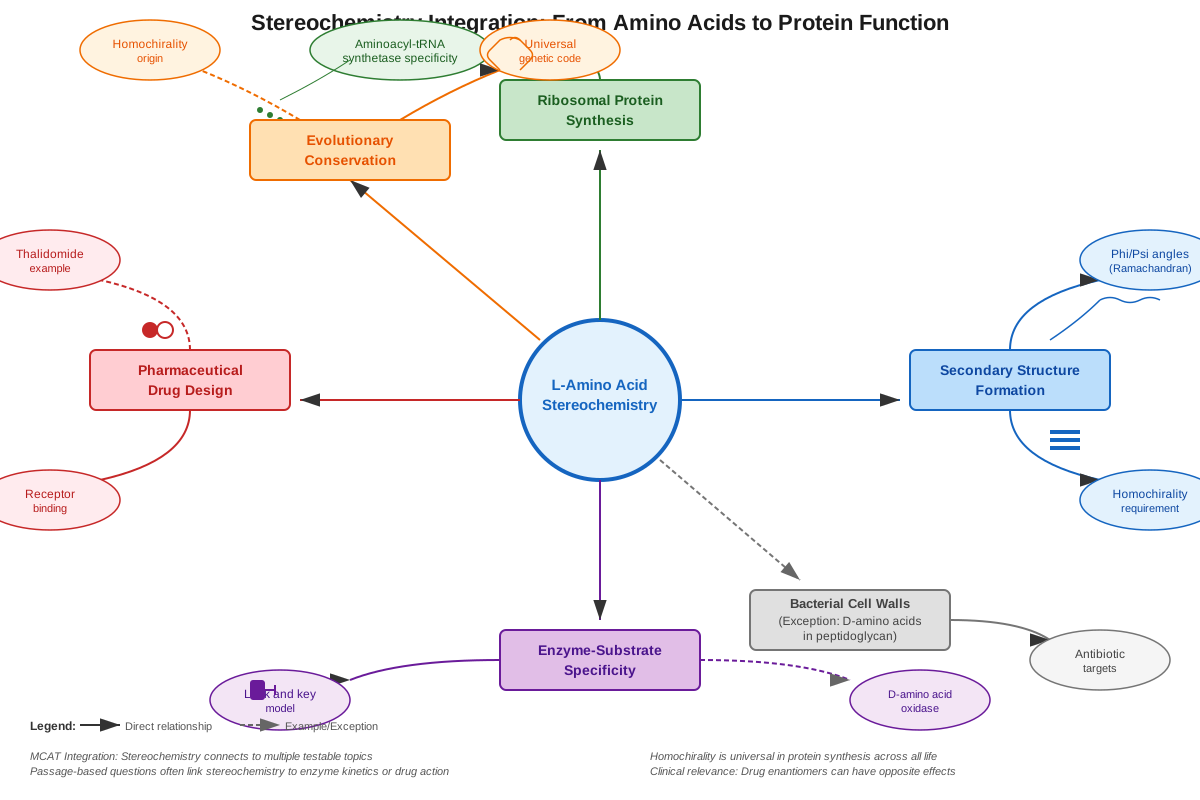
Amino acid stereochemistry represents one of the most fundamental and frequently tested concepts in Biochemistry on the MCAT. Understanding the three-dimensional arrangement of atoms around the central carbon of amino acids is essential for comprehending protein structure, enzyme function, and biological specificity. The stereochemical properties of amino acids determine how proteins fold, how enzymes recognize substrates, and how biological systems maintain their remarkable specificity. Every naturally occurring amino acid (except glycine) exists as a chiral molecule, meaning it has a non-superimposable mirror image, and biological systems almost exclusively utilize the L-configuration of amino acids.
The MCAT extensively tests amino acid stereochemistry because it bridges multiple disciplines: organic chemistry principles (chirality, optical activity, Fischer projections), biochemistry concepts (protein structure and function), and biological reasoning (evolutionary conservation, molecular recognition). Questions may appear as discrete items testing nomenclature and configuration assignment, or embedded within passages discussing protein synthesis, enzyme mechanisms, or pharmaceutical development. Understanding stereochemistry is not merely about memorizing which configuration is "natural"—it requires spatial reasoning skills and the ability to interconvert between different representational systems (Fischer projections, perspective formulas, and three-dimensional models).
Within the broader context of Amino Acids and Proteins, stereochemistry serves as the foundation for understanding peptide bond formation, secondary structure preferences, and the biological activity of proteins. The stereochemical purity of amino acids in biological systems reflects billions of years of evolutionary selection and enables the precise molecular recognition events that underlie all of biochemistry. Mastering this topic provides the conceptual framework necessary for advanced topics including protein folding, enzyme kinetics, and drug-receptor interactions.
Learning Objectives
- [ ] Define amino acid stereochemistry using accurate Biochemistry terminology
- [ ] Explain why amino acid stereochemistry matters for the MCAT
- [ ] Apply amino acid stereochemistry to exam-style questions
- [ ] Identify common mistakes related to amino acid stereochemistry
- [ ] Connect amino acid stereochemistry to related Biochemistry concepts
- [ ] Assign absolute configuration (R/S) to amino acid α-carbons using Cahn-Ingold-Prelog priority rules
- [ ] Interconvert between Fischer projections, perspective formulas, and three-dimensional representations of amino acids
- [ ] Predict the optical activity and specific rotation properties of amino acid solutions
- [ ] Explain the biological significance of L-amino acid exclusivity in protein synthesis
Prerequisites
- Chirality and stereoisomers: Understanding that molecules with four different substituents around a tetrahedral carbon exist as non-superimposable mirror images is essential for recognizing why amino acids (except glycine) are chiral
- Fischer projections: Familiarity with this two-dimensional representation system allows rapid determination of stereochemical configuration without building three-dimensional models
- Cahn-Ingold-Prelog priority rules: These rules provide the systematic method for assigning R and S configurations to chiral centers
- Optical activity: Knowledge that chiral molecules rotate plane-polarized light enables understanding of how amino acid solutions are characterized experimentally
- Basic amino acid structure: Recognition that amino acids contain an amino group, carboxyl group, hydrogen, and variable R-group attached to a central α-carbon is fundamental
Why This Topic Matters
Clinical and Real-World Significance
The stereochemistry of amino acids has profound implications for human health and pharmaceutical development. The thalidomide tragedy of the 1960s—where one enantiomer treated morning sickness while its mirror image caused severe birth defects—demonstrated the critical importance of stereochemical purity in drug design. Many modern pharmaceuticals target proteins with exquisite stereochemical specificity; enzymes can distinguish between D- and L-amino acids with extraordinary precision. Certain bacterial cell walls contain D-amino acids, making them targets for antibiotics that exploit this stereochemical difference. Neurodegenerative diseases like Alzheimer's involve protein misfolding, where stereochemical constraints play crucial roles in determining proper versus pathological conformations.
MCAT Exam Statistics and Question Types
Amino acid stereochemistry appears on virtually every MCAT administration, with studies suggesting 2-4 questions per exam directly test this concept, while many additional questions require stereochemical reasoning as prerequisite knowledge. Questions typically fall into several categories: (1) discrete items asking students to identify the configuration of a given amino acid structure, (2) passage-based questions about enzyme specificity or protein synthesis that require understanding L-amino acid exclusivity, (3) experimental analysis questions involving optical rotation measurements, and (4) organic chemistry-biochemistry hybrid questions testing interconversion between representational systems. The AAMC consistently includes amino acid stereochemistry in the "Amino Acids and Proteins" subsection, which comprises approximately 5-8% of the Biological and Biochemical Foundations section.
Common Exam Passage Contexts
MCAT passages frequently embed stereochemistry within discussions of: enzyme-substrate recognition (explaining why enzymes are stereospecific), protein synthesis and ribosomal function (emphasizing that only L-amino acids are incorporated), pharmaceutical development (comparing biological activity of stereoisomers), analytical biochemistry (interpreting polarimetry data), evolutionary biochemistry (explaining the origin of homochirality), and structural biology (relating stereochemistry to secondary structure preferences like the right-handed α-helix).
Core Concepts
Chirality and the Amino Acid α-Carbon
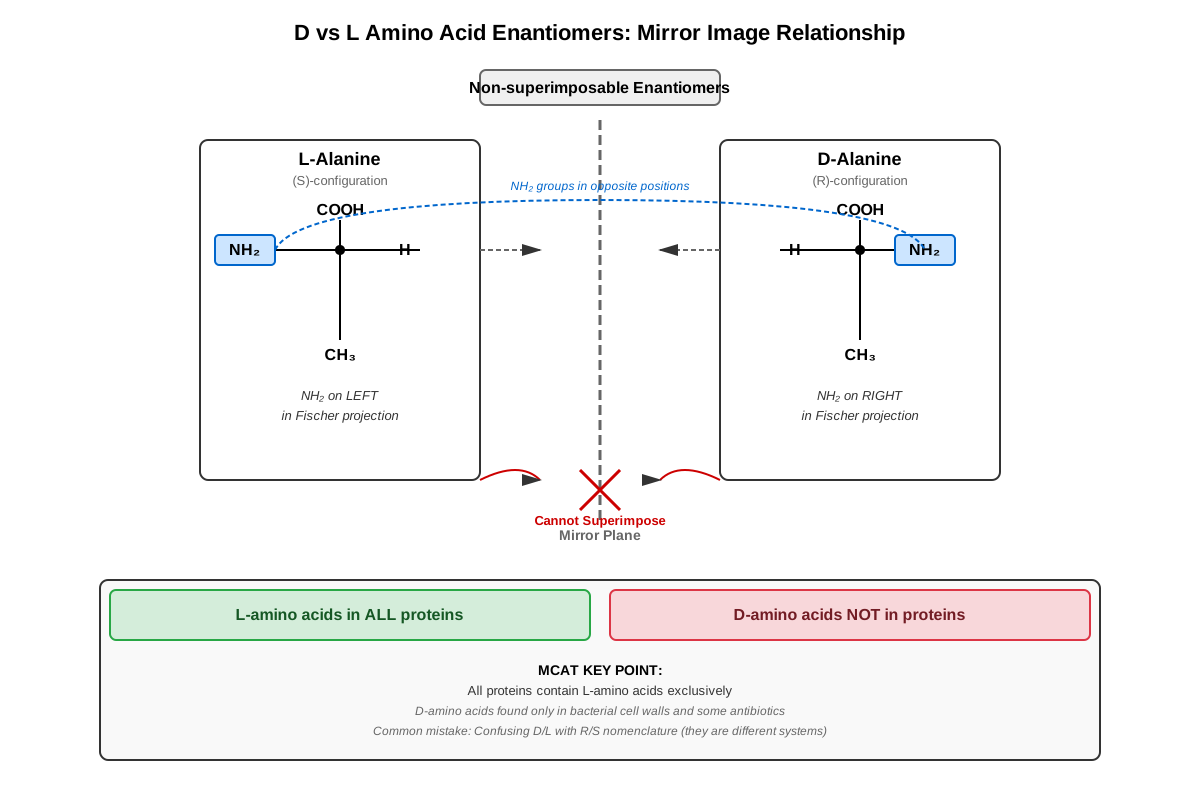
The α-carbon of an amino acid is the central tetrahedral carbon atom to which four different groups are attached: an amino group (-NH₃⁺ at physiological pH), a carboxyl group (-COO⁻ at physiological pH), a hydrogen atom, and a variable side chain (R-group). This arrangement creates a chiral center—a carbon atom bonded to four different substituents—making the molecule non-superimposable on its mirror image. These non-superimposable mirror images are called enantiomers.
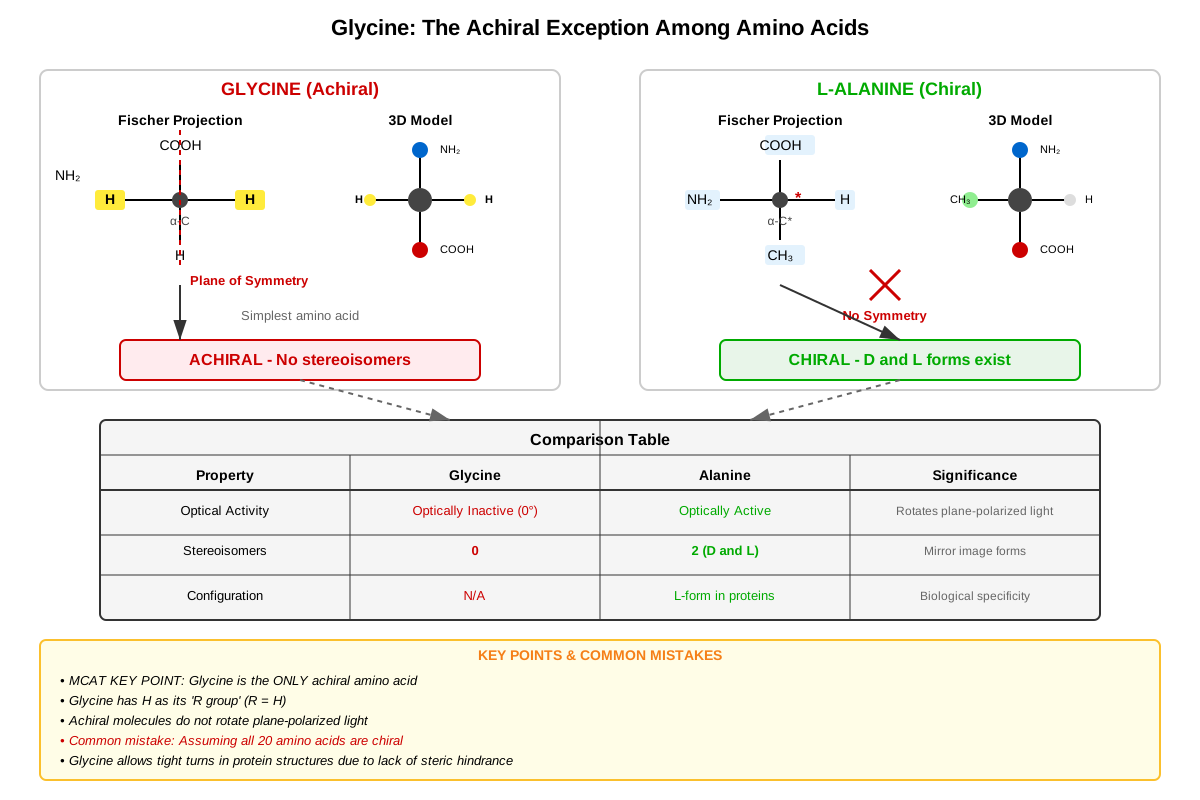
Glycine represents the sole exception among the 20 standard amino acids because its R-group is simply a hydrogen atom, meaning the α-carbon has two identical hydrogen substituents. Without four different groups, glycine lacks a chiral center and exists as an achiral molecule with no enantiomers. This unique property gives glycine special conformational flexibility in proteins, allowing it to adopt backbone angles that would be sterically forbidden for other amino acids.
The presence of chirality means that amino acids can exist in two mirror-image forms that have identical physical properties (melting point, boiling point, solubility) in achiral environments but differ in their interaction with other chiral molecules and in their ability to rotate plane-polarized light. This optical activity forms the basis for experimental characterization of amino acid stereochemistry.
D and L Nomenclature System
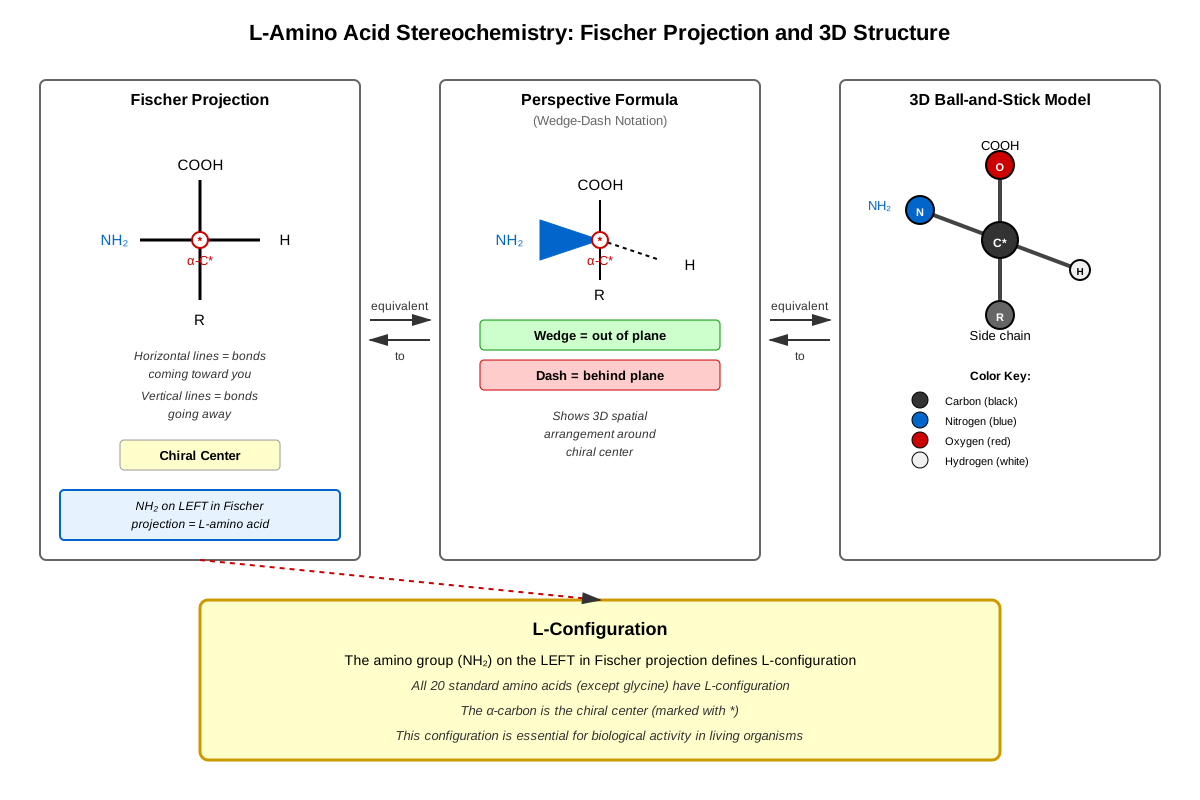
The D/L system is a relative configurational nomenclature based on the structure of glyceraldehyde, a simple three-carbon sugar. In Fischer projection format (where horizontal bonds project toward the viewer and vertical bonds project away), an amino acid is designated L if the amino group appears on the left side of the α-carbon, and D if it appears on the right side. This system is particularly useful in biochemistry because it provides immediate visual recognition of configuration.
Critically, all naturally occurring amino acids in proteins belong to the L-series. This biological homochirality—the exclusive use of one enantiomeric form—is one of the most fundamental characteristics of life on Earth. The evolutionary origin of this preference remains debated, but once established, it became locked in because the translation machinery (ribosomes, tRNA synthetases) evolved to recognize only L-amino acids. The few D-amino acids found in nature occur in specialized contexts: bacterial cell walls, certain peptide antibiotics, and some neurotransmitter systems.
When drawing Fischer projections of L-amino acids, the convention places the carboxyl group at the top and the R-group at the bottom, with the amino group projecting to the left and hydrogen to the right. This standardized orientation allows rapid comparison of different amino acid structures.
R and S Absolute Configuration
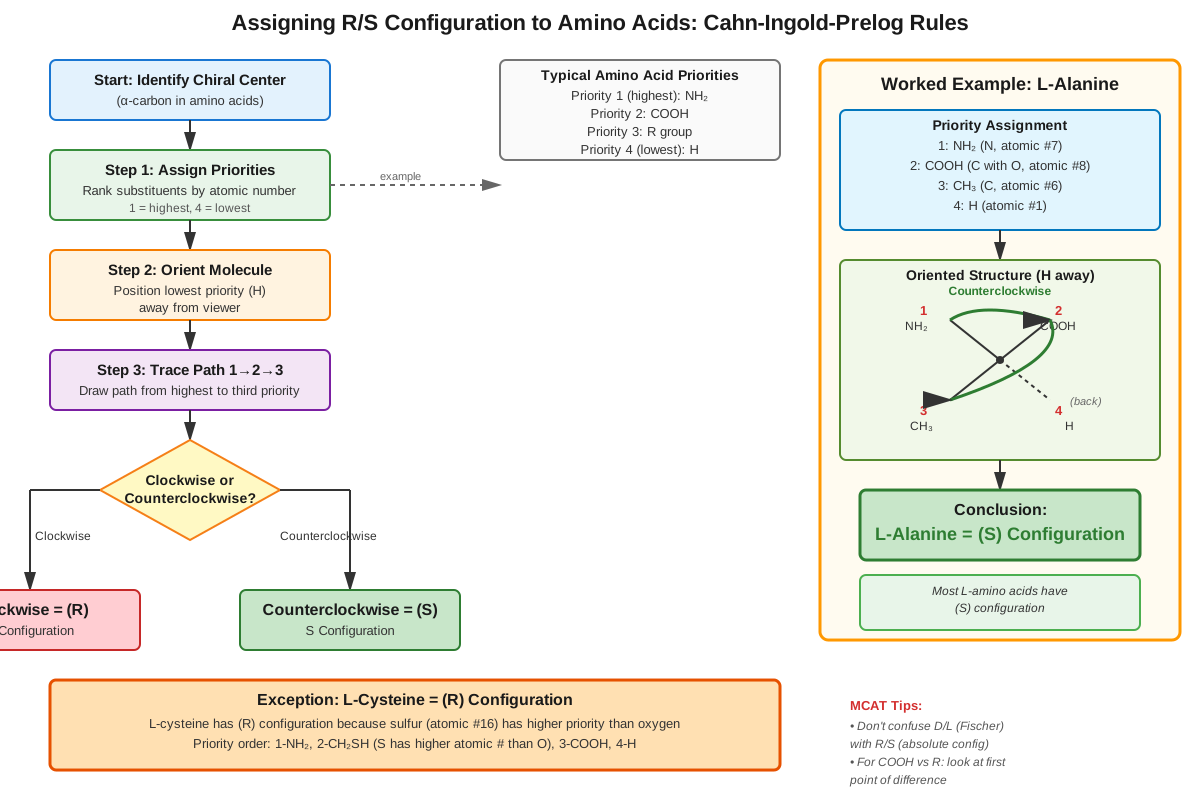
The Cahn-Ingold-Prelog (CIP) system provides an unambiguous method for specifying absolute configuration using R (rectus, right) and S (sinister, left) designations. This system assigns priorities to the four substituents based on atomic number: higher atomic number receives higher priority. For amino acids at physiological pH:
- Priority 1: Amino group (-NH₃⁺) - nitrogen has the highest atomic number among directly bonded atoms
- Priority 2: Carboxyl group (-COO⁻) - carbon bonded to two oxygens via double bond equivalents
- Priority 3: R-group (variable) - depends on the specific amino acid
- Priority 4: Hydrogen - lowest atomic number
To assign configuration, orient the molecule so the lowest priority group (hydrogen) points away from the viewer. Then trace a path from priority 1 → 2 → 3. If this path curves clockwise, the configuration is R; if counterclockwise, it is S.
For L-amino acids, the R/S designation depends on the specific R-group. Most L-amino acids have S configuration at the α-carbon (including alanine, valine, leucine, and most others). However, cysteine is L but has R configuration because the sulfur-containing side chain has higher priority than the carboxyl group, reversing the priority order. This apparent contradiction demonstrates that D/L and R/S are independent systems: D/L describes relative configuration (relationship to glyceraldehyde), while R/S describes absolute configuration (actual three-dimensional arrangement).
Fischer Projections and Three-Dimensional Representations
Fischer projections provide a two-dimensional method for representing three-dimensional chiral molecules. The critical conventions are:
- Vertical lines represent bonds projecting away from the viewer (into the page)
- Horizontal lines represent bonds projecting toward the viewer (out of the page)
- The intersection represents the chiral center
- The most oxidized carbon (carboxyl group for amino acids) is placed at the top
To convert a Fischer projection to a three-dimensional perspective formula, remember that horizontal substituents come forward. For an L-amino acid in standard Fischer orientation, the amino group projects toward you on the left, and the hydrogen projects toward you on the right, while the carboxyl and R-group extend away from you.
A common MCAT task involves rotating Fischer projections. Key rules:
- 90° rotation inverts configuration (L becomes D, or vice versa)
- 180° rotation preserves configuration
- Exchanging any two groups inverts configuration
- Exchanging two pairs of groups preserves configuration
Optical Activity and Specific Rotation
Optical activity refers to the ability of chiral molecules to rotate the plane of plane-polarized light. A solution that rotates light clockwise (when looking toward the light source) is dextrorotatory and designated (+) or d. A solution rotating light counterclockwise is levorotatory and designated (−) or l.
The specific rotation [α] is an intrinsic property of a chiral compound measured under standard conditions:
[α] = α / (l × c)Where:
- α = observed rotation in degrees
- l = path length in decimeters
- c = concentration in g/mL
Importantly, the D/L nomenclature is not related to the direction of optical rotation (+/−). An L-amino acid might be dextrorotatory or levorotatory depending on its specific structure. For example, L-alanine is dextrorotatory (+), while L-cysteine is levorotatory (−). The D/L system describes configuration, while (+)/(−) describes a physical property.
A racemic mixture contains equal amounts of both enantiomers and shows no net optical rotation because the rotations cancel. Biological systems produce optically pure L-amino acids, but chemical synthesis typically yields racemic mixtures unless stereoselective methods are employed.
Biological Significance of L-Amino Acid Exclusivity
The exclusive use of L-amino acids in protein biosynthesis has profound consequences:
- Structural consistency: All proteins fold with the same stereochemical constraints, enabling predictable secondary structures like α-helices (which are right-handed due to L-amino acid geometry)
- Molecular recognition: Enzymes evolved active sites complementary to L-amino acid substrates; D-amino acids typically cannot bind productively
- Translation fidelity: Aminoacyl-tRNA synthetases have proofreading mechanisms that discriminate against D-amino acids, maintaining stereochemical purity
- Evolutionary conservation: Once established, the L-amino acid system became universal because changing it would require simultaneous modification of the entire translation apparatus
- Pharmaceutical implications: Drugs targeting proteins must account for stereochemical complementarity; many enzyme inhibitors are designed as L-amino acid analogs
The rare occurrence of D-amino acids in bacterial cell walls makes them targets for antibiotics. Vancomycin, for example, binds to D-alanyl-D-alanine termini in bacterial peptidoglycan, a target absent in human proteins composed exclusively of L-amino acids.
Stereochemistry and Protein Structure
The stereochemistry of amino acids directly influences protein folding through steric constraints. The L-configuration restricts the allowed φ (phi) and ψ (psi) backbone dihedral angles, as visualized in Ramachandran plots. These restrictions explain why:
- α-helices are right-handed in proteins (left-handed helices would create steric clashes with L-amino acid side chains)
- β-sheets adopt specific geometries with alternating up-and-down side chains
- Glycine appears frequently in turns and loops where conformational flexibility is needed
- Proline restricts backbone flexibility due to its cyclic structure
The stereochemical homogeneity of L-amino acids enables the regular, repeating structures that characterize protein secondary structure. If proteins contained random mixtures of D- and L-amino acids, the irregular stereochemistry would prevent formation of stable α-helices and β-sheets.
Comparison Table: Key Stereochemical Properties
| Property | L-Amino Acids | D-Amino Acids | Glycine |
|---|---|---|---|
| Configuration at α-carbon | L (amino on left in Fischer) | D (amino on right in Fischer) | Achiral (no configuration) |
| Occurrence in proteins | Universal in all organisms | Absent from ribosomally synthesized proteins | Present (achiral) |
| R/S designation | Usually S (except cysteine = R) | Usually R (except cysteine = S) | Not applicable |
| Recognition by aminoacyl-tRNA synthetases | High affinity, substrate | Rejected by proofreading | Recognized (achiral) |
| Optical activity | (+) or (−) depending on structure | Opposite rotation from L-enantiomer | None (achiral) |
| Biological synthesis | All 20 standard amino acids | Limited (some bacteria, specialized pathways) | Standard amino acid |
Concept Relationships
The concepts within amino acid stereochemistry form an interconnected network. Chirality at the α-carbon serves as the foundational concept, determining that amino acids (except glycine) exist as enantiomers. This chirality leads directly to optical activity, the measurable physical property that allows experimental characterization. The D/L nomenclature system provides a relative method for describing configuration, while the R/S system offers absolute configurational assignment—both systems describe the same three-dimensional reality but use different reference frameworks.
Fischer projections serve as the practical tool connecting two-dimensional representations to three-dimensional molecular reality, enabling students to visualize and manipulate stereochemical information efficiently. The biological exclusivity of L-amino acids represents the evolutionary consequence of stereochemical selection, which in turn determines protein structural constraints and enables the regular secondary structures essential for protein function.
These stereochemical concepts connect to prerequisite organic chemistry knowledge: chirality builds on understanding of tetrahedral geometry and molecular symmetry; optical activity extends principles of light-matter interaction; Fischer projections apply systematic representational conventions. Looking forward, amino acid stereochemistry enables understanding of peptide bond formation (connecting specific stereoisomers), enzyme specificity (explaining molecular recognition), protein folding (determining allowed conformations), and drug design (requiring stereochemical complementarity).
Relationship Map:
Tetrahedral α-carbon with four different substituents → Chirality → Existence of enantiomers → D and L configurations (relative) and R and S configurations (absolute) → Optical activity (measurable property) → Fischer projections (representational tool) → Biological L-amino acid selection → Protein structural constraints → Regular secondary structures and enzyme specificity → Biological function and pharmaceutical applications
Quick check — test yourself on Amino acid stereochemistry so far.
Try Flashcards →High-Yield Facts
⭐ All naturally occurring amino acids in proteins are L-amino acids (except glycine, which is achiral)
⭐ Glycine is the only achiral amino acid because its R-group is hydrogen, giving the α-carbon two identical substituents
⭐ L-amino acids have the amino group on the left in Fischer projection with carboxyl at top and R-group at bottom
⭐ Most L-amino acids have S configuration, but L-cysteine has R configuration due to the high priority of its sulfur-containing side chain
⭐ D/L nomenclature is independent of (+)/(−) optical rotation; an L-amino acid can be dextrorotatory or levorotatory
- Enantiomers have identical physical properties (melting point, boiling point, solubility) in achiral environments but differ in optical rotation and interaction with other chiral molecules
- A 180° rotation of a Fischer projection preserves configuration, while a 90° rotation inverts it
- Exchanging any two groups on a chiral center inverts the configuration (L to D or vice versa)
- Racemic mixtures contain equal amounts of both enantiomers and show zero net optical rotation
- Aminoacyl-tRNA synthetases have proofreading mechanisms that discriminate against D-amino acids, maintaining stereochemical purity during translation
- The right-handed α-helix is favored in proteins because L-amino acid stereochemistry creates steric clashes in left-handed helices
- Bacterial cell walls contain D-amino acids, making them targets for antibiotics like vancomycin
- Specific rotation [α] is an intrinsic property calculated as observed rotation divided by (path length × concentration)
- Proline is technically an imino acid but still has L-configuration at its α-carbon
- The Cahn-Ingold-Prelog priority rules assign priorities based on atomic number, with higher atomic number receiving higher priority
Common Misconceptions
Misconception: All L-amino acids are levorotatory (rotate light to the left).
Correction: The D/L nomenclature describes configuration (three-dimensional arrangement), not optical rotation. L-amino acids can be either dextrorotatory (+) or levorotatory (−). For example, L-alanine is (+), while L-cysteine is (−). The direction of optical rotation depends on the entire molecular structure and cannot be predicted from D/L designation alone.
Misconception: L-amino acids always have S configuration.
Correction: While most L-amino acids have S configuration at the α-carbon, L-cysteine has R configuration. This occurs because the sulfur atom in cysteine's side chain has higher atomic number than the oxygen atoms in the carboxyl group, changing the priority order in the Cahn-Ingold-Prelog system. The D/L and R/S systems are independent and can give apparently contradictory labels.
Misconception: Glycine is an L-amino acid.
Correction: Glycine is achiral because its R-group is hydrogen, meaning the α-carbon has two identical substituents (two hydrogens). Without four different groups, there is no chiral center, and the D/L nomenclature does not apply. Glycine has no enantiomer and shows no optical activity.
Misconception: Rotating a Fischer projection by any amount preserves the configuration.
Correction: Only 180° rotation preserves configuration. A 90° rotation inverts the configuration (changing L to D or vice versa). This occurs because 90° rotation moves groups from horizontal positions (projecting toward viewer) to vertical positions (projecting away), fundamentally changing the three-dimensional arrangement. Similarly, exchanging any two groups inverts configuration.
Misconception: D-amino acids never occur in biological systems.
Correction: While D-amino acids are absent from ribosomally synthesized proteins, they do occur in specialized biological contexts. Bacterial cell walls contain D-alanine and D-glutamate in their peptidoglycan structure. Some bacteria produce D-amino acid-containing peptide antibiotics. Certain neurotransmitter systems use D-serine. However, these D-amino acids are produced by racemization of L-amino acids after synthesis, not by direct incorporation during translation.
Misconception: The amino and carboxyl groups in amino acids are always in their neutral forms (-NH₂ and -COOH).
Correction: At physiological pH (~7.4), amino acids exist as zwitterions with charged groups: -NH₃⁺ (protonated amino group) and -COO⁻ (deprotonated carboxyl group). This ionization state affects priority assignment in the R/S system and is the biologically relevant form. The neutral forms predominate only at extreme pH values.
Misconception: Enzymes can use either D- or L-amino acids as substrates with equal efficiency.
Correction: Enzymes are highly stereospecific, typically recognizing only L-amino acids. The active site geometry evolved to complement L-amino acid substrates, and D-amino acids usually cannot bind productively due to steric clashes. This stereochemical specificity is fundamental to enzyme function and explains why only L-amino acids are incorporated into proteins.
Worked Examples
Example 1: Configuration Assignment and Fischer Projection Manipulation
Question: Consider L-serine, which has the structure with -CH₂OH as its R-group. (a) Draw the Fischer projection of L-serine. (b) Assign the R/S configuration. (c) If you exchange the positions of the amino group and hydrogen, what is the resulting configuration?
Solution:
(a) Drawing L-serine Fischer projection:
- Place the carboxyl group (-COO⁻) at the top (most oxidized carbon)
- Place the R-group (-CH₂OH) at the bottom
- For L-configuration, place the amino group (-NH₃⁺) on the left
- Place hydrogen (H) on the right
        COO⁻
         |
H₃N⁺—C—H
         |
      CH₂OH
(b) Assigning R/S configuration:
Step 1: Assign priorities using Cahn-Ingold-Prelog rules
- Priority 1: -NH₃⁺ (nitrogen, atomic number 7)
- Priority 2: -COO⁻ (carbon bonded to two oxygens)
- Priority 3: -CH₂OH (carbon bonded to one oxygen)
- Priority 4: -H (hydrogen, atomic number 1)
Step 2: Orient the molecule with lowest priority (H) pointing away
In the Fischer projection, H is on the right (horizontal), meaning it projects toward the viewer. We need to mentally rotate or redraw so H points away.
Step 3: Trace the path 1→2→3
When H points away, tracing from NH₃⁺ → COO⁻ → CH₂OH proceeds counterclockwise.
Result: L-serine has S configuration
(c) Exchanging amino group and hydrogen:
Exchanging any two groups on a chiral center inverts the configuration. Since L-serine has S configuration, exchanging the amino group and hydrogen produces D-serine with R configuration.
This demonstrates the fundamental rule: any single exchange inverts stereochemistry. The resulting molecule is the enantiomer of the starting material.
Key Learning Points: This example reinforces that (1) Fischer projections follow strict conventions, (2) most L-amino acids have S configuration, (3) exchanging two groups inverts configuration, and (4) D/L and R/S systems are independent but related.
Example 2: Optical Activity and Racemic Mixtures
Question: A biochemist measures the optical rotation of three amino acid solutions using a polarimeter with a 1.0 dm path length:
- Solution A: 0.50 g/mL of pure L-alanine shows +7.0° rotation
- Solution B: 0.50 g/mL of pure D-alanine shows −7.0° rotation
- Solution C: 0.50 g/mL of an alanine mixture shows 0° rotation
(a) Calculate the specific rotation [α] of L-alanine. (b) What is the composition of Solution C? (c) If Solution C is diluted to 0.25 g/mL, what rotation would be observed?
Solution:
(a) Calculating specific rotation:
Using the formula:
[α] = α / (l × c)Where:
- α = +7.0° (observed rotation)
- l = 1.0 dm (path length)
- c = 0.50 g/mL (concentration)
[α] = (+7.0°) / (1.0 dm × 0.50 g/mL) = +14° mL/(g·dm)Result: The specific rotation of L-alanine is +14° mL/(g·dm)
Note: Specific rotation is an intrinsic property independent of concentration or path length.
(b) Determining composition of Solution C:
Solution C shows 0° rotation despite containing 0.50 g/mL alanine. This indicates a racemic mixture containing equal amounts of L-alanine and D-alanine. The (+) rotation from L-alanine exactly cancels the (−) rotation from D-alanine.
Composition: 50% L-alanine (0.25 g/mL) and 50% D-alanine (0.25 g/mL)
This demonstrates that enantiomers rotate plane-polarized light by equal magnitudes in opposite directions.
(c) Predicting rotation after dilution:
A racemic mixture shows 0° rotation at any concentration because the enantiomers are present in equal amounts. Diluting from 0.50 g/mL to 0.25 g/mL reduces the rotation from each enantiomer proportionally, but they still cancel.
Result: Solution C would show 0° rotation at 0.25 g/mL
If Solution C contained only L-alanine at 0.25 g/mL, the rotation would be:
α = [α] × l × c = (+14°) × (1.0 dm) × (0.25 g/mL) = +3.5°Key Learning Points: This example illustrates that (1) specific rotation is an intrinsic property, (2) enantiomers have equal but opposite rotations, (3) racemic mixtures show zero net rotation, and (4) optical rotation is proportional to concentration for optically pure samples.
Exam Strategy
Approaching MCAT Questions on Amino Acid Stereochemistry
Step 1: Identify the question type
- Configuration assignment (D/L or R/S)
- Fischer projection manipulation
- Optical activity calculation
- Biological significance/enzyme specificity
- Structural consequence of stereochemistry
Step 2: Recall the relevant principle
- For D/L: amino group position in Fischer projection
- For R/S: Cahn-Ingold-Prelog priority rules
- For optical activity: relationship between structure and rotation
- For biological questions: L-amino acid exclusivity
Step 3: Apply systematic reasoning
- Draw structures if not provided
- Use Fischer projection conventions carefully
- Check your priority assignments twice for R/S
- Consider the biological context
Trigger Words and Phrases
Watch for these high-yield terms that signal stereochemistry content:
- "Chiral center" or "stereocenter" → identify the α-carbon and its four substituents
- "Enantiomer" → mirror-image relationship, opposite configurations
- "Optically active" → chiral molecule that rotates plane-polarized light
- "Racemic" → equal mixture of enantiomers, zero net rotation
- "Stereospecific" → enzyme or reaction that distinguishes between stereoisomers
- "L-amino acid" → naturally occurring configuration in proteins
- "Fischer projection" → apply horizontal = toward viewer, vertical = away conventions
- "Absolute configuration" → R/S system
- "Specific rotation" → intrinsic optical property, requires calculation
Process of Elimination Tips
When evaluating answer choices:
- Eliminate answers that violate L-amino acid universality: If a question asks about naturally occurring proteins, any answer suggesting D-amino acids is likely incorrect (unless discussing bacteria or specialized cases)
- Check Fischer projection conventions: Eliminate answers that incorrectly interpret horizontal/vertical bond orientations or misapply rotation rules
- Verify R/S assignments: Eliminate answers that assign S to D-amino acids or R to L-amino acids (except cysteine)
- Test optical activity logic: Eliminate answers that claim racemic mixtures show optical rotation or that D/L directly predicts (+)/(−)
- Consider biological context: Eliminate answers that ignore enzyme stereospecificity or suggest proteins can incorporate D-amino acids during translation
Time Allocation Advice
- Discrete questions (30-60 seconds): Quickly identify configuration or apply a single principle
- Fischer projection manipulations (45-75 seconds): Carefully track rotations and exchanges; drawing helps prevent errors
- Calculation questions (60-90 seconds): Set up the specific rotation formula correctly; watch units
- Passage-based questions (60-120 seconds): Extract relevant stereochemical information from the passage; connect to biological significance
Exam Tip: If a question provides a Fischer projection, immediately identify whether it's L or D configuration before reading the question stem. This orientation saves time and prevents errors in subsequent reasoning.
Memory Techniques
Mnemonics for Key Concepts
"CORN" for R/S Configuration:
When the lowest priority group points away, trace Carboxyl → Organic R-group → Nitrogen (amino group). If this spells CORN clockwise, it's R; counterclockwise is S.
(Note: This works for most amino acids but requires checking priority order)
"Left is Life" for L-Amino Acids:
In Fischer projections, the amino group on the Left indicates L-configuration, which is the form used in Life (biological proteins).
"Glycine is Tiny and Achiral":
Glycine has the smallest R-group (just H), making it Achiral—the only amino acid without stereoisomers. Its Tiny size gives it unique flexibility in proteins.
"Cysteine is the Rebel":
Cysteine is the only L-amino acid with R configuration—it Rebels against the usual pattern because Sulfur has high priority.
"180 is Straight, 90 is Inverted":
Rotating a Fischer projection 180° keeps configuration straight (unchanged); 90° rotation inverts it (L↔D).
Visualization Strategies
The "Steering Wheel" Method for R/S Assignment:
Imagine the molecule as a steering wheel with the lowest priority group (H) as the steering column pointing away from you. The three higher priority groups form the wheel rim. Turn the wheel from priority 1 → 2 → 3. Clockwise = R (right turn), counterclockwise = S (sinister/left turn).
The "Mirror Test" for Enantiomers:
When comparing two structures, imagine placing a mirror between them. If they are mirror images that cannot be superimposed (like your left and right hands), they are enantiomers. If they can be superimposed by rotation, they are the same molecule.
The "Hands" Analogy:
Your hands are enantiomers—mirror images that cannot be superimposed. Just as a right-handed glove won't fit a left hand, D-amino acids won't fit into enzyme active sites evolved for L-amino acids. This explains enzyme stereospecificity.
Acronyms
CLAN for Fischer Projection Standard Orientation:
- Carboxyl at top
- Left amino group = L-configuration
- Always check horizontal = toward viewer
- Number priorities for R/S
ROPE for Optical Activity:
- Rotation observed experimentally
- Opposite for enantiomers
- Pure samples show maximum rotation
- Equal mixtures (racemic) show zero
Summary
Amino acid stereochemistry represents a cornerstone concept in MCAT Biochemistry, integrating principles from organic chemistry with biological function. The 19 chiral amino acids (all except glycine) exist as enantiomers, but biological systems exclusively utilize L-amino acids in protein synthesis. This stereochemical homogeneity enables the regular secondary structures and precise molecular recognition events essential for life. Understanding the D/L nomenclature system (based on Fischer projections with amino group position) and the R/S system (based on Cahn-Ingold-Prelog priority rules) allows accurate description of three-dimensional molecular structure. Most L-amino acids have S configuration, with L-cysteine as the notable exception having R configuration due to its sulfur-containing side chain. Optical activity—the rotation of plane-polarized light—provides experimental characterization of chiral molecules, with enantiomers showing equal but opposite rotations and racemic mixtures showing zero net rotation. The biological exclusivity of L-amino acids reflects evolutionary selection and enables enzyme stereospecificity, protein structural regularity, and pharmaceutical targeting. Mastery of Fischer projection manipulations, configuration assignment, and the biological significance of stereochemistry is essential for success on MCAT questions testing Amino Acids and Proteins.
Key Takeaways
- All naturally occurring amino acids in proteins are L-amino acids, with glycine being achiral (no stereoisomers)
- D/L nomenclature describes relative configuration (amino group left = L in Fischer projection), while R/S describes absolute configuration (based on priority rules)
- Most L-amino acids have S configuration, but L-cysteine has R configuration due to sulfur's high priority
- Optical rotation direction (+/−) is independent of D/L configuration; L-amino acids can be dextrorotatory or levorotatory
- Fischer projection manipulations follow strict rules: 180° rotation preserves configuration, 90° rotation inverts it, exchanging two groups inverts configuration
- Enzyme stereospecificity for L-amino acids explains why only one enantiomer is biologically active and why D-amino acids are excluded from proteins
- Racemic mixtures contain equal amounts of both enantiomers and show zero net optical rotation despite containing chiral molecules
Related Topics
Peptide Bond Formation and Primary Structure: Understanding amino acid stereochemistry is prerequisite for comprehending how L-amino acids link through peptide bonds to form polypeptide chains. The stereochemistry at each α-carbon influences the backbone geometry and subsequent folding.
Protein Secondary Structure: The exclusive use of L-amino acids determines the allowed φ and ψ dihedral angles (Ramachandran plot), explaining why α-helices are right-handed and why certain backbone conformations are forbidden. Glycine's achirality gives it unique flexibility in turns and loops.
Enzyme Kinetics and Specificity: Enzyme active sites evolved to complement L-amino acid substrates, providing a molecular explanation for stereospecificity. This connects to induced fit models and the concept of transition state stabilization.
Pharmaceutical Chemistry and Drug Design: Many drugs are amino acid analogs or target proteins with stereochemical specificity. Understanding enantiomeric differences in biological activity is crucial for medicinal chemistry.
Protein Synthesis and Translation: Aminoacyl-tRNA synthetases discriminate against D-amino acids through proofreading mechanisms, maintaining the stereochemical purity essential for proper protein folding and function.
Practice CTA
Now that you've mastered the core concepts of amino acid stereochemistry, it's time to reinforce your understanding through active practice. Work through the practice questions to test your ability to assign configurations, manipulate Fischer projections, and apply stereochemical reasoning to biological contexts. Use the flashcards to drill high-yield facts until configuration assignment becomes automatic. Remember: stereochemistry questions reward systematic thinking and careful attention to three-dimensional structure. The time you invest in mastering this foundational topic will pay dividends across multiple MCAT sections, from discrete biochemistry questions to passage-based reasoning about enzyme mechanisms and protein function. You've built the conceptual framework—now solidify it through deliberate practice!
Sign up free to keep reading
Create a free AnvayaPrep account to finish this MCAT guide on Amino acid stereochemistry — plus flashcards and practice questions.