Overview
Protein secondary structure represents the local spatial arrangement of the polypeptide backbone, stabilized primarily by hydrogen bonds between backbone amide groups. This level of protein organization sits between primary structure (amino acid sequence) and tertiary structure (overall three-dimensional folding). Understanding secondary structure is fundamental to Biochemistry and forms a cornerstone of the Amino Acids and Proteins unit tested on the MCAT.
The MCAT frequently tests protein secondary structure through passage-based questions involving protein folding diseases, enzyme mechanisms, and structural biology experiments. Questions may present experimental data from circular dichroism spectroscopy, ask students to predict structural changes from amino acid substitutions, or require interpretation of Ramachandran plots. Mastery of this topic enables students to tackle questions about protein stability, denaturation, and the relationship between structure and function—concepts that appear across multiple MCAT sections including Biochemistry, Biology, and even Organic Chemistry when discussing hydrogen bonding patterns.
Protein secondary structure Biochemistry connects intimately to broader concepts in molecular biology and physiology. The α-helix and β-sheet structures that dominate secondary structure appear in virtually every protein class, from membrane-spanning receptors to enzymatic active sites. Understanding how peptide bonds constrain backbone geometry, how hydrogen bonding patterns stabilize regular structures, and how certain amino acids favor or disfavor specific conformations provides the foundation for comprehending protein folding, misfolding diseases like Alzheimer's and Creutzfeldt-Jakob disease, and rational drug design strategies that target protein structure.
Learning Objectives
- [ ] Define Protein secondary structure using accurate Biochemistry terminology
- [ ] Explain why Protein secondary structure matters for the MCAT
- [ ] Apply Protein secondary structure to exam-style questions
- [ ] Identify common mistakes related to Protein secondary structure
- [ ] Connect Protein secondary structure to related Biochemistry concepts
- [ ] Distinguish between α-helix and β-sheet structures based on hydrogen bonding patterns and geometric parameters
- [ ] Predict which amino acids are likely to disrupt or stabilize specific secondary structures
- [ ] Interpret experimental data (circular dichroism, X-ray crystallography) that characterizes secondary structure content
Prerequisites
- Amino acid structure and properties: Understanding side chain chemistry is essential because certain residues favor or disrupt specific secondary structures
- Peptide bond formation and properties: The planar, rigid nature of peptide bonds constrains backbone geometry and makes secondary structure possible
- Hydrogen bonding: Secondary structures are stabilized primarily by hydrogen bonds between backbone carbonyl oxygens and amide hydrogens
- Basic organic chemistry: Recognizing functional groups, understanding resonance stabilization, and predicting hydrogen bond donors/acceptors
- Protein primary structure: The amino acid sequence determines which secondary structures can form and where they occur
Why This Topic Matters
Clinical and Real-World Significance
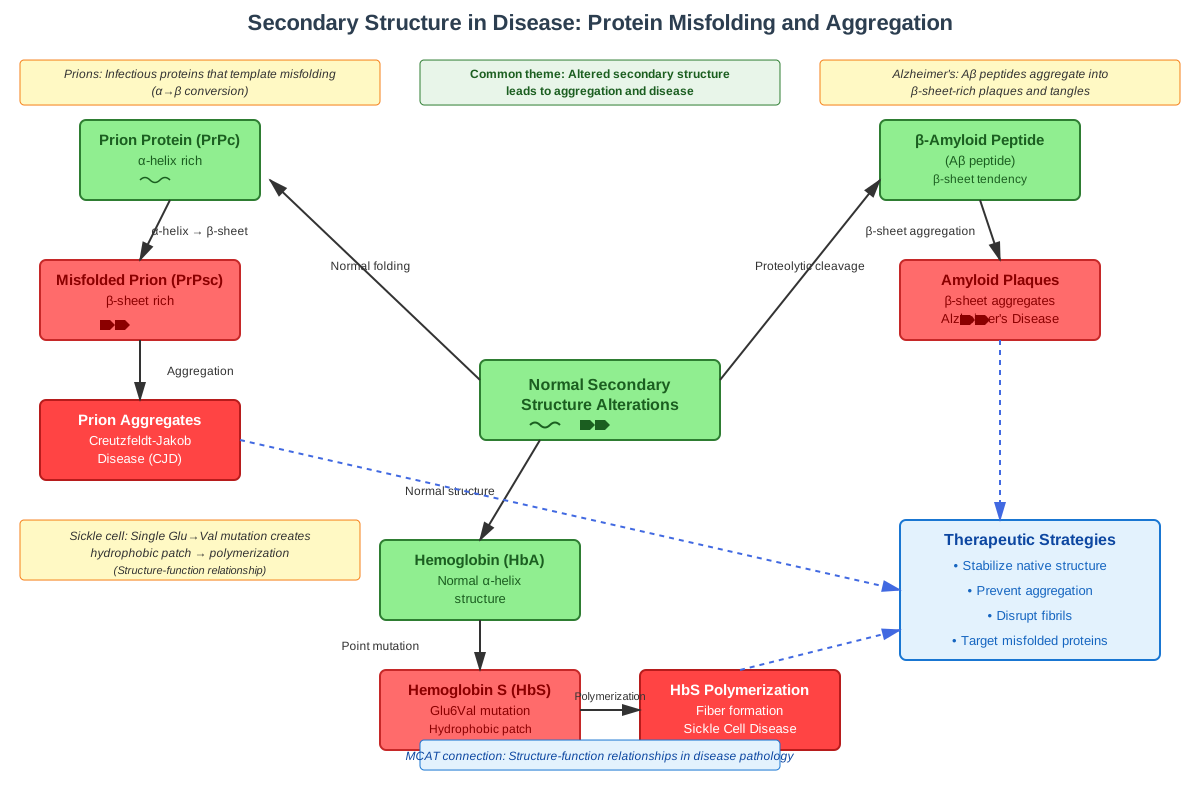
Protein secondary structure abnormalities underlie numerous human diseases. In prion diseases (Creutzfeldt-Jakob disease, mad cow disease), normal α-helical prion protein misfolds into β-sheet-rich aggregates that are infectious and neurotoxic. Alzheimer's disease involves β-amyloid peptides that aggregate into β-sheet structures forming plaques. Sickle cell disease results from a single amino acid substitution that alters hemoglobin's secondary and tertiary structure, causing polymerization. Understanding secondary structure enables comprehension of how proteins fold correctly, why misfolding occurs, and how chaperone proteins assist proper folding.
MCAT Exam Statistics
Protein structure questions appear in approximately 15-20% of Biochemistry passages on the MCAT. Secondary structure specifically appears in:
- Discrete questions testing definitions and properties (5-8 questions per exam)
- Passage-based questions involving experimental techniques like circular dichroism or X-ray crystallography (3-5 passages per exam)
- Integrated questions connecting structure to function, stability, or disease mechanisms
Common Exam Presentations
The MCAT presents Protein secondary structure MCAT content through:
- Experimental passages describing protein purification and characterization
- Clinical vignettes about protein misfolding diseases
- Research passages on enzyme mechanisms requiring structural knowledge
- Questions asking students to predict structural consequences of mutations
- Data interpretation requiring understanding of techniques that detect secondary structure
Core Concepts
Definition and Fundamental Principles
Protein secondary structure refers to the regular, repeating local conformations of the polypeptide backbone, stabilized primarily by hydrogen bonds between the carbonyl oxygen of one amino acid and the amide hydrogen of another. Unlike primary structure (which is the linear sequence) or tertiary structure (which is the overall three-dimensional fold), secondary structure describes recurring patterns in limited regions of the protein chain.
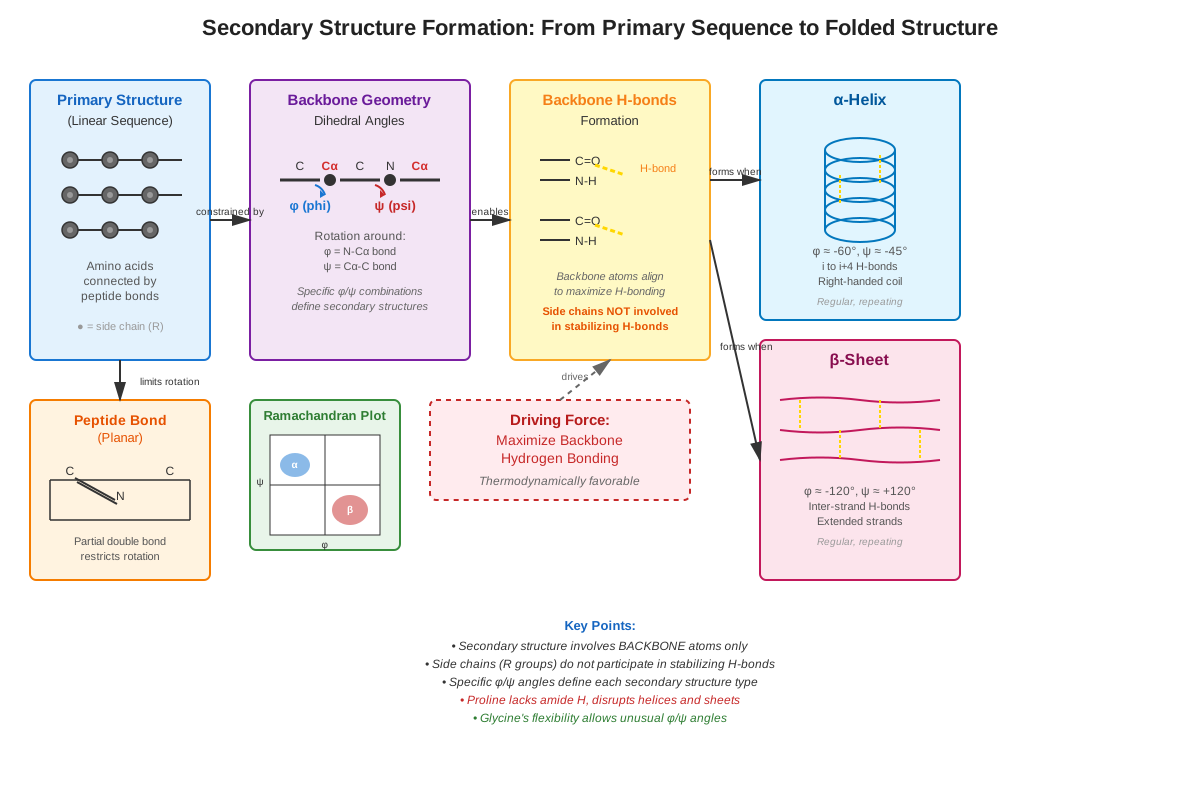
The peptide bond's partial double-bond character restricts rotation around the C-N bond, creating a planar peptide unit. However, rotation remains possible around the N-Cα bond (phi angle, φ) and the Cα-C bond (psi angle, ψ). Only certain combinations of φ and ψ angles are sterically allowed, as shown in Ramachandran plots. The most favorable angle combinations correspond to regular secondary structures: α-helices, β-sheets, and turns.
The α-Helix
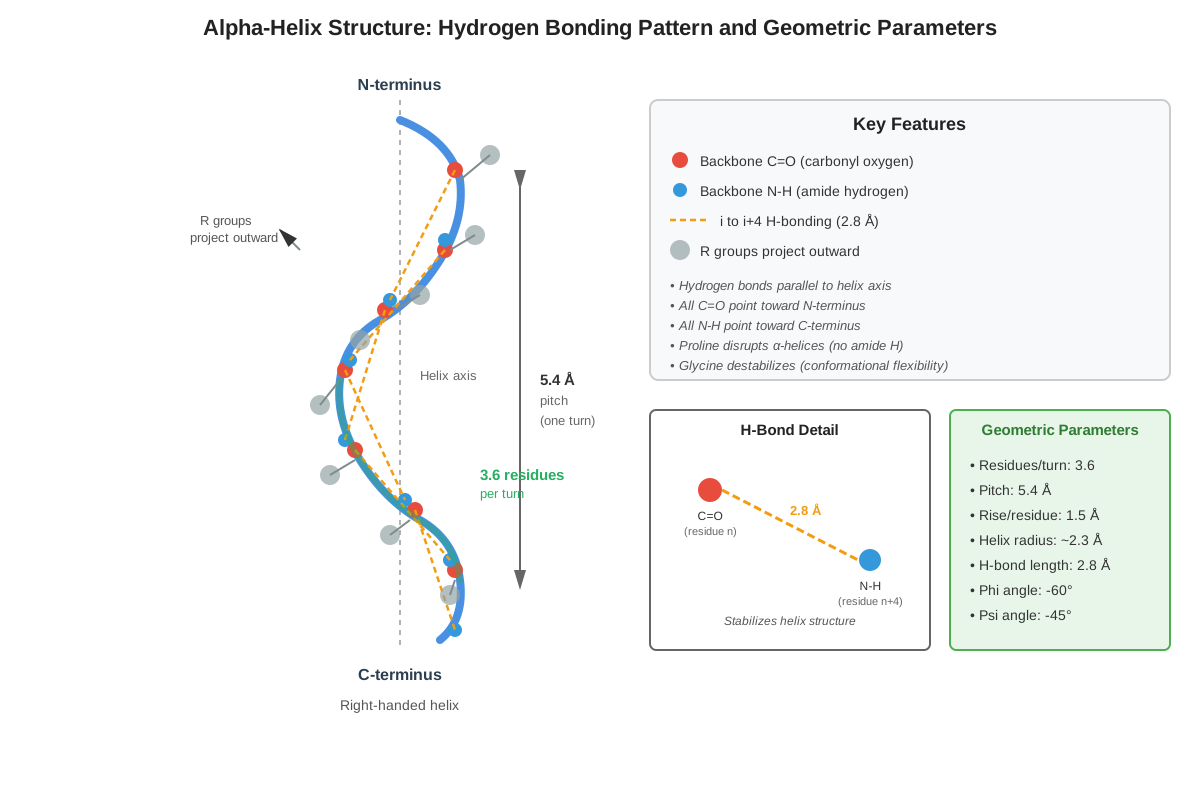
The α-helix is the most common secondary structure, appearing in approximately 30-35% of residues in typical globular proteins. In an α-helix:
Structural characteristics:
- Right-handed helical structure (left-handed helices are theoretically possible but extremely rare)
- 3.6 residues per turn
- Rise of 5.4 Å per turn (1.5 Å per residue)
- Hydrogen bonds form between the C=O of residue n and the N-H of residue n+4
- All backbone C=O and N-H groups participate in hydrogen bonding (except near termini)
- Side chains project outward from the helix axis
Stabilizing factors:
- Hydrogen bonds aligned parallel to the helix axis provide maximum stability
- Favorable φ and ψ angles (approximately φ = -60°, ψ = -45°)
- Hydrophobic residues on one face can create amphipathic helices important for membrane proteins
Helix-favoring amino acids:
- Alanine, glutamate, leucine, and methionine strongly favor α-helices
- Small, uncharged residues fit well into the helix geometry
Helix-breaking amino acids:
- Proline is the strongest helix breaker because its cyclic structure constrains φ to approximately -60°, and it lacks an amide hydrogen for hydrogen bonding
- Glycine is too flexible, allowing too many conformations
- Charged residues of the same sign in close proximity create electrostatic repulsion
The β-Sheet
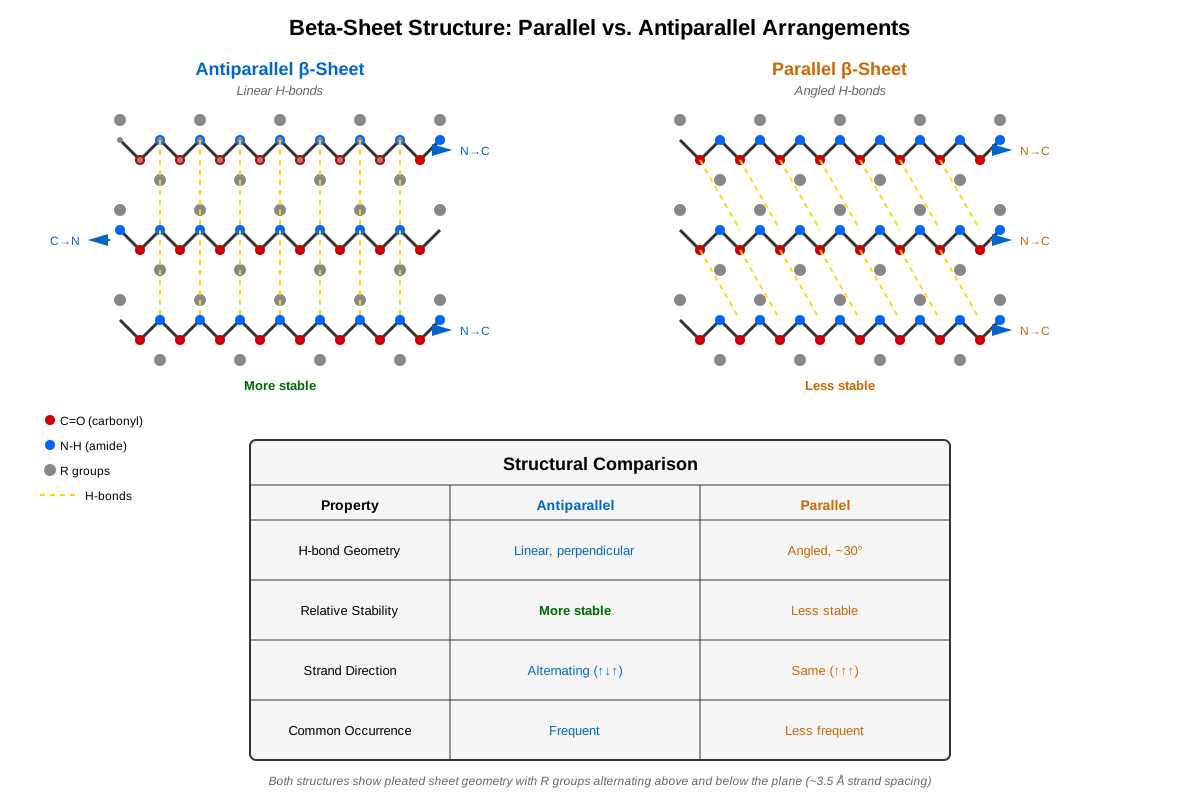
β-sheets consist of multiple β-strands (extended polypeptide chains) aligned side-by-side, stabilized by hydrogen bonds between strands. β-sheets comprise approximately 20-25% of residues in typical proteins.
Structural characteristics:
- Extended, pleated conformation (not helical)
- Hydrogen bonds form between backbone atoms of adjacent strands
- Side chains alternate above and below the sheet plane
- Rise of approximately 3.5 Å per residue (more extended than α-helix)
Types of β-sheets:
| Feature | Parallel β-Sheet | Antiparallel β-Sheet |
|---|---|---|
| Strand direction | N→C termini run in same direction | N→C termini run in opposite directions |
| Hydrogen bonding | Less optimal geometry, weaker | Optimal linear geometry, stronger |
| Stability | Less stable | More stable |
| Occurrence | Less common | More common |
β-sheet-favoring amino acids:
- Branched β-carbon residues: valine, isoleucine, threonine
- Aromatic residues: phenylalanine, tyrosine, tryptophan
- These residues fit well in the extended conformation
Turns and Loops
Turns (also called reverse turns or β-turns) are short segments (typically 4 residues) that reverse the polypeptide chain direction, often connecting antiparallel β-strands. Turns enable compact protein folding.
Characteristics:
- Stabilized by hydrogen bond between C=O of residue n and N-H of residue n+3
- Often found on protein surfaces
- Frequently contain glycine (flexibility) and proline (conformational constraint)
Loops are longer, irregular regions connecting regular secondary structures. They often form active sites or binding sites and show high sequence variability between related proteins.
Random Coil
Random coil (or irregular structure) refers to regions without regular, repeating structure. Despite the name, these regions are not truly random but adopt specific conformations determined by the amino acid sequence. Random coil regions comprise approximately 40-50% of typical globular proteins.
Supersecondary Structures (Motifs)
Supersecondary structures or motifs are combinations of secondary structure elements that appear repeatedly across different proteins:
- Helix-turn-helix: DNA-binding motif in transcription factors
- β-barrel: cylindrical structure formed by β-sheets, common in membrane proteins
- Greek key: specific β-sheet topology
- Coiled coil: two or more α-helices wound around each other (e.g., in keratin, myosin)
- β-α-β unit: β-strand, α-helix, β-strand arrangement common in enzymes
Factors Affecting Secondary Structure Stability
Hydrogen bonding patterns:
The regular, repetitive hydrogen bonding in α-helices and β-sheets provides significant stabilization. Each hydrogen bond contributes approximately 4-20 kJ/mol, and the cumulative effect of many hydrogen bonds stabilizes the structure.
Steric constraints:
The Ramachandran plot shows that only certain φ and ψ angle combinations avoid steric clashes between backbone and side chain atoms. α-helices and β-sheets occupy the most favorable regions.
Electrostatic interactions:
Charged residues can stabilize or destabilize secondary structures. In α-helices, the helix dipole (partial positive charge at N-terminus, partial negative at C-terminus) can be stabilized by appropriately placed charged residues.
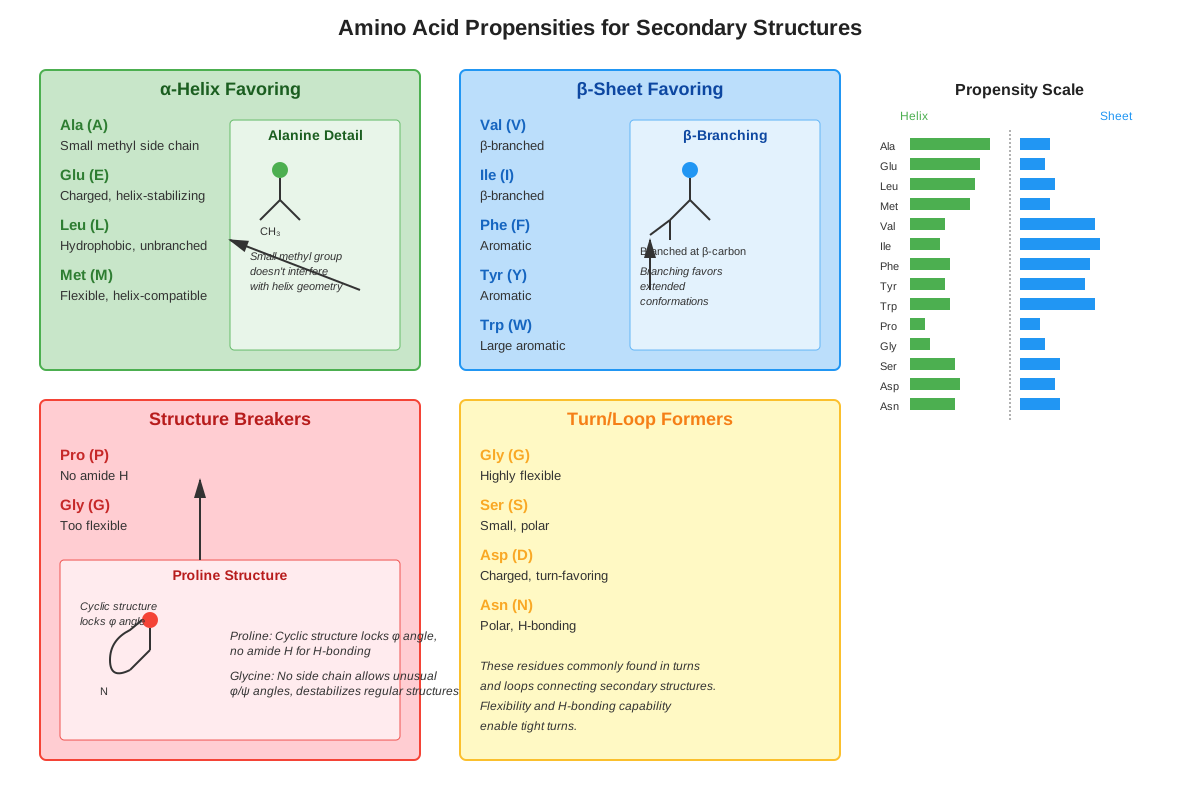
Amino acid propensities:
Different amino acids have different intrinsic preferences for secondary structures based on their side chain properties:
- Helix formers: Ala, Glu, Leu, Met
- Sheet formers: Val, Ile, Phe, Tyr, Trp
- Helix/sheet breakers: Pro, Gly
- Turn formers: Gly, Pro, Ser, Asp
Concept Relationships
Protein secondary structure emerges directly from primary structure (amino acid sequence). The sequence determines which secondary structures form and where. Specific amino acid propensities and local sequence patterns dictate whether a region adopts α-helix, β-sheet, or irregular structure.
Relationship map:
Primary structure (sequence) → determines → Secondary structure (local folding) → assembles into → Tertiary structure (overall 3D shape) → combines to form → Quaternary structure (multi-subunit assembly)
Secondary structure elements interact through their side chains to stabilize tertiary structure. For example, hydrophobic residues on one face of an amphipathic α-helix may pack against a hydrophobic core formed by β-sheets. The hydrophobic effect drives burial of nonpolar residues, bringing secondary structure elements together.
Hydrogen bonding learned in general chemistry directly explains secondary structure stability. The peptide bond's properties (planarity, partial double-bond character) from organic chemistry constrain the backbone geometry that makes regular secondary structures possible.
Secondary structure connects to protein function because active sites often form at junctions between secondary structure elements, and structural motifs like helix-turn-helix directly mediate biological activities like DNA binding.
Understanding secondary structure is essential for comprehending protein folding and denaturation. Heat, pH extremes, and chaotic agents disrupt hydrogen bonds, causing loss of secondary structure and protein denaturation. Chaperone proteins assist proper secondary structure formation during protein synthesis.
High-Yield Facts
⭐ α-helices contain 3.6 residues per turn with hydrogen bonds between residue n and residue n+4
⭐ Proline breaks α-helices because it lacks an amide hydrogen and constrains backbone geometry
⭐ Antiparallel β-sheets are more stable than parallel β-sheets due to optimal hydrogen bonding geometry
⭐ Secondary structure is stabilized primarily by backbone hydrogen bonds, not side chain interactions
⭐ Glycine is the most flexible amino acid and frequently appears in turns and loops
- α-helices have φ ≈ -60° and ψ ≈ -45°; β-sheets have φ ≈ -120° and ψ ≈ +120°
- The α-helix has a dipole moment with partial positive charge at the N-terminus
- β-turns typically contain 4 residues and reverse chain direction by approximately 180°
- Circular dichroism spectroscopy distinguishes α-helix, β-sheet, and random coil content
- Ramachandran plots show sterically allowed φ and ψ angle combinations
- Coiled-coil structures contain a heptad repeat pattern (abcdefg) with hydrophobic residues at positions a and d
- Membrane-spanning regions typically form α-helices (20-25 hydrophobic residues) or β-barrels
- Supersecondary structures (motifs) are evolutionarily conserved and often associated with specific functions
Quick check — test yourself on Protein secondary structure so far.
Try Flashcards →Common Misconceptions
Misconception: Secondary structure is determined by side chain interactions.
Correction: Secondary structure is stabilized primarily by hydrogen bonds between backbone carbonyl oxygens and amide hydrogens. Side chains project outward from α-helices and alternate above/below β-sheets, but backbone interactions define the structure. Side chains influence which secondary structures form (through steric effects and propensities) but don't directly stabilize them through interactions with each other at the secondary structure level.
Misconception: All hydrogen bonds in proteins are equally strong.
Correction: Hydrogen bond strength depends on geometry. Antiparallel β-sheets have stronger hydrogen bonds than parallel β-sheets because the bonds are more linear (optimal geometry). Additionally, hydrogen bonds in α-helices are aligned with the helix axis, providing directional stability. Environmental factors (pH, temperature, solvent) also affect hydrogen bond strength.
Misconception: Proline destabilizes all protein structures.
Correction: While proline is a strong α-helix breaker, it actually stabilizes certain structures. Proline frequently appears in turns and loops where its conformational rigidity is advantageous. The cyclic structure of proline constrains the φ angle, making it ideal for specific geometries required in reverse turns. Proline is also common at the beginning of α-helices.
Misconception: Random coil means the protein is unfolded or denatured.
Correction: Random coil (irregular structure) is a normal component of native, functional proteins, comprising 40-50% of typical globular proteins. These regions lack regular repeating structure but are not "unfolded" in the sense of denaturation. They adopt specific, functional conformations determined by the sequence. True denatured protein has lost all organized structure, including tertiary structure.
Misconception: β-sheets are flat, planar structures.
Correction: β-sheets have a pleated appearance due to the tetrahedral geometry of the Cα atoms. Side chains alternate above and below the sheet plane, creating a corrugated or pleated surface. This pleating is essential for accommodating side chains while maintaining optimal hydrogen bonding geometry between strands.
Misconception: Secondary structure can be predicted with 100% accuracy from primary structure.
Correction: While amino acid propensities and local sequence patterns allow prediction of secondary structure with approximately 70-80% accuracy, perfect prediction is impossible from sequence alone. Tertiary structure context, long-range interactions, and environmental factors influence which secondary structures actually form. Some sequences are ambiguous and can adopt multiple conformations.
Worked Examples
Example 1: Predicting Structural Consequences of Mutations
Question: A researcher studies a protein containing an α-helix spanning residues 45-62. A mutation changes Leu-52 to Pro-52. What structural consequence is most likely, and why?
Solution:
Step 1: Identify the structural context
The mutation occurs in the middle of an α-helix (position 52 of a helix spanning 45-62).
Step 2: Recall proline's structural properties
Proline is the strongest α-helix breaker because:
- Its cyclic structure constrains the φ angle to approximately -60°
- It lacks an amide hydrogen, preventing it from serving as a hydrogen bond donor
- The rigid ring structure creates steric clashes in the helix geometry
Step 3: Predict the consequence
The Pro-52 mutation will likely break or severely kink the α-helix at position 52. The helix may split into two shorter helices (residues 45-51 and 53-62) with a break or bend at position 52.
Step 4: Consider functional implications
If this helix is important for protein function (e.g., part of a DNA-binding domain or active site), the kink could:
- Alter the protein's overall tertiary structure
- Disrupt protein-protein or protein-DNA interactions
- Potentially cause loss of function or misfolding
Answer: The mutation will most likely break or kink the α-helix at position 52 because proline cannot participate in the regular hydrogen bonding pattern and its rigid structure is incompatible with α-helix geometry. This could disrupt the protein's tertiary structure and function.
Connection to learning objectives: This example applies secondary structure knowledge to predict mutation consequences (LO: Apply to exam-style questions) and demonstrates understanding of amino acid propensities (LO: Predict which amino acids stabilize/disrupt structures).
Example 2: Interpreting Experimental Data
Question: A biochemist uses circular dichroism (CD) spectroscopy to analyze a purified protein. The CD spectrum shows a strong negative peak at 222 nm and another at 208 nm, with a positive peak near 190 nm. After heating the protein to 95°C, the spectrum changes to show a single negative peak near 200 nm. What do these data indicate about the protein's structure?
Solution:
Step 1: Interpret the initial CD spectrum
CD spectroscopy detects secondary structure by measuring differential absorption of left- and right-circularly polarized light.
Characteristic CD signatures:
- α-helix: negative peaks at 222 nm and 208 nm, positive peak near 190 nm
- β-sheet: negative peak near 218 nm, positive peak near 195 nm
- Random coil: negative peak near 200 nm
The initial spectrum (negative peaks at 222 and 208 nm, positive at 190 nm) indicates the protein is predominantly α-helical.
Step 2: Interpret the spectrum after heating
After heating to 95°C, the spectrum shows a single negative peak near 200 nm, characteristic of random coil.
Step 3: Explain the structural change
Heating to 95°C denatures the protein by disrupting hydrogen bonds that stabilize secondary structure. The α-helical structure unfolds into random coil.
Step 4: Connect to biochemical principles
This demonstrates that:
- Secondary structure depends on hydrogen bonding
- Heat provides kinetic energy that overcomes hydrogen bond stability
- Denaturation involves loss of secondary and tertiary structure
- The process is often reversible if the protein is cooled slowly (renaturation)
Answer: The initial spectrum indicates the protein is predominantly α-helical. After heating to 95°C, the protein denatures, losing its α-helical secondary structure and adopting a random coil conformation. This demonstrates that secondary structure is stabilized by hydrogen bonds that are disrupted by heat.
Connection to learning objectives: This example demonstrates interpretation of experimental data characterizing secondary structure (LO: Interpret experimental data) and connects structure to stability concepts (LO: Connect to related concepts).
Exam Strategy
Approaching MCAT Questions on Secondary Structure
Step 1: Identify the question type
- Definition/recall: "Which of the following best describes an α-helix?"
- Application: "A mutation from Ala to Pro would most likely..."
- Data interpretation: "The CD spectrum shows..."
- Mechanism: "Why are antiparallel β-sheets more stable than parallel?"
Step 2: Activate relevant knowledge
Immediately recall the key distinction: secondary structure = local backbone conformation stabilized by backbone hydrogen bonds.
Step 3: Watch for trigger words
| Trigger Phrase | Likely Testing |
|---|---|
| "Hydrogen bonding pattern" | α-helix vs. β-sheet distinction |
| "Proline substitution" | Helix breaking |
| "Ramachandran plot" | Allowed φ/ψ angles |
| "Circular dichroism" | Experimental detection of secondary structure |
| "Amphipathic helix" | Membrane proteins or protein-lipid interactions |
| "Coiled coil" | Structural proteins (keratin, myosin) |
| "Misfolding" | Prion diseases, amyloid formation |
Step 4: Use process of elimination
Common wrong answer patterns:
- Confusing secondary with tertiary structure (e.g., answers mentioning disulfide bonds or hydrophobic core formation)
- Attributing secondary structure stability to side chain interactions rather than backbone hydrogen bonds
- Confusing parallel and antiparallel β-sheets
- Incorrectly stating that all amino acids favor α-helices equally
Step 5: Time allocation
- Discrete questions: 60-90 seconds
- Passage-based questions: 90-120 seconds after reading the passage
- Don't get stuck on memorizing exact φ/ψ angles; understand the concepts
High-Yield Exam Tips
Exam Tip: If a question asks about protein stability and mentions heating, pH changes, or chaotic agents, immediately think about hydrogen bond disruption and secondary structure loss.
Exam Tip: When evaluating mutation effects, first determine if the mutation involves proline or glycine—these have the most dramatic effects on secondary structure.
Exam Tip: For experimental passages, remember that different techniques detect different structural levels: CD spectroscopy → secondary structure; X-ray crystallography → all levels; NMR → all levels in solution.
Memory Techniques
Mnemonics for Helix-Breaking Amino Acids
"Please Go" = Proline and Glycine break helices
- Proline: no amide hydrogen, rigid ring
- Glycine: too flexible, too many conformations
Mnemonic for Helix-Favoring Amino Acids
"A MEAL" = Ala, Met, Elu, Ala (repeated for emphasis), Leu
These small to medium, uncharged residues fit well in helix geometry.
Mnemonic for β-Sheet-Favoring Amino Acids
"FIFTY" = Fhe, Ile, Fhe (repeated), Tyr, Yr (alternate spelling)
Branched and aromatic residues favor extended β-sheet conformation.
Visualization Strategy for α-Helix
Imagine a spiral staircase:
- Each step is one amino acid (3.6 steps per complete turn)
- The handrail represents the hydrogen bonds running parallel to the axis
- Side chains are decorations hanging off the outside of the staircase
Visualization Strategy for β-Sheet
Imagine a pleated skirt or accordion:
- Each pleat is one β-strand
- The folds represent the pleated nature
- Hydrogen bonds are the stitching connecting adjacent pleats
- Parallel vs. antiparallel: all pleats face the same direction vs. alternating directions
Acronym for Secondary Structure Types
"HALT" = Helix, Antiparallel sheet, Loops/turns, Turns (irregular)
This covers the major categories you need to know.
Memory Aid for n+4 Rule
"Four-ward to hydrogen bond" = In α-helices, residue n hydrogen bonds with residue n+4 (four residues forward)
Summary
Protein secondary structure represents the local, regular conformations of the polypeptide backbone, stabilized primarily by hydrogen bonds between backbone carbonyl oxygens and amide hydrogens. The two major types are α-helices (right-handed spirals with 3.6 residues per turn and hydrogen bonds between residues n and n+4) and β-sheets (extended strands aligned side-by-side, either parallel or antiparallel). Turns and loops connect these regular structures, while random coil regions lack repeating patterns. Amino acids have different propensities for secondary structures: proline and glycine break helices, while alanine, leucine, and glutamate favor helices, and valine, isoleucine, and aromatic residues favor β-sheets. The MCAT tests secondary structure through questions about protein stability, mutation effects, experimental techniques like circular dichroism, and disease mechanisms involving protein misfolding. Understanding that secondary structure depends on backbone geometry and hydrogen bonding—not side chain interactions—is essential for correctly answering exam questions and connecting this topic to broader concepts in protein folding, stability, and function.
Key Takeaways
- Protein secondary structure is the local backbone conformation stabilized by hydrogen bonds between backbone atoms, not side chains
- α-helices contain 3.6 residues per turn with hydrogen bonds between residues n and n+4; proline breaks helices
- β-sheets consist of extended strands connected by hydrogen bonds; antiparallel sheets are more stable than parallel sheets due to optimal hydrogen bonding geometry
- Amino acid propensities determine which secondary structures form: Ala/Leu/Glu favor helices; Val/Ile/Phe favor sheets; Pro/Gly break helices
- Experimental techniques like circular dichroism spectroscopy can distinguish α-helix, β-sheet, and random coil content
- Secondary structure connects to protein function, stability, and disease—misfolding into aberrant β-sheets causes prion and amyloid diseases
- Understanding secondary structure requires integrating knowledge of peptide bonds, hydrogen bonding, and steric constraints from prerequisite chemistry topics
Related Topics
Protein Tertiary Structure: After mastering secondary structure, students should study how secondary structure elements pack together through side chain interactions, hydrophobic effects, and disulfide bonds to create the overall three-dimensional protein shape. Tertiary structure determines protein function and stability.
Protein Folding and Chaperones: Understanding how proteins achieve their native secondary and tertiary structures, the role of chaperone proteins in preventing misfolding, and the thermodynamics of protein folding builds directly on secondary structure knowledge.
Protein Denaturation: The loss of secondary and tertiary structure due to heat, pH extremes, or chaotic agents connects to secondary structure stability and hydrogen bonding principles.
Enzyme Structure and Function: Active sites often form at junctions between secondary structure elements, and understanding secondary structure is essential for comprehending enzyme mechanisms and regulation.
Membrane Proteins: Transmembrane domains typically form α-helices or β-barrels, making secondary structure knowledge essential for understanding membrane protein topology and function.
Protein Misfolding Diseases: Prion diseases, Alzheimer's disease, and other amyloidoses involve aberrant secondary structure formation, particularly conversion of α-helices to β-sheets.
Practice CTA
Now that you've mastered the fundamentals of protein secondary structure, it's time to reinforce your understanding through active practice. Complete the practice questions and flashcards associated with this topic to test your ability to apply these concepts to MCAT-style questions. Focus especially on questions involving mutation predictions, experimental data interpretation, and connecting secondary structure to protein function and disease. Remember, the MCAT rewards not just memorization but the ability to apply concepts to novel situations—practice is essential for developing this skill. You've built a strong foundation; now solidify it through deliberate practice!
Sign up free to keep reading
Create a free AnvayaPrep account to finish this MCAT guide on Protein secondary structure — plus flashcards and practice questions.