Overview
Uncompetitive inhibition represents one of the three major reversible enzyme inhibition mechanisms tested on the MCAT, alongside competitive and noncompetitive inhibition. Unlike competitive inhibitors that bind to the free enzyme, uncompetitive inhibitors bind exclusively to the enzyme-substrate (ES) complex, creating a "dead-end" ESI complex that cannot proceed to form product. This unique binding pattern produces distinctive kinetic effects: both Km and Vmax decrease proportionally, leaving the Vmax/Km ratio unchanged. Understanding this mechanism is crucial for interpreting Lineweaver-Burk plots and distinguishing between inhibition types—a high-yield skill for MCAT Biochemistry passages.
The MCAT frequently tests uncompetitive inhibition through graphical analysis, particularly using double-reciprocal plots where uncompetitive inhibitors produce parallel lines with different y-intercepts. This topic bridges fundamental enzyme kinetics with pharmacological applications and metabolic regulation. Students must master not only the theoretical framework but also the practical application of recognizing inhibition patterns from experimental data. The ability to quickly identify uncompetitive inhibition from kinetic parameters or graphical representations can save valuable time on exam day and unlock points in both discrete questions and passage-based items.
Within the broader context of Biochemistry, uncompetitive inhibition connects to allosteric regulation, multi-substrate enzyme mechanisms, and drug design principles. This inhibition type is particularly relevant for enzymes following sequential ordered mechanisms, where substrate binding induces conformational changes that create the inhibitor binding site. Mastering this concept strengthens understanding of enzyme regulation, metabolic pathway control, and the thermodynamic principles governing protein-ligand interactions—all high-yield topics for the MCAT.
Learning Objectives
- [ ] Define uncompetitive inhibition using accurate Biochemistry terminology
- [ ] Explain why uncompetitive inhibition matters for the MCAT
- [ ] Apply uncompetitive inhibition to exam-style questions
- [ ] Identify common mistakes related to uncompetitive inhibition
- [ ] Connect uncompetitive inhibition to related Biochemistry concepts
- [ ] Distinguish uncompetitive inhibition from competitive and noncompetitive inhibition using kinetic parameters
- [ ] Interpret Lineweaver-Burk plots to identify uncompetitive inhibition patterns
- [ ] Predict the effects of uncompetitive inhibitors on reaction velocity at varying substrate concentrations
- [ ] Explain the molecular basis for why uncompetitive inhibitors bind only to ES complexes
Prerequisites
- Michaelis-Menten kinetics: Understanding Km, Vmax, and the hyperbolic relationship between substrate concentration and reaction velocity is essential for recognizing how uncompetitive inhibitors alter these parameters
- Enzyme-substrate complex formation: Knowledge of how enzymes bind substrates and the induced-fit model explains why uncompetitive inhibitors require the ES complex for binding
- Lineweaver-Burk plots: Familiarity with double-reciprocal plots (1/V vs 1/[S]) enables interpretation of the parallel line pattern characteristic of uncompetitive inhibition
- Competitive inhibition: Understanding the baseline inhibition mechanism helps distinguish the unique features of uncompetitive inhibition
- Thermodynamic principles: Basic knowledge of equilibrium constants and Le Chatelier's principle clarifies how uncompetitive inhibitors shift reaction equilibria
Why This Topic Matters
Clinical and Real-World Significance: Uncompetitive inhibition plays important roles in drug design and metabolic regulation. Several pharmaceutical agents function as uncompetitive inhibitors, including memantine (used in Alzheimer's disease treatment as an NMDA receptor uncompetitive antagonist) and certain anticonvulsants. In metabolic pathways, uncompetitive inhibition provides a regulatory mechanism that becomes more effective as substrate concentrations increase—a feature that prevents product accumulation when pathway flux is high. This self-limiting property makes uncompetitive inhibition valuable for maintaining metabolic homeostasis.
Exam Statistics and Frequency: Enzyme inhibition appears in approximately 15-20% of MCAT Biochemistry passages, with uncompetitive inhibition specifically tested in 3-5% of all MCAT questions. While less common than competitive inhibition, uncompetitive inhibition questions tend to be higher difficulty and serve as discriminators between high-scoring and average-scoring students. The MCAT particularly favors questions requiring interpretation of kinetic data, graphical analysis, and comparison between inhibition types—all areas where uncompetitive inhibition features prominently.
Common Exam Presentations: The MCAT typically presents uncompetitive inhibition through: (1) experimental passages showing enzyme kinetics data with and without inhibitor, requiring students to identify the inhibition type; (2) Lineweaver-Burk plots displaying parallel lines; (3) discrete questions asking students to predict kinetic parameter changes; (4) passage-based questions about drug mechanisms or metabolic regulation; and (5) questions requiring students to explain why certain inhibitors are more effective at high substrate concentrations. Recognition of the parallel line pattern on double-reciprocal plots is particularly high-yield, as this visual signature uniquely identifies uncompetitive inhibition.
Core Concepts
Definition and Mechanism of Uncompetitive Inhibition
Uncompetitive inhibition occurs when an inhibitor binds exclusively to the enzyme-substrate (ES) complex rather than to the free enzyme. This binding creates an enzyme-substrate-inhibitor (ESI) complex that is catalytically inactive and cannot proceed to form product. The fundamental distinction from other inhibition types lies in this absolute requirement for substrate binding before inhibitor binding can occur.
The molecular basis for this selectivity involves conformational changes induced by substrate binding. When substrate binds to the enzyme's active site, the protein undergoes structural rearrangements (induced fit) that create or expose the inhibitor binding site. This allosteric site does not exist—or is inaccessible—in the free enzyme conformation. Consequently, the inhibitor cannot bind until substrate has already bound and induced the necessary conformational change.
The reaction scheme for uncompetitive inhibition follows this pattern:
E + S ⇌ ES → E + P
      ↓
     +I
      ↓
     ESI (inactive)
The ESI complex represents a thermodynamic "sink" that removes ES complexes from the productive pathway. According to Le Chatelier's principle, formation of ESI shifts the equilibrium to favor more ES complex formation, which paradoxically decreases the apparent Km (the substrate concentration at half-maximal velocity).
Kinetic Parameters: Effects on Km and Vmax
Uncompetitive inhibition produces characteristic changes in both Km and Vmax that distinguish it from other inhibition mechanisms. Understanding these changes is essential for MCAT success.
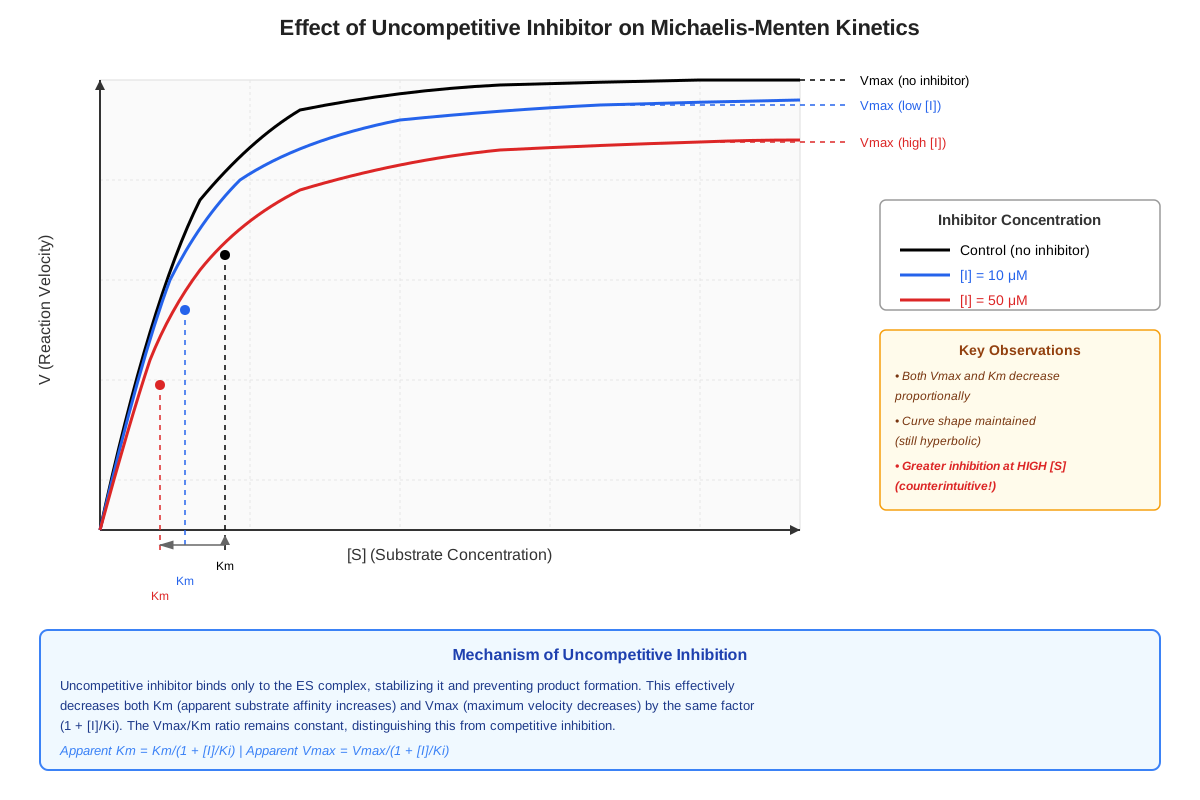
Vmax Decrease: The maximum velocity decreases in the presence of an uncompetitive inhibitor because some fraction of ES complexes are trapped in the inactive ESI form. Even at saturating substrate concentrations, not all ES complexes can proceed to product formation. The apparent Vmax (Vmax,app) is related to the true Vmax by:
Vmax,app = Vmax / (1 + [I]/Ki)where [I] is inhibitor concentration and Ki is the inhibitor dissociation constant for the ESI complex.
Km Decrease: The apparent Km also decreases by the same factor:
Km,app = Km / (1 + [I]/Ki)This proportional decrease in both parameters is the hallmark of uncompetitive inhibition. The decrease in Km occurs because the inhibitor effectively removes ES complexes from solution, shifting the equilibrium to favor more ES formation from free enzyme and substrate. This makes the enzyme appear to have higher affinity for substrate (lower Km).
Vmax/Km Ratio: Critically, the ratio Vmax/Km remains constant because both parameters decrease by the same factor. This ratio represents catalytic efficiency, and its constancy indicates that uncompetitive inhibitors do not affect the enzyme's efficiency at low substrate concentrations—they simply reduce the total amount of active enzyme available.
Lineweaver-Burk Plot Characteristics
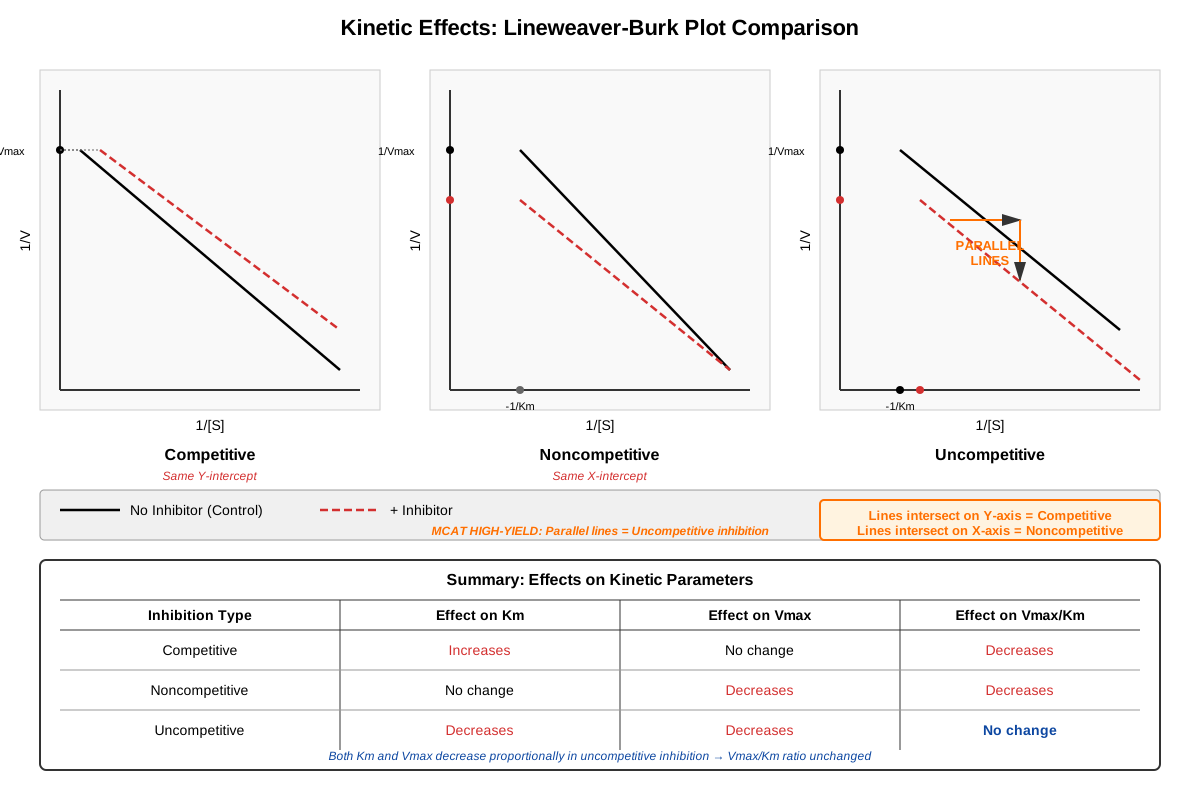
The Lineweaver-Burk plot (double-reciprocal plot) provides the most recognizable signature of uncompetitive inhibition on the MCAT. This plot graphs 1/V (y-axis) versus 1/[S] (x-axis), transforming the hyperbolic Michaelis-Menten curve into a straight line.
For uninhibited enzyme, the Lineweaver-Burk equation is:
1/V = (Km/Vmax)(1/[S]) + 1/VmaxThis produces a line with slope = Km/Vmax, y-intercept = 1/Vmax, and x-intercept = -1/Km.
In the presence of an uncompetitive inhibitor, both Km and Vmax decrease proportionally, so:
1/V = (Km,app/Vmax,app)(1/[S]) + 1/Vmax,appSince Km,app/Vmax,app = Km/Vmax (the ratio is unchanged), the slope remains identical to the uninhibited line. However, because Vmax,app < Vmax, the y-intercept (1/Vmax,app) is larger than the uninhibited y-intercept. Similarly, because Km,app < Km, the x-intercept (-1/Km,app) moves closer to the origin (becomes less negative).
The result: parallel lines with the inhibited line above the uninhibited line. This parallel pattern is pathognomonic for uncompetitive inhibition and is the fastest way to identify this mechanism on the MCAT.
| Inhibition Type | Lineweaver-Burk Pattern | Slope Change | Y-intercept Change | X-intercept Change |
|---|---|---|---|---|
| Competitive | Lines intersect on y-axis | Increases | No change | Moves right (less negative) |
| Noncompetitive | Lines intersect on x-axis | Increases | Increases | No change |
| Uncompetitive | Parallel lines | No change | Increases | Moves right (less negative) |
Substrate Concentration Dependence
A unique and counterintuitive feature of uncompetitive inhibition is that inhibition becomes more effective at higher substrate concentrations. This occurs because the inhibitor can only bind to ES complexes—the more ES complexes present, the more targets available for inhibitor binding.
At low [S], few ES complexes exist, so the inhibitor has limited effect. As [S] increases, more ES complexes form, providing more binding sites for the inhibitor. This creates a self-limiting regulatory mechanism: when substrate accumulates (indicating high pathway flux), uncompetitive inhibitors become more potent, slowing the reaction and preventing excessive product formation.
This property contrasts sharply with competitive inhibition, where high substrate concentrations overcome inhibition by outcompeting the inhibitor for the active site. For uncompetitive inhibition, increasing substrate concentration cannot overcome inhibition—in fact, it enhances inhibition.
Comparison with Other Inhibition Types
Understanding uncompetitive inhibition requires distinguishing it from competitive and noncompetitive (mixed) inhibition:
Competitive Inhibition: The inhibitor binds to free enzyme at the active site, competing with substrate. Increasing [S] overcomes inhibition. Km increases (apparent lower affinity), but Vmax remains unchanged because saturating [S] eventually displaces all inhibitor.
Noncompetitive Inhibition: The inhibitor binds to both free enzyme and ES complex with equal affinity at an allosteric site. Vmax decreases (less active enzyme available), but Km remains unchanged because substrate binding affinity is unaffected.
Uncompetitive Inhibition: The inhibitor binds only to ES complex. Both Km and Vmax decrease proportionally. Increasing [S] cannot overcome inhibition and actually enhances it.
| Parameter | Competitive | Noncompetitive | Uncompetitive |
|---|---|---|---|
| Km | Increases | No change | Decreases |
| Vmax | No change | Decreases | Decreases |
| Vmax/Km | Decreases | Decreases | No change |
| Inhibitor binding site | Active site (free E) | Allosteric site (E and ES) | Allosteric site (ES only) |
| Effect of increasing [S] | Overcomes inhibition | No effect | Enhances inhibition |
Molecular Basis and Structural Requirements
Uncompetitive inhibition requires specific structural features in the enzyme. The inhibitor binding site must be created or exposed only after substrate binding induces conformational changes. This typically occurs in enzymes with:
- Significant induced-fit mechanisms: Enzymes that undergo substantial conformational changes upon substrate binding are more likely to exhibit uncompetitive inhibition
- Sequential ordered mechanisms: Multi-substrate enzymes where substrates bind in a specific order often show uncompetitive inhibition with respect to the second substrate
- Allosteric sites distant from the active site: The inhibitor binding site must be spatially separate from the substrate binding site
- Conformational coupling: Structural changes at the active site must be transmitted to the inhibitor binding site
These requirements explain why uncompetitive inhibition is less common than competitive inhibition but still represents an important regulatory mechanism for certain enzyme classes.
Concept Relationships
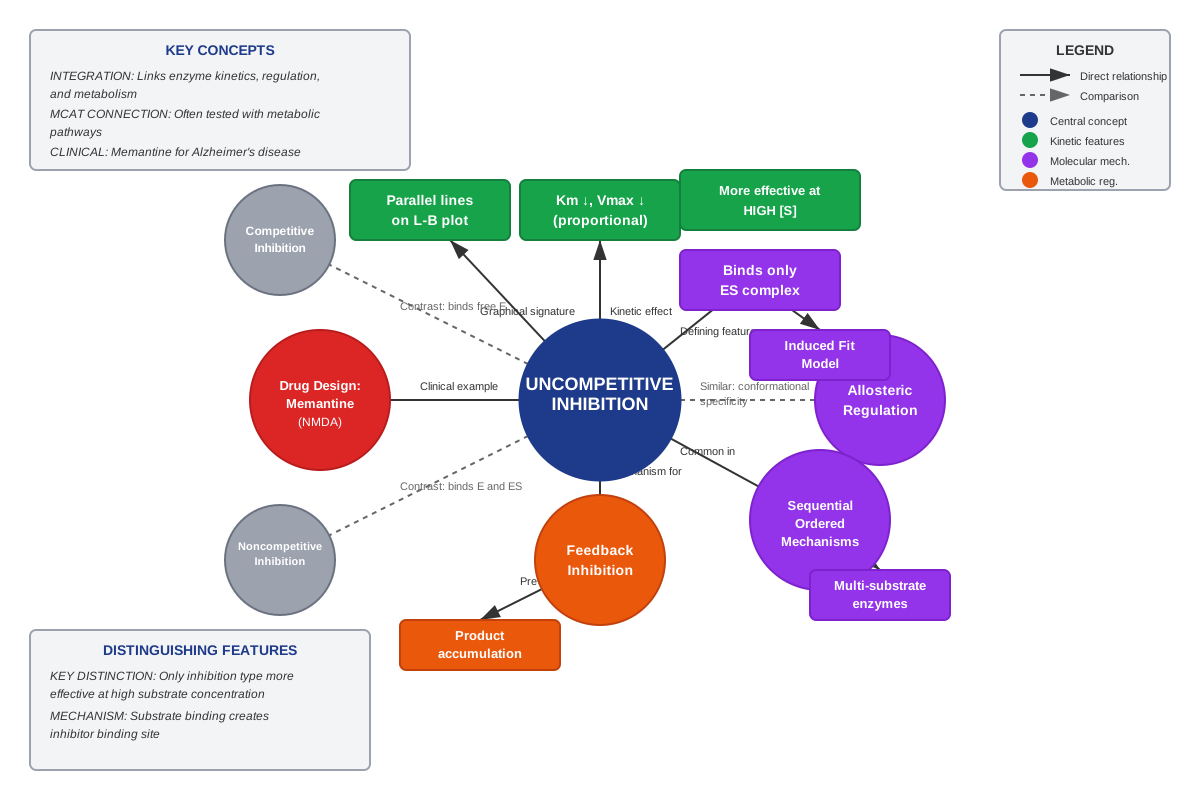
The concepts within uncompetitive inhibition form an interconnected network centered on the ES complex as the critical species. Substrate binding → creates inhibitor binding site → ESI complex formation → removes ES from productive pathway → decreases both Km and Vmax proportionally → produces parallel Lineweaver-Burk lines. This causal chain explains all observable kinetic effects.
Uncompetitive inhibition connects to prerequisite topics through Michaelis-Menten kinetics (provides the baseline parameters that change), enzyme-substrate complex formation (explains why substrate must bind first), and competitive inhibition (provides contrast for understanding unique features). The relationship to Lineweaver-Burk plots is bidirectional: understanding the plots helps identify uncompetitive inhibition, while understanding the mechanism explains why the plots show parallel lines.
Within broader Biochemistry, uncompetitive inhibition links to allosteric regulation (both involve binding sites distinct from the active site), metabolic pathway control (uncompetitive inhibition provides feedback regulation), and drug design (understanding the mechanism enables development of substrate-dependent inhibitors). The concept also connects to thermodynamics through Le Chatelier's principle, which explains the paradoxical Km decrease, and to protein structure through induced-fit conformational changes.
The progression of understanding flows: basic enzyme kinetics → inhibition mechanisms → graphical analysis → metabolic regulation → pharmacological applications. Each level builds on the previous, with uncompetitive inhibition serving as a bridge between fundamental kinetics and applied biochemistry.
Quick check — test yourself on Uncompetitive inhibition so far.
Try Flashcards →High-Yield Facts
⭐ Uncompetitive inhibitors bind exclusively to the ES complex, never to free enzyme
⭐ Both Km and Vmax decrease proportionally in uncompetitive inhibition
⭐ Lineweaver-Burk plots show parallel lines for uncompetitive inhibition (same slope, different y-intercept)
⭐ The Vmax/Km ratio (catalytic efficiency) remains constant in uncompetitive inhibition
⭐ Increasing substrate concentration enhances uncompetitive inhibition rather than overcoming it
- Uncompetitive inhibition is most common in multi-substrate enzymes with ordered sequential mechanisms
- The ESI complex is catalytically inactive and represents a thermodynamic dead-end
- Uncompetitive inhibitors decrease the apparent Km, making the enzyme appear to have higher substrate affinity
- The inhibitor binding site is created or exposed by substrate-induced conformational changes
- Uncompetitive inhibition provides self-limiting regulation: inhibition increases when substrate accumulates
- On Lineweaver-Burk plots, the inhibited line appears above and parallel to the uninhibited line
- The x-intercept (-1/Km) moves closer to zero (becomes less negative) with uncompetitive inhibition
- Memantine, used in Alzheimer's treatment, functions as an uncompetitive NMDA receptor antagonist
- Uncompetitive inhibition cannot be overcome by adding more substrate, unlike competitive inhibition
- The degree of inhibition depends on the ratio [I]/Ki, where Ki is the dissociation constant for ESI
Common Misconceptions
Misconception: Uncompetitive inhibitors bind to the active site like competitive inhibitors. → Correction: Uncompetitive inhibitors bind to an allosteric site that only exists or is accessible after substrate has bound to the active site. The inhibitor and substrate binding sites are distinct.
Misconception: Decreasing Km means the inhibitor makes the enzyme work worse. → Correction: A decreased Km actually indicates increased apparent affinity for substrate. However, this doesn't mean the enzyme works better—Vmax also decreases, so the overall catalytic capacity is reduced. The Km decrease occurs because inhibitor binding shifts equilibrium to favor ES complex formation.
Misconception: Parallel lines on a Lineweaver-Burk plot mean no inhibition is occurring. → Correction: Parallel lines are the diagnostic signature of uncompetitive inhibition. The lines are parallel because the slope (Km/Vmax) remains constant, but the inhibited line is shifted upward, indicating decreased velocity at all substrate concentrations.
Misconception: Adding more substrate will eventually overcome uncompetitive inhibition. → Correction: Unlike competitive inhibition, uncompetitive inhibition cannot be overcome by increasing substrate concentration. In fact, higher substrate concentrations create more ES complexes, providing more targets for inhibitor binding and actually enhancing inhibition.
Misconception: Uncompetitive and noncompetitive inhibition are the same thing. → Correction: These are distinct mechanisms. Noncompetitive inhibitors bind to both free enzyme and ES complex with equal affinity, leaving Km unchanged while decreasing Vmax. Uncompetitive inhibitors bind only to ES complex, decreasing both Km and Vmax proportionally. Their Lineweaver-Burk patterns differ: noncompetitive shows intersecting lines on the x-axis, while uncompetitive shows parallel lines.
Misconception: The ESI complex can slowly convert to product. → Correction: The ESI complex is catalytically inactive and cannot proceed to product formation. It represents a dead-end complex that must dissociate (releasing inhibitor) before the ES complex can continue through the catalytic cycle.
Misconception: Uncompetitive inhibition is rare and unimportant for the MCAT. → Correction: While less common than competitive inhibition, uncompetitive inhibition is specifically tested on the MCAT because it requires deeper understanding of enzyme kinetics. Questions about uncompetitive inhibition often serve as discriminators between high-scoring students and average performers.
Worked Examples
Example 1: Interpreting Kinetic Data
Question: An enzyme has a Km of 10 μM and Vmax of 100 μmol/min in the absence of inhibitor. When compound X is added at 5 μM concentration, the apparent Km becomes 5 μM and the apparent Vmax becomes 50 μmol/min. What type of inhibition does compound X exhibit? Calculate the Ki value.
Solution:
Step 1: Analyze the parameter changes
- Km decreased from 10 μM to 5 μM (decreased by factor of 2)
- Vmax decreased from 100 to 50 μmol/min (decreased by factor of 2)
- Both parameters decreased proportionally
Step 2: Identify inhibition type
The proportional decrease in both Km and Vmax is diagnostic for uncompetitive inhibition. Competitive inhibition would increase Km without changing Vmax, while noncompetitive inhibition would decrease Vmax without changing Km.
Step 3: Calculate Ki
For uncompetitive inhibition:
Km,app = Km / (1 + [I]/Ki)
5 = 10 / (1 + 5/Ki)
1 + 5/Ki = 2
5/Ki = 1
Ki = 5 μM
We can verify using Vmax:
Vmax,app = Vmax / (1 + [I]/Ki)
50 = 100 / (1 + 5/5)
50 = 100 / 2 ✓Answer: Compound X is an uncompetitive inhibitor with Ki = 5 μM.
Key Concepts Applied: This problem tests recognition of uncompetitive inhibition from kinetic parameters (Learning Objective 1), application to exam-style calculations (Learning Objective 3), and understanding of the proportional decrease in both Km and Vmax (Core Concept).
Example 2: Lineweaver-Burk Plot Analysis
Question: A researcher generates Lineweaver-Burk plots for an enzyme under three conditions: no inhibitor (line A), with inhibitor 1 (line B), and with inhibitor 2 (line C). Line A has a y-intercept of 0.01 min/μmol and x-intercept of -0.1 μM⁻¹. Line B is parallel to line A but has a y-intercept of 0.02 min/μmol. Line C intersects line A at the y-axis and has a y-intercept of 0.01 min/μmol. Identify the inhibition type for each inhibitor and calculate the kinetic parameters.
Solution:
Step 1: Analyze Line A (no inhibitor)
- y-intercept = 1/Vmax = 0.01 min/μmol → Vmax = 100 μmol/min
- x-intercept = -1/Km = -0.1 μM⁻¹ → Km = 10 μM
Step 2: Analyze Line B (inhibitor 1)
- Parallel to line A → same slope → uncompetitive inhibition
- y-intercept = 0.02 min/μmol → Vmax,app = 50 μmol/min
- Since lines are parallel, slope is unchanged: Km,app/Vmax,app = Km/Vmax
- Km,app = (Km/Vmax) × Vmax,app = (10/100) × 50 = 5 μM
- Both Km and Vmax decreased by factor of 2
Step 3: Analyze Line C (inhibitor 2)
- Intersects line A at y-axis → same y-intercept → Vmax unchanged
- Different slope → competitive inhibition
- Vmax = 100 μmol/min (unchanged)
- Km increases (x-intercept moves right, closer to zero)
Answer: Inhibitor 1 is uncompetitive (Km,app = 5 μM, Vmax,app = 50 μmol/min). Inhibitor 2 is competitive (Vmax unchanged at 100 μmol/min, Km increased).
Key Concepts Applied: This problem tests Lineweaver-Burk plot interpretation (Learning Objective 7), distinguishing between inhibition types (Learning Objective 6), and recognizing the parallel line signature of uncompetitive inhibition (Core Concept). The comparison with competitive inhibition reinforces understanding of unique uncompetitive features.
Exam Strategy
Approaching MCAT Questions: When encountering enzyme inhibition questions, immediately identify what information is provided: kinetic parameters (Km, Vmax), graphical data (Lineweaver-Burk or Michaelis-Menten plots), or experimental descriptions. For uncompetitive inhibition specifically, look for the parallel line pattern on double-reciprocal plots or proportional decreases in both Km and Vmax.
Trigger Words and Phrases: Watch for these high-yield phrases that suggest uncompetitive inhibition:
- "Binds only to the enzyme-substrate complex"
- "Parallel lines on Lineweaver-Burk plot"
- "Both Km and Vmax decrease"
- "Cannot be overcome by increasing substrate"
- "More effective at high substrate concentrations"
- "Requires substrate binding before inhibitor can bind"
- "Allosteric site created by substrate binding"
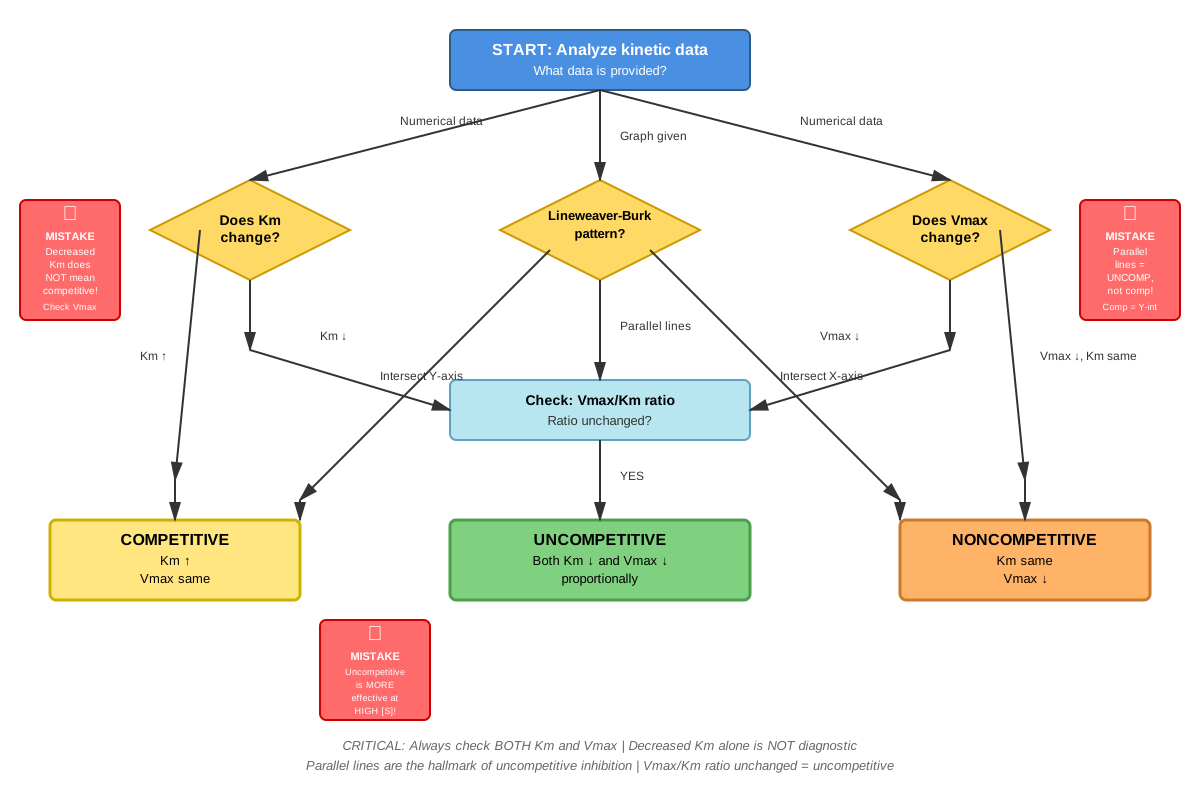
Process of Elimination: When comparing inhibition types, use this systematic approach:
- Check if Vmax changes: If no → competitive; if yes → proceed to step 2
- Check if Km changes: If no → noncompetitive; if yes → proceed to step 3
- Check direction of Km change: If increases → competitive; if decreases → uncompetitive
- Verify with Lineweaver-Burk pattern: Parallel lines confirm uncompetitive
For graphical questions, the parallel line pattern is the fastest identifier—if you see parallel lines, immediately select uncompetitive inhibition without needing to calculate parameters.
Time Allocation: Lineweaver-Burk plot questions should take 30-45 seconds once you recognize the pattern. Kinetic parameter calculation questions may require 60-90 seconds. If a question asks you to calculate Ki or predict velocity at specific conditions, budget 90-120 seconds. Don't waste time calculating exact values if the question only asks for inhibition type—pattern recognition is faster and equally accurate.
Exam Tip: If you're unsure between uncompetitive and noncompetitive inhibition, remember that "uncompetitive" sounds like "unique" and has the unique feature of decreasing Km (the only inhibition type that does this). Noncompetitive keeps Km "normal" (unchanged).
Memory Techniques
Mnemonic for Kinetic Parameters: "Uncompetitive = Under and Under" (both Km and Vmax go down/under their original values)
Mnemonic for Lineweaver-Burk Pattern: "Uncompetitive = Uniform slope" (parallel lines have uniform/same slope)
Visualization Strategy: Picture the ES complex as a "locked door" that the substrate has "opened." The uncompetitive inhibitor is a person who can only enter through the open door—they can't get in when the door is closed (free enzyme). Once inside, they jam the door so it can't complete its function (ESI complex is inactive).
Acronym for Binding Requirements: ESCO - Enzyme-Substrate Complex Only (uncompetitive inhibitors bind to ES complex only)
Comparison Memory Aid: Create a mental table:
- Competitive: Changes Km only (increases)
- Noncompetitive: No change in Km (changes Vmax only)
- Uncompetitive: Unique - changes both (decreases both)
Graphical Memory Device: For Lineweaver-Burk plots, remember "Parallel = Peculiar = Proportional" - parallel lines indicate the peculiar inhibition type (uncompetitive) where both parameters change proportionally.
Substrate Concentration Effect: "Uncompetitive inhibition is UNstoppable by substrate" - unlike competitive inhibition, you cannot overcome it by adding more substrate. In fact, more substrate makes it worse.
Summary
Uncompetitive inhibition represents a unique enzyme inhibition mechanism where the inhibitor binds exclusively to the enzyme-substrate complex, creating an inactive ESI complex. This binding pattern produces the diagnostic signature of proportionally decreased Km and Vmax values, leaving the Vmax/Km ratio unchanged. On Lineweaver-Burk plots, uncompetitive inhibition generates parallel lines with the inhibited line shifted upward, reflecting the unchanged slope but increased y-intercept. The molecular basis involves substrate-induced conformational changes that create or expose the inhibitor binding site, explaining why the inhibitor cannot bind to free enzyme. Counterintuitively, increasing substrate concentration enhances rather than overcomes uncompetitive inhibition because more ES complexes provide more inhibitor binding targets. This mechanism contrasts with competitive inhibition (increased Km, unchanged Vmax) and noncompetitive inhibition (unchanged Km, decreased Vmax). For MCAT success, students must rapidly recognize uncompetitive inhibition from kinetic data or graphical patterns and understand its unique properties, particularly the parallel line signature and substrate concentration dependence.
Key Takeaways
- Uncompetitive inhibitors bind only to the ES complex, never to free enzyme, requiring substrate-induced conformational changes to create the binding site
- Both Km and Vmax decrease proportionally in uncompetitive inhibition, maintaining a constant Vmax/Km ratio
- Lineweaver-Burk plots show parallel lines for uncompetitive inhibition—the fastest and most reliable identification method on the MCAT
- Increasing substrate concentration cannot overcome uncompetitive inhibition and actually enhances it by creating more ES complex targets
- Uncompetitive inhibition differs from competitive (Km increases, Vmax unchanged) and noncompetitive (Km unchanged, Vmax decreases) inhibition
- The ESI complex is catalytically inactive and represents a thermodynamic dead-end that removes ES complexes from the productive pathway
- Recognition of the parallel line pattern on double-reciprocal plots is the highest-yield skill for MCAT questions on this topic
Related Topics
Competitive Inhibition: Understanding competitive inhibition provides essential contrast for recognizing uncompetitive inhibition's unique features. Mastering both mechanisms enables rapid differentiation on exam questions and deepens understanding of enzyme regulation strategies.
Noncompetitive (Mixed) Inhibition: This inhibition type completes the triad of major reversible inhibition mechanisms. Comparing all three types strengthens pattern recognition skills and prepares students for complex questions requiring inhibition type identification.
Allosteric Regulation: Uncompetitive inhibition involves allosteric binding sites, making it a gateway to understanding broader allosteric regulation principles including cooperativity, feedback inhibition, and metabolic pathway control.
Multi-Substrate Enzyme Mechanisms: Uncompetitive inhibition is particularly common in sequential ordered mechanisms, connecting this topic to more complex enzyme kinetics involving multiple substrates and products.
Drug Design and Pharmacology: Understanding uncompetitive inhibition mechanisms informs rational drug design, particularly for developing substrate-dependent inhibitors with reduced off-target effects.
Practice CTA
Now that you've mastered the core concepts of uncompetitive inhibition, it's time to solidify your understanding through active practice. Attempt the practice questions to test your ability to identify inhibition types from kinetic data and interpret Lineweaver-Burk plots under time pressure. Use the flashcards to reinforce the high-yield facts and kinetic parameter relationships—these rapid-recall skills will save valuable seconds on test day. Remember, uncompetitive inhibition questions often separate high scorers from average performers, so investing time in practice now will pay dividends on exam day. You've built a strong foundation; now apply it to achieve mastery!
Sign up free to keep reading
Create a free AnvayaPrep account to finish this MCAT guide on Uncompetitive inhibition — plus flashcards and practice questions.