Overview
Dihybrid crosses represent a fundamental concept in classical genetics that extends Mendelian inheritance patterns beyond single-trait analysis. While monohybrid crosses examine the inheritance of one characteristic, dihybrid crosses track two different traits simultaneously, revealing how genes assort and combine during sexual reproduction. This analytical framework was pioneered by Gregor Mendel through his famous pea plant experiments, where he observed that traits such as seed color and seed shape inherited independently of one another.
For the MCAT, dihybrid crosses serve as a critical bridge between basic Mendelian genetics and more complex inheritance patterns. The Biology section of the MCAT frequently tests students' ability to predict offspring ratios, construct Punnett squares, and apply probability rules to genetic scenarios. Understanding dihybrid crosses is essential because these problems require integration of multiple concepts: dominance relationships, independent assortment, probability theory, and phenotypic ratio analysis. Questions may appear as standalone discrete items or embedded within passage-based scenarios involving genetic counseling, agricultural breeding, or evolutionary biology contexts.
Within the broader framework of Molecular Biology and Genetics, dihybrid crosses connect foundational principles to advanced topics. They provide the mathematical and conceptual basis for understanding linkage, recombination, epistasis, and polygenic inheritance. Mastery of dihybrid crosses Biology concepts enables students to tackle more sophisticated genetic problems and appreciate how multiple genes interact to produce complex phenotypes. This topic exemplifies the quantitative reasoning skills that distinguish high-scoring MCAT candidates, as it demands both conceptual understanding and computational accuracy.
Learning Objectives
- [ ] Define dihybrid crosses using accurate Biology terminology
- [ ] Explain why dihybrid crosses matters for the MCAT
- [ ] Apply dihybrid crosses to exam-style questions
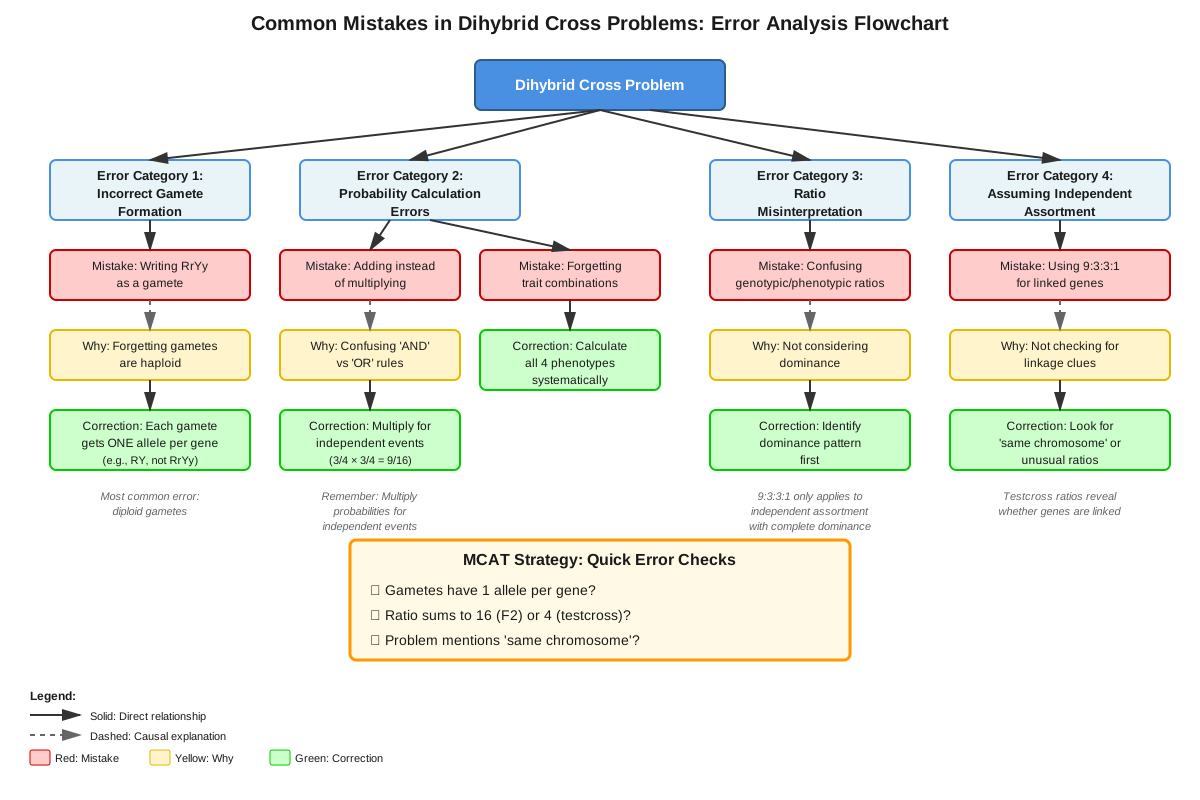
- [ ] Identify common mistakes related to dihybrid crosses
- [ ] Connect dihybrid crosses to related Biology concepts
- [ ] Construct and interpret 16-square Punnett squares for dihybrid crosses
- [ ] Calculate expected phenotypic and genotypic ratios using probability rules
- [ ] Distinguish between independent assortment and linked genes based on offspring ratios
- [ ] Predict outcomes of testcrosses involving two traits
Prerequisites
- Mendelian genetics and monohybrid crosses: Understanding single-trait inheritance patterns provides the foundation for analyzing two traits simultaneously
- Dominance relationships (complete dominance, incomplete dominance, codominance): These relationships determine how alleles express themselves phenotypically in dihybrid scenarios
- Basic probability and multiplication/addition rules: Dihybrid cross calculations rely heavily on probability theory to predict offspring frequencies
- Meiosis and gamete formation: Knowledge of how chromosomes segregate during meiosis explains the biological basis for independent assortment
- Genotype versus phenotype distinction: Clear differentiation between genetic composition and observable traits is essential for ratio analysis
- Punnett square construction: Facility with basic Punnett squares is necessary before tackling 16-square dihybrid grids
Why This Topic Matters
Dihybrid crosses MCAT questions appear with moderate frequency across both the Biological and Biochemical Foundations of Living Systems section and occasionally in passage-based questions. According to AAMC content analysis, genetics comprises approximately 8-12% of the Biology section, with dihybrid crosses representing a significant portion of these questions. The MCAT particularly favors questions that test whether students can distinguish between independent assortment and linkage, calculate probabilities without constructing full Punnett squares, and interpret experimental breeding data.
In clinical and research contexts, dihybrid cross principles underlie genetic counseling for families concerned about multiple inherited conditions, agricultural breeding programs that aim to combine desirable traits, and evolutionary studies examining how trait combinations affect fitness. Understanding how two genes assort provides insight into genetic diversity generation, which has implications for population genetics, conservation biology, and personalized medicine approaches that consider multiple genetic risk factors simultaneously.
Common MCAT question formats include: (1) calculating the probability of offspring with specific two-trait phenotypes, (2) determining parental genotypes from offspring ratios, (3) identifying whether genes are linked or assort independently based on deviation from expected 9:3:3:1 ratios, (4) analyzing testcross results to deduce unknown genotypes, and (5) applying chi-square analysis to determine if observed data fits theoretical predictions. Passage-based questions often embed dihybrid crosses within agricultural genetics, model organism research, or human pedigree analysis scenarios.
Core Concepts
Definition and Fundamental Principles
A dihybrid cross is a breeding experiment that tracks the inheritance of two different traits, each controlled by a separate gene with two alleles. The term "dihybrid" refers to organisms that are heterozygous for both genes being studied (e.g., AaBb). When two dihybrids mate (AaBb × AaBb), their offspring display predictable phenotypic ratios that reveal fundamental principles of inheritance.
The foundation of dihybrid cross analysis rests on Mendel's Law of Independent Assortment, which states that alleles of different genes assort independently during gamete formation, provided the genes are located on different chromosomes or far apart on the same chromosome. This principle means that the inheritance of one trait does not influence the inheritance of another trait. For example, whether a pea plant receives a "tall" or "short" allele has no bearing on whether it receives a "yellow" or "green" seed color allele.
Gamete Formation and the Fork-Line Method
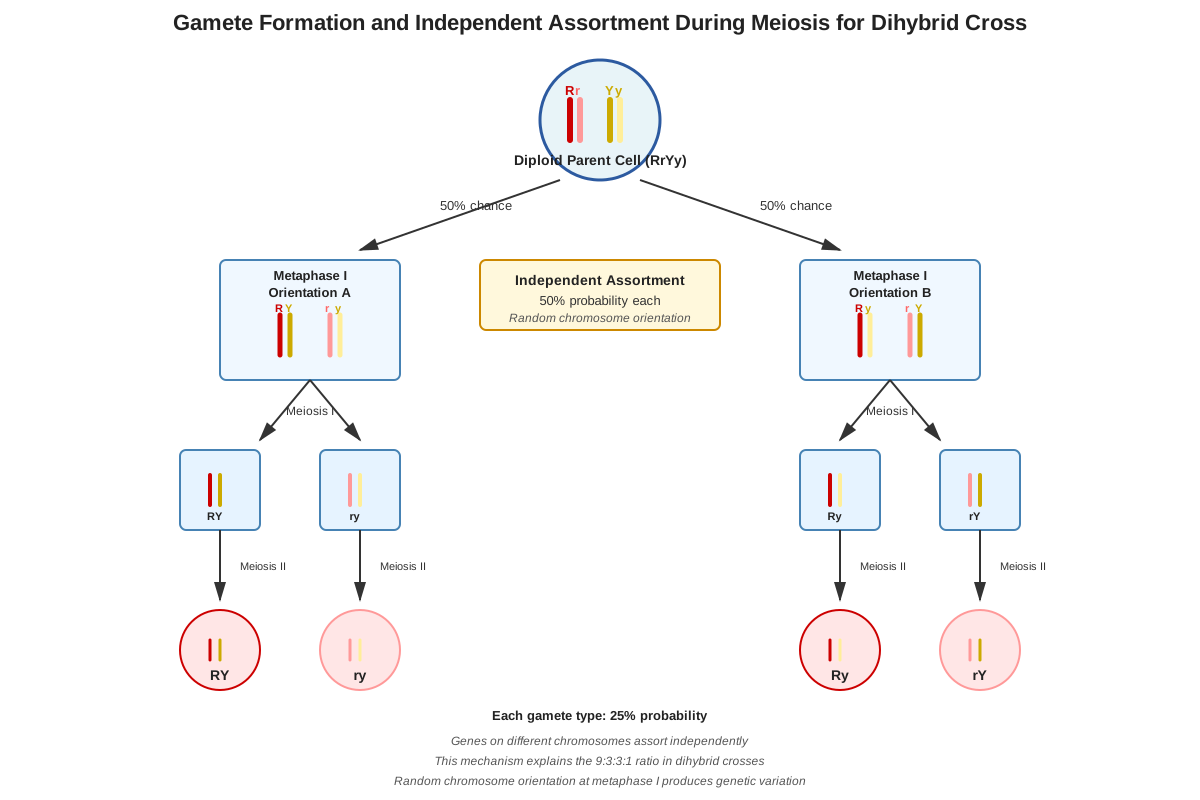
When an organism with genotype AaBb produces gametes through meiosis, independent assortment generates four equally probable gamete types: AB, Ab, aB, and ab. Each gamete receives one allele from each gene, and the combination occurs randomly. The fork-line method (also called the branch diagram method) provides an efficient way to determine all possible gamete combinations:
- For the first gene (Aa): 1/2 probability of A, 1/2 probability of a
- For the second gene (Bb): 1/2 probability of B, 1/2 probability of b
- Multiply probabilities along each branch: (1/2)(1/2) = 1/4 for each of the four gamete types
This method becomes particularly valuable when dealing with three or more genes, where constructing full Punnett squares becomes impractical.
The 16-Square Punnett Square
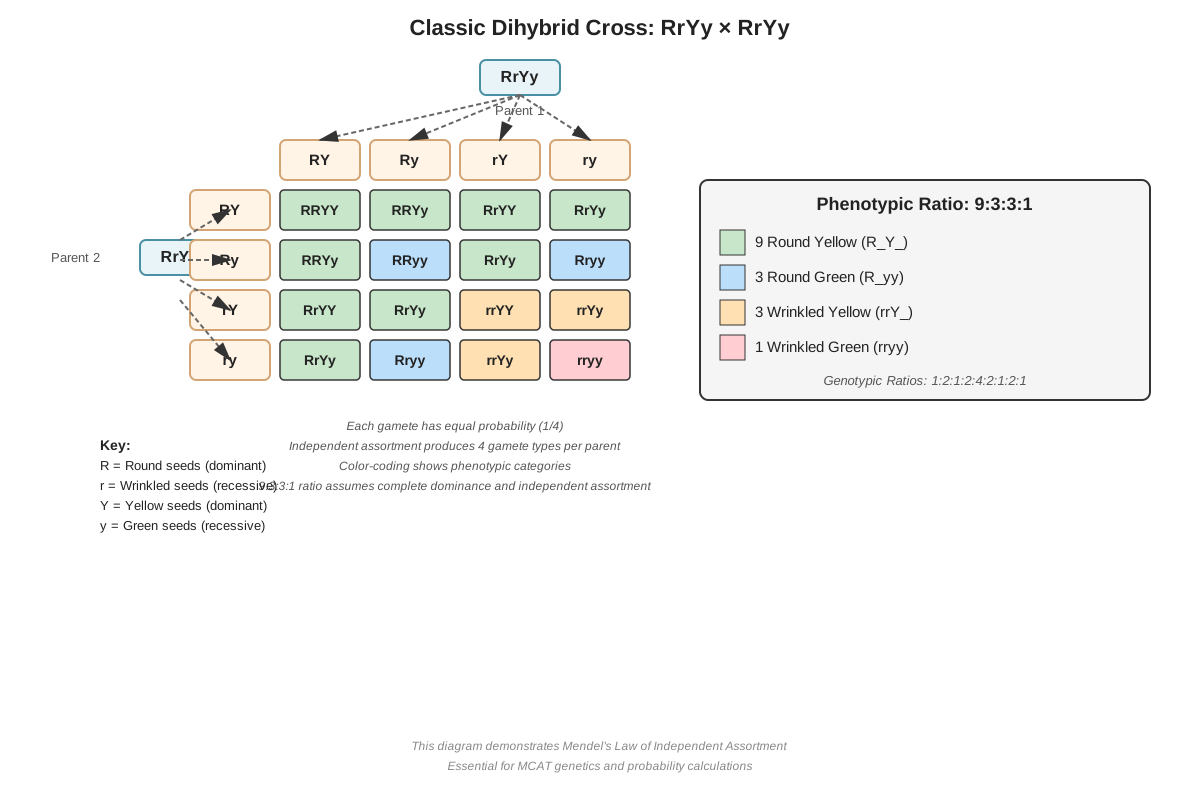
The classic dihybrid cross between two heterozygotes (AaBb × AaBb) requires a 4×4 Punnett square with 16 boxes, representing all possible combinations of the four gamete types from each parent. The resulting genotypic ratio contains nine distinct genotypes:
- 1 AABB : 2 AABb : 1 AAbb : 2 AaBB : 4 AaBb : 2 Aabb : 1 aaBB : 2 aaBb : 1 aabb
When both genes exhibit complete dominance, these nine genotypes collapse into four phenotypic classes, producing the famous 9:3:3:1 phenotypic ratio:
- 9/16 display both dominant traits (A_B_)
- 3/16 display the first dominant and second recessive (A_bb)
- 3/16 display the first recessive and second dominant (aaB_)
- 1/16 display both recessive traits (aabb)
The underscore notation (A_) indicates that the second allele can be either dominant or recessive without changing the phenotype.
Probability Method for Dihybrid Crosses
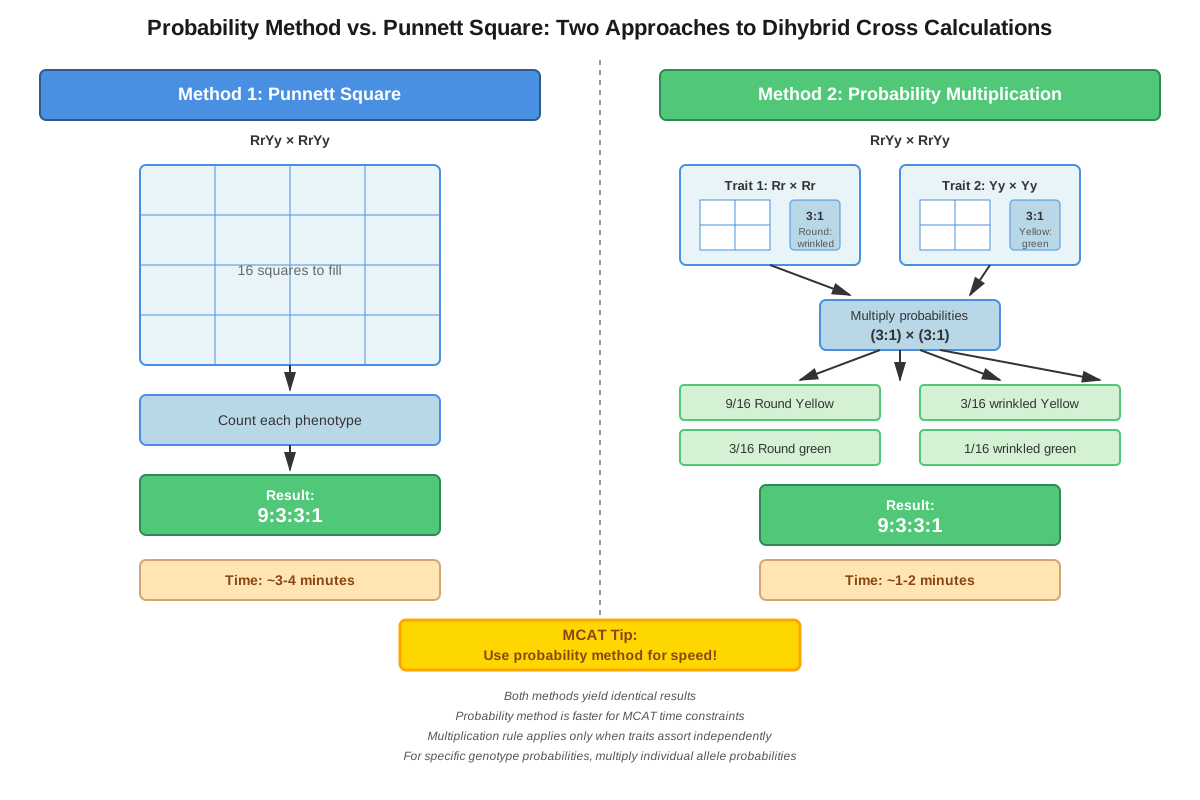
Rather than constructing complete Punnett squares, the multiplication rule allows rapid calculation of specific offspring probabilities. This approach treats each gene as an independent monohybrid cross, then multiplies the individual probabilities:
Example: What is the probability of obtaining an AaBb offspring from AaBb × AaBb?
- Probability of Aa from Aa × Aa = 1/2
- Probability of Bb from Bb × Bb = 1/2
- Combined probability = (1/2)(1/2) = 1/4
Example: What is the probability of obtaining a phenotype showing both dominant traits (A_B_)?
- Probability of A_ from Aa × Aa = 3/4
- Probability of B_ from Bb × Bb = 3/4
- Combined probability = (3/4)(3/4) = 9/16
This method dramatically reduces calculation time on timed exams and minimizes errors from constructing large Punnett squares.
Testcross Applications
A testcross involves crossing an individual with unknown genotype (but dominant phenotype) with a homozygous recessive individual (aabb). The testcross reveals the unknown genotype by examining offspring ratios:
| Unknown Genotype | Testcross | Expected Offspring Ratio |
|---|---|---|
| AABB | AABB × aabb | All AaBb (100% both dominant) |
| AaBB | AaBB × aabb | 1 AaBb : 1 aaBb (50% both dominant, 50% one dominant) |
| AABb | AABb × aabb | 1 AaBb : 1 AAbb (50% both dominant, 50% one dominant) |
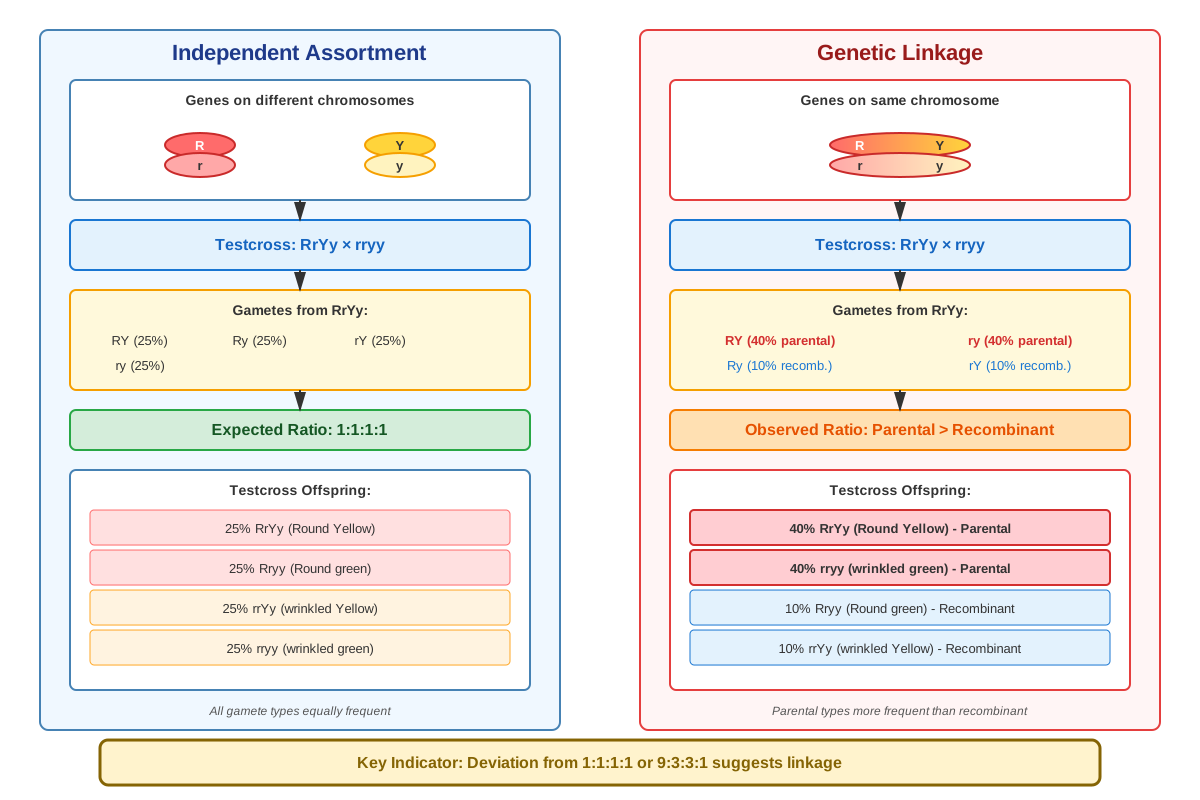
| AaBb | AaBb × aabb | 1 AaBb : 1 Aabb : 1 aaBb : 1 aabb (1:1:1:1 ratio) |
The 1:1:1:1 ratio from an AaBb × aabb testcross directly reflects the four gamete types produced by the dihybrid parent, making this a powerful diagnostic tool in genetics research and breeding programs.
Variations in Phenotypic Ratios
The classic 9:3:3:1 ratio assumes complete dominance at both loci. Different dominance relationships produce modified ratios:
Incomplete dominance at one locus: If gene A shows incomplete dominance while gene B shows complete dominance, the AaBb × AaBb cross yields a 3:6:3:1:2:1 ratio (six phenotypic classes instead of four).
Codominance: When both alleles express simultaneously, more phenotypic classes emerge. For example, with codominance at both loci, nine genotypic classes produce nine distinct phenotypes.
Epistasis: When one gene masks the expression of another, ratios deviate from 9:3:3:1. Common epistatic ratios include 9:7, 12:3:1, and 13:3, depending on the specific interaction pattern.
Independent Assortment Versus Linkage
The 9:3:3:1 ratio only occurs when genes assort independently. Linked genes—those located close together on the same chromosome—do not assort independently and produce offspring ratios that deviate from Mendelian expectations. When genes are completely linked (no recombination), a dihybrid testcross yields a 1:1 ratio instead of 1:1:1:1, with parental combinations appearing far more frequently than recombinant types.
The degree of deviation from expected ratios correlates with the distance between genes: closer genes show greater linkage and more extreme ratio distortion, while distant genes on the same chromosome may still approximate independent assortment due to frequent recombination events.
Concept Relationships
Dihybrid crosses build directly upon monohybrid cross principles by extending single-gene analysis to two-gene systems. The Law of Segregation (from monohybrid crosses) operates simultaneously for both genes, while the Law of Independent Assortment governs how alleles from different genes combine. These two laws work together to generate the characteristic 9:3:3:1 ratio.
The connection to meiosis is fundamental: independent assortment occurs because homologous chromosome pairs align randomly during metaphase I, and this random alignment determines which allele combinations end up in each gamete. Understanding meiotic mechanisms explains why genes on different chromosomes assort independently while linked genes do not.
Dihybrid crosses connect forward to more advanced genetics topics. Linkage and recombination represent deviations from independent assortment, with recombination frequency providing a measure of genetic distance. Epistasis modifies dihybrid ratios by introducing gene interactions where one locus affects another's expression. Polygenic inheritance extends dihybrid principles to multiple genes affecting a single trait, producing continuous variation rather than discrete phenotypic classes.
The probability methods used in dihybrid crosses apply broadly to population genetics, where Hardy-Weinberg calculations predict genotype frequencies, and to pedigree analysis, where inheritance probabilities inform genetic counseling. The quantitative reasoning skills developed through dihybrid cross problems transfer to experimental design, data interpretation, and statistical analysis throughout biology.
Relationship map: Mendelian principles → Monohybrid crosses → Dihybrid crosses → Probability calculations → Testcross analysis → Linkage detection → Recombination mapping → Epistasis → Polygenic traits → Quantitative genetics
Quick check — test yourself on Dihybrid crosses so far.
Try Flashcards →High-Yield Facts
⭐ The classic dihybrid cross (AaBb × AaBb) produces a 9:3:3:1 phenotypic ratio when both genes show complete dominance and assort independently
⭐ Each dihybrid parent (AaBb) produces four equally probable gamete types: AB, Ab, aB, ab (each with 1/4 probability)
⭐ The probability method multiplies individual gene probabilities: P(AaBb) = P(Aa) × P(Bb) = (1/2)(1/2) = 1/4
⭐ A testcross of a dihybrid (AaBb × aabb) yields a 1:1:1:1 phenotypic ratio, directly revealing the dihybrid parent's gamete types
⭐ Deviation from the 9:3:3:1 ratio suggests either gene linkage or epistatic interactions between loci
- The 16-square Punnett square for a dihybrid cross contains 9 different genotypes but only 4 phenotypes (with complete dominance)
- Independent assortment requires genes to be on different chromosomes or far apart on the same chromosome
- The probability of obtaining offspring with both recessive traits (aabb) from AaBb × AaBb is 1/16
- Incomplete dominance or codominance at either locus increases the number of phenotypic classes beyond four
- The multiplication rule applies when calculating probabilities for independent events; the addition rule applies for mutually exclusive outcomes
- In a dihybrid cross, 9/16 of offspring show at least one dominant allele at both loci (A_B_ phenotype)
- Testcrosses with homozygous recessive individuals reveal unknown genotypes because the recessive parent contributes only recessive alleles
- The fork-line method efficiently determines gamete types for organisms heterozygous at multiple loci
- Chi-square analysis tests whether observed offspring ratios significantly deviate from expected Mendelian ratios
- Linked genes produce an excess of parental phenotype combinations and a deficiency of recombinant types compared to independent assortment predictions
Common Misconceptions
Misconception: All dihybrid crosses produce a 9:3:3:1 ratio.
Correction: The 9:3:3:1 ratio only occurs when both genes exhibit complete dominance AND assort independently. Incomplete dominance, codominance, epistasis, or linkage all produce different ratios. Always check the dominance relationships and whether genes are linked before assuming this ratio.
Misconception: The genotype AaBb can only produce four types of offspring.
Correction: The dihybrid parent produces four types of gametes, but when crossed with another dihybrid, these gametes can combine in 16 different ways, producing nine distinct genotypes. The confusion arises from conflating gamete types with offspring genotypes.
Misconception: Probability calculations require constructing a full Punnett square.
Correction: The multiplication rule allows direct calculation of specific genotype or phenotype probabilities without drawing any Punnett square. Treat each gene independently, calculate its probability, then multiply. This method is faster and less error-prone for complex crosses.
Misconception: A 1:1:1:1 ratio always indicates a testcross.
Correction: While AaBb × aabb produces 1:1:1:1, other crosses can yield this ratio under specific conditions. For example, with complete linkage, different crosses might produce 1:1 ratios that could be mistaken for 1:1:1:1 if not carefully analyzed. Always consider the full genetic context.
Misconception: Independent assortment means genes are on different chromosomes.
Correction: Genes on the same chromosome can still assort independently if they are far enough apart that recombination occurs frequently (approaching 50% recombination frequency). Conversely, genes on different chromosomes always assort independently. Distance matters as much as chromosome location.
Misconception: The 9:3:3:1 ratio means exactly 9, 3, 3, and 1 offspring.
Correction: These numbers represent ratios or probabilities, not absolute counts. In a small sample, random variation means observed numbers will deviate from expected ratios. With 16 offspring, you might see 10:2:3:1 or 8:4:2:2 due to chance. Only large sample sizes approximate theoretical ratios closely.
Misconception: Heterozygotes (AaBb) always show intermediate phenotypes.
Correction: This confuses incomplete dominance with complete dominance. With complete dominance, heterozygotes are phenotypically indistinguishable from homozygous dominant individuals. Only incomplete dominance produces intermediate phenotypes, and this must be explicitly stated in the problem.
Worked Examples
Example 1: Classic Dihybrid Cross with Probability Method
Problem: In guinea pigs, black coat (B) is dominant to white (b), and short hair (S) is dominant to long hair (s). Two guinea pigs heterozygous for both traits are crossed. What is the probability of obtaining offspring that are black with long hair?
Solution:
Step 1: Identify the cross: BbSs × BbSs
Step 2: Determine the target phenotype: black with long hair = B_ss (at least one B allele, two s alleles)
Step 3: Calculate probability for each gene independently:
- Probability of B_ (black) from Bb × Bb:
- Possible outcomes: BB, Bb, Bb, bb
- Black phenotypes: BB, Bb, Bb = 3/4
- Probability of ss (long hair) from Ss × Ss:
- Possible outcomes: SS, Ss, Ss, ss
- Long hair phenotype: ss = 1/4
Step 4: Apply multiplication rule:
- P(black with long hair) = P(B_) × P(ss)
- P(B_ss) = (3/4) × (1/4) = 3/16
Answer: 3/16 or approximately 18.75% of offspring will be black with long hair.
Connection to learning objectives: This example demonstrates the probability method for dihybrid crosses, avoiding the need to construct a 16-square Punnett square. It reinforces that each gene can be analyzed independently when genes assort independently, a key principle for efficient MCAT problem-solving.
Example 2: Testcross Analysis
Problem: A researcher has a tomato plant with round, red fruit (both dominant traits). To determine if the plant is homozygous or heterozygous for these traits, she performs a testcross with a plant that has oblong, yellow fruit (both recessive). The cross produces 78 round, red; 82 round, yellow; 76 oblong, red; and 80 oblong, yellow offspring. What is the genotype of the original plant? (R = round, r = oblong; Y = red, y = yellow)
Solution:
Step 1: Analyze the offspring ratio:
- 78 : 82 : 76 : 80 ≈ 1:1:1:1 ratio (approximately equal numbers of each phenotype)
Step 2: Recall testcross expectations:
- Testcross format: Unknown genotype × rryy
- A 1:1:1:1 ratio indicates the unknown parent produces four equally probable gamete types
Step 3: Determine which genotype produces four gamete types:
- RRYY produces only RY gametes → would give all round, red offspring (eliminated)
- RrYY produces RY and rY gametes → would give 1:1 ratio of two phenotypes (eliminated)
- RRYy produces RY and Ry gametes → would give 1:1 ratio of two phenotypes (eliminated)
- RrYy produces RY, Ry, rY, and ry gametes → gives 1:1:1:1 ratio ✓
Step 4: Verify by checking expected offspring:
- RrYy × rryy testcross:
- RY × ry → RrYy (round, red)
- Ry × ry → Rryy (round, yellow)
- rY × ry → rrYy (oblong, red)
- ry × ry → rryy (oblong, yellow)
- This matches the observed 1:1:1:1 phenotypic distribution
Answer: The original plant's genotype is RrYy (heterozygous for both traits).
Connection to learning objectives: This example illustrates how testcross results reveal unknown genotypes and demonstrates the application of dihybrid cross principles to experimental data interpretation—a common MCAT passage-based question format. The approximately equal ratios confirm independent assortment of the two genes.
Exam Strategy
When approaching dihybrid crosses MCAT questions, first identify whether the problem requires a full Punnett square or can be solved more efficiently with probability methods. For questions asking about a single specific genotype or phenotype, always use the multiplication rule—this saves significant time and reduces calculation errors. Reserve Punnett squares for questions requiring complete offspring distributions or when visualizing all possibilities aids understanding.
Trigger words and phrases to watch for:
- "Heterozygous for both traits" → signals AaBb genotype
- "Testcross" → immediately think cross with homozygous recessive (aabb)
- "Independent assortment" → confirms genes are unlinked; expect 9:3:3:1 or related ratios
- "Probability of offspring with..." → use multiplication rule, not Punnett square
- "Observed ratio deviates from expected" → consider linkage or epistasis
Process-of-elimination strategies:
- Eliminate answer choices that violate basic probability rules (probabilities cannot exceed 1 or be negative)
- For ratio questions, eliminate options that don't sum to 16 (or the appropriate denominator)
- If a question mentions independent assortment, eliminate answers suggesting linkage effects
- For testcross questions, eliminate genotypes that couldn't produce the observed offspring diversity
Time allocation: Simple probability calculations should take 30-45 seconds. Testcross interpretation questions may require 60-90 seconds to analyze ratios and deduce genotypes. If a question seems to require constructing a full 16-square Punnett square, reconsider whether probability methods could work instead—full Punnett squares should be a last resort due to time constraints.
Common question formats:
- Direct probability calculations (most common)
- Testcross interpretation (moderate frequency)
- Ratio analysis to determine inheritance patterns (moderate frequency)
- Distinguishing independent assortment from linkage (less common but high-yield)
Exam Tip: When calculating probabilities, write out each gene's probability separately before multiplying. This intermediate step prevents errors and makes your work easier to check if time permits. For example, write "P(Aa) = 1/2, P(Bb) = 1/2, therefore P(AaBb) = 1/4" rather than attempting mental calculation.
Memory Techniques
Mnemonic for gamete types from AaBb: "All Big Ants Bite" → AB, Ab, aB, ab (the four gamete types in order)
Mnemonic for the 9:3:3:1 ratio: "Nine Cats Can't Catch Three Mice, Three Birds, or One Rat" → helps remember 9 (both dominant), 3 (first dominant), 3 (second dominant), 1 (both recessive)
Visualization strategy: Picture a 4×4 grid divided into quadrants:
- Top-left quadrant (9 squares): both dominant traits
- Top-right quadrant (3 squares): first dominant, second recessive
- Bottom-left quadrant (3 squares): first recessive, second dominant
- Bottom-right square (1 square): both recessive
This visual pattern helps quickly recall the 9:3:3:1 distribution without reconstructing the entire Punnett square.
Acronym for testcross analysis: "TEST" →
- Testcross uses homozygous recessive
- Equal ratios indicate heterozygous parent
- Single phenotype indicates homozygous parent
- Two phenotypes indicate one heterozygous gene
Probability rule memory aid: "Multiply for AND, Add for OR"
- Want Aa AND Bb? → Multiply: P(Aa) × P(Bb)
- Want Aa OR aa? → Add: P(Aa) + P(aa)
Fork-line method memory: Think of a tree branching: each gene creates a new branch point, and you follow all possible paths from trunk to leaves, multiplying probabilities along each path.
Summary
Dihybrid crosses extend Mendelian genetics to two-trait inheritance, revealing how genes assort independently during reproduction. The classic AaBb × AaBb cross produces a 9:3:3:1 phenotypic ratio when both genes exhibit complete dominance and are located on different chromosomes. This ratio emerges because each parent produces four equally probable gamete types (AB, Ab, aB, ab), which combine in 16 possible ways. Efficient problem-solving relies on the multiplication rule: calculate each gene's probability independently, then multiply for combined probabilities. Testcrosses with homozygous recessive individuals reveal unknown genotypes through offspring ratio analysis, with 1:1:1:1 ratios indicating dihybrid parents. Deviations from expected Mendelian ratios suggest either gene linkage or epistatic interactions. Mastery of dihybrid crosses requires understanding independent assortment's mechanistic basis in meiosis, facility with probability calculations, and recognition of how different dominance relationships modify phenotypic ratios. These skills form the foundation for analyzing complex genetic scenarios on the MCAT and understanding real-world applications in genetic counseling, breeding programs, and evolutionary biology.
Key Takeaways
- Dihybrid crosses track two traits simultaneously, with the classic AaBb × AaBb cross yielding a 9:3:3:1 phenotypic ratio under complete dominance and independent assortment
- The multiplication rule enables rapid probability calculations without constructing full Punnett squares: treat each gene independently and multiply individual probabilities
- Each dihybrid parent (AaBb) produces four equally probable gamete types (AB, Ab, aB, ab), each with 1/4 probability
- Testcrosses with homozygous recessive individuals (aabb) reveal unknown genotypes through offspring ratio patterns, with 1:1:1:1 indicating a dihybrid parent
- Deviations from expected 9:3:3:1 ratios signal either linked genes (non-independent assortment) or epistatic interactions between loci
- Independent assortment occurs because genes on different chromosomes or far apart on the same chromosome segregate randomly during meiosis
- Different dominance relationships (incomplete dominance, codominance) modify the number of phenotypic classes and alter expected ratios from the classic 9:3:3:1 pattern
Related Topics
Linkage and Recombination: Genes located close together on the same chromosome violate independent assortment, producing offspring ratios that deviate from Mendelian expectations. Understanding dihybrid crosses provides the baseline for recognizing linkage effects and calculating recombination frequencies.
Epistasis: Gene interactions where one locus masks or modifies another's expression produce modified dihybrid ratios (9:7, 12:3:1, 13:3). Mastering standard dihybrid crosses enables recognition of these deviations and interpretation of underlying genetic mechanisms.
Chi-Square Analysis: Statistical testing determines whether observed offspring ratios significantly differ from expected Mendelian ratios. Dihybrid cross predictions provide the expected values for chi-square calculations in genetic experiments.
Three-Point Crosses: Extending dihybrid principles to three genes simultaneously allows mapping of gene order and distances on chromosomes. The probability methods learned in dihybrid crosses scale to these more complex scenarios.
Pedigree Analysis: Human genetic counseling applies dihybrid cross principles to predict inheritance probabilities for families concerned about multiple genetic conditions. Understanding two-trait inheritance enables analysis of complex pedigrees.
Population Genetics: Hardy-Weinberg equilibrium calculations for multiple loci build upon dihybrid cross probability methods, extending individual-level predictions to population-level allele frequency analysis.
Practice CTA
Now that you've mastered the core concepts of dihybrid crosses, it's time to solidify your understanding through active practice. Work through the practice questions to test your ability to calculate probabilities, interpret testcross results, and distinguish independent assortment from linkage. Use the flashcards to reinforce high-yield facts and ratios until they become automatic. Remember: genetics problems reward systematic approaches and careful probability calculations. The time you invest in practicing dihybrid crosses will pay dividends not only on discrete genetics questions but also in passage-based scenarios throughout the MCAT Biology section. You've built a strong foundation—now apply it with confidence!
Sign up free to keep reading
Create a free AnvayaPrep account to finish this MCAT guide on Dihybrid crosses — plus flashcards and practice questions.