Overview
Hardy-Weinberg equilibrium is a foundational principle in population genetics that describes the mathematical relationship between allele frequencies and genotype frequencies in a non-evolving population. This principle, formulated independently by mathematician G.H. Hardy and physician Wilhelm Weinberg in 1908, provides a null hypothesis for evolutionary biology: it predicts what happens to genetic variation when evolution is not occurring. The Hardy-Weinberg equilibrium model states that allele and genotype frequencies in a population will remain constant from generation to generation in the absence of evolutionary influences. This equilibrium is expressed through two fundamental equations: p + q = 1 (for allele frequencies) and p² + 2pq + q² = 1 (for genotype frequencies), where p represents the frequency of the dominant allele and q represents the frequency of the recessive allele.
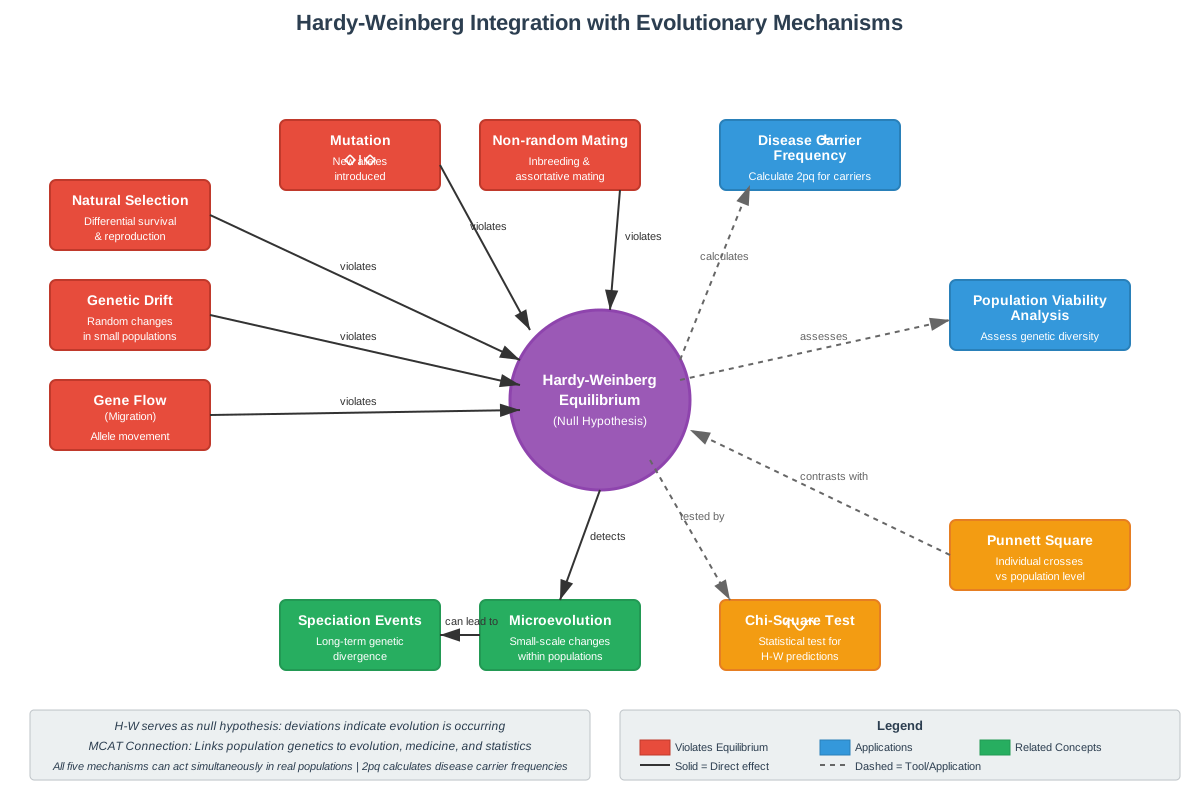
For the MCAT, Hardy-Weinberg equilibrium represents a critical intersection of Molecular Biology and Genetics with quantitative reasoning. The MCAT frequently tests this concept through calculation-based questions, passage analysis involving population studies, and conceptual questions about evolutionary mechanisms. Understanding this principle is essential because it serves as the baseline against which evolutionary change is measured—any deviation from Hardy-Weinberg predictions indicates that one or more evolutionary forces are acting on the population. This makes it an invaluable tool for identifying and understanding mechanisms of evolution, including natural selection, genetic drift, gene flow, mutation, and non-random mating.
The significance of Hardy-Weinberg equilibrium extends beyond isolated genetics problems. It connects to broader Biology concepts including evolution, natural selection, speciation, genetic diversity, and population dynamics. In the context of the MCAT, this topic bridges multiple disciplines: it requires mathematical problem-solving skills (similar to those tested in the Chemical and Physical Foundations section), conceptual understanding of biological principles, and the ability to interpret experimental data from passages. Mastery of Hardy-Weinberg principles enables students to tackle complex questions about disease inheritance patterns, evolutionary biology, and population-level genetic changes—all high-yield topics for the Biological and Biochemical Foundations section of the MCAT.
Learning Objectives
- [ ] Define Hardy-Weinberg equilibrium using accurate Biology terminology
- [ ] Explain why Hardy-Weinberg equilibrium matters for the MCAT
- [ ] Apply Hardy-Weinberg equilibrium to exam-style questions
- [ ] Identify common mistakes related to Hardy-Weinberg equilibrium
- [ ] Connect Hardy-Weinberg equilibrium to related Biology concepts
- [ ] Calculate allele and genotype frequencies using Hardy-Weinberg equations given population data
- [ ] Determine whether a population is in Hardy-Weinberg equilibrium by comparing observed and expected frequencies
- [ ] Analyze which specific conditions are violated when a population deviates from equilibrium
- [ ] Predict how changes in population parameters affect allele frequencies over multiple generations
Prerequisites
- Mendelian genetics and inheritance patterns: Understanding dominant and recessive alleles is essential for interpreting p and q values in Hardy-Weinberg calculations
- Basic probability and algebra: The Hardy-Weinberg equations are derived from probability principles, and solving problems requires algebraic manipulation
- Allele and genotype concepts: Distinguishing between alleles (variants of a gene) and genotypes (allele combinations) is fundamental to applying the equations correctly
- Population versus individual genetics: Hardy-Weinberg applies to populations, not individuals, requiring a shift in thinking from Punnett squares to population-level frequencies
- Basic evolutionary concepts: Familiarity with natural selection, mutation, and genetic drift provides context for understanding when and why Hardy-Weinberg equilibrium is violated
Why This Topic Matters
Hardy-Weinberg equilibrium has profound real-world applications in medical genetics, public health, and evolutionary biology. Genetic counselors use Hardy-Weinberg calculations to estimate carrier frequencies for recessive genetic diseases like cystic fibrosis, sickle cell anemia, and Tay-Sachs disease in different populations. For example, knowing that approximately 1 in 2,500 Caucasian newborns has cystic fibrosis allows calculation of the carrier frequency (approximately 1 in 25), which is crucial for genetic screening programs. Conservation biologists apply these principles to assess genetic diversity in endangered species and design breeding programs that maintain healthy genetic variation. Epidemiologists use Hardy-Weinberg models to track disease alleles and predict disease prevalence across generations.
On the MCAT, Hardy-Weinberg equilibrium appears with moderate frequency but high predictability. Approximately 2-4 questions per exam directly or indirectly test this concept, typically appearing in the Biological and Biochemical Foundations section. Questions fall into several categories: (1) direct calculation problems requiring students to compute allele or genotype frequencies, (2) conceptual questions asking which conditions are violated in a given scenario, (3) passage-based questions presenting population data and asking students to interpret whether evolution is occurring, and (4) experimental design questions about how to test for Hardy-Weinberg equilibrium. The MCAT particularly favors questions that combine Hardy-Weinberg calculations with interpretation—for example, calculating carrier frequency and then determining implications for disease prevalence.
Common exam presentations include passages describing isolated populations, disease inheritance studies, or evolutionary experiments. The MCAT often embeds Hardy-Weinberg questions within broader genetics passages, requiring students to recognize when the principle applies. Discrete questions may present a scenario and ask students to identify which assumption is violated or to calculate the frequency of heterozygotes given the frequency of a recessive phenotype. The interdisciplinary nature of this topic means it can appear alongside molecular genetics, evolution, or even biochemistry content, making it a versatile and high-yield concept to master.
Core Concepts
The Hardy-Weinberg Principle and Equations
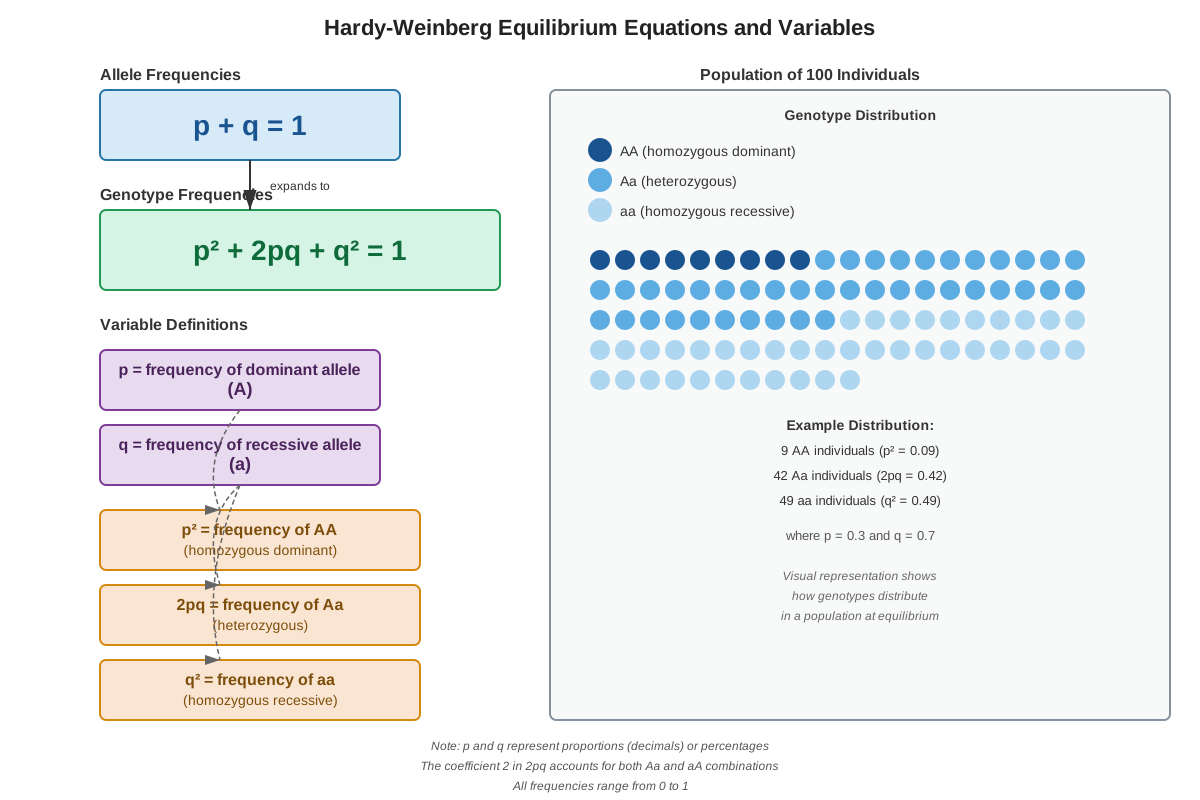
The Hardy-Weinberg principle states that allele and genotype frequencies remain constant in a population across generations when five specific conditions are met. This principle is expressed mathematically through two equations that form the foundation of population genetics calculations.
The allele frequency equation is:
p + q = 1Where:
- p = frequency of the dominant allele (often denoted as A)
- q = frequency of the recessive allele (often denoted as a)
The genotype frequency equation is:
p² + 2pq + q² = 1Where:
- p² = frequency of homozygous dominant individuals (AA)
- 2pq = frequency of heterozygous individuals (Aa)
- q² = frequency of homozygous recessive individuals (aa)
The genotype frequency equation is derived from the allele frequency equation by expanding (p + q)², which represents the probability of all possible allele combinations when gametes combine randomly. This mathematical relationship assumes that mating is random and that the population is large enough for probability to accurately predict outcomes.
The Five Conditions for Hardy-Weinberg Equilibrium
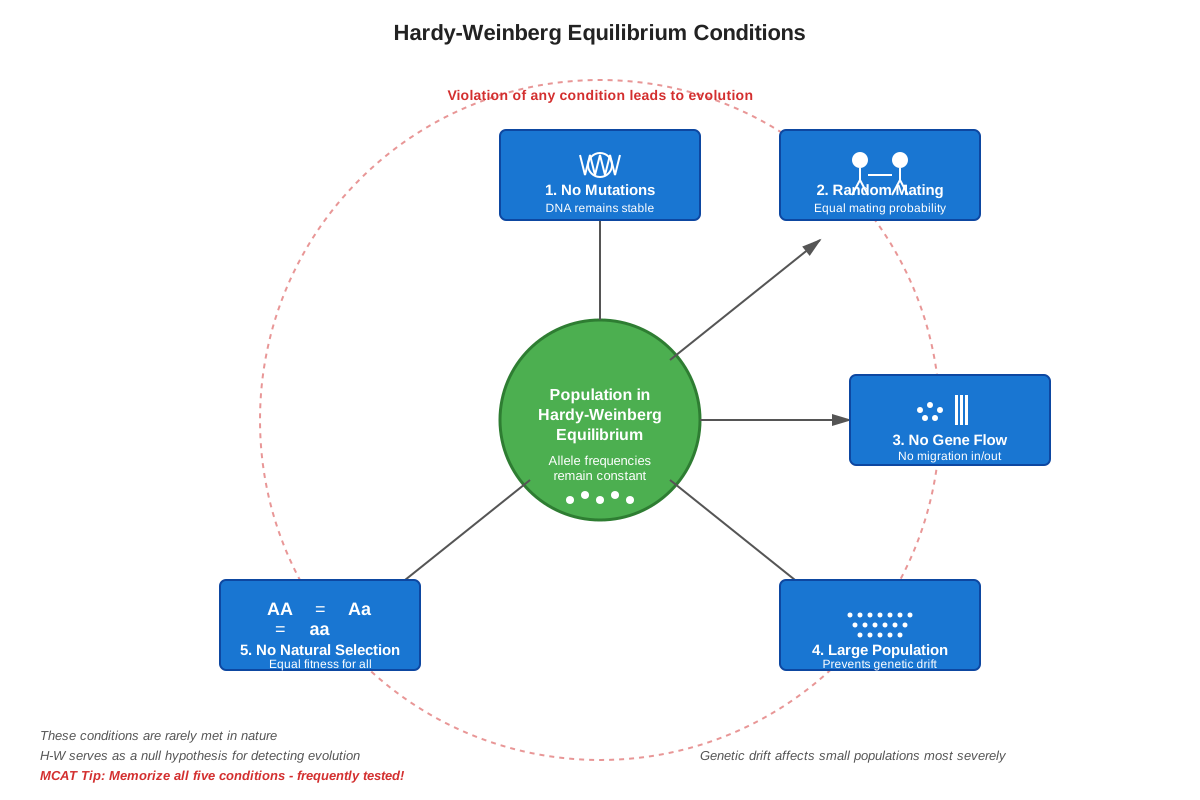
For a population to maintain Hardy-Weinberg equilibrium, five conditions must be simultaneously satisfied:
- No mutations: The gene pool must remain stable with no new alleles introduced through mutation. Mutations change allele frequencies by creating new variants or altering existing ones.
- Random mating: All individuals must have equal probability of mating with any other individual regardless of genotype. Non-random mating (such as inbreeding or assortative mating) changes genotype frequencies even if allele frequencies remain constant.
- No gene flow (migration): No individuals can move into or out of the population, bringing or removing alleles. Immigration and emigration alter allele frequencies by adding or subtracting genetic variants.
- Large population size (no genetic drift): The population must be infinitely large, or at least large enough that random sampling errors don't affect allele frequencies. In small populations, chance events can cause significant changes in allele frequencies through genetic drift.
- No natural selection: All genotypes must have equal fitness—equal probability of survival and reproduction. When certain genotypes confer advantages or disadvantages, natural selection changes allele frequencies over time.
| Condition Violated | Effect on Population | Example |
|---|---|---|
| Mutations occur | New alleles introduced; frequencies change | Radiation exposure causing new genetic variants |
| Non-random mating | Genotype frequencies change; allele frequencies may stay constant | Inbreeding in isolated communities |
| Gene flow present | Allele frequencies change | Migration between populations |
| Small population | Random changes in allele frequencies | Founder effect or bottleneck |
| Selection operates | Allele frequencies change directionally | Antibiotic resistance in bacteria |
Calculating Allele Frequencies from Phenotype Data
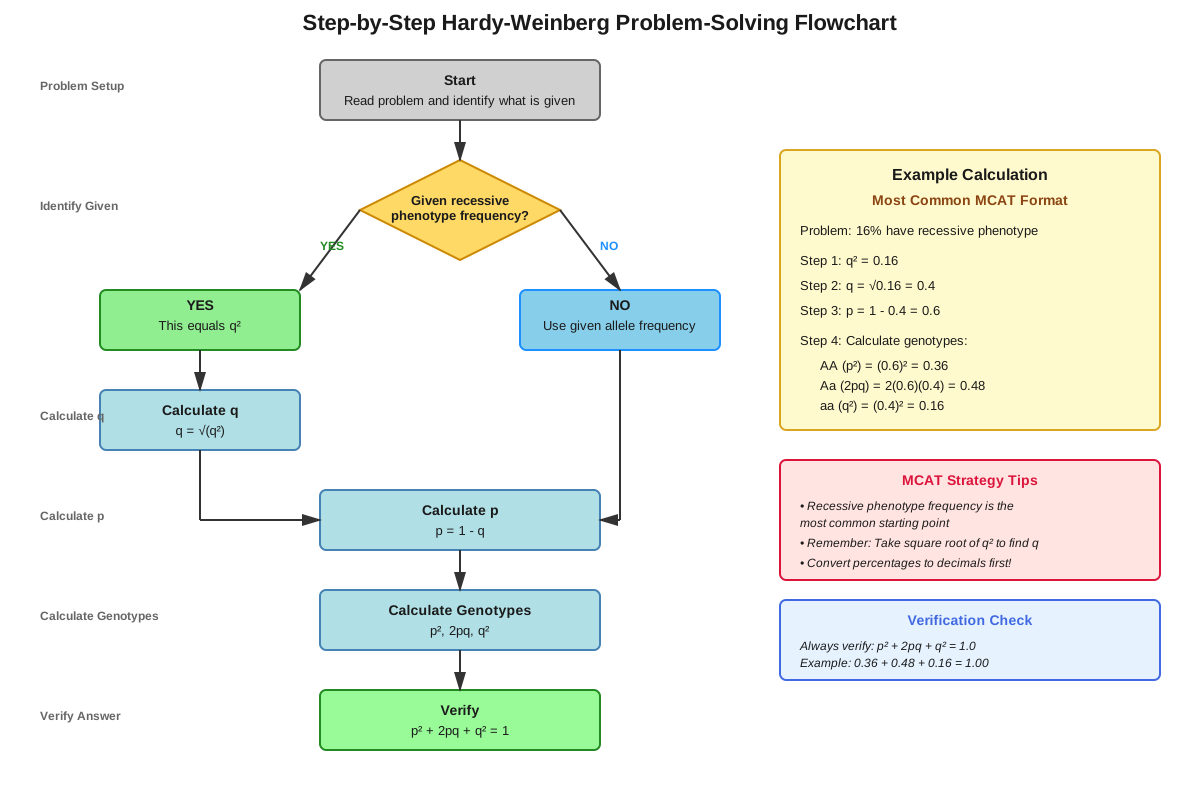
The most common MCAT application involves calculating allele frequencies when given information about phenotypes. Since recessive phenotypes only appear in homozygous recessive individuals (aa), their frequency directly equals q².
Step-by-step approach:
- Identify the frequency of the recessive phenotype (this equals q²)
- Take the square root to find q
- Calculate p using p = 1 - q
- Calculate genotype frequencies using p², 2pq, and q²
For example, if 1% of a population expresses a recessive trait:
- q² = 0.01
- q = √0.01 = 0.1
- p = 1 - 0.1 = 0.9
- Frequency of AA = p² = (0.9)² = 0.81 or 81%
- Frequency of Aa = 2pq = 2(0.9)(0.1) = 0.18 or 18%
- Frequency of aa = q² = 0.01 or 1%
Carrier Frequency Calculations
A particularly high-yield application for the MCAT involves calculating carrier frequency for recessive genetic diseases. Carriers are heterozygous individuals (Aa) who don't express the disease but can pass the allele to offspring. The carrier frequency is represented by 2pq in the Hardy-Weinberg equation.
This calculation is clinically relevant for genetic counseling. For instance, cystic fibrosis affects approximately 1 in 3,200 Caucasian births (q² ≈ 0.0003). Therefore:
- q = √0.0003 ≈ 0.017
- p = 1 - 0.017 = 0.983
- Carrier frequency (2pq) = 2(0.983)(0.017) ≈ 0.033 or about 1 in 30
This means that while the disease is relatively rare, carriers are much more common—a critical insight for population screening programs.
Testing for Hardy-Weinberg Equilibrium
To determine whether a population is in equilibrium, compare observed genotype frequencies with expected frequencies calculated from allele frequencies:
- Calculate allele frequencies from the observed data
- Use Hardy-Weinberg equations to predict expected genotype frequencies
- Compare observed versus expected frequencies
- Apply chi-square test (if required) to determine if differences are statistically significant
If observed frequencies significantly differ from expected frequencies, the population is not in Hardy-Weinberg equilibrium, indicating that one or more of the five conditions is violated.
Applications to Evolution and Natural Selection
Hardy-Weinberg equilibrium serves as a null model for evolution. Evolution is defined as change in allele frequencies over time, so any deviation from Hardy-Weinberg predictions indicates evolution is occurring. This makes the principle invaluable for:
- Detecting natural selection: If certain genotypes are more or less common than predicted, selection may be operating
- Measuring evolutionary rate: The magnitude of deviation indicates how strongly evolutionary forces are acting
- Identifying selection targets: Comparing multiple genes can reveal which are under selection
- Predicting future frequencies: Understanding current forces allows projection of future genetic composition
For example, if a population shows excess heterozygotes compared to Hardy-Weinberg predictions, heterozygote advantage (a form of balancing selection) may be operating, as seen with sickle cell trait in malaria-endemic regions.
Concept Relationships
The concepts within Hardy-Weinberg equilibrium are hierarchically and functionally interconnected. The allele frequency equation (p + q = 1) serves as the foundation from which the genotype frequency equation (p² + 2pq + q²) is mathematically derived through probability expansion. These equations only hold true when the five equilibrium conditions are met, creating a logical dependency: conditions → equilibrium → predictable frequencies.
The relationship flows as follows:
Five Conditions Met → Population in Equilibrium → Allele Frequencies Constant → Genotype Frequencies Predictable → No Evolution Occurring
Conversely, when conditions are violated:
Condition Violated → Equilibrium Disrupted → Allele Frequencies Change → Evolution Occurs
Hardy-Weinberg equilibrium connects to prerequisite knowledge of Mendelian genetics by extending single-cross predictions to population-level patterns. While Punnett squares predict offspring ratios from specific parental crosses, Hardy-Weinberg predicts genotype distributions across entire populations. The principle also bridges to evolutionary biology by providing the mathematical framework for detecting and measuring natural selection, genetic drift, and other evolutionary mechanisms.
The concept connects forward to advanced topics including:
- Population genetics models: More complex equations that incorporate selection coefficients and migration rates
- Speciation: Understanding how populations diverge genetically over time
- Molecular evolution: Applying similar principles to DNA sequence variation
- Quantitative genetics: Extending to traits controlled by multiple genes
Within the MCAT curriculum, Hardy-Weinberg equilibrium integrates with disease genetics (calculating carrier frequencies), evolutionary biology (measuring selection), and experimental design (testing hypotheses about population structure). This interconnectedness makes it a high-yield topic that appears across multiple question types and passage contexts.
Quick check — test yourself on Hardy Weinberg equilibrium so far.
Try Flashcards →High-Yield Facts
⭐ The Hardy-Weinberg genotype frequency equation is p² + 2pq + q² = 1, where p² represents homozygous dominant, 2pq represents heterozygotes, and q² represents homozygous recessive individuals
⭐ To calculate carrier frequency for a recessive disease, use 2pq after determining q from the frequency of affected individuals (q²)
⭐ The five conditions for Hardy-Weinberg equilibrium are: no mutations, random mating, no gene flow, large population size, and no natural selection
⭐ When given the frequency of a recessive phenotype, take the square root to find q, then calculate p = 1 - q
⭐ Hardy-Weinberg equilibrium represents a non-evolving population; any deviation indicates evolution is occurring
- The allele frequency equation (p + q = 1) must always be satisfied regardless of whether the population is in equilibrium
- Non-random mating changes genotype frequencies but not necessarily allele frequencies, while selection, mutation, migration, and drift change allele frequencies
- Heterozygote advantage (like sickle cell trait in malaria regions) causes deviation from Hardy-Weinberg equilibrium with excess heterozygotes
- In a population at Hardy-Weinberg equilibrium, allele frequencies remain constant across generations even though individuals are born and die
- The chi-square test can be used to statistically determine whether observed genotype frequencies significantly differ from Hardy-Weinberg predictions
- For X-linked traits, Hardy-Weinberg calculations differ because males have only one X chromosome (hemizygous), so male frequency of recessive traits equals q, not q²
- Inbreeding increases homozygosity (both p² and q²) while decreasing heterozygosity (2pq) without changing allele frequencies
- The Hardy-Weinberg principle applies to autosomal genes with two alleles; extensions exist for multiple alleles and sex-linked genes
Common Misconceptions
Misconception: Hardy-Weinberg equilibrium means the population is not changing at all.
Correction: Equilibrium means allele and genotype frequencies remain constant, but individuals are still born, die, and reproduce. The genetic composition of the population stays stable, but the population itself is dynamic.
Misconception: If a population is not in Hardy-Weinberg equilibrium, all five conditions must be violated.
Correction: Violation of even a single condition is sufficient to disrupt equilibrium. Often, only one or two conditions are violated in real populations, and identifying which specific condition is violated is a key MCAT skill.
Misconception: The value of p must always be greater than q.
Correction: The letters p and q are arbitrary designations. Either allele can be more common. By convention, p often represents the dominant allele, but this doesn't mean p > q. The only requirement is that p + q = 1.
Misconception: Hardy-Weinberg calculations can only be used for populations in equilibrium.
Correction: The equations can calculate expected frequencies for any population, even those not in equilibrium. Comparing these expected frequencies to observed frequencies is precisely how we detect that equilibrium is violated.
Misconception: Heterozygotes (2pq) are always the most common genotype.
Correction: The most common genotype depends on allele frequencies. When one allele is very rare (q close to 0), the homozygous dominant genotype (p²) is most common. Heterozygotes are maximized when p = q = 0.5, where 2pq = 0.5.
Misconception: Dominant alleles always increase in frequency over time.
Correction: Dominance describes phenotype expression, not evolutionary advantage. Without selection or other evolutionary forces, allele frequencies remain constant regardless of dominance. A dominant allele can decrease in frequency if it reduces fitness.
Misconception: You need to know the total population size to calculate allele frequencies.
Correction: Hardy-Weinberg calculations use frequencies (proportions), not absolute numbers. Whether the population has 100 or 100,000 individuals, the same frequency calculations apply.
Worked Examples
Example 1: Calculating Carrier Frequency for a Recessive Disease
Problem: Phenylketonuria (PKU) is an autosomal recessive disorder. In a particular population, 1 in 10,000 newborns is affected with PKU. Assuming Hardy-Weinberg equilibrium, what is the frequency of carriers in this population?
Solution:
Step 1: Identify what we know.
- PKU is recessive, so affected individuals have genotype aa
- Frequency of affected individuals = 1/10,000 = 0.0001
- This represents q²
Step 2: Calculate q (frequency of recessive allele).
q² = 0.0001
q = √0.0001 = 0.01
Step 3: Calculate p (frequency of dominant allele).
p = 1 - q = 1 - 0.01 = 0.99Step 4: Calculate carrier frequency (heterozygotes).
2pq = 2(0.99)(0.01) = 0.0198 ≈ 0.02 or 2%Answer: Approximately 2% of the population are carriers, or about 1 in 50 individuals.
Key Insight: Notice that carriers are 200 times more common than affected individuals (0.02 vs 0.0001). This is typical for rare recessive diseases and explains why two unaffected parents can have an affected child—both may be carriers. This concept frequently appears in MCAT genetics passages about genetic counseling.
Example 2: Determining if a Population is in Equilibrium
Problem: A researcher studies a population of 1,000 wildflowers for a gene controlling petal color. She observes:
- 360 red flowers (RR)
- 480 pink flowers (Rr)
- 160 white flowers (rr)
Is this population in Hardy-Weinberg equilibrium?
Solution:
Step 1: Calculate observed genotype frequencies.
- Frequency of RR = 360/1000 = 0.36
- Frequency of Rr = 480/1000 = 0.48
- Frequency of rr = 160/1000 = 0.16
Step 2: Calculate allele frequencies from observed data.
- Frequency of R allele (p) = frequency of RR + (1/2)(frequency of Rr)
- p = 0.36 + (0.5)(0.48) = 0.36 + 0.24 = 0.60
- Frequency of r allele (q) = 1 - p = 1 - 0.60 = 0.40
Step 3: Calculate expected genotype frequencies using Hardy-Weinberg.
- Expected RR = p² = (0.60)² = 0.36
- Expected Rr = 2pq = 2(0.60)(0.40) = 0.48
- Expected rr = q² = (0.40)² = 0.16
Step 4: Compare observed to expected frequencies.
| Genotype | Observed | Expected | Match? |
|---|---|---|---|
| RR | 0.36 | 0.36 | ✓ |
| Rr | 0.48 | 0.48 | ✓ |
| rr | 0.16 | 0.16 | ✓ |
Answer: Yes, this population is in Hardy-Weinberg equilibrium because observed frequencies exactly match expected frequencies.
Key Insight: This problem demonstrates the complete process of testing for equilibrium. On the MCAT, you might see variations where frequencies don't match, requiring you to identify which condition is violated. For example, if heterozygotes were less common than expected, inbreeding might be occurring. If one homozygote class were less common, selection against that genotype might be operating.
Exam Strategy
When approaching Hardy-Weinberg equilibrium questions on the MCAT, follow this systematic strategy:
Step 1: Identify the question type
- Calculation problem (find allele or genotype frequencies)
- Conceptual problem (which condition is violated)
- Interpretation problem (is the population evolving)
Step 2: Extract key information
- What frequencies are given (phenotype, genotype, or allele)?
- Is the trait dominant, recessive, or codominant?
- What is the question actually asking for?
Step 3: Set up the problem
- Write out p + q = 1 and p² + 2pq + q² = 1
- Assign variables to what you know
- Identify what you need to find
Step 4: Solve systematically
- Start with what you can calculate directly (usually q² from recessive phenotype)
- Work through the equations step by step
- Check that your answer makes biological sense
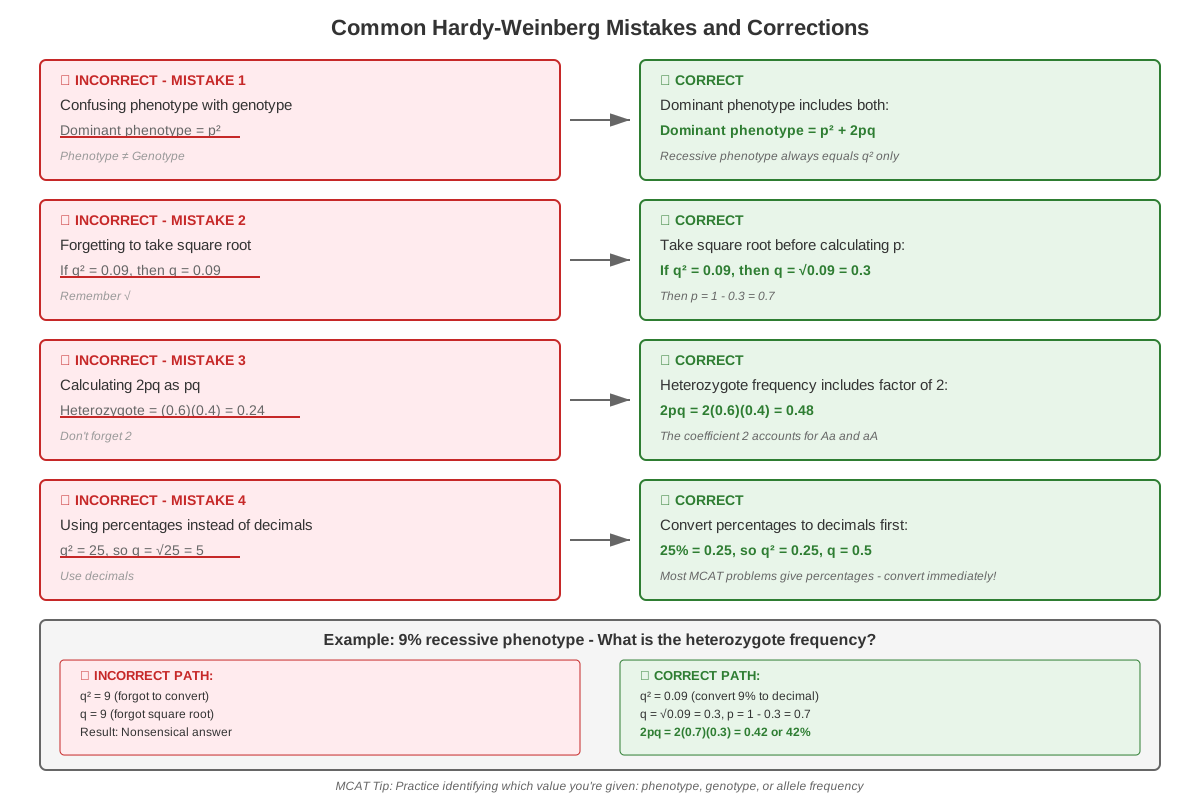
Exam Tip: The MCAT loves to test whether you can identify q² from a recessive phenotype. This is the most common starting point for calculations. If you see "1 in 100 individuals are affected by a recessive disease," immediately recognize this as q² = 0.01.
Trigger words and phrases to watch for:
- "Assuming Hardy-Weinberg equilibrium" → Use the equations directly
- "Carrier frequency" → Calculate 2pq
- "Recessive disorder affects X%" → This is q²; take the square root
- "Is this population evolving?" → Compare observed vs. expected frequencies
- "Which condition is violated?" → Analyze the scenario for mutations, migration, selection, drift, or non-random mating
- "Heterozygote advantage" → Expect excess 2pq compared to predictions
Process-of-elimination strategies:
- Eliminate answers that violate p + q = 1: If answer choices give allele frequencies, check that they sum to 1
- Eliminate biologically impossible frequencies: Frequencies must be between 0 and 1 (or 0% and 100%)
- Check magnitude: Carrier frequency (2pq) should be much larger than disease frequency (q²) for rare recessive diseases
- Verify dominance relationships: Make sure your answer is consistent with which allele is dominant
Time allocation advice:
- Simple calculation problems (given q², find 2pq): 30-45 seconds
- Multi-step problems (calculate multiple frequencies): 60-90 seconds
- Conceptual problems (identify violated conditions): 45-60 seconds
- Passage-based problems with data interpretation: 90-120 seconds
Exam Tip: Don't waste time calculating all three genotype frequencies if the question only asks for one. If you need carrier frequency, calculate 2pq and move on—you don't need p² and q² unless specifically asked.
Memory Techniques
Mnemonic for the Five Conditions: "MR. GNLS"
- Mutations (no mutations)
- Random mating (must be random)
- Gene flow (no migration)
- Number (large population size)
- Life/death (no selection—equal survival)
- Selection (no natural selection)
Alternative mnemonic: "No MRNAS" (No Mutations, Random mating, No migration, All equal fitness, Size large)
Visualization Strategy for Equations:
Picture a square Punnett square for the population:
        R (p)    r (q)
R (p)   RR(p²)   Rr(pq)
r (q)   Rr(pq)   rr(q²)
This visual reinforces that:
- Corners are homozygotes (p² and q²)
- Middle cells are heterozygotes (pq + pq = 2pq)
- All cells sum to 1
Acronym for Problem-Solving: "SQRT"
- Start with the recessive phenotype (q²)
- Quare root to find q
- Remaining frequency is p (p = 1 - q)
- Total up genotypes using p² + 2pq + q²
Memory aid for carrier frequency:
"Carriers are 2pq—two people, two alleles" (heterozygotes have two different alleles)
Conceptual anchor:
Think of Hardy-Weinberg as a "genetic photograph"—it captures what a population looks like when frozen in time with no evolutionary forces acting. Any blur in the photo (deviation from predictions) means something is moving (evolution is occurring).
Summary
Hardy-Weinberg equilibrium is a mathematical model describing allele and genotype frequencies in non-evolving populations, expressed through the equations p + q = 1 and p² + 2pq + q² = 1. This principle requires five conditions: no mutations, random mating, no gene flow, large population size, and no natural selection. When these conditions are met, allele frequencies remain constant across generations, providing a null hypothesis against which evolution can be measured. For the MCAT, mastery requires both computational skills (calculating allele frequencies, genotype frequencies, and carrier frequencies from given data) and conceptual understanding (identifying which conditions are violated and interpreting what this means for evolution). The most common application involves calculating carrier frequency (2pq) for recessive genetic diseases by starting with disease frequency (q²), taking the square root to find q, then calculating p and applying the genotype frequency equation. Hardy-Weinberg serves as a bridge between Mendelian genetics and population-level evolutionary processes, making it essential for understanding how genetic variation is maintained or changed in populations over time.
Key Takeaways
- Hardy-Weinberg equilibrium describes populations where allele frequencies remain constant (p + q = 1) and genotype frequencies follow p² + 2pq + q² = 1
- The five required conditions are no mutations, random mating, no gene flow, large population size, and no natural selection—violation of any condition causes evolution
- For recessive diseases, start with disease frequency (q²), take the square root to find q, then calculate carrier frequency using 2pq
- Hardy-Weinberg serves as a null model for evolution; deviations from predicted frequencies indicate evolutionary forces are acting
- Carrier frequency (2pq) is always much higher than disease frequency (q²) for rare recessive disorders, which is clinically important for genetic counseling
- The MCAT tests Hardy-Weinberg through direct calculations, conceptual questions about violated conditions, and passage-based data interpretation
- Non-random mating changes genotype frequencies without necessarily changing allele frequencies, while selection, mutation, migration, and drift change allele frequencies themselves
Related Topics
Population Genetics and Evolution: Hardy-Weinberg equilibrium provides the foundation for understanding more complex evolutionary models, including selection coefficients, fitness calculations, and multi-allele systems. Mastering Hardy-Weinberg enables progression to topics like directional selection, balancing selection, and evolutionary game theory.
Genetic Drift and Founder Effects: These mechanisms violate the large population size condition of Hardy-Weinberg. Understanding how random sampling affects small populations builds directly on Hardy-Weinberg principles and explains genetic patterns in isolated or bottlenecked populations.
Natural Selection and Adaptation: Hardy-Weinberg provides the baseline for measuring selection. Topics like heterozygote advantage (sickle cell trait), directional selection (antibiotic resistance), and stabilizing selection all involve comparing observed frequencies to Hardy-Weinberg predictions.
Quantitative Genetics: Extending Hardy-Weinberg principles to traits controlled by multiple genes involves similar mathematical approaches but with increased complexity. This includes heritability calculations and polygenic inheritance patterns.
Molecular Evolution and Phylogenetics: Hardy-Weinberg concepts apply to DNA sequence variation within populations. Understanding allele frequency changes at the molecular level connects to topics like molecular clocks, neutral theory, and phylogenetic tree construction.
Medical Genetics and Genetic Counseling: Clinical applications of Hardy-Weinberg include calculating recurrence risks, population screening strategies, and understanding disease prevalence in different ethnic groups—all relevant for MCAT passages with clinical contexts.
Practice CTA
Now that you've mastered the core concepts of Hardy-Weinberg equilibrium, it's time to solidify your understanding through active practice. Work through the practice questions to test your ability to calculate allele frequencies, identify violated conditions, and interpret population genetics data. Use the flashcards to reinforce key equations, conditions, and high-yield facts until they become automatic. Remember, Hardy-Weinberg questions are highly predictable on the MCAT—with focused practice, these can become some of your most reliable points. The mathematical framework you've learned here will serve you not only for direct Hardy-Weinberg questions but also for broader evolutionary biology and genetics passages. You've got this!
Sign up free to keep reading
Create a free AnvayaPrep account to finish this MCAT guide on Hardy Weinberg equilibrium — plus flashcards and practice questions.