Overview
Punnett squares are fundamental tools in Molecular Biology and Genetics that allow scientists and clinicians to predict the probability of offspring inheriting specific traits from their parents. Named after British geneticist Reginald Punnett, these diagrams provide a systematic method for determining all possible combinations of alleles that can result from a genetic cross. For the MCAT, Punnett squares represent an essential skill that bridges theoretical genetics with practical problem-solving, appearing frequently in both discrete questions and passage-based scenarios within the Biology section.
Understanding Punnett squares extends far beyond simple memorization of grid patterns. These tools embody core principles of Mendelian inheritance, including the law of segregation and the law of independent assortment. When students master Punnett squares Biology concepts, they gain the ability to calculate genotypic and phenotypic ratios, determine carrier probabilities, and analyze inheritance patterns for both simple and complex traits. This knowledge forms the foundation for understanding more advanced topics such as linkage, epistasis, and population genetics—all of which may appear on the Punnett squares MCAT questions.
The MCAT tests not just the mechanical construction of Punnett squares, but also the conceptual understanding of what these diagrams represent. Test-makers frequently embed Punnett square problems within clinical vignettes about genetic counseling, disease inheritance, or evolutionary biology. Students must be able to quickly construct these diagrams under time pressure, interpret the results accurately, and connect the mathematical outcomes to biological phenomena. This topic serves as a critical junction point where molecular genetics, probability theory, and clinical medicine converge—making it indispensable for achieving a competitive MCAT score.
Learning Objectives
- [ ] Define Punnett squares using accurate Biology terminology
- [ ] Explain why Punnett squares matters for the MCAT
- [ ] Apply Punnett squares to exam-style questions
- [ ] Identify common mistakes related to Punnett squares
- [ ] Connect Punnett squares to related Biology concepts
- [ ] Construct Punnett squares for monohybrid, dihybrid, and sex-linked crosses
- [ ] Calculate genotypic and phenotypic ratios from completed Punnett squares
- [ ] Determine the probability of specific offspring genotypes in multi-generational crosses
- [ ] Distinguish between complete dominance, incomplete dominance, and codominance using Punnett square analysis
Prerequisites
- Mendelian genetics principles: Understanding the laws of segregation and independent assortment is essential for knowing why alleles separate and combine in predictable patterns
- Allele terminology (dominant, recessive, homozygous, heterozygous): These terms form the basic vocabulary needed to label and interpret Punnett square components
- Basic probability rules: Punnett squares are fundamentally probability tools, requiring knowledge of multiplication and addition rules
- Chromosome structure and meiosis: Understanding how gametes form with haploid chromosome sets explains why each parent contributes one allele per gene
- Genotype versus phenotype distinction: Interpreting Punnett square results requires differentiating between genetic composition and observable traits
Why This Topic Matters
Punnett squares hold significant clinical relevance in genetic counseling, where healthcare professionals use these tools to inform prospective parents about the likelihood of passing hereditary conditions to their children. Conditions such as cystic fibrosis, sickle cell disease, and hemophilia follow predictable inheritance patterns that can be modeled using Punnett squares. Medical professionals rely on these calculations to provide accurate risk assessments, enabling families to make informed reproductive decisions.
On the MCAT, Punnett squares appear with moderate to high frequency, typically in 2-4 questions per exam administration. These questions most commonly appear in the Biological and Biochemical Foundations of Living Systems section, though they occasionally surface in passages discussing evolutionary fitness or population dynamics. The MCAT tests Punnett squares through multiple question formats: discrete questions asking for direct probability calculations, passage-based questions requiring interpretation of experimental crosses, and data analysis questions presenting genetic ratios that students must explain.
Exam passages frequently embed Punnett square concepts within scenarios about disease inheritance patterns, agricultural breeding experiments, or evolutionary case studies. A typical passage might describe a pedigree for a genetic disorder and ask students to determine carrier probabilities, or present data from fruit fly crosses and require analysis of inheritance patterns. The MCAT particularly favors questions that combine Punnett square mechanics with conceptual understanding—for example, asking why observed ratios deviate from expected Mendelian ratios due to phenomena like incomplete penetrance or lethal alleles.
Core Concepts
Definition and Structure of Punnett Squares
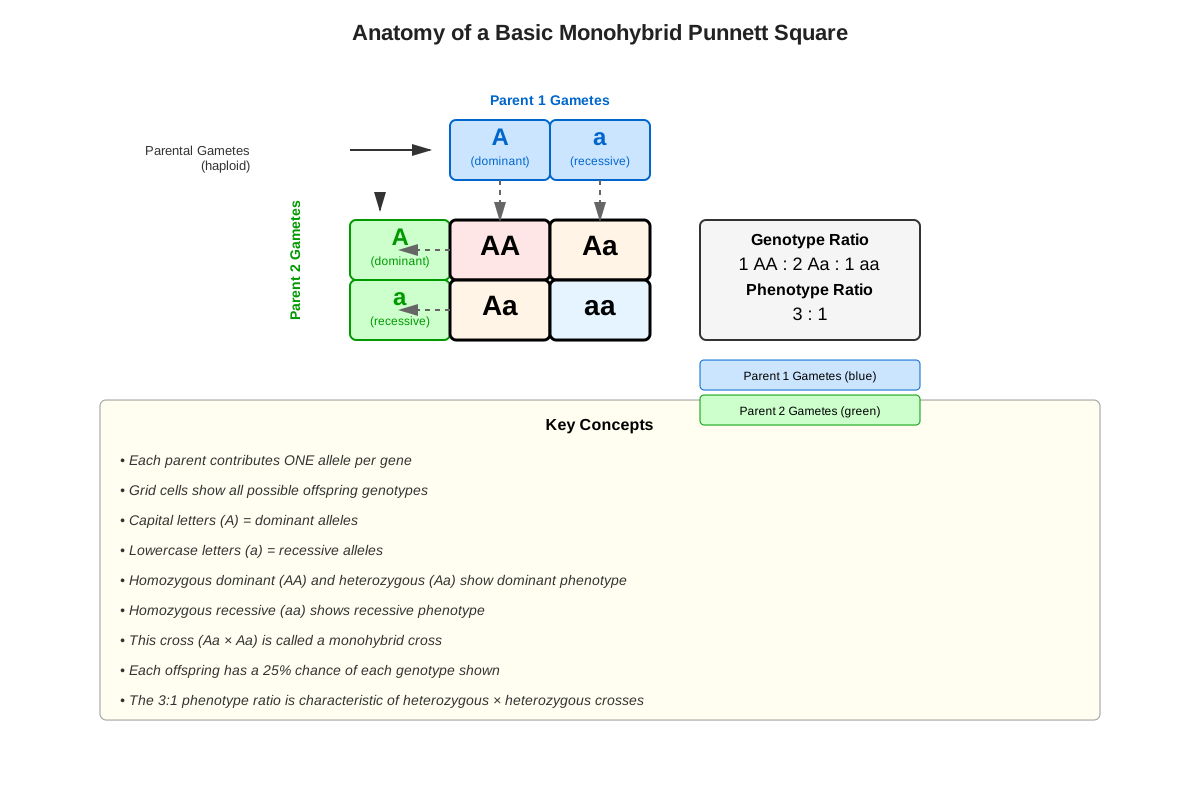
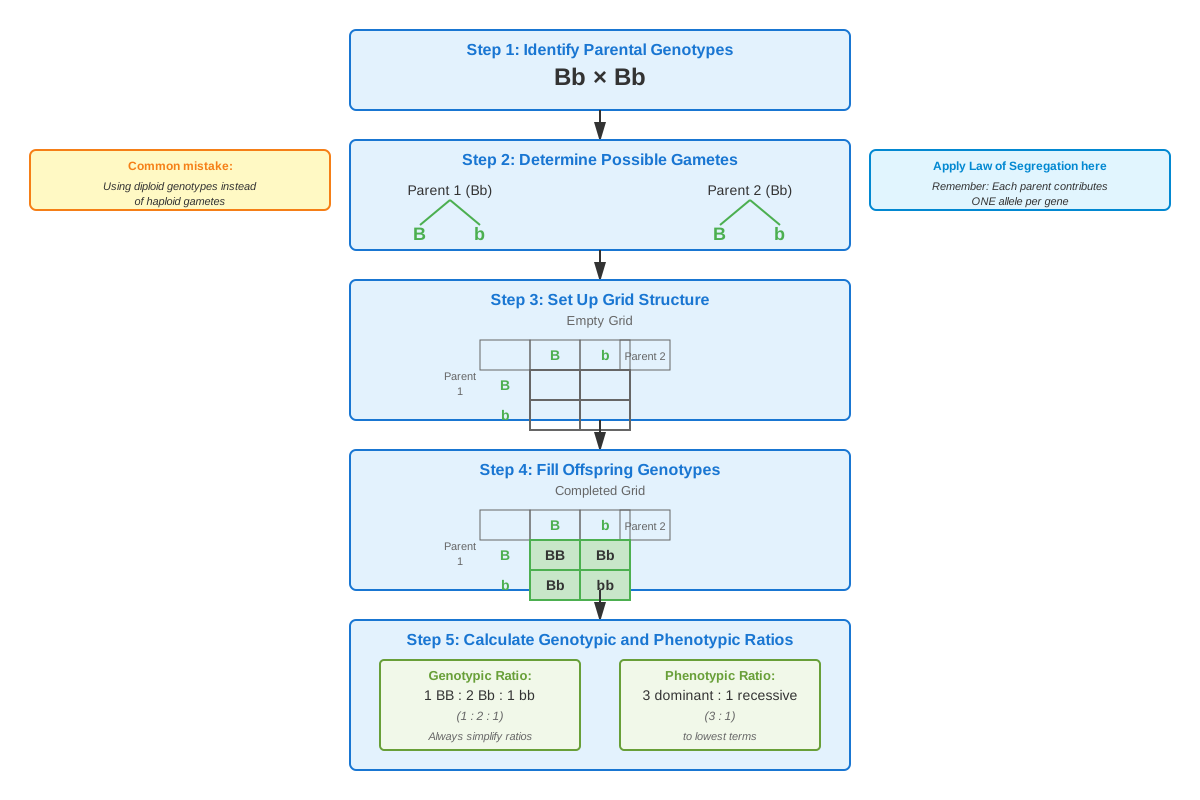
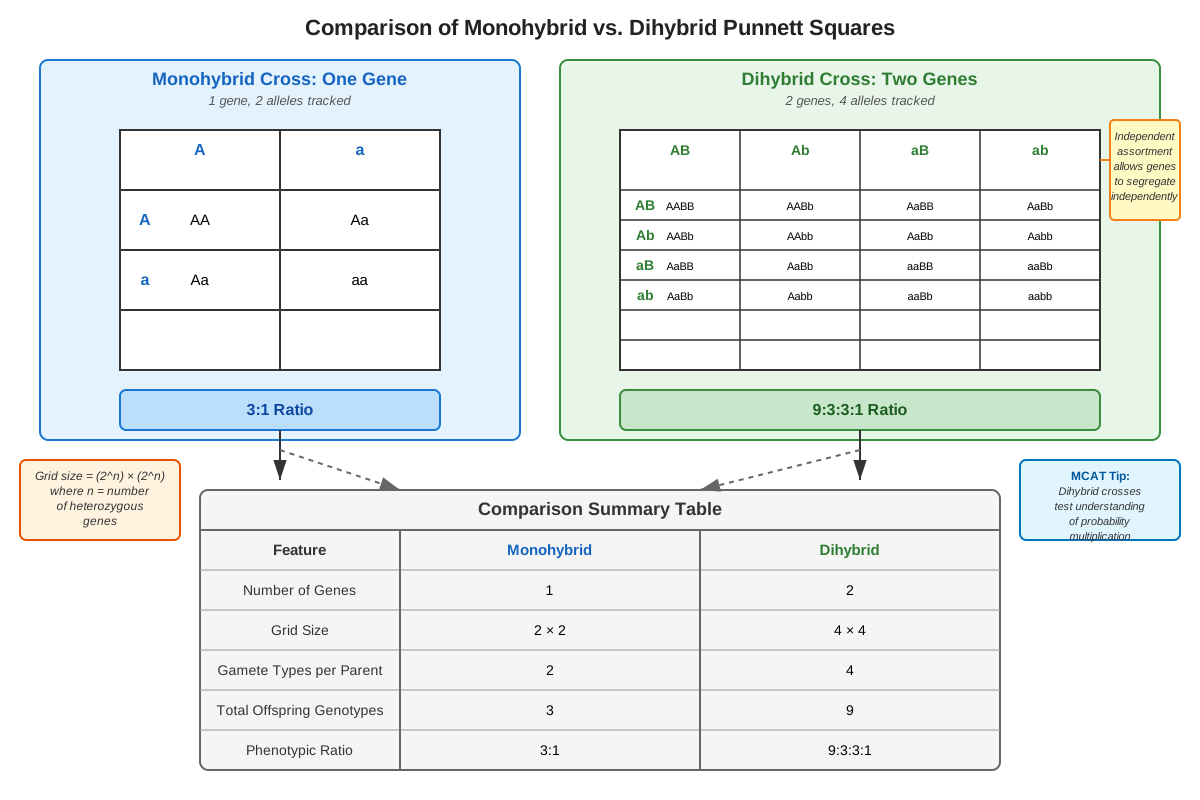
A Punnett square is a grid-based diagram that systematically displays all possible combinations of parental alleles in offspring. The structure consists of a square divided into boxes, with one parent's possible gametes listed along the top and the other parent's gametes listed along the left side. Each internal box represents a potential offspring genotype, formed by combining the alleles from the corresponding row and column. The number of boxes in a Punnett square equals the product of the number of gamete types from each parent (2 × 2 = 4 for a monohybrid cross, 4 × 4 = 16 for a dihybrid cross).
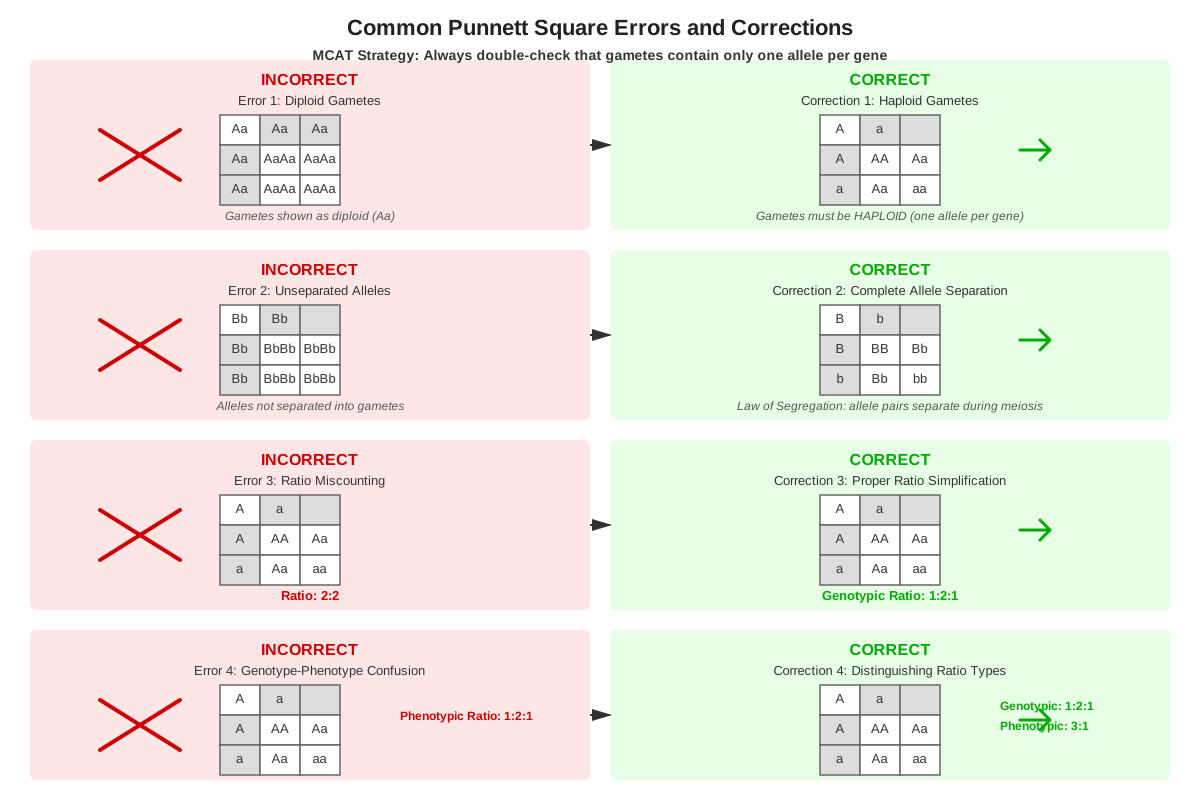
The fundamental principle underlying Punnett squares is that each parent contributes exactly one allele for each gene to their offspring. During meiosis, homologous chromosomes separate, ensuring that gametes receive only one copy of each chromosome and therefore one allele per gene. When fertilization occurs, the fusion of two haploid gametes restores the diploid state, with offspring inheriting one allele from each parent. Punnett squares visualize this process by showing every possible pairing of maternal and paternal alleles.
Monohybrid Crosses
A monohybrid cross examines the inheritance of a single gene with two alleles. The classic example involves crossing two heterozygous individuals (Aa × Aa), where "A" represents the dominant allele and "a" represents the recessive allele. The Punnett square for this cross contains four boxes:
     A    a
A   AA   Aa
a   Aa   aa
This cross produces a genotypic ratio of 1 AA : 2 Aa : 1 aa, and assuming complete dominance, a phenotypic ratio of 3 dominant : 1 recessive. The 3:1 ratio is one of the most important patterns in genetics and appears frequently on the MCAT. Students must recognize that this ratio only applies when both parents are heterozygous and the trait shows complete dominance.
Other monohybrid crosses produce different ratios. A cross between a homozygous dominant and homozygous recessive individual (AA × aa) yields 100% heterozygous offspring (all Aa), demonstrating a 4:0 phenotypic ratio. A cross between a heterozygous and homozygous recessive individual (Aa × aa) produces a 1:1 ratio of heterozygous to homozygous recessive offspring, resulting in a 1:1 phenotypic ratio.
Dihybrid Crosses
A dihybrid cross tracks the inheritance of two genes simultaneously, assuming the genes are on different chromosomes and therefore assort independently. The classic dihybrid cross involves two heterozygous parents (AaBb × AaBb). Each parent can produce four types of gametes: AB, Ab, aB, and ab. The resulting Punnett square contains 16 boxes (4 × 4).
The phenotypic ratio for a dihybrid cross with complete dominance at both loci is 9:3:3:1:
- 9 offspring showing both dominant traits
- 3 offspring showing the first dominant trait and second recessive trait
- 3 offspring showing the first recessive trait and second dominant trait
- 1 offspring showing both recessive traits
This 9:3:3:1 ratio is a high-yield fact for the MCAT and serves as evidence for the law of independent assortment. Deviations from this ratio suggest genetic linkage, epistasis, or other non-Mendelian inheritance patterns.
Test Crosses
A test cross involves breeding an individual with an unknown genotype (but dominant phenotype) with a homozygous recessive individual. This technique determines whether the unknown individual is homozygous dominant or heterozygous. If any offspring display the recessive phenotype, the unknown parent must be heterozygous, as homozygous dominant individuals can only pass dominant alleles. If all offspring show the dominant phenotype (especially with large sample sizes), the unknown parent is likely homozygous dominant.
Test crosses are particularly important in agricultural genetics and appear on the MCAT in passages about breeding experiments. The homozygous recessive individual serves as a "genetic detector" because it can only contribute recessive alleles, making the unknown parent's genotype visible in the offspring phenotypes.
Sex-Linked Inheritance
Sex-linked traits are controlled by genes located on sex chromosomes, most commonly the X chromosome. Sex-linked inheritance patterns differ from autosomal patterns because males (XY) have only one X chromosome, making them hemizygous for X-linked genes. Females (XX) have two X chromosomes and can be homozygous or heterozygous for X-linked alleles.
For X-linked recessive traits, the Punnett square must account for sex chromosomes. A cross between a carrier female (X^A X^a) and a normal male (X^A Y) produces:
        X^A    Y
X^A   X^A X^A  X^A Y
X^a   X^A X^a  X^a Y
This cross yields a 1:1 ratio of carrier to normal females, and a 1:1 ratio of affected to normal males. The pattern where affected males are born to carrier females is characteristic of X-linked recessive disorders like hemophilia and color blindness.
Non-Mendelian Inheritance Patterns
While basic Punnett squares assume complete dominance, several inheritance patterns modify expected ratios:
Incomplete dominance occurs when heterozygotes display an intermediate phenotype. A cross between red (R^R R^R) and white (R^W R^W) flowers producing pink heterozygotes (R^R R^W) yields a 1:2:1 phenotypic ratio that matches the genotypic ratio.
Codominance occurs when both alleles are fully expressed in heterozygotes. The ABO blood system demonstrates codominance, where I^A I^B individuals express both A and B antigens. Punnett squares for codominant traits show three distinct phenotypes in a 1:2:1 ratio from a heterozygous cross.
Multiple alleles exist when more than two alleles are possible for a gene in a population, though individuals still carry only two alleles. The ABO blood system has three alleles (I^A, I^B, i), creating six possible genotypes and four phenotypes.
| Genotype | Phenotype | Dominance Pattern |
|---|---|---|
| I^A I^A or I^A i | Type A | I^A dominant to i |
| I^B I^B or I^B i | Type B | I^B dominant to i |
| I^A I^B | Type AB | Codominance |
| ii | Type O | Recessive |
Probability Calculations
Punnett squares inherently represent probability calculations. Each box in a Punnett square represents an equally likely outcome, so the probability of any specific genotype equals the number of boxes with that genotype divided by the total number of boxes. For a monohybrid cross (Aa × Aa), the probability of an aa offspring is 1/4 or 25%.
For multiple independent events, the product rule applies: multiply individual probabilities. The probability of having two consecutive aa offspring from Aa × Aa parents is 1/4 × 1/4 = 1/16. For mutually exclusive events, the sum rule applies: add individual probabilities. The probability of an offspring being either AA or Aa from the same cross is 1/4 + 2/4 = 3/4.
The MCAT frequently tests these probability rules without requiring students to draw complete Punnett squares. Recognizing when to multiply versus add probabilities is essential for efficient problem-solving.
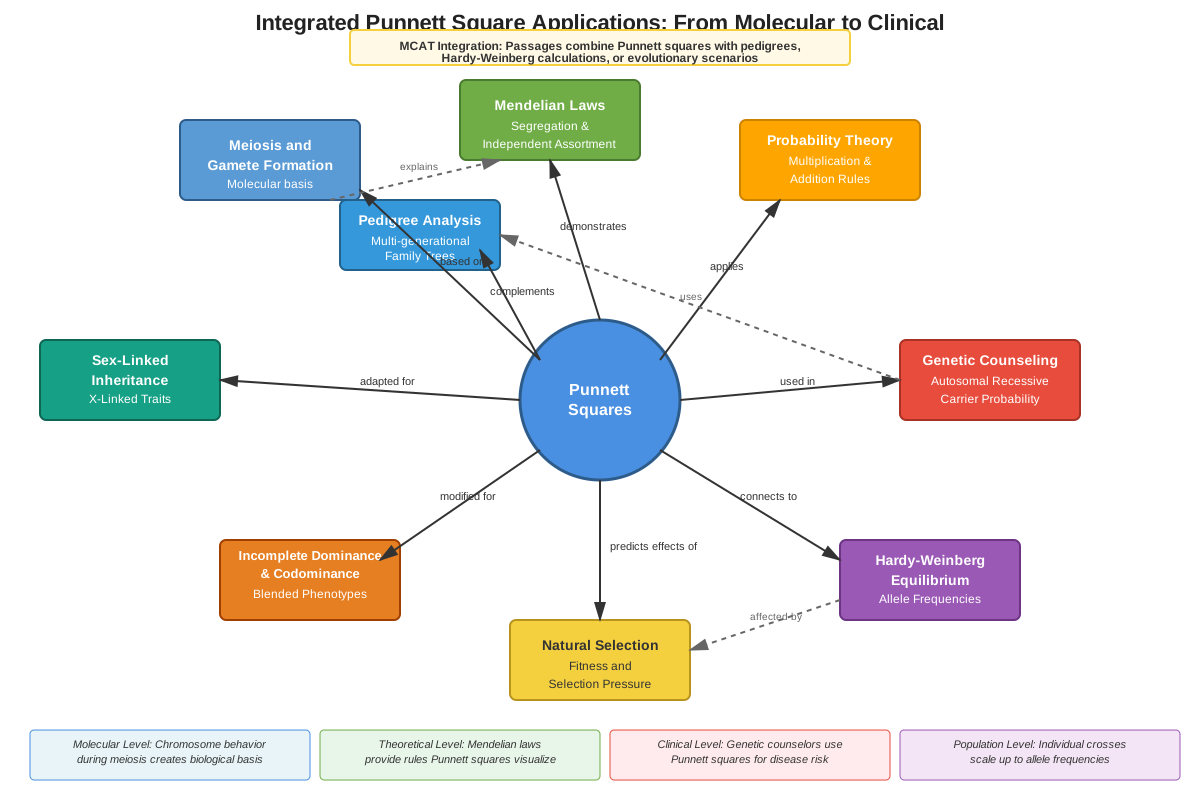
Concept Relationships
Punnett squares serve as the practical application of Mendelian genetics principles. The law of segregation explains why each parent contributes one allele per gene (represented by the gametes along the edges of the square), while the law of independent assortment explains why dihybrid crosses produce 16 equally likely combinations (genes on different chromosomes segregate independently during meiosis).
The relationship flows as follows: Meiosis → produces haploid gametes with one allele per gene → Punnett squares visualize all possible gamete combinations → Fertilization randomly combines gametes → Offspring genotypes can be predicted with specific probabilities → Phenotypes emerge based on dominance relationships.
Punnett squares connect forward to more advanced genetics topics. Understanding basic Punnett square ratios is prerequisite for recognizing genetic linkage (when observed ratios deviate from expected independent assortment), epistasis (when one gene masks the expression of another), and Hardy-Weinberg equilibrium (which uses similar probability principles at the population level). The chi-square test, used to determine if observed genetic ratios match expected ratios, relies on predictions generated from Punnett squares.
Sex-linked inheritance patterns demonstrated through Punnett squares explain the higher prevalence of certain genetic disorders in males, connecting to clinical genetics and genetic counseling. The carrier concept, clearly visible in Punnett squares as heterozygous individuals, is fundamental to understanding recessive disease transmission and population genetics.
Quick check — test yourself on Punnett squares so far.
Try Flashcards →High-Yield Facts
⭐ The classic monohybrid cross (Aa × Aa) produces a 3:1 phenotypic ratio and 1:2:1 genotypic ratio with complete dominance
⭐ The dihybrid cross (AaBb × AaBb) produces a 9:3:3:1 phenotypic ratio when genes assort independently
⭐ Test crosses (unknown × homozygous recessive) reveal whether a dominant phenotype individual is homozygous or heterozygous
⭐ X-linked recessive traits appear more frequently in males because they are hemizygous (only one X chromosome)
⭐ Each box in a Punnett square represents an equally probable outcome, making probability calculations straightforward
- Incomplete dominance produces a 1:2:1 phenotypic ratio that matches the genotypic ratio because heterozygotes have a distinct phenotype
- Codominance results in both alleles being fully expressed in heterozygotes, as seen in ABO blood types (I^A I^B = Type AB)
- The product rule (multiply probabilities) applies to independent events occurring together; the sum rule (add probabilities) applies to mutually exclusive alternatives
- Carrier females (X^A X^a) for X-linked recessive traits have a 50% chance of passing the recessive allele to each offspring
- A 1:1 phenotypic ratio indicates a cross between a heterozygote and a homozygous recessive individual (Aa × aa)
- Punnett squares assume random fertilization, independent assortment, and complete penetrance—deviations suggest non-Mendelian inheritance
- The number of boxes in a Punnett square equals the product of possible gamete types from each parent (2^n × 2^n for n genes)
Common Misconceptions
Misconception: Each offspring from a cross has an independent chance of inheriting alleles, so if three offspring in a row are aa, the fourth is more likely to be AA or Aa.
Correction: Each fertilization event is independent with constant probabilities. Previous offspring outcomes do not influence future probabilities—this is the gambler's fallacy applied to genetics. Each offspring from Aa × Aa parents always has a 1/4 chance of being aa, regardless of siblings' genotypes.
Misconception: The 3:1 ratio means that in a family of four children, exactly three will show the dominant trait and one will show the recessive trait.
Correction: The 3:1 ratio represents probabilities, not guaranteed outcomes in small samples. Each child independently has a 3/4 chance of showing the dominant phenotype. Small families may deviate significantly from expected ratios; the ratios become more accurate with larger sample sizes.
Misconception: Dominant alleles are more common in populations than recessive alleles.
Correction: Dominance describes how alleles interact to produce phenotypes, not their frequency in populations. Many recessive alleles are actually more common than their dominant counterparts. For example, the recessive allele for blue eyes is more frequent in some populations than the dominant brown eye allele.
Misconception: In incomplete dominance, the alleles blend permanently, so heterozygotes cannot produce homozygous offspring.
Correction: Alleles remain discrete units that segregate during meiosis. In incomplete dominance, the phenotype appears blended, but the alleles themselves do not mix. Pink flowers (R^R R^W) can produce both red (R^R R^R) and white (R^W R^W) offspring when crossed with other pink flowers.
Misconception: All genes on the same chromosome must be inherited together.
Correction: While genes on the same chromosome tend to be inherited together (genetic linkage), crossing over during meiosis can separate them. The closer two genes are on a chromosome, the less likely crossing over will separate them, but complete linkage is rare except for genes very close together.
Misconception: Female carriers of X-linked recessive traits never show symptoms.
Correction: While female carriers typically don't show full symptoms due to having one normal X chromosome, X-inactivation (lyonization) can cause mosaic expression. Some carrier females show mild symptoms, and in rare cases of skewed X-inactivation, symptoms can be more pronounced.
Worked Examples
Example 1: Monohybrid Cross with Complete Dominance
Problem: In pea plants, tall (T) is dominant to short (t). A gardener crosses two heterozygous tall plants. What is the probability that the first three offspring will all be tall?
Solution:
Step 1: Set up the cross: Tt × Tt
Step 2: Construct the Punnett square:
     T    t
T   TT   Tt
t   Tt   tt
Step 3: Determine the probability of a single tall offspring:
- Genotypes producing tall phenotype: TT (1 box), Tt (2 boxes) = 3 boxes total
- Total boxes: 4
- Probability of tall = 3/4
Step 4: Apply the product rule for three independent events:
- Probability of three tall offspring = 3/4 × 3/4 × 3/4 = 27/64 ≈ 42%
Key concept: This problem tests understanding that each offspring is an independent event, requiring multiplication of individual probabilities. This connects to Learning Objective: Apply Punnett squares to exam-style questions.
Example 2: Dihybrid Cross with Independent Assortment
Problem: In fruit flies, gray body (G) is dominant to black body (g), and normal wings (N) are dominant to vestigial wings (n). A researcher crosses two flies heterozygous for both traits (GgNn × GgNn). What fraction of offspring will have gray bodies and vestigial wings?
Solution:
Step 1: Identify the target phenotype: gray body (G_) and vestigial wings (nn)
Step 2: Rather than drawing the full 16-box Punnett square, use probability rules:
- Probability of gray body (G_): This includes GG and Gg genotypes
- From Gg × Gg: 1/4 GG + 2/4 Gg = 3/4 gray
- Probability of vestigial wings (nn):
- From Nn × Nn: 1/4 nn
Step 3: Apply the product rule (independent genes):
- Probability of gray body AND vestigial wings = 3/4 × 1/4 = 3/16
Step 4: Verify this matches the 9:3:3:1 ratio:
- 9/16 gray body, normal wings (G_N_)
- 3/16 gray body, vestigial wings (G_nn) ← our answer
- 3/16 black body, normal wings (ggN_)
- 1/16 black body, vestigial wings (ggnn)
Key concept: This problem demonstrates efficient problem-solving by treating each gene separately and using probability rules instead of drawing large Punnett squares. This connects to Learning Objective: Calculate genotypic and phenotypic ratios from completed Punnett squares.
Example 3: X-Linked Recessive Inheritance
Problem: Hemophilia is an X-linked recessive disorder. A woman who is a carrier (X^H X^h) has children with a man who does not have hemophilia (X^H Y). What is the probability that their first son will have hemophilia?
Solution:
Step 1: Set up the cross with sex chromosomes: X^H X^h × X^H Y
Step 2: Construct the Punnett square:
          X^H      Y
X^H    X^H X^H   X^H Y
X^h    X^H X^h   X^h Y
Step 3: Identify male offspring (those with Y chromosome):
- X^H Y (normal male) - 1 box
- X^h Y (affected male) - 1 box
Step 4: Calculate probability among sons only:
- Probability of affected son = 1/2 of male offspring = 50%
Step 5: Alternative calculation considering all offspring:
- Probability of male offspring = 1/2
- Probability of affected male among all offspring = 1/4
- But the question asks specifically about sons, so the answer is 1/2
Key concept: This problem tests understanding of sex-linked inheritance and the importance of carefully reading what the question asks. The probability differs depending on whether we're considering all offspring (1/4) or only male offspring (1/2). This connects to Learning Objective: Construct Punnett squares for sex-linked crosses.
Exam Strategy
When approaching Punnett square questions on the MCAT, first identify the inheritance pattern: autosomal or sex-linked, complete dominance or non-Mendelian. Look for trigger words like "carrier" (indicating heterozygous), "affected" (usually homozygous recessive or hemizygous for X-linked), or "true-breeding" (homozygous). These terms immediately inform how to set up the cross.
For time efficiency, determine whether you actually need to draw the full Punnett square. Simple monohybrid crosses can often be solved using memorized ratios (3:1, 1:1, etc.). Dihybrid crosses asking about a single phenotype combination can be solved by treating each gene separately and multiplying probabilities. Only draw complete Punnett squares when the question requires analyzing multiple genotypes or when you're uncertain about the approach.
Process-of-elimination strategies are particularly effective for Punnett square questions. If a question asks about a heterozygous × homozygous recessive cross, immediately eliminate any answer choice suggesting all offspring will show the dominant phenotype—this is impossible. For dihybrid crosses, if the answer choices include ratios, eliminate any that don't sum to 16 parts (the total number of boxes in a dihybrid Punnett square).
Watch for questions that test conceptual understanding rather than mechanical calculation. The MCAT might present observed ratios that deviate from expected Mendelian ratios and ask you to explain why. Common explanations include genetic linkage (genes on the same chromosome), lethal alleles (certain genotypes are non-viable), or epistasis (one gene affects another's expression). These questions test whether you understand what Punnett squares assume and what violations of those assumptions look like.
Time allocation for Punnett square questions should be approximately 60-90 seconds for straightforward monohybrid crosses, 90-120 seconds for dihybrid crosses or sex-linked problems, and up to 2 minutes for complex problems involving multiple generations or non-Mendelian inheritance. If a problem requires drawing a 16-box dihybrid Punnett square, work quickly but accurately—one misplaced allele can cascade into an incorrect answer.
Memory Techniques
Mnemonic for monohybrid ratios: "3-2-1 Blast Off"
- 3:1 phenotypic ratio (heterozygous × heterozygous, complete dominance)
- 2 in the middle of 1:2:1 genotypic ratio
- 1:1 ratio (heterozygous × homozygous recessive)
Mnemonic for dihybrid ratio: "Nine Lives, Three Tries, Three Tries, One Shot" = 9:3:3:1
Visualization for sex-linked inheritance: Picture the X chromosome as a large "container" that can hold alleles, while the Y chromosome is a small "stick" with no room for most genes. This visual helps remember that males are hemizygous for X-linked traits.
Acronym for setting up Punnett squares - GAME:
- Gametes along the edges (determine what allele combinations each parent can produce)
- Alleles combined in boxes (fill in the grid by combining row and column alleles)
- Match genotypes to phenotypes (apply dominance rules)
- Evaluate ratios (count boxes for each phenotype/genotype)
Memory aid for probability rules: "AND means multiply, OR means add"
- Probability of event A AND event B occurring = P(A) × P(B)
- Probability of event A OR event B occurring = P(A) + P(B)
Summary
Punnett squares are essential genetic tools that systematically predict offspring genotypes and phenotypes by displaying all possible combinations of parental alleles. These diagrams embody Mendelian principles of segregation and independent assortment, with each box representing an equally probable outcome. Mastery requires understanding multiple inheritance patterns: complete dominance producing 3:1 monohybrid and 9:3:3:1 dihybrid ratios, incomplete dominance and codominance yielding 1:2:1 ratios with distinct heterozygous phenotypes, and sex-linked inheritance showing characteristic patterns of male predominance for X-linked recessive traits. Success on MCAT questions demands both mechanical proficiency in constructing Punnett squares and conceptual understanding of what these ratios represent, including recognition of when observed ratios deviate from Mendelian expectations due to linkage, epistasis, or lethal alleles. Efficient problem-solving often involves using probability rules rather than drawing complete diagrams, particularly for dihybrid crosses where individual gene probabilities can be multiplied to find specific phenotype combinations.
Key Takeaways
- Punnett squares visualize all possible offspring genotypes by systematically combining parental gametes, with each box representing an equally probable outcome
- The 3:1 phenotypic ratio (monohybrid, complete dominance) and 9:3:3:1 ratio (dihybrid, independent assortment) are the most frequently tested patterns on the MCAT
- Sex-linked inheritance produces characteristic patterns where affected males are born to carrier females, with sons of carrier mothers having a 50% chance of being affected
- Non-Mendelian patterns (incomplete dominance, codominance) produce 1:2:1 phenotypic ratios because heterozygotes have distinct phenotypes
- Efficient MCAT problem-solving often uses probability rules (product rule for AND, sum rule for OR) rather than drawing complete Punnett squares
- Test crosses (unknown × homozygous recessive) determine whether dominant phenotype individuals are homozygous or heterozygous
- Deviations from expected Mendelian ratios indicate genetic linkage, epistasis, lethal alleles, or other non-Mendelian phenomena
Related Topics
Genetic Linkage and Recombination: Building on Punnett square foundations, this topic explores what happens when genes are located on the same chromosome and don't assort independently. Understanding basic Punnett square ratios is essential for recognizing when linkage causes deviations from expected patterns.
Pedigree Analysis: Pedigrees are family trees showing trait inheritance across generations. Punnett squares provide the mathematical foundation for determining inheritance patterns and carrier probabilities visible in pedigrees, making this a natural progression.
Hardy-Weinberg Equilibrium: This population genetics principle uses similar probability calculations to predict allele and genotype frequencies in populations. Mastering individual-level Punnett squares prepares students for population-level genetic analysis.
Epistasis and Gene Interactions: Advanced genetics topics where one gene affects another's expression, producing modified Mendelian ratios (9:3:4, 9:7, etc.). Understanding standard Punnett square ratios is prerequisite for recognizing these modifications.
Chi-Square Analysis: This statistical test determines whether observed genetic ratios significantly differ from expected ratios predicted by Punnett squares, connecting genetics to quantitative reasoning skills tested on the MCAT.
Practice CTA
Now that you've mastered the core concepts of Punnett squares, it's time to solidify your understanding through active practice. Challenge yourself with the practice questions and flashcards designed specifically for this topic—these resources will help you identify any remaining gaps in your knowledge and build the speed and confidence needed for test day. Remember, genetics problems become significantly easier with repetition, and each problem you solve strengthens the neural pathways that will serve you on the MCAT. Your investment in practice now will pay dividends when you encounter these high-yield questions under timed conditions!
Sign up free to keep reading
Create a free AnvayaPrep account to finish this MCAT guide on Punnett squares — plus flashcards and practice questions.