Overview
Evidence evaluation is a cornerstone skill within the Critical Analysis and Reasoning Skills (CARS) section of the MCAT, requiring test-takers to systematically assess the quality, relevance, and strength of information presented in complex passages. This skill extends beyond simple comprehension; it demands that students critically examine how authors support their claims, distinguish between strong and weak arguments, and recognize the logical relationships between evidence and conclusions. In the context of Evidence evaluation MCAT questions, students must rapidly identify whether presented data, examples, studies, or testimonials actually support the author's thesis, or whether they represent tangential information, logical fallacies, or insufficient support.
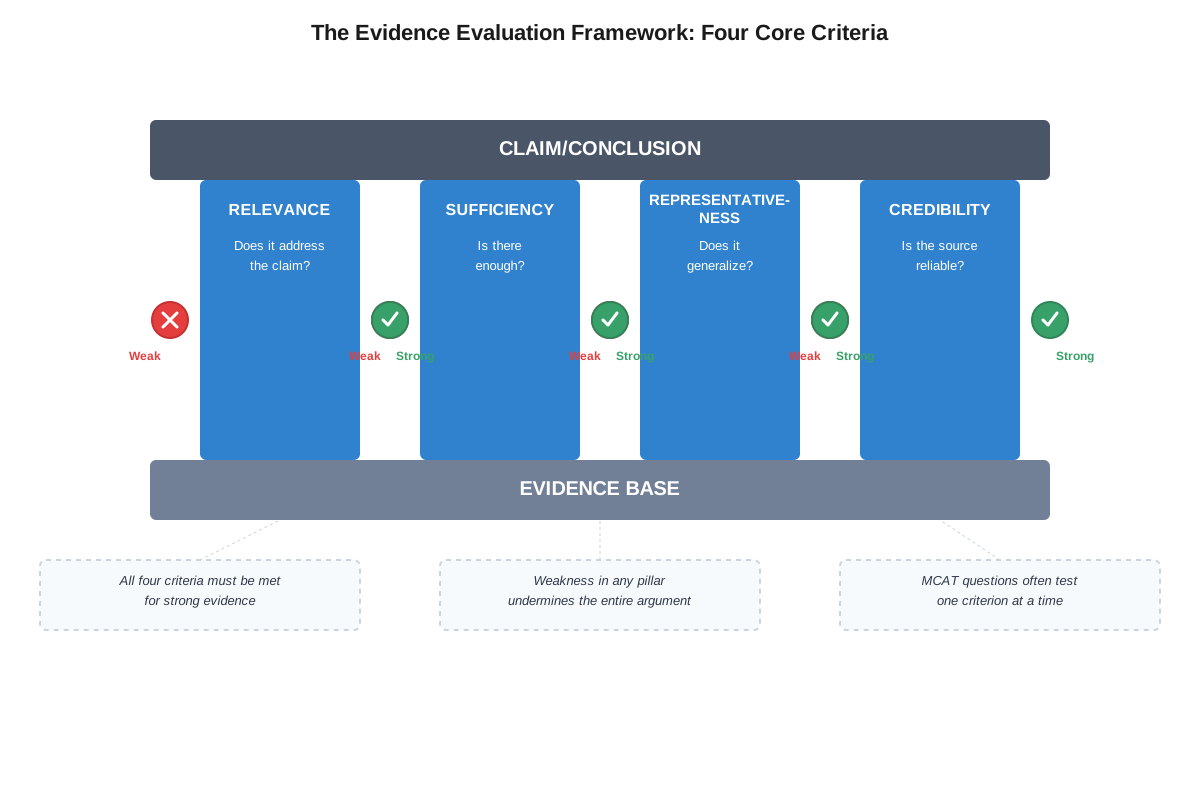
The ability to evaluate evidence effectively separates high-scoring MCAT candidates from average performers. Unlike content-based sections where memorization plays a significant role, Evidence evaluation Critical Analysis and Reasoning Skills questions test analytical thinking in real-time. Students must assess whether evidence is relevant (does it address the claim?), sufficient (is there enough of it?), representative (does it generalize appropriately?), and credible (does it come from reliable sources or sound methodology?). This mirrors the critical thinking physicians employ daily when evaluating research studies, patient symptoms, and treatment options—making it an authentic assessment of pre-medical competencies.
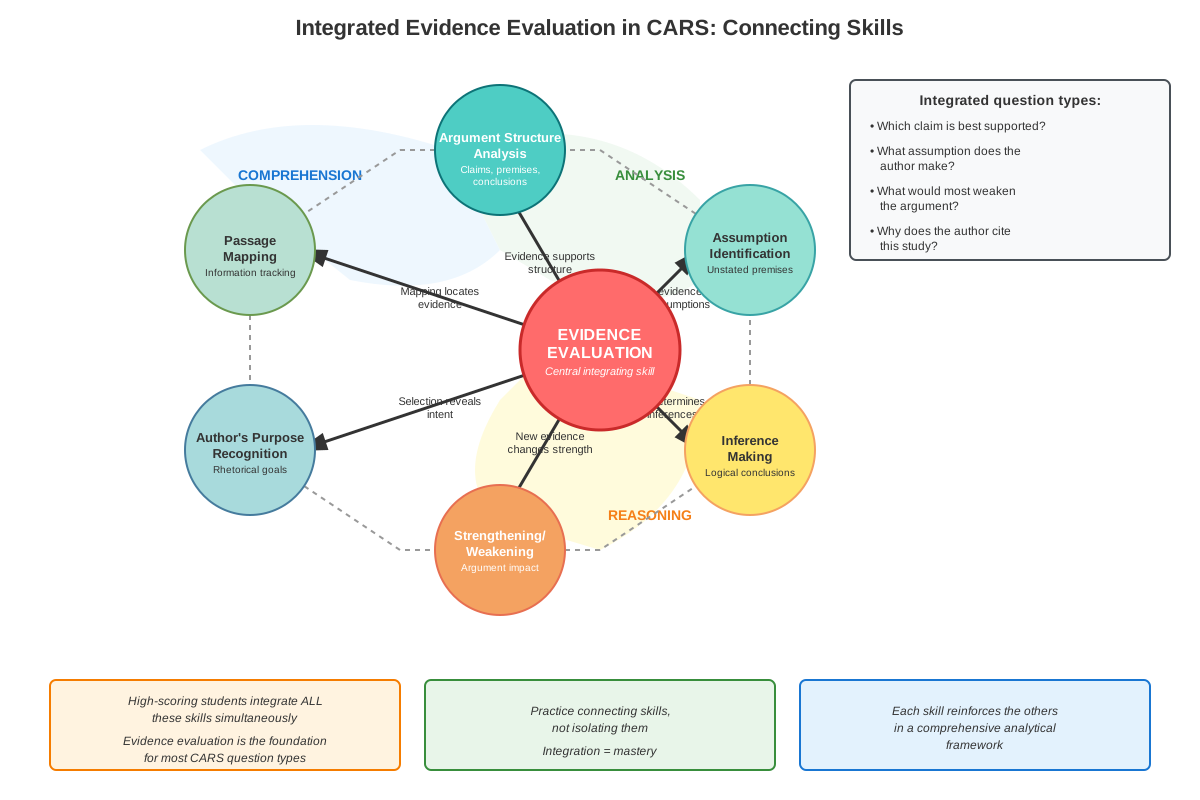
Within the broader framework of CARS Skills, evidence evaluation connects intimately with argument analysis, assumption identification, and logical reasoning. While argument analysis focuses on the structure of claims and conclusions, evidence evaluation specifically examines the building blocks that support those structures. Students who master evidence evaluation develop a systematic approach to dissecting passages, enabling them to answer not only direct "evidence" questions but also inference, strengthening/weakening, and application questions that implicitly require evidence assessment. This foundational skill underpins approximately 30-40% of CARS questions, making it essential for achieving competitive scores.
Learning Objectives
- [ ] Define Evidence evaluation using accurate Critical Analysis and Reasoning Skills terminology
- [ ] Explain why Evidence evaluation matters for the MCAT
- [ ] Apply Evidence evaluation to exam-style questions
- [ ] Identify common mistakes related to Evidence evaluation
- [ ] Connect Evidence evaluation to related Critical Analysis and Reasoning Skills concepts
- [ ] Distinguish between different types of evidence (empirical, anecdotal, statistical, expert testimony) and assess their relative strengths
- [ ] Evaluate whether evidence is sufficient, relevant, and representative for supporting specific claims
- [ ] Recognize common evidence-related fallacies and weaknesses in argumentative passages
Prerequisites
- Basic reading comprehension: Understanding literal meaning of complex texts is necessary before evaluating the quality of evidence presented within them
- Argument structure recognition: Identifying claims, conclusions, and supporting statements provides the framework within which evidence operates
- Logical reasoning fundamentals: Understanding basic logical relationships (cause-effect, correlation, generalization) enables assessment of whether evidence actually supports conclusions
- Passage mapping skills: The ability to track main ideas and supporting details helps locate and categorize evidence quickly during timed conditions
Why This Topic Matters
Evidence evaluation represents a fundamental competency for future physicians who must constantly assess the quality of information—from interpreting laboratory results and imaging studies to evaluating conflicting research findings and patient histories. Medical practice increasingly emphasizes evidence-based medicine, where treatment decisions rest on critical appraisal of clinical studies, meta-analyses, and systematic reviews. The MCAT's emphasis on evidence evaluation directly tests whether candidates possess the analytical rigor necessary for this aspect of medical practice.
From an exam perspective, evidence evaluation appears in approximately 30-40% of CARS questions, making it one of the highest-yield skills to master. These questions manifest in several formats: direct evidence questions ("Which of the following best supports the author's claim?"), weakening/strengthening questions ("Which finding would most undermine the argument?"), and inference questions that require assessing what evidence allows us to conclude. According to AAMC data, students who perform well on evidence evaluation questions typically score in the 128+ range on CARS, while those who struggle often plateau in the 124-126 range.
In MCAT passages, evidence evaluation commonly appears when authors present scientific studies, historical examples, statistical data, expert opinions, analogies, or hypothetical scenarios to support their positions. Test-makers deliberately include passages with varying evidence quality—some with robust, relevant support and others with weak, tangential, or logically flawed evidence. The ability to distinguish between these scenarios determines success on many CARS questions. Passages from social sciences, humanities, and natural sciences all require evidence evaluation, though the types of evidence vary by discipline (empirical data in sciences, historical examples in humanities, case studies in social sciences).
Core Concepts
Definition and Scope of Evidence Evaluation
Evidence evaluation refers to the systematic process of assessing the quality, relevance, strength, and sufficiency of information used to support claims, arguments, or conclusions within a text. This process involves multiple dimensions of analysis: determining whether evidence is factually accurate, logically connected to the claim it purports to support, representative of broader patterns, and sufficient in quantity and quality to justify the conclusion drawn. In MCAT passages, evidence can take numerous forms—empirical research findings, statistical data, expert testimony, historical examples, analogies, hypothetical scenarios, or anecdotal accounts—each requiring different evaluative criteria.
The scope of evidence evaluation extends beyond simply identifying what evidence exists; it requires judging whether that evidence performs its intended argumentative function. Strong evidence directly addresses the specific claim being made, comes from credible sources or sound methodology, represents patterns rather than isolated instances, and provides sufficient detail to be verifiable. Weak evidence, conversely, may be tangentially related to the claim, come from questionable sources, represent outliers or exceptions, or lack the specificity needed for meaningful assessment.
Types of Evidence and Their Relative Strengths
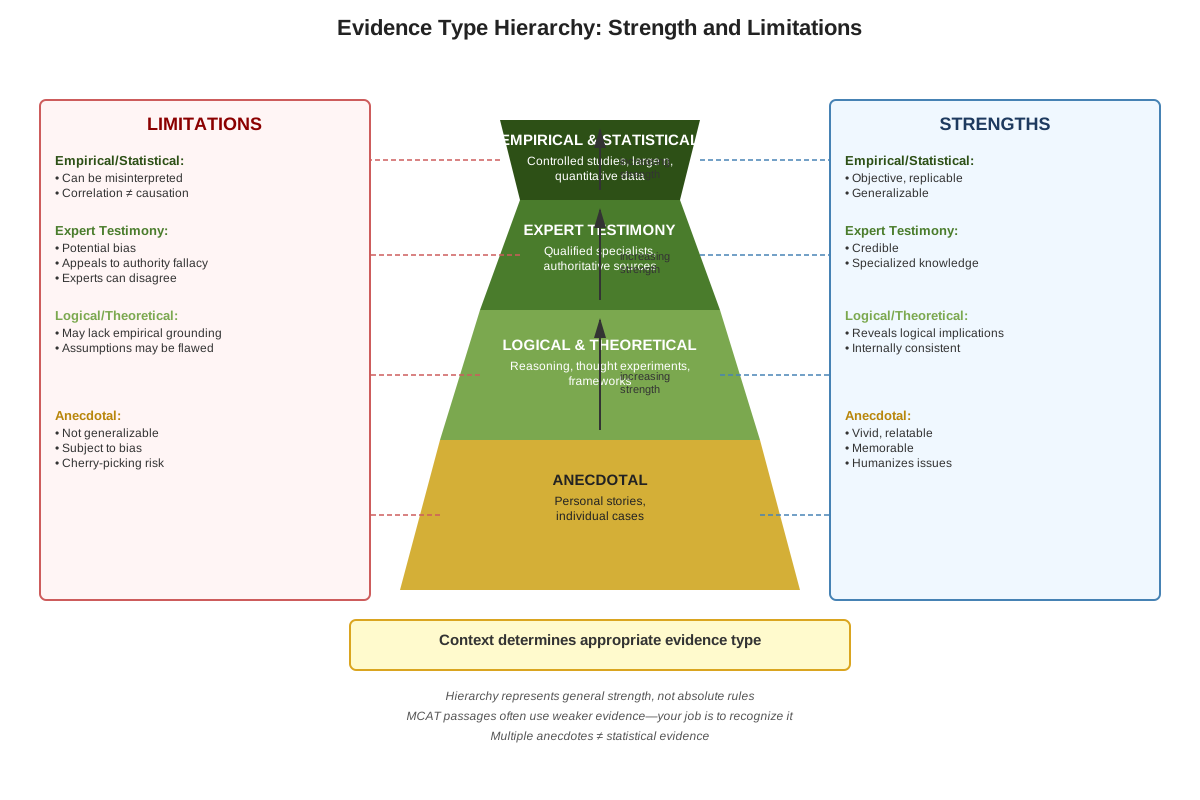
Different types of evidence carry varying degrees of persuasive power and applicability depending on the context and claim being supported:
| Evidence Type | Characteristics | Strengths | Limitations |
|---|---|---|---|
| Empirical/Experimental | Data from controlled studies, experiments, or systematic observations | High internal validity; establishes causation; replicable | May lack external validity; can be expensive/time-consuming |
| Statistical | Numerical data showing patterns, correlations, or trends | Quantifiable; shows magnitude; identifies patterns | Correlation ≠ causation; vulnerable to sampling bias |
| Expert Testimony | Opinions or interpretations from recognized authorities | Leverages specialized knowledge; efficient | Subject to bias; expertise may not transfer across domains |
| Historical Examples | Past events or cases illustrating a point | Concrete; memorable; shows real-world application | May not generalize; cherry-picking risk; context differences |
| Analogical | Comparisons between similar situations or phenomena | Makes abstract concepts concrete; aids understanding | Analogies always break down; differences may outweigh similarities |
| Anecdotal | Individual stories or personal experiences | Vivid; emotionally compelling; humanizes issues | Not representative; vulnerable to cognitive biases; limited generalizability |
Understanding these distinctions enables rapid assessment of evidence strength in MCAT passages. For instance, an author arguing that a new educational policy will improve outcomes nationwide would need more than anecdotal evidence from a single school; statistical data from multiple representative schools or experimental studies with control groups would provide stronger support.
The Four Criteria for Strong Evidence: RRSC Framework
Effective evidence evaluation employs four key criteria, remembered through the acronym RRSC:
- Relevance: Does the evidence directly address the specific claim being made? Evidence can be factually accurate yet irrelevant if it doesn't connect logically to the conclusion. For example, citing increased funding for education is irrelevant evidence for a claim about teaching methodology effectiveness unless a connection between funding and methodology implementation is established.
- Representativeness: Does the evidence reflect typical patterns rather than outliers or exceptions? A single case study or unusual example cannot support broad generalizations. Strong evidence draws from diverse, representative samples that reflect the population or phenomenon being discussed.
- Sufficiency: Is there enough evidence to justify the conclusion? A single study, one example, or limited data points typically cannot support sweeping claims. The scope of the conclusion must match the breadth and depth of evidence provided.
- Credibility: Does the evidence come from reliable sources using sound methodology? This includes considering potential biases, conflicts of interest, methodological rigor, and whether claims are verifiable. Expert testimony from someone with relevant credentials carries more weight than opinions from non-experts.
Evidence vs. Interpretation
A critical distinction in evidence evaluation involves separating raw evidence from the author's interpretation of that evidence. Raw evidence consists of facts, data, observations, or documented events—the "what happened" or "what was found." Interpretation represents the author's analysis, explanation, or conclusions drawn from that evidence—the "what it means" or "why it matters."
MCAT passages frequently present interpretations as if they were evidence, testing whether students can distinguish between the two. For example:
- Evidence: "The study found that 65% of participants showed improvement after the intervention."
- Interpretation: "This proves the intervention is highly effective and should be implemented widely."
The interpretation goes beyond what the evidence actually shows (improvement in a specific study population) to make broader claims about effectiveness and implementation. Strong evidence evaluation recognizes this gap and assesses whether the interpretation is justified by the evidence or represents an overreach.
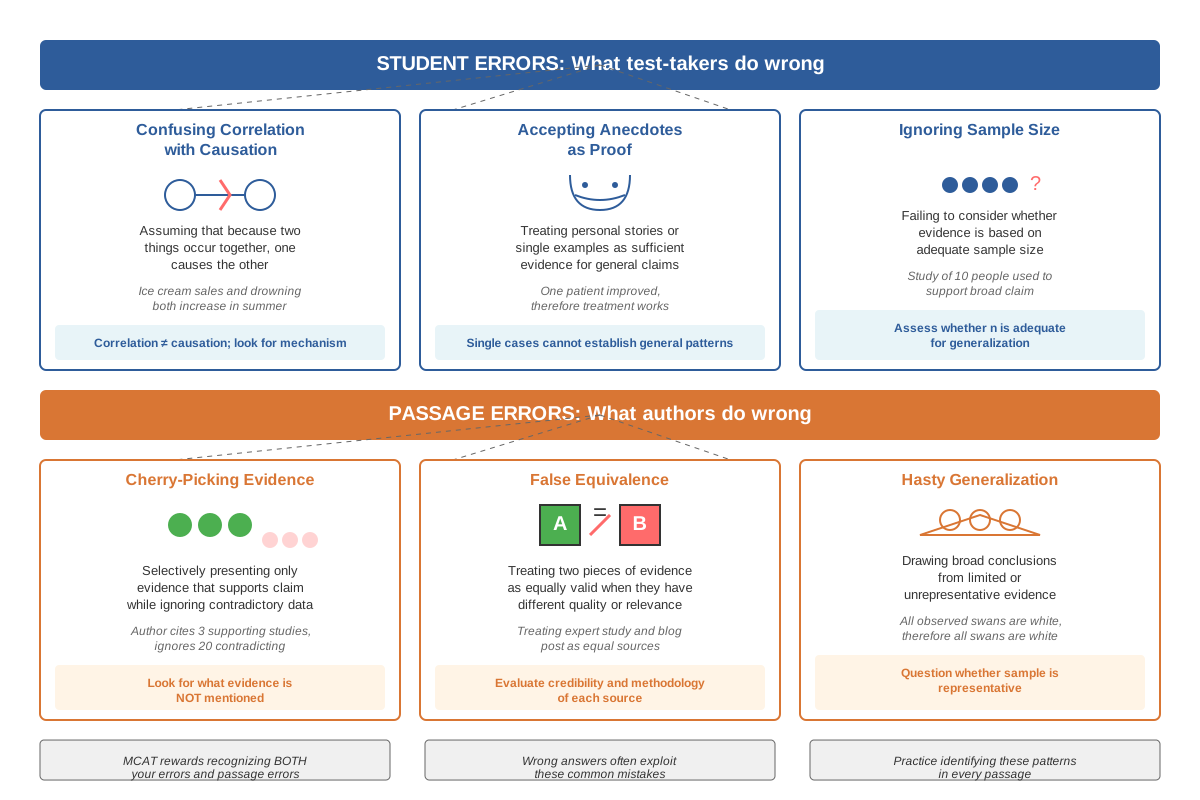
Common Evidence Weaknesses and Red Flags
Certain patterns signal weak or problematic evidence in MCAT passages:
- Insufficient sample size: Generalizing from too few cases or examples
- Unrepresentative samples: Drawing broad conclusions from atypical or biased populations
- Temporal issues: Using outdated evidence for current claims or assuming past patterns will continue
- Correlation-causation confusion: Treating correlational evidence as if it establishes causation
- Cherry-picking: Selectively presenting evidence that supports a position while ignoring contradictory evidence
- Vague or unverifiable claims: Evidence lacking specific details that would allow verification
- Inappropriate authority: Citing experts outside their domain of expertise
- Circular reasoning: Using the conclusion as evidence for itself
- False analogies: Drawing comparisons between fundamentally different situations
Recognizing these weaknesses enables rapid identification of vulnerable points in arguments and helps predict correct answers to strengthening/weakening questions.
Evidence Evaluation in Different Passage Types
The application of evidence evaluation varies somewhat across MCAT passage disciplines:
Humanities passages (philosophy, literature, art criticism) often rely on interpretive evidence, historical examples, and logical argumentation. Evidence evaluation focuses on whether examples truly illustrate the principles claimed, whether historical context is accurately represented, and whether logical connections are sound.
Social sciences passages (psychology, sociology, economics) typically present empirical studies, statistical data, and case studies. Evidence evaluation emphasizes methodological soundness, sample representativeness, appropriate statistical interpretation, and whether findings generalize beyond the study population.
Natural sciences passages (though less common in CARS) may discuss scientific theories, experimental findings, or observational data. Evidence evaluation centers on experimental design, control of variables, replicability, and whether alternative explanations have been ruled out.
Regardless of discipline, the fundamental RRSC criteria apply, though their specific manifestations differ based on the type of evidence typically employed in each field.
Concept Relationships
Evidence evaluation functions as a central node connecting multiple CARS skills. It builds directly upon argument structure recognition—one must first identify claims and conclusions before evaluating the evidence supporting them. The relationship flows: Argument Structure → Evidence Identification → Evidence Evaluation → Conclusion Assessment.
Evidence evaluation enables inference questions by establishing what the evidence actually supports versus what it doesn't. If evidence is weak or insufficient, inferences must be correspondingly limited. Strong evidence permits stronger inferences. This creates the relationship: Evidence Quality → Inference Scope.
The skill also connects intimately with assumption identification. Assumptions often bridge gaps between evidence and conclusions; recognizing these gaps requires evaluating whether evidence alone justifies the conclusion or whether unstated premises are necessary. The relationship: Evidence Gaps → Necessary Assumptions.
Strengthening and weakening questions directly test evidence evaluation by asking what additional information would improve or undermine an argument. Success requires understanding what makes evidence strong or weak: Evidence Evaluation Criteria → Prediction of Strengthening/Weakening Information.
Finally, evidence evaluation supports author's purpose and tone analysis. Authors who provide strong, balanced evidence typically adopt measured, analytical tones, while those relying on weak or one-sided evidence may employ more rhetorical or persuasive tones. The relationship: Evidence Quality Patterns → Author's Rhetorical Strategy.
Quick check — test yourself on Evidence evaluation so far.
Try Flashcards →High-Yield Facts
⭐ Evidence must be both relevant AND sufficient—relevance alone doesn't make evidence strong; there must be enough of it to support the scope of the conclusion.
⭐ Anecdotal evidence cannot support generalizations—individual cases or personal stories, no matter how compelling, don't establish patterns or universal claims.
⭐ Correlation does not establish causation—statistical associations between variables don't prove that one causes the other without additional evidence ruling out confounding factors.
⭐ Expert testimony is only strong within the expert's domain—credentials in one field don't automatically transfer authority to unrelated areas.
⭐ Sample representativeness matters more than sample size alone—a large but biased sample provides weaker evidence than a smaller but representative sample.
- Evidence from controlled experiments generally provides stronger support for causal claims than observational studies or correlational data.
- Historical examples must be contextually similar to current situations to serve as strong evidence for predictions or recommendations.
- Vague or unverifiable evidence cannot be effectively evaluated—specificity and verifiability are prerequisites for strong evidence.
- The absence of evidence is not evidence of absence—lack of supporting evidence doesn't automatically prove the opposite claim.
- Multiple independent lines of evidence (triangulation) provide stronger support than a single source, even if that source seems robust.
- Evidence that contradicts the author's claim but is acknowledged and addressed typically strengthens the overall argument by demonstrating thoroughness.
Common Misconceptions
Misconception: More evidence always means stronger support for a conclusion.
Correction: Evidence quality matters more than quantity. Ten weak, irrelevant examples provide less support than one strong, directly relevant study. MCAT passages sometimes include multiple pieces of tangential evidence to test whether students can recognize that volume doesn't compensate for relevance.
Misconception: If evidence is factually true, it must support the author's claim.
Correction: Evidence can be completely accurate yet irrelevant to the specific claim being made. The logical connection between evidence and conclusion matters as much as the evidence's factual accuracy. For example, true statements about historical literacy rates don't necessarily support claims about modern educational policy effectiveness.
Misconception: Expert opinions always constitute strong evidence.
Correction: Expert testimony varies in strength based on the expert's relevant credentials, potential biases, whether the opinion falls within their domain of expertise, and whether other experts agree. A single expert opinion, especially on controversial topics or outside their specialty, provides relatively weak evidence.
Misconception: Statistical evidence is always stronger than qualitative evidence.
Correction: Statistics can be misleading, based on flawed methodology, or misinterpreted. Qualitative evidence (case studies, detailed observations, historical analysis) can provide crucial context and insights that statistics miss. The strength depends on appropriateness to the claim and methodological soundness, not the type of evidence.
Misconception: If an author cites a study or source, that evidence must be strong.
Correction: MCAT passages deliberately include weak evidence to test evaluation skills. Authors may cite outdated studies, misinterpret findings, use unrepresentative samples, or draw conclusions beyond what the evidence supports. Students must evaluate the evidence itself, not simply accept that cited sources equal strong support.
Misconception: Evidence that supports part of an argument supports the entire argument.
Correction: Arguments often contain multiple claims or a chain of reasoning. Evidence may strongly support one component while leaving others unsupported. For example, evidence that a problem exists doesn't automatically support a proposed solution to that problem—each claim requires its own evidence.
Worked Examples
Example 1: Evaluating Evidence Strength
Passage excerpt: "The benefits of meditation for stress reduction are well-established. Sarah, a corporate executive, reports that after beginning a daily meditation practice, her stress levels decreased significantly and her productivity improved. This demonstrates that companies should implement mandatory meditation programs for all employees to enhance workplace performance."
Question: Which of the following best describes the strength of evidence for the author's recommendation?
Analysis Process:
- Identify the claim: Companies should implement mandatory meditation programs to enhance workplace performance.
- Identify the evidence: A single anecdotal report from one individual (Sarah) about personal stress reduction and productivity improvement.
- Apply RRSC criteria:
- Relevance: Partially relevant—stress reduction and productivity relate to workplace performance, but individual experience doesn't directly address company-wide mandatory programs.
- Representativeness: Very weak—one person's experience cannot represent all employees across different companies, roles, and contexts.
- Sufficiency: Insufficient—a single case cannot support a broad recommendation for all companies and employees.
- Credibility: Limited—self-reported outcomes without objective measurement; no control for other factors that might explain improvements.
- Evaluate evidence type: Anecdotal evidence is the weakest form for supporting generalizations or policy recommendations.
- Identify gaps: No evidence addresses whether meditation benefits transfer to all individuals, whether mandatory programs would be effective (versus voluntary), whether benefits justify costs, or whether other factors explain Sarah's improvements.
Conclusion: The evidence is weak and insufficient to support the recommendation. Stronger evidence would include controlled studies with diverse employee populations, comparison of mandatory versus voluntary programs, cost-benefit analyses, and objective performance metrics.
Learning objective connection: This example demonstrates applying evidence evaluation to exam-style questions by systematically assessing evidence against established criteria.
Example 2: Distinguishing Evidence from Interpretation
Passage excerpt: "A recent study examined 500 high school students across ten schools, finding that students who participated in arts programs scored an average of 12% higher on standardized tests than non-participants. This clearly proves that arts education causes improved academic performance and should be prioritized in all schools. The correlation between arts participation and test scores is undeniable evidence of causation."
Question: The author's conclusion that arts education causes improved academic performance is:
Analysis Process:
- Separate evidence from interpretation:
- Evidence: Correlation between arts participation and higher test scores in a specific sample (500 students, ten schools, 12% difference).
- Interpretation: The claim that this correlation proves causation and justifies universal policy recommendations.
- Evaluate the evidence itself:
- Relevance: Relevant to academic performance claims.
- Representativeness: Reasonably representative sample size and multiple schools.
- Sufficiency: Adequate for establishing correlation but insufficient for causation.
- Credibility: Depends on study methodology (not fully described).
- Evaluate the interpretation:
- The author commits the correlation-causation fallacy—the evidence shows association, not causation.
- Alternative explanations not ruled out: Perhaps students with higher academic ability or motivation self-select into arts programs; perhaps schools with arts programs have more resources generally; perhaps family socioeconomic factors influence both arts participation and test scores.
- The leap from correlation in one study to universal policy recommendations exceeds what the evidence supports.
- Identify the logical gap: The evidence would need to come from controlled experiments (randomly assigning students to arts programs) or longitudinal studies tracking the same students before and after arts participation while controlling for confounding variables.
Conclusion: The evidence establishes correlation but does not support the causal claim or broad policy recommendation. The author has overinterpreted the evidence by treating correlation as causation and generalizing beyond what the study demonstrates.
Learning objective connection: This example illustrates identifying common mistakes (correlation-causation confusion) and connecting evidence evaluation to logical reasoning concepts.
Exam Strategy
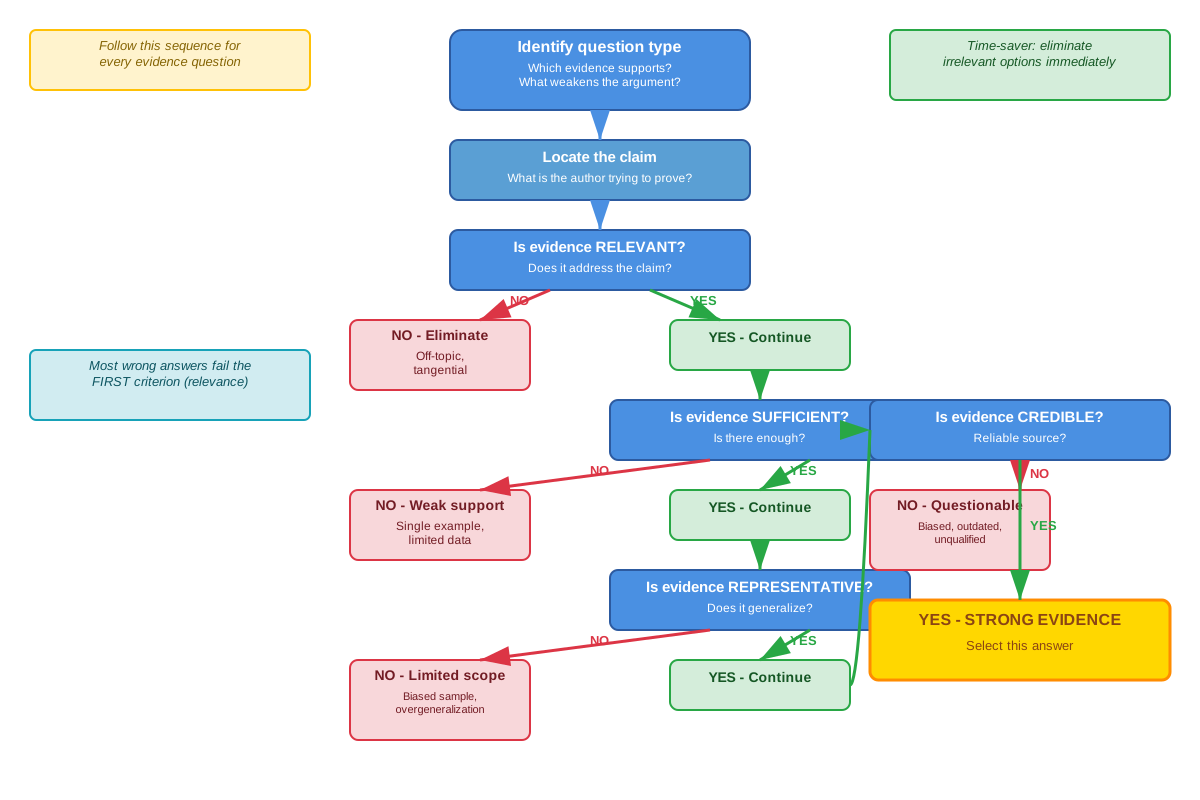
When approaching MCAT questions involving evidence evaluation, employ this systematic process:
Step 1: Identify the specific claim or conclusion being supported. MCAT questions often ask about evidence for a particular statement, not the passage's overall argument. Locate the exact claim in question.
Step 2: Find all evidence presented in support of that claim. Evidence may appear in the same paragraph or elsewhere in the passage. Don't assume evidence is always adjacent to the claim it supports.
Step 3: Apply the RRSC framework rapidly: Is the evidence Relevant, Representative, Sufficient, and Credible? Usually, one or two of these criteria will clearly distinguish strong from weak evidence.
Step 4: Watch for trigger words that signal evidence evaluation questions:
- "Which of the following best supports..." (identify strong evidence)
- "The author's claim is most weakened by..." (identify contradictory or undermining evidence)
- "Which assumption is necessary..." (identify evidence gaps)
- "The evidence provided suggests..." (distinguish what evidence actually shows from overinterpretation)
- "The author uses X as evidence for..." (identify the claim-evidence relationship)
Step 5: Eliminate answer choices using evidence-specific criteria:
- Eliminate choices that confuse correlation with causation
- Eliminate choices that cite irrelevant evidence, even if factually true
- Eliminate choices that generalize from insufficient or unrepresentative evidence
- Eliminate choices that treat interpretation as if it were evidence
Step 6: For strengthening/weakening questions, predict what would address the evidence's weaknesses before looking at answer choices. If evidence is anecdotal, strengthening would involve broader data; if correlational, strengthening would establish causation; if from a biased sample, strengthening would involve representative samples.
Time allocation: Evidence evaluation questions typically require 60-90 seconds. Spend 20-30 seconds locating and categorizing the evidence, 20-30 seconds applying evaluation criteria, and 20-30 seconds eliminating wrong answers and confirming the correct choice. If a question requires more than 90 seconds, flag it and return if time permits—these questions can become time sinks if you get caught debating subtle distinctions.
Exam Tip: When two answer choices seem equally plausible, return to the RRSC framework. The correct answer will align with multiple criteria, while the distractor will typically violate at least one criterion clearly.
Memory Techniques
RRSC Mnemonic for evidence evaluation criteria: "Really Reliable Scientists Care"
- Relevance: Does it address the claim?
- Representativeness: Does it reflect typical patterns?
- Sufficiency: Is there enough of it?
- Credibility: Is the source/method sound?
Evidence Strength Hierarchy (visualize as a pyramid, strongest at top):
- Controlled experiments (top tier)
- Statistical data from representative samples
- Expert consensus within domain
- Historical examples with contextual similarity
- Analogies with strong parallels
- Anecdotal evidence (bottom tier)
The "So What?" Test: When evaluating evidence, ask "So what does this actually prove?" If the answer is "not much" or "something different from what the author claims," the evidence is weak.
The Three C's of Weak Evidence: Correlation claimed as causation, Cherry-picked examples, Circular reasoning. If you spot any of these, the evidence is vulnerable.
STAR Method for strengthening/weakening questions:
- Specific: What specific weakness exists in the current evidence?
- Target: What would directly address that weakness?
- Anticipate: Predict the type of information needed before reading choices
- Recognize: Identify the answer choice matching your prediction
Summary
Evidence evaluation represents a fundamental CARS skill requiring systematic assessment of information quality, relevance, and sufficiency in supporting claims. Mastery involves distinguishing between different evidence types (empirical, statistical, anecdotal, expert testimony, historical examples, analogies), understanding their relative strengths and appropriate applications, and applying the RRSC framework (Relevance, Representativeness, Sufficiency, Credibility) to evaluate evidence systematically. Strong evidence directly addresses specific claims, comes from credible sources using sound methodology, represents patterns rather than outliers, and provides adequate support for the scope of conclusions drawn. Common weaknesses include correlation-causation confusion, insufficient sample sizes, unrepresentative samples, cherry-picking, and inappropriate generalization from anecdotal evidence. Success on MCAT evidence evaluation questions requires separating raw evidence from interpretation, recognizing when authors overreach beyond what evidence supports, and predicting what information would strengthen or weaken arguments based on identifying evidence gaps and vulnerabilities.
Key Takeaways
- Evidence evaluation assesses whether information is relevant, representative, sufficient, and credible (RRSC framework) for supporting specific claims
- Different evidence types carry varying strengths: controlled experiments > statistical data > expert testimony > historical examples > analogies > anecdotal evidence
- Correlation does not establish causation—this is the most common evidence-related error in MCAT passages
- Evidence quality matters more than quantity; multiple weak examples don't equal strong support
- Distinguish between raw evidence (facts, data, observations) and interpretation (what the author claims the evidence means)
- Anecdotal evidence and single examples cannot support broad generalizations or universal claims
- Strengthening/weakening questions test your ability to identify evidence gaps and predict what information would address them
Related Topics
Argument Structure and Analysis: Understanding how claims, premises, and conclusions relate provides the framework within which evidence operates; mastering evidence evaluation enables deeper argument analysis.
Assumption Identification: Recognizing unstated premises that bridge gaps between evidence and conclusions; evidence evaluation reveals where these gaps exist.
Logical Reasoning and Fallacies: Understanding common logical errors (false cause, hasty generalization, appeal to authority) directly relates to recognizing evidence weaknesses.
Inference and Implication: Determining what conclusions evidence actually supports versus what authors claim it supports; strong evidence evaluation skills enable accurate inference assessment.
Passage Mapping and Main Ideas: Efficiently locating and categorizing evidence within complex passages supports rapid evidence evaluation under timed conditions.
Practice CTA
Now that you've mastered the core concepts of evidence evaluation, it's time to apply these skills to MCAT-style passages and questions. The practice questions and flashcards will challenge you to rapidly identify evidence types, apply the RRSC framework, distinguish evidence from interpretation, and predict strengthening/weakening information—all under timed conditions that simulate test day. Remember: evidence evaluation is a skill that improves dramatically with deliberate practice. Each practice question you analyze strengthens your ability to dissect arguments and recognize evidence quality patterns, directly translating to higher CARS scores. You've built the foundation—now reinforce it through application!
Sign up free to keep reading
Create a free AnvayaPrep account to finish this MCAT guide on Evidence evaluation — plus flashcards and practice questions.