Overview
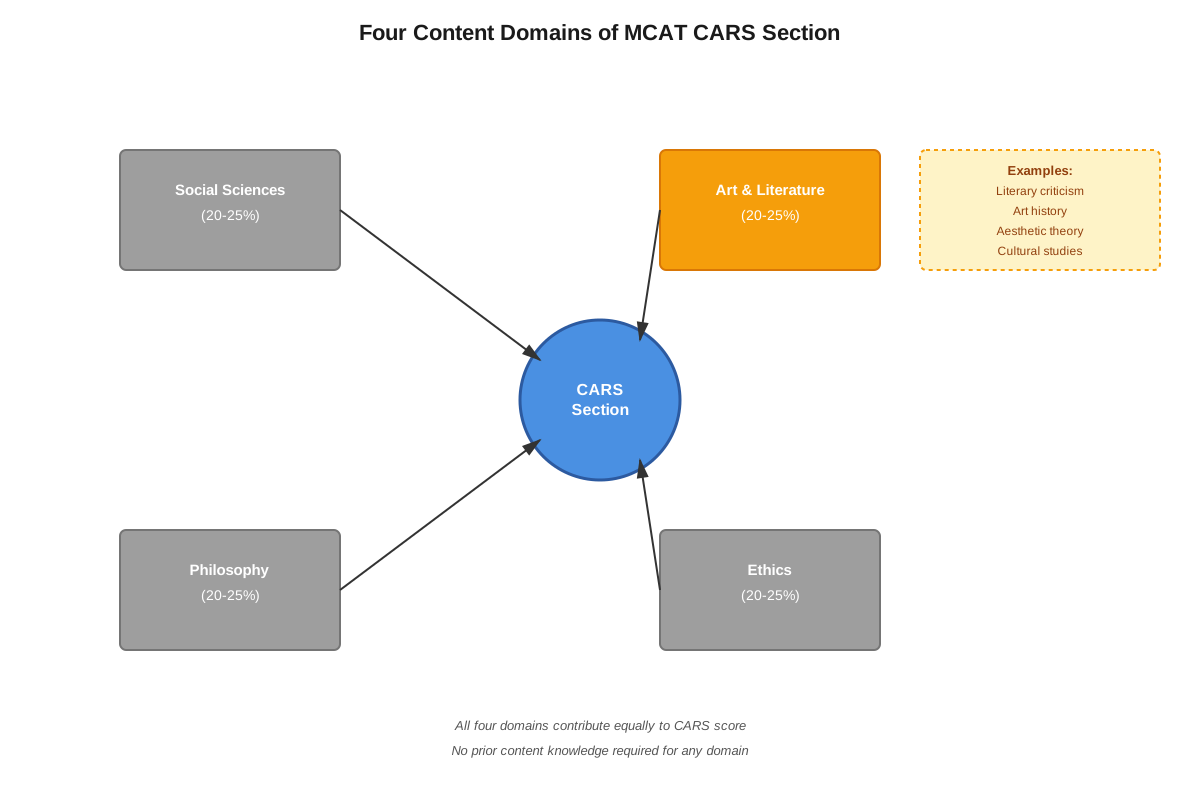
Art and literature passages represent one of the four major content domains tested in the Critical Analysis and Reasoning Skills (CARS) section of the MCAT. These passages draw from humanities disciplines including literary criticism, art history, aesthetic theory, cultural studies, and philosophical discussions of creative expression. Unlike the science sections of the MCAT, CARS Skills passages require students to analyze complex arguments, evaluate authorial intent, and synthesize information without relying on prior content knowledge. Art and literature passages specifically challenge test-takers to navigate abstract concepts, subjective interpretations, and nuanced arguments about creative works and their cultural significance.
The MCAT includes art and literature passages to assess a future physician's ability to comprehend complex texts, recognize subtle distinctions in meaning, and evaluate arguments that may not have clear-cut answers—skills essential for interpreting medical literature, understanding patient narratives, and navigating ethical dilemmas. These passages often feature dense prose with sophisticated vocabulary, metaphorical language, and layered arguments that require careful attention to authorial tone and rhetorical strategy. Students must develop the ability to extract main ideas, identify supporting evidence, and distinguish between what an author explicitly states versus what they imply.
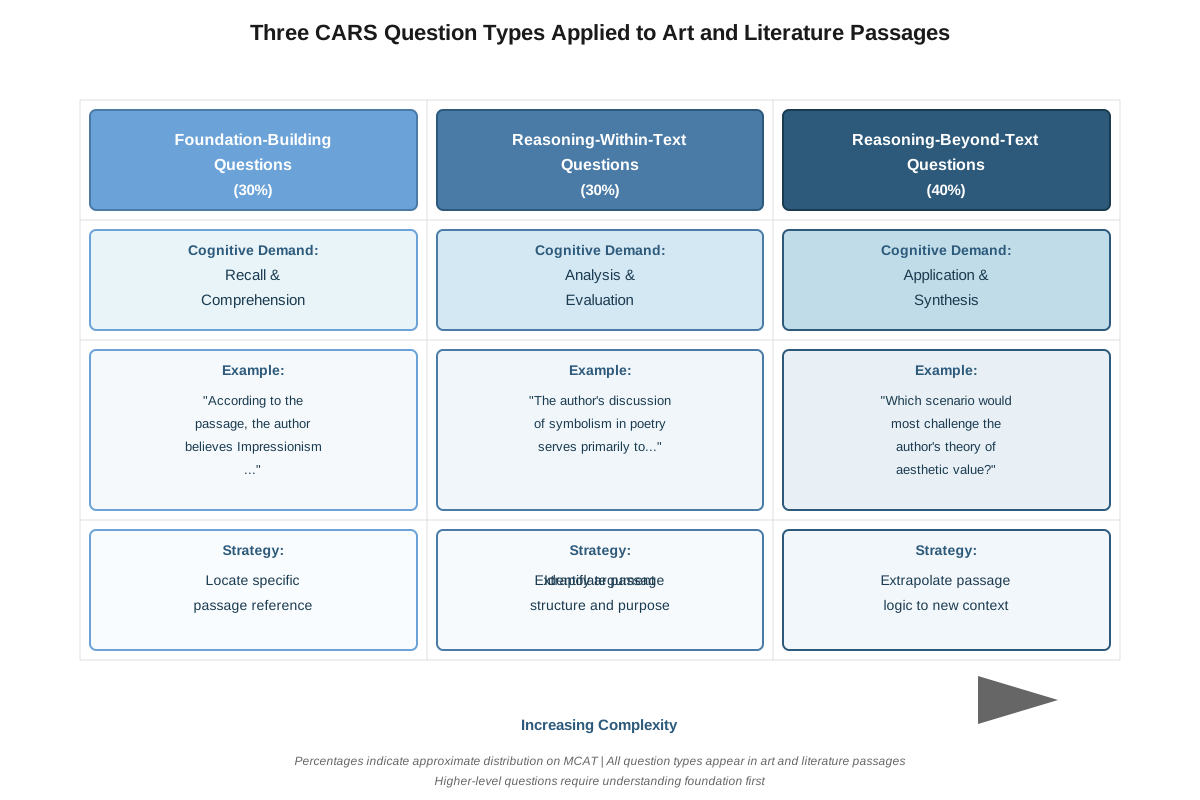
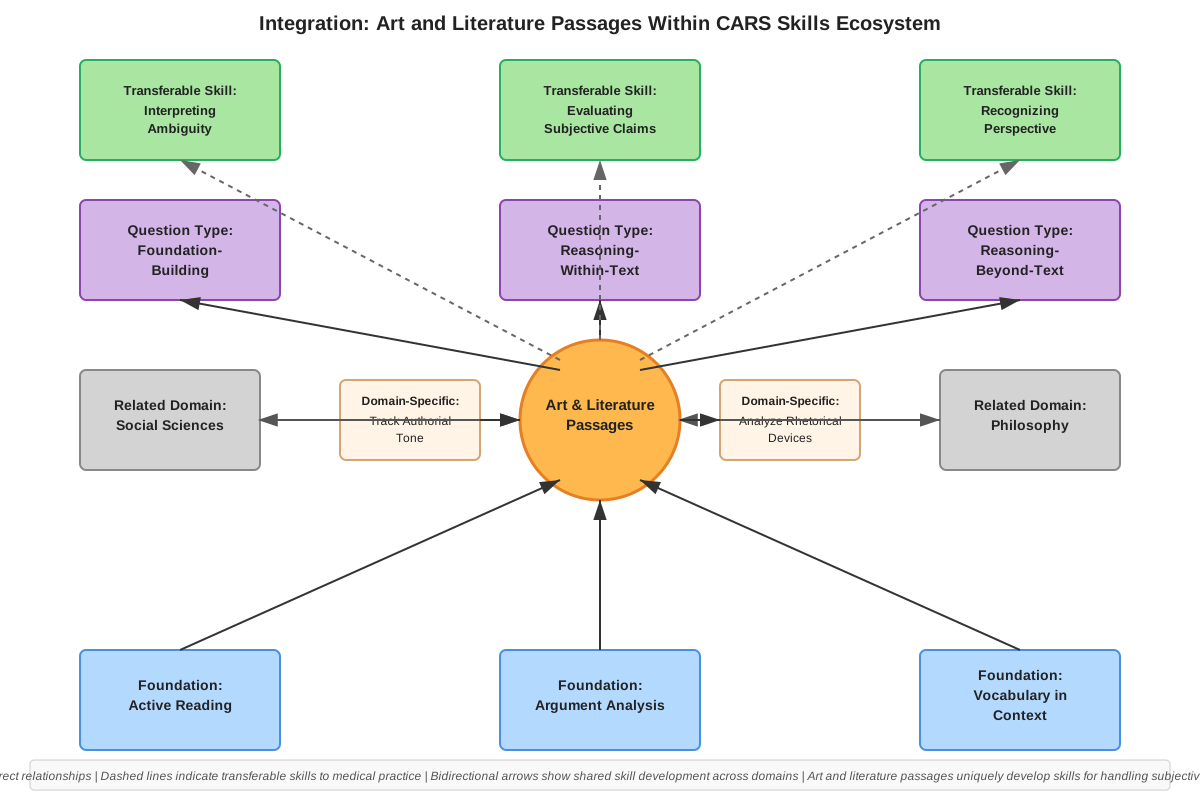
Within the broader framework of Critical Analysis and Reasoning Skills, art and literature passages complement passages from social sciences, philosophy, and ethics. Together, these passage types train students to think critically across diverse intellectual domains. Mastering art and literature passages strengthens analytical skills that transfer to all CARS question types, including foundation-building questions (understanding basic components), reasoning-within-text questions (analyzing arguments), and reasoning-beyond-text questions (applying concepts to new contexts).
Learning Objectives
- [ ] Define Art and literature passages using accurate Critical Analysis and Reasoning Skills terminology
- [ ] Explain why Art and literature passages matters for the MCAT
- [ ] Apply Art and literature passages to exam-style questions
- [ ] Identify common mistakes related to Art and literature passages
- [ ] Connect Art and literature passages to related Critical Analysis and Reasoning Skills concepts
- [ ] Analyze the rhetorical strategies authors employ in art and literature passages
- [ ] Distinguish between objective claims and subjective interpretations in aesthetic arguments
- [ ] Evaluate how cultural and historical context influences arguments about creative works
Prerequisites
- Basic reading comprehension: Ability to understand college-level texts is essential for parsing complex humanities prose
- Familiarity with argument structure: Understanding premises, conclusions, and evidence helps identify how authors build their cases
- General CARS passage approach: Knowledge of active reading strategies and question types provides the foundation for domain-specific skills
- Vocabulary development: Exposure to academic language aids in navigating the sophisticated terminology common in humanities writing
Why This Topic Matters
Art and literature passages appear in approximately 20-25% of CARS passages on the MCAT, making them a significant component of the section. These passages test skills that extend beyond the exam itself—physicians must regularly interpret complex, ambiguous information, understand diverse perspectives, and communicate about subjective experiences. The ability to analyze aesthetic arguments parallels the interpretive work required when evaluating patient symptoms, understanding illness narratives, or considering the human dimensions of medical practice.
On the MCAT, art and literature passages frequently appear as 500-600 word excerpts from scholarly works, critical essays, or theoretical discussions. Common question types include identifying the author's main thesis, understanding how specific examples support broader arguments, recognizing tone and attitude, and applying the author's reasoning to hypothetical scenarios. These passages often feature questions about authorial intent, the function of specific paragraphs or examples, and the implications of the author's claims.
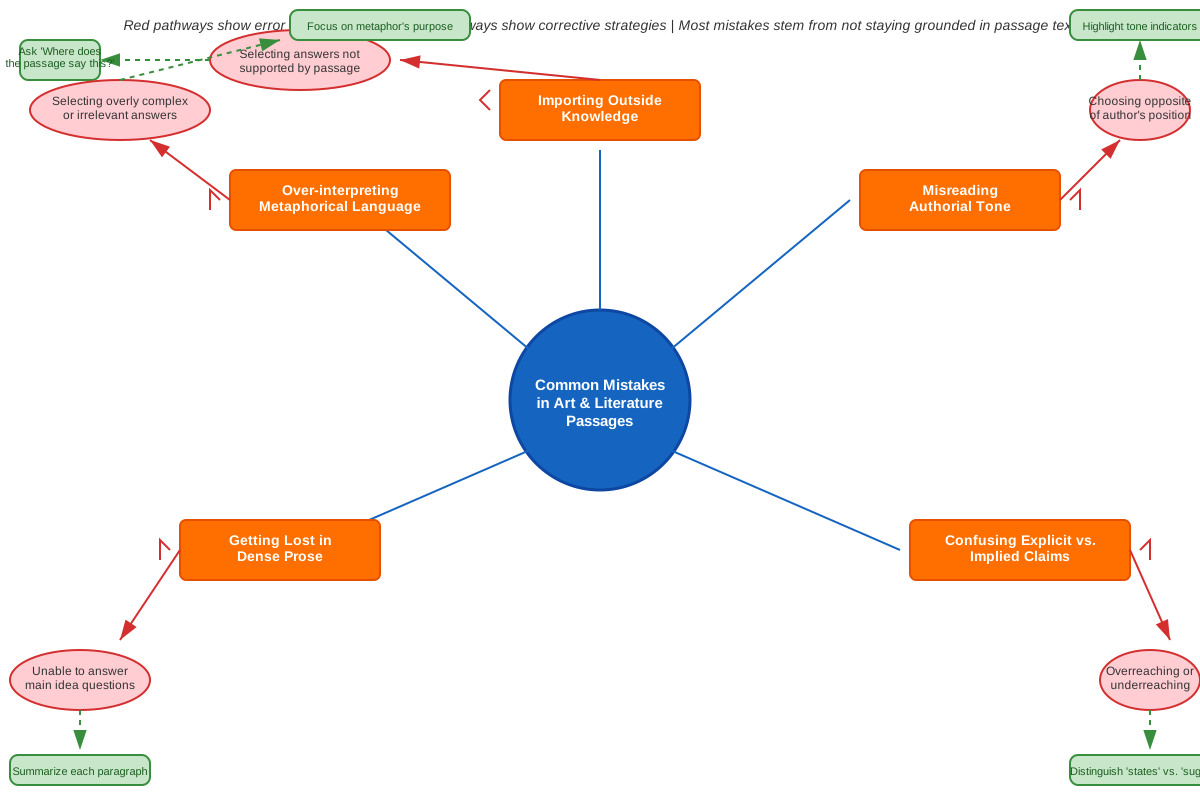
Students who struggle with art and literature passages typically face challenges with abstract language, unfamiliar subject matter, or difficulty distinguishing between the author's view and views they describe. However, these passages follow predictable patterns: authors typically present a thesis about a creative work or aesthetic principle, support it with examples and analysis, and may contrast their view with alternative interpretations. Recognizing these structural patterns enables efficient navigation even when the specific content is unfamiliar.
Core Concepts
Defining Art and Literature Passages
Art and literature passages are CARS passages that focus on creative expression, aesthetic theory, cultural artifacts, and the interpretation of artistic works. These passages may discuss specific novels, paintings, films, or musical compositions, or they may explore broader questions about the nature of art, the role of the artist, or the relationship between art and society. The defining characteristic is their focus on humanities content rather than social science research or philosophical argumentation (though overlap exists).
These passages typically feature several distinctive elements: discussion of specific creative works as evidence, attention to form and style, consideration of interpretation and meaning, and engagement with questions of value and significance. Authors may analyze how a particular novel reflects its historical moment, argue for a new interpretation of a painting, or theorize about what makes certain works aesthetically powerful.
Characteristics of Art and Literature Passages
Subjective interpretation plays a central role in art and literature passages. Unlike scientific passages that present empirical findings, these passages often acknowledge multiple valid interpretations while arguing for one perspective. Authors may use phrases like "suggests," "can be read as," or "invites interpretation" to signal the interpretive nature of their claims. Test-takers must distinguish between claims about objective facts (when a work was created, what it literally depicts) and interpretive arguments (what it means, what it accomplishes).
Dense, sophisticated prose characterizes many art and literature passages. Authors may employ metaphorical language, complex sentence structures, and specialized vocabulary from literary criticism or art history. Terms like "aesthetic," "motif," "genre," "narrative voice," "composition," and "symbolism" appear frequently. The prose itself often mirrors the complexity of the creative works under discussion.
Cultural and historical context frequently frames arguments in these passages. Authors may discuss how social conditions influenced an artist's work, how a literary movement responded to historical events, or how contemporary audiences received a creative work differently than modern readers. Understanding the relationship between context and interpretation is crucial for answering questions about authorial claims.
Common Argument Structures
Art and literature passages typically follow several recognizable patterns:
| Argument Type | Structure | Example Focus |
|---|---|---|
| Interpretive argument | Present a reading of a work, support with textual evidence | Arguing that a novel critiques capitalism through its protagonist's journey |
| Comparative analysis | Contrast two works, artists, or movements | Examining how two painters approached portraiture differently |
| Theoretical application | Apply an aesthetic theory to specific examples | Using feminist theory to analyze representations of women in film |
| Historical contextualization | Explain how context shaped creative production | Discussing how war influenced modernist poetry |
| Evaluative argument | Assess the quality or significance of a work | Arguing why a particular novel deserves canonical status |
Rhetorical Strategies in Art and Literature Passages
Authors employ specific rhetorical strategies to build their arguments. Close reading involves detailed analysis of specific passages, images, or moments in a creative work to support broader interpretive claims. An author might quote a single line from a poem and analyze its word choice, rhythm, and imagery to demonstrate a larger point about the poem's themes.
Contextualization situates creative works within broader cultural, historical, or biographical frameworks. Authors may discuss an artist's life experiences, the social movements of their era, or the artistic traditions they inherited to explain aspects of their work.
Comparison and contrast helps authors clarify their arguments by showing what makes a particular work or approach distinctive. By contrasting one artist's technique with another's, authors can highlight specific features that might otherwise go unnoticed.
Tone and Authorial Attitude
Recognizing authorial tone is essential for answering CARS questions correctly. In art and literature passages, authors may adopt various stances:
- Appreciative: Celebrating a work's achievements or an artist's contributions
- Critical: Identifying limitations, problems, or failures in a work or interpretation
- Analytical: Maintaining scholarly distance while examining how something works
- Revisionist: Challenging established interpretations or canonical judgments
- Theoretical: Applying abstract frameworks to understand creative phenomena
Questions frequently ask about the author's attitude toward specific claims, works, or other critics. Careful attention to qualifying language, evaluative terms, and the overall trajectory of the argument helps identify tone accurately.
Types of Evidence in Art and Literature Passages
Authors support their claims with several types of evidence:
- Textual evidence: Direct quotations from literary works or descriptions of visual elements in artworks
- Biographical information: Details about artists' lives that illuminate their creative choices
- Historical facts: Information about the era in which works were created or received
- Critical consensus: References to how other scholars or critics have interpreted works
- Theoretical frameworks: Application of aesthetic, cultural, or philosophical theories
Understanding how authors use evidence helps test-takers evaluate argument strength and answer questions about support for specific claims.
Concept Relationships
The concepts within art and literature passages form an interconnected system. Subjective interpretation relies on textual evidence and close reading to remain grounded rather than purely speculative. Cultural and historical context shapes both the creation of works and their interpretation, influencing what meanings audiences can derive. Rhetorical strategies like comparison and contextualization serve the larger goal of building interpretive arguments that readers find persuasive.
These concepts connect to broader CARS skills: recognizing argument structure in art passages parallels identifying claims and support in any passage type. Understanding authorial tone in aesthetic discussions develops the same skills needed to detect attitude in social science or philosophical passages. The ability to distinguish explicit statements from implications applies across all CARS content domains.
The relationship map flows as follows: Cultural/historical context → influences → Creative work → requires → Interpretation → supported by → Close reading and evidence → organized through → Rhetorical strategies → conveyed with → Authorial tone → builds → Argument about meaning/significance
Quick check — test yourself on Art and literature passages so far.
Try Flashcards →High-Yield Facts
⭐ Art and literature passages comprise approximately 20-25% of CARS passages, making them a significant but not dominant passage type
⭐ These passages test interpretation skills rather than prior knowledge—no background in art history or literature is required
⭐ Authors in art and literature passages frequently acknowledge multiple interpretations while arguing for their preferred reading
⭐ Questions about authorial tone and attitude appear more frequently in art and literature passages than in other CARS passage types
⭐ The author's main thesis often appears in the first or last paragraph, with middle paragraphs providing examples and analysis
- Passages may discuss any art form: literature, visual arts, music, film, theater, or dance
- Close reading questions ask how specific details support broader interpretive claims
- Comparison questions require understanding what distinguishes one work, artist, or approach from another
- Application questions may ask how the author would interpret a new example using their established framework
- Historical context questions test understanding of how time period influences creation or interpretation
Common Misconceptions
Misconception: Prior knowledge of art and literature is necessary to answer questions correctly → Correction: All information needed to answer questions appears in the passage itself; outside knowledge can actually lead to incorrect answers if it contradicts passage content
Misconception: Art and literature passages are purely subjective with no wrong answers → Correction: While the subject matter involves interpretation, questions have definitively correct answers based on what the passage states and implies
Misconception: The author's interpretation is always presented as the only valid reading → Correction: Authors frequently acknowledge alternative interpretations while arguing their view is more compelling or better supported
Misconception: Unfamiliar vocabulary makes these passages impossible to understand → Correction: Context clues and passage structure usually clarify specialized terms; questions rarely hinge on knowing precise definitions of technical vocabulary
Misconception: These passages require slower reading than other CARS passages → Correction: While prose may be dense, the same active reading strategies and time management apply; spending too long on difficult sentences reduces time for questions
Misconception: Questions about tone are asking for personal reactions to the passage → Correction: Tone questions ask about the author's attitude as evidenced by word choice, qualifiers, and argument structure, not the reader's feelings
Worked Examples
Example 1: Interpretive Argument Analysis
Passage excerpt: "Morrison's Beloved resists easy categorization, blending elements of historical fiction, ghost story, and psychological drama. Yet this generic hybridity serves a clear purpose: to represent the fragmented nature of traumatic memory itself. The novel's non-linear structure, with its sudden temporal shifts and gaps in narrative, mirrors the way trauma disrupts conventional storytelling. When Sethe recalls her past, the narrative fractures, circling obsessively around certain moments while leaving others in shadow. This formal choice is not merely stylistic experimentation but rather an ethical commitment to representing trauma authentically, refusing the false coherence that linear narrative would impose on experiences that resist integration."
Question: The author's primary purpose in this paragraph is to:
A) Critique Morrison's experimental narrative techniques as unnecessarily confusing
B) Argue that the novel's formal structure reflects and represents traumatic experience
C) Compare Morrison's approach to trauma with other contemporary novelists
D) Explain why historical fiction requires non-linear narrative structures
Analysis:
Step 1: Identify the main claim. The author states that the novel's "generic hybridity serves a clear purpose" and that the "formal choice is not merely stylistic experimentation but rather an ethical commitment."
Step 2: Examine supporting evidence. The author explains how non-linear structure "mirrors" traumatic memory and how narrative fragmentation represents how "trauma disrupts conventional storytelling."
Step 3: Assess tone. The author uses positive, purposeful language ("clear purpose," "ethical commitment") rather than critical language.
Step 4: Evaluate options. Option A contradicts the positive tone. Option C introduces comparison not present in the paragraph. Option D overgeneralizes to all historical fiction. Option B accurately captures the argument that formal structure represents traumatic experience.
Answer: B
Connection to learning objectives: This example demonstrates applying art and literature passage skills to exam-style questions by identifying the author's interpretive argument and distinguishing it from incorrect alternatives.
Example 2: Tone and Attitude Question
Passage excerpt: "Traditional art historians have long celebrated Caravaggio's dramatic use of chiaroscuro, praising his innovative manipulation of light and shadow. While these technical achievements merit recognition, this conventional focus obscures more troubling aspects of his work. The violence depicted in paintings like Judith Beheading Holofernes exceeds narrative necessity, suggesting a fascination with brutality that contemporary viewers too readily excuse as 'baroque intensity.' We must ask whether aesthetic innovation justifies such graphic representations, or whether our celebration of Caravaggio's technique allows us to avoid confronting the disturbing psychology his work reveals."
Question: The author's attitude toward traditional art historical assessments of Caravaggio can best be described as:
A) Dismissive of their validity
B) Appreciative but concerned about their limitations
C) Neutral and objective
D) Enthusiastically supportive
Analysis:
Step 1: Identify evaluative language. The author acknowledges achievements "merit recognition" (positive) but states this focus "obscures more troubling aspects" (critical).
Step 2: Note qualifying language. "While" signals contrast between what the author accepts and what concerns them.
Step 3: Examine the author's main concern. The author questions whether "aesthetic innovation justifies" violent content and suggests traditional approaches "allow us to avoid confronting" problems.
Step 4: Assess overall stance. The author doesn't completely reject traditional views (eliminating A) but clearly expresses concern about what they miss (eliminating C and D).
Answer: B
Connection to learning objectives: This example illustrates identifying authorial tone by analyzing evaluative language and recognizing how authors can simultaneously acknowledge merit while expressing reservations.
Exam Strategy
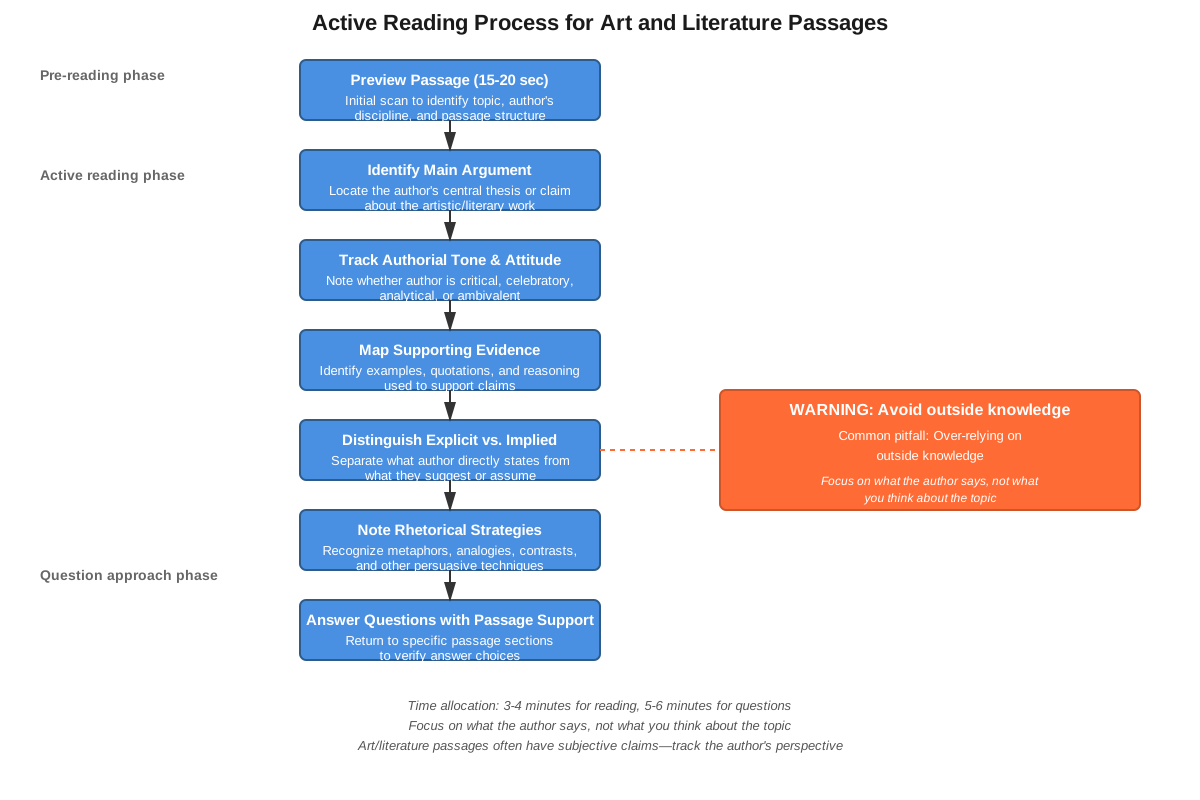
When approaching art and literature passages on the MCAT, begin by identifying the passage type quickly—usually the first sentence mentioning an artist, literary work, or aesthetic concept signals this domain. Read actively for the author's main interpretive claim, which often appears as a thesis statement in the opening or closing paragraph.
Trigger words that signal important content include:
- Interpretive language: "suggests," "reveals," "reflects," "embodies," "represents"
- Contrast markers: "however," "yet," "while," "although" (often signal the author's own view versus others')
- Evaluative terms: "significant," "powerful," "problematic," "innovative," "conventional"
- Evidence introduction: "for example," "consider," "as seen in," "demonstrates"
For process of elimination, watch for answer choices that:
- Introduce comparisons not made in the passage
- Overstate the author's certainty (or understate it)
- Confuse the author's view with views they describe
- Rely on outside knowledge rather than passage content
- Misidentify tone (too positive, too negative, or too neutral)
Time allocation should follow standard CARS pacing: approximately 5 minutes for a 500-word passage and its questions. Don't get bogged down in difficult sentences; the questions will direct attention to the most important content. If a paragraph discusses a specific example in detail, note its function (supporting a broader claim) rather than memorizing every detail.
For tone questions, create a mental scale from strongly negative to strongly positive, then locate the author's position based on word choice and qualifiers. Authors in art and literature passages often occupy middle positions—appreciative but critical, or analytical rather than purely celebratory.
When facing application questions that ask how the author would interpret a new example, identify the principle or framework the author uses in the passage, then apply that same logic to the new scenario. The correct answer will maintain consistency with the author's established reasoning pattern.
Memory Techniques
ARTIST mnemonic for approaching art and literature passages:
- Argument: Identify the author's main interpretive claim
- Rhetorical strategies: Note how the author builds their case
- Tone: Assess the author's attitude toward their subject
- Interpretation: Distinguish subjective readings from objective facts
- Structure: Track how paragraphs function (thesis, example, analysis)
- Textual evidence: Note what specific details support claims
CLOSE for remembering what authors do with creative works:
- Contextualize: Place works in historical/cultural settings
- Link: Connect specific details to broader meanings
- Oppose: Contrast with other works or interpretations
- Support: Use textual evidence to back claims
- Evaluate: Assess significance or quality
Visualization strategy: Picture art and literature passages as guided museum tours. The author is the tour guide pointing out specific features (close reading), explaining historical background (contextualization), and offering interpretations (argument). Your job is to understand what the guide emphasizes and why, not to form your own independent interpretation.
Summary
Art and literature passages test critical reading and analytical reasoning through humanities content, requiring students to navigate interpretive arguments, recognize authorial tone, and evaluate how evidence supports claims about creative works. These passages appear in approximately one-quarter of CARS sections and assess skills essential for medical practice: interpreting ambiguous information, understanding diverse perspectives, and analyzing complex arguments. Success requires identifying the author's main thesis, tracking how examples support broader claims, distinguishing explicit statements from implications, and recognizing rhetorical strategies like close reading, contextualization, and comparison. While the subject matter involves aesthetic interpretation, questions have definitive correct answers based on passage content. No prior knowledge of art or literature is necessary—all required information appears in the passage itself. Students must avoid common pitfalls like confusing the author's view with views they describe, relying on outside knowledge, or misidentifying tone. Mastering these passages strengthens analytical skills that transfer across all CARS content domains.
Key Takeaways
- Art and literature passages test interpretation and analysis skills through humanities content, requiring no prior subject knowledge
- The author's main thesis typically appears in opening or closing paragraphs, with middle paragraphs providing examples and analysis
- Distinguishing between objective facts and subjective interpretations is crucial for answering questions accurately
- Authorial tone questions require careful attention to evaluative language, qualifiers, and overall argument trajectory
- Close reading, contextualization, and comparison are the primary rhetorical strategies authors employ in these passages
- Questions have definitive correct answers based on passage content, despite the interpretive nature of the subject matter
- Success requires the same active reading strategies and time management used for all CARS passages
Related Topics
Social science passages: These passages share CARS skills with art and literature passages but focus on empirical research and social phenomena rather than creative works. Mastering interpretation in aesthetic contexts strengthens ability to analyze arguments in social science contexts.
Philosophy passages: Philosophical discussions of aesthetics, beauty, and artistic value bridge art/literature and philosophy domains. Understanding how arguments work in one domain facilitates comprehension in the other.
Rhetorical analysis: Deeper study of how authors construct persuasive arguments through language choice, structure, and evidence applies across all CARS passage types.
Historical context in CARS: Many passages across domains require understanding how historical context shapes arguments; skills developed with art and literature passages transfer to other content areas.
Practice CTA
Now that you've mastered the core concepts of art and literature passages, it's time to apply these skills to practice questions. Work through CARS passages focusing on creative works, paying special attention to identifying authorial claims, recognizing tone, and distinguishing interpretation from fact. Use the flashcards to reinforce key terminology and strategies. Remember: these passages test your analytical reasoning, not your knowledge of art history or literature. Trust the passage, apply the strategies you've learned, and you'll see improvement with consistent practice. Every passage you analyze strengthens the critical thinking skills that will serve you throughout medical school and your career as a physician.
Sign up free to keep reading
Create a free AnvayaPrep account to finish this MCAT guide on Art and literature passages — plus flashcards and practice questions.