Overview
Philosophy passages represent one of the most challenging and intellectually demanding passage types students encounter in the Critical Analysis and Reasoning Skills (CARS) section of the MCAT. These passages draw from centuries of philosophical thought, presenting arguments about ethics, epistemology, metaphysics, aesthetics, political philosophy, and logic. Unlike scientific passages that rely on empirical evidence and data, philosophy passages construct arguments through logical reasoning, conceptual analysis, and abstract thinking. Students must navigate dense prose, identify underlying assumptions, trace complex argumentative structures, and evaluate the strength of philosophical claims—all within the time constraints of the exam.
The MCAT includes philosophy passages to assess a student's ability to comprehend sophisticated arguments, recognize logical relationships, and think critically about abstract ideas. These skills directly translate to medical practice, where physicians must evaluate ethical dilemmas, weigh competing values, understand patient perspectives shaped by different worldviews, and make reasoned judgments in ambiguous situations. Philosophy passages test whether students can move beyond memorization to engage with ideas at a conceptual level, a capacity essential for medical decision-making and patient care.
Within the broader framework of CARS Skills, philosophy passages serve as the ultimate test of pure reasoning ability. While humanities passages may rely on historical context and social science passages on empirical studies, philosophy passages demand that students follow abstract arguments through multiple layers of reasoning. Mastering philosophy passages strengthens all CARS competencies: identifying main ideas, understanding author perspective, evaluating evidence and reasoning, and making inferences. Success with these passages indicates readiness for the analytical challenges of medical school and clinical practice.
Learning Objectives
- [ ] Define Philosophy passages using accurate Critical Analysis and Reasoning Skills terminology
- [ ] Explain why Philosophy passages matters for the MCAT
- [ ] Apply Philosophy passages to exam-style questions
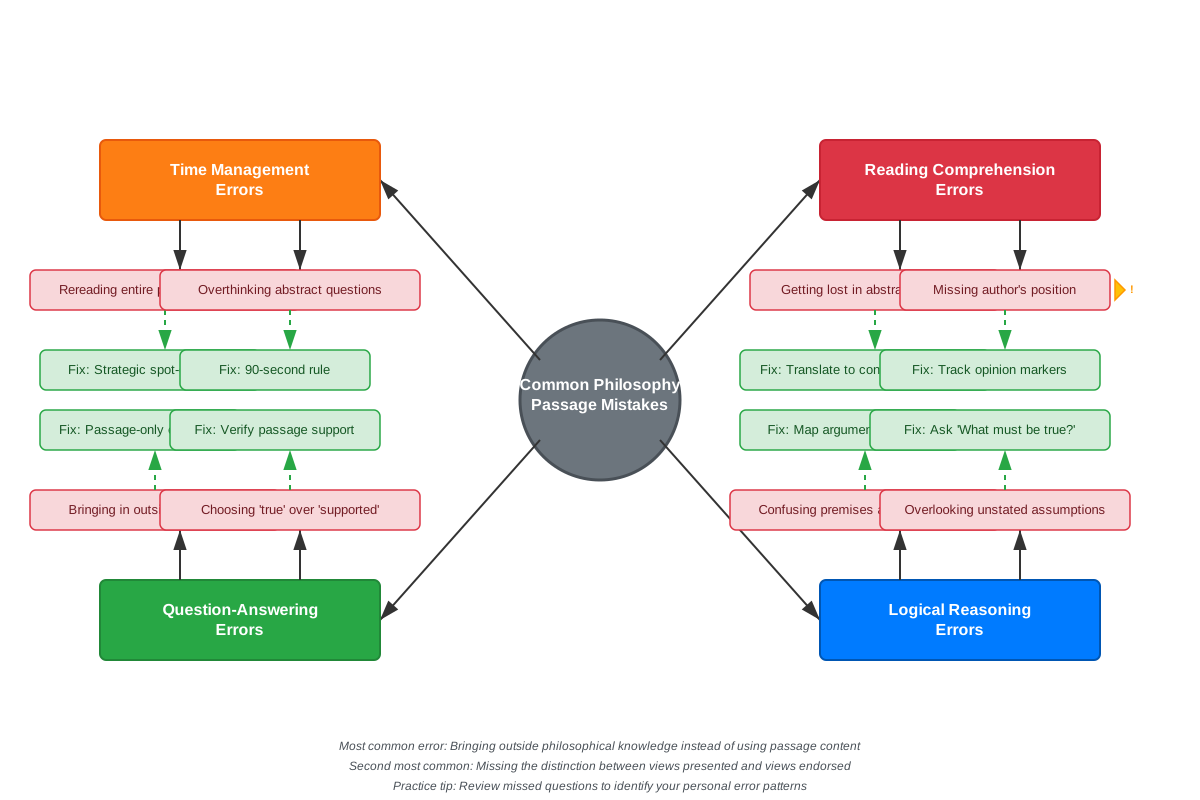
- [ ] Identify common mistakes related to Philosophy passages
- [ ] Connect Philosophy passages to related Critical Analysis and Reasoning Skills concepts
- [ ] Analyze the argumentative structure of philosophical texts, identifying premises, conclusions, and logical connections
- [ ] Distinguish between different philosophical approaches (e.g., deontological vs. consequentialist reasoning)
- [ ] Evaluate the strength of philosophical arguments by identifying unstated assumptions and potential counterarguments
- [ ] Synthesize information from multiple philosophical perspectives presented within a single passage
Prerequisites
- Basic reading comprehension skills: Ability to understand complex sentences and paragraph structure is essential for parsing dense philosophical prose
- Familiarity with argument structure: Understanding premises, conclusions, and logical connectors helps identify how philosophical arguments are constructed
- General CARS passage strategies: Foundational skills in identifying main ideas, author tone, and passage organization apply to all CARS passage types
- Comfort with abstract thinking: Philosophy passages require thinking about concepts rather than concrete examples, building on general analytical abilities
Why This Topic Matters
Philosophy passages appear regularly on the MCAT, typically comprising 1-2 passages per CARS section. These passages consistently challenge even high-performing students because they require a different cognitive approach than science-based reasoning. Medical schools value the skills tested by philosophy passages because physicians regularly confront ethical dilemmas, must understand diverse patient value systems, and need to reason through situations without clear empirical answers. A physician deciding whether to override a patient's treatment refusal, allocating scarce medical resources, or navigating end-of-life care engages in philosophical reasoning about autonomy, beneficence, justice, and human dignity.
On the exam, philosophy passages frequently explore topics such as moral responsibility, the nature of knowledge and truth, theories of justice, the relationship between individual and society, free will versus determinism, and the foundations of ethical judgment. Questions typically ask students to identify the author's main argument, recognize assumptions underlying the reasoning, apply the author's logic to new scenarios, evaluate objections to the position, or distinguish the author's view from alternative philosophical perspectives. The abstract nature of these passages means that students cannot rely on background knowledge; success depends entirely on careful reading and logical analysis.
Philosophy passages also serve as equalizers on the MCAT. While students with humanities backgrounds may feel more comfortable with the writing style, the passages are designed so that no prior philosophical knowledge is required or advantageous. What matters is the ability to follow an argument, understand conceptual distinctions, and reason logically—skills that any student can develop through practice. Mastering philosophy passages demonstrates the intellectual flexibility and analytical rigor that medical schools seek in applicants.
Core Concepts
Characteristics of Philosophy Passages
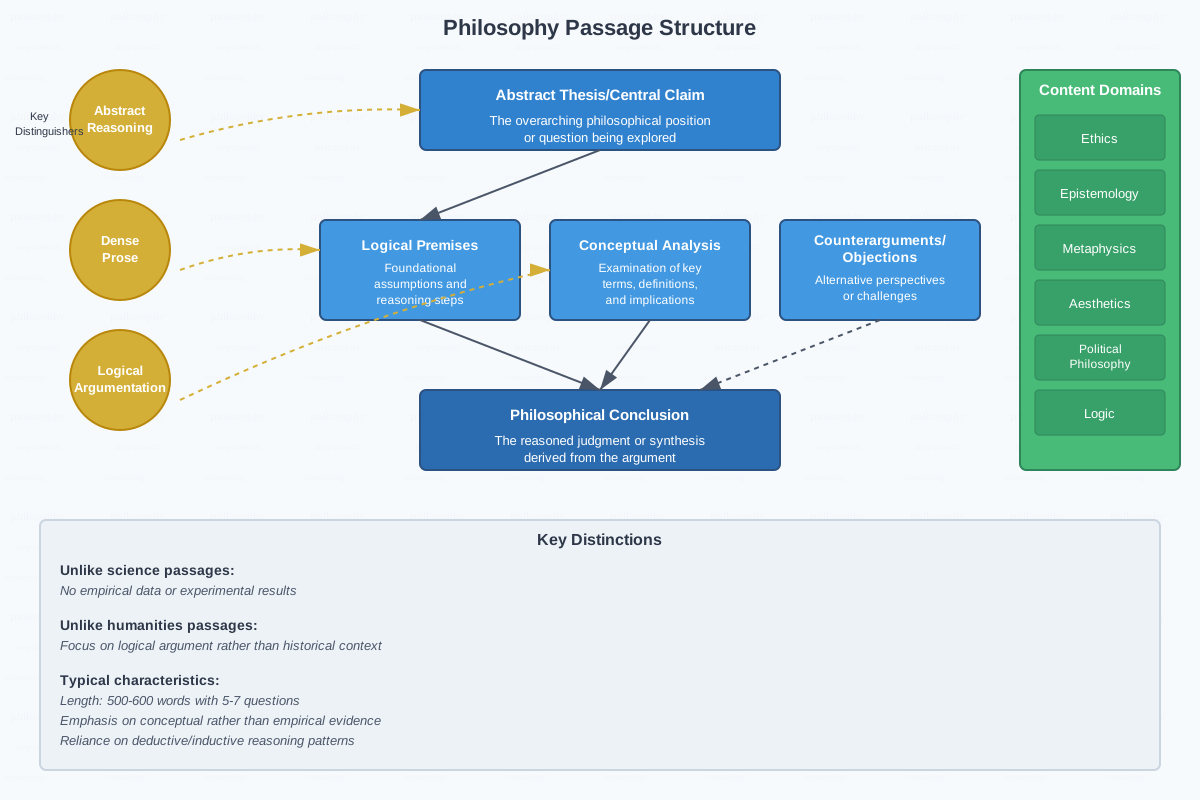
Philosophy passages in the MCAT CARS section exhibit distinctive features that set them apart from other passage types. These texts typically present abstract arguments about fundamental questions of human existence, knowledge, morality, and society. The language tends to be dense and precise, with authors carefully defining terms and making subtle distinctions between related concepts. Unlike empirical passages that cite studies or historical passages that reference specific events, philosophy passages build arguments through logical reasoning and conceptual analysis.
The structure of philosophy passages often follows a dialectical pattern: presenting a position, considering objections or alternative views, and then defending or refining the original claim. Authors may introduce thought experiments—hypothetical scenarios designed to test intuitions about philosophical principles. For example, a passage might present a scenario about moral responsibility to explore whether intentions or consequences matter more in ethical judgment. These passages require students to track multiple perspectives while identifying which view the author ultimately endorses.
Types of Philosophical Content
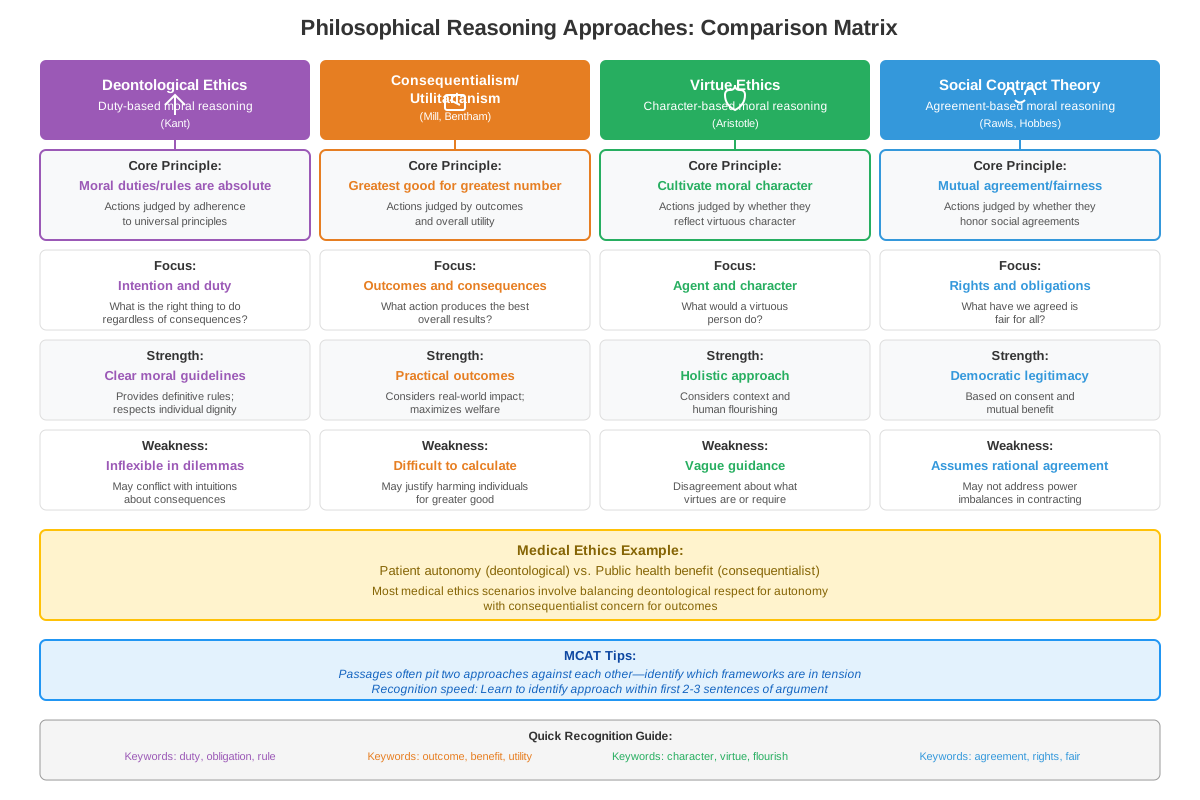
Philosophy passages on the MCAT draw from several major branches of philosophy. Ethics passages examine questions of right and wrong, exploring theories like consequentialism (judging actions by outcomes), deontology (judging actions by adherence to moral rules), and virtue ethics (focusing on character traits). A passage might argue for a particular approach to medical ethics or critique utilitarian reasoning in healthcare allocation.
Epistemology passages investigate the nature and limits of knowledge. These texts might explore how we justify beliefs, the relationship between perception and reality, or the foundations of scientific knowledge. An epistemological passage could examine whether medical knowledge is fundamentally different from other forms of knowledge or discuss the role of uncertainty in clinical judgment.
Metaphysics passages address fundamental questions about reality, existence, causation, and identity. While less common on the MCAT, these passages might explore the mind-body problem (relevant to understanding consciousness and mental health) or questions of personal identity over time (relevant to understanding patient autonomy and advance directives).
Political philosophy passages examine justice, rights, liberty, and the relationship between individuals and society. These passages often connect directly to healthcare policy questions, exploring how to balance individual freedom with collective welfare or how to distribute medical resources fairly.
Argumentative Structure in Philosophy Passages
Understanding how philosophical arguments are constructed is crucial for Philosophy passages Critical Analysis and Reasoning Skills. Most philosophical arguments follow a premise-conclusion structure, where the author presents reasons (premises) that support a claim (conclusion). However, philosophical arguments often involve multiple layers, with sub-arguments supporting intermediate conclusions that then support the main thesis.
Deductive arguments attempt to prove conclusions with certainty. If the premises are true and the logic is valid, the conclusion must be true. Philosophy passages may present deductive arguments using conditional reasoning ("If X, then Y"), categorical reasoning ("All X are Y"), or logical principles. Students must evaluate whether the premises are acceptable and whether the conclusion actually follows from them.
Inductive arguments provide probable support for conclusions based on patterns, analogies, or examples. A philosopher might argue that because certain principles have proven valuable in multiple contexts, they likely apply to a new situation. Evaluating inductive arguments requires assessing the strength of the evidence and considering potential counterexamples.
Dialectical reasoning involves examining a thesis by considering objections and counterarguments. Philosophy passages often present opposing views not to endorse them but to strengthen the author's position by showing it can withstand criticism. Students must distinguish between views the author presents for consideration and views the author actually supports.
Key Philosophical Concepts and Distinctions
Philosophy passages frequently employ specific conceptual distinctions that students must recognize. The normative-descriptive distinction separates claims about how things ought to be (normative) from claims about how things actually are (descriptive). A passage might argue that just because people generally act in self-interested ways (descriptive claim) doesn't mean they should do so (normative claim).
The necessary-sufficient condition distinction appears frequently in philosophical reasoning. A necessary condition must be present for something to occur, while a sufficient condition guarantees it will occur. Understanding this distinction helps students evaluate logical relationships in arguments.
Thought experiments serve as crucial tools in philosophy passages. These hypothetical scenarios isolate specific variables to test philosophical principles. The famous "trolley problem" in ethics, for instance, asks whether it's permissible to divert a runaway trolley to kill one person instead of five, testing intuitions about active versus passive harm. Students must understand what philosophical point the thought experiment is designed to illustrate.
Author's Purpose and Perspective
Identifying the author's purpose is essential for Philosophy passages MCAT success. Philosophical authors typically aim to persuade readers of a particular position, critique an existing view, clarify conceptual confusion, or explore implications of accepting certain principles. The author's tone may be argumentative (defending a controversial position), analytical (examining the logic of an argument), or exploratory (considering multiple perspectives without firmly committing to one).
Understanding the author's assumptions—unstated beliefs that underlie the argument—is critical. A philosopher arguing for patient autonomy might assume that individuals are generally capable of rational decision-making about their own welfare. Recognizing these assumptions allows students to evaluate the argument's foundations and understand potential objections.
Comparison of Philosophical Approaches
| Philosophical Approach | Core Principle | Application to Medical Ethics | Strengths | Limitations |
|---|---|---|---|---|
| Consequentialism | Actions are right if they produce the best outcomes | Maximize overall health and well-being | Clear decision procedure; considers real-world impact | Difficult to predict consequences; may justify harming individuals for greater good |
| Deontology | Actions are right if they follow moral rules/duties | Respect patient autonomy regardless of outcomes | Protects individual rights; provides clear moral boundaries | May be inflexible; rules can conflict |
| Virtue Ethics | Focus on character traits rather than specific actions | Cultivate compassion, wisdom, courage in medical practice | Emphasizes moral development; accounts for context | Less guidance for specific decisions; virtues can conflict |
| Care Ethics | Emphasizes relationships and responsiveness to needs | Prioritize patient-physician relationship and individual context | Attentive to particular situations; values emotional connection | May lack universal principles; risk of paternalism |
Concept Relationships
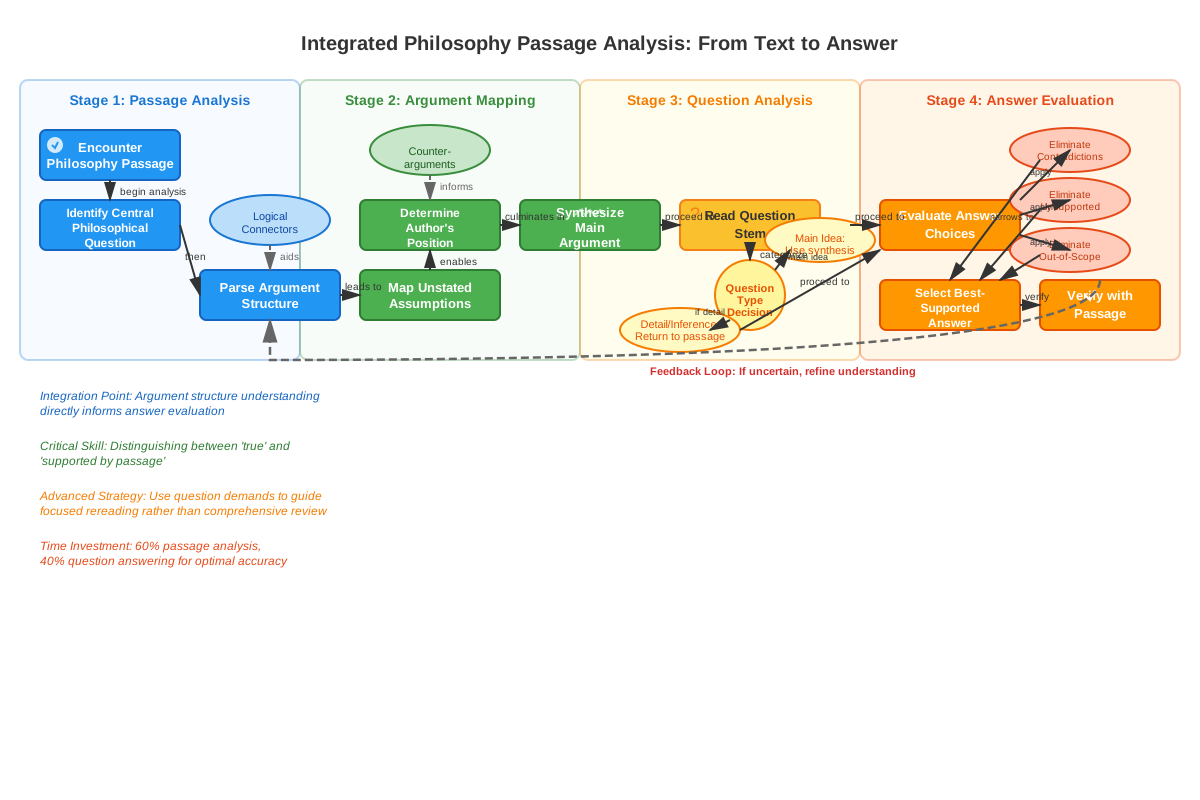
Philosophy passages integrate multiple concepts that work together to create complex arguments. The argumentative structure (premises leading to conclusions) provides the skeleton of the passage, while philosophical content (ethical principles, epistemological claims, metaphysical assumptions) provides the substance. Understanding the author's perspective helps students interpret ambiguous statements and predict how the author would respond to new scenarios.
The relationship flows as follows: Philosophical question or problem → Author's thesis or position → Premises and reasoning supporting the thesis → Consideration of objections or alternative views → Response to objections → Implications or applications of the position. Students must track this progression while distinguishing the author's actual views from positions presented only for critique.
Philosophy passages connect to broader CARS Skills through their emphasis on argument analysis. The skills developed for philosophy passages—identifying assumptions, evaluating logical connections, recognizing unstated implications—transfer directly to analyzing arguments in social science and humanities passages. Conversely, general CARS skills like identifying main ideas and understanding passage structure provide the foundation for tackling philosophical content.
The connection to medical practice creates a bridge between abstract reasoning and practical application. Philosophical concepts about autonomy, beneficence, justice, and informed consent directly inform medical ethics. Understanding philosophical arguments about the nature of knowledge helps students appreciate the epistemological foundations of evidence-based medicine. Recognizing how philosophers construct and evaluate arguments models the reasoning process physicians use when making clinical judgments in uncertain situations.
High-Yield Facts
⭐ Philosophy passages test pure reasoning ability without requiring prior philosophical knowledge; success depends on following the author's argument, not on background information
⭐ The author's main argument is often stated explicitly in the first or last paragraph, but may be refined or qualified throughout the passage
⭐ When a philosophy passage presents multiple perspectives, the author typically endorses one view while using others as foils for comparison or targets for critique
⭐ Thought experiments in philosophy passages are designed to isolate specific variables and test intuitions about philosophical principles; understanding their purpose is key to answering related questions
⭐ Questions asking what the author would "most likely agree with" require applying the passage's reasoning to new scenarios, not just recalling stated information
- Philosophy passages frequently employ conditional reasoning ("if-then" statements); tracking these logical relationships is essential for understanding the argument
- Authors often make subtle distinctions between related concepts; questions may test whether students recognize these nuances
- Objections or counterarguments presented in philosophy passages are usually introduced to be refuted, not endorsed by the author
- Abstract philosophical principles in passages often have concrete applications that questions may ask students to identify
- The strength of a philosophical argument depends both on the acceptability of premises and the validity of logical connections between premises and conclusions
Quick check — test yourself on Philosophy passages so far.
Try Flashcards →Common Misconceptions
Misconception: Philosophy passages require prior knowledge of philosophical theories or famous philosophers to answer correctly.
Correction: The MCAT is designed so that all information needed to answer questions is contained within the passage. While familiarity with philosophical writing may increase comfort, no background knowledge is required or advantageous. Students should focus on understanding the specific argument presented in the passage rather than trying to recall external philosophical knowledge.
Misconception: When a philosophy passage presents multiple viewpoints, the author doesn't take a position and remains neutral.
Correction: While philosophy passages often present multiple perspectives, the author typically endorses one view. Students must carefully track language cues (such as "however," "in fact," "actually") that signal the author's own position versus views presented only for consideration or critique. The author's thesis is usually defended with more detailed reasoning than alternative views.
Misconception: Philosophy passages are purely abstract and have no connection to real-world applications or medical practice.
Correction: Philosophy passages on the MCAT are selected specifically for their relevance to issues physicians encounter, such as medical ethics, patient autonomy, justice in healthcare allocation, and the nature of medical knowledge. Questions often ask students to apply philosophical reasoning to practical scenarios, demonstrating the connection between abstract principles and concrete situations.
Misconception: The "correct" answer to philosophy passage questions is subjective or a matter of opinion.
Correction: While philosophy deals with debatable questions, MCAT questions have objectively correct answers based on what the passage states or implies. The correct answer is the one best supported by the passage's reasoning, not the one that matches the student's personal philosophical views. Students must set aside their own opinions and focus on understanding the author's argument.
Misconception: Dense, complex language in philosophy passages means the ideas are impossibly difficult to understand.
Correction: While philosophy passages use sophisticated language, the underlying arguments follow logical structures that students can learn to recognize. Breaking down complex sentences, identifying the main claim and supporting reasons, and tracking how ideas connect makes even dense passages comprehensible. The difficulty lies more in the abstract nature of the content than in the complexity of the ideas themselves.
Misconception: If a philosophy passage discusses ethics, any answer choice that seems morally good must be correct.
Correction: Questions about philosophy passages test understanding of the specific argument presented, not general moral intuitions. An answer choice might describe an action that seems morally praiseworthy but still be incorrect if it doesn't align with the reasoning in the passage. Students must distinguish between what they personally believe is ethical and what the passage's argument supports.
Worked Examples
Example 1: Analyzing an Ethics Passage
Passage Summary: A philosopher argues that medical paternalism—physicians making decisions for patients "for their own good"—is sometimes justified despite the importance of patient autonomy. The author distinguishes between "soft paternalism" (intervening when patients lack decision-making capacity) and "hard paternalism" (overriding competent patients' choices). While rejecting hard paternalism, the author defends soft paternalism, arguing that respecting autonomy means respecting the person's authentic values, which may be obscured by temporary impairment, emotional distress, or inadequate information. The passage presents an objection that any paternalism risks abuse, but responds that carefully defined criteria and procedural safeguards can minimize this risk while protecting vulnerable patients.
Question: Based on the passage, the author would most likely agree with which of the following statements?
A) Patient autonomy should never be overridden under any circumstances
B) Physicians should make treatment decisions for patients who are temporarily too distressed to think clearly
C) Hard paternalism is justified when physicians have more medical knowledge than patients
D) Respecting autonomy means always accepting whatever choice a patient expresses
Analysis:
Step 1: Identify the author's main position. The author defends soft paternalism while rejecting hard paternalism. This immediately eliminates options A and C—A is too absolute (the author accepts some paternalism), while C endorses hard paternalism that the author explicitly rejects.
Step 2: Examine the distinction the author makes. The key is that the author defines respecting autonomy as respecting a person's authentic values, not necessarily every expressed choice. When temporary factors impair decision-making, intervention may actually serve autonomy by protecting the person's deeper values.
Step 3: Evaluate remaining options. Option D contradicts the author's position by equating autonomy with accepting any expressed choice. Option B aligns with the author's defense of soft paternalism—temporary distress that impairs clear thinking would justify intervention according to the passage's reasoning.
Answer: B
Connection to Learning Objectives: This example demonstrates applying philosophy passage reasoning to exam-style questions by identifying the author's position, understanding key conceptual distinctions (soft vs. hard paternalism, expressed choice vs. authentic values), and recognizing which answer choice aligns with the passage's argument rather than general intuitions about medical ethics.
Example 2: Evaluating Argument Structure
Passage Summary: A philosopher examines whether scientific knowledge is fundamentally different from other forms of knowledge. The passage presents the "demarcation problem"—how to distinguish science from non-science. The author critiques the view that science is defined by empirical observation, noting that theoretical entities like electrons are not directly observable. The author also rejects the criterion of falsifiability (that scientific claims must be testable), arguing that some accepted scientific theories contain unfalsifiable components. Instead, the author proposes that science is characterized by a particular community practice: systematic peer review, replication of results, and progressive problem-solving. The passage concludes that the boundary between science and other knowledge forms is less sharp than commonly assumed.
Question: Which of the following, if true, would most weaken the author's argument?
A) Many scientific theories have been overturned by subsequent research
B) Peer review and replication are also practiced in some non-scientific fields
C) Some scientific claims have been accepted without adequate empirical testing
D) Theoretical entities in science are inferred from observable effects
Analysis:
Step 1: Identify what the author's argument depends on. The author's conclusion is that science is characterized by specific community practices (peer review, replication, progressive problem-solving) rather than by empirical observation or falsifiability.
Step 2: Determine what would undermine this argument. If the proposed criteria don't actually distinguish science from non-science, the argument fails. The author needs these practices to be distinctive features of science.
Step 3: Evaluate each option:
- Option A (theories overturned) is irrelevant to what defines science; the author might even see this as supporting the progressive problem-solving criterion
- Option B directly challenges the author's position by showing that the proposed criteria aren't unique to science
- Option C might support the author's rejection of empirical observation as the defining criterion, not weaken the overall argument
- Option D addresses a point the author already acknowledged (theoretical entities) without challenging the main argument
Answer: B
Connection to Learning Objectives: This example demonstrates identifying the logical structure of a philosophical argument, recognizing what assumptions the argument depends on, and evaluating what evidence would challenge those assumptions—key skills for philosophy passage questions asking about argument strength or weakness.
Exam Strategy
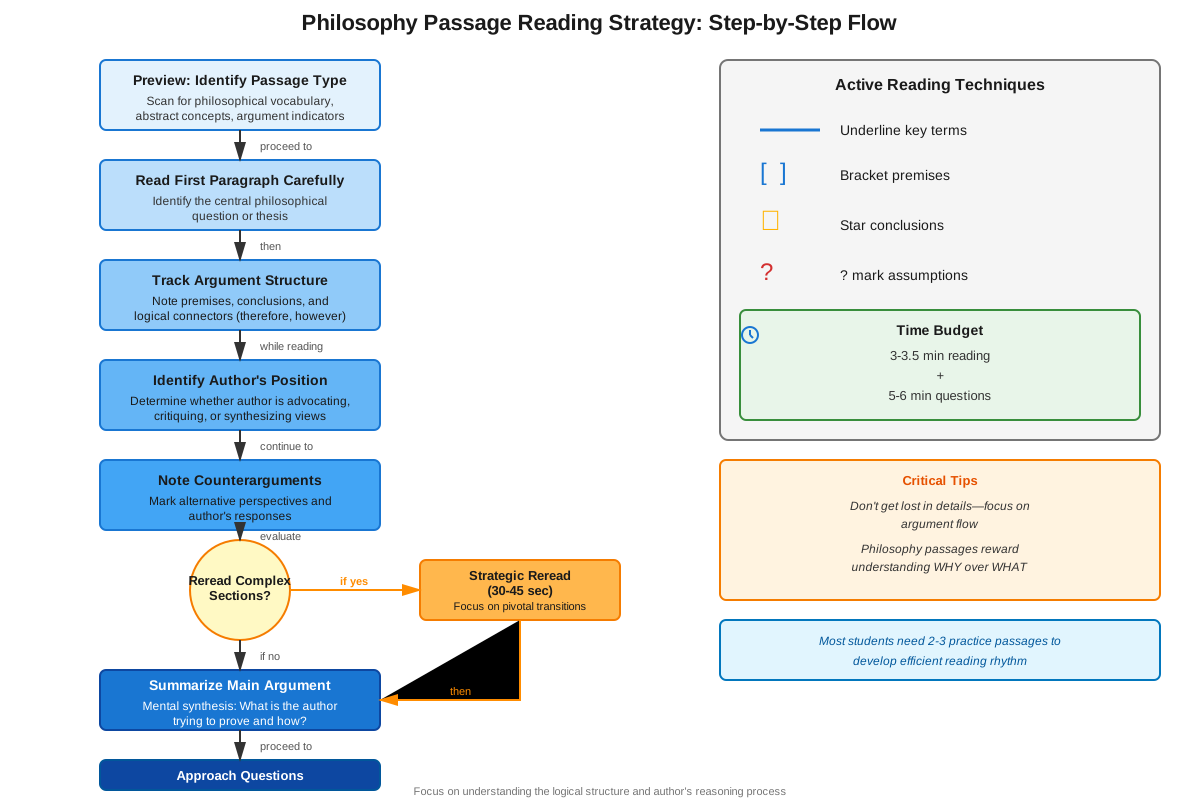
When approaching philosophy passages on the MCAT, begin by reading more slowly than with other passage types. The dense, abstract language requires careful attention to understand the argument's structure. As you read, actively identify the author's main thesis—often signaled by phrases like "I argue that," "the central claim is," or "ultimately." Mark this thesis in your passage notes, as most questions will relate back to it.
Trigger words that signal important logical relationships include: "however," "nevertheless," "in contrast" (indicating the author's position differs from what was just described); "because," "since," "given that" (introducing premises or reasons); "therefore," "thus," "consequently" (introducing conclusions); "assumes," "presupposes," "takes for granted" (indicating unstated assumptions); "implies," "suggests," "entails" (indicating logical consequences).
Track the passage's argumentative structure by noting: (1) What question or problem is being addressed? (2) What is the author's answer or position? (3) What reasons support this position? (4) What objections or alternative views are considered? (5) How does the author respond to these objections? Creating a simple outline of this structure helps answer questions about the author's reasoning.
For questions asking what the author would "most likely agree with" or how the author would respond to a new scenario, return to the passage's core reasoning rather than relying on memory. Apply the author's principles and logic to the new situation. Eliminate answer choices that contradict the passage's argument or introduce ideas not supported by the passage's reasoning.
Process of elimination is particularly powerful for philosophy passages. Wrong answers often: (1) contradict the author's stated position, (2) confuse the author's view with an opposing view presented in the passage, (3) make claims too extreme or absolute when the author's position is more nuanced, (4) introduce considerations not relevant to the passage's argument, or (5) align with common sense but not with the specific reasoning in the passage.
Allocate approximately 10 minutes per philosophy passage, including questions. If a passage seems particularly dense, don't panic—these passages are challenging for all test-takers. Focus on understanding the main argument and its basic structure rather than getting lost in complex details. Many questions can be answered with a solid grasp of the author's central thesis and primary supporting reasons.
When stuck between two answer choices, return to the passage and find specific textual support. The correct answer will have clear backing in the passage's reasoning, while the incorrect answer will typically have a subtle flaw—perhaps going slightly beyond what the passage supports or misrepresenting a nuance in the author's position.
Memory Techniques
PACE for approaching philosophy passages:
- Position: Identify the author's main thesis or argument
- Assumptions: Note unstated beliefs underlying the reasoning
- Counterarguments: Track objections and how the author responds
- Examples: Understand the purpose of thought experiments and illustrations
LOGIC for evaluating philosophical arguments:
- Link premises to conclusions: Does the conclusion actually follow?
- Objections considered: Has the author addressed potential criticisms?
- Gaps in reasoning: Are there unstated assumptions?
- Implications: What follows if we accept this argument?
- Consistency: Is the argument internally coherent?
Visualization strategy: Picture philosophical arguments as buildings. The conclusion is the roof—what the author wants you to accept. The premises are the supporting pillars—the reasons offered. Assumptions are the foundation—often underground and not visible, but essential for stability. Objections are forces pushing against the building—the author must show the structure can withstand them. This mental model helps track how all elements of the argument relate.
The "Three Perspectives" technique: Philosophy passages often present (1) a common view or traditional position, (2) an opposing or alternative view, and (3) the author's own position (which may synthesize or differ from both). As you read, label these perspectives to avoid confusion about which view the author actually endorses.
For remembering key philosophical distinctions, create contrast pairs:
- Normative (ought/should) vs. Descriptive (is/are)
- Necessary (must have) vs. Sufficient (enough to guarantee)
- Deductive (proves with certainty) vs. Inductive (supports with probability)
- Intrinsic (valuable in itself) vs. Instrumental (valuable as means to end)
Summary
Philosophy passages in the MCAT CARS section test students' ability to comprehend and analyze abstract arguments about fundamental questions of ethics, knowledge, reality, and society. These passages are characterized by dense prose, logical reasoning, conceptual distinctions, and dialectical structure that presents and responds to objections. Success requires identifying the author's main thesis, understanding the premises that support it, recognizing unstated assumptions, and tracking how the author addresses counterarguments. Unlike passages requiring background knowledge, philosophy passages demand pure reasoning ability—following the logic of the specific argument presented. Students must distinguish the author's position from alternative views discussed in the passage, understand the purpose of thought experiments, and apply the passage's reasoning to new scenarios. Common question types ask about the author's main argument, what would strengthen or weaken the reasoning, how the author would respond to objections, and what the author would likely agree with in novel situations. Mastering philosophy passages develops critical thinking skills essential for medical practice, where physicians must reason through ethical dilemmas, evaluate arguments, and make judgments in situations without clear empirical answers.
Key Takeaways
- Philosophy passages test logical reasoning and argument analysis without requiring prior philosophical knowledge; all necessary information is contained within the passage
- The author's main thesis is typically stated explicitly and defended through premises, consideration of objections, and responses to counterarguments
- Students must distinguish between the author's actual position and alternative views presented only for comparison or critique
- Thought experiments serve specific purposes in philosophical arguments—understanding what principle they're designed to test is crucial for answering related questions
- Success requires applying the passage's specific reasoning to new scenarios rather than relying on personal opinions or general moral intuitions
- Key philosophical distinctions (normative vs. descriptive, necessary vs. sufficient, deductive vs. inductive) frequently appear and must be recognized
- Wrong answers often confuse the author's view with opposing views, make claims too extreme, or introduce considerations not supported by the passage's reasoning
Related Topics
Humanities Passages in CARS: Philosophy passages share with humanities passages an emphasis on interpretation and argument analysis, but humanities passages typically focus on historical, cultural, or artistic contexts rather than abstract logical reasoning. Mastering philosophy passages strengthens skills for analyzing arguments in any humanities context.
Social Science Passages in CARS: While social science passages rely more on empirical evidence and research findings, they often incorporate philosophical assumptions about human nature, society, and knowledge. Understanding philosophical reasoning helps students identify these underlying assumptions in social science arguments.
Medical Ethics: The philosophical reasoning practiced in CARS passages directly applies to medical ethics coursework in medical school. Concepts like autonomy, beneficence, justice, and informed consent have philosophical foundations that CARS philosophy passages explore.
Evidence-Based Medicine: Epistemological questions about the nature and limits of knowledge, frequently addressed in philosophy passages, relate directly to understanding the foundations of evidence-based medicine and clinical reasoning under uncertainty.
Critical Thinking in Clinical Practice: The argument analysis skills developed through philosophy passages—identifying assumptions, evaluating logical connections, considering objections—transfer directly to clinical reasoning, where physicians must evaluate competing diagnoses, weigh treatment options, and make judgments with incomplete information.
Practice CTA
Now that you've mastered the core concepts of philosophy passages, it's time to put your knowledge into practice. Attempt the practice questions and flashcards to reinforce your understanding and build the pattern recognition essential for MCAT success. Philosophy passages become significantly more manageable with practice—each passage you work through strengthens your ability to identify argument structure, track the author's reasoning, and apply philosophical principles to new scenarios. Remember, these passages test skills that will serve you throughout medical school and your career as a physician. Embrace the challenge, trust the strategies you've learned, and approach each practice passage as an opportunity to refine your analytical abilities. You're developing the critical thinking skills that will make you not just a successful test-taker, but an exceptional physician.
Sign up free to keep reading
Create a free AnvayaPrep account to finish this MCAT guide on Philosophy passages — plus flashcards and practice questions.