Overview
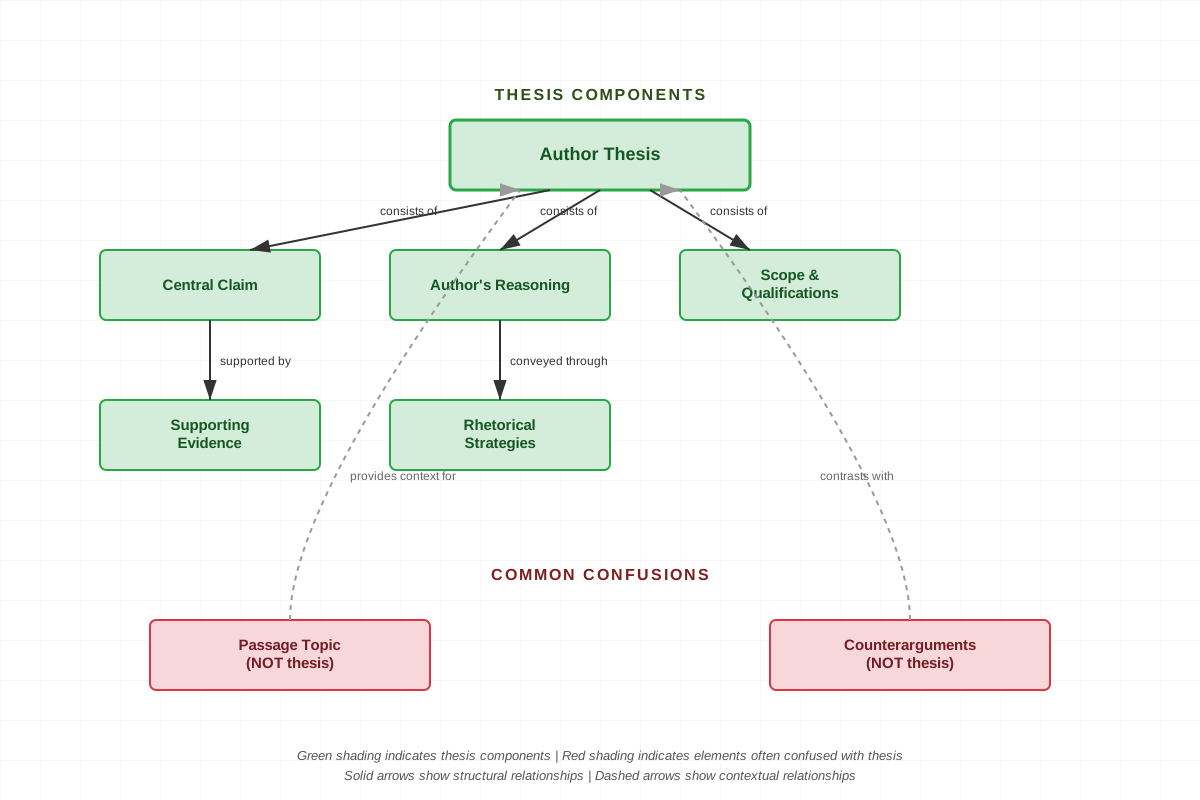
The author thesis represents the central argument, main claim, or overarching position that an author advances throughout a passage. In the context of the MCAT Critical Analysis and Reasoning Skills (CARS) section, identifying and understanding the author's thesis is fundamental to answering questions correctly. Unlike simply recognizing what a passage discusses, grasping the thesis requires students to discern what the author believes about the topic and why they hold that position. The thesis typically emerges through the accumulation of evidence, examples, and reasoning that the author presents, and it may be stated explicitly in a thesis statement or conveyed implicitly through the passage's overall argumentative structure.
Mastering author thesis identification is essential for MCAT success because approximately 30-40% of CARS questions directly or indirectly test this skill. Questions may ask students to identify the main idea, determine the author's primary purpose, select which statement the author would most likely agree with, or distinguish between the author's view and opposing perspectives presented in the passage. Without accurately identifying the thesis, students risk misinterpreting the passage's purpose and selecting answer choices that reflect tangential points, opposing views, or mere topics rather than the author's actual position.
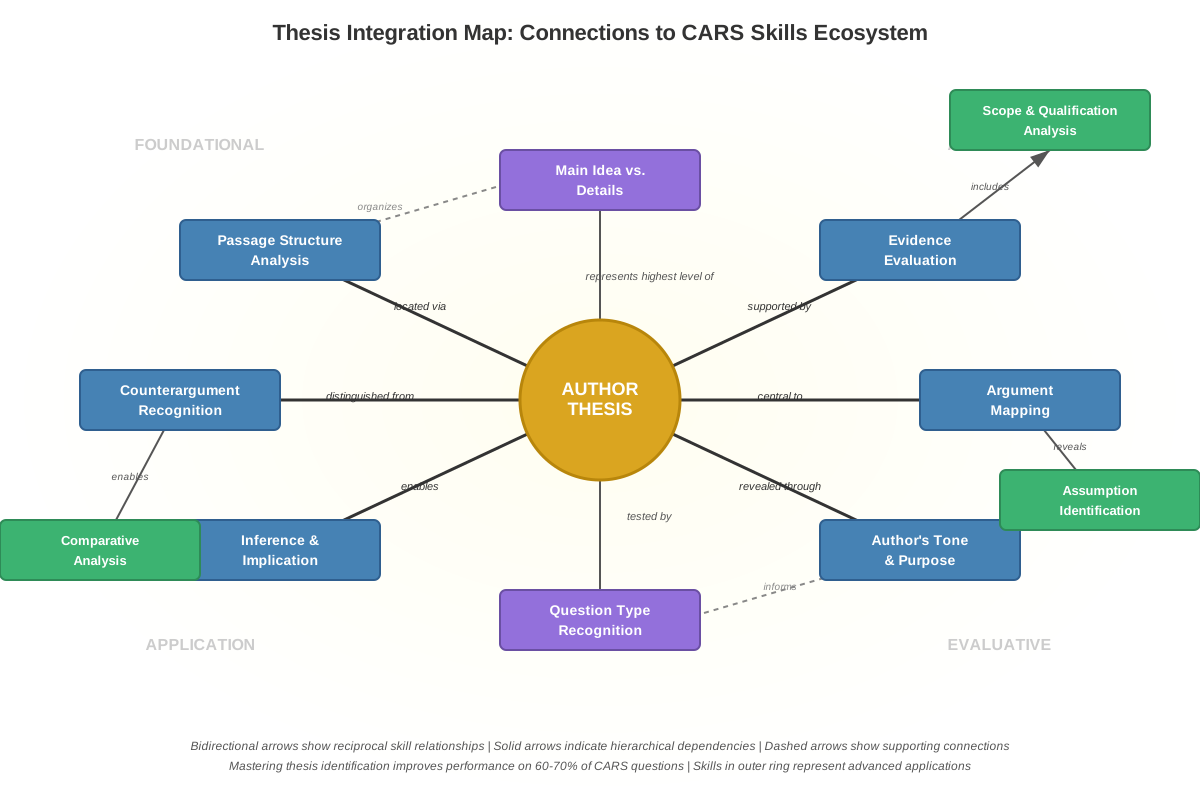
The author thesis connects intimately with other CARS Skills including identifying supporting evidence, recognizing rhetorical strategies, understanding passage structure, and evaluating argumentative strength. The thesis serves as the conceptual anchor around which all other passage elements orbit—examples support it, counterarguments challenge it, and qualifications refine it. Understanding this hierarchical relationship enables students to navigate complex passages efficiently and answer questions with confidence, making author thesis identification a cornerstone skill for achieving competitive CARS scores.
Learning Objectives
- [ ] Define author thesis using accurate Critical Analysis and Reasoning Skills terminology
- [ ] Explain why author thesis matters for the MCAT
- [ ] Apply author thesis to exam-style questions
- [ ] Identify common mistakes related to author thesis
- [ ] Connect author thesis to related Critical Analysis and Reasoning Skills concepts
- [ ] Distinguish between an author's thesis and the passage topic or subject matter
- [ ] Differentiate between explicitly stated and implicitly conveyed theses
- [ ] Evaluate the strength and scope of an author's thesis based on supporting evidence
- [ ] Recognize how thesis statements evolve or become refined throughout a passage
Prerequisites
- Basic reading comprehension: Understanding literal meaning of sentences and paragraphs is necessary before analyzing argumentative structure
- Familiarity with argumentative writing: Recognizing that authors make claims supported by evidence helps distinguish thesis from supporting details
- Understanding of main idea vs. details: Differentiating between central points and supporting information provides the foundation for thesis identification
- Knowledge of passage structure: Recognizing introductions, body paragraphs, and conclusions helps locate where theses typically appear
Why This Topic Matters
The ability to identify an author thesis extends beyond standardized testing into medical practice, where physicians must critically evaluate research articles, position papers, and clinical guidelines. Medical professionals regularly encounter conflicting viewpoints in literature and must discern each author's central claim to make evidence-based decisions. This skill directly translates to evaluating whether a study's conclusions are justified by its methodology or whether a review article's recommendations align with the evidence presented.
On the MCAT, author thesis questions appear with remarkable frequency across all CARS passages. Statistical analysis of released MCAT exams reveals that 2-3 questions per passage (out of 5-7 total) directly assess thesis comprehension. These questions appear in several formats: "The author's primary purpose is to...", "Which of the following best captures the main idea?", "The author would most likely agree with which statement?", and "The passage argument depends on which assumption?" Additionally, even questions that ostensibly test other skills—such as inference or application—require accurate thesis identification as a foundation for correct reasoning.
Common manifestations in exam passages include: humanities passages where authors critique prevailing interpretations of artworks or historical events; social science passages where authors propose new theoretical frameworks or challenge existing paradigms; and passages from various disciplines where authors synthesize multiple perspectives while advancing their own position. The MCAT deliberately selects passages with nuanced, sophisticated theses that require careful reading to distinguish from superficially similar but ultimately incorrect answer choices.
Core Concepts
Defining Author Thesis
The author thesis is the central, unifying claim that represents the author's position on the subject matter discussed in a passage. It answers the question: "What is the author trying to convince the reader to believe or accept?" The thesis differs fundamentally from the passage topic (what the passage is about) and from supporting details (evidence used to substantiate the thesis). For example, a passage topic might be "urban planning," while the thesis could be "contemporary urban planning overemphasizes efficiency at the expense of community cohesion."
A complete thesis typically contains both a subject and a predicate—it makes a specific claim about something rather than merely identifying an area of discussion. Strong thesis identification requires recognizing not just what the author discusses, but the evaluative stance, judgment, or argument the author advances. The thesis represents the author's intellectual contribution to the conversation about the topic.
Explicit vs. Implicit Theses
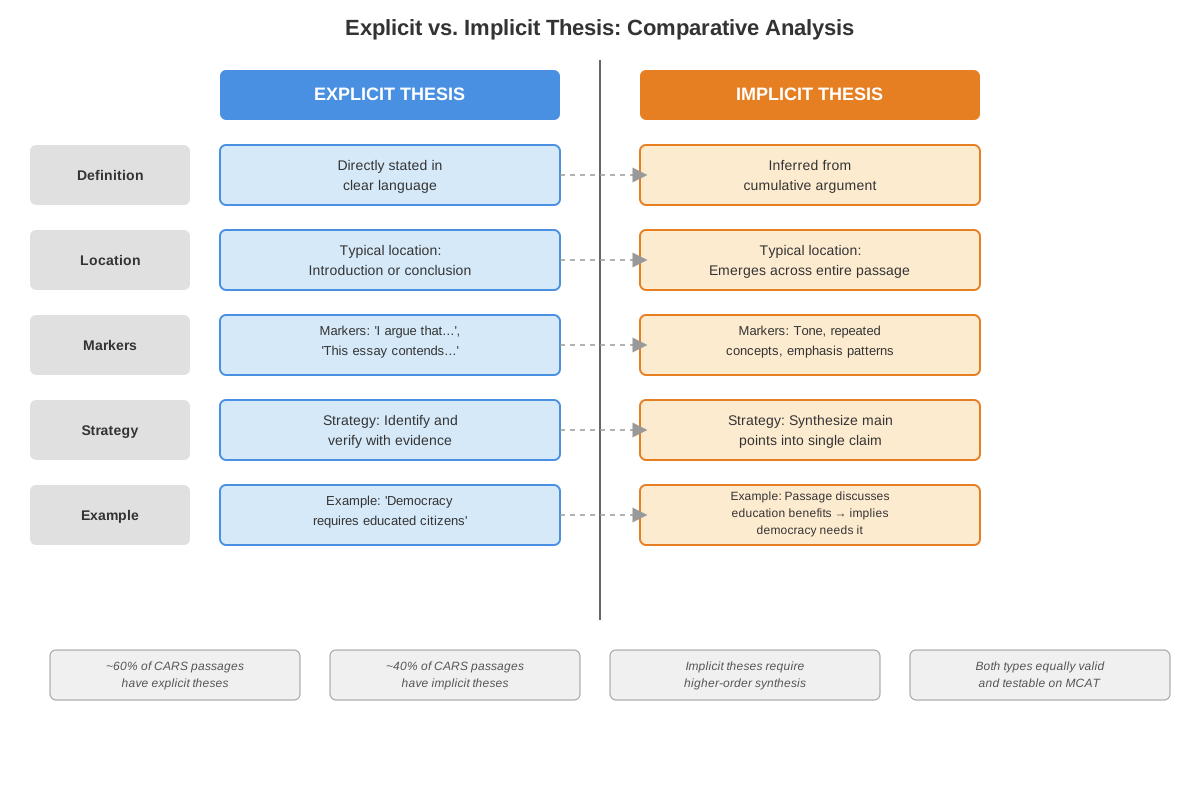
Explicit theses are directly stated in the passage, often in recognizable thesis statements. These typically appear in the introduction (first or second paragraph) or conclusion, using clear language that signals the author's position: "This essay argues that...", "I contend that...", "The evidence suggests that...", or "Ultimately, we must recognize that..." When an explicit thesis exists, students should identify it precisely and use it as a reference point for understanding the entire passage.
Implicit theses are conveyed through the cumulative effect of the passage without being directly stated in a single sentence. The author's position emerges through the pattern of evidence presented, the tone adopted toward different perspectives, and the overall argumentative trajectory. Identifying implicit theses requires synthesizing information across multiple paragraphs and recognizing the author's evaluative stance through word choice, emphasis, and structural decisions. Many MCAT passages feature implicit theses to increase difficulty and test deeper comprehension.
Thesis Scope and Specificity
The scope of a thesis refers to how broad or narrow the claim is. MCAT passages typically feature theses with moderate scope—neither so broad as to be vague nor so narrow as to be trivial. For instance, "Art influences society" is too broad, while "Picasso's 1907 painting Les Demoiselles d'Avignon used angular forms" is too narrow. An appropriate thesis might be "Modernist art movements fundamentally challenged traditional assumptions about representation and meaning."
Understanding scope helps eliminate answer choices that are too extreme (overgeneralizing the author's position) or too limited (focusing on a supporting example rather than the overarching claim). Students should ask: "Does this capture the full extent of what the author argues, without extending beyond what the passage supports?"
Thesis vs. Topic vs. Purpose
These three related but distinct concepts frequently confuse students:
| Element | Definition | Example |
|---|---|---|
| Topic | The subject matter discussed | "The role of emotions in moral judgment" |
| Thesis | The author's claim about the topic | "Emotions are not merely influences on moral judgment but constitute its essential foundation" |
| Purpose | Why the author wrote the passage | "To challenge rationalist accounts of ethics by demonstrating the centrality of emotional responses" |
The topic answers "What is this about?", the thesis answers "What does the author believe about it?", and the purpose answers "Why did the author write this?" All three are interconnected, but MCAT questions may target any of them specifically, requiring precise differentiation.
Supporting Evidence and Thesis Relationship
The thesis functions as the apex of an argumentative hierarchy, with all supporting evidence, examples, and reasoning serving to substantiate it. Recognizing this relationship helps students distinguish between the thesis and supporting points. Ask: "Is this claim being proven, or is it helping to prove something else?" The thesis is what's being proven; everything else is doing the proving.
Strong passages present multiple forms of support: empirical evidence, logical reasoning, expert testimony, historical examples, or theoretical frameworks. Each supporting element should connect clearly to the thesis. When a passage element seems disconnected from what appears to be the thesis, reconsider whether the thesis has been correctly identified.
Thesis Evolution and Qualification
Sophisticated passages may present a thesis that evolves or becomes refined as the argument progresses. An author might begin with a provisional claim, acknowledge complications or counterarguments, and then present a more nuanced final position. For example, an author might initially suggest "Technology improves education," then acknowledge limitations, and finally argue "Technology improves education when implemented with attention to pedagogical principles and equity concerns."
Qualifications are limitations or conditions the author places on their thesis. Words like "generally," "often," "in most cases," "when properly implemented," or "with certain exceptions" signal that the author is making a measured rather than absolute claim. MCAT answer choices frequently test whether students recognize these qualifications—overstated answer choices that remove qualifications are typically incorrect.
Recognizing Thesis Through Rhetorical Signals
Authors use various rhetorical signals to indicate their thesis:
- Emphasis markers: "most importantly," "crucially," "the key point is"
- Conclusion indicators: "therefore," "thus," "consequently," "it follows that"
- Position statements: "I argue," "this essay contends," "the evidence demonstrates"
- Evaluative language: Strong positive or negative descriptors revealing the author's stance
- Structural placement: First paragraph (introducing the thesis), last paragraph (restating it), or topic sentences of body paragraphs (developing it)
Recognizing these signals accelerates thesis identification and increases accuracy, particularly under time pressure.
Concept Relationships
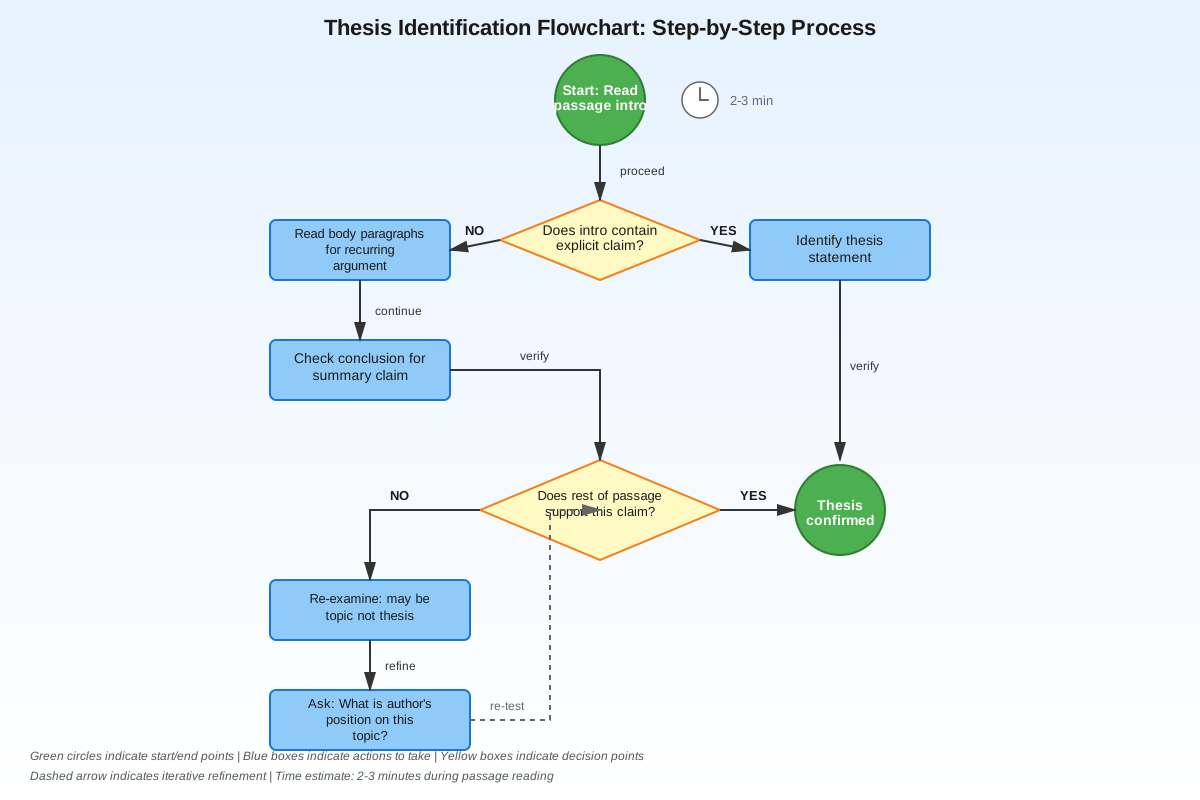
The author thesis serves as the central organizing principle connecting all other CARS skills. Passage structure is designed to present and support the thesis—introductions establish it, body paragraphs develop it through evidence and reasoning, and conclusions reinforce it. Understanding this relationship allows students to use structural analysis to locate and verify the thesis.
Supporting evidence exists in a hierarchical relationship with the thesis: the thesis is the superordinate claim, while evidence provides subordinate support. This relationship flows in one direction—evidence supports the thesis, not vice versa. Recognizing this hierarchy prevents students from confusing a particularly detailed example with the overarching argument.
Counterarguments and alternative perspectives relate to the thesis through opposition or contrast. Authors present counterarguments to acknowledge complexity and then refute or qualify them, ultimately strengthening their own thesis. The thesis represents the author's position after considering these alternatives. Students must distinguish between views the author presents for consideration and the view the author actually endorses.
Author's tone and attitude directly reflect the thesis. If the thesis is critical of a particular theory, the tone when discussing that theory will be skeptical or negative. If the thesis defends a practice, the tone will be supportive. Tone serves as a verification mechanism—if the identified thesis doesn't align with the author's tone, reconsider the thesis identification.
The relationship map flows as follows:
Topic → establishes subject matter → Thesis (author's claim about topic) → supported by → Evidence and Examples → organized through → Passage Structure → challenged by → Counterarguments → which are addressed to strengthen → Thesis → conveyed through → Tone and Rhetorical Strategies → ultimately serving → Author's Purpose
High-Yield Facts
⭐ The thesis is what the author believes or argues, not merely what the passage discusses—distinguish between topic and thesis in every passage.
⭐ Approximately 30-40% of CARS questions directly test thesis comprehension—mastering this skill significantly impacts overall CARS performance.
⭐ The thesis may be explicit (directly stated) or implicit (conveyed cumulatively)—always synthesize the entire passage to verify thesis identification.
⭐ Wrong answer choices often present supporting details, opposing views, or overgeneralizations—eliminate choices that are too narrow, too broad, or contrary to the author's position.
⭐ Thesis statements typically appear in introductions or conclusions—but always verify by checking consistency with the entire passage.
- The thesis represents the author's intellectual contribution, not a neutral summary of the topic.
- Qualifications and limitations are integral to the thesis—removing them creates an inaccurate representation.
- Multiple perspectives in a passage don't mean multiple theses—identify which perspective the author endorses.
- The thesis should account for the majority of the passage content—if large sections seem unrelated, reconsider the thesis.
- Tone and evaluative language provide crucial clues about the author's thesis—neutral descriptions suggest background information rather than thesis.
- The most detailed or emotionally charged section often relates directly to the thesis—authors emphasize what matters most to their argument.
- Questions asking about "main idea," "primary purpose," "central claim," or "author would agree" all test thesis comprehension.
Quick check — test yourself on Author thesis so far.
Try Flashcards →Common Misconceptions
Misconception: The thesis is always explicitly stated in the first paragraph.
Correction: While theses often appear early, they may be implicit, emerge gradually, or be stated most clearly in the conclusion. Always synthesize the entire passage to verify thesis identification rather than assuming the first paragraph contains it.
Misconception: The most detailed example or longest paragraph contains the thesis.
Correction: Detailed examples and extended discussions typically provide supporting evidence for the thesis rather than stating it. The thesis is usually more abstract and general than specific examples. Length indicates emphasis but not necessarily thesis location.
Misconception: If a passage discusses multiple perspectives, it has multiple theses.
Correction: A passage has one thesis—the author's position. Multiple perspectives may be presented for context, comparison, or refutation, but only one represents what the author actually argues. Distinguish between perspectives the author describes and the perspective the author endorses.
Misconception: The thesis is the same as the topic or subject matter.
Correction: The topic is what the passage is about (e.g., "climate policy"), while the thesis is the author's specific claim about that topic (e.g., "market-based climate policies are insufficient without regulatory enforcement"). The thesis makes an argument; the topic simply identifies a domain of discussion.
Misconception: Identifying the thesis is subjective and different readers can legitimately identify different theses.
Correction: While passages can be complex, the author's thesis is an objective feature of the text that can be identified through careful analysis of evidence, structure, and rhetorical signals. MCAT passages are written to have one defensible thesis, and answer choices are crafted to distinguish between correct thesis identification and common misreadings.
Misconception: The thesis must be a single sentence from the passage.
Correction: While explicit theses may be stated in one sentence, the complete thesis often requires synthesizing information across multiple sentences or paragraphs. For implicit theses, no single sentence may capture the full argument—students must construct a thesis statement based on the passage's overall trajectory.
Misconception: Strong, absolute language always indicates the thesis.
Correction: Authors may use strong language when presenting opposing views they plan to refute, or when emphasizing supporting evidence. Conversely, the thesis itself may be carefully qualified and nuanced. Evaluate whether strong language represents the author's position or another perspective being discussed.
Worked Examples
Example 1: Explicit Thesis Identification
Passage Excerpt: "Art historians have long debated whether aesthetic value is objective or subjective. Some argue that beauty exists independently of observers, while others contend that aesthetic judgments are entirely personal. However, this dichotomy is false. Aesthetic value emerges from the interaction between artwork properties and culturally-shaped perceptual capacities. Neither purely objective nor purely subjective, aesthetic experience is best understood as intersubjective—grounded in shared human perceptual and cognitive structures while remaining open to cultural variation. The following analysis demonstrates how this intersubjective framework resolves longstanding puzzles in aesthetic theory."
Question: Which of the following best represents the author's thesis?
A) Art historians disagree about whether aesthetic value is objective or subjective.
B) Aesthetic value is entirely subjective and varies from person to person.
C) Aesthetic value emerges from interaction between artwork properties and culturally-shaped perception, making it intersubjective rather than purely objective or subjective.
D) Aesthetic experience is grounded in shared human cognitive structures.
Analysis:
- Step 1: Identify what the author argues versus what the author merely describes. The first two sentences describe existing debates (background information), not the author's position.
- Step 2: Locate position indicators. "However, this dichotomy is false" signals the author is rejecting both positions described earlier and introducing their own view.
- Step 3: Identify the claim. The author argues aesthetic value is "intersubjective"—neither purely objective nor subjective, but emerging from interaction between artwork and culturally-shaped perception.
- Step 4: Verify scope. The thesis should account for the entire passage. The phrase "following analysis demonstrates" indicates the rest of the passage will support this intersubjective framework.
- Step 5: Evaluate choices:
- Choice A describes the debate (topic) but not the author's position—eliminate.
- Choice B represents one position the author explicitly rejects—eliminate.
- Choice C captures the complete thesis including the key term "intersubjective" and the explanation of what this means—correct.
- Choice D is too narrow, capturing only part of the thesis without the crucial "intersubjective" framework or the rejection of the objective/subjective dichotomy—eliminate.
Answer: C
Connection to Learning Objectives: This example demonstrates distinguishing between topic (the debate about aesthetic value) and thesis (the author's intersubjective position), and shows how to eliminate choices that present background information or opposing views rather than the author's actual argument.
Example 2: Implicit Thesis Identification
Passage Summary: A passage discusses how 19th-century industrialization changed family structures. Paragraph 1 describes pre-industrial family economies where production occurred in households. Paragraph 2 details how factory work separated workplace from home. Paragraph 3 explains how this separation created the "cult of domesticity" idealizing women's homemaking. Paragraph 4 notes that this ideology obscured women's continued economic contributions. Throughout, the author uses phrases like "supposedly separate spheres," "idealized rather than actual," and "masked ongoing economic realities."
Question: The author's primary purpose is to:
A) Describe how industrialization changed family structures in the 19th century.
B) Explain the origins of the cult of domesticity ideology.
C) Argue that the cult of domesticity ideology misrepresented actual gender roles and economic contributions.
D) Compare pre-industrial and industrial family economies.
Analysis:
- Step 1: Note that no single sentence explicitly states "I argue that..." This requires synthesizing the implicit thesis.
- Step 2: Identify the author's evaluative stance through word choice. Terms like "supposedly," "idealized rather than actual," and "masked" indicate skepticism toward the cult of domesticity ideology.
- Step 3: Determine what the author emphasizes. The passage doesn't merely describe changes (which would be neutral) but specifically highlights the gap between ideology and reality.
- Step 4: Synthesize the implicit argument. The author argues that the cult of domesticity ideology was inaccurate—it presented an idealized version that didn't match women's actual continued economic roles.
- Step 5: Evaluate choices:
- Choice A is too neutral and broad—it describes the topic but not the author's specific argument about ideology versus reality—eliminate.
- Choice B is too narrow, focusing on one element (origins) without capturing the critical stance toward the ideology—eliminate.
- Choice C captures both the specific focus (cult of domesticity) and the author's critical argument (it misrepresented reality)—correct.
- Choice D focuses on comparison, which is background information in paragraph 1, not the main argument—eliminate.
Answer: C
Connection to Learning Objectives: This example demonstrates identifying implicit theses through synthesis of tone, emphasis, and evaluative language across multiple paragraphs, and shows how neutral descriptive answer choices often misrepresent argumentative passages.
Exam Strategy
When approaching MCAT passages, implement a systematic thesis identification process before attempting questions. During the initial read-through (3-4 minutes), actively search for the thesis by asking: "What is the author trying to convince me of?" Mark potential thesis statements or, for implicit theses, jot a brief synthesis in the margin.
Trigger words and phrases that signal thesis statements include:
- Argument indicators: "argues," "contends," "maintains," "claims"
- Conclusion markers: "therefore," "thus," "consequently," "ultimately"
- Emphasis signals: "most importantly," "crucially," "the key point"
- Contrast markers introducing the author's view: "however," "nevertheless," "in contrast"
- Evaluative language revealing stance: "unfortunately," "remarkably," "problematically"
Process-of-elimination strategy for thesis questions:
- Eliminate choices that are too narrow: If a choice focuses on a single example or supporting detail rather than the overarching argument, eliminate it. Ask: "Does this account for the entire passage or just one part?"
- Eliminate choices that are too broad: If a choice could apply to many passages on the general topic rather than capturing this author's specific argument, it's likely too broad. The correct thesis should be distinctive to this particular passage.
- Eliminate opposing views: Passages often present counterarguments or alternative perspectives. Choices representing views the author argues against are common wrong answers. Verify that the choice represents what the author endorses, not what they critique.
- Eliminate neutral descriptions: For argumentative passages, purely descriptive choices that don't capture the author's evaluative stance are typically incorrect. The thesis should reflect the author's position, not just the topic.
- Verify tone alignment: The correct thesis should align with the author's tone. If the author is critical throughout but a choice presents a positive claim, or vice versa, eliminate it.
Time allocation: Spend 30-45 seconds on thesis identification during the initial read. This investment pays dividends because thesis comprehension enables faster, more accurate answering of multiple questions. If uncertain between two choices, return to the passage and verify which one aligns with the majority of the content and the author's tone.
Question stem variations all testing thesis comprehension:
- "The author's main point is..."
- "The primary purpose of the passage is to..."
- "Which of the following best captures the central claim?"
- "The author would most likely agree with which statement?"
- "The passage argument primarily serves to..."
Recognize these as thesis questions and apply the same identification strategy regardless of wording variations.
Memory Techniques
T.H.E.S.I.S. Mnemonic for thesis identification:
- Tone: What's the author's attitude? (Critical, supportive, analytical?)
- Hierarchy: What's the superordinate claim that other points support?
- Emphasis: What does the author stress or return to repeatedly?
- Structure: Where in the passage structure does the main claim appear?
- Indicators: What rhetorical signals point to the thesis?
- Synthesis: What claim emerges from combining all paragraphs?
Visualization Strategy: Picture the passage as a tree. The thesis is the trunk—everything else (branches, leaves) extends from it and depends on it. If you've identified a "branch" (supporting detail) as the thesis, trace it back to find the trunk it grows from.
The "So What?" Test: After identifying a potential thesis, ask "So what? Why does this matter? What's the author really arguing?" If your answer reveals a deeper claim, that deeper claim is likely the actual thesis. For example, if you identify "Social media use has increased," ask "So what?"—the answer might be "So what? This increase has fundamentally altered political discourse," which is the actual thesis.
Acronym for Common Wrong Answers: T.O.N.E.
- Too narrow (supporting detail, not thesis)
- Opposing view (what author argues against)
- Neutral description (topic, not argumentative thesis)
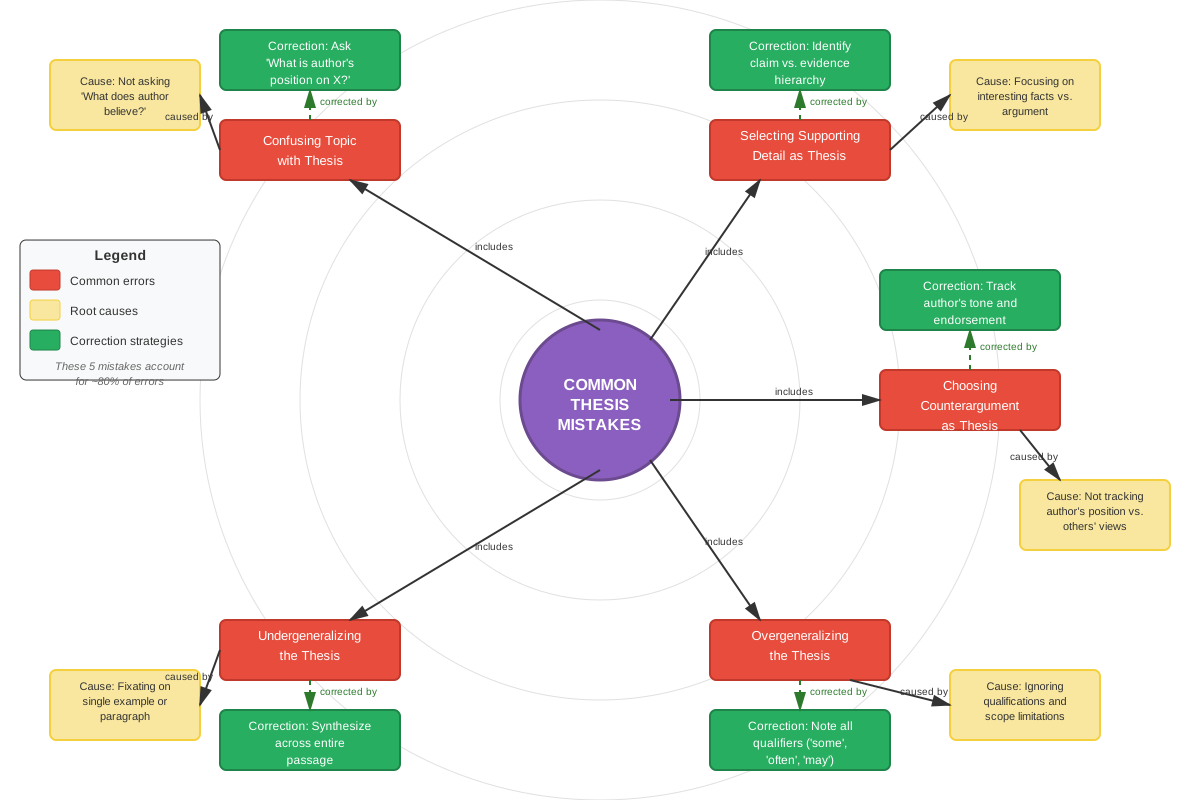
- Extreme/overgeneralized (goes beyond passage scope)
When evaluating answer choices, check whether each fits a T.O.N.E. category to eliminate it efficiently.
Summary
The author thesis represents the central argument or claim that an author advances throughout a passage, distinguishing itself from the mere topic (subject matter) and from supporting details (evidence). Mastering thesis identification is essential for MCAT CARS success because it underlies 30-40% of questions and provides the foundation for understanding passage structure, evaluating arguments, and making inferences. Theses may be explicit (directly stated) or implicit (conveyed cumulatively), and students must synthesize information across the entire passage while attending to rhetorical signals, tone, and emphasis patterns. Common errors include confusing the thesis with supporting details, opposing views, or neutral topic descriptions. Successful thesis identification requires distinguishing between what the author discusses and what the author argues, recognizing the hierarchical relationship between thesis and evidence, and verifying that the identified thesis accounts for the passage's overall content and aligns with the author's evaluative stance. Strategic approaches include systematic searching during initial reading, using process-of-elimination to remove choices that are too narrow, too broad, oppositional, or neutral, and verifying tone alignment between the thesis and the author's language throughout the passage.
Key Takeaways
- The author thesis is the central claim or argument the author advances—what they want readers to believe—not merely what the passage discusses
- Distinguish between topic (subject matter), thesis (author's claim about the topic), and purpose (why the author wrote the passage)
- Theses may be explicit (directly stated) or implicit (requiring synthesis across paragraphs), with implicit theses being more challenging and common on difficult passages
- Approximately 30-40% of CARS questions directly test thesis comprehension through various question stems about main idea, primary purpose, or author agreement
- Common wrong answers present supporting details (too narrow), opposing views (what author argues against), neutral descriptions (topic without argumentative stance), or overgeneralizations (beyond passage scope)
- Use rhetorical signals (emphasis markers, conclusion indicators, evaluative language) and structural placement (introductions, conclusions) to locate and verify the thesis
- The thesis sits at the top of an argumentative hierarchy—all evidence, examples, and reasoning should support it, providing a verification mechanism for thesis identification
Related Topics
Passage Structure and Organization: Understanding how passages are organized (introduction, body, conclusion) and how different structural elements (topic sentences, transitions, paragraph functions) relate to and support the thesis. Mastering thesis identification enables more sophisticated structural analysis.
Supporting Evidence and Examples: Learning to distinguish between different types of evidence (empirical data, logical reasoning, expert testimony, analogies) and evaluate how effectively they support the thesis. Thesis identification is prerequisite to evidence evaluation.
Author's Tone and Attitude: Developing skills to recognize subtle indicators of the author's stance (word choice, emphasis, rhetorical questions) and using tone as a verification mechanism for thesis identification. These skills are mutually reinforcing.
Counterarguments and Alternative Perspectives: Understanding how authors present, acknowledge, and respond to opposing views, and how this dialectical structure ultimately strengthens the thesis. Requires distinguishing between views presented and views endorsed.
Inference and Application Questions: Extending thesis comprehension to predict what the author would think about new scenarios or how the author's argument applies to different contexts. Thesis mastery is foundational for these higher-order skills.
Practice CTA
Now that you've mastered the conceptual foundations of author thesis identification, it's time to apply these skills to authentic MCAT-style passages. The practice questions and flashcards have been specifically designed to reinforce the strategies and concepts covered in this guide, with particular emphasis on distinguishing theses from supporting details, recognizing implicit arguments, and eliminating common wrong answer types. Consistent practice with immediate feedback is the most effective way to transform conceptual understanding into the automatic, efficient skill application required for CARS success. Challenge yourself to articulate why wrong answers are incorrect using the T.O.N.E. framework, and verify that your thesis identification accounts for the entire passage content. Your investment in deliberate practice now will yield significant score improvements—let's put these skills to work!
Sign up free to keep reading
Create a free AnvayaPrep account to finish this MCAT guide on Author thesis — plus flashcards and practice questions.