Overview
Eliminating extreme answers is a critical test-taking strategy within the Critical Analysis and Reasoning Skills (CARS) section of the MCAT that enables students to systematically identify and remove answer choices that overstate, understate, or distort the author's position. This technique recognizes that the MCAT CARS section rewards nuanced reading comprehension and penalizes students who select answers containing absolute language, sweeping generalizations, or claims that extend beyond the scope of the passage. Extreme answers often include words like "always," "never," "only," "all," "none," "impossible," or "must," which signal categorical claims rarely supported by the measured, academic prose typical of MCAT passages.
The CARS Skills tested on the MCAT demand that students distinguish between what an author explicitly states, what can be reasonably inferred, and what represents an unjustified leap in logic. Extreme answer choices exploit common reading errors: students who skim passages, bring in outside knowledge, or fail to appreciate the author's careful hedging often fall prey to these distractors. By mastering the systematic elimination of extreme answers, test-takers can significantly improve their accuracy even when uncertain about the correct response, transforming a 25% random guess into a 50% or better probability by removing two clearly extreme options.
Within the broader framework of Critical Analysis and Reasoning Skills MCAT preparation, eliminating extreme answers connects intimately with passage analysis, author tone identification, and claim evaluation. This strategy serves as both a defensive mechanism—protecting against careless errors—and an offensive tool that accelerates question completion by quickly narrowing the field of viable answers. Understanding this technique is essential because approximately 60-70% of CARS questions include at least one extreme distractor, making this skill applicable across the majority of the 53 CARS questions students will encounter on test day.
Learning Objectives
- [ ] Define Eliminating extreme answers using accurate Critical Analysis and Reasoning Skills terminology
- [ ] Explain why Eliminating extreme answers matters for the MCAT
- [ ] Apply Eliminating extreme answers to exam-style questions
- [ ] Identify common mistakes related to Eliminating extreme answers
- [ ] Connect Eliminating extreme answers to related Critical Analysis and Reasoning Skills concepts
- [ ] Distinguish between appropriately strong language and unjustified extreme claims in answer choices
- [ ] Recognize qualifier words that signal moderate versus extreme positions
- [ ] Evaluate when an extreme answer choice might actually be correct based on passage support
Prerequisites
- Basic reading comprehension skills: Understanding main ideas, supporting details, and paragraph structure enables recognition of what the passage actually claims versus what answer choices suggest
- Familiarity with MCAT CARS question types: Knowledge of Foundations of Comprehension, Reasoning Within the Text, and Reasoning Beyond the Text questions helps contextualize when extreme answers are most likely to appear
- Understanding of logical reasoning fundamentals: Recognizing the difference between necessary and sufficient conditions, and between correlation and causation, provides the foundation for identifying logical overreach in answer choices
- Passage annotation techniques: The ability to mark key claims, transitions, and author opinions allows for quick verification when evaluating whether an answer choice exceeds passage support
Why This Topic Matters
In clinical and academic contexts, the ability to identify extreme or unsupported claims directly translates to critical evaluation of medical literature, patient communications, and research findings. Physicians must constantly assess whether conclusions drawn from studies are justified by the data or represent overstatements that could lead to inappropriate treatment decisions. The skill of recognizing when language exceeds evidentiary support protects against both medical errors and the uncritical acceptance of preliminary findings.
On the MCAT specifically, eliminating extreme answers appears with remarkable frequency across the CARS section. Statistical analysis of released MCAT materials suggests that approximately 65% of CARS questions contain at least one extreme distractor, and roughly 15-20% of questions can be answered correctly through elimination alone, without definitively identifying the right answer. Questions testing author agreement/disagreement, main idea identification, and inference drawing are particularly rich sources of extreme answer choices. The AAMC deliberately includes these distractors because they effectively discriminate between students who read carefully and those who rely on superficial pattern matching or outside assumptions.
Common manifestations in exam passages include answer choices that transform an author's qualified claim ("some evidence suggests") into an absolute statement ("definitively proves"), extend a limited argument about one domain into a universal principle, or attribute to the author a position more radical than what the passage supports. For instance, if a passage discusses how social media can contribute to anxiety in certain populations, an extreme answer might claim the author believes social media always causes anxiety or that it is the primary cause of modern mental health issues. Recognizing these distortions quickly and confidently is essential for maintaining the pace required to complete 53 questions in 90 minutes.
Core Concepts
Definition and Characteristics of Extreme Answers
An extreme answer is a response option that makes categorical, absolute, or sweeping claims that exceed the scope, strength, or specificity of what the passage supports. These answers typically fail one of three tests: they overstate the degree of certainty the author expresses, they expand the scope beyond what the passage addresses, or they eliminate nuance that the author carefully maintains.
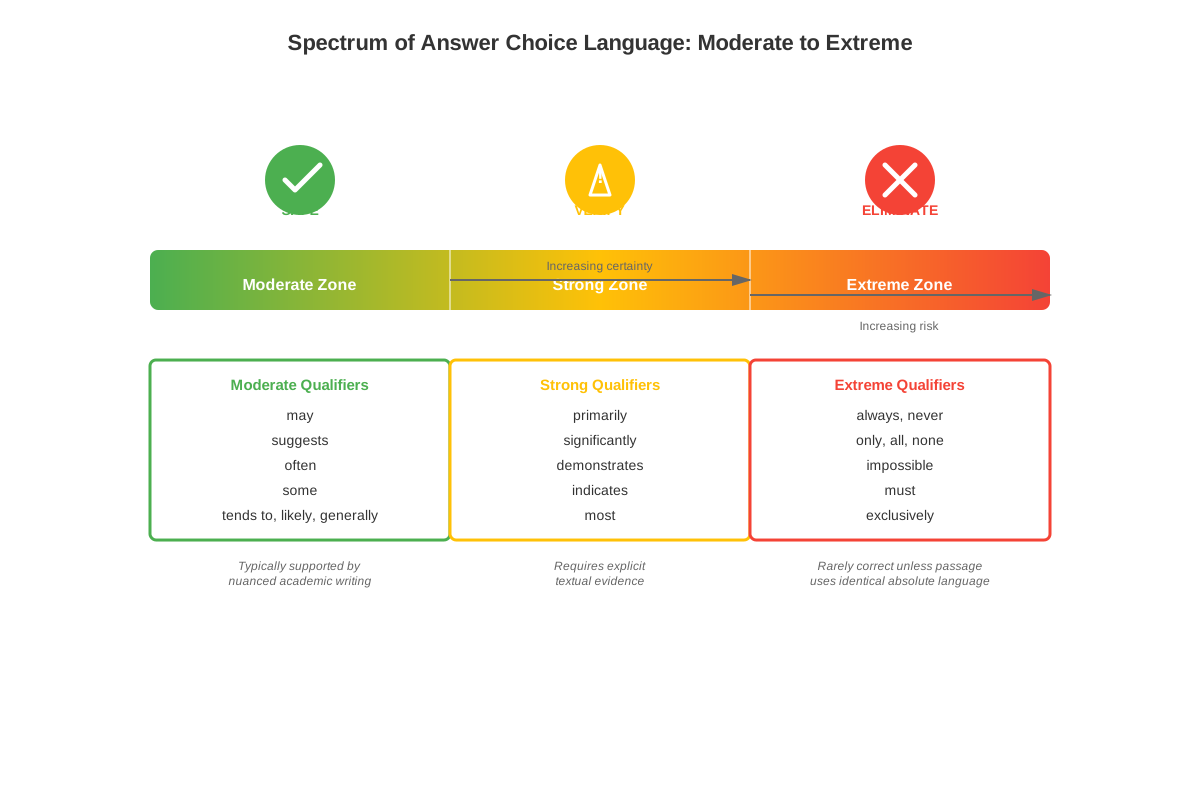
Extreme answers commonly feature absolute qualifiers—words that permit no exceptions or middle ground. The most frequent offenders include:
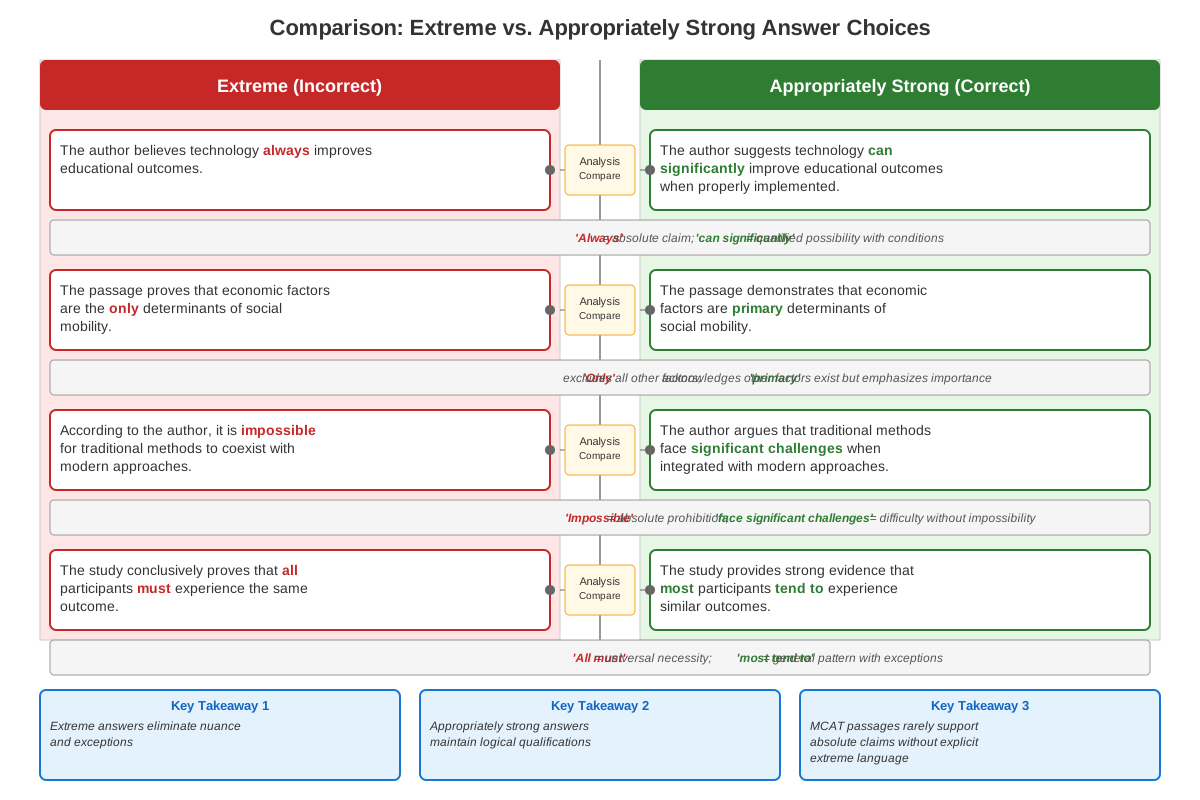
| Extreme Qualifiers | Moderate Alternatives |
|---|---|
| Always, never, all, none | Often, usually, many, some |
| Only, solely, exclusively | Primarily, mainly, largely |
| Must, cannot, impossible | Likely, probably, unlikely |
| Completely, totally, entirely | Substantially, significantly, considerably |
| Proves, definitively establishes | Suggests, supports, indicates |
However, the mere presence of absolute language does not automatically disqualify an answer. The critical question is whether the passage provides sufficient support for such strong language. If an author explicitly states "all participants showed improvement," then an answer containing "all" would be justified. The error occurs when answer choices introduce extremity not present in the source material.
The Spectrum of Claim Strength
Understanding claim strength requires recognizing that arguments exist on a continuum from tentative suggestions to definitive assertions. MCAT passages, drawn from humanities and social sciences, typically occupy the moderate-to-cautious range of this spectrum. Authors in these disciplines routinely hedge their claims with qualifiers like "may," "might," "could," "appears to," or "suggests that."
The spectrum can be visualized as:
- Speculative: "It is possible that..." / "One might wonder whether..."
- Suggestive: "Evidence indicates..." / "This supports the view that..."
- Probable: "It is likely that..." / "The data strongly suggest..."
- Definitive: "This proves..." / "It is certain that..."
Most MCAT passages operate in zones 1-3, while extreme answer choices often leap to zone 4. A passage discussing how economic factors "contribute to" educational disparities would not support an answer claiming economics "determine" or "are solely responsible for" such disparities. The shift from contributory to deterministic language represents a critical escalation in claim strength.
Scope Violations
Scope violations occur when answer choices extend claims beyond the boundaries the passage establishes. These violations manifest in several forms:
Temporal scope expansion: A passage discussing 19th-century literature should not support answers about "all of literary history" unless explicitly addressed.
Population scope expansion: Research on college students does not justify claims about "all people" or "humanity in general."
Domain scope expansion: An argument about economic policy does not automatically extend to political, social, or cultural domains unless the passage makes those connections.
Causal scope expansion: Correlation or association described in a passage does not support answer choices claiming causation, and single-factor explanations rarely justify multi-factor claims.
Context-Dependent Extremity
Advanced test-takers recognize that extremity is context-dependent. An answer that would be extreme for one passage might be perfectly justified for another. Consider these scenarios:
- A passage arguing that a particular philosophical position is "fundamentally flawed" could support an answer using strong negative language
- A passage presenting empirical research with universal findings could justify answers containing "all" or "every"
- A passage explicitly rejecting alternative explanations could support answers using "only" or "solely"
The key is passage-answer alignment: the strength of language in the answer must match the strength of language and evidence in the passage. This requires careful attention to how authors signal their confidence levels through word choice, citation of evidence, and acknowledgment of limitations or counterarguments.
Strategic Application in Question Types
Different MCAT CARS question types exhibit varying susceptibility to extreme answer distractors:
Main Idea questions: Extreme answers often overstate the author's central claim or ignore the balanced, exploratory nature of many passages. If a passage examines multiple perspectives on an issue, an answer presenting one perspective as definitively correct is likely extreme.
Inference questions: These are particularly vulnerable to extreme distractors because students must extend beyond explicit statements. However, valid inferences remain tethered to passage content—extreme answers make leaps the passage cannot support.
Author Agreement questions: Extreme answers frequently mischaracterize the author's position as more radical or absolute than the passage indicates. Authors who "question" a theory would not necessarily "reject" it entirely.
Application questions: When asked how an author would respond to new information, extreme answers often predict reactions more categorical than the author's measured tone would suggest.
The Exception: When Extreme Answers Are Correct
Approximately 5-10% of correct MCAT CARS answers contain what initially appears to be extreme language. These exceptions occur when:
- The passage itself is extreme: Some passages, particularly opinion pieces or advocacy arguments, do make categorical claims
- The question asks about specific passage statements: Questions like "According to the passage..." may require selecting answers with strong language if that language appears in the text
- The extreme language is actually precise: Sometimes "only" or "must" accurately captures a logical relationship the passage establishes
- All other answers are demonstrably wrong: When three answers contradict the passage, the remaining "extreme" answer may be correct by elimination
This reality underscores why eliminating extreme answers is a strategy, not an absolute rule. The technique works because extreme answers are usually wrong, but students must verify against passage content rather than applying the strategy mechanically.
Concept Relationships
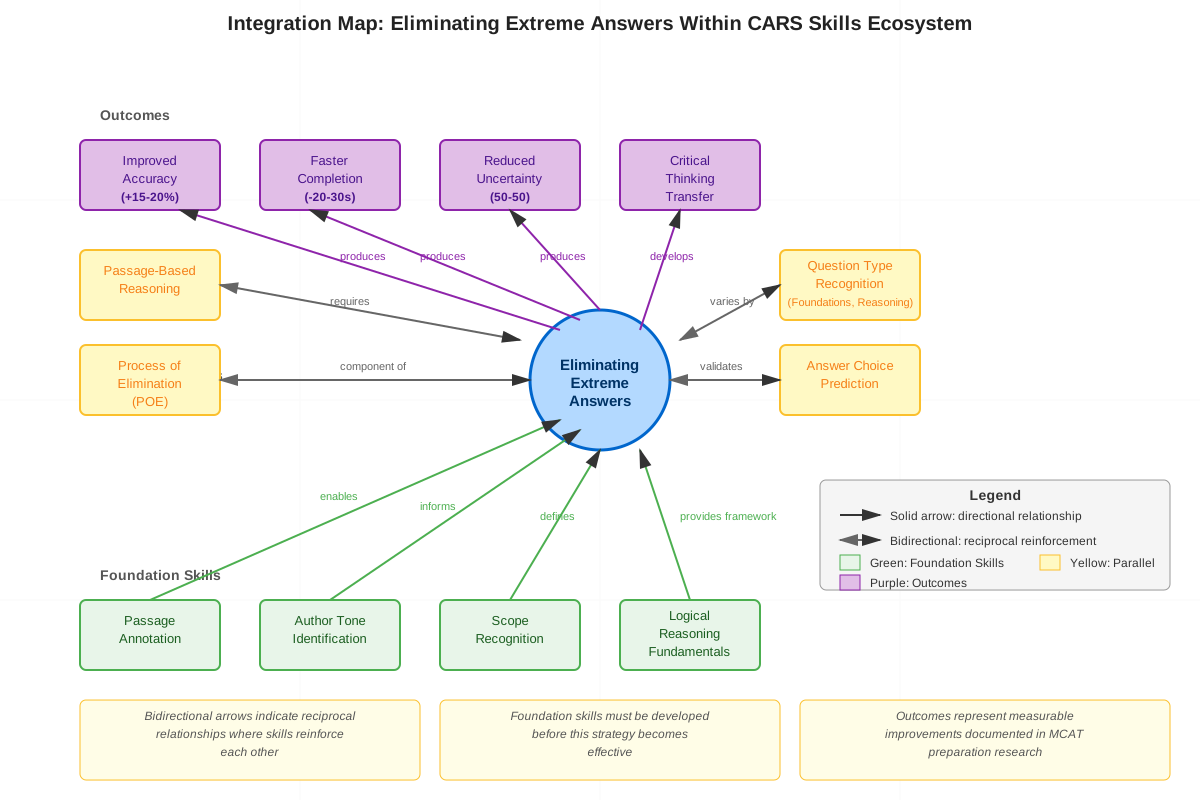
The strategy of eliminating extreme answers functions as a node in an interconnected network of CARS skills. At its foundation, this technique depends on accurate passage comprehension—students cannot identify when an answer exceeds passage support without first understanding what the passage actually claims. This comprehension requires active reading and annotation skills that capture the author's main arguments, supporting evidence, and qualifying language.
The relationship flows as follows: Active Reading → captures Author's Tone and Claim Strength → enables Passage-Answer Comparison → facilitates Eliminating Extreme Answers → improves Answer Selection Accuracy.
Eliminating extreme answers connects bidirectionally with identifying passage scope. Understanding what topics, time periods, and populations the passage addresses allows recognition of scope violations in answer choices, while the process of evaluating answers for extremity reinforces awareness of passage boundaries. Similarly, this strategy interacts with recognizing author hedging and qualifiers—the more attuned students become to moderate language in passages, the more readily they spot unjustified escalation in answer choices.
The technique also relates to wrong answer pathology more broadly. Extreme answers represent one category in a taxonomy that includes out-of-scope answers, opposite answers, and distortions. Often, an answer choice exhibits multiple pathologies simultaneously—it might be both extreme and out-of-scope, or extreme and opposite to the author's position. Recognizing these overlapping characteristics accelerates elimination.
Finally, eliminating extreme answers supports time management strategy. By quickly removing one or two clearly extreme options, students reduce cognitive load and can invest more time in carefully distinguishing between the remaining moderate choices. This creates a positive feedback loop: faster elimination → more time for careful analysis → better accuracy → increased confidence → faster elimination on subsequent questions.
High-Yield Facts
⭐ Approximately 65% of MCAT CARS questions contain at least one extreme answer distractor, making this elimination strategy applicable to the majority of questions.
⭐ Words like "always," "never," "only," "all," "none," "must," and "impossible" are red flags that should trigger immediate verification against passage content.
⭐ MCAT passages typically use hedging language ("may," "might," "suggests," "often") that signals moderate claims; answers that remove this hedging are usually incorrect.
⭐ Extreme answers often transform correlation into causation or single factors into sole explanations, exceeding what the passage supports.
⭐ The presence of absolute language does not automatically make an answer wrong—the critical test is whether the passage provides sufficient support for that level of certainty.
- Scope violations (temporal, population, or domain expansion) frequently accompany extreme language, creating compound errors in answer choices.
- Main idea questions are particularly susceptible to extreme distractors that overstate the author's central claim or ignore balanced exploration of multiple perspectives.
- Authors who "question," "critique," or "examine" a theory would not necessarily "reject" or "disprove" it—verb choice matters significantly.
- Extreme answers exploit the common student error of bringing in outside knowledge or assumptions not supported by the passage.
- When all four answer choices seem problematic, the "least extreme" option is often correct, even if not perfectly worded.
Quick check — test yourself on Eliminating extreme answers so far.
Try Flashcards →Common Misconceptions
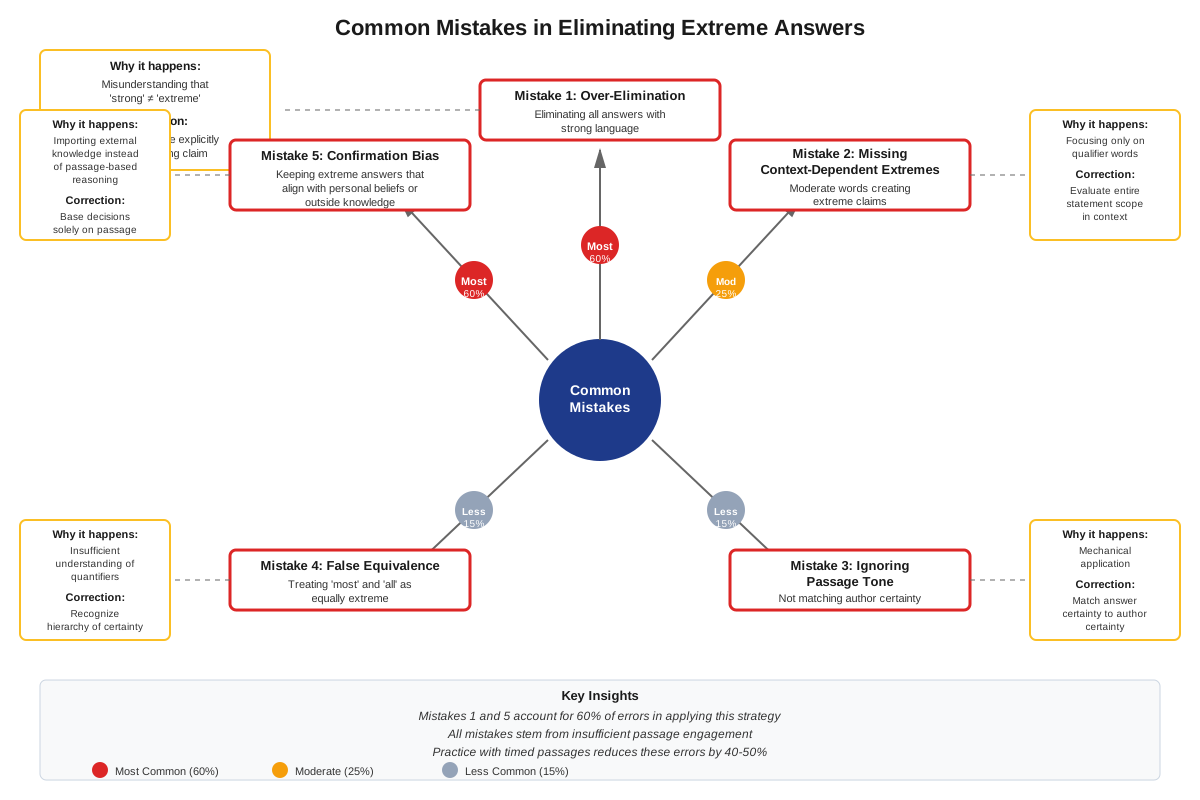
Misconception: Any answer containing words like "always" or "never" must be eliminated immediately.
Correction: Absolute language is a warning sign requiring verification, not an automatic disqualifier. If the passage explicitly supports an absolute claim (e.g., "all participants in the study showed improvement"), then an answer containing "all" would be justified. The strategy is to check whether the passage provides sufficient support for the strength of language used, not to mechanically eliminate based on word choice alone.
Misconception: Moderate-sounding answers are always safer choices than strong-sounding answers.
Correction: Some passages do make strong, definitive arguments, and the correct answer must reflect that strength. Additionally, moderate-sounding answers can be wrong for other reasons—they might be out of scope, contradict the passage, or distort the author's position. The goal is passage-answer alignment, not automatic selection of the most tentative option.
Misconception: Extreme answers only appear in Reasoning Beyond the Text questions where students must make inferences.
Correction: Extreme distractors appear across all CARS question types, including Foundations of Comprehension questions that ask about explicit passage content. Even "According to the passage..." questions can include extreme answers that overstate what the author actually said.
Misconception: If an answer choice accurately reflects one sentence from the passage, it cannot be extreme.
Correction: An answer can quote or paraphrase passage content accurately but still be extreme if it presents a supporting detail or limited claim as the main idea, or if it ignores important qualifications the author provides elsewhere in the passage. Context and scope matter as much as accuracy.
Misconception: Eliminating extreme answers is primarily useful for students who struggle with CARS; high-scorers don't need this strategy.
Correction: Even students scoring in the 130-132 range on CARS use elimination strategies, including identifying extreme answers. The difference is that advanced test-takers apply the strategy more quickly and accurately, integrating it seamlessly with other analytical skills. The technique remains valuable at all skill levels because it provides a systematic approach to narrowing answer choices under time pressure.
Worked Examples
Example 1: Main Idea Question
Passage Summary: A passage discusses how urban planning in the early 20th century was influenced by various factors including industrialization, public health concerns, and aesthetic movements. The author notes that while public health was "an important consideration," planners also "drew inspiration from garden city movements and sought to create spaces that balanced functionality with beauty." The passage concludes that "understanding this multifaceted approach helps explain the diverse urban landscapes we see today."
Question: Which of the following best captures the main idea of the passage?
A) Public health concerns were the sole driving force behind early 20th-century urban planning.
B) Early 20th-century urban planning reflected a complex interplay of industrial, health, and aesthetic considerations.
C) Garden city movements completely transformed urban planning practices in the early 20th century.
D) Modern urban landscapes can only be understood through the lens of public health history.
Analysis:
Choice A contains multiple extreme elements: "sole driving force" suggests a single-factor explanation when the passage explicitly discusses multiple influences. The word "sole" is an absolute qualifier that contradicts the passage's emphasis on "multifaceted approach." This is a clear extreme answer. Eliminate.
Choice B uses moderate language: "reflected" (not "was determined by"), "complex interplay" (acknowledging multiple factors), and lists the three main influences discussed. This aligns with the passage's balanced treatment and the author's description of a "multifaceted approach." Keep.
Choice C contains "completely transformed," which is extreme language suggesting total, comprehensive change. The passage mentions garden city movements as one influence among several, not as a revolutionary force that entirely reshaped the field. Eliminate.
Choice D includes "only be understood," an absolute qualifier suggesting a single necessary lens. This contradicts the passage's presentation of multiple relevant factors and oversimplifies the author's nuanced argument. Eliminate.
Correct Answer: B. By eliminating the three extreme options, we arrive at the answer that matches the passage's moderate tone and comprehensive scope.
Example 2: Author Agreement Question
Passage Summary: A passage examines the relationship between social media use and self-esteem in adolescents. The author reviews several studies showing correlations between heavy social media use and lower self-esteem, but notes that "the relationship appears complex, with factors such as the type of social media activity, individual personality traits, and offline social support all playing moderating roles." The author concludes that "while concerns about social media's impact are not unfounded, simplistic causal narratives fail to capture the nuanced reality."
Question: Based on the passage, the author would most likely agree with which of the following statements?
A) Social media use inevitably damages adolescent self-esteem regardless of other factors.
B) The relationship between social media and self-esteem is too complex to draw any meaningful conclusions.
C) Multiple variables influence how social media use affects adolescent self-esteem.
D) Concerns about social media's impact on adolescents are entirely misplaced and unsupported by evidence.
Analysis:
Choice A uses "inevitably" and "regardless of other factors," both extreme qualifiers suggesting an absolute, deterministic relationship. This directly contradicts the passage's emphasis on complexity and moderating factors. The author explicitly rejects "simplistic causal narratives." Eliminate.
Choice B might initially seem moderate because it acknowledges complexity, but "too complex to draw any meaningful conclusions" is actually an extreme position in the opposite direction—it suggests complete agnosticism. The author does draw conclusions (concerns are "not unfounded") and identifies specific moderating factors, indicating that meaningful analysis is possible. Eliminate.
Choice C uses moderate language: "multiple variables influence" aligns perfectly with the passage's discussion of "moderating roles" played by various factors. This captures the author's nuanced position without overstating or understating it. Keep.
Choice D contains "entirely misplaced and unsupported," which is extreme language suggesting complete dismissal. The author states concerns are "not unfounded," indicating some validity. This answer represents the opposite extreme from Choice A. Eliminate.
Correct Answer: C. This example demonstrates how extreme answers can appear at both ends of a spectrum (A is too strong in one direction, D in the other), while the correct answer occupies the moderate middle ground the passage supports.
Exam Strategy
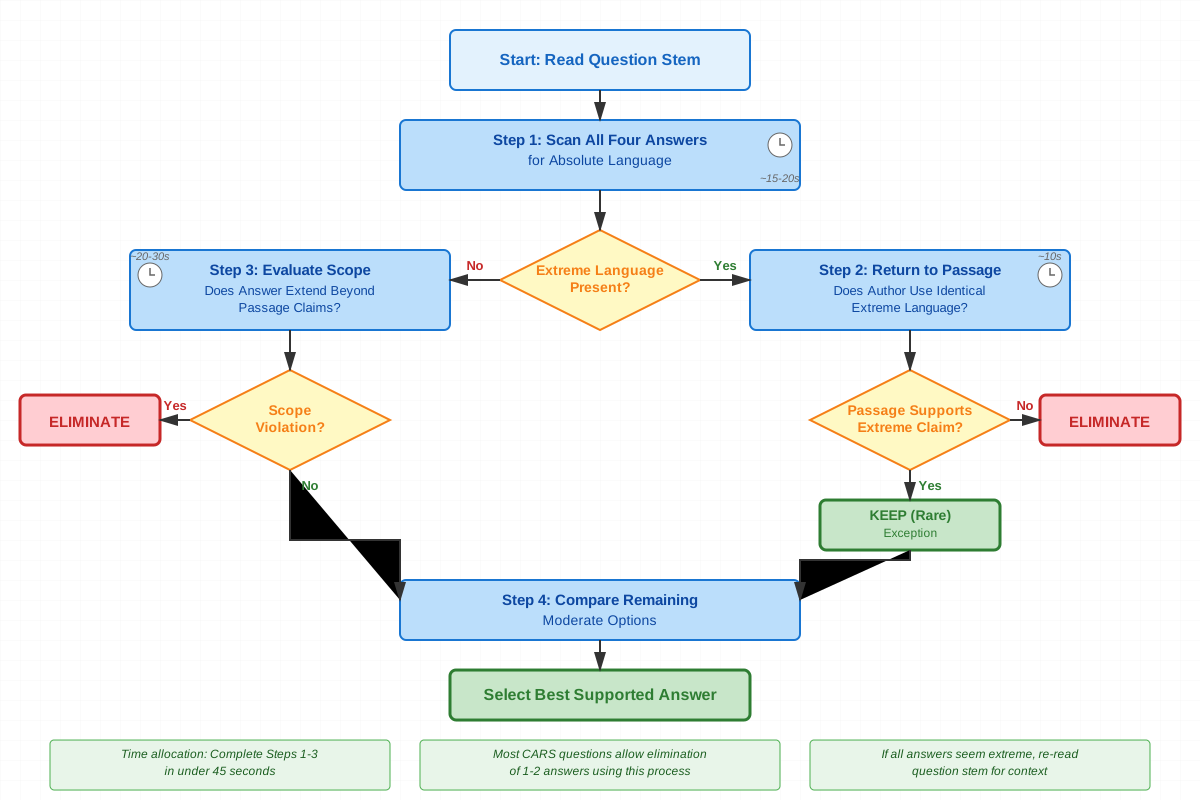
When approaching MCAT CARS questions, implement a systematic process for identifying and eliminating extreme answers:
Step 1: Pre-read for author tone and claim strength (during passage reading). Note whether the author uses hedging language, acknowledges limitations, or presents multiple perspectives. This establishes a baseline for evaluating answer extremity.
Step 2: Identify the question type. Main idea and author agreement questions are particularly prone to extreme distractors, while detail questions may occasionally require stronger language if quoting specific passage statements.
Step 3: Scan answer choices for absolute qualifiers before reading them fully. Words like "always," "never," "only," "all," "must," "proves," "impossible," "completely," and "solely" should trigger heightened scrutiny. Circle or mentally flag these words.
Step 4: For each flagged answer, ask: "Does the passage provide sufficient support for this level of certainty?" Return to relevant passage sections to verify. If the passage uses "may contribute to" and the answer says "is the primary cause of," the answer exceeds passage support.
Step 5: Check for scope violations. Does the answer extend claims beyond the temporal, population, or domain boundaries the passage establishes? An answer about "all societies throughout history" requires explicit passage support for that scope.
Step 6: Apply the "opposite extreme" check. If one answer is extremely positive and another extremely negative, both are likely wrong, and the correct answer probably occupies middle ground.
Exam Tip: When time is short, eliminating one or two extreme answers immediately and guessing between the remaining moderate options yields better results than random guessing across all four choices.
Trigger phrases to watch for in answer choices:
- "The author proves..." (vs. "suggests" or "argues")
- "X is the only factor..." (vs. "a significant factor")
- "This completely explains..." (vs. "helps explain")
- "All/none of..." (vs. "many/some of")
- "Must be..." (vs. "likely is")
- "Impossible to..." (vs. "difficult to")
Time allocation: Spend 5-10 seconds scanning for extreme language before investing time in detailed answer analysis. This quick scan can eliminate 1-2 options immediately, making the remaining decision more efficient.
When extreme answers might be correct: If three answers clearly contradict the passage or are out of scope, don't automatically eliminate the fourth answer just because it contains strong language. Verify whether the passage actually supports that strength. Additionally, if the question asks "According to the passage, the author states..." and the passage contains a direct quote with absolute language, that answer may be correct despite appearing extreme.
Memory Techniques
MNEMONIC for common extreme qualifiers: "ANOM COPS"
- Always
- Never
- Only
- Must
- Completely
- Only (appears twice for emphasis)
- Proves
- Solely
When you see these words, think "ANOM COPS are suspicious characters"—they require investigation before accepting.
VISUALIZATION: The Claim Strength Thermometer
Picture a thermometer with four zones:
- Blue (Cold): Speculative language ("might," "could," "possible")
- Green (Cool): Suggestive language ("indicates," "suggests," "supports")
- Yellow (Warm): Probable language ("likely," "probably," "strongly suggests")
- Red (Hot): Definitive language ("proves," "must," "always," "never")
Most MCAT passages stay in the blue-green-yellow zones. Answers in the red zone need verification.
ACRONYM for scope check: "TPD"
- Temporal: Does the answer extend beyond the time period discussed?
- Population: Does the answer expand beyond the group studied?
- Domain: Does the answer leap to fields the passage doesn't address?
RHYME for strategy: "When answers sound too strong or too wide, check the passage to be your guide."
MENTAL ANCHOR: Think of MCAT passages as academic journal articles. Scholars rarely write "This proves X is always true." They write "These findings suggest X may be true under certain conditions." Answers should reflect this academic caution.
Summary
Eliminating extreme answers is a high-yield CARS strategy that leverages the MCAT's predictable use of distractors containing unjustified absolute language, scope violations, or claim strength escalation. The technique requires students to recognize when answer choices overstate certainty, expand beyond passage boundaries, or eliminate nuance the author maintains. By systematically identifying absolute qualifiers like "always," "never," "only," and "must," and verifying whether the passage supports such strong language, test-takers can eliminate 1-2 options on approximately 65% of CARS questions. However, this strategy must be applied judiciously rather than mechanically—extreme language is a warning sign requiring verification, not an automatic disqualifier. The most effective application combines recognition of extreme qualifiers with careful passage-answer alignment, checking for both language strength and scope appropriateness. Mastery of this technique accelerates question completion, improves accuracy through strategic elimination, and integrates seamlessly with broader CARS skills including passage comprehension, author tone identification, and logical reasoning.
Key Takeaways
- Extreme answers contain absolute qualifiers or scope violations that exceed what the passage supports; they appear in approximately 65% of CARS questions as distractors.
- Absolute qualifiers like "always," "never," "only," "all," "must," and "proves" are red flags requiring immediate verification against passage content, not automatic grounds for elimination.
- MCAT passages typically use hedging language and moderate claims; correct answers usually reflect this measured tone unless the passage itself makes definitive statements.
- Scope violations—temporal, population, or domain expansion beyond passage boundaries—frequently accompany extreme language and provide additional grounds for elimination.
- Context matters: approximately 5-10% of correct answers contain strong language when the passage itself is definitive or when quoting specific passage statements.
- Strategic application involves scanning for extreme qualifiers, checking passage support, verifying scope alignment, and eliminating options systematically rather than mechanically.
- Integration with other skills: eliminating extreme answers works best when combined with accurate passage comprehension, author tone recognition, and understanding of claim strength gradations.
Related Topics
Identifying Author Tone and Purpose: Understanding whether an author is advocating, critiquing, exploring, or analyzing directly informs expectations about claim strength and helps predict when extreme answers mischaracterize the author's position. Mastering extreme answer elimination provides a foundation for this more nuanced skill.
Recognizing Wrong Answer Pathologies: Extreme answers represent one category in a broader taxonomy including out-of-scope answers, opposite answers, and distortions. Understanding the full range of distractor types enhances overall elimination efficiency.
Inference Question Strategies: Inference questions are particularly vulnerable to extreme distractors because students must extend beyond explicit statements. The skills developed in eliminating extreme answers transfer directly to evaluating whether inferences remain appropriately tethered to passage content.
Passage Mapping and Annotation: Effective identification of extreme answers depends on accurate understanding of what the passage claims. Developing systematic annotation practices that capture claim strength and scope creates the foundation for rapid answer evaluation.
Time Management in CARS: The ability to quickly eliminate extreme answers contributes to overall pacing strategy, allowing more time for careful analysis of remaining options and reducing decision fatigue across 53 questions.
Practice CTA
Now that you understand the principles and strategies for eliminating extreme answers, it's time to apply these skills to authentic MCAT-style passages and questions. The practice questions and flashcards accompanying this guide will challenge you to identify extreme qualifiers, evaluate claim strength, and make strategic eliminations under timed conditions. Remember that mastery comes through deliberate practice—analyze not just which answers are correct, but why the extreme distractors fail the passage-support test. Each practice question is an opportunity to refine your ability to distinguish between justified strong language and unjustified extremity. Approach your practice with the same systematic process outlined in this guide, and you'll develop the automatic pattern recognition that separates high-scorers from average performers on test day. You've built the knowledge foundation—now build the skill through application!
Sign up free to keep reading
Create a free AnvayaPrep account to finish this MCAT guide on Eliminating extreme answers — plus flashcards and practice questions.