Overview
Passage mapping is a systematic approach to reading and annotating MCAT Critical Analysis and Reasoning Skills (CARS) passages that transforms passive reading into active comprehension. This technique involves creating a mental or written outline of a passage's structure, main ideas, author's viewpoint, and logical flow while reading. Rather than attempting to memorize every detail, passage mapping enables test-takers to construct a cognitive framework that facilitates rapid information retrieval when answering questions.
For the MCAT, passage mapping represents one of the most powerful CARS Skills available to maximize both accuracy and efficiency. The CARS section presents nine passages with 5-7 questions each, covering humanities and social sciences topics that may be entirely unfamiliar. Without a strategic reading approach, students often find themselves re-reading entire passages multiple times, consuming precious minutes while still struggling to identify relevant information. Passage mapping addresses this challenge by creating a "mental GPS" of the passage that allows test-takers to navigate back to specific information quickly and confidently.
Within the broader landscape of Critical Analysis and Reasoning Skills, passage mapping serves as the foundational skill upon which all other CARS strategies depend. It connects directly to question-answering techniques, time management, and critical thinking skills. A well-constructed passage map enables students to distinguish between main ideas and supporting details, recognize rhetorical strategies, identify shifts in perspective, and understand the author's purpose—all essential competencies for MCAT success. This technique bridges the gap between simply reading words and truly comprehending complex argumentative and expository texts under timed conditions.
Learning Objectives
- [ ] Define Passage mapping using accurate Critical Analysis and Reasoning Skills terminology
- [ ] Explain why Passage mapping matters for the MCAT
- [ ] Apply Passage mapping to exam-style questions
- [ ] Identify common mistakes related to Passage mapping
- [ ] Connect Passage mapping to related Critical Analysis and Reasoning Skills concepts
- [ ] Construct an effective passage map within 3-4 minutes while maintaining comprehension
- [ ] Differentiate between high-yield and low-yield information during initial passage reading
- [ ] Utilize passage maps to eliminate incorrect answer choices systematically
Prerequisites
- Basic reading comprehension: Understanding of how to extract main ideas from paragraphs is essential because passage mapping builds upon fundamental reading skills to create structured understanding
- Familiarity with MCAT CARS format: Knowledge of passage length, question types, and time constraints provides context for why passage mapping techniques must be efficient and strategic
- Understanding of argument structure: Recognition of premises, conclusions, and supporting evidence enables identification of logical relationships that form the backbone of effective passage maps
Why This Topic Matters
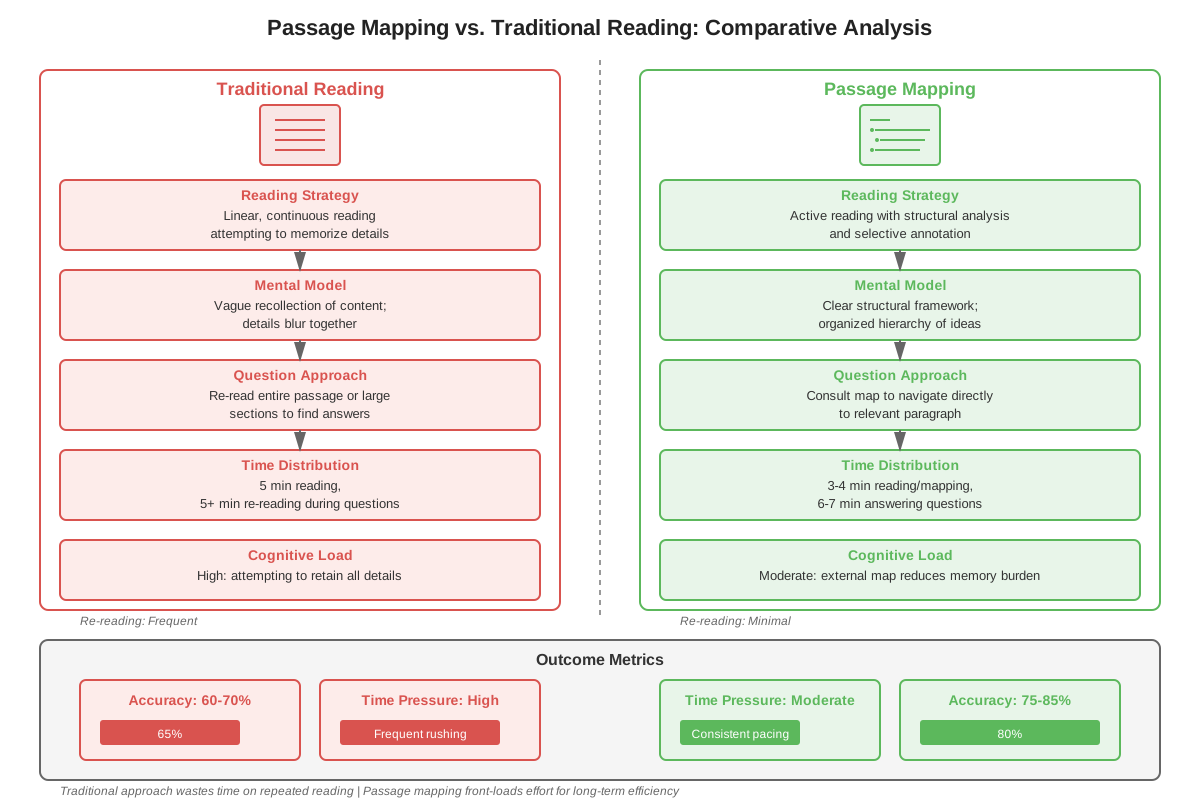
Passage mapping directly addresses one of the most significant challenges MCAT test-takers face: processing dense, unfamiliar texts under severe time pressure. The CARS section allows approximately 10 minutes per passage, including both reading and answering 5-7 questions. Without a systematic approach, students waste valuable time re-reading passages, searching for information they've already encountered, or worse—answering questions based on vague recollections rather than textual evidence.
On the MCAT, passage mapping skills are tested indirectly through every single CARS question. Approximately 30-35% of CARS questions require understanding the passage's main idea or author's primary purpose—information that should be immediately accessible from a well-constructed passage map. Another 25-30% of questions ask about specific details or supporting evidence, which a passage map helps locate quickly through paragraph-level annotations. The remaining questions involve inference, application, or evaluation, all of which depend on understanding the passage's overall structure and argumentative flow.
This topic appears in exam passages through various manifestations. Test-takers encounter passages with complex organizational structures (chronological, comparative, problem-solution, cause-effect), multiple perspectives or voices, subtle shifts in tone or argument, and dense philosophical or theoretical content. A systematic passage mapping approach transforms these challenging texts into manageable, navigable resources. Students who master this skill typically see score improvements of 2-4 points in CARS, as they spend less time searching for information and more time analyzing answer choices critically.
Core Concepts
Definition and Components of Passage Mapping
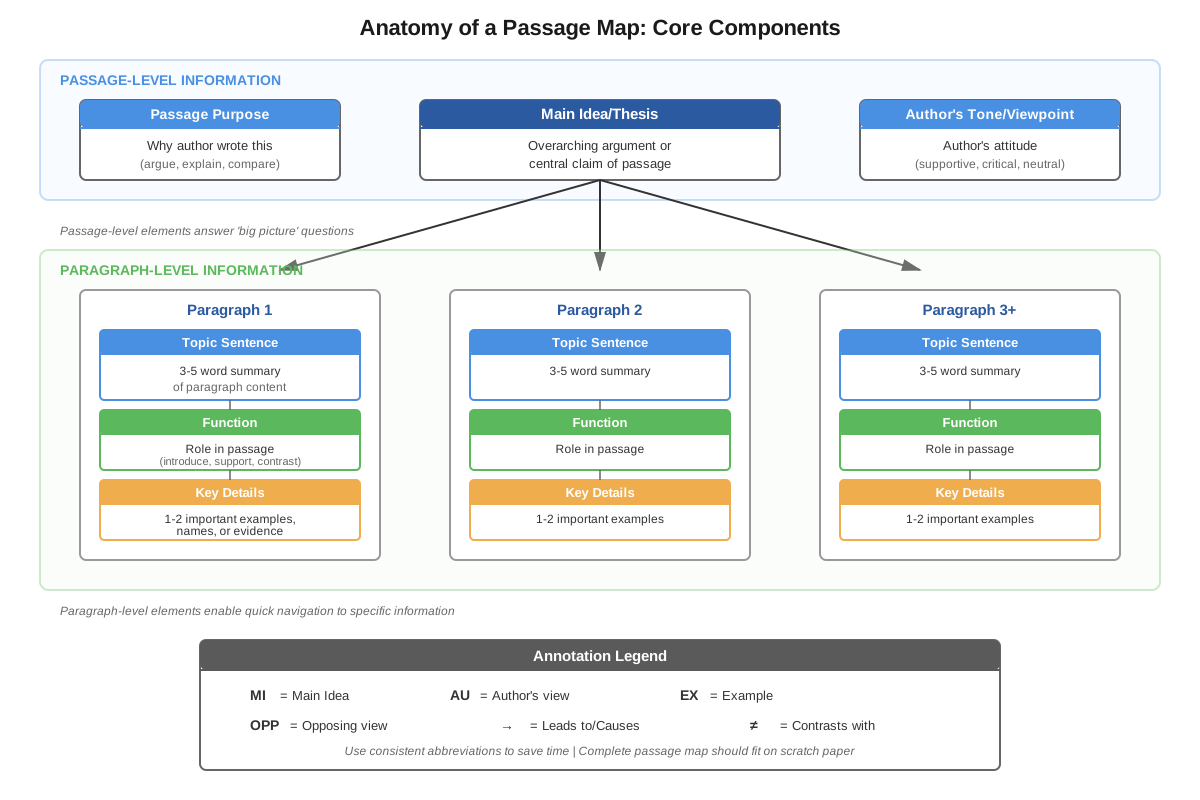
Passage mapping is the strategic process of creating a hierarchical outline of a passage's structure, content, and purpose during the initial reading. This technique involves identifying and noting the function of each paragraph, the main idea of the passage, the author's viewpoint and tone, and the logical relationships between ideas. Unlike traditional note-taking, passage mapping focuses on structure and function rather than content details.
A complete passage map contains four essential components:
- Paragraph-level labels: Brief 2-4 word descriptions of each paragraph's primary function or content
- Main idea identification: A clear statement of the passage's central thesis or purpose
- Author's viewpoint: Recognition of the author's position, tone, and attitude toward the subject
- Structural relationships: Understanding of how paragraphs connect logically (contrast, support, elaboration, etc.)
The Passage Mapping Process
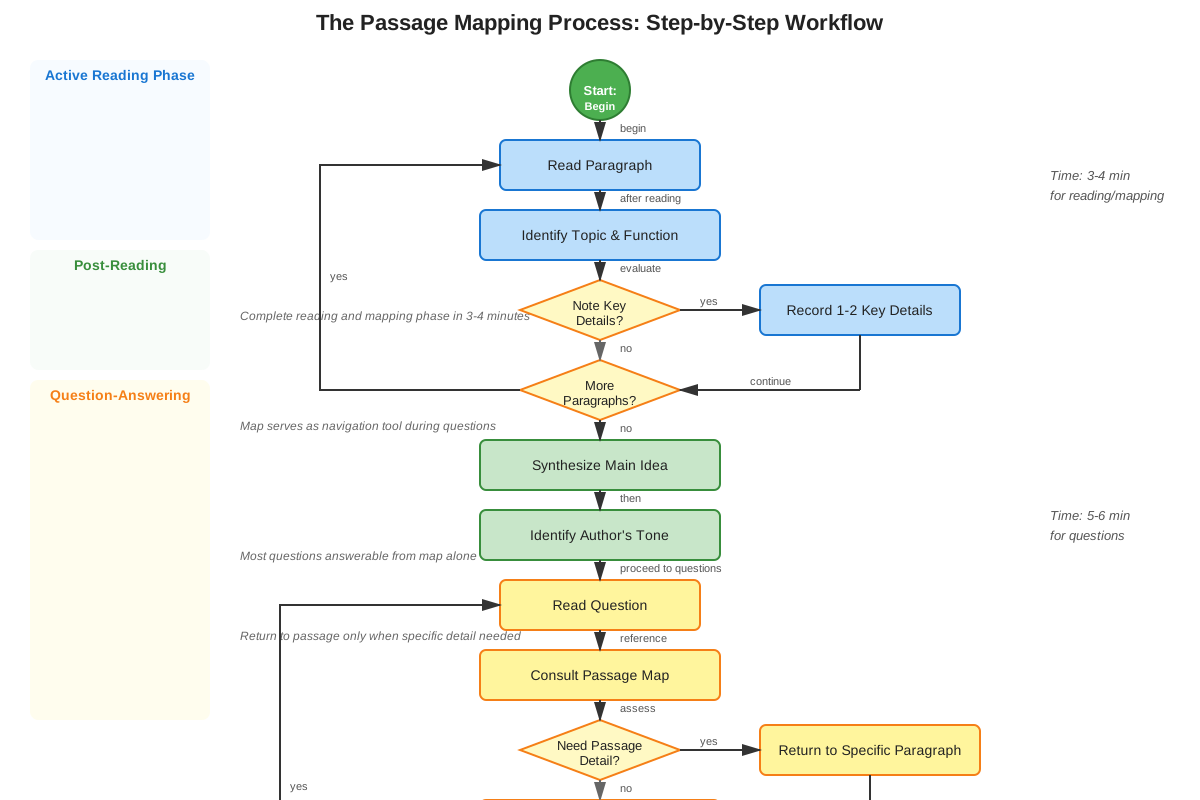
The systematic approach to passage mapping MCAT style involves a specific sequence of cognitive and physical actions:
Step 1: Preview (15-20 seconds)
Quickly scan the passage to identify length, paragraph count, and any obvious structural features like questions posed, dates, or names. This preview primes the brain for the type of content to expect.
Step 2: Active Reading with Annotation (2.5-3 minutes)
Read each paragraph while simultaneously creating brief marginal notes or mental labels. Focus on identifying:
- The paragraph's main function (introduce, support, contrast, conclude, etc.)
- Key transition words indicating logical relationships
- Shifts in perspective, time, or topic
- The author's attitude indicators (positive, negative, neutral, ambivalent)
Step 3: Synthesis (20-30 seconds)
After completing the passage, pause to articulate the main idea in one sentence and confirm understanding of the author's overall purpose and viewpoint.
Step 4: Strategic Question Approach (remaining time)
Use the passage map to navigate efficiently to relevant information for each question, avoiding the trap of re-reading the entire passage.
Types of Information to Map
Effective passage mapping requires discrimination between high-yield and low-yield information. High-yield elements that should always be mapped include:
| High-Yield Elements | Why They Matter | Mapping Strategy |
|---|---|---|
| Main thesis/argument | Answers "main idea" questions directly | Identify in introduction or conclusion |
| Author's viewpoint | Critical for tone and purpose questions | Note positive/negative language |
| Paragraph functions | Enables quick navigation | Label each paragraph's role |
| Contrasts and comparisons | Frequently tested | Mark with "vs." or "contrast" |
| Shifts in perspective | Often signal important distinctions | Note "Author says" vs. "Others believe" |
| Conclusions and implications | Common question focus | Highlight final paragraph carefully |
Low-yield elements that should not be mapped in detail include specific examples (unless they're the passage's main focus), proper names and dates (note location only), technical terminology definitions (unless central to argument), and minor supporting details.
Annotation Techniques and Symbols
Physical or mental annotation systems enhance passage mapping efficiency. Effective annotators develop a consistent symbol system:
- MI or underline: Main Idea
- + or -: Positive or negative viewpoint
- Ex: Example (note location, don't memorize content)
- Def: Definition
- ?: Author poses a question
- !: Important claim or turning point
- vs. or ≠: Contrast or opposition
- →: Cause-effect relationship
- ¶1, ¶2, etc.: Paragraph reference labels
The key principle is consistency and speed—annotations should take seconds, not minutes, and should be immediately interpretable when returning to the passage.
Structural Patterns in MCAT Passages
MCAT CARS passages typically follow recognizable organizational patterns. Identifying these patterns quickly enhances passage mapping effectiveness:
Argumentative Structure: Author presents a thesis and supports it with evidence and reasoning. Map by identifying the claim, supporting arguments, and counterarguments addressed.
Comparative Structure: Author examines two or more perspectives, theories, or phenomena. Map by clearly distinguishing what is being compared and the basis of comparison.
Historical/Chronological Structure: Author traces development of an idea or event over time. Map by noting time periods and what characterizes each.
Problem-Solution Structure: Author identifies an issue and proposes or evaluates solutions. Map by clearly separating problem description from solution discussion.
Theoretical Exploration: Author explains a complex concept or theory. Map by identifying the concept, its components, and implications or applications.
Adapting Passage Mapping to Passage Difficulty
Not all passages require identical mapping intensity. CARS Skills mastery includes calibrating effort to passage complexity:
Straightforward passages (clear structure, familiar topic, explicit main idea): Use minimal annotation, focusing primarily on paragraph functions and main idea identification.
Moderate passages (some complexity, multiple perspectives, implicit connections): Use standard passage mapping with paragraph labels and viewpoint tracking.
Complex passages (dense philosophical content, multiple nested arguments, subtle distinctions): Invest additional time in careful mapping, noting relationships between ideas and tracking logical flow meticulously.
This adaptive approach prevents both under-preparation (missing key structural elements) and over-preparation (wasting time on unnecessary detail).
Concept Relationships
Passage mapping serves as the central hub connecting multiple Critical Analysis and Reasoning Skills competencies. The relationship flows as follows:
Active Reading Skills → Passage Mapping → Question-Answering Efficiency
Active reading provides the raw comprehension that passage mapping organizes into a usable structure, which then enables rapid, accurate question answering. Without active reading, passage mapping becomes superficial; without passage mapping, active reading yields unorganized information that's difficult to retrieve under time pressure.
Passage Mapping ↔ Main Idea Identification
These skills reinforce each other bidirectionally. Effective passage mapping requires identifying the main idea, while the process of mapping (synthesizing paragraph functions) facilitates main idea recognition. Students who struggle with main idea questions almost always have inadequate passage maps.
Passage Mapping → Detail Location → Elimination Strategy
A well-constructed passage map enables rapid location of specific details referenced in questions, which in turn allows systematic evaluation and elimination of answer choices based on textual evidence rather than memory.
Structural Pattern Recognition → Passage Mapping Efficiency
Recognizing common passage structures (argumentative, comparative, etc.) accelerates the mapping process by providing a template for organizing information. This recognition develops through practice and becomes increasingly automatic.
Time Management ← Passage Mapping → Accuracy
Passage mapping represents the optimal balance point between speed and comprehension. Investing 3-4 minutes in effective mapping saves 2-3 minutes during question answering while simultaneously improving accuracy by grounding answers in passage structure rather than vague recollection.
High-Yield Facts
⭐ Passage mapping should consume approximately 3-4 minutes of the 10 minutes allocated per passage, including reading time
⭐ The most critical element of any passage map is identifying the author's main idea and viewpoint, as these answer 30-35% of CARS questions directly
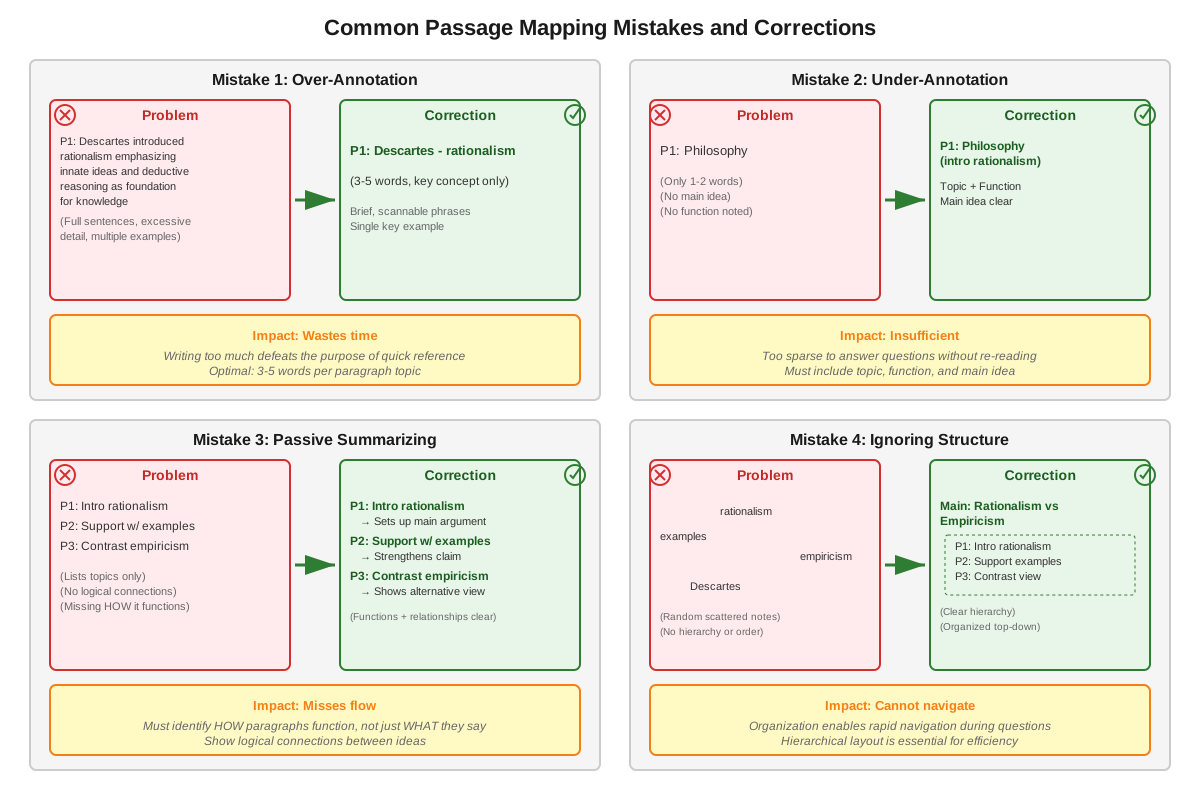
⭐ Paragraph function labels should describe what the paragraph does (introduces, contrasts, supports, concludes) rather than what it says (specific content)
⭐ Effective passage maps enable answering most questions without re-reading the entire passage, typically requiring reference to only 1-2 specific paragraphs
⭐ The introduction and conclusion paragraphs contain the highest-yield information for main idea and purpose questions and deserve the most careful attention
- Passage mapping reduces cognitive load by externalizing passage structure, freeing working memory for analysis and reasoning
- Consistent annotation symbols used across all practice passages become automatic, reducing the mental effort required during actual test conditions
- The optimal passage map balances detail and brevity—too sparse provides insufficient guidance, too detailed wastes time
- Passages with multiple perspectives require explicit tracking of who believes what to avoid attribution errors in questions
- Transition words (however, moreover, in contrast, therefore) are high-yield mapping targets as they signal logical relationships between ideas
Quick check — test yourself on Passage mapping so far.
Try Flashcards →Common Misconceptions
Misconception: Passage mapping means writing detailed notes on everything in the passage
Correction: Effective passage mapping focuses on structure and function, not comprehensive content notes. The goal is a skeletal outline that enables navigation, not a summary that duplicates the passage.
Misconception: Strong readers don't need passage mapping because they can remember everything
Correction: Even excellent readers benefit from passage mapping because MCAT questions often require precise textual evidence and test subtle distinctions that are difficult to recall from memory alone. Passage mapping is about efficiency and accuracy, not compensating for poor reading.
Misconception: Passage mapping takes too much time and reduces question-answering time
Correction: While passage mapping requires an initial time investment of 3-4 minutes, it saves 2-3 minutes during question answering by eliminating repeated re-reading. The net effect is time savings with improved accuracy.
Misconception: The passage map should be created after reading the entire passage
Correction: Passage mapping should occur simultaneously with reading. Creating the map during reading enhances comprehension and retention, whereas mapping after reading requires re-reading and defeats the efficiency purpose.
Misconception: Every paragraph needs equal attention in passage mapping
Correction: Introduction and conclusion paragraphs typically contain the highest-yield information (main idea, author's purpose), while middle paragraphs often provide supporting details or examples that require less intensive mapping. Strategic allocation of attention improves efficiency.
Misconception: Passage mapping works the same way for all passage types and difficulties
Correction: Effective passage mapping adapts to passage complexity and structure. Straightforward passages require minimal annotation, while complex philosophical passages benefit from more detailed tracking of arguments and relationships.
Worked Examples
Example 1: Argumentative Passage on Art Criticism
Passage Excerpt (abbreviated for illustration):
[¶1] Traditional art criticism has long operated under the assumption that objective standards of beauty exist and can be applied universally across cultures and time periods. This view, dominant in Western aesthetic theory since the Enlightenment, holds that trained critics possess special insight into artistic merit.
[¶2] However, recent scholarship challenges this universalist perspective. Anthropological studies demonstrate that aesthetic preferences vary dramatically across cultures, suggesting that beauty standards are socially constructed rather than objectively real.
[¶3] Despite these challenges, some philosophers argue that complete aesthetic relativism is untenable. They contend that while cultural factors influence taste, certain formal properties—balance, harmony, complexity—appeal across cultural boundaries.
[¶4] The author believes the truth lies between these extremes. Art criticism should acknowledge cultural specificity while recognizing that human perceptual systems share commonalities that create some cross-cultural aesthetic overlap.
Passage Mapping Process:
Step 1: Paragraph Labels
- ¶1: Traditional view—objective beauty standards
- ¶2: Challenge—cultural variation (relativism)
- ¶3: Counter to challenge—some universal elements
- ¶4: Author's view—middle position
Step 2: Main Idea Identification
"Art criticism should balance recognition of cultural differences in aesthetic judgment with acknowledgment of some cross-cultural commonalities"
Step 3: Author's Viewpoint
Moderate/balanced; rejects both extreme universalism and complete relativism
Step 4: Structural Pattern
Thesis-Antithesis-Synthesis (dialectical structure)
Application to Sample Question:
"The author's primary purpose in the passage is to:"
Using the passage map, the answer becomes immediately clear: to propose a balanced perspective on aesthetic judgment that incorporates both cultural specificity and universal elements. The map reveals this is a synthesis passage where the author stakes out middle ground between opposing views.
Example 2: Comparative Passage on Educational Theories
Passage Excerpt (abbreviated):
[¶1] Progressive education, pioneered by John Dewey, emphasizes experiential learning and student-centered instruction. Students learn by doing, with teachers serving as facilitators rather than lecturers.
[¶2] Traditional education, by contrast, prioritizes systematic knowledge transmission through direct instruction. Teachers present structured content, and students master foundational skills through practice and repetition.
[¶3] Research on educational outcomes presents a complex picture. Progressive methods enhance creativity and engagement but sometimes result in gaps in foundational knowledge. Traditional approaches build strong basic skills but may reduce intrinsic motivation.
[¶4] The author suggests that effective education integrates both approaches, using direct instruction for foundational skills and progressive methods for application and creative thinking.
Passage Mapping Process:
Step 1: Paragraph Labels
- ¶1: Progressive ed—experiential, student-centered
- ¶2: Traditional ed—direct instruction, teacher-centered
- ¶3: Research—both have strengths/weaknesses
- ¶4: Author—integration of both
Step 2: Structural Pattern Recognition
Comparative structure with synthesis conclusion
Step 3: Key Contrast Mapping
| Progressive | Traditional |
|---|---|
| Experiential | Direct instruction |
| Student-centered | Teacher-centered |
| Creativity (+) | Basic skills (+) |
| Knowledge gaps (-) | Less motivation (-) |
Step 4: Author's Position
Integrative—combine both approaches strategically
Application to Sample Question:
"According to the passage, which of the following represents a limitation of progressive education?"
The passage map immediately directs attention to ¶3, where research findings are discussed. The map's notation "Knowledge gaps (-)" under progressive education provides the answer without requiring re-reading the entire passage.
Exam Strategy
Question-Answering Workflow Using Passage Maps
When approaching CARS questions with a completed passage map, follow this systematic process:
- Read the question stem carefully and identify the question type (main idea, detail, inference, application, etc.)
- Consult your passage map to determine which paragraph(s) contain relevant information
- Navigate to the specific location rather than re-reading the entire passage
- Verify answer choices against textual evidence from the identified location
- Eliminate choices that contradict the passage map's structural understanding
Trigger Words for Passage Mapping
Certain words and phrases signal high-yield information that should always be noted in passage maps:
Main Idea Triggers: "The central argument," "primarily concerned with," "main purpose," "overall thesis"
Viewpoint Triggers: "The author believes," "argues that," "contends," "suggests," "maintains"
Contrast Triggers: "However," "in contrast," "on the other hand," "whereas," "unlike," "conversely"
Support Triggers: "For example," "evidence suggests," "studies show," "this demonstrates"
Conclusion Triggers: "Therefore," "thus," "consequently," "in sum," "ultimately"
When these triggers appear in questions, they indicate exactly what type of information from your passage map will answer the question.
Time Allocation Strategy
Optimal time distribution for a 10-minute passage with passage mapping:
- Preview: 15-20 seconds
- Active reading with mapping: 2.5-3 minutes
- Synthesis pause: 20-30 seconds
- Question answering: 6-7 minutes (approximately 1 minute per question)
If a passage seems particularly complex during preview, allocate an additional 30-60 seconds to mapping, but compensate by working more efficiently on straightforward questions.
Process of Elimination Using Passage Maps
Passage maps enable systematic elimination of wrong answers:
For Main Idea questions: Eliminate choices that focus on details from single paragraphs rather than the overall passage purpose identified in your map
For Detail questions: Eliminate choices that reference information from the wrong paragraph according to your map
For Author's Viewpoint questions: Eliminate choices that contradict the tone or position noted in your map
For Inference questions: Eliminate choices that contradict the logical relationships mapped between paragraphs
Exam Tip: If you find yourself unable to answer a question using your passage map, this indicates the map was incomplete. During practice, note which types of information you consistently fail to map and adjust your technique accordingly.
Memory Techniques
The MAPS Acronym for Passage Mapping Components
Main idea - What is the passage's central thesis or purpose?
Author's viewpoint - What does the author believe and what is their tone?
Paragraph functions - What role does each paragraph play?
Structure - How do the parts connect logically?
Use MAPS as a mental checklist after reading each passage to ensure your map is complete.
The "Skeleton, Not Summary" Visualization
Visualize your passage map as a skeleton that provides structure without filling in every detail. Just as a skeleton shows the body's framework without including muscles, organs, and skin, your passage map should show the passage's framework without including every supporting detail and example. This mental image prevents over-mapping.
Paragraph Function Vocabulary
Memorize this standard set of paragraph function labels to speed up mapping:
- Intro: Introduces topic or thesis
- Support: Provides evidence for main argument
- Example: Illustrates a concept with specific instance
- Contrast: Presents opposing view or alternative
- Counter: Addresses and refutes counterargument
- Explain: Clarifies or elaborates on complex idea
- Conclude: Summarizes or states implications
Using consistent vocabulary across all practice passages makes mapping automatic.
The "GPS Navigation" Analogy
Remember that a passage map functions like GPS navigation for a passage. Just as GPS shows your location, destination, and route without describing every building along the way, your passage map shows where information is located and how to get there without describing every detail. This analogy reinforces the appropriate level of detail for effective mapping.
Summary
Passage mapping is the systematic technique of creating a structural outline of MCAT CARS passages during initial reading, focusing on paragraph functions, main ideas, author's viewpoint, and logical relationships rather than comprehensive content details. This approach transforms passive reading into active comprehension, enabling efficient navigation back to specific information when answering questions. The optimal passage map balances brevity and utility, consuming 3-4 minutes during reading but saving 2-3 minutes during question answering while simultaneously improving accuracy. Effective passage mapping requires identifying high-yield elements (main thesis, author's position, paragraph functions, contrasts) while avoiding low-yield details (specific examples, dates, names). The technique adapts to passage difficulty and structure, with more complex passages requiring more detailed mapping. Mastery of passage mapping directly improves performance on all CARS question types by grounding answers in passage structure rather than vague memory, and it serves as the foundational skill upon which all other CARS strategies depend.
Key Takeaways
- Passage mapping creates a navigable structural outline during reading, focusing on function over content details, enabling rapid information retrieval during question answering
- The four essential components of every passage map are paragraph-level labels, main idea identification, author's viewpoint, and structural relationships between ideas
- Effective passage mapping consumes 3-4 minutes but saves 2-3 minutes during questions, resulting in net time savings with improved accuracy
- High-yield mapping targets include main thesis, author's position, paragraph functions, contrasts, and perspective shifts, while low-yield elements like specific examples should be noted by location only
- Passage maps enable systematic answer elimination by providing structural understanding that reveals which choices contradict the passage's organization, main idea, or author's viewpoint
- Consistent annotation symbols and paragraph function vocabulary become automatic with practice, reducing cognitive load during actual test conditions
- Adaptive mapping intensity—minimal for straightforward passages, detailed for complex ones—optimizes the balance between comprehension and efficiency
Related Topics
Question Type Strategies: Understanding the seven major CARS question types (main idea, detail, inference, function, strengthen/weaken, application, tone) enables targeted use of passage maps to answer each type efficiently. Mastering passage mapping provides the foundation for developing type-specific strategies.
Active Reading Techniques: Skills like predicting content, questioning the author, and monitoring comprehension work synergistically with passage mapping to enhance overall CARS performance. These techniques provide the raw comprehension that passage mapping organizes.
Time Management in CARS: Strategic allocation of time across passages, questions, and review depends on efficient passage mapping. Students who master mapping can confidently invest time upfront knowing it will be recovered during question answering.
Elimination Strategies: Systematic approaches to eliminating wrong answers rely heavily on the structural understanding provided by passage maps. Advanced elimination techniques build directly on mapping skills.
Main Idea Identification: This specific skill represents the most critical component of passage mapping and deserves dedicated practice. Mastery of passage mapping naturally improves main idea identification, which in turn improves mapping quality.
Practice CTA
Now that you understand the principles and techniques of passage mapping, the next critical step is deliberate practice. Attempt the practice questions and flashcards associated with this topic, focusing not just on getting answers correct but on refining your mapping process. Time yourself creating passage maps, evaluate their completeness using the MAPS checklist, and track which types of information you consistently miss. Remember that passage mapping is a skill that improves dramatically with consistent practice—students typically see significant improvement after mapping just 15-20 passages with careful self-evaluation. Your investment in mastering this foundational CARS skill will pay dividends across every passage you encounter on test day. Start practicing now, and watch your CARS performance transform!
Sign up free to keep reading
Create a free AnvayaPrep account to finish this MCAT guide on Passage mapping — plus flashcards and practice questions.