Overview
Ethics passages represent one of the most challenging and frequently tested passage types within the Critical Analysis and Reasoning Skills (CARS) section of the MCAT. These passages explore moral philosophy, ethical frameworks, professional conduct, and value-based decision-making across diverse contexts including medicine, law, politics, and social policy. Unlike passages that present purely factual information, ethics passages require test-takers to navigate complex arguments about what ought to be done, how competing values should be balanced, and what principles should guide human behavior. The ability to analyze ethical reasoning without imposing personal biases is essential for success on these passages.
Understanding Ethics passages MCAT content is crucial because approximately 15-20% of CARS passages contain significant ethical components, and these passages consistently challenge even high-performing students. The MCAT tests not just reading comprehension but the ability to trace logical arguments, identify underlying assumptions, distinguish between descriptive and normative claims, and evaluate the strength of ethical reasoning. Medical schools value this skill because physicians constantly face ethical dilemmas involving patient autonomy, resource allocation, informed consent, and end-of-life care. The CARS Skills tested through ethics passages directly translate to the critical thinking required in clinical practice.
Ethics passages connect to broader Critical Analysis and Reasoning Skills by requiring synthesis of multiple reasoning modes: identifying main ideas and supporting details, understanding author perspective and tone, recognizing rhetorical strategies, and applying passage information to novel scenarios. These passages often feature dense philosophical language, abstract concepts, and nuanced arguments that demand careful attention to logical structure. Mastering ethics passages strengthens overall CARS performance by developing the analytical precision needed across all passage types.
Learning Objectives
- [ ] Define Ethics passages using accurate Critical Analysis and Reasoning Skills terminology
- [ ] Explain why Ethics passages matters for the MCAT
- [ ] Apply Ethics passages to exam-style questions
- [ ] Identify common mistakes related to Ethics passages
- [ ] Connect Ethics passages to related Critical Analysis and Reasoning Skills concepts
- [ ] Distinguish between normative and descriptive claims within ethical arguments
- [ ] Analyze the logical structure of ethical reasoning including premises, conclusions, and underlying assumptions
- [ ] Evaluate competing ethical frameworks and their application to specific scenarios
- [ ] Recognize rhetorical strategies authors use to advance ethical positions
Prerequisites
- Basic reading comprehension skills: Ability to identify main ideas, supporting details, and passage structure forms the foundation for analyzing complex ethical arguments
- Understanding of argument structure: Recognizing premises, conclusions, and logical connections enables tracking of ethical reasoning chains
- Familiarity with CARS question types: Knowledge of Foundations of Comprehension, Reasoning Within the Text, and Reasoning Beyond the Text questions allows strategic approach to ethics passages
- Vocabulary at college reading level: Ethics passages frequently employ sophisticated philosophical terminology that requires strong vocabulary skills
- Ability to separate personal beliefs from passage content: Objective analysis of ethical arguments regardless of personal agreement is essential for accurate answer selection
Why This Topic Matters
Ethics passages hold profound clinical significance because medical practice is inherently value-laden. Physicians must navigate competing ethical principles daily: respecting patient autonomy while promoting beneficence, balancing individual patient needs against public health concerns, and allocating limited resources fairly. The MCAT includes ethics passages specifically to assess whether future physicians can analyze complex moral reasoning objectively and systematically—skills that directly impact patient care quality and professional decision-making.
From an exam statistics perspective, ethics passages appear in approximately 3-4 of the 9 CARS passages on any given MCAT administration, making them one of the most common passage types. These passages typically generate 5-7 questions each and are associated with lower average accuracy rates compared to humanities or social science passages without ethical components. Questions frequently test the ability to identify the author's ethical framework, apply ethical principles to new scenarios, recognize assumptions underlying moral arguments, and distinguish between what is and what ought to be.
Ethics passages commonly appear in several formats on the MCAT: philosophical treatises discussing moral theory (utilitarianism, deontology, virtue ethics), applied ethics debates about specific issues (euthanasia, genetic engineering, justice in healthcare), critiques of existing ethical practices or policies, and historical analyses of how ethical standards have evolved. Passages may present a single coherent ethical argument, compare competing perspectives, or trace the development of ethical thought across time. Recognizing these common structures helps students approach passages strategically and anticipate question types.
Core Concepts
Defining Ethics Passages
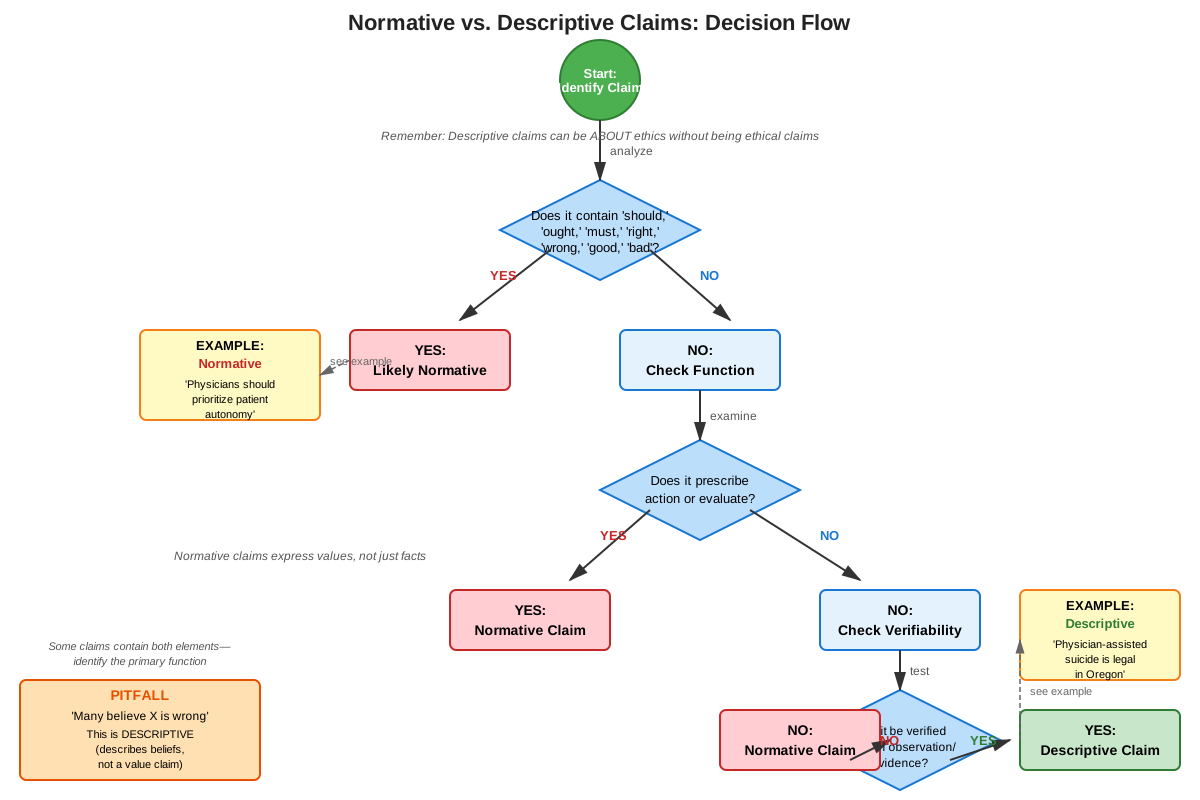
Ethics passages are CARS passages that focus on moral philosophy, ethical reasoning, value judgments, and normative claims about how individuals or societies should act. These passages differ from purely descriptive passages by making arguments about what is right, wrong, just, fair, or morally required rather than simply reporting facts. The defining characteristic is the presence of normative claims—statements about what ought to be—as opposed to descriptive claims that report what is. For example, "Physicians should prioritize patient autonomy" is normative, while "Most physicians prioritize patient autonomy" is descriptive.
Ethics passages in CARS Skills assessment require students to analyze moral reasoning without allowing personal ethical beliefs to influence answer selection. The MCAT tests the ability to understand and work within the author's ethical framework, even when that framework conflicts with the test-taker's personal values. This objectivity is crucial because questions ask what the author would likely argue, what follows logically from stated principles, or how the author's reasoning applies to new situations—not what the student personally believes is morally correct.
Major Ethical Frameworks
Understanding common ethical frameworks helps students recognize the logical structure of ethics passages and predict how authors will reason through moral dilemmas. While passages rarely explicitly name these frameworks, recognizing their underlying logic improves comprehension and question accuracy.
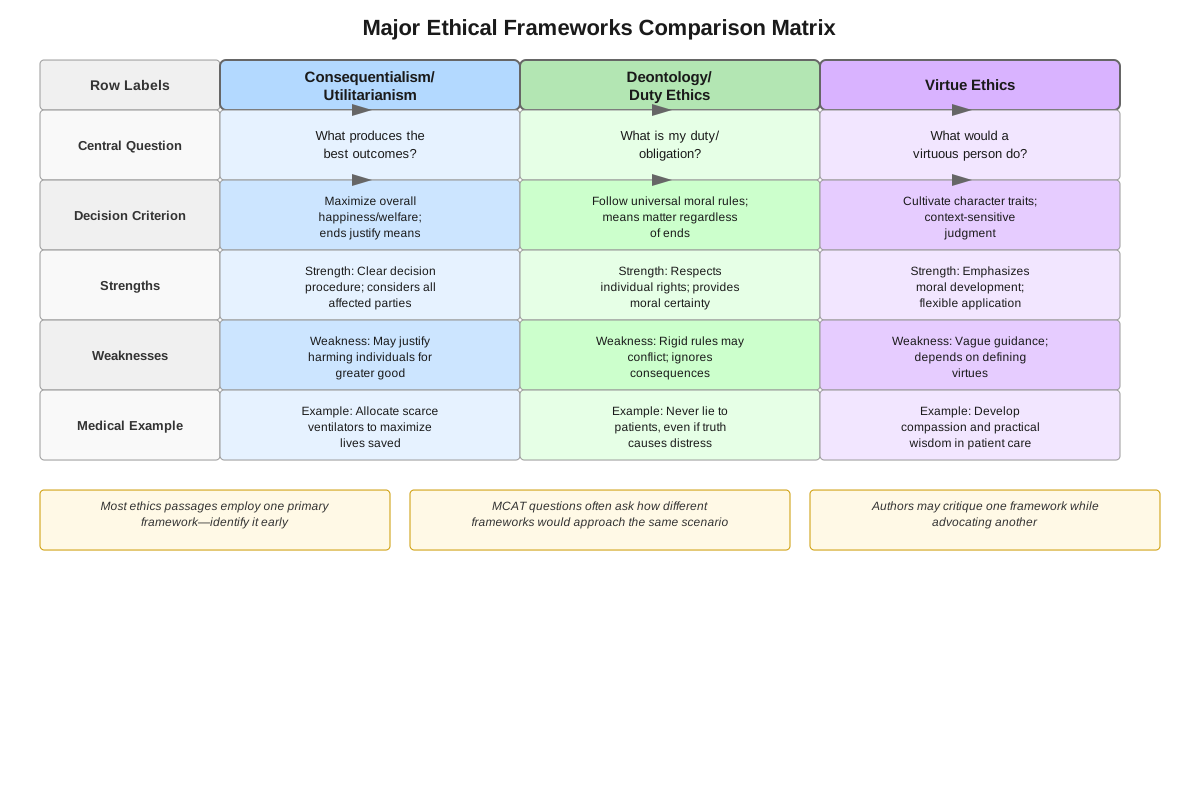
Consequentialism/Utilitarianism evaluates actions based on their outcomes, particularly whether they maximize overall happiness, well-being, or utility. Authors using this framework argue that the morally right action produces the best consequences for the greatest number of people. Key indicators include language about outcomes, benefits, harms, maximizing good, and aggregate welfare. Weaknesses often discussed include difficulty predicting consequences, potential for sacrificing individual rights for collective benefit, and challenges in measuring and comparing different types of utility.
Deontology focuses on duties, rules, and principles rather than consequences. Actions are right or wrong based on whether they conform to moral rules or respect fundamental rights, regardless of outcomes. Deontological authors emphasize concepts like moral duty, categorical imperatives, inherent rights, dignity, and inviolable principles. Common critiques include inflexibility when rules conflict, difficulty determining which duties take priority, and potential for following rules that produce terrible outcomes.
Virtue Ethics centers on character traits and what a virtuous person would do rather than rules or consequences. This framework asks what actions express virtues like courage, compassion, honesty, and wisdom. Passages using virtue ethics discuss moral character development, role models, practical wisdom (phronesis), and the cultivation of excellence. Limitations include cultural variation in defining virtues, lack of clear action guidance in specific situations, and potential circularity in defining virtuous acts as what virtuous people do.
Care Ethics emphasizes relationships, empathy, and contextual responsiveness rather than abstract principles. This framework, often contrasted with justice-based approaches, values caring relationships, attention to particular needs, and maintaining connections. Authors may critique traditional ethics as overly abstract and disconnected from lived experience. Care ethics appears frequently in passages about medical practice, family obligations, and social responsibility.
Normative vs. Descriptive Claims
Distinguishing between normative claims (value judgments about what should be) and descriptive claims (factual statements about what is) is fundamental to analyzing ethics passages. This distinction appears in numerous MCAT questions that ask students to identify the author's position, recognize assumptions, or determine what evidence would strengthen or weaken an argument.
| Claim Type | Characteristics | Example | Question Indicators |
|---|---|---|---|
| Normative | Contains "should," "ought," "must," "right," "wrong," "just" | "Healthcare is a human right" | "The author's main argument," "The passage suggests that..." |
| Descriptive | Reports facts, observations, or current states | "45 million Americans lack health insurance" | "According to the passage," "The author states that..." |
| Mixed | Combines factual claims with value judgments | "Because healthcare improves quality of life, it should be universally accessible" | "The author's reasoning depends on," "Which assumption underlies..." |
Many ethics passages move between descriptive and normative claims, using factual observations as premises to support moral conclusions. Recognizing this structure helps students identify the logical gaps where assumptions reside—a frequent focus of MCAT questions.
Ethical Reasoning Structure
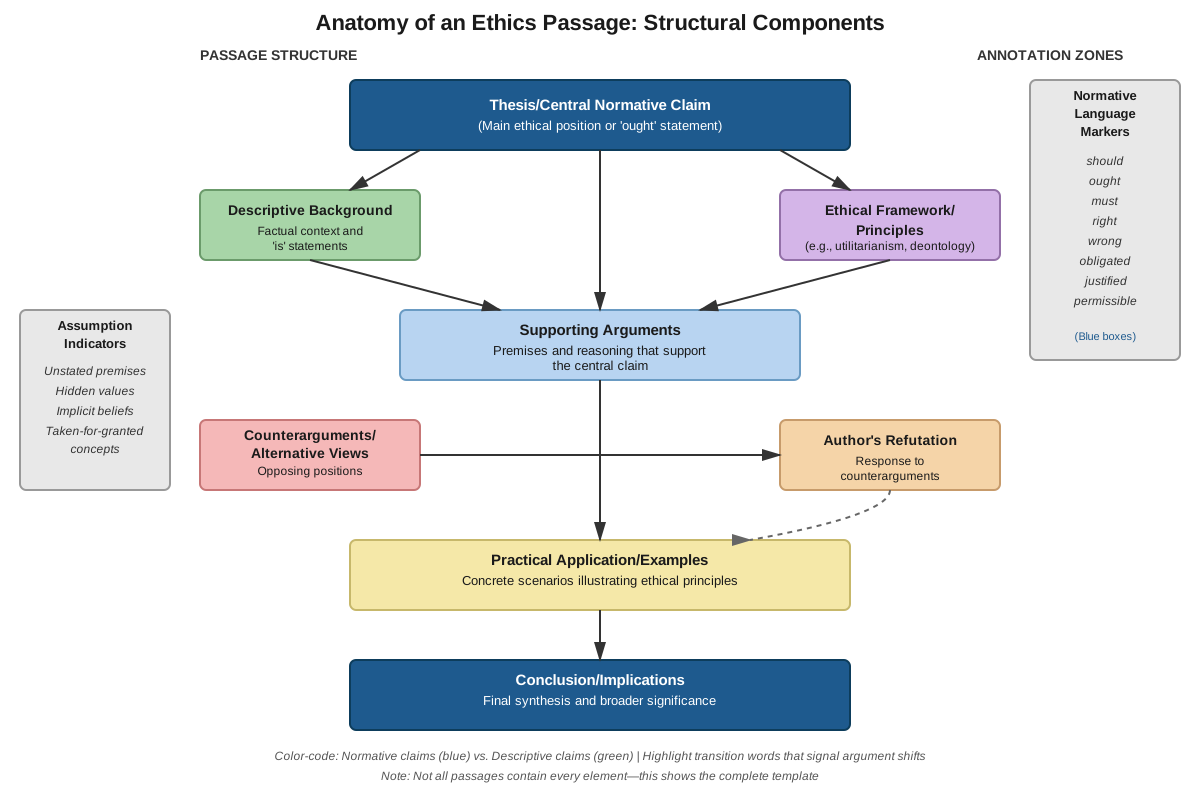
Ethics passages follow predictable argumentative structures that students can learn to recognize quickly. The typical structure includes:
- Ethical claim or thesis: The author's main normative position about what should be done or what is morally required
- Underlying principles: The fundamental values or ethical framework supporting the claim
- Supporting arguments: Reasons why the ethical claim follows from the principles
- Consideration of objections: Acknowledgment and response to counterarguments
- Application or implications: How the ethical position applies to specific cases or broader contexts
Recognizing this structure allows students to predict where key information will appear and anticipate question types. For example, questions about the author's main argument map to the ethical claim, questions about assumptions target underlying principles, and application questions draw on the implications section.
Common Ethical Concepts in MCAT Passages
Several ethical concepts appear repeatedly across MCAT ethics passages. Familiarity with these concepts accelerates comprehension and improves accuracy:
Autonomy refers to self-determination and the right to make one's own decisions without coercion. Medical ethics passages frequently discuss patient autonomy, informed consent, and the balance between respecting choices and protecting welfare.
Beneficence means acting for the benefit of others, promoting well-being and preventing harm. This principle often appears in discussions of physician obligations and public health interventions.
Justice concerns fair distribution of benefits and burdens, equal treatment, and addressing inequalities. Passages may discuss distributive justice (how resources should be allocated), procedural justice (fair processes), or corrective justice (addressing past wrongs).
Rights are entitlements that impose obligations on others. Passages distinguish between negative rights (freedom from interference) and positive rights (entitlement to goods or services), and discuss conflicts between individual rights and collective welfare.
Moral agency refers to the capacity to make ethical decisions and be held responsible for actions. Passages may discuss what conditions are necessary for moral agency and how it relates to autonomy and responsibility.
Rhetorical Strategies in Ethics Passages
Authors of ethics passages employ specific rhetorical strategies to advance their positions. Recognizing these strategies helps students understand author perspective and tone—frequent question topics.
Thought experiments present hypothetical scenarios designed to test ethical intuitions or reveal inconsistencies in moral reasoning. Famous examples include the trolley problem and the violinist analogy. MCAT questions often ask about the purpose or effectiveness of these thought experiments.
Analogical reasoning draws parallels between familiar and unfamiliar situations to support ethical claims. Authors argue that if we accept a moral judgment in one case, consistency requires accepting it in analogous cases. Questions may ask students to identify analogies or evaluate their strength.
Reductio ad absurdum demonstrates that a position leads to absurd or unacceptable conclusions, therefore the position must be rejected. This strategy appears when authors show that opposing views have problematic implications.
Appeals to principles invoke widely accepted moral values or established ethical frameworks to support specific positions. Authors may appeal to human dignity, fairness, compassion, or other shared values.
Concept Relationships
The concepts within ethics passages form an interconnected web of reasoning. Ethical frameworks (consequentialism, deontology, virtue ethics, care ethics) provide the foundational logic that generates specific ethical claims about what should be done. These frameworks rest on underlying principles (autonomy, beneficence, justice, rights) that serve as premises in ethical arguments. The distinction between normative and descriptive claims operates throughout, as authors use factual observations (descriptive) to support moral conclusions (normative).
Rhetorical strategies serve as the vehicle for presenting ethical reasoning, with thought experiments, analogies, and appeals to principles making abstract ethical frameworks concrete and persuasive. The structure of ethical reasoning organizes these elements into coherent arguments that move from principles through supporting reasons to specific applications.
These ethics passage concepts connect to broader Critical Analysis and Reasoning Skills through shared analytical processes. Identifying main ideas and supporting details in ethics passages requires recognizing the ethical claim and its justification. Understanding author perspective demands awareness of which ethical framework guides the reasoning. Evaluating argument strength involves assessing whether normative conclusions follow logically from stated principles. Application questions test whether students can extend the author's ethical reasoning to novel scenarios consistently.
The relationship map flows as follows: Ethical Framework → determines → Underlying Principles → generate → Ethical Claims → supported by → Ethical Reasoning Structure → expressed through → Rhetorical Strategies → analyzed using → Normative/Descriptive Distinction → all assessed via → CARS Skills.
Quick check — test yourself on Ethics passages so far.
Try Flashcards →High-Yield Facts
⭐ Ethics passages contain normative claims about what ought to be, not just descriptive claims about what is—questions frequently test the ability to distinguish between these claim types.
⭐ Approximately 15-20% of CARS passages have significant ethical content, making ethics passages one of the most common and important passage types to master.
⭐ The MCAT tests understanding of the author's ethical framework, not the test-taker's personal moral beliefs—answer choices reflecting personal values rather than passage content are consistently wrong.
⭐ Common ethical frameworks include consequentialism (outcome-focused), deontology (duty-focused), virtue ethics (character-focused), and care ethics (relationship-focused)—recognizing these frameworks accelerates comprehension.
⭐ Questions about assumptions in ethics passages typically target the gap between descriptive premises and normative conclusions—the unstated principle connecting facts to moral judgments.
- Thought experiments in ethics passages serve to test ethical intuitions, reveal inconsistencies, or illustrate abstract principles through concrete scenarios.
- Authors often acknowledge counterarguments before refuting them—this structure signals important content for "author would most likely agree" questions.
- Analogical reasoning in ethics passages argues that morally similar cases should be treated similarly—questions may ask about the strength or relevance of analogies.
- The principle of autonomy (self-determination) appears more frequently in MCAT ethics passages than any other ethical concept, particularly in medical contexts.
- Ethics passages frequently discuss tensions between individual rights and collective welfare, requiring students to track how authors balance competing values.
- Extreme answer choices in ethics questions are usually incorrect—ethical reasoning on the MCAT typically involves nuanced positions rather than absolute claims.
Common Misconceptions
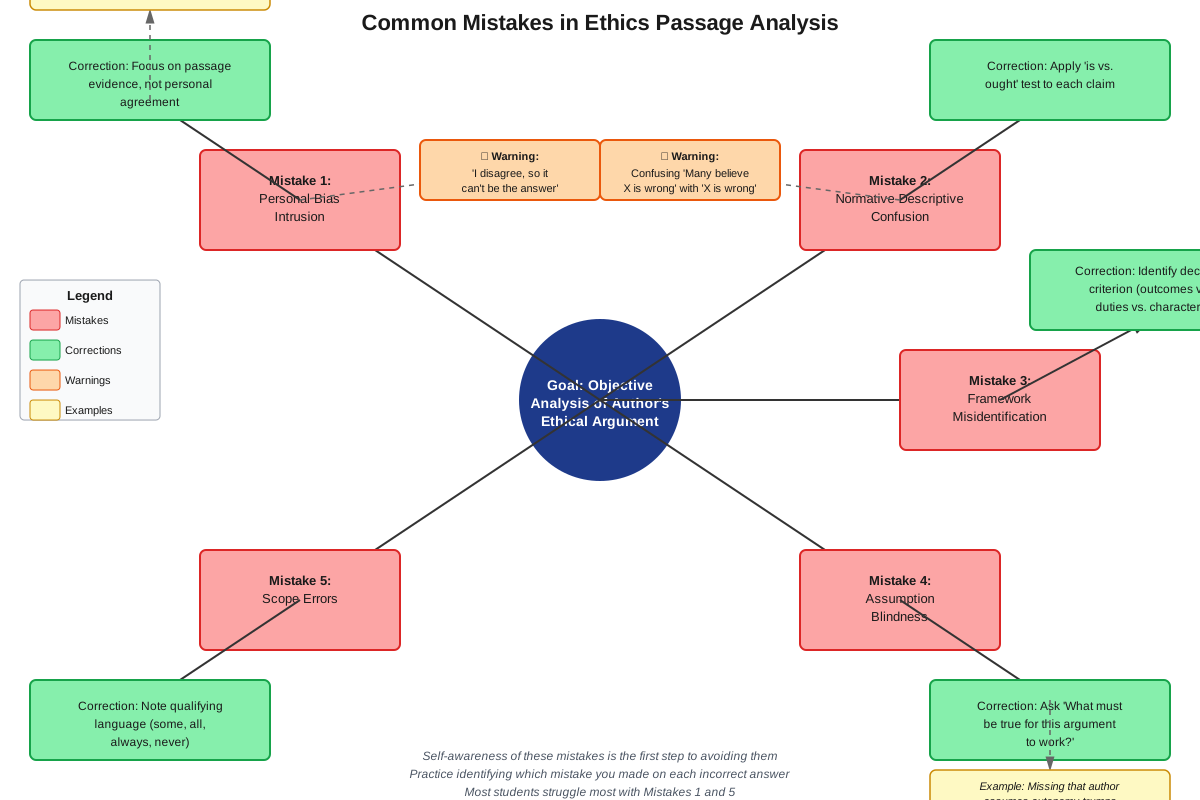
Misconception: Ethics passages test personal moral beliefs and students should choose answers that align with their own values.
Correction: The MCAT exclusively tests comprehension and analysis of the author's ethical reasoning as presented in the passage. Correct answers reflect what the author argues or would likely argue, regardless of whether the test-taker agrees. Personal moral intuitions are irrelevant and often lead to incorrect answer selection.
Misconception: All ethics passages explicitly name the ethical framework (utilitarianism, deontology, etc.) being used.
Correction: Most MCAT ethics passages never explicitly identify their ethical framework. Students must infer the framework from the type of reasoning employed—whether the author focuses on consequences, duties, character, or relationships. Recognizing implicit frameworks requires familiarity with how each framework approaches moral questions.
Misconception: Descriptive claims about what people actually do or believe constitute ethical arguments about what should be done.
Correction: The "is-ought gap" means that factual claims about current practices or beliefs cannot alone justify normative conclusions about what is morally right. Ethics passages often use descriptive claims as premises, but the normative conclusion requires an additional principle (often unstated) connecting facts to values. Questions about assumptions frequently target this gap.
Misconception: If an author presents multiple ethical perspectives, the passage doesn't have a main argument or the author is neutral.
Correction: Authors frequently present opposing views to acknowledge counterarguments before defending their own position. Careful attention to tone, the amount of space devoted to each view, and explicit evaluative language reveals which position the author supports. The main argument is the author's defended position, not merely the topic under discussion.
Misconception: Ethical reasoning is purely subjective, so any answer that seems reasonable is acceptable.
Correction: While ethical conclusions may be debatable in real life, MCAT questions have definitively correct answers based on logical analysis of the passage. Correct answers follow necessarily from the author's stated or implied principles, while incorrect answers introduce reasoning inconsistent with the passage or make logical errors. The test assesses analytical rigor, not moral relativism.
Worked Examples
Example 1: Identifying Ethical Framework and Main Argument
Passage Excerpt: "The physician's primary obligation is to promote patient welfare and prevent harm. While respecting patient preferences is important, this respect cannot extend to actions that would significantly damage the patient's health. When a patient requests treatment that medical evidence shows will cause more harm than benefit, the physician must refuse. To do otherwise would violate the fundamental commitment to beneficence that defines medical practice. The physician's expertise creates a duty to protect patients from choices made without full understanding of medical consequences."
Question: The author's argument most strongly reflects which ethical framework?
Analysis Process:
- Identify the main ethical claim: Physicians should refuse harmful treatments even when patients request them
- Examine the reasoning: The argument focuses on the physician's duty to promote welfare and prevent harm (beneficence), emphasizing obligations over outcomes or patient autonomy
- Note key language: "obligation," "must refuse," "duty," "fundamental commitment"—all duty-focused terms
- Evaluate against frameworks:
- Consequentialism? No—doesn't focus on maximizing overall utility
- Deontology? Yes—emphasizes duties and obligations regardless of patient preferences
- Virtue ethics? No—doesn't discuss character traits or virtues
- Care ethics? No—doesn't emphasize relationships or contextual responsiveness
Answer: Deontology. The passage prioritizes the physician's duty to beneficence over respecting patient autonomy, using rule-based reasoning characteristic of deontological ethics.
Connection to Learning Objectives: This example demonstrates applying ethics passage concepts to exam-style questions by identifying the underlying ethical framework through analysis of reasoning structure and key terminology.
Example 2: Distinguishing Normative from Descriptive Claims and Identifying Assumptions
Passage Excerpt: "Studies show that 70% of patients prefer to receive full disclosure of medical errors that affect their care. Furthermore, transparency about errors improves patient trust and reduces malpractice litigation. Therefore, physicians have an ethical obligation to disclose all medical errors to affected patients."
Question: The author's argument depends on which of the following assumptions?
Analysis Process:
- Identify the conclusion (normative claim): "Physicians have an ethical obligation to disclose all medical errors"
- Identify the premises (descriptive claims):
- Most patients prefer disclosure
- Transparency improves trust and reduces litigation
- Recognize the is-ought gap: The premises describe facts about preferences and outcomes, but the conclusion makes a moral claim about obligation
- Determine what principle bridges this gap: The unstated assumption must connect these facts to moral obligation
- Evaluate potential assumptions:
- Must connect patient preferences or beneficial outcomes to physician obligations
- Likely something like: "Physicians should act in ways that respect patient preferences and promote beneficial outcomes" or "Actions that improve trust and reduce harm are morally required"
Answer: The assumption is that physicians have an obligation to act in ways that align with patient preferences and produce beneficial outcomes. This principle is necessary to move from the descriptive premises about what patients prefer and what consequences follow to the normative conclusion about what physicians should do.
Connection to Learning Objectives: This example illustrates identifying common mistakes (confusing descriptive and normative claims) and applying the concept of the is-ought gap to recognize unstated assumptions—a frequent MCAT question type.
Exam Strategy
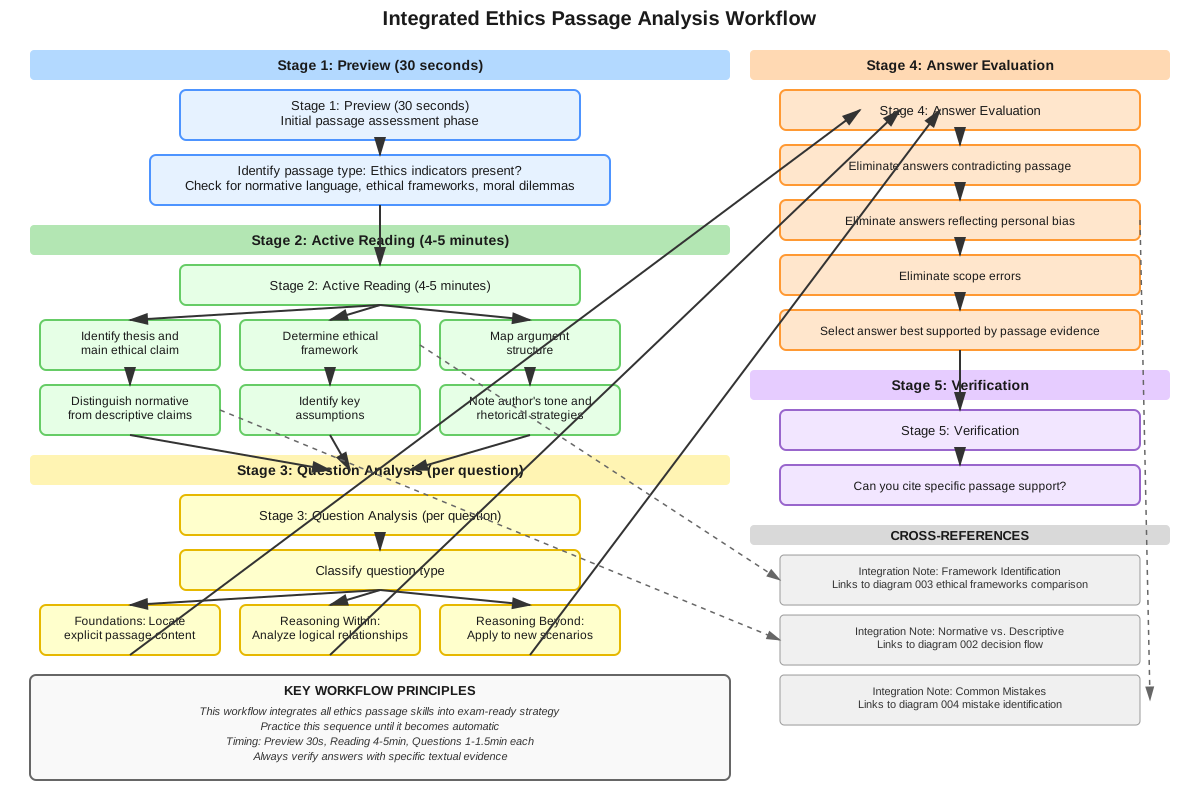
When approaching ethics passages on the MCAT, begin by identifying whether the passage presents a single ethical argument, compares multiple perspectives, or traces historical development of ethical thought. This initial categorization guides expectations about passage structure and likely question types. Single-argument passages typically generate questions about the author's main claim, supporting reasoning, and assumptions. Comparative passages often ask about differences between perspectives or which view would support specific positions. Historical passages may test understanding of how ethical standards evolved or what factors influenced changes.
Trigger words and phrases signal important content in ethics passages. Normative indicators include "should," "ought," "must," "right," "wrong," "just," "unjust," "obligated," "required," "permissible," and "impermissible." These words mark ethical claims that often become question topics. Framework indicators help identify the type of ethical reasoning: "consequences," "outcomes," "utility," and "maximize" suggest consequentialism; "duty," "obligation," "principle," and "rights" indicate deontology; "virtue," "character," "excellence," and "flourishing" point to virtue ethics; "care," "relationships," "empathy," and "context" signal care ethics.
Contrast words like "however," "but," "although," "while," and "despite" often introduce the author's position after presenting opposing views. Pay special attention to content following these markers, as it typically represents the author's defended position rather than views being critiqued. Similarly, evaluative language like "unfortunately," "problematically," "correctly," or "importantly" reveals author perspective and tone.
For process-of-elimination strategies specific to ethics passages, immediately eliminate answer choices that:
- Reflect common moral intuitions not supported by passage reasoning
- Introduce ethical concepts or frameworks not mentioned or implied in the passage
- Make extreme claims ("always," "never," "only") unless the author explicitly uses such language
- Confuse descriptive and normative claims (e.g., treating what people do believe as what they should believe)
- Apply the author's reasoning inconsistently or extend it beyond what the passage supports
Correct answers in ethics passages typically maintain consistency with the author's ethical framework and reasoning structure. When evaluating answer choices, ask: "Would this position follow logically from the principles and reasoning the author has established?" This consistency check eliminates many attractive but incorrect options.
Time allocation for ethics passages should mirror other CARS passages—approximately 10 minutes total including reading and questions. However, ethics passages often require slightly slower initial reading (4-5 minutes) to ensure accurate understanding of the ethical framework and argument structure, which then accelerates question answering. Investing time upfront to identify the author's main ethical claim, underlying principles, and reasoning structure pays dividends by making questions more straightforward.
When stuck on an ethics question, return to the passage and locate relevant content rather than relying on memory or general ethical knowledge. The correct answer is always supported by passage content, and re-reading specific sections often clarifies ambiguity. Avoid the temptation to answer based on what seems morally correct independent of the passage—this approach consistently leads to incorrect answers.
Memory Techniques
CANDO framework for analyzing ethics passages:
- Claim: Identify the main ethical claim or thesis
- Assumptions: Recognize unstated principles connecting premises to conclusions
- Normative vs. descriptive: Distinguish value judgments from factual statements
- Duties, outcomes, or character: Determine which ethical framework guides reasoning
- Objections: Note counterarguments and how the author responds
The Four Frameworks Mnemonic - "Cats Don't Very Care":
- Consequentialism: Outcomes matter most
- Deontology: Duties and rules matter most
- Virtue ethics: Character matters most
- Care ethics: Relationships matter most
Visualization strategy for tracking ethical arguments: Picture a bridge with descriptive claims (facts) on one side and normative claims (values) on the other. The bridge itself represents the ethical principle connecting them. When questions ask about assumptions, visualize what must be true for the bridge to hold—this represents the unstated principle.
The "Should Test" for identifying normative claims: Mentally insert "should" or "ought" into statements. If it fits naturally and captures the author's meaning, the claim is normative. If it sounds awkward or changes the meaning, the claim is descriptive. For example, "Patients prefer disclosure" (descriptive) versus "Physicians should disclose errors" (normative).
Author Agreement Acronym - TRACE:
- Tone: What's the author's attitude toward this position?
- Reasoning: Does this follow from the author's logic?
- Assumptions: Is this consistent with underlying principles?
- Contrasts: Did the author argue against this view?
- Evidence: Did the author provide support for this claim?
Summary
Ethics passages represent a critical component of MCAT CARS, testing the ability to analyze moral reasoning objectively and systematically. These passages present normative arguments about what should be done, grounded in ethical frameworks including consequentialism, deontology, virtue ethics, and care ethics. Success requires distinguishing normative from descriptive claims, identifying underlying principles and assumptions, recognizing rhetorical strategies like thought experiments and analogies, and applying the author's reasoning consistently to novel scenarios. The fundamental challenge is analyzing ethical arguments based solely on passage content while setting aside personal moral beliefs. Students must track the logical structure of ethical reasoning, understand how factual premises connect to moral conclusions, and recognize which ethical framework guides the author's position. Mastering ethics passages strengthens overall CARS performance by developing precision in argument analysis, attention to logical structure, and ability to work within unfamiliar conceptual frameworks—skills essential across all passage types and in future medical practice.
Key Takeaways
- Ethics passages test analysis of moral reasoning as presented in the passage, never personal ethical beliefs or general moral knowledge
- Distinguishing normative claims (what should be) from descriptive claims (what is) is fundamental to understanding ethical arguments and answering questions about assumptions
- Recognizing ethical frameworks (consequentialism, deontology, virtue ethics, care ethics) accelerates comprehension and helps predict how authors will reason through moral dilemmas
- The gap between descriptive premises and normative conclusions is where assumptions reside—a frequent focus of MCAT questions
- Correct answers maintain consistency with the author's stated or implied ethical principles and reasoning structure, even when that reasoning conflicts with common moral intuitions
- Rhetorical strategies like thought experiments and analogies serve specific purposes in ethical arguments that often become question topics
- Ethics passages appear in 15-20% of CARS content and are associated with lower accuracy rates, making them high-priority for focused practice
Related Topics
Philosophical Reasoning Passages: Ethics passages represent one type of philosophical reasoning in CARS. Mastering ethics passages builds skills applicable to epistemology (theory of knowledge), metaphysics (nature of reality), and logic passages. The analytical approach to identifying claims, assumptions, and argument structure transfers directly.
Social Science Passages with Normative Components: Many social science passages include ethical dimensions when discussing policy, justice, or social change. Understanding ethics passages enhances ability to recognize when social science passages shift from descriptive analysis to normative recommendations.
Author Perspective and Tone: Ethics passages provide excellent practice for identifying author perspective since moral positions often involve clear evaluative stances. Skills developed analyzing ethical arguments strengthen ability to detect subtle author attitudes across all passage types.
Application Questions: Ethics passages frequently generate application questions asking how the author's reasoning applies to novel scenarios. Mastering these questions in ethics contexts improves performance on application questions throughout CARS.
Practice CTA
Now that you've mastered the core concepts of ethics passages, it's time to apply this knowledge through deliberate practice. Attempt the practice questions and flashcards associated with this topic, focusing on identifying ethical frameworks, distinguishing normative from descriptive claims, and recognizing assumptions in moral arguments. Each practice question is an opportunity to refine your analytical approach and build the pattern recognition that leads to consistent high performance. Remember: ethics passages are skills-based, not knowledge-based. Your ability to analyze ethical reasoning objectively improves dramatically with focused practice. Approach each passage systematically using the strategies outlined in this guide, and you'll develop the confidence and competence to excel on even the most challenging ethics passages the MCAT presents.
Sign up free to keep reading
Create a free AnvayaPrep account to finish this MCAT guide on Ethics passages — plus flashcards and practice questions.