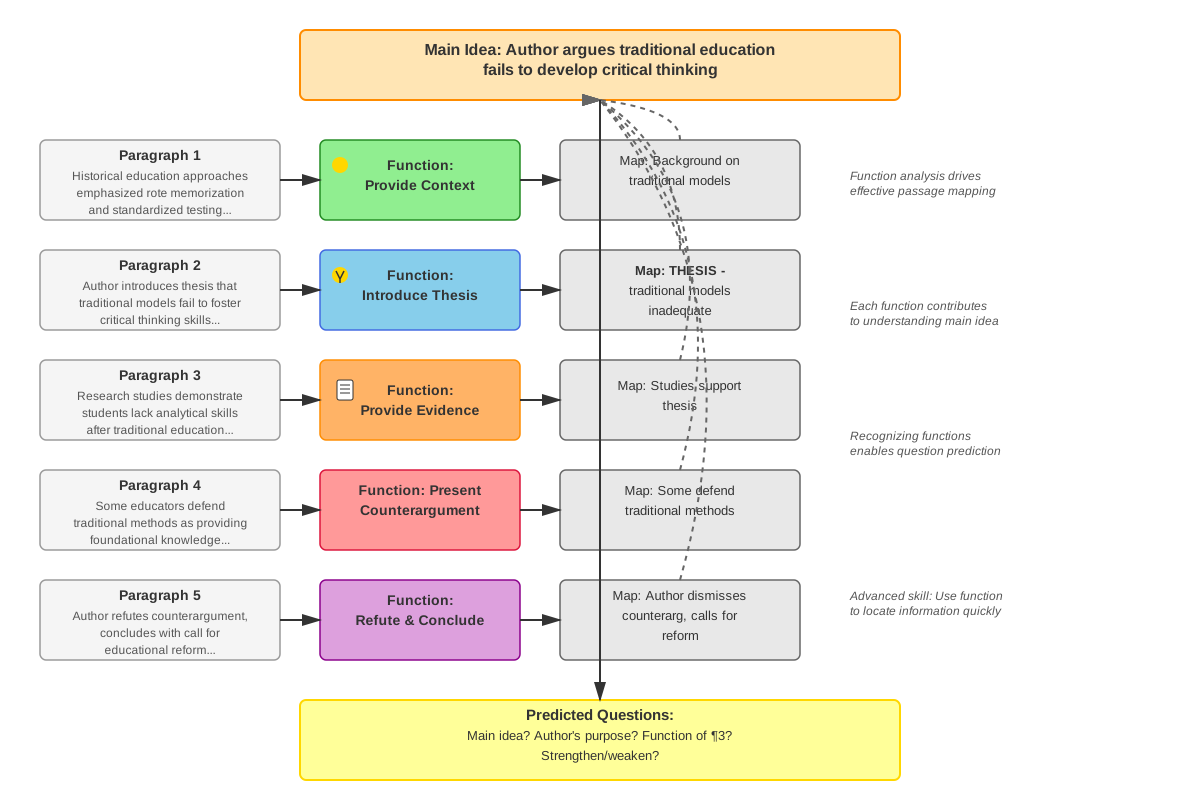
Overview
The function of a paragraph is a fundamental concept in Critical Analysis and Reasoning Skills (CARS) that requires students to identify the specific role a paragraph plays within the broader structure and argument of a passage. Rather than simply summarizing what a paragraph says, understanding paragraph function demands that test-takers recognize why the author included that particular paragraph and how it contributes to the overall purpose of the text. This skill is essential for the MCAT because CARS passages are densely constructed arguments where every paragraph serves a deliberate rhetorical purpose—whether introducing a thesis, providing supporting evidence, acknowledging counterarguments, offering examples, or drawing conclusions.
Mastering function of a paragraph MCAT questions enables students to navigate complex passages more efficiently and answer questions about passage structure, author's purpose, and argumentative strategy. These questions frequently appear on the exam and test whether students can distinguish between content (what is said) and function (why it is said). A paragraph might describe a scientific study, but its function could be to challenge a previously stated theory, illustrate a broader principle, or provide historical context for a contemporary debate.
Within the broader framework of CARS Skills, paragraph function connects intimately with passage mapping, main idea identification, and rhetorical analysis. Understanding how individual paragraphs function allows students to construct mental outlines of passages, predict where arguments are heading, and quickly locate information when answering questions. This metacognitive awareness of textual structure is what separates high-scoring students from those who struggle with time management and comprehension on the CARS section.
Learning Objectives
- [ ] Define function of a paragraph using accurate Critical Analysis and Reasoning Skills terminology
- [ ] Explain why function of a paragraph matters for the MCAT
- [ ] Apply function of a paragraph to exam-style questions
- [ ] Identify common mistakes related to function of a paragraph
- [ ] Connect function of a paragraph to related Critical Analysis and Reasoning Skills concepts
- [ ] Distinguish between paragraph content and paragraph function in complex passages
- [ ] Categorize paragraphs according to their rhetorical roles (introduction, support, counterargument, conclusion, etc.)
- [ ] Predict likely paragraph functions based on passage structure and transitional language
Prerequisites
- Basic reading comprehension: Understanding literal meaning of text is necessary before analyzing structural function
- Familiarity with argumentative structure: Recognizing claims, evidence, and conclusions helps identify how paragraphs support overall arguments
- Knowledge of common rhetorical patterns: Understanding comparison, cause-effect, and problem-solution structures aids in recognizing paragraph roles
- Passage mapping fundamentals: The ability to create brief annotations helps track how each paragraph contributes to the whole
Why This Topic Matters
Understanding paragraph function is critical for real-world academic and professional reading. Scholars, researchers, and professionals must quickly identify how information is organized in complex texts to extract relevant details efficiently. In medical school, students encounter dense scientific literature where recognizing whether a paragraph presents methodology, results, limitations, or implications directly impacts comprehension and critical evaluation of research.
On the MCAT, paragraph function questions appear in approximately 15-20% of CARS passages, making this a medium-to-high yield topic. These questions typically ask: "The author's primary purpose in the third paragraph is to..." or "The function of the second paragraph is most likely to..." The AAMC consistently tests whether students can move beyond surface-level comprehension to analyze structural and rhetorical elements of passages.
Function of a paragraph Critical Analysis and Reasoning Skills questions commonly appear in passages discussing philosophy, social sciences, humanities, and arts—disciplines where argumentative structure is particularly complex. Students who master this skill gain significant advantages in time management, as they can quickly navigate passages by understanding the "architecture" of arguments rather than getting lost in details. Additionally, recognizing paragraph function helps with other question types, including main idea, author's purpose, and passage structure questions.
Core Concepts
Defining Paragraph Function
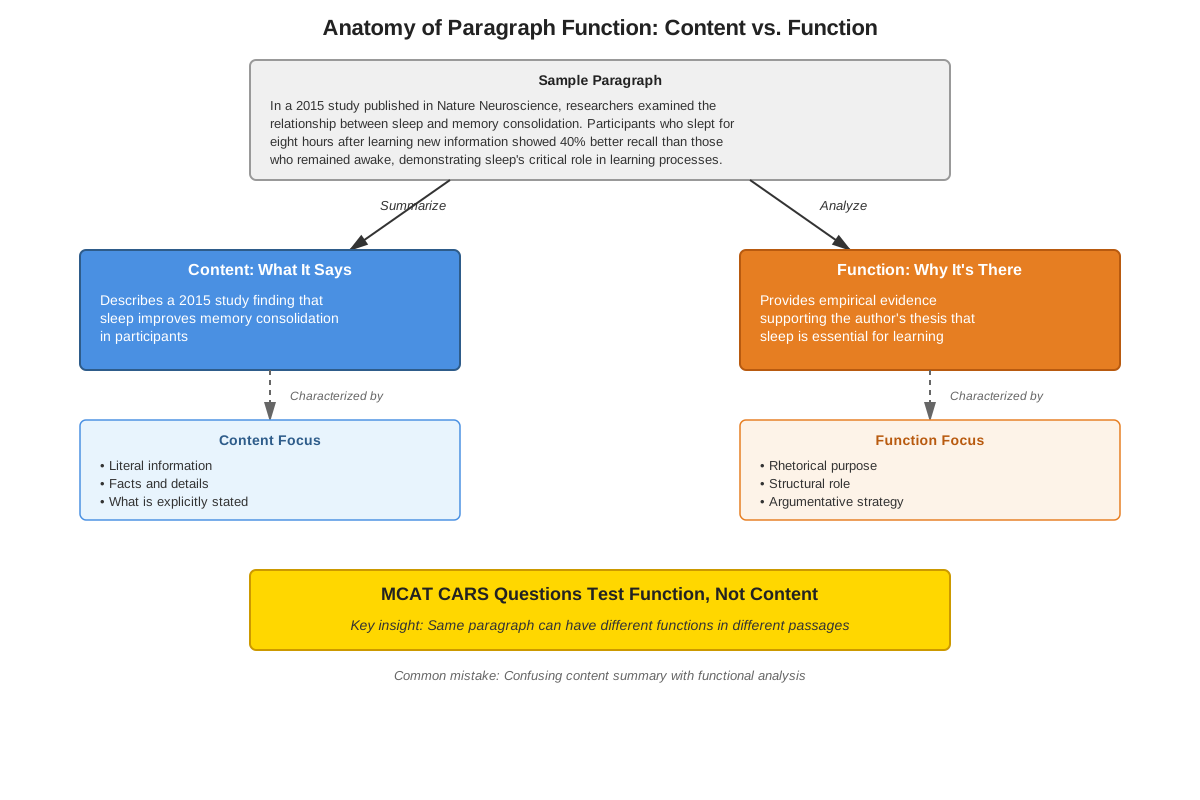
The function of a paragraph refers to the specific role that paragraph plays in advancing the author's overall purpose and argument within a passage. Unlike paragraph content (the literal information presented), function describes the rhetorical work the paragraph performs. For example, a paragraph might contain a description of a historical event (content), but its function could be to provide background context for understanding a contemporary debate.
Identifying paragraph function requires students to ask: "Why did the author include this paragraph at this specific location in the passage?" This question shifts focus from what is being said to why it is being said and how it relates to surrounding paragraphs and the passage's main idea.
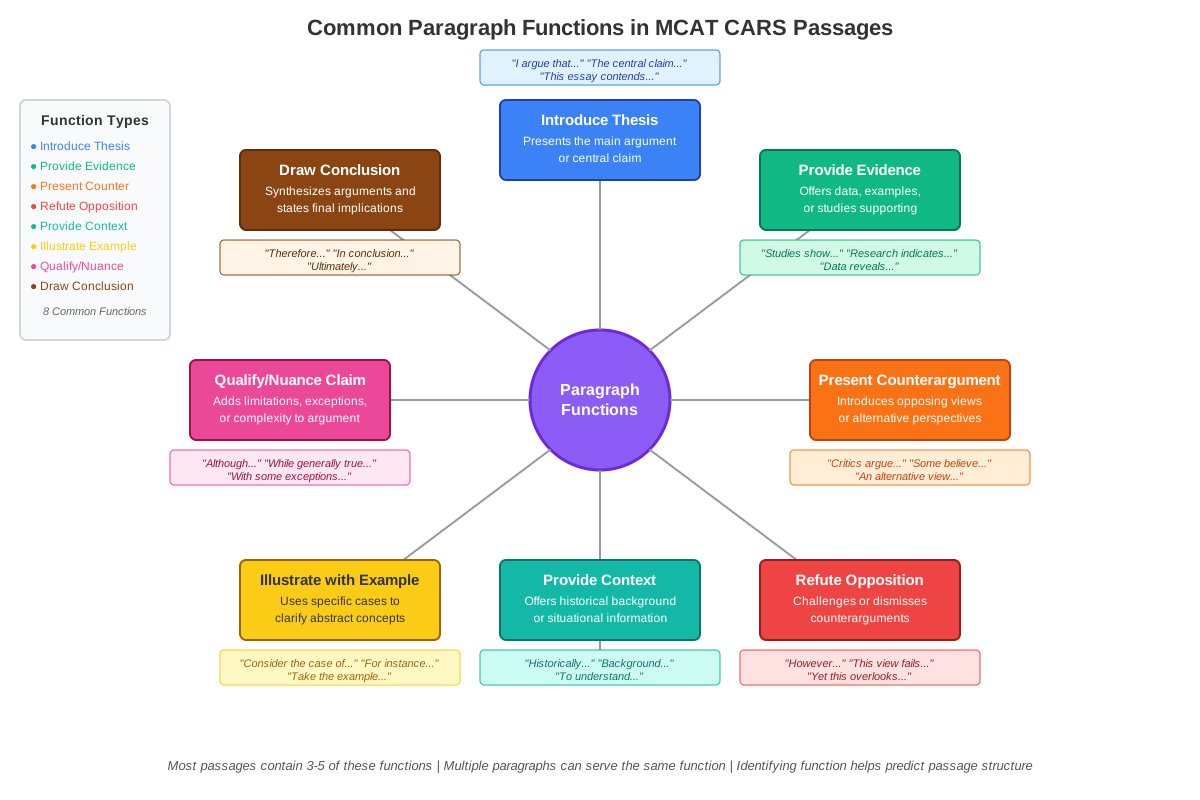
Common Paragraph Functions
Paragraphs in MCAT CARS passages typically serve one or more of the following functions:
| Function Type | Description | Common Indicators |
|---|---|---|
| Introduction/Thesis | Presents the main argument or topic | Opening paragraph, broad statements, thesis statements |
| Background/Context | Provides historical, theoretical, or situational context | "Historically," "traditionally," temporal references |
| Supporting Evidence | Offers data, examples, or reasoning that supports the main argument | "For example," "research shows," specific studies or statistics |
| Counterargument | Presents opposing views or alternative perspectives | "However," "critics argue," "some believe," "on the other hand" |
| Refutation | Challenges or dismisses counterarguments | "Nevertheless," "this view fails to account for," "yet" |
| Elaboration/Explanation | Expands on or clarifies a previously stated idea | "In other words," "specifically," "that is" |
| Comparison/Contrast | Examines similarities or differences between concepts | "Similarly," "in contrast," "whereas," "unlike" |
| Illustration/Example | Provides concrete instances of abstract principles | "For instance," "consider," specific cases or anecdotes |
| Conclusion/Synthesis | Summarizes arguments or draws final implications | Final paragraph, "thus," "therefore," "in conclusion" |
Distinguishing Content from Function
A critical skill in analyzing paragraph function is separating what a paragraph discusses from what it accomplishes rhetorically. Consider this example:
Content: A paragraph describes three studies showing that meditation reduces cortisol levels in stressed individuals.
Possible Functions:
- If this appears early in a passage arguing for meditation's benefits: providing supporting evidence
- If this follows a paragraph claiming meditation has no physiological effects: refuting a counterargument
- If this appears in a passage comparing stress-reduction techniques: illustrating one approach among several
- If this introduces a passage that will critique these studies: establishing a position to be challenged
The same content can serve different functions depending on its position within the passage and its relationship to the author's overall argument.
Structural Markers and Transitions
Authors use specific linguistic signals to indicate paragraph function. Recognizing these transition words and structural markers helps students quickly identify roles:
Continuity markers (paragraph continues previous function): "Furthermore," "Additionally," "Moreover," "Also"
Contrast markers (paragraph shifts to opposing view): "However," "Nevertheless," "Conversely," "On the contrary," "Despite this"
Causation markers (paragraph explains consequences): "Therefore," "Thus," "Consequently," "As a result"
Exemplification markers (paragraph provides examples): "For instance," "To illustrate," "Consider," "Such as"
Emphasis markers (paragraph stresses importance): "Indeed," "Significantly," "Crucially," "Most importantly"
Paragraph Function in Passage Architecture
Understanding how paragraphs function together creates a mental map of passage structure. Most CARS passages follow predictable architectural patterns:
Classic Argumentative Structure:
- Introduction of topic/thesis (Paragraph 1)
- Supporting evidence (Paragraphs 2-3)
- Counterargument acknowledgment (Paragraph 4)
- Refutation of counterargument (Paragraph 5)
- Conclusion/implications (Paragraph 6)
Comparative Structure:
- Introduction of two concepts to compare (Paragraph 1)
- Description of first concept (Paragraph 2)
- Description of second concept (Paragraph 3)
- Analysis of similarities (Paragraph 4)
- Analysis of differences (Paragraph 5)
- Synthesis or preference statement (Paragraph 6)
Problem-Solution Structure:
- Problem identification (Paragraph 1)
- Problem elaboration/consequences (Paragraph 2)
- Failed solutions or complications (Paragraph 3)
- Proposed solution (Paragraph 4)
- Support for solution (Paragraph 5)
- Implementation or implications (Paragraph 6)
Recognizing these patterns helps predict paragraph functions even before reading them in detail.
Function vs. Main Idea
Students often confuse paragraph function with paragraph main idea. The main idea is the central point or claim of a paragraph, while the function is the role that paragraph plays in the larger passage. A paragraph's main idea might be "Impressionist painters rejected academic conventions," while its function could be "providing historical background for understanding modern art movements." The main idea tells you what the paragraph argues; the function tells you why that argument appears in this passage at this location.
Concept Relationships
Paragraph function analysis builds directly on passage mapping skills. When students create passage maps (brief annotations of each paragraph), they are essentially identifying paragraph functions. These functions then inform understanding of passage structure, which reveals how the author organizes their argument.
The relationship flows as follows:
Reading comprehension → Identifying paragraph content → Analyzing paragraph function → Understanding passage structure → Determining author's purpose → Answering structure and purpose questions
Paragraph function also connects intimately with rhetorical analysis. Understanding function requires recognizing rhetorical strategies: Is the author using an example to persuade? Presenting a counterargument to appear balanced? Providing background to establish credibility? These rhetorical moves are the mechanisms through which paragraphs perform their functions.
Additionally, paragraph function relates to main idea identification at both paragraph and passage levels. The function of individual paragraphs reveals how they support or develop the passage's main idea. A passage arguing for educational reform might include paragraphs with functions like: establishing the problem (current system failures), providing evidence (statistics on outcomes), acknowledging concerns (counterarguments about costs), and proposing solutions (specific reforms).
Finally, understanding paragraph function enhances question-answering strategy. Many CARS questions ask about specific paragraphs or passage structure. Recognizing that Paragraph 3 functions as a counterargument helps answer questions like "The author mentions X in order to..." or "The primary purpose of the third paragraph is to..."
High-Yield Facts
⭐ Paragraph function describes WHY a paragraph exists in the passage, not WHAT it says—focus on rhetorical purpose, not content summary.
⭐ Transition words at paragraph beginnings are the strongest indicators of function—words like "however," "furthermore," and "for example" signal specific roles.
⭐ The same content can serve different functions depending on passage context—always consider a paragraph's relationship to surrounding text.
⭐ Most CARS passages follow predictable structural patterns—recognizing these patterns helps predict paragraph functions before reading in detail.
⭐ Counterargument paragraphs typically appear in the middle of passages—authors present opposing views after establishing their position but before concluding.
- Introductory paragraphs often present the topic broadly before narrowing to a specific thesis or question.
- Supporting evidence paragraphs frequently contain specific examples, studies, statistics, or expert opinions.
- Concluding paragraphs typically synthesize previous arguments or discuss broader implications rather than introducing new evidence.
- Paragraphs that elaborate or explain usually follow more abstract or complex statements that require clarification.
- Comparison paragraphs often use parallel structure, discussing similar aspects of different subjects in the same order.
- Refutation paragraphs not only acknowledge counterarguments but actively challenge or dismiss them with reasoning.
- Background/context paragraphs provide information necessary for understanding the main argument but don't directly support the thesis.
- Illustration paragraphs make abstract concepts concrete through specific examples or case studies.
- Paragraphs near passage midpoints often represent turning points where authors shift from setup to analysis or from problem to solution.
- Function questions frequently use phrases like "in order to," "primarily serves to," or "the author's purpose in mentioning."
Quick check — test yourself on Function of a paragraph so far.
Try Flashcards →Common Misconceptions
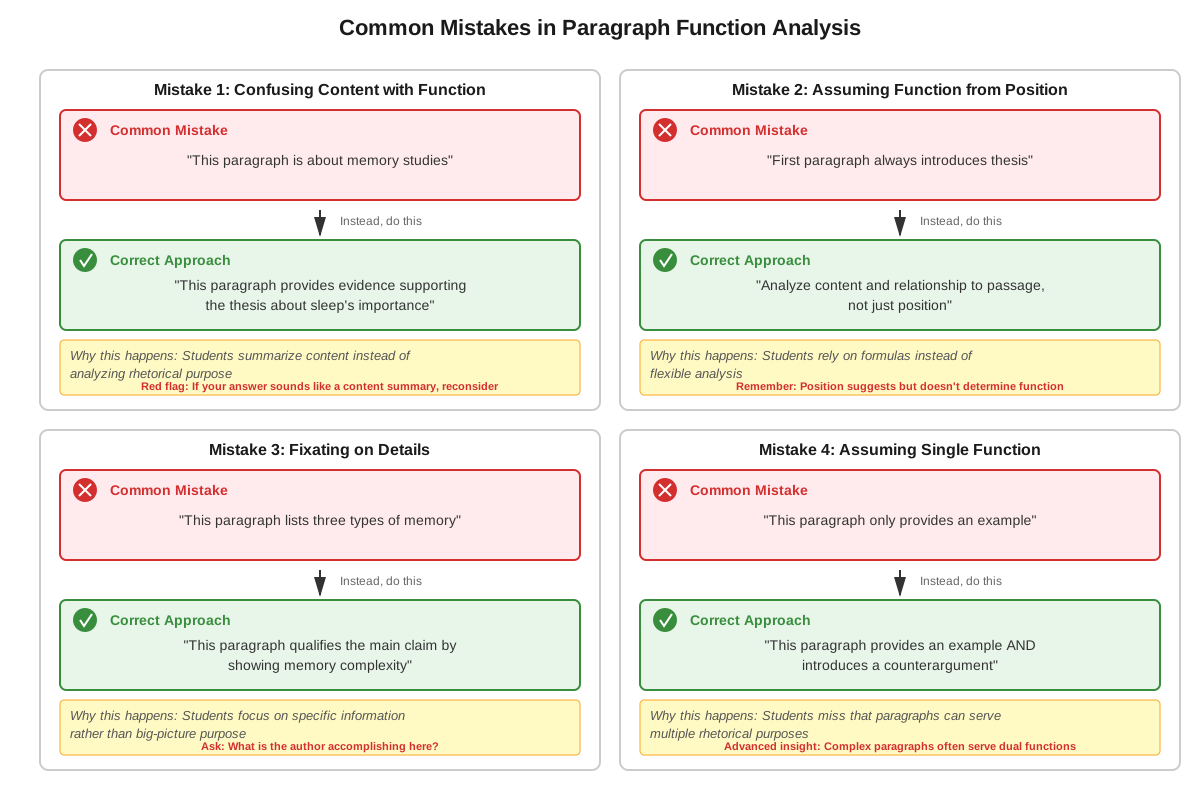
Misconception: Paragraph function is the same as paragraph summary.
Correction: Summary describes what a paragraph says (content), while function describes why the author included it and how it advances the argument. A paragraph might summarize a study (content), but its function could be to support a claim, refute an opposing view, or provide an example.
Misconception: Every paragraph has only one function.
Correction: Paragraphs can serve multiple functions simultaneously. A paragraph might provide an example (illustration) while also supporting the main argument (evidence) and contrasting with a previous approach (comparison). However, MCAT questions typically ask for the primary or main function.
Misconception: Paragraph function can be determined by reading that paragraph alone.
Correction: Function is inherently relational—it depends on how a paragraph connects to surrounding paragraphs and the overall passage argument. A paragraph describing a theory might function as background in one passage but as the main thesis in another.
Misconception: The first sentence of a paragraph always reveals its function.
Correction: While topic sentences often indicate function, some paragraphs build toward their functional role, and transition words may appear mid-paragraph. Additionally, some authors use more subtle structural cues that require reading the entire paragraph to identify.
Misconception: Counterargument paragraphs mean the author agrees with those opposing views.
Correction: Authors present counterarguments for various rhetorical purposes: to appear balanced, to set up a refutation, to acknowledge complexity, or to show awareness of alternative perspectives. Presenting a counterargument doesn't indicate endorsement—look for the author's response in subsequent paragraphs.
Misconception: Longer paragraphs have more important functions than shorter ones.
Correction: Paragraph length doesn't determine functional importance. A brief paragraph might serve the crucial function of stating the thesis, while a longer paragraph might simply provide one of several examples. Function relates to rhetorical role, not word count.
Worked Examples
Example 1: Identifying Function in a Philosophy Passage
Passage Context: A passage discusses whether artificial intelligence can possess genuine consciousness. Paragraph 1 introduces the debate. Paragraph 2 describes the "computational theory of mind" that suggests consciousness emerges from information processing. Paragraph 3 (our focus) reads:
"Critics of the computational theory point to the 'hard problem of consciousness'—the question of why physical processes in the brain give rise to subjective experience. A computer might process information about the color red, they argue, but it doesn't experience 'redness' the way humans do. This qualitative, subjective aspect of consciousness, termed 'qualia' by philosophers, seems fundamentally different from mere computation. No matter how sophisticated the algorithm, these critics maintain, silicon-based processing cannot generate genuine phenomenal experience."
Question: The primary function of Paragraph 3 is to:
Analysis Process:
- Identify content: The paragraph discusses the "hard problem of consciousness" and qualia, arguing that computation cannot produce subjective experience.
- Examine context: This follows a paragraph describing the computational theory (Paragraph 2). The transition "Critics of the computational theory" signals a shift.
- Recognize structural markers: "Critics argue" and "these critics maintain" indicate presentation of opposing views.
- Determine relationship to passage: This presents an alternative perspective to the theory described in Paragraph 2.
- Identify function: This paragraph functions as a counterargument—it presents objections to the computational theory introduced previously.
Answer: The primary function is to present a counterargument to the computational theory of mind by introducing the "hard problem of consciousness."
Connection to Learning Objectives: This example demonstrates how to distinguish content (discussion of qualia and the hard problem) from function (presenting a counterargument), and shows how transition words ("Critics of...") signal paragraph function.
Example 2: Function in a Social Science Passage
Passage Context: A passage argues that urban green spaces improve community mental health. Paragraph 1 introduces the thesis. Paragraph 2 presents statistical evidence of reduced depression in neighborhoods with parks. Paragraph 3 discusses the psychological mechanisms (stress reduction, social connection). Paragraph 4 (our focus) reads:
"The relationship between green spaces and mental health is not universal, however. A 2019 study in Detroit found no significant correlation between park proximity and reported well-being among residents. The researchers suggested that factors such as park maintenance, safety concerns, and community trust might mediate the relationship. In neighborhoods where parks were poorly maintained or perceived as dangerous, residents avoided them entirely, negating any potential mental health benefits."
Question: The author most likely includes Paragraph 4 in order to:
Analysis Process:
- Identify content: Describes a study showing no correlation between parks and well-being, with explanations for this finding.
- Examine context: Follows three paragraphs supporting the thesis that green spaces improve mental health. The transition "however" signals a shift.
- Recognize structural markers: "However" indicates contrast, but note that the paragraph doesn't completely reject the thesis—it qualifies it.
- Determine relationship to passage: This acknowledges limitations or conditions under which the main argument might not hold.
- Assess author's treatment: The author doesn't use this to reject the thesis but to acknowledge complexity and specify conditions.
- Identify function: This paragraph functions to acknowledge a counterexample while qualifying the main argument—showing that the relationship is conditional rather than absolute.
Answer: The function is to acknowledge limitations of the main argument by presenting conditions under which green spaces may not improve mental health, thereby adding nuance to the thesis.
Connection to Learning Objectives: This example shows how the same content (a contradictory study) can serve different functions depending on how the author treats it. Here, it's not a full counterargument to be refuted but a qualification that adds sophistication to the argument. This demonstrates the importance of analyzing author's tone and treatment, not just content.
Exam Strategy
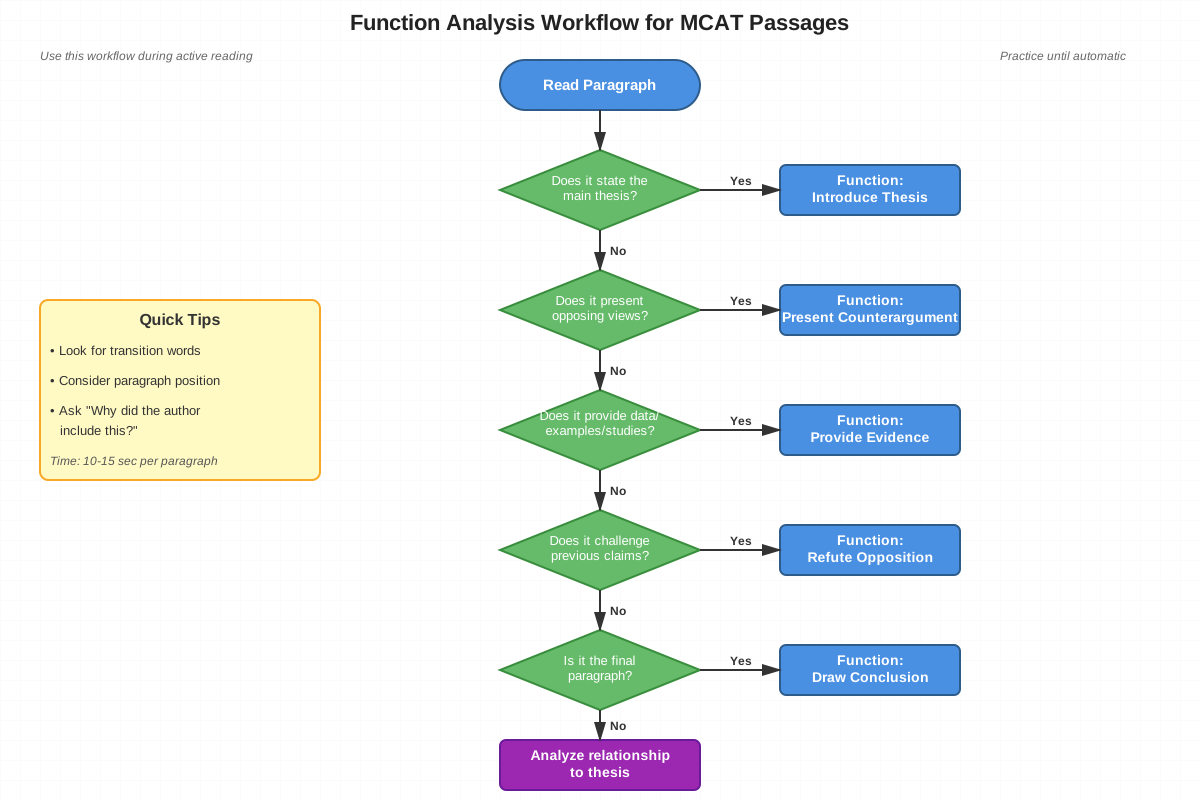
When approaching function of a paragraph MCAT questions, use this systematic process:
Step 1: Identify the question type
Look for phrases like "primary purpose," "main function," "the author includes X in order to," or "serves primarily to." These signal function questions rather than content questions.
Step 2: Read the paragraph in context
Never evaluate a paragraph in isolation. Read the preceding paragraph's final sentence and the following paragraph's first sentence to understand how the target paragraph connects to surrounding text.
Step 3: Look for structural markers
Identify transition words at the paragraph's beginning and throughout. These are your strongest clues: "However" suggests counterargument or contrast; "For example" suggests illustration; "Furthermore" suggests continuation of previous function.
Step 4: Ask "Why here?"
Consider why the author placed this paragraph at this specific location. What would be missing if this paragraph were removed? What does it add to the argument's development?
Step 5: Distinguish content from function
Eliminate answer choices that merely summarize what the paragraph says. Correct answers describe the rhetorical work the paragraph performs.
Exam Tip: If two answer choices seem correct, choose the one that describes the paragraph's relationship to the overall passage argument rather than just to the immediately preceding paragraph.
Trigger words to watch for in answer choices:
- "Support" or "provide evidence for" → supporting function
- "Challenge" or "refute" → counterargument or refutation function
- "Illustrate" or "exemplify" → illustration function
- "Introduce" or "establish" → introductory function
- "Qualify" or "limit" → nuancing or conditioning function
- "Contrast" or "compare" → comparative function
- "Explain" or "clarify" → elaboration function
Time allocation: Spend 15-20 seconds reviewing the paragraph's context before evaluating answer choices. This upfront investment prevents re-reading and saves time overall.
Process of elimination strategy: Eliminate answers that:
- Describe content rather than function
- Describe functions that appear elsewhere in the passage but not in the target paragraph
- Use extreme language ("completely refute," "definitively prove") unless the paragraph's language is equally strong
- Ignore the paragraph's relationship to surrounding text
Memory Techniques
PACES Mnemonic for common paragraph functions:
- Provide evidence/support
- Acknowledge counterarguments
- Clarify/elaborate concepts
- Exemplify with illustrations
- Synthesize/conclude arguments
The "Why Here?" Question: Before every paragraph, mentally ask "Why did the author put this here?" This simple question shifts focus from content to function automatically.
Transition Word Categories (visualize as traffic signals):
- Green light (continue same direction): Furthermore, Moreover, Additionally
- Yellow light (prepare for change): However, Nevertheless, Although
- Red light (stop and turn): Conversely, On the contrary, In contrast
The Architecture Analogy: Think of passages as buildings where each paragraph is a room with a specific purpose. The entrance hall (introduction) leads to the main living space (thesis/argument), with supporting rooms (evidence), a guest room (counterarguments), and an exit (conclusion). This spatial metaphor helps remember that function relates to position and purpose within a structure.
Function vs. Content Reminder: "Content = WHAT; Function = WHY" — write this on your scratch paper at the test's beginning.
Summary
Understanding the function of a paragraph is essential for MCAT CARS success because it enables students to analyze passage structure and rhetorical strategy rather than merely comprehending content. Paragraph function describes the specific role a paragraph plays in advancing the author's overall argument—whether introducing a thesis, providing supporting evidence, acknowledging counterarguments, offering illustrations, or drawing conclusions. Mastering this skill requires distinguishing between what a paragraph says (content) and why the author included it (function), recognizing structural markers and transition words that signal function, and understanding how paragraphs work together to create coherent argumentative structures. Success on function questions depends on reading paragraphs in context, asking "Why did the author place this here?", and selecting answers that describe rhetorical work rather than content summary. This analytical skill connects directly to passage mapping, main idea identification, and overall CARS performance.
Key Takeaways
- Function describes WHY a paragraph exists and HOW it advances the argument, not WHAT it says—always distinguish content from rhetorical purpose
- Transition words and structural markers are the strongest indicators of paragraph function—pay special attention to paragraph-opening transitions
- Context is essential—a paragraph's function depends on its relationship to surrounding paragraphs and the overall passage argument
- Most CARS passages follow predictable structural patterns—recognizing these patterns helps predict and identify paragraph functions efficiently
- Common functions include: introduction, support/evidence, counterargument, refutation, elaboration, illustration, comparison, and conclusion—familiarize yourself with how each appears in passages
- Function questions require analysis, not summary—eliminate answer choices that merely restate paragraph content
- The same content can serve different functions in different contexts—always consider the specific passage's argumentative structure
Related Topics
Passage Structure and Organization: Understanding how entire passages are organized builds directly on paragraph function analysis. Mastering paragraph function enables recognition of larger structural patterns like problem-solution, cause-effect, and comparative frameworks.
Main Idea Identification: Recognizing paragraph functions helps distinguish between main ideas and supporting details. Paragraphs with supporting or illustrative functions contain details, while those with thesis or conclusion functions contain main ideas.
Author's Purpose and Tone: Paragraph function analysis reveals author's rhetorical strategies, which directly informs understanding of overall purpose and attitude toward the subject matter.
Rhetorical Analysis: Advanced analysis of how authors use rhetorical devices and argumentative strategies builds on the foundation of understanding basic paragraph functions.
Question Type Strategies: Many CARS question types (inference, strengthen/weaken, application) benefit from understanding paragraph function, as it reveals the logical structure of arguments.
Practice CTA
Now that you understand the function of a paragraph and how it appears on the MCAT CARS section, it's time to apply these concepts to practice questions. Work through CARS passages specifically focusing on identifying each paragraph's function before attempting questions. Create passage maps that note function rather than content, and challenge yourself to predict paragraph functions based on structural patterns. The more you practice distinguishing content from function and recognizing rhetorical patterns, the more efficiently you'll navigate CARS passages on test day. Remember: understanding paragraph function isn't just about answering function questions—it's about developing the structural awareness that elevates your performance across all CARS question types. You've built the foundation; now strengthen it through deliberate practice!
Sign up free to keep reading
Create a free AnvayaPrep account to finish this MCAT guide on Function of a paragraph — plus flashcards and practice questions.