Overview
Main idea identification is the foundational skill in the Critical Analysis and Reasoning Skills (CARS) section of the MCAT, requiring test-takers to distill complex passages into their essential arguments and central claims. This cognitive process involves distinguishing between primary arguments and supporting details, recognizing authorial intent, and synthesizing information across multiple paragraphs to extract the overarching thesis. Unlike content-based sections of the MCAT that test memorized facts, main idea identification assesses the ability to comprehend, analyze, and evaluate unfamiliar texts from diverse disciplines including humanities, social sciences, and occasionally natural sciences presented in a non-technical manner.
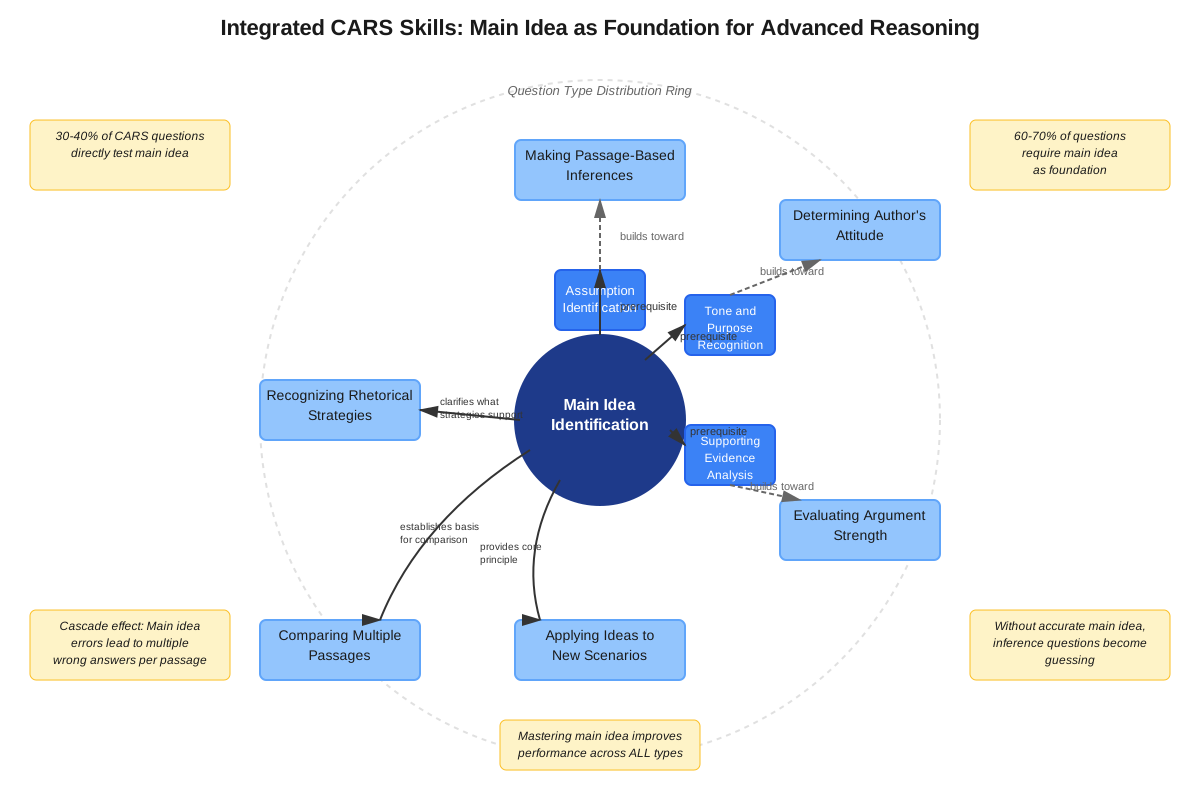
Mastery of main idea identification MCAT skills directly correlates with success on approximately 30-40% of CARS questions, as many question stems explicitly ask for the "main point," "central thesis," or "primary purpose" of a passage. Beyond these direct applications, understanding the main idea serves as the foundation for answering inference questions, author's attitude questions, and application questions, since all passage-based reasoning must be anchored in accurate comprehension of the author's central argument. Students who struggle with main idea identification often find themselves selecting answer choices that address minor details or tangential points, leading to cascading errors throughout an entire passage set.
Within the broader framework of CARS Skills, main idea identification represents the first critical step in the hierarchical process of passage analysis. It connects intimately with other essential skills including identifying supporting evidence, recognizing rhetorical strategies, evaluating argument structure, and making passage-based inferences. Without accurately identifying the main idea, students cannot effectively evaluate the strength of an argument, distinguish between claims and evidence, or predict how an author might respond to new scenarios—all higher-order skills tested extensively on the MCAT.
Learning Objectives
- [ ] Define Main idea identification using accurate Critical Analysis and Reasoning Skills terminology
- [ ] Explain why Main idea identification matters for the MCAT
- [ ] Apply Main idea identification to exam-style questions
- [ ] Identify common mistakes related to Main idea identification
- [ ] Connect Main idea identification to related Critical Analysis and Reasoning Skills concepts
- [ ] Distinguish between main ideas, supporting details, and illustrative examples in complex passages
- [ ] Synthesize information from multiple paragraphs to construct a comprehensive main idea statement
- [ ] Evaluate answer choices for main idea questions using specific elimination criteria
- [ ] Recognize structural patterns that signal main idea location within passages
Prerequisites
- Basic reading comprehension: Ability to understand college-level texts is essential, as CARS passages assume sophisticated vocabulary and complex sentence structures
- Paragraph structure awareness: Understanding topic sentences, supporting sentences, and transitions enables efficient navigation of passage organization
- Argument vs. evidence distinction: Recognizing the difference between claims and the support provided for them prevents confusion between main ideas and details
- Active reading strategies: Techniques like annotation and mental summarization allow for engagement with dense material under time pressure
Why This Topic Matters
Main idea identification Critical Analysis and Reasoning Skills represents the single most important competency for CARS success because it serves as the foundation upon which all other reasoning skills are built. In clinical practice, physicians must regularly extract central findings from research articles, patient histories, and consultation notes—skills that directly parallel MCAT passage analysis. The ability to identify what matters most in a sea of information translates to diagnostic reasoning, where distinguishing primary pathology from secondary symptoms can be life-saving.
On the MCAT, main idea questions appear in every CARS section, typically comprising 2-3 questions per passage across the 9 passages in the section. This translates to approximately 18-27 questions (out of 53 total CARS questions) that either directly test main idea identification or require it as a prerequisite skill. Question stems that explicitly test this skill include: "The main idea of the passage is...", "The author's primary purpose is to...", "Which of the following best describes the central thesis?", and "The passage is primarily concerned with...". Additionally, questions asking about passage organization, tone, or overall argument structure all require accurate main idea identification as a foundation.
Common passage types that heavily emphasize main idea identification include argumentative essays presenting a thesis with supporting evidence, comparative analyses weighing multiple perspectives, historical narratives with an interpretive angle, and theoretical discussions proposing new frameworks. Passages from philosophy, art criticism, cultural studies, and social sciences frequently feature abstract main ideas that require synthesis across multiple paragraphs, making them particularly challenging for students who focus excessively on details rather than overarching arguments.
Core Concepts
Definition and Components of Main Idea
The main idea of a passage represents the author's central claim, argument, or purpose—the single most important point the author wants readers to understand or accept. It differs from a topic (the general subject matter) and from a theme (a recurring concept). The main idea is typically expressible as a complete sentence that captures both what the passage is about and what the author is saying about that subject. For instance, a passage might have "artificial intelligence" as its topic, but the main idea would be "Artificial intelligence development requires ethical frameworks that prioritize human autonomy over efficiency gains."
Main ideas possess several defining characteristics. They are comprehensive, encompassing the entire passage rather than just one section. They are specific enough to distinguish the passage from others on similar topics, yet general enough to cover all major points discussed. They reflect authorial intent—what the author set out to accomplish—rather than reader interpretation. Finally, main ideas are defensible through evidence presented within the passage itself.
Structural Locations of Main Ideas
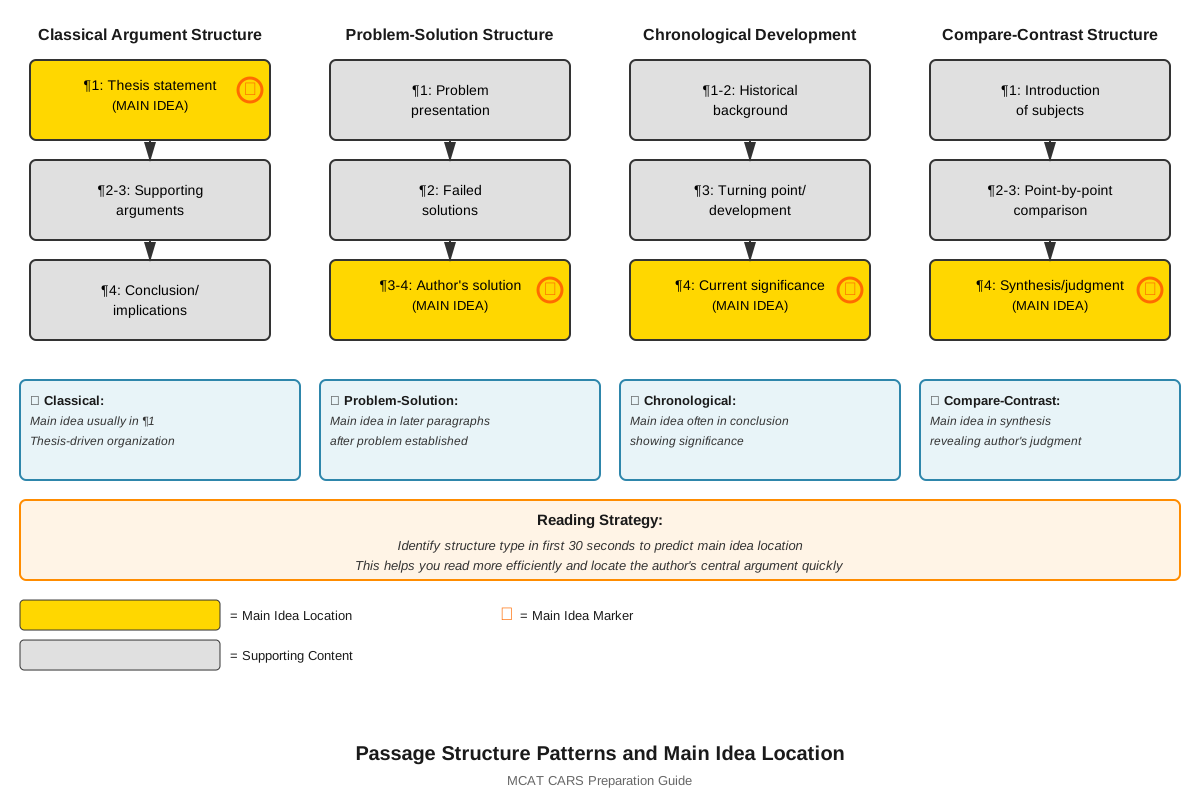
Understanding where main ideas typically appear dramatically improves identification efficiency. The thesis statement location varies by passage structure:
Classical structure: Main idea appears in the first or second paragraph, often in the last sentence of the introductory paragraph. The author states their position early, then spends subsequent paragraphs defending it with evidence and addressing counterarguments.
Inductive structure: Main idea appears near the end of the passage, after the author has presented evidence, examples, or scenarios that build toward a conclusion. This structure moves from specific observations to general principles.
Embedded structure: Main idea appears in the middle of the passage, often after the author has introduced a problem or question in the opening and before applying the main idea to specific cases in the conclusion.
Distributed structure: The main idea is never stated explicitly in a single sentence but must be synthesized from claims made across multiple paragraphs. This structure is particularly common in humanities passages and represents the highest difficulty level for main idea identification.
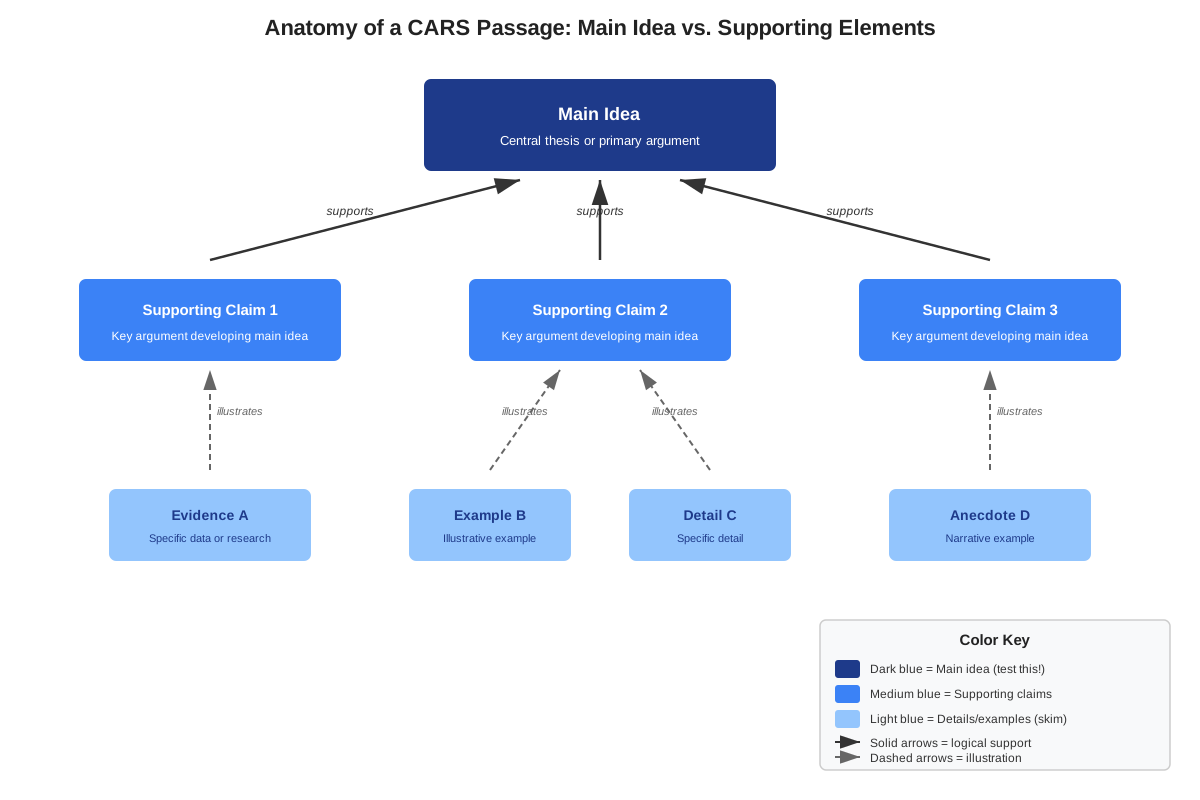
Distinguishing Main Ideas from Supporting Elements
A critical skill involves differentiating the main idea from various supporting elements:
| Element Type | Purpose | Relationship to Main Idea | Example Markers |
|---|---|---|---|
| Main Idea | Central argument or thesis | IS the main idea | "Ultimately," "The key point," "Most importantly" |
| Major Supporting Point | Defends or explains main idea | Directly supports | "First," "Additionally," "Furthermore" |
| Minor Detail | Illustrates or clarifies support | Indirectly supports | "For example," "Specifically," "In particular" |
| Counterargument | Presents opposing view | Contrasts with main idea | "Critics argue," "However," "On the other hand" |
| Background Information | Provides context | Precedes main idea | "Historically," "Traditionally," "In the past" |
| Tangential Point | Related but not central | Weakly connected | "Incidentally," "As an aside," "Interestingly" |
The Synthesis Process
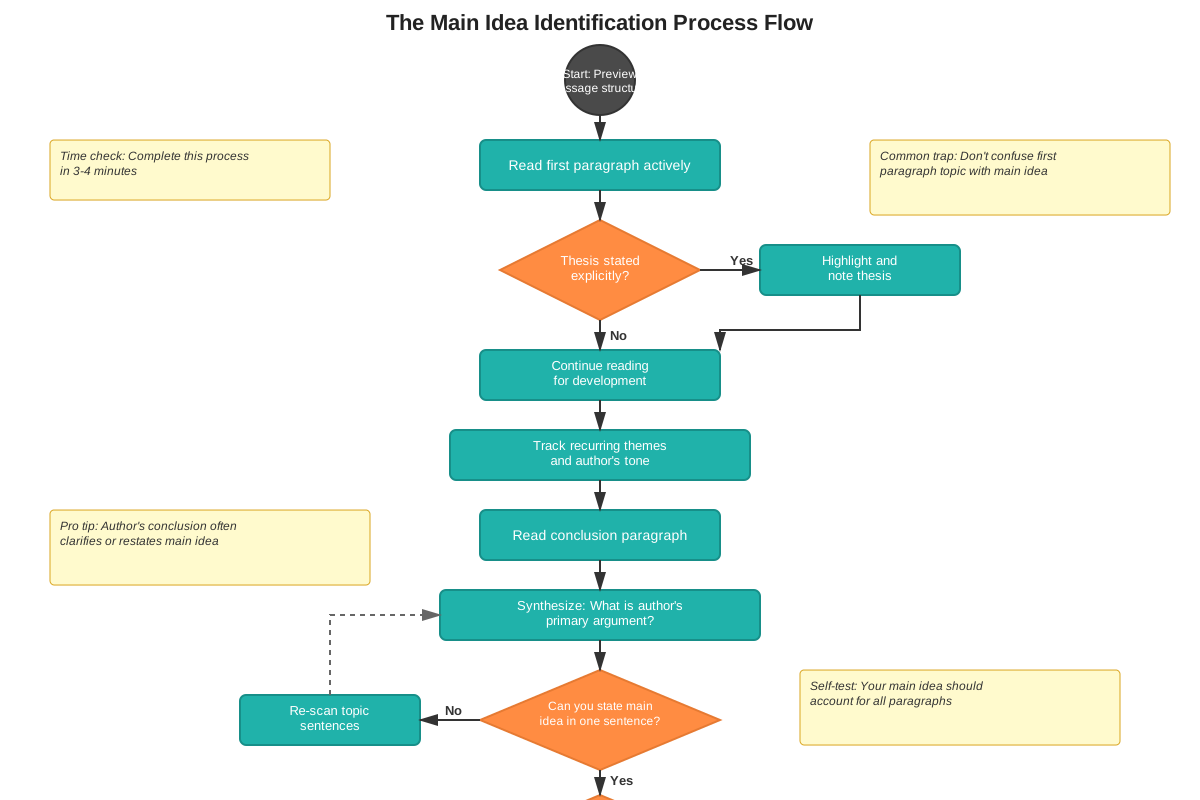
For passages without explicit thesis statements, synthesis becomes necessary. This process involves:
- Identifying the topic of each paragraph
- Extracting the claim made in each paragraph (not just the subject, but what is said about it)
- Recognizing patterns across paragraphs (Are they all supporting the same point? Building toward a conclusion? Comparing perspectives?)
- Formulating a statement that captures the common thread or ultimate conclusion
- Testing the synthesis by checking whether it accounts for all major paragraphs and distinguishes this passage from others on similar topics
Author's Purpose and Main Idea
The author's primary purpose and the main idea are intimately connected but not identical. The purpose describes what the author is trying to accomplish (persuade, explain, compare, critique, propose), while the main idea describes the specific content of that accomplishment. For example:
- Purpose: To critique a prevailing theory
- Main idea: "The rational choice model of economics fails to account for the role of emotions in decision-making, limiting its predictive power."
Understanding purpose helps identify main ideas because it reveals the author's stance and approach. Signal words indicating purpose include: "argue," "demonstrate," "challenge," "propose," "examine," "evaluate," "defend," and "question."
Scope and Main Idea
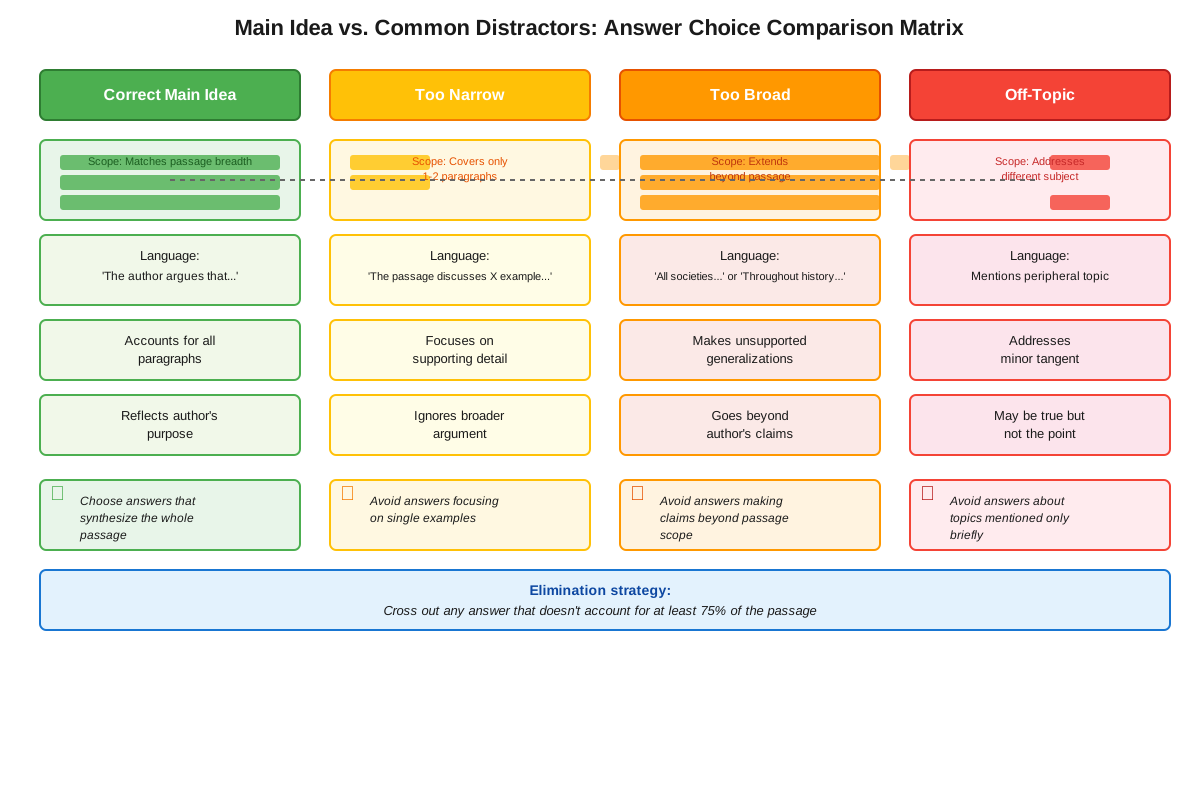
The scope of a passage—how broad or narrow its focus—directly affects main idea identification. A passage with narrow scope will have a specific, detailed main idea, while a broad scope passage will have a more general main idea. Common scope errors include:
- Selecting an answer that is too broad (covers more than the passage discusses)
- Selecting an answer that is too narrow (focuses on only one paragraph or example)
- Selecting an answer that is off-topic (addresses related but distinct issues)
Tone and Main Idea
The author's tone—their attitude toward the subject—provides crucial clues for main idea identification. A critical tone suggests the main idea involves challenging or refuting something. An enthusiastic tone suggests advocacy or promotion. A balanced, analytical tone suggests comparison or evaluation. Tone indicators include:
- Word choice: "unfortunately," "remarkably," "merely," "profound"
- Qualifiers: "somewhat," "entirely," "arguably," "undeniably"
- Rhetorical questions: Often signal points the author wants to emphasize or challenge
- Punctuation: Exclamation points, quotation marks used for irony
Concept Relationships
Main idea identification serves as the central hub connecting multiple CARS Skills. The relationship flows hierarchically: accurate main idea identification → enables recognition of supporting evidence → allows evaluation of argument strength → facilitates making valid inferences → supports application to new scenarios.
Topic identification precedes main idea identification; students must first determine what the passage is about before understanding what is being said about that topic. This relationship is foundational: Topic → Main Idea → Supporting Details → Examples.
Paragraph function analysis works in parallel with main idea identification. Understanding whether a paragraph introduces, supports, contrasts, or concludes helps locate and confirm the main idea. The relationship is reciprocal: identifying the main idea clarifies paragraph functions, while recognizing paragraph functions aids main idea identification.
Inference questions depend entirely on accurate main idea identification because valid inferences must align with the author's central argument. An inference that contradicts or ignores the main idea cannot be correct. The relationship is: Main Idea → Constrains Valid Inferences → Enables Prediction.
Author's attitude and tone both inform and are informed by the main idea. The tone reveals the author's stance, which is embedded in the main idea, while the main idea clarifies why the author adopts a particular tone. This circular relationship requires simultaneous consideration: Tone ↔ Main Idea.
Passage structure and organization directly impact main idea location and identification strategy. Classical structures make identification straightforward, while distributed structures require synthesis. The relationship is: Structure Type → Determines Identification Strategy → Affects Difficulty Level.
High-Yield Facts
⭐ The main idea must account for the entire passage, not just the majority of it—if an answer choice doesn't explain why a particular paragraph exists, it's likely too narrow.
⭐ Main ideas are never explicitly stated in approximately 40% of MCAT CARS passages, requiring synthesis across multiple paragraphs rather than simple location of a thesis statement.
⭐ The first and last paragraphs contain the main idea or its clearest expression in approximately 70% of passages, making these paragraphs the highest-yield for initial focus.
⭐ Wrong answer choices for main idea questions typically fall into four categories: too broad, too narrow, off-topic, or opposite to the author's actual position.
⭐ Transition words like "however," "but," "yet," and "although" often precede or follow the main idea, as they signal the author's true position after presenting alternative views.
- Main idea questions are the most frequently tested question type in CARS, appearing 2-3 times per passage on average.
- The main idea always reflects what the author believes or argues, never what others believe unless the passage is purely descriptive.
- Passages with questions in the title or opening typically answer those questions in the main idea.
- Abstract or theoretical passages require more synthesis than concrete, narrative passages for main idea identification.
- The main idea should be defensible using only information from the passage, without requiring outside knowledge.
- Correct main idea answer choices often use synonyms or paraphrasing rather than exact passage language.
- If two answer choices seem equally valid, the one that better accounts for the passage's scope and tone is correct.
- Main ideas in comparative passages typically address the comparison itself, not just one of the subjects being compared.
Quick check — test yourself on Main idea identification so far.
Try Flashcards →Common Misconceptions
Misconception: The main idea is always explicitly stated in the passage.
Correction: While many passages contain explicit thesis statements, approximately 40% of MCAT CARS passages require readers to synthesize the main idea from claims distributed across multiple paragraphs. Students must be prepared to construct main ideas rather than simply locate them.
Misconception: The main idea is whatever the passage discusses most.
Correction: Frequency of discussion does not determine the main idea. A passage might spend three paragraphs describing a phenomenon and only one paragraph arguing for its significance, with that argument being the actual main idea. The main idea represents the author's point, not the most-discussed topic.
Misconception: The first sentence of the passage is always the main idea.
Correction: While first sentences often introduce topics, they frequently provide background information, pose questions, or present scenarios that lead to the main idea. The main idea more commonly appears at the end of the first paragraph or even later in the passage.
Misconception: If an answer choice is true according to the passage, it must be the main idea.
Correction: Many statements can be true based on passage content without being the main idea. Supporting details, examples, and minor points are all true but don't capture the central argument. The main idea must be both true and central to the author's purpose.
Misconception: Main ideas are always complex and sophisticated.
Correction: Some passages have relatively straightforward main ideas, even if the supporting discussion is complex. Students sometimes overlook simple, clear main ideas in favor of more complicated interpretations. The main idea should be as simple as the passage allows while remaining comprehensive.
Misconception: The main idea changes as the passage progresses.
Correction: While passages may introduce new information or shift focus between paragraphs, the main idea remains constant—it's the overarching point that unifies all sections. What may appear as shifts are typically different aspects of support for the same central claim.
Misconception: Descriptive passages don't have main ideas.
Correction: Even purely descriptive passages have main ideas that capture what is being described and why. The main idea might be "The development of jazz in New Orleans resulted from the unique convergence of African, Caribbean, and European musical traditions," which is descriptive but still represents a central claim about causation and significance.
Worked Examples
Example 1: Explicit Main Idea in Classical Structure
Passage Excerpt (condensed):
"For decades, art historians have debated whether Renaissance painting represented a radical break from medieval traditions or a gradual evolution. Recent scholarship, however, has convincingly demonstrated that this dichotomy is false. Renaissance artists did not reject medieval techniques; rather, they selectively incorporated medieval methods while introducing innovations in perspective and human representation. This synthesis, not revolution, characterizes the period. Evidence from workshop records shows apprentices learning traditional tempera techniques before experimenting with oils. Similarly, compositional analysis reveals that many 'revolutionary' Renaissance works maintain medieval symbolic hierarchies while adding naturalistic details."
Question: Which of the following best expresses the main idea of the passage?
A) Renaissance painting evolved gradually from medieval traditions rather than representing a complete break.
B) Workshop records provide valuable evidence about Renaissance artistic techniques.
C) Medieval and Renaissance painting both used symbolic hierarchies in composition.
D) Art historians have long debated the relationship between medieval and Renaissance art.
Analysis:
Step 1: Identify the topic—the relationship between Renaissance and medieval painting.
Step 2: Locate potential thesis statements—the third sentence ("Recent scholarship, however, has convincingly demonstrated that this dichotomy is false") signals a shift to the author's position, and the fourth sentence explicitly states the position.
Step 3: Confirm with passage structure—the remaining sentences provide evidence (workshop records, compositional analysis) supporting the synthesis claim.
Step 4: Evaluate answer choices:
- Choice A: Captures the synthesis argument and accounts for the entire passage. The phrase "evolved gradually" may be slightly imprecise (the passage emphasizes selective incorporation, not gradual evolution), but it's the closest to the main idea.
- Choice B: Too narrow—workshop records are evidence, not the main point.
- Choice C: Too narrow—symbolic hierarchies are one example, not the central claim.
- Choice D: True but not the main idea—this describes the background context, not the author's argument.
Answer: A
Key Lesson: When a passage presents a debate and then takes a position, the main idea is the author's position, not the existence of the debate. Signal words like "however" and "rather" indicate the author's true stance.
Example 2: Synthesized Main Idea in Distributed Structure
Passage Excerpt (condensed):
"Paragraph 1: The concept of 'wilderness' as pristine nature untouched by humans has shaped American environmental policy for over a century. National parks were established to preserve these supposedly virgin landscapes.
Paragraph 2: Archaeological evidence increasingly reveals that landscapes considered wilderness were actually managed by Indigenous peoples for thousands of years. The Amazon rainforest, long viewed as pristine, shows signs of extensive cultivation.
Paragraph 3: This historical management challenges the philosophical foundations of conservation. If no truly untouched nature exists, what exactly are we preserving?
Paragraph 4: Some conservationists now advocate for 'rewilding' that acknowledges human history rather than erasing it. This approach recognizes humans as part of ecosystems rather than separate from them."
Question: The author's primary purpose is to:
A) Describe the history of American national parks
B) Present evidence that Indigenous peoples managed landscapes
C) Challenge the concept of wilderness as untouched nature and its implications for conservation
D) Advocate for rewilding as the best conservation strategy
Analysis:
Step 1: Note the absence of an explicit thesis statement—no single sentence captures the full argument.
Step 2: Identify each paragraph's function:
- Paragraph 1: Introduces the traditional wilderness concept
- Paragraph 2: Presents evidence challenging that concept
- Paragraph 3: Explores implications of the challenge
- Paragraph 4: Describes an alternative approach
Step 3: Synthesize the progression—the passage moves from traditional concept → evidence against it → philosophical implications → alternative approach. The unifying thread is challenging the wilderness concept and exploring consequences.
Step 4: Evaluate answer choices:
- Choice A: Too narrow—national parks are mentioned only as context.
- Choice B: Too narrow—evidence about Indigenous management is one component, not the primary purpose.
- Choice C: Comprehensive—accounts for both the challenge (paragraphs 1-2) and the implications (paragraphs 3-4). The word "implications" captures the philosophical and practical consequences discussed.
- Choice D: Too narrow and too strong—rewilding is presented as one response, not advocated as "best."
Answer: C
Key Lesson: When no explicit thesis exists, synthesize by identifying the common thread across all paragraphs. The main idea should explain why each paragraph is included and how they connect. Purpose questions often require this synthesis.
Exam Strategy
Systematic Approach to Main Idea Questions
Step 1: Pre-read the question stem before reading the passage. If you see "main idea," "primary purpose," or "central thesis" questions, you know to focus on big-picture understanding rather than details during your initial read.
Step 2: Identify passage structure in the first 30 seconds. Is there a clear thesis statement? Does the passage pose a question it will answer? Does it present multiple perspectives? Structure determines where to look for the main idea.
Step 3: Focus on high-yield locations during reading:
- Last sentence of first paragraph (most common thesis location)
- First sentence of last paragraph (common for inductive structures)
- Sentences following "however," "but," "yet" (signal author's true position)
- Sentences with strong language ("must," "clearly," "essential")
Step 4: Create a mental one-sentence summary after reading. Before looking at answer choices, articulate the main idea in your own words. This prevents answer choices from distorting your understanding.
Trigger Words and Phrases
Question stems that test main idea:
- "The main idea/point/argument of the passage is..."
- "The author's primary purpose is to..."
- "Which of the following best describes the passage?"
- "The passage is primarily concerned with..."
- "The central thesis of the passage is..."
Passage phrases that signal main ideas:
- "The key point is..."
- "Most importantly..."
- "Ultimately..."
- "The fundamental issue..."
- "What this means is..."
- "In essence..."
Phrases that signal NOT the main idea:
- "For example..." (introduces supporting detail)
- "Specifically..." (introduces minor detail)
- "Historically..." (introduces background)
- "Some argue..." (introduces counterargument, unless passage defends it)
Process of Elimination Strategy
Eliminate answers that are too narrow: If an answer choice only accounts for one or two paragraphs, it cannot be the main idea. Ask: "Does this explain why every paragraph exists?"
Eliminate answers that are too broad: If an answer choice could apply to dozens of different passages on the topic, it's likely too general. The main idea should distinguish this specific passage.
Eliminate answers that are off-topic: If an answer choice addresses something mentioned only briefly or tangentially, eliminate it. The main idea must be central, not peripheral.
Eliminate answers with extreme language unless the passage itself is extreme. Words like "always," "never," "only," "all," or "none" are rarely correct for main idea questions unless the author explicitly uses such language.
Eliminate answers that contradict the author's tone: If the author is critical but an answer choice suggests support, or vice versa, eliminate it. The main idea must align with the author's attitude.
Time Allocation
Spend no more than 60 seconds on main idea questions if you've read the passage carefully. These questions should be among the fastest to answer because they test your overall comprehension rather than requiring you to locate specific details. If you find yourself spending more than 60 seconds, you likely didn't grasp the main idea during your initial read—in this case, quickly skim the first and last paragraphs again before selecting an answer.
Exam Tip: If you're torn between two answer choices for a main idea question, choose the one that better accounts for the passage's scope and tone. The correct answer will feel comprehensive without being vague, and it will match the author's attitude (critical, supportive, analytical, etc.).
Memory Techniques
The SCOPE Mnemonic
Use SCOPE to evaluate main idea answer choices:
- Specific enough to distinguish this passage from others
- Comprehensive enough to account for all paragraphs
- Opinion/position of the author, not just the topic
- Purpose-aligned with what the author is trying to accomplish
- Entire passage covered, not just the majority
The "Elevator Pitch" Visualization
Imagine you have 15 seconds in an elevator to tell someone what the passage argues. What single sentence would you say? This mental exercise forces synthesis and prevents getting lost in details. Practice creating these "pitches" for every passage you read.
The "Title Test" Technique
Pretend you're creating a title for the passage that captures its main argument (not just its topic). Good titles for academic articles often mirror main ideas. For example:
- Topic-based title: "Renaissance Art" (too vague)
- Main-idea-based title: "Renaissance Art as Synthesis, Not Revolution" (captures the argument)
The Three-Layer Pyramid
Visualize passage content as a pyramid:
- Top (smallest): Main idea—one sentence
- Middle: Major supporting points—3-5 sentences
- Bottom (largest): Details, examples, evidence—everything else
When answering main idea questions, you're selecting the top of the pyramid. If an answer choice includes middle or bottom content, it's too narrow.
The "But What?" Chain
For passages without explicit thesis statements, repeatedly ask "But what is the author saying about this?" after each paragraph:
- Paragraph 1 discusses X → But what about X?
- Paragraph 2 discusses Y → But what about Y?
- Paragraph 3 discusses Z → But what about Z?
The answer that emerges from this chain is your synthesized main idea.
Summary
Main idea identification represents the cornerstone skill for MCAT CARS success, requiring test-takers to distinguish central arguments from supporting details and synthesize overarching theses from complex passages. The main idea is the author's primary claim or purpose—what they most want readers to understand or accept—and it must be comprehensive enough to account for the entire passage while specific enough to distinguish it from other texts on similar topics. Successful identification depends on recognizing passage structure (classical, inductive, embedded, or distributed), understanding the relationship between topic and argument, and accurately interpreting authorial tone and purpose. Students must avoid common pitfalls including confusing main ideas with frequently discussed topics, selecting answers that are too narrow or too broad, and mistaking background information or counterarguments for the central thesis. Approximately 30-40% of CARS questions directly or indirectly test main idea identification, making it the highest-yield skill to master. Strategic approaches include focusing on high-yield locations (first and last paragraphs, sentences following transition words), creating mental summaries before viewing answer choices, and systematically eliminating options based on scope, tone, and comprehensiveness.
Key Takeaways
- The main idea is the author's central argument or purpose, not merely the topic or most-discussed concept—it answers "What is the author saying about the subject?"
- Approximately 40% of MCAT passages require synthesizing the main idea from multiple paragraphs rather than locating an explicit thesis statement, demanding active construction rather than passive identification.
- Main idea answer choices must satisfy three criteria: comprehensive (accounts for entire passage), specific (distinguishes this passage from others), and aligned (matches author's tone and purpose).
- The first and last paragraphs contain the highest concentration of main idea information, with thesis statements most commonly appearing in the final sentence of the introduction or first sentence of the conclusion.
- Wrong answers for main idea questions predictably fall into four categories: too narrow (one paragraph's point), too broad (applies to many passages), off-topic (peripheral issues), or opposite (contradicts author's position).
- Transition words like "however," "but," and "yet" frequently signal the author's true position, especially when contrasting their view with others' perspectives or common assumptions.
- Main idea identification serves as the foundation for all other CARS skills—accurate comprehension of the central argument enables valid inferences, proper evaluation of evidence, and correct application to new scenarios.
Related Topics
Supporting Evidence Analysis: After identifying the main idea, students must recognize how authors use evidence, examples, and reasoning to defend their central claims. This skill involves distinguishing between strong and weak support, identifying logical fallacies, and evaluating the sufficiency of evidence—all of which depend on first understanding what claim is being supported.
Author's Tone and Attitude: Closely related to main idea identification, tone analysis requires recognizing the author's emotional stance and level of certainty toward their subject. Mastering main idea identification enables more accurate tone assessment because the main idea embodies the author's position, and tone reflects their attitude toward that position.
Passage Structure and Organization: Understanding how passages are organized (problem-solution, compare-contrast, chronological, cause-effect) directly facilitates main idea identification by revealing where thesis statements typically appear and how arguments develop. This topic builds on main idea skills by examining the architecture that supports central claims.
Inference and Implication Questions: These higher-order questions require students to extend passage arguments to new scenarios or unstated conclusions. Success depends entirely on accurate main idea identification because valid inferences must align with and extend the author's central argument rather than contradicting or ignoring it.
Strengthen and Weaken Questions: These question types ask students to identify information that would support or undermine the passage's argument. Mastering main idea identification is prerequisite because students must first understand the central claim before evaluating what would affect its validity.
Practice CTA
Now that you've mastered the theoretical foundations of main idea identification, it's time to apply these strategies to authentic MCAT-style passages. The practice questions and flashcards accompanying this guide will challenge you to identify main ideas across diverse passage types, from explicit thesis statements to distributed arguments requiring synthesis. Remember: main idea identification is a skill that improves dramatically with deliberate practice. Each passage you analyze strengthens your ability to distinguish central claims from supporting details, recognize structural patterns, and avoid common traps. Approach each practice question systematically using the SCOPE framework and elimination strategies you've learned. Your investment in mastering this foundational skill will pay dividends across every CARS passage you encounter on test day. You've got this!
Sign up free to keep reading
Create a free AnvayaPrep account to finish this MCAT guide on Main idea identification — plus flashcards and practice questions.