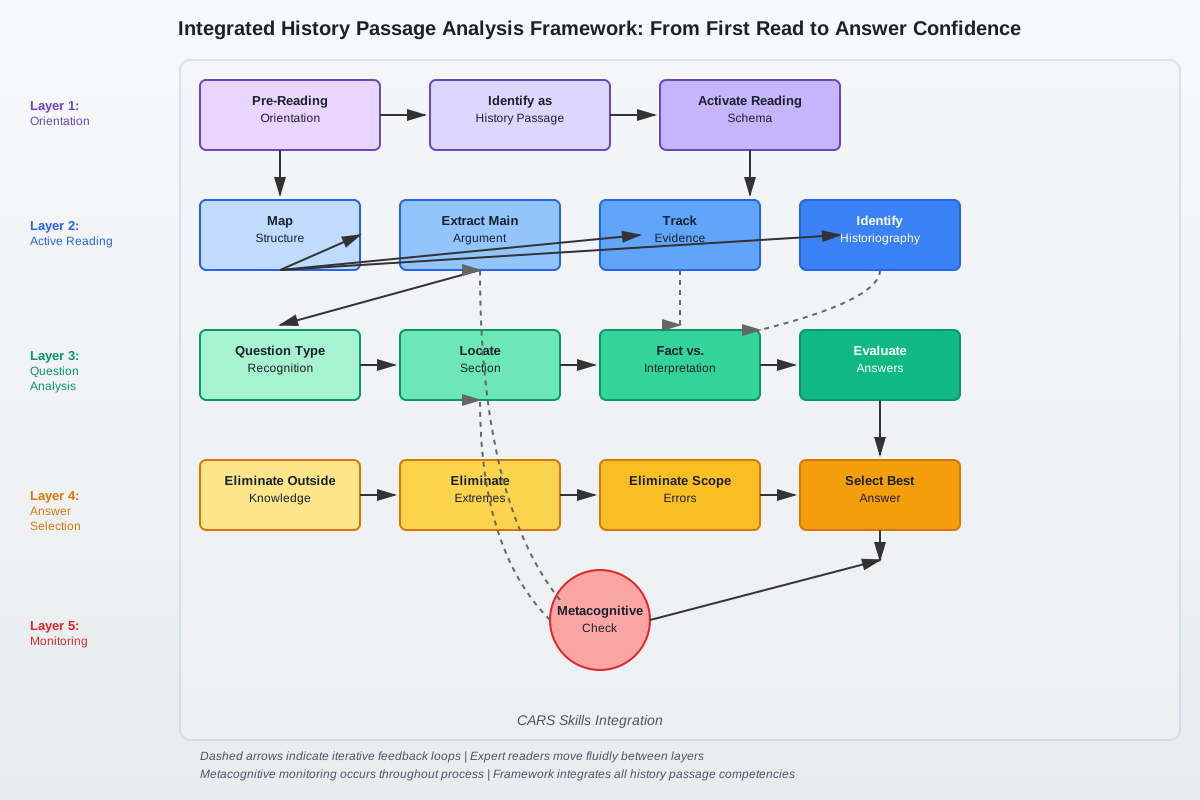
Overview
History passages represent one of the most frequently encountered passage types in the Critical Analysis and Reasoning Skills (CARS) section of the MCAT. These passages draw from historical scholarship, historiography, biographical accounts, and analyses of historical events, movements, and figures. Unlike the natural sciences tested elsewhere on the MCAT, History passages MCAT questions require students to engage with interpretive arguments about the past, evaluate historical evidence, and understand how historians construct narratives from fragmentary sources. Mastery of history passages demands the ability to distinguish between primary and secondary sources, recognize authorial bias, understand periodization, and follow complex causal arguments about social, political, and cultural change over time.
The significance of history passages extends beyond mere content comprehension. These passages test fundamental CARS Skills including the ability to identify main ideas, follow the development of arguments across multiple paragraphs, distinguish between factual claims and interpretive judgments, and evaluate the strength of evidence supporting historical conclusions. History passages frequently incorporate multiple perspectives on the same event, requiring test-takers to track competing interpretations and understand why historians might disagree about causes, significance, or meaning. This analytical work mirrors the critical thinking physicians must employ when evaluating conflicting research findings or treatment philosophies.
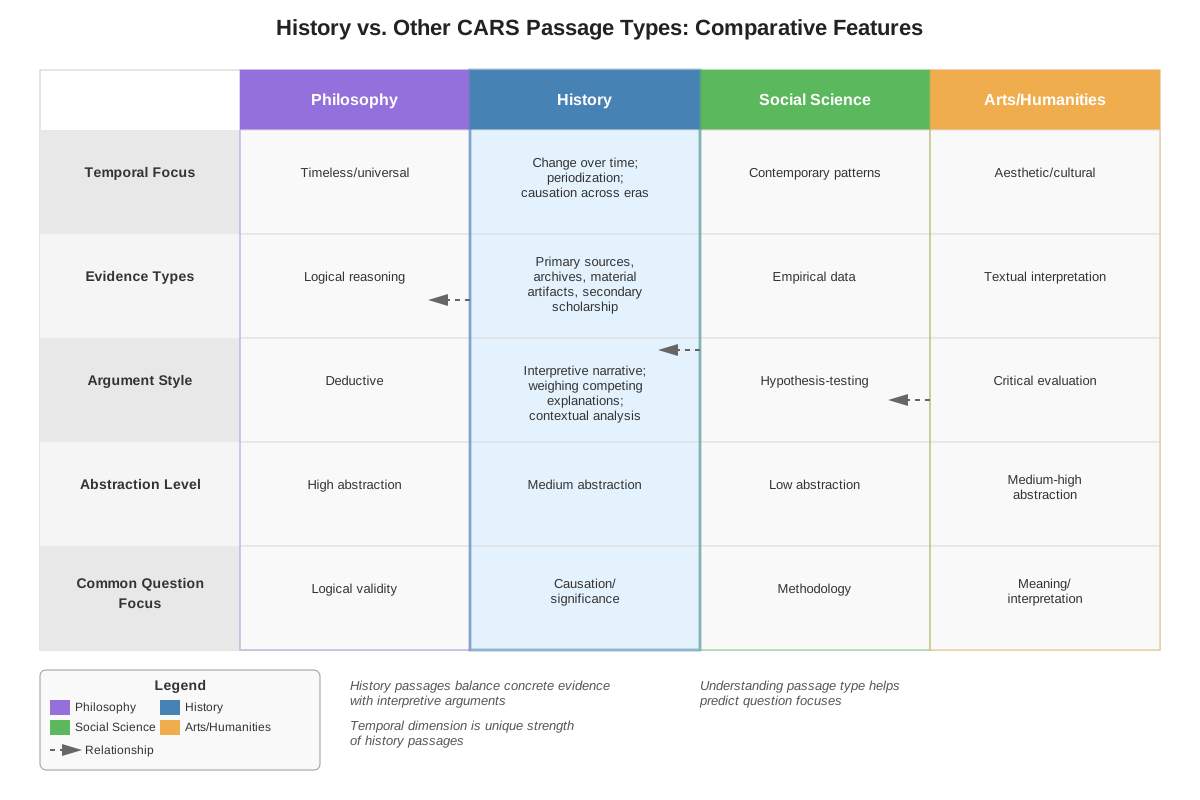
Within the broader landscape of Critical Analysis and Reasoning Skills, history passages occupy a middle ground between more abstract philosophical texts and more concrete social science passages. They share with philosophy passages a concern for interpretation and meaning-making, but ground these concerns in specific temporal contexts and empirical evidence. They connect to social science passages through shared interest in human behavior, institutions, and cultural patterns, but emphasize change over time and the unique particularity of past contexts. Understanding how to approach history passages therefore builds transferable skills applicable across the entire CARS section.
Learning Objectives
- [ ] Define History passages using accurate Critical Analysis and Reasoning Skills terminology
- [ ] Explain why History passages matters for the MCAT
- [ ] Apply History passages to exam-style questions
- [ ] Identify common mistakes related to History passages
- [ ] Connect History passages to related Critical Analysis and Reasoning Skills concepts
- [ ] Distinguish between descriptive historical narrative and interpretive historical argument
- [ ] Evaluate the strength of historical evidence and recognize limitations of historical sources
- [ ] Identify historiographical shifts and understand how historical interpretation changes over time
Prerequisites
- Basic reading comprehension skills: Ability to identify main ideas, supporting details, and paragraph structure forms the foundation for all CARS passage analysis
- Understanding of argument structure: Recognition of premises, conclusions, and evidence types enables evaluation of historical claims
- Familiarity with CARS question types: Knowledge of inference, main idea, and application questions allows strategic approach to history passage questions
- General awareness of major historical periods: Basic chronological orientation (ancient, medieval, modern, contemporary) helps contextualize passage content without requiring specific historical knowledge
Why This Topic Matters
History passages appear with significant frequency in the CARS section, typically comprising 15-25% of all passages on any given MCAT administration. The AAMC deliberately includes history passages because they test skills essential to medical practice: evaluating conflicting interpretations, understanding how context shapes meaning, recognizing the limitations of available evidence, and constructing coherent narratives from incomplete information. Physicians regularly engage in similar reasoning when taking patient histories, reviewing medical literature with evolving interpretations, or understanding how medical knowledge has changed over time.
On the MCAT, history passages generate questions across all major CARS question types. Main idea questions test whether students can identify the author's central interpretive claim about a historical phenomenon. Inference questions require drawing conclusions consistent with historical evidence presented in the passage. Application questions ask students to extend historical arguments to new contexts or evaluate hypothetical scenarios using the passage's analytical framework. Function questions probe understanding of why authors include specific historical examples or evidence. The complexity of historical argumentation—with its multiple time periods, causal chains, and interpretive layers—makes these passages particularly effective at discriminating between high-scoring and average test-takers.
Common manifestations of history passages include: biographical analyses exploring how individuals shaped or were shaped by their times; examinations of historical movements (political, social, artistic, intellectual); comparative studies of different historical periods or cultures; historiographical discussions about how interpretation of events has evolved; and analyses of historical causation exploring why particular changes occurred. These passages frequently incorporate quotations from primary sources, references to competing scholarly interpretations, and discussions of historical methodology.
Core Concepts
Defining History Passages
History passages are CARS passages that engage with the human past through analysis of events, figures, movements, institutions, or ideas situated in specific temporal contexts. These passages differ from mere chronological recounting by advancing interpretive arguments about historical significance, causation, or meaning. A true history passage doesn't simply state what happened; it argues why events unfolded as they did, what they meant to contemporaries, how they should be understood today, or why previous interpretations were inadequate.
The distinguishing feature of history passages lies in their temporal orientation and concern with change over time. While a sociology passage might discuss social structures, a history passage examines how those structures emerged, evolved, or dissolved. While a political science passage might analyze power dynamics, a history passage situates those dynamics within specific historical moments and traces their transformation. This temporal dimension requires readers to track multiple time frames simultaneously: the period being discussed, the period when sources were created, and sometimes the period when interpretations were formed.
Primary vs. Secondary Sources in History Passages
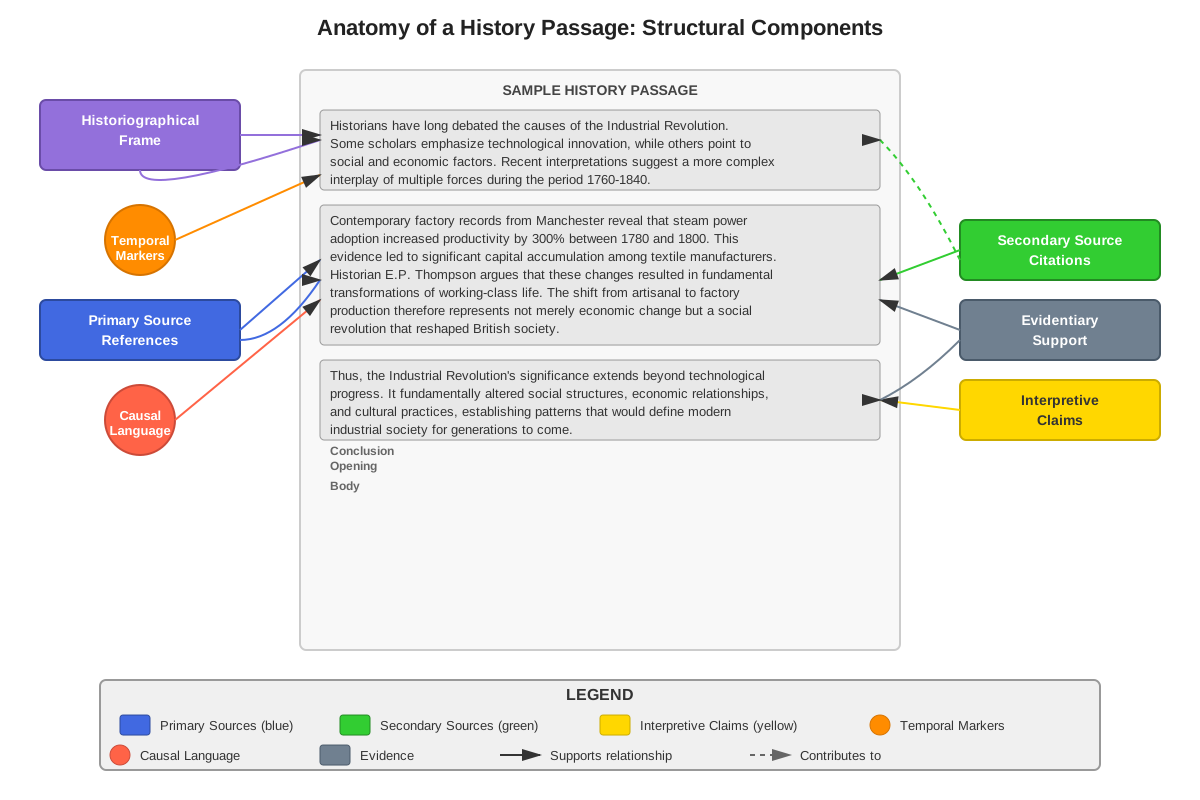
History passages frequently reference or incorporate both primary sources (documents, artifacts, or accounts created during the period under study) and secondary sources (later scholarly interpretations of that period). Understanding this distinction proves crucial for CARS success. When a passage quotes a 19th-century letter, that quotation represents primary evidence about 19th-century attitudes. When the passage author interprets that letter, the interpretation represents secondary analysis subject to evaluation and potential disagreement.
MCAT history passages often test whether students can distinguish between what historical actors thought or did (primary evidence) and what modern scholars conclude about those thoughts or actions (secondary interpretation). Questions may ask what can be directly inferred from primary sources versus what requires additional interpretive steps. Strong test-takers recognize that primary sources provide evidence but don't speak for themselves—they require interpretation, and that interpretation can vary.
Historical Causation and Complexity
History passages frequently grapple with causation—explaining why events occurred. Historical causation differs from scientific causation in important ways that MCAT passages exploit. Historical events typically result from multiple interacting causes operating at different levels (individual decisions, social structures, economic forces, cultural values, contingent circumstances). History passages often present complex causal arguments involving necessary versus sufficient conditions, immediate versus underlying causes, and intended versus unintended consequences.
Test-takers must follow causal chains across multiple paragraphs, recognizing when authors distinguish between precipitating events and deeper structural causes. A passage might argue that while a specific incident triggered a revolution, underlying economic tensions made revolution inevitable. Questions test whether students can identify which factors the author considers most significant, how different causal factors interact, and what evidence supports particular causal claims.
Historiography and Interpretive Change
Historiography—the study of how historical interpretation changes over time—appears frequently in MCAT history passages. These passages might contrast earlier scholarly consensus with more recent interpretations, explain why historians' understanding of an event has shifted, or argue for a new way of understanding familiar historical phenomena. Historiographical passages test whether students can track multiple interpretive frameworks simultaneously and understand what drives interpretive change (new evidence, new methodologies, changing contemporary concerns).
A typical historiographical structure presents an older interpretation, identifies its limitations or blind spots, and proposes a revised understanding. Questions test whether students can identify what distinguished older from newer interpretations, what evidence or reasoning supports the revision, and what assumptions underlie different interpretive approaches.
Context and Anachronism
History passages emphasize the importance of historical context—understanding past events, ideas, and behaviors within their own temporal framework rather than imposing present-day values or assumptions. Authors frequently warn against anachronism, the error of attributing modern concepts, motivations, or values to historical actors who couldn't have held them. A passage might argue that interpreting 18th-century political thought through 21st-century democratic ideals distorts historical understanding.
MCAT questions test whether students recognize anachronistic reasoning, can identify when interpretations appropriately consider historical context, and understand why context matters for historical interpretation. This skill connects directly to medical practice, where understanding patient perspectives within their cultural and personal contexts proves essential for effective care.
Periodization and Historical Change
History passages employ periodization—dividing the past into distinct periods characterized by particular features. Authors might discuss "the Renaissance," "the Industrial Revolution," or "the Cold War era" as meaningful units of analysis. MCAT passages sometimes question conventional periodizations, arguing that traditional boundaries obscure important continuities or that change occurred earlier or later than typically assumed.
Understanding periodization requires recognizing that historical periods are interpretive constructs, not natural divisions. Questions may test whether students understand what characteristics define a particular period according to the passage, why an author challenges conventional periodization, or how different periodization schemes reflect different analytical priorities.
Evidence Evaluation in Historical Argument
History passages require careful evaluation of historical evidence. Unlike scientific experiments that can be repeated, historical events occurred once and must be reconstructed from surviving sources—which are always incomplete, potentially biased, and require interpretation. Strong history passages acknowledge evidentiary limitations while building arguments from available sources.
MCAT questions test whether students can identify what evidence supports particular claims, recognize when evidence is ambiguous or incomplete, distinguish between strong and weak evidentiary support, and understand how source limitations affect interpretive confidence. This mirrors medical reasoning, where physicians must make decisions based on incomplete patient information and imperfect diagnostic data.
Concept Relationships
The core concepts within history passages form an interconnected analytical framework. Historical causation requires understanding context because causes operate within specific temporal and cultural circumstances. Periodization shapes how historians identify causal patterns by grouping events into meaningful units. Historiography emerges from the interplay between new evidence and changing interpretive frameworks, as historians reexamine sources through new analytical lenses. The distinction between primary and secondary sources underpins all historical argument, as interpretations must be grounded in evidence from the period under study.
These history passage concepts connect to broader CARS skills. The emphasis on evidence evaluation links to scientific reasoning tested in other MCAT sections, though applied to non-repeatable historical events rather than controlled experiments. The concern with anachronism and context relates to perspective-taking skills tested across CARS passages. Historiographical analysis parallels the treatment of competing theories in philosophy and social science passages. Understanding causation in history passages builds skills applicable to passages discussing social, political, or economic phenomena in any time period.
The relationship map flows: Primary Sources → provide evidence for → Historical Claims → which are interpreted through → Historiographical Frameworks → shaped by → Contemporary Context → while avoiding → Anachronism → through attention to → Historical Context → which enables understanding of → Causation → organized through → Periodization → and evaluated through → Evidence Assessment.
Quick check — test yourself on History passages so far.
Try Flashcards →High-Yield Facts
⭐ History passages advance interpretive arguments about the past, not merely chronological narratives of events
⭐ Primary sources provide evidence from the historical period; secondary sources offer later scholarly interpretation
⭐ Historical causation typically involves multiple interacting factors at different levels (individual, structural, cultural, economic)
⭐ Historiography examines how historical interpretation changes over time due to new evidence, methods, or contemporary concerns
⭐ Anachronism—imposing present-day concepts on the past—represents a fundamental error in historical reasoning
- Historical context determines the meaning and significance of past events, ideas, and behaviors
- Periodization divides history into interpretive units but represents scholarly construction rather than natural divisions
- Historical evidence is always incomplete and requires interpretation; strong arguments acknowledge evidentiary limitations
- History passages frequently contrast older and newer interpretations, testing ability to track multiple frameworks
- Questions often test whether claims represent factual description or interpretive judgment requiring evidence
Common Misconceptions
Misconception: History passages test specific historical knowledge or facts about dates, names, and events → Correction: CARS history passages test reasoning skills applied to historical content; all necessary information appears in the passage, and outside historical knowledge should not influence answer selection
Misconception: The author's interpretation must be correct because it appears in the passage → Correction: History passages present one interpretation among possible alternatives; questions may ask about limitations, competing views, or what would weaken the author's argument
Misconception: Primary sources provide objective truth about historical events → Correction: Primary sources offer evidence from the period but reflect the biases, limitations, and perspectives of their creators; they require critical interpretation
Misconception: Historical causation works like scientific causation with single, deterministic causes → Correction: Historical events typically result from multiple interacting causes; historians debate which factors were most significant and how they interacted
Misconception: Understanding the passage requires agreeing with the author's interpretation → Correction: CARS tests comprehension and analysis of arguments, not agreement; correct answers reflect what the passage states or implies, regardless of personal views
Misconception: Newer historical interpretations are always better than older ones → Correction: While historiography often progresses, passages may present new interpretations as flawed or argue for rehabilitating older views; questions test understanding of specific arguments, not assumptions about interpretive progress
Worked Examples
Example 1: Historiographical Analysis
Passage excerpt: "Early twentieth-century historians portrayed the American Revolution primarily as a conflict over constitutional principles, emphasizing colonists' ideological commitment to liberty and self-governance. This interpretation, dominant for decades, reflected historians' own Progressive Era concerns with democratic ideals. Beginning in the 1960s, however, social historians challenged this consensus, arguing that economic interests and class conflict drove revolutionary mobilization more than abstract principles. These revisionist scholars examined tax records, debt patterns, and wealth distribution to demonstrate that revolutionary rhetoric often masked material grievances. More recently, historians have sought synthesis, acknowledging both ideological and economic factors while emphasizing how these dimensions interacted in complex ways that varied across regions and social groups."
Question: According to the passage, what primarily motivated the shift from constitutional to economic interpretations of the American Revolution?
Analysis: This question tests understanding of historiographical change. The passage indicates that early historians emphasized constitutional principles, reflecting "their own Progressive Era concerns." The shift to economic interpretations came from "social historians" in the 1960s who "challenged this consensus." The passage doesn't attribute the shift to new evidence discovery (though new sources like tax records are mentioned) but rather to a new methodological approach ("social historians") and implicitly to changing scholarly concerns (the 1960s context suggests new attention to class and economic factors).
Answer approach: The correct answer would identify the emergence of social history methodology and changing scholarly priorities rather than simply "new evidence" or "better understanding." This tests whether students recognize that historiographical change reflects both methodological innovation and shifting contemporary concerns, not just accumulation of facts.
Example 2: Evidence and Causation
Passage excerpt: "The collapse of the Mayan civilization in the ninth century has puzzled archaeologists for generations. Recent analysis of lake sediment cores reveals severe drought conditions lasting decades during the collapse period. Some scholars conclude that climate change caused Mayan decline by undermining agricultural productivity. However, this interpretation faces challenges. Mayan cities collapsed at different times over a century-long period, not simultaneously as a single drought event would suggest. Moreover, the Maya had survived earlier droughts without societal collapse. A more nuanced view recognizes drought as a stress factor that interacted with political fragmentation, warfare, and environmental degradation from intensive agriculture. The civilization's vulnerability to drought resulted from these accumulated pressures rather than climate alone."
Question: The author's argument about Mayan collapse primarily emphasizes which type of causation?
Analysis: This question tests understanding of complex historical causation. The passage presents a simple causal claim (drought caused collapse) then complicates it with evidence (different collapse timing, earlier drought survival). The author's own position appears in the final sentences: drought was "a stress factor that interacted with" other causes, and vulnerability resulted from "accumulated pressures." This represents multi-causal explanation emphasizing interaction between factors rather than single-cause determinism.
Answer approach: The correct answer would identify complex, interactive causation involving multiple factors rather than simple, single-cause explanation. Wrong answers might oversimplify by selecting only climate, only political factors, or only environmental degradation. This tests whether students can distinguish between causes mentioned in the passage and the author's actual causal argument about how factors interacted.
Exam Strategy
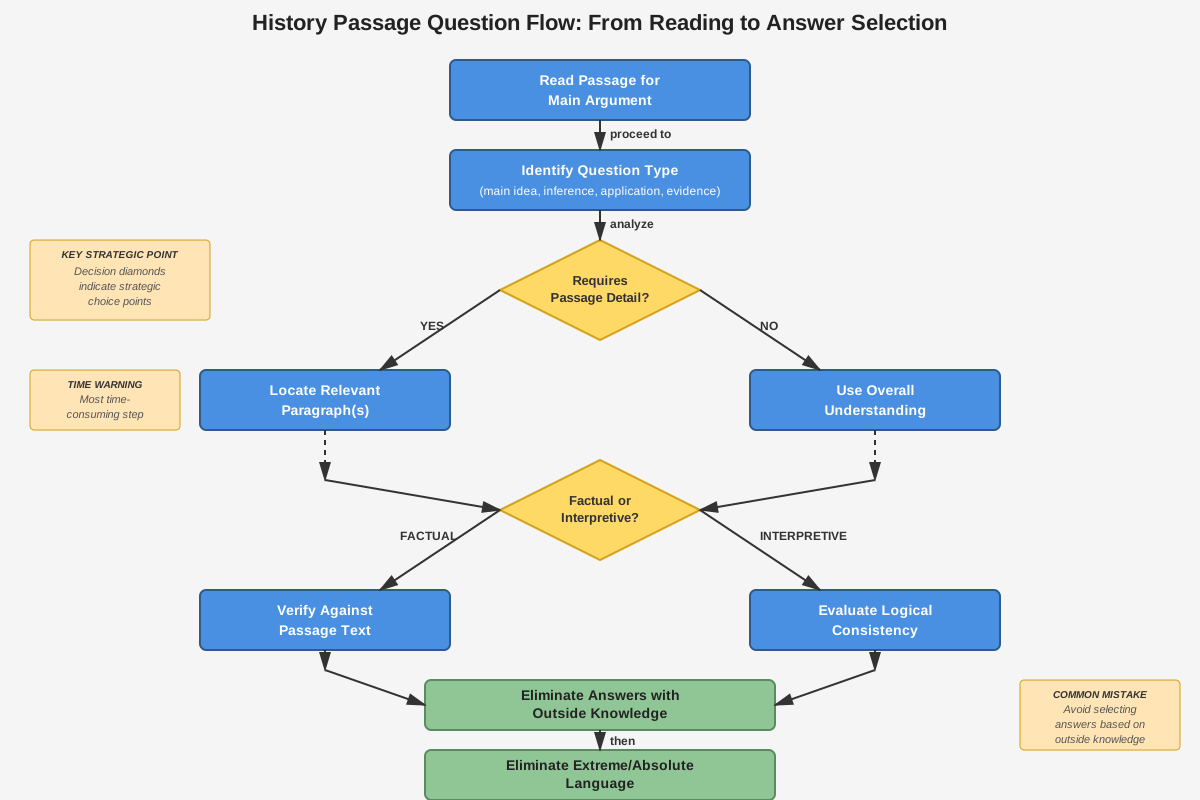
When approaching history passages on the MCAT, begin by identifying the passage's central interpretive claim—the author's main argument about historical significance, causation, or meaning. This differs from the topic (what the passage discusses) and represents the author's analytical contribution. Often this claim appears in the opening or closing paragraphs, though complex passages may build toward it gradually.
Trigger words signaling important analytical moves include: "however," "in contrast," "traditionally," "recently," "revision," "interpretation," "suggests," "indicates," "caused," "resulted from," "significance," and "meaning." These words often mark shifts between competing interpretations, causal claims, or evidentiary support. When you encounter these triggers, slow down and ensure you understand the relationship being established.
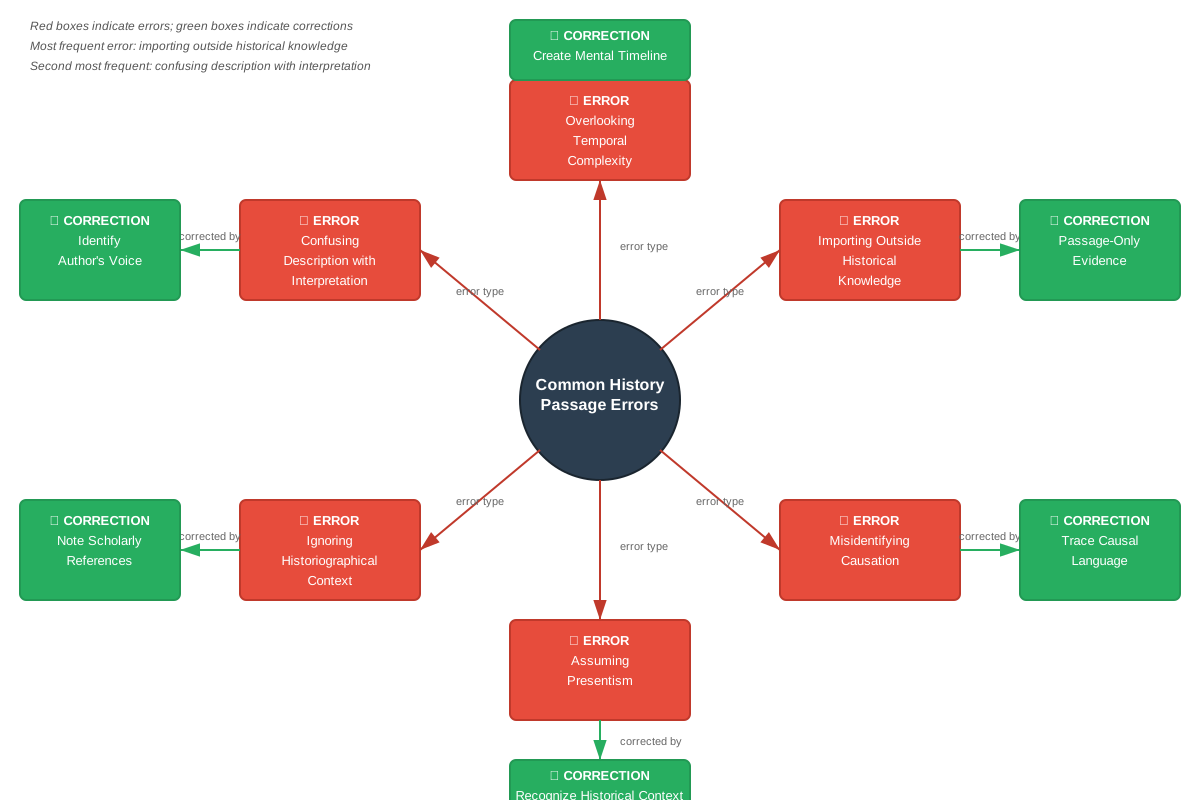
For process of elimination, recognize that wrong answers in history passage questions often commit one of several characteristic errors: (1) confusing primary evidence with secondary interpretation, (2) selecting claims too strong for the evidence provided, (3) imposing outside historical knowledge not supported by the passage, (4) confusing what the passage describes with what it argues, or (5) selecting anachronistic interpretations the passage explicitly rejects. Systematically check each answer choice against these common traps.
Time allocation for history passages should mirror other CARS passages—approximately 10 minutes total including questions. However, history passages with complex historiographical structures or multiple time periods may require slightly more careful initial reading (5-6 minutes) to establish the interpretive framework, allowing faster question answering (4-5 minutes) once the structure is clear. Don't get lost in historical details; focus on the author's analytical moves and argument structure.
Exam Tip: When a history passage presents multiple interpretations, create a mental or marginal note map tracking which scholars hold which views and what evidence supports each position. Questions frequently test whether you can match claims to interpretive frameworks.
Memory Techniques
HIPEC for history passage analysis:
- Historiography: Is the passage discussing changing interpretations?
- Interpretation: What's the author's main analytical claim?
- Primary sources: What evidence comes from the historical period?
- Evidence: How strong is the support for claims?
- Causation: What causal relationships does the author establish?
PAST for avoiding common errors:
- Primary vs. secondary: Don't confuse evidence with interpretation
- Anachronism: Don't impose modern concepts on historical periods
- Support: Check that claims have adequate evidentiary support
- Time: Track which time period is being discussed
Visualization strategy: Imagine history passages as layered transparencies. The bottom layer shows historical events and primary sources. Middle layers show different scholarly interpretations of those events. The top layer shows the passage author's own interpretation and argument. Questions test your ability to distinguish between these layers and understand their relationships.
For periodization and chronology, remember that you don't need to memorize dates, but you should track temporal relationships within the passage. Create a simple mental timeline noting "earlier period," "later period," "traditional interpretation," "recent revision" to maintain orientation.
Summary
History passages in MCAT CARS test critical reasoning skills through analysis of historical content, requiring students to evaluate interpretive arguments about the past, distinguish between evidence and interpretation, understand complex causation, and track competing scholarly frameworks. Success demands recognizing that these passages advance analytical claims about historical significance and meaning rather than merely recounting events. Students must distinguish primary sources (evidence from the historical period) from secondary interpretations (scholarly analysis), evaluate the strength of historical evidence while acknowledging its inherent limitations, understand how historiography evolves through new methodologies and changing concerns, avoid anachronistic reasoning by respecting historical context, and follow complex causal arguments involving multiple interacting factors. The skills tested through history passages—evaluating incomplete evidence, tracking competing interpretations, understanding context-dependent meaning, and constructing coherent narratives from fragmentary information—directly parallel reasoning required in medical practice, making these passages valuable preparation for clinical thinking beyond their specific CARS application.
Key Takeaways
- History passages test reasoning about interpretive arguments, not recall of historical facts; all necessary information appears in the passage
- Distinguish between primary sources (evidence from the period) and secondary sources (later scholarly interpretation) to evaluate historical claims accurately
- Historical causation typically involves multiple interacting factors; identify which causes the author emphasizes and how they relate
- Historiographical passages present changing interpretations over time; track what distinguishes different scholarly frameworks and what drives interpretive shifts
- Avoid anachronism by understanding historical phenomena within their own temporal context rather than imposing present-day concepts
- Evidence evaluation in history passages requires recognizing that sources are incomplete and biased, yet arguments must be grounded in available evidence
- Strong performance requires identifying the author's central interpretive claim and distinguishing it from mere description of historical events
Related Topics
Philosophy passages: Share with history passages an emphasis on interpretation and argumentation but focus on abstract concepts rather than temporal specificity; mastering history passages builds skills for tracking complex philosophical arguments
Social science passages: Connect to history passages through shared interest in human behavior and institutions but emphasize contemporary phenomena and empirical research methods rather than change over time
Comparative analysis across passages: History passages frequently employ comparison (different periods, cultures, or interpretations); skills developed here transfer to any CARS passage requiring comparative reasoning
Author perspective and bias: Understanding how historians' own contexts shape their interpretations connects to broader CARS skills in identifying authorial perspective across all passage types
Practice CTA
Now that you've mastered the core concepts and strategies for history passages, it's time to apply these skills to authentic MCAT-style questions. Work through the practice passages and questions, paying special attention to distinguishing primary from secondary sources, identifying historiographical shifts, and evaluating complex causal arguments. Each practice question offers an opportunity to refine your analytical approach and build the confidence needed for test day success. Remember: history passages reward careful attention to argument structure and evidence evaluation—skills that improve with deliberate practice. You've built the foundation; now strengthen it through application!
Sign up free to keep reading
Create a free AnvayaPrep account to finish this MCAT guide on History passages — plus flashcards and practice questions.