Overview
Strengthen weaken reasoning is a fundamental skill tested extensively in the Critical Analysis and Reasoning Skills (CARS) section of the MCAT. This cognitive process involves evaluating arguments by identifying evidence or considerations that either support (strengthen) or undermine (weaken) the author's claims, conclusions, or reasoning. Unlike simple comprehension questions, strengthen-weaken questions require students to engage in higher-order thinking by analyzing the logical structure of arguments and determining how new information would affect the validity or persuasiveness of those arguments.
The MCAT CARS section frequently presents passages containing complex arguments across humanities and social sciences disciplines, and approximately 15-20% of CARS questions directly test strengthen-weaken reasoning abilities. These questions assess whether students can think critically about evidence, recognize logical relationships, and evaluate the impact of additional information on an argument's strength. Mastery of this skill is essential not only for MCAT success but also for medical practice, where physicians must constantly evaluate evidence, weigh competing explanations, and adjust their reasoning based on new clinical findings.
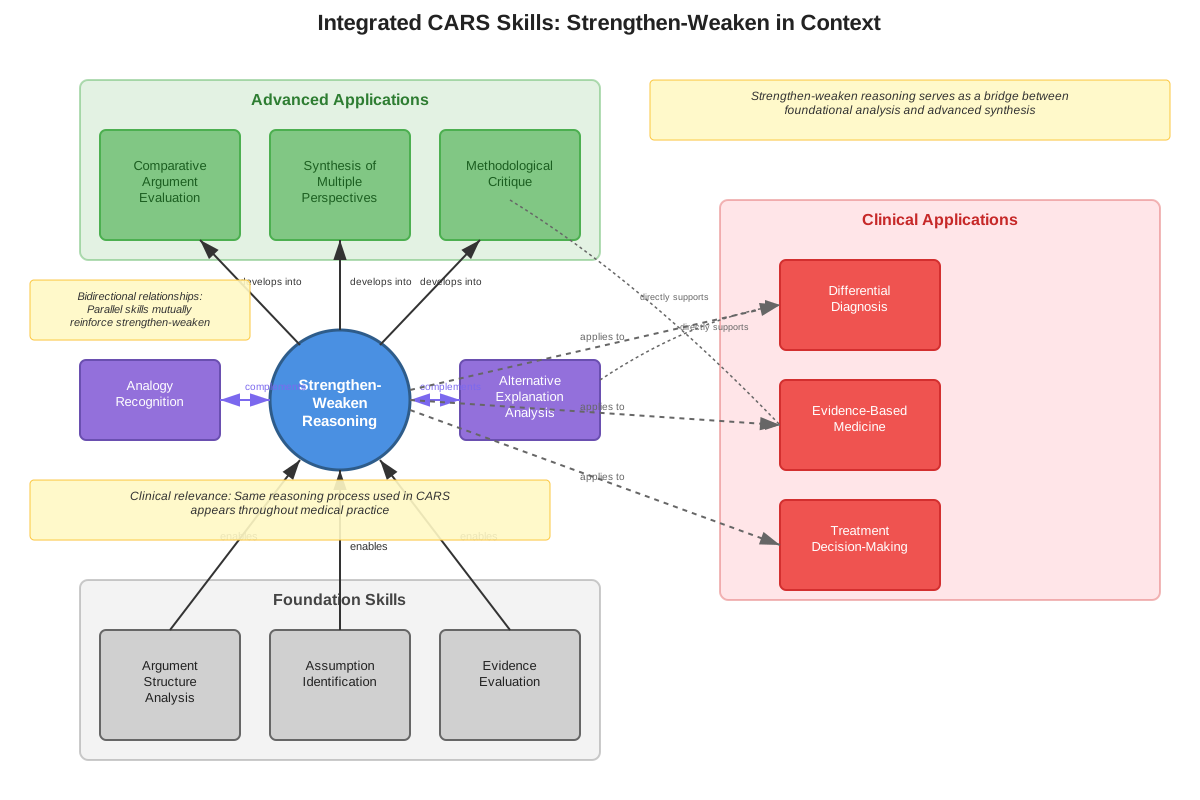
Within the broader framework of CARS Skills, strengthen-weaken reasoning connects intimately with argument analysis, assumption identification, and logical reasoning. Students who excel at this topic can quickly identify an argument's core structure, recognize its underlying assumptions, and predict what types of evidence would make the argument more or less convincing. This skill builds upon foundational reasoning abilities while serving as a gateway to more advanced critical thinking tasks required throughout medical education and clinical practice.
Learning Objectives
- [ ] Define Strengthen weaken reasoning using accurate Critical Analysis and Reasoning Skills terminology
- [ ] Explain why Strengthen weaken reasoning matters for the MCAT
- [ ] Apply Strengthen weaken reasoning to exam-style questions
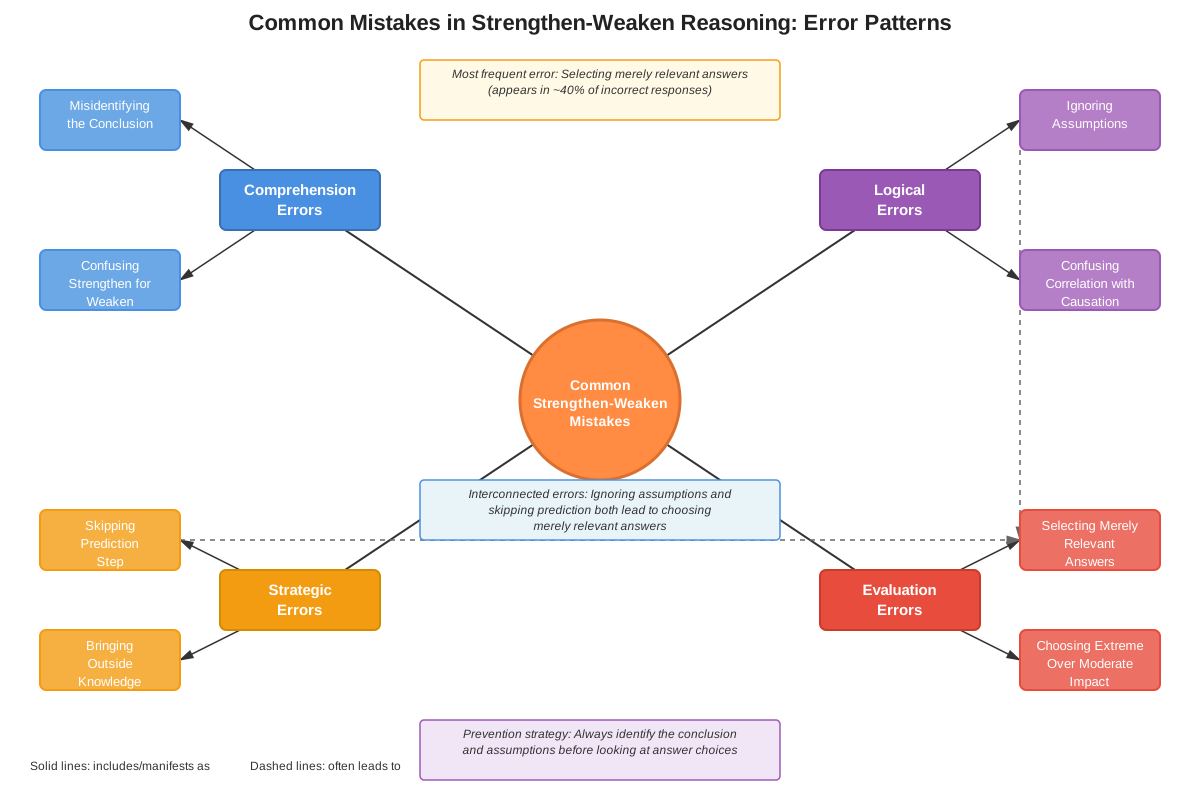
- [ ] Identify common mistakes related to Strengthen weaken reasoning
- [ ] Connect Strengthen weaken reasoning to related Critical Analysis and Reasoning Skills concepts
- [ ] Distinguish between evidence that directly strengthens/weakens an argument versus evidence that is merely relevant
- [ ] Analyze the logical structure of complex arguments to identify their most vulnerable points
- [ ] Evaluate multiple answer choices to determine which provides the strongest support or most significant challenge to an argument
Prerequisites
- Basic argument structure: Understanding premises, conclusions, and how evidence supports claims is essential for identifying what would strengthen or weaken an argument
- Assumption identification: Recognizing unstated assumptions allows students to find the gaps where strengthening or weakening evidence would have maximum impact
- Logical reasoning fundamentals: Familiarity with valid and invalid reasoning patterns helps predict what types of evidence would affect argument strength
- Reading comprehension: The ability to accurately understand passage content is necessary before evaluating how new information would interact with existing arguments
Why This Topic Matters
In clinical practice, physicians constantly engage in strengthen-weaken reasoning when evaluating diagnostic possibilities, treatment options, and research findings. A patient presents with symptoms that suggest multiple diagnoses; each additional test result either strengthens or weakens the likelihood of each possibility. A new study emerges claiming a treatment's effectiveness; clinicians must evaluate whether the study design and evidence genuinely strengthen the case for that treatment or whether methodological flaws weaken its conclusions. This same reasoning process underlies evidence-based medicine, where practitioners must critically evaluate research to determine which findings should influence clinical practice.
On the MCAT, strengthen-weaken questions appear in approximately 15-20% of CARS passages, making them one of the most frequently tested question types. These questions typically appear as: "Which of the following, if true, would most STRENGTHEN the author's argument?" or "Which finding would most WEAKEN the claim that...?" The AAMC consistently includes these questions because they assess critical thinking skills essential for medical school success—the ability to evaluate evidence, revise conclusions based on new information, and think flexibly about complex problems.
Strengthen-weaken questions commonly appear in passages discussing scientific theories, historical interpretations, philosophical arguments, and social science research. The MCAT may present an author's theory about why a historical event occurred, then ask which archaeological finding would most weaken that theory. Or a passage might discuss competing explanations for a psychological phenomenon, followed by a question about which experimental result would strengthen one explanation over another. These questions test whether students can move beyond simple comprehension to engage in sophisticated analytical reasoning about evidence and argumentation.
Core Concepts
Defining Strengthen-Weaken Reasoning
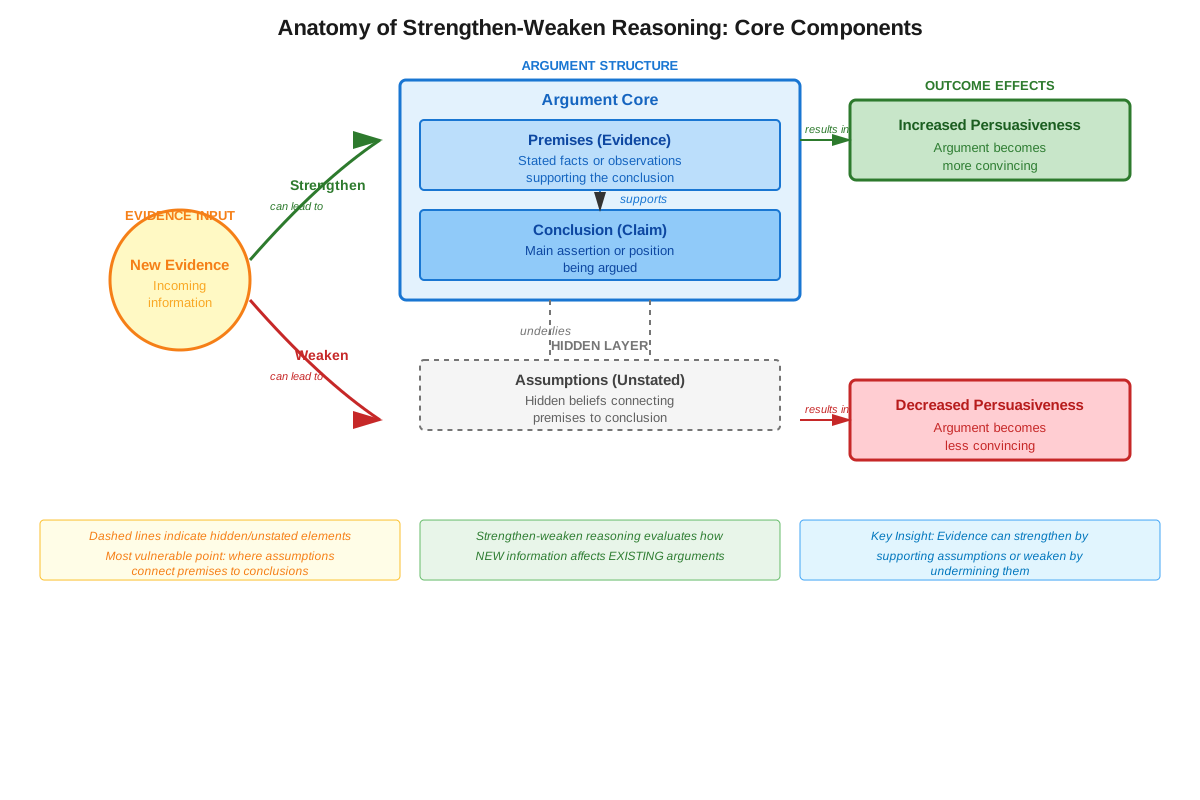
Strengthen weaken reasoning refers to the analytical process of evaluating how additional evidence, information, or considerations would affect the logical force or persuasiveness of an argument. When evidence strengthens an argument, it increases the likelihood that the conclusion is true, makes the reasoning more convincing, or provides additional support for the author's claims. When evidence weakens an argument, it decreases confidence in the conclusion, reveals problems with the reasoning, or suggests alternative explanations that undermine the author's position.
This reasoning process requires understanding three key components: (1) the argument's structure—identifying premises, conclusions, and the logical connections between them; (2) the argument's assumptions—recognizing unstated beliefs or conditions that must be true for the argument to work; and (3) the argument's scope—understanding exactly what the author is and is not claiming. Only by grasping these elements can students accurately predict what would strengthen or weaken the argument.
Types of Strengthening Evidence
Evidence can strengthen arguments through several distinct mechanisms, each operating differently:
Direct supporting evidence provides additional examples, data, or observations that align with the argument's conclusion. If an author argues that economic factors caused a historical event, discovering additional documents showing economic distress during that period would directly strengthen the claim by providing more instances of the proposed cause.
Ruling out alternatives strengthens an argument by eliminating competing explanations. If an author claims Factor X caused Outcome Y, evidence showing that other potential causes were absent or insufficient strengthens the argument by making Factor X the most plausible remaining explanation.
Confirming predictions strengthens arguments when evidence matches what the theory would predict. If an author's theory predicts that a certain pattern should appear under specific conditions, finding that exact pattern under those conditions provides strong support.
Addressing counterarguments strengthens arguments by responding to potential objections. Evidence showing that apparent problems with the argument are actually not problematic increases confidence in the conclusion.
Establishing necessary conditions strengthens arguments by confirming that prerequisites for the conclusion were actually present. If an argument assumes certain conditions existed, evidence proving those conditions strengthens the overall reasoning.
Types of Weakening Evidence
Weakening evidence operates through parallel but opposite mechanisms:
Contradictory evidence directly conflicts with the argument's claims or predictions. If an author argues all members of a group share a characteristic, finding even one member lacking that characteristic weakens the universal claim.
Alternative explanations weaken arguments by suggesting other plausible causes or interpretations. If evidence shows that Factor Z could also explain Outcome Y, this weakens an argument claiming Factor X was the sole or primary cause.
Challenging assumptions weakens arguments by showing that unstated premises are questionable or false. Since arguments depend on their assumptions, evidence undermining those assumptions significantly weakens the overall reasoning.
Limiting scope weakens arguments by showing they apply to fewer cases than claimed. Evidence that an argument's conclusion only holds under specific, limited conditions reduces its general applicability and persuasiveness.
Revealing methodological problems weakens arguments by showing that the evidence supporting them was gathered or analyzed improperly, making the conclusions less reliable.
The Spectrum of Impact
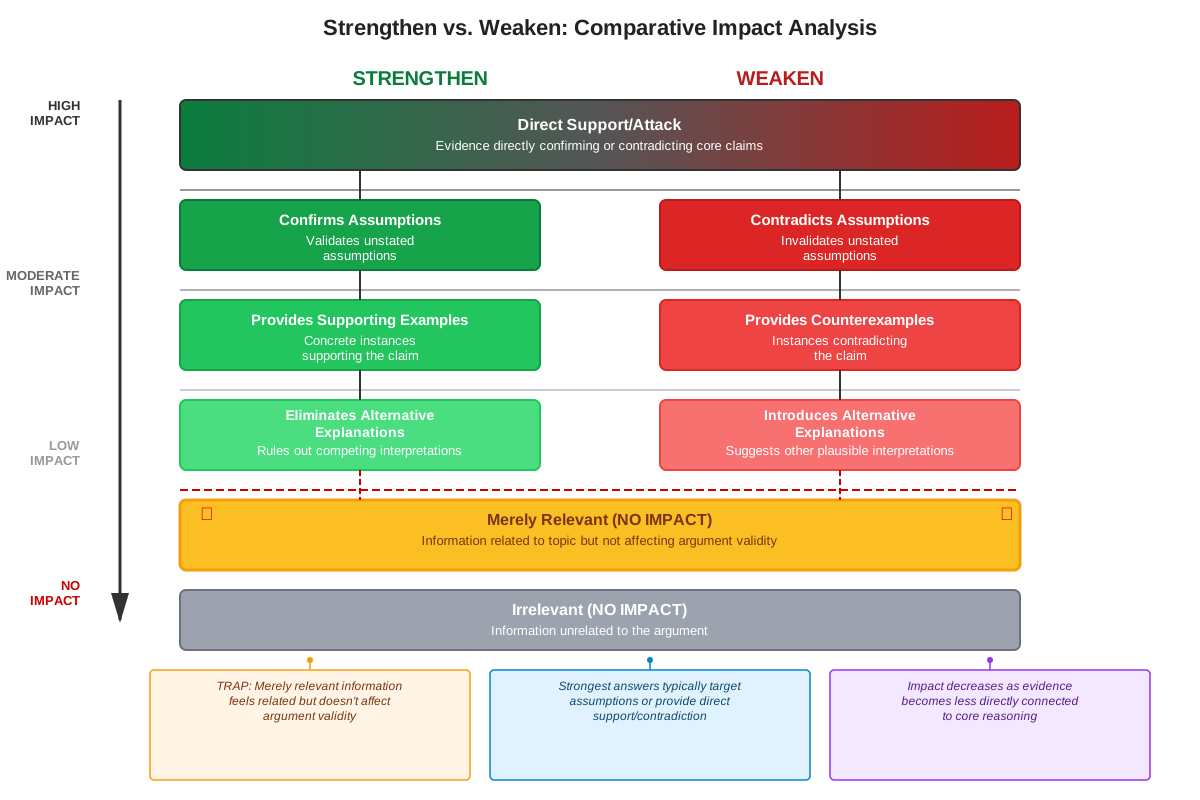
Not all strengthening or weakening evidence has equal impact. Understanding this spectrum is crucial for MCAT success:
| Impact Level | Characteristics | Example |
|---|---|---|
| Decisive | Proves or disproves the conclusion definitively | Finding a logical contradiction in the argument itself |
| Strong | Significantly increases or decreases confidence in the conclusion | Eliminating all alternative explanations |
| Moderate | Noticeably affects the argument's strength but doesn't settle the issue | Providing additional supporting examples |
| Weak | Slightly relevant but minimal impact | Tangentially related information |
| Irrelevant | No actual effect on the argument's logical force | Information about unrelated topics |
MCAT questions typically ask for the answer that "most" strengthens or weakens an argument, requiring students to compare the relative impact of different pieces of evidence. The correct answer usually has strong or moderate impact, while wrong answers often have weak impact or are entirely irrelevant despite appearing related to the topic.
Identifying Vulnerable Points
Arguments are most susceptible to strengthening or weakening at their vulnerable points—places where the reasoning depends on questionable assumptions, makes logical leaps, or relies on limited evidence. Skilled test-takers quickly identify these vulnerable points when reading passages:
Causal claims are vulnerable to evidence about alternative causes, correlation without causation, or reversed causality. When an author claims X causes Y, consider what would happen if evidence showed Y actually causes X, or if Z causes both X and Y.
Generalizations are vulnerable to counterexamples and evidence about scope limitations. When an author makes a broad claim based on limited examples, evidence about different contexts or populations can significantly weaken the argument.
Analogies are vulnerable to evidence highlighting relevant differences between the compared situations. When an author argues that because A and B are similar in some ways, they must be similar in another way, evidence showing important differences weakens the analogy.
Predictions are vulnerable to evidence about actual outcomes. When an author predicts what will or should happen, evidence about what actually happened either strengthens or weakens the predictive argument.
The Role of Assumptions
Assumptions are unstated premises that must be true for an argument to work. They represent the logical gaps between stated evidence and conclusions. Strengthen-weaken reasoning often targets these assumptions because they are the argument's weakest points—the places where the reasoning could break down.
Consider this argument: "The ancient civilization collapsed suddenly. Archaeological evidence shows a major drought occurred at that time. Therefore, the drought caused the civilization's collapse." This argument assumes: (1) the civilization couldn't survive the drought, (2) no other factors contributed to the collapse, (3) the timing correlation indicates causation, and (4) the drought was severe enough to cause societal collapse. Evidence addressing any of these assumptions would significantly strengthen or weaken the argument.
Strengthening evidence might show that the civilization's agricultural system was particularly vulnerable to drought, that no other major disruptions occurred during that period, or that similar droughts caused collapses in comparable civilizations. Weakening evidence might reveal that the civilization had sophisticated water management systems, that internal political conflicts were intensifying before the drought, or that other civilizations in the region survived the same drought without collapsing.
Concept Relationships
Strengthen-weaken reasoning sits at the intersection of multiple Critical Analysis and Reasoning Skills competencies. It builds directly upon argument analysis, which involves identifying premises, conclusions, and logical structure. Before determining what would strengthen or weaken an argument, students must first understand what the argument actually claims and how it supports those claims. This foundational skill enables the more sophisticated evaluation required for strengthen-weaken questions.
Assumption identification serves as a crucial bridge to strengthen-weaken reasoning. Once students identify an argument's unstated assumptions, they can predict what evidence would confirm or challenge those assumptions—which is precisely what strengthens or weakens the argument. The relationship flows: Argument Analysis → Assumption Identification → Strengthen-Weaken Reasoning.
Strengthen-weaken reasoning also connects to inference and implication skills. When evaluating whether evidence strengthens or weakens an argument, students must infer how that evidence would interact with the argument's logic. This requires understanding not just what the evidence directly states, but what it implies for the argument's validity.
The skill relates to author's purpose and tone analysis because understanding why an author makes certain claims helps predict what evidence would support or undermine their goals. An author arguing for a controversial position will structure their argument to anticipate objections, and recognizing this structure helps identify vulnerable points.
Within strengthen-weaken reasoning itself, concepts form a logical progression: Understanding argument structure → Identifying assumptions and vulnerable points → Recognizing types of strengthening/weakening evidence → Evaluating relative impact of different evidence → Selecting the strongest answer. Each step depends on the previous ones, creating an integrated analytical process.
High-Yield Facts
⭐ Strengthen-weaken questions ask about hypothetical evidence—"if true" is a key phrase indicating you should accept the answer choice as fact and evaluate its impact
⭐ The correct answer to a strengthen question makes the conclusion MORE likely to be true; it doesn't need to prove the conclusion definitively
⭐ The correct answer to a weaken question makes the conclusion LESS likely to be true; it doesn't need to disprove the conclusion completely
⭐ Evidence that eliminates alternative explanations is one of the strongest ways to support an argument
⭐ Evidence revealing false assumptions is one of the most effective ways to weaken an argument
- Strengthen-weaken questions typically appear 3-4 times per CARS section, making them among the most common question types
- Wrong answers often discuss relevant topics but don't actually affect the argument's logical strength
- Evidence can be factually true but logically irrelevant to the specific argument being evaluated
- The strongest weakening evidence often comes from the same category as the argument's evidence (e.g., if the argument uses statistical data, statistical counterevidence is often most effective)
- Extreme answer choices (using words like "always," "never," "only") are rarely correct for strengthen-weaken questions unless the argument itself makes extreme claims
- Evidence about the author's credibility or motivations rarely strengthens or weakens the logical force of their arguments
- Strengthen-weaken reasoning requires evaluating the logical relationship between evidence and conclusion, not personal agreement with the conclusion
Quick check — test yourself on Strengthen weaken reasoning so far.
Try Flashcards →Common Misconceptions
Misconception: Strengthening evidence must prove the conclusion is definitely true → Correction: Strengthening evidence only needs to make the conclusion more likely or more plausible than before. Even modest increases in probability count as strengthening. The MCAT asks for what "most strengthens," not what "proves."
Misconception: Any information related to the passage topic will strengthen or weaken the argument → Correction: Relevance to the topic doesn't guarantee logical impact on the argument. Evidence must specifically address the logical connection between the argument's premises and conclusion, or challenge/support its assumptions. Tangentially related information often appears in wrong answers.
Misconception: Weakening an argument means showing the conclusion is false → Correction: Weakening means reducing confidence in the conclusion or revealing problems with the reasoning. An argument can be weakened even if its conclusion happens to be true, by showing that the stated reasons don't adequately support it or that alternative explanations exist.
Misconception: Personal agreement or disagreement with the conclusion should influence answer selection → Correction: Strengthen-weaken reasoning is purely logical, not ideological. Students must evaluate logical relationships objectively, regardless of personal beliefs about the topic. The MCAT tests analytical reasoning, not opinions.
Misconception: The longest or most detailed answer choice is usually correct → Correction: Answer length has no correlation with correctness. Wrong answers are often lengthy because they include irrelevant details or discuss tangential issues. The correct answer might be concise because it directly addresses the argument's core logical structure.
Misconception: Strengthen-weaken questions only appear with explicitly argumentative passages → Correction: These questions can appear with any passage type, including descriptive or explanatory passages. Even when an author primarily describes or explains, they make claims that can be strengthened or weakened by additional evidence.
Misconception: Evidence that strengthens one part of a passage strengthens the entire passage → Correction: Passages often contain multiple distinct arguments or claims. Evidence might strengthen one specific claim while being irrelevant to others. Students must identify which specific argument the question targets.
Worked Examples
Example 1: Historical Argument
Passage excerpt: "The rapid decline of the Mayan civilization in the 9th century has puzzled historians for decades. Recent evidence suggests that prolonged drought conditions, lasting approximately 200 years, coincided with the civilization's collapse. The drought would have severely impacted agricultural production, leading to food shortages, social unrest, and eventual abandonment of major cities. This environmental explanation accounts for the widespread nature of the collapse across the Mayan region."
Question: Which of the following findings, if true, would most WEAKEN the argument that drought caused the Mayan collapse?
Answer choices:
A) Archaeological evidence shows that Mayan cities had sophisticated water storage systems capable of sustaining populations through multi-year droughts
B) Other civilizations in Central America also experienced population declines during the same period
C) Climate data confirms that the drought was the most severe in the region's recorded history
D) Mayan agricultural texts describe various drought-resistant crops
Analysis:
First, identify the argument's structure:
- Premise: Prolonged drought occurred during the collapse period
- Premise: Drought would impact agriculture and cause social problems
- Conclusion: Therefore, drought caused the collapse
- Key assumption: The Mayan civilization couldn't adequately cope with the drought conditions
Now evaluate each answer:
Choice A directly challenges the key assumption by showing the Mayans had technology to survive droughts. If they could store enough water to sustain populations through multi-year droughts, then a drought—even a prolonged one—wouldn't necessarily cause collapse. This significantly weakens the causal argument by suggesting the civilization should have survived. This is the correct answer.
Choice B might seem to strengthen the argument by showing the drought affected a wide area, but it doesn't weaken the causal claim. If anything, it shows the environmental impact was regional, which could support the drought explanation.
Choice C strengthens rather than weakens the argument by confirming the drought's severity, making it more plausible as a cause of collapse.
Choice D provides some weakening evidence by suggesting the Mayans had agricultural adaptations, but it's weaker than Choice A. Knowing about drought-resistant crops doesn't tell us whether they actually used them effectively or whether these crops could sustain the entire population through a 200-year drought. Choice A more directly shows the civilization had effective coping mechanisms.
Key lesson: The strongest weakening evidence challenges the argument's core assumptions. Here, the assumption that the Mayans couldn't survive the drought is the logical weak point. Evidence showing they had survival capabilities directly undermines the causal claim.
Example 2: Scientific Theory
Passage excerpt: "The 'social brain hypothesis' proposes that primate intelligence evolved primarily to navigate complex social relationships rather than to solve environmental challenges. Proponents point to the strong correlation between primate species' brain size and their typical social group size. Species living in larger, more complex social groups consistently show larger neocortex ratios. This pattern suggests that social demands, not ecological pressures, drove the evolution of primate cognitive abilities."
Question: Which of the following, if true, would most STRENGTHEN the social brain hypothesis?
Answer choices:
A) Primate species living in similar environments but different social structures show brain size differences corresponding to social complexity
B) Brain size in primates has increased steadily over evolutionary time
C) Some highly intelligent primate species live in relatively small social groups
D) Environmental problem-solving requires significant cognitive resources
Analysis:
Identify the argument:
- Premise: Brain size correlates with social group size
- Conclusion: Social demands (not ecological pressures) drove brain evolution
- Key assumption: The correlation indicates causation, and social factors are more important than environmental factors
Evaluate each answer:
Choice A provides strong support by using a controlled comparison. By holding environment constant while varying social structure, this evidence isolates the social variable. If brain size tracks with social complexity even when environmental challenges are the same, this strongly suggests social factors are indeed the primary driver. This rules out the alternative explanation that both brain size and social group size might be responses to environmental complexity. This is the correct answer.
Choice B is irrelevant to the specific argument. General brain size increase over time doesn't tell us whether social or environmental factors drove that increase. This is a common wrong answer type—factually interesting but logically disconnected from the argument.
Choice C actually weakens the argument by providing counterexamples. If some highly intelligent species have small social groups, this challenges the proposed correlation between social complexity and intelligence.
Choice D weakens rather than strengthens the argument by suggesting environmental problem-solving (an alternative explanation) requires significant cognitive resources, making it a more plausible alternative driver of brain evolution.
Key lesson: The strongest strengthening evidence often eliminates alternative explanations or provides controlled comparisons that isolate the proposed causal factor. Choice A does both—it controls for environmental factors while showing social complexity still predicts brain size.
Exam Strategy
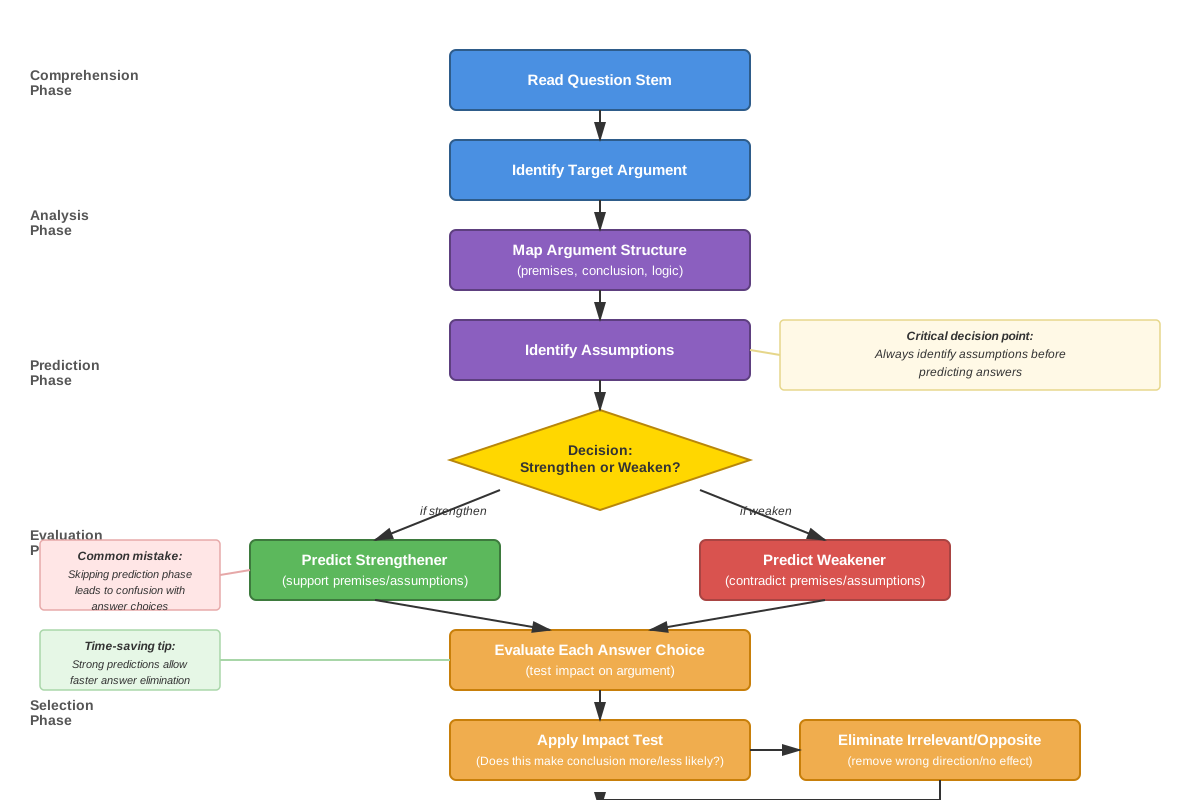
When approaching strengthen-weaken questions on the MCAT, follow this systematic process:
Step 1: Identify the specific argument (15-20 seconds). Don't assume the question asks about the passage's main argument. Read the question stem carefully to determine which specific claim you're evaluating. Underline or mentally note the exact conclusion you need to strengthen or weaken.
Step 2: Analyze the argument's structure (10-15 seconds). Quickly identify: What's the conclusion? What premises support it? What assumptions connect premises to conclusion? Where are the logical gaps? The vulnerable points are usually at the assumptions or where the author makes logical leaps.
Step 3: Predict what would strengthen or weaken (10 seconds). Before reading answer choices, briefly consider: What type of evidence would support this argument? What would challenge it? This prediction prevents you from being swayed by attractive but incorrect answers.
Step 4: Evaluate each answer choice (30-40 seconds total). For each option, ask: "If this were true, would the conclusion be more or less likely?" Don't just look for relevant information—evaluate logical impact. Use the process of elimination, but be careful not to eliminate answers too quickly based on superficial readings.
Step 5: Compare remaining choices (10-15 seconds). If multiple answers seem to strengthen or weaken the argument, compare their relative impact. The correct answer typically has stronger, more direct impact on the argument's core logic.
Exam Tip: Watch for these trigger phrases in question stems: "most strengthens," "most weakens," "most undermines," "provides the best support for," "casts the most doubt on," "most calls into question." These all signal strengthen-weaken questions.
Process of elimination strategies:
Eliminate answers that are irrelevant despite being topically related. If an answer discusses the passage topic but doesn't affect the logical relationship between premises and conclusion, it's wrong.
Eliminate answers that strengthen when you need to weaken or vice versa. This seems obvious, but under time pressure, students sometimes select answers that have the opposite effect from what the question asks.
Eliminate answers that are too extreme unless the argument itself makes extreme claims. If the argument says "X often causes Y," evidence that "X always causes Y" doesn't strengthen it as much as evidence that "X causes Y in most documented cases."
Eliminate answers about author credibility or motivation unless the argument explicitly relies on authority. Arguments stand or fall based on their logic and evidence, not on who makes them.
Time management: Allocate approximately 75-90 seconds per strengthen-weaken question. These questions require careful analysis but shouldn't consume excessive time. If you're stuck between two answers after 90 seconds, make your best judgment and move on—you can flag it for review if time permits.
Memory Techniques
CAST mnemonic for types of strengthening evidence:
- Confirm predictions the theory makes
- Address counterarguments or objections
- Support with additional examples or data
- Terminate alternative explanations
WACL mnemonic for types of weakening evidence:
- Wrong assumptions revealed
- Alternative explanations provided
- Contradictory evidence presented
- Limitations in scope exposed
The Bridge Visualization: Picture an argument as a bridge connecting premises (one side) to conclusion (other side). Assumptions are the invisible supports holding up the bridge. Strengthening evidence adds more supports or reinforces existing ones. Weakening evidence removes supports or shows they're unstable. This mental image helps you focus on the logical structure rather than getting lost in content details.
The "If-Then" Test: For any answer choice, mentally insert it into this frame: "If [answer choice] is true, then the conclusion is [more/less] likely because..." If you can't complete this sentence with a clear logical connection, the answer is probably wrong.
The Opposite Test: For strengthen questions, ask "Would the opposite of this answer weaken the argument?" For weaken questions, ask "Would the opposite strengthen it?" If the answer is no, the choice probably doesn't affect the argument's strength.
ASSUME acronym for finding vulnerable points:
- Analogies that might not hold
- Scope that might be too broad
- Statistics that might be misinterpreted
- Unstated premises
- Multiple causes treated as single causes
- Evidence that might have alternative explanations
Summary
Strengthen-weaken reasoning is a critical CARS skill that requires students to evaluate how additional evidence would affect an argument's logical force. This process involves understanding argument structure, identifying assumptions and vulnerable points, and determining whether new information makes conclusions more or less likely to be true. Strengthening evidence supports conclusions by providing additional examples, eliminating alternatives, confirming predictions, or addressing counterarguments. Weakening evidence undermines conclusions by contradicting claims, suggesting alternatives, challenging assumptions, or revealing methodological problems. Success on strengthen-weaken questions requires focusing on logical relationships rather than topical relevance, recognizing that evidence doesn't need to prove or disprove conclusions definitively—only make them more or less plausible. The most effective approach involves systematically analyzing argument structure, predicting what would affect the argument before reading answer choices, and comparing the relative impact of different pieces of evidence to select the answer with the strongest logical effect on the specific argument being evaluated.
Key Takeaways
- Strengthen-weaken reasoning evaluates how hypothetical evidence affects an argument's logical force, not whether conclusions are true or false
- The strongest strengthening evidence typically eliminates alternative explanations or confirms the argument's key assumptions
- The strongest weakening evidence typically reveals false assumptions or provides plausible alternative explanations
- Focus on logical relationships between evidence and conclusions, not merely topical relevance or personal agreement
- Arguments are most vulnerable at their assumptions—the unstated premises connecting evidence to conclusions
- "If true" in question stems signals that you should accept the answer choice as fact and evaluate its logical impact
- Correct answers have strong or moderate impact on the argument's core logic; wrong answers are often irrelevant despite appearing related to the topic
Related Topics
Assumption Identification: Mastering strengthen-weaken reasoning naturally leads to deeper work on finding unstated premises, as assumptions represent the primary targets for strengthening and weakening evidence. Advanced assumption work involves distinguishing necessary from sufficient assumptions and recognizing implicit logical connections.
Argument Evaluation: Building on strengthen-weaken skills, argument evaluation involves comprehensive assessment of reasoning quality, including identifying logical fallacies, evaluating evidence quality, and determining overall argument soundness. This represents the next level of critical analysis.
Causal Reasoning: Many strengthen-weaken questions involve causal arguments, making dedicated study of causation valuable. This includes understanding correlation versus causation, necessary and sufficient causes, and common causal fallacies.
Analogical Reasoning: Since arguments often rely on analogies, understanding how to evaluate analogies—identifying relevant similarities and differences—enhances strengthen-weaken reasoning abilities, particularly for questions targeting analogical arguments.
Evidence Evaluation: Deeper study of evidence types, quality, and interpretation builds on strengthen-weaken foundations. This includes understanding different forms of evidence (statistical, anecdotal, experimental) and their relative strengths in different contexts.
Practice CTA
Now that you've mastered the core concepts of strengthen-weaken reasoning, it's time to apply these skills to practice questions and flashcards. Active practice is essential for translating conceptual understanding into test-day performance. Challenge yourself with timed practice sets, focusing on systematically applying the strategies outlined in this guide. Pay special attention to questions where you're torn between two answers—these reveal opportunities to refine your analytical process. Remember, strengthen-weaken reasoning is a skill that improves dramatically with deliberate practice. Each question you work through strengthens your ability to quickly identify argument structure, spot vulnerable assumptions, and evaluate logical impact. You're building the critical thinking skills that will serve you not just on the MCAT, but throughout your medical career!
Sign up free to keep reading
Create a free AnvayaPrep account to finish this MCAT guide on Strengthen weaken reasoning — plus flashcards and practice questions.