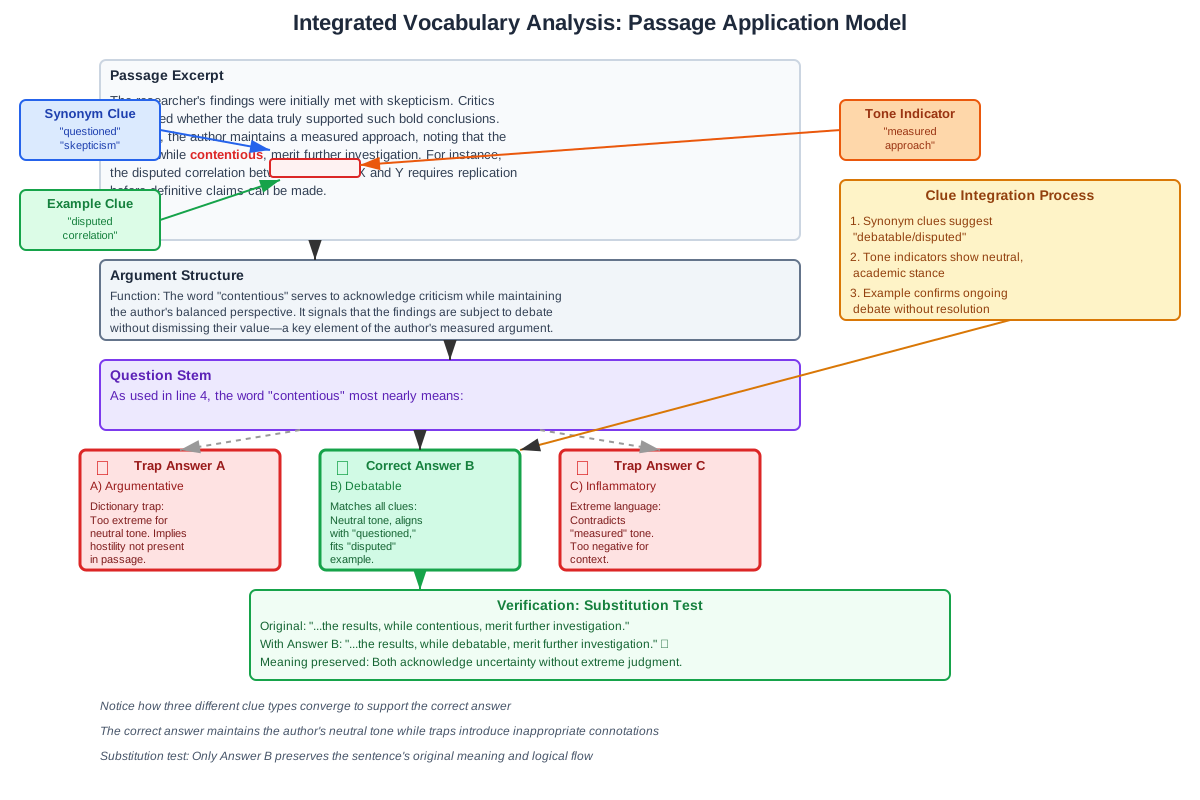
Overview
Vocabulary in context is a fundamental skill tested extensively in the Critical Analysis and Reasoning Skills (CARS) section of the MCAT. This skill requires test-takers to determine the precise meaning of words and phrases as they are used within specific passages, rather than relying solely on dictionary definitions or common usage. The MCAT frequently presents passages where familiar words carry specialized, nuanced, or even unconventional meanings that must be inferred from surrounding textual clues. Mastering this skill is essential because the CARS section evaluates not just reading comprehension, but the ability to understand how authors manipulate language to convey complex ideas, arguments, and perspectives.
The importance of vocabulary in context extends beyond simple word recognition. On the MCAT, passages drawn from humanities, social sciences, and natural sciences often employ discipline-specific terminology, figurative language, and rhetorical devices that require careful interpretation. A word that appears straightforward may carry subtle connotations or technical meanings specific to the passage's subject matter. Test-takers who approach vocabulary questions with preconceived definitions often fall into traps, while those who analyze contextual clues—including sentence structure, surrounding arguments, and authorial tone—can accurately determine intended meanings even for unfamiliar terms.
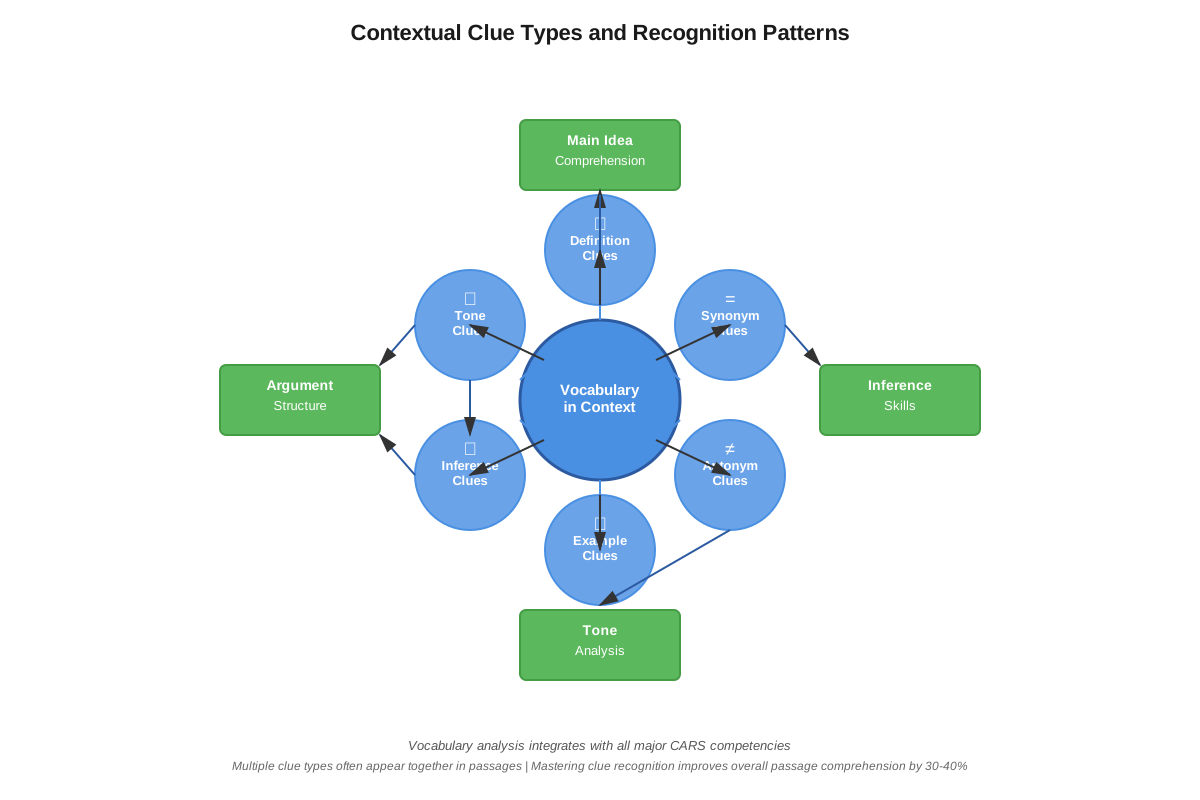
Within the broader framework of CARS Skills, vocabulary in context serves as a foundational competency that supports higher-order analytical tasks. Understanding precise word meanings enables accurate comprehension of main ideas, recognition of authorial intent, evaluation of argumentative structure, and assessment of rhetorical strategies. This skill intersects with other critical reading abilities, including inference-making, tone analysis, and passage mapping, making it an indispensable component of MCAT preparation that directly impacts overall CARS performance.
Learning Objectives
- [ ] Define Vocabulary in context using accurate Critical Analysis and Reasoning Skills terminology
- [ ] Explain why Vocabulary in context matters for the MCAT
- [ ] Apply Vocabulary in context to exam-style questions
- [ ] Identify common mistakes related to Vocabulary in context
- [ ] Connect Vocabulary in context to related Critical Analysis and Reasoning Skills concepts
- [ ] Distinguish between denotative and connotative meanings within MCAT passages
- [ ] Utilize contextual clues (syntactic, semantic, and structural) to determine word meanings
- [ ] Evaluate how authorial purpose influences word choice and meaning
Prerequisites
- Basic reading comprehension: Understanding literal meanings of sentences and paragraphs is necessary before analyzing nuanced word usage
- Familiarity with parts of speech: Recognizing whether a word functions as a noun, verb, adjective, or adverb helps determine its contextual role
- General vocabulary foundation: A broad vocabulary base provides reference points for understanding how words can shift meaning in different contexts
- Understanding of denotation vs. connotation: Distinguishing between literal definitions and implied meanings is fundamental to contextual analysis
Why This Topic Matters
Vocabulary in context questions appear in virtually every CARS passage on the MCAT, typically comprising 10-15% of all CARS questions. These questions assess whether test-takers can move beyond superficial reading to grasp how authors use language strategically. In medical practice, this skill translates directly to interpreting patient narratives, understanding medical literature with specialized terminology, and communicating effectively across diverse contexts where words may carry different implications.
On the MCAT, vocabulary in context questions typically appear in two formats: direct vocabulary questions asking "What does the author most likely mean by [word/phrase]?" and inference questions where understanding a specific term's contextual meaning is necessary to answer correctly. These questions often target words with multiple meanings, technical terms used in non-standard ways, or figurative language that requires interpretation. Passages from philosophy, art criticism, literary analysis, and social theory are particularly rich sources for vocabulary in context questions because these disciplines frequently employ abstract terminology and metaphorical language.
The AAMC consistently includes vocabulary in context questions because they efficiently test multiple competencies simultaneously: careful reading, attention to detail, inference-making, and understanding of authorial intent. Students who excel at these questions demonstrate the analytical precision required for medical school coursework and clinical reasoning. Furthermore, these questions serve as equalizers—even students with extensive vocabulary knowledge must analyze context carefully, while students with more modest vocabularies can succeed through systematic contextual analysis.
Core Concepts
Definition of Vocabulary in Context
Vocabulary in context refers to the practice of determining the specific meaning of a word or phrase based on how it is used within a particular passage, sentence, or argument, rather than relying on its standard dictionary definition or common usage. This skill requires readers to consider multiple contextual factors: the surrounding sentences, the passage's overall argument, the author's tone and purpose, the discipline-specific conventions, and the logical relationships between ideas. On the MCAT, this concept is tested through questions that ask test-takers to identify what an author "most likely means" by a specific term, requiring analysis of textual evidence rather than external knowledge.
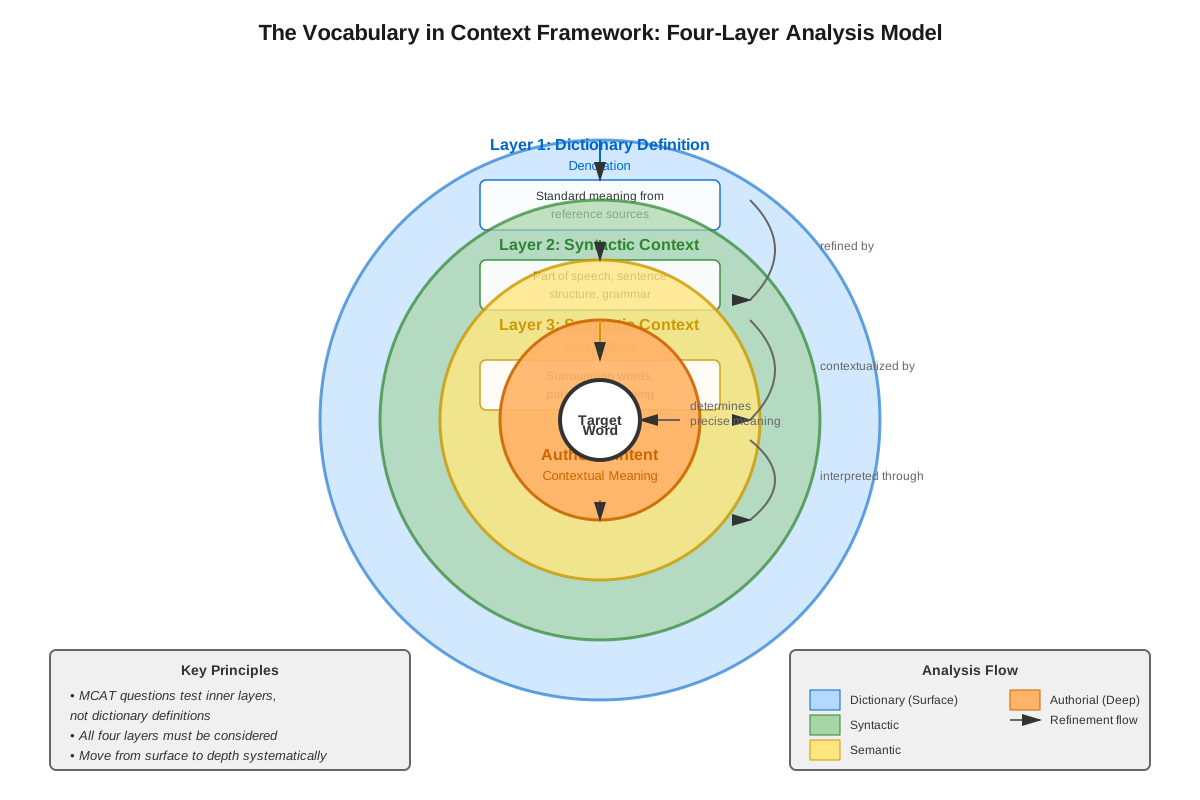
Types of Contextual Clues
Understanding the various types of contextual clues enables systematic analysis of unfamiliar or ambiguous terms:
Syntactic clues derive from sentence structure and grammatical relationships. The position of a word within a sentence, its grammatical function, and its relationship to other sentence elements provide information about meaning. For example, if an unfamiliar word appears between an article and a noun it modifies, it must be an adjective, which narrows possible meanings.
Semantic clues come from the meanings of surrounding words and phrases. Authors often provide definitions, examples, synonyms, antonyms, or explanations near challenging vocabulary. Phrases like "in other words," "that is," "for example," or "unlike" signal that clarifying information follows.
Structural clues emerge from the passage's organization and argumentative flow. Understanding where a term appears in the argument—whether in a thesis statement, supporting evidence, counterargument, or conclusion—helps determine its function and meaning. Terms used repeatedly throughout a passage often carry specialized meanings central to the author's argument.
Tonal clues reflect the author's attitude and emotional stance. Words carry connotations (emotional associations) beyond their denotations (literal meanings). An author's overall tone—whether critical, admiring, skeptical, or neutral—influences how specific words should be interpreted.
Denotation vs. Connotation in MCAT Passages
The distinction between denotation (literal, dictionary definition) and connotation (implied, emotional, or cultural associations) is crucial for MCAT success. Many vocabulary in context questions hinge on recognizing that an author uses a word for its connotative rather than denotative meaning.
| Aspect | Denotation | Connotation |
|---|---|---|
| Definition | Literal, dictionary meaning | Implied associations and emotional overtones |
| Stability | Relatively fixed across contexts | Varies by context, culture, and usage |
| MCAT Testing | Less frequently tested directly | Frequently tested through contextual questions |
| Example | "Home" = place of residence | "Home" = comfort, belonging, safety |
Consider the word "clinical" in different contexts: its denotation relates to medical observation and treatment, but in a passage about artistic style, "clinical" might connote emotional detachment or excessive precision. MCAT passages exploit these connotative shifts to test careful reading.
Figurative Language and Non-Literal Usage
MCAT passages frequently employ figurative language—metaphors, similes, analogies, and idiomatic expressions—where words must be interpreted non-literally. A philosophy passage might describe an argument as "gaining traction," using a physical metaphor for intellectual acceptance. An art criticism passage might call a painting "aggressive," attributing human qualities to an inanimate object.
Recognizing figurative language requires attention to logical impossibility or category mismatch. If a passage states that "the theory collapsed," the word "collapsed" cannot mean literal physical falling; context reveals it means the theory was discredited or disproven. MCAT questions often ask about such figurative uses, testing whether students can identify the intended meaning rather than the literal one.
Discipline-Specific Terminology
Different academic disciplines use specialized vocabularies, and MCAT passages drawn from various fields employ terms with technical meanings that may differ from everyday usage. A term like "romantic" has a specific meaning in literary history (relating to the Romantic movement) distinct from its common meaning (relating to love). "Liberal" in political philosophy carries different connotations than in contemporary political discourse.
The MCAT does not expect test-takers to possess specialized knowledge of these disciplines. Instead, passages provide sufficient context to determine technical meanings. Questions testing discipline-specific terminology assess whether students can use contextual clues rather than outside knowledge to determine meanings.
Process for Determining Contextual Meaning
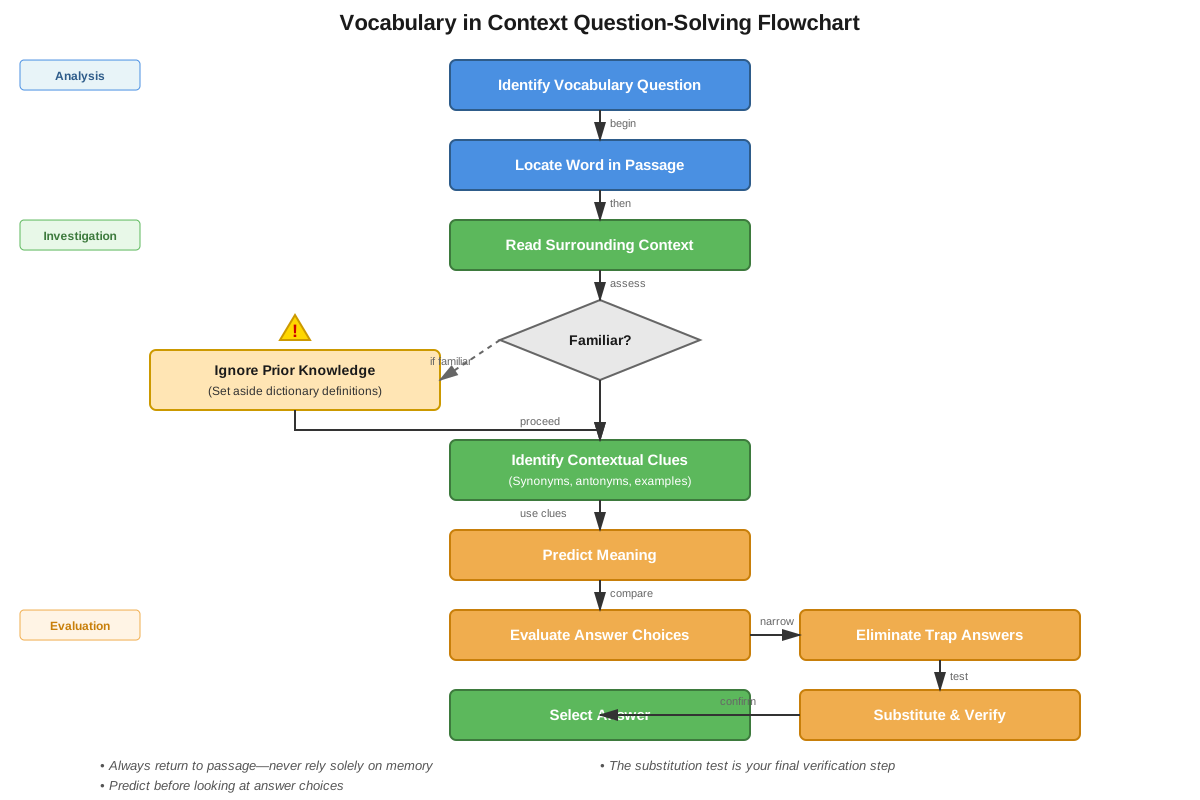
A systematic approach to vocabulary in context questions involves several steps:
- Identify the target word or phrase and locate it within the passage
- Read the complete sentence containing the term, not just the immediate phrase
- Examine surrounding sentences (typically 1-2 before and after) for clarifying information
- Consider the passage's main argument and how the term relates to it
- Analyze the author's tone and purpose in the relevant section
- Evaluate answer choices by substituting them into the original context
- Eliminate choices that create logical contradictions or shift the author's meaning
- Select the answer that preserves the passage's logic and authorial intent
This process emphasizes that vocabulary in context questions are fundamentally reading comprehension questions rather than vocabulary tests. Success depends on careful textual analysis, not extensive vocabulary knowledge.
Common Question Formats
MCAT vocabulary in context questions typically follow predictable formats:
- "The author most likely uses the word [X] (paragraph Y) to mean..."
- "In the context of the passage, [phrase] most nearly means..."
- "When the author describes [X] as [Y], the author most likely means that..."
- "The word [X] (paragraph Y) refers to..."
These questions may target single words, short phrases, or even complete clauses. They may ask about literal meanings, figurative meanings, or the function a term serves in the argument. Recognizing these formats helps test-takers quickly identify what the question demands.
Concept Relationships
Vocabulary in context serves as a foundational skill that enables and enhances other CARS Skills. The relationship flows hierarchically: accurate word-level comprehension → sentence-level understanding → paragraph-level comprehension → passage-level analysis → question-answering accuracy.
This skill connects directly to main idea identification because misunderstanding key terms leads to misidentifying the passage's central argument. It supports inference-making since inferences depend on precise understanding of stated information. It enables tone and attitude analysis because authorial tone is conveyed largely through word choice and connotation. It facilitates argument structure analysis because recognizing how terms function (as claims, evidence, qualifiers, or counterpoints) requires understanding their contextual meanings.
The relationship can be mapped as: Vocabulary in Context → enables → Accurate Comprehension → supports → Inference and Analysis → leads to → Correct Answer Selection. Conversely, weaknesses in vocabulary in context create cascading comprehension failures that undermine performance across all question types.
Within the topic itself, the concepts interconnect: understanding denotation vs. connotation requires recognizing contextual clues; interpreting figurative language depends on distinguishing literal from non-literal meanings; analyzing discipline-specific terminology involves applying the systematic process for determining contextual meaning. These concepts form an integrated skill set rather than isolated techniques.
Quick check — test yourself on Vocabulary in context so far.
Try Flashcards →High-Yield Facts
⭐ Vocabulary in context questions test reading comprehension, not vocabulary knowledge—the passage always contains sufficient clues to determine the correct answer
⭐ The correct answer preserves the passage's logic and authorial intent—substituting the correct answer for the original term should not change the passage's meaning
⭐ Common words used in uncommon ways are frequently tested—familiar terms with multiple meanings are more likely to appear than obscure vocabulary
⭐ Connotation matters more than denotation in most CARS passages—emotional associations and implied meanings often determine the correct answer
⭐ Context extends beyond the immediate sentence—surrounding sentences, paragraph structure, and overall argument all provide interpretive clues
- Figurative language appears in approximately 60-70% of CARS passages and is a common target for vocabulary questions
- Words with discipline-specific technical meanings are often defined or explained within the passage itself
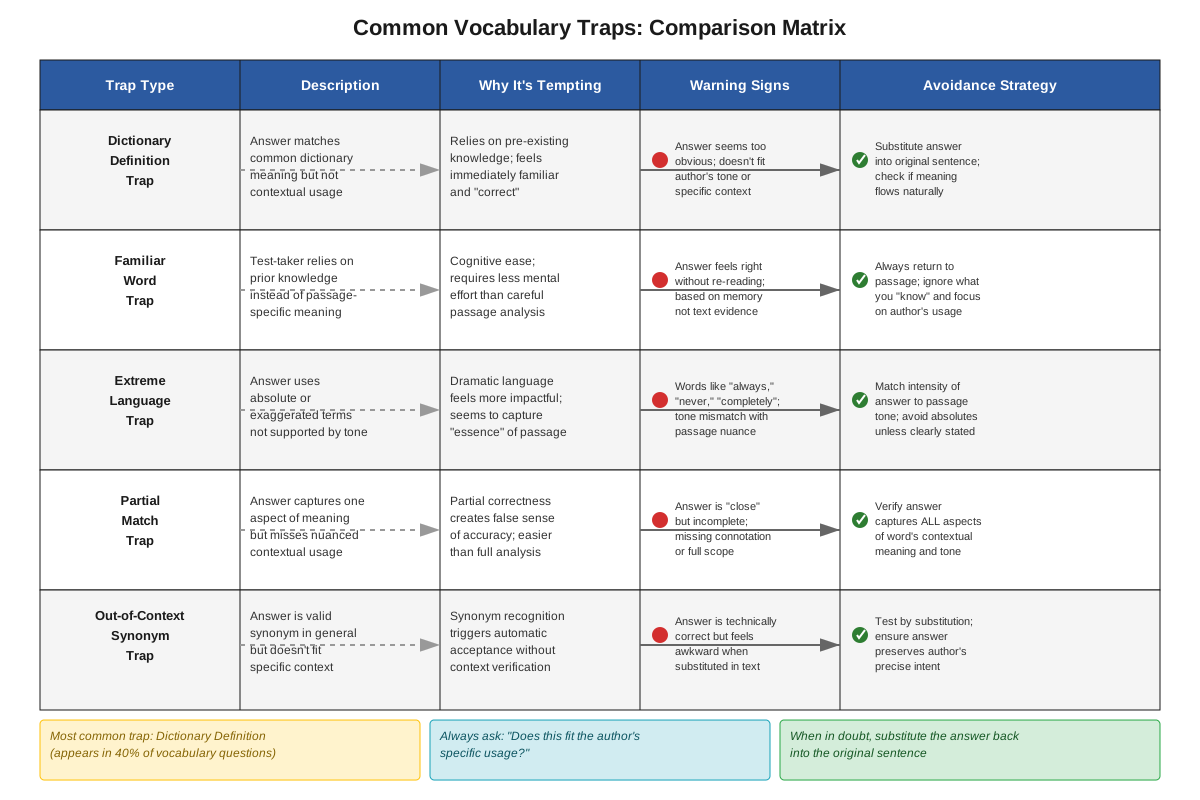
- Answer choices for vocabulary questions typically include the word's common meaning as a distractor
- Tone and attitude questions often depend on understanding the connotative meanings of specific word choices
- Vocabulary in context questions typically appear 1-2 times per passage, making them among the most frequent CARS question types
Common Misconceptions
Misconception: Vocabulary in context questions can be answered using dictionary definitions or prior knowledge of word meanings.
Correction: These questions specifically test the ability to determine meaning from context. The correct answer must fit the passage's specific usage, which may differ from standard definitions. Always prioritize textual evidence over external knowledge.
Misconception: Only the sentence containing the target word needs to be read to answer vocabulary questions.
Correction: Contextual meaning often depends on information from surrounding sentences, the paragraph's main point, or even the passage's overall argument. Reading only the immediate sentence frequently leads to misinterpretation.
Misconception: Obscure or difficult vocabulary is more likely to be tested than common words.
Correction: The MCAT more frequently tests common words used in specialized or non-standard ways. Words like "liberal," "romantic," "critical," or "economy" appear more often than rare vocabulary because they have multiple meanings that depend heavily on context.
Misconception: If you don't know a word's meaning, you cannot answer the question correctly.
Correction: Unfamiliarity with a word's standard meaning is irrelevant if you can analyze contextual clues systematically. Many students successfully answer vocabulary questions about words they've never encountered by using the surrounding text.
Misconception: The correct answer will be a synonym of the target word.
Correction: While the correct answer may be synonymous in the passage's context, it often represents a specific aspect, connotation, or application of the word rather than a general synonym. The answer must fit the precise contextual usage, not just share semantic similarity.
Misconception: Vocabulary in context questions are quick and easy, requiring minimal time investment.
Correction: These questions require careful reading of multiple sentences and thoughtful evaluation of answer choices. Rushing through them leads to errors. Allocate appropriate time to analyze context thoroughly.
Worked Examples
Example 1: Determining Connotative Meaning
Passage Excerpt: "The architect's vision was decidedly austere, rejecting the ornamental excesses of his predecessors in favor of clean lines and functional simplicity. Critics initially dismissed this austere approach as cold and unwelcoming, but subsequent generations came to appreciate how the restraint created spaces of contemplative calm."
Question: In the context of the passage, the word "austere" most nearly means:
A) Harsh and severe
B) Simple and unadorned
C) Economically frugal
D) Morally strict
Analysis:
Step 1: Locate "austere" in context—it appears twice, describing the architect's vision and approach.
Step 2: Examine surrounding clues—the passage explains austere as "rejecting ornamental excesses" and favoring "clean lines and functional simplicity." This provides a definition through contrast and example.
Step 3: Consider connotation—while "austere" can mean harsh (choice A) or strict (choice D), the passage's tone is ultimately positive ("contemplative calm"), suggesting these negative connotations don't fit.
Step 4: Evaluate choices by substitution:
- A) "Harsh and severe" contradicts the positive outcome described
- B) "Simple and unadorned" matches "clean lines and functional simplicity"
- C) "Economically frugal" introduces an economic dimension not present in the passage
- D) "Morally strict" relates to behavior, not architectural style
Answer: B) Simple and unadorned
Connection to Learning Objectives: This example demonstrates how contextual clues (the explanation following "austere") and tonal analysis (the shift from criticism to appreciation) determine meaning more accurately than the word's common connotations.
Example 2: Interpreting Figurative Language
Passage Excerpt: "The theory had dominated the field for decades, but new evidence began to erode its foundations. What had seemed an impregnable fortress of established fact revealed itself to be built on sand. Within five years, the entire edifice had crumbled, leaving researchers to construct new frameworks from the rubble."
Question: When the author states that the theory "revealed itself to be built on sand," the author most likely means that:
A) The theory lacked empirical support
B) The theory was developed in desert regions
C) The theory was based on unstable assumptions
D) The theory involved geological concepts
Analysis:
Step 1: Recognize figurative language—"built on sand" is a metaphorical expression, not literal.
Step 2: Identify the extended metaphor—the passage uses architectural imagery throughout: "foundations," "fortress," "edifice," "crumbled," "construct," "rubble."
Step 3: Interpret the metaphor—"built on sand" contrasts with building on solid ground, suggesting instability or unreliability.
Step 4: Connect to passage meaning—the theory "crumbled" when faced with "new evidence," indicating its basis was inadequate.
Step 5: Evaluate choices:
- A) "Lacked empirical support" is possible but doesn't capture the instability metaphor
- B) "Developed in desert regions" takes the metaphor literally—clearly incorrect
- C) "Based on unstable assumptions" captures both the metaphor and the passage's meaning
- D) "Involved geological concepts" misinterprets the figurative language
Answer: C) Based on unstable assumptions
Connection to Learning Objectives: This example illustrates how recognizing figurative language and extended metaphors enables accurate interpretation of non-literal word usage, a frequent MCAT testing point.
Exam Strategy
Approaching Vocabulary in Context Questions
When encountering vocabulary in context questions, implement this strategic approach:
First, identify the question type immediately by recognizing trigger phrases like "most nearly means," "most likely refers to," or "the author uses [word] to mean." This identification helps activate the appropriate analytical framework.
Second, return to the passage before looking at answer choices. Locate the target word or phrase and read the complete sentence plus 1-2 sentences before and after. This prevents answer choices from biasing interpretation.
Third, formulate your own prediction of the word's contextual meaning based on textual clues. This prediction serves as an anchor for evaluating answer choices and reduces susceptibility to attractive distractors.
Fourth, evaluate each answer choice by mentally substituting it into the original sentence. The correct answer should preserve the passage's logic, tone, and meaning without creating contradictions or awkwardness.
Trigger Words and Phrases
Certain words and phrases in questions signal specific analytical requirements:
- "Most nearly means": Focus on semantic equivalence in context, not dictionary definitions
- "Most likely refers to": Identify the specific concept, idea, or entity the term represents
- "The author uses [X] to mean": Emphasize authorial intent and purpose
- "In the context of the passage": Prioritize passage-specific usage over general meanings
- "The word [X] suggests": Consider connotations and implications beyond literal meaning
Recognizing these triggers helps focus analysis on what the question actually demands rather than what seems to be asked.
Process of Elimination Tips
Vocabulary in context questions lend themselves to systematic elimination:
Eliminate choices that:
- Represent the word's common meaning when the passage uses it unconventionally
- Introduce concepts or ideas not present in the relevant passage section
- Create logical contradictions when substituted into the original sentence
- Shift the author's tone (e.g., making a neutral statement negative)
- Require outside knowledge not provided in the passage
Favor choices that:
- Align with the passage's overall argument and purpose
- Preserve the logical relationships between ideas
- Match the author's tone and attitude
- Can be supported by specific textual evidence
- Fit naturally when substituted into the original context
Time Allocation
Vocabulary in context questions typically require 45-60 seconds each—slightly less than the CARS average of 60-90 seconds per question. However, rushing through them to save time is counterproductive because they require careful reading of multiple sentences.
Exam Tip: If a vocabulary question seems confusing or the answer choices all seem plausible, return to the passage and read a wider context (3-4 sentences before and after). The additional context usually clarifies the intended meaning.
Allocate time proportionally: 20 seconds to locate and read context, 15 seconds to formulate a prediction, 20 seconds to evaluate answer choices. This structured approach prevents both rushing and overthinking.
Memory Techniques
The CONTEXT Mnemonic
Use CONTEXT to remember the systematic approach to vocabulary questions:
- Consider the complete sentence
- Observe surrounding sentences
- Note the author's tone
- Think about the passage's argument
- Evaluate answer choices by substitution
- X-out choices that contradict the passage
- Trust textual evidence over assumptions
The Three-Circle Visualization
Visualize contextual meaning as three concentric circles:
Inner circle (immediate context): The sentence containing the target word
Middle circle (local context): The paragraph and surrounding sentences
Outer circle (global context): The passage's overall argument and purpose
The correct answer must fit all three circles. This visualization reminds test-takers to consider multiple levels of context rather than focusing narrowly on the immediate sentence.
The Substitution Test
Remember: "Swap and Check"—always substitute the answer choice into the original sentence and check whether it preserves meaning. This simple technique catches many errors that occur when students select answers that seem correct in isolation but don't fit the specific context.
Connotation vs. Denotation Reminder
Use the phrase "Feelings over Facts" to remember that CARS passages often emphasize connotative (emotional, implied) meanings over denotative (literal, dictionary) meanings. When answer choices include both literal and figurative interpretations, the figurative often proves correct.
Summary
Vocabulary in context represents a critical MCAT CARS skill that tests the ability to determine precise word meanings based on textual evidence rather than dictionary definitions or prior knowledge. Success requires systematic analysis of multiple contextual clues—syntactic, semantic, structural, and tonal—to identify how authors use language within specific passages. The MCAT frequently tests common words used in specialized ways, figurative language, and discipline-specific terminology, making careful reading more important than extensive vocabulary knowledge. Effective strategies include reading beyond the immediate sentence, formulating predictions before evaluating answer choices, using substitution to verify answers, and recognizing that connotative meanings often matter more than denotative ones. This skill serves as a foundation for broader CARS competencies, enabling accurate comprehension, inference-making, and argument analysis. Mastery requires practice with diverse passage types and consistent application of systematic analytical processes that prioritize textual evidence over assumptions.
Key Takeaways
- Vocabulary in context questions test reading comprehension through textual analysis, not vocabulary knowledge or memorization
- Context extends beyond the immediate sentence to include surrounding text, paragraph structure, and overall passage argument
- Common words used in uncommon ways appear more frequently than obscure vocabulary on the MCAT
- Connotative (implied, emotional) meanings often determine correct answers more than denotative (literal) meanings
- Systematic approaches—reading widely, predicting answers, substituting choices—significantly improve accuracy
- Figurative language and discipline-specific terminology require interpretation based on passage-provided clues
- The correct answer always preserves the passage's logic, tone, and authorial intent when substituted for the original term
Related Topics
Inference and Implication Questions: Mastering vocabulary in context directly supports inference-making because accurate inferences depend on precise understanding of stated information. Both skills require careful textual analysis and attention to nuance.
Tone and Attitude Analysis: Understanding how word choice conveys authorial attitude builds on vocabulary in context skills. Connotative meanings of specific words often reveal the author's perspective and emotional stance.
Main Idea and Purpose Questions: Identifying central arguments requires understanding key terms precisely. Misinterpreting crucial vocabulary leads to misidentifying main ideas.
Argument Structure and Reasoning: Recognizing how terms function within arguments (as claims, evidence, qualifiers, or counterpoints) depends on understanding their contextual meanings and logical relationships.
Passage Mapping and Active Reading: Effective passage mapping includes noting key terms and their contextual meanings, making vocabulary in context skills integral to efficient passage navigation.
Practice CTA
Now that you've mastered the core concepts of vocabulary in context, it's time to apply these skills to authentic MCAT-style passages and questions. The practice questions and flashcards accompanying this guide will reinforce your systematic approach and build the pattern recognition essential for test-day success. Remember: vocabulary in context questions reward careful reading and systematic analysis, skills that improve dramatically with deliberate practice. Each practice question you complete strengthens your ability to analyze textual clues efficiently and accurately—capabilities that will serve you throughout the CARS section and beyond. Approach practice with the same analytical rigor you'll bring to test day, and you'll see consistent improvement in both accuracy and confidence.
Sign up free to keep reading
Create a free AnvayaPrep account to finish this MCAT guide on Vocabulary in context — plus flashcards and practice questions.