Overview
Indicators are weak acids or bases that undergo distinct, observable color changes in response to changes in pH. These substances are fundamental tools in General Chemistry for visualizing acid-base reactions, determining equivalence points in titrations, and estimating the pH of solutions. On the MCAT, indicators represent a high-yield topic within the Acids and Bases unit because they integrate multiple concepts: acid-base equilibria, the Henderson-Hasselbalch equation, buffer systems, and titration curves. Understanding indicators requires both conceptual knowledge of how weak acids behave in solution and practical application skills for interpreting experimental data.
The MCAT frequently tests indicators through passage-based questions involving titration experiments, laboratory scenarios requiring pH determination, or theoretical questions about selecting appropriate indicators for specific reactions. Questions may present titration curves and ask students to identify which indicator would be suitable based on its transition range, or they may provide experimental data and require interpretation of color changes to determine solution pH. Because indicators bridge theoretical acid-base chemistry with practical laboratory applications, they appear across multiple question formats and difficulty levels.
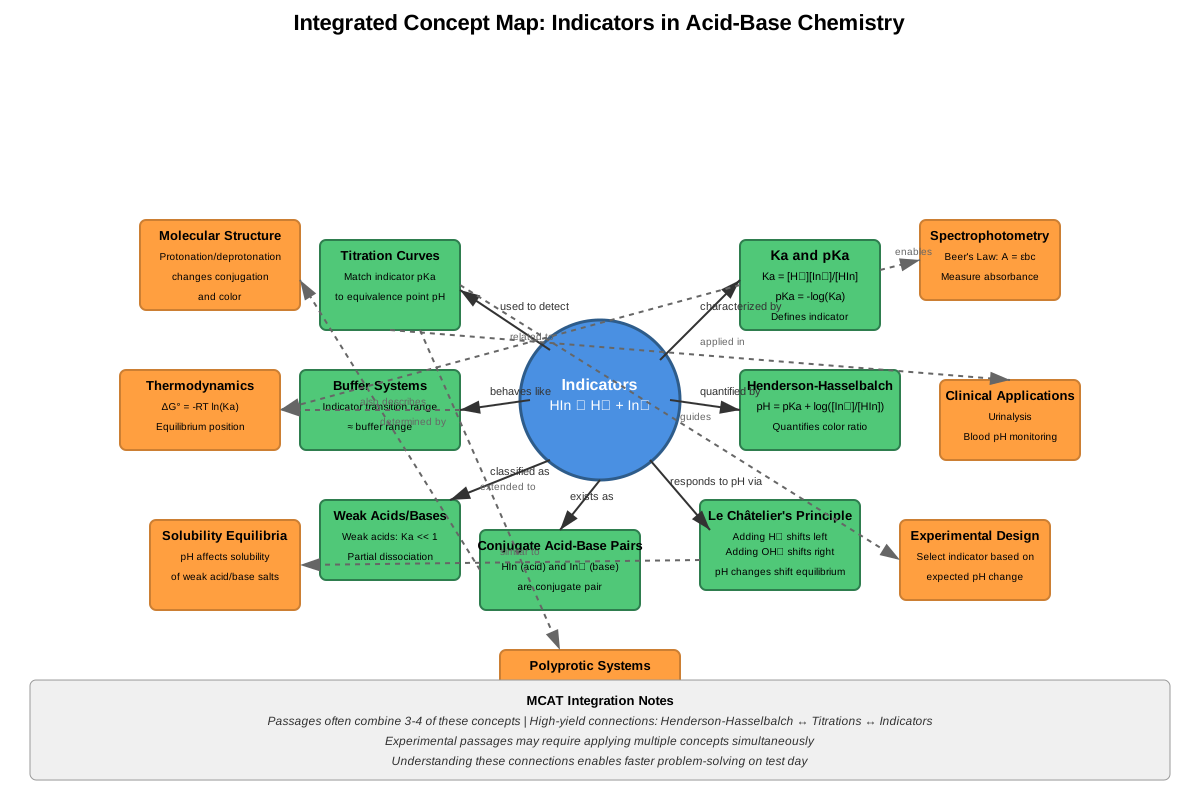
Mastery of indicators connects directly to broader General Chemistry concepts including Le Châtelier's principle, equilibrium constants (Ka and pKa), conjugate acid-base pairs, and buffer capacity. The behavior of indicators exemplifies how molecular structure determines chemical properties—a theme that extends throughout the MCAT curriculum. Additionally, understanding indicators provides essential context for interpreting experimental passages in both the Chemical and Physical Foundations section and occasionally in Biological and Biochemical Foundations passages involving enzyme assays or physiological pH measurements.
Learning Objectives
- [ ] Define indicators using accurate General Chemistry terminology
- [ ] Explain why indicators matter for the MCAT
- [ ] Apply indicators to exam-style questions
- [ ] Identify common mistakes related to indicators
- [ ] Connect indicators to related General Chemistry concepts
- [ ] Calculate the pH range over which an indicator changes color using the Henderson-Hasselbalch equation
- [ ] Select appropriate indicators for acid-base titrations based on equivalence point pH
- [ ] Predict the predominant form (acid vs. base) of an indicator at a given pH
- [ ] Interpret titration curves and identify suitable indicators from graphical data
Prerequisites
- Acid-base equilibria and Ka/Kb calculations: Indicators are weak acids or bases, so understanding equilibrium expressions is essential for predicting their behavior
- Henderson-Hasselbalch equation: This equation quantitatively describes the relationship between pH, pKa, and the ratio of conjugate acid-base forms
- Titration fundamentals: Indicators are primarily used to detect equivalence points, requiring knowledge of strong acid-strong base, weak acid-strong base, and weak base-strong acid titrations
- Le Châtelier's principle: Changes in pH shift the equilibrium between indicator forms, demonstrating this fundamental principle
- Conjugate acid-base pairs: Indicators exist as conjugate pairs with distinct colors for each form
Why This Topic Matters
Clinical and Real-World Significance: Indicators have widespread applications in medicine and research. Blood pH monitoring, urinalysis dipsticks, and diagnostic tests for gastric acid levels all employ indicator chemistry. Litmus paper and pH paper used in clinical laboratories rely on indicator compounds to provide rapid pH assessments. Understanding indicators helps interpret laboratory results and quality control procedures in healthcare settings.
Exam Statistics: Indicators appear in approximately 3-5% of MCAT General Chemistry questions, with higher frequency in passage-based questions involving experimental design or data interpretation. The AAMC frequently includes titration passages (appearing in roughly 10-15% of exams) where indicator selection or interpretation is tested. Questions range from straightforward recall of indicator properties to complex multi-step problems requiring integration of equilibrium concepts, titration curves, and experimental design principles.
Common Exam Appearances: The MCAT presents indicators through several formats: (1) titration curve passages asking students to select appropriate indicators based on equivalence point pH; (2) experimental passages describing color changes and requiring pH determination; (3) discrete questions testing knowledge of specific indicators like phenolphthalein or methyl orange; (4) laboratory technique passages where indicator choice affects experimental validity; and (5) biochemistry passages involving pH-dependent enzyme assays where indicators monitor reaction progress. The exam particularly favors questions that require students to apply the Henderson-Hasselbalch equation to indicator equilibria or to recognize when an indicator is unsuitable for a particular titration.
Core Concepts
Definition and Fundamental Properties
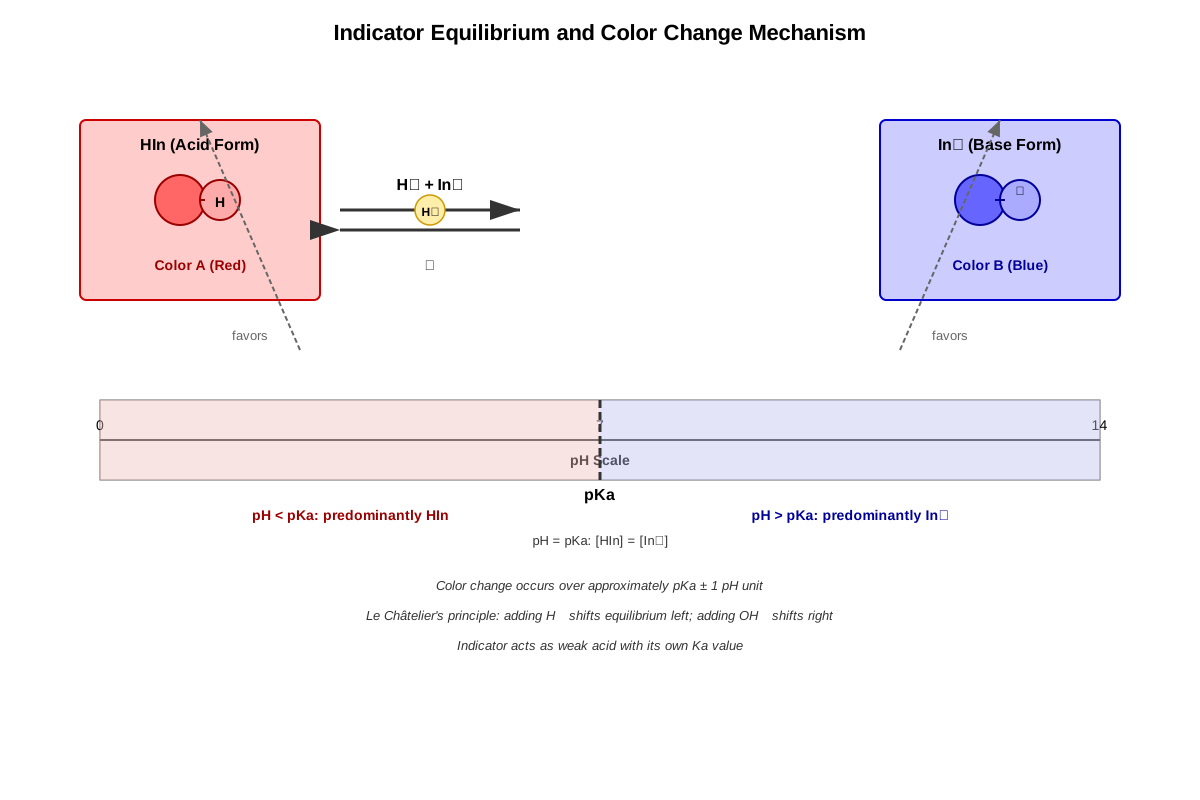
Indicators are weak organic acids (HIn) or bases (In) that exhibit different colors in their protonated and deprotonated forms. The color change occurs because protonation or deprotonation alters the molecule's electronic structure, specifically the conjugation patterns and electron distribution that determine light absorption. For an indicator that is a weak acid, the equilibrium can be represented as:
HIn(aq) ⇌ H⁺(aq) + In⁻(aq)
(Color A)        (Color B)
The indicator constant (KIn) describes this equilibrium:
KIn = [H⁺][In⁻]/[HIn]This expression is analogous to Ka for any weak acid. The pKIn (the negative logarithm of KIn) determines the pH at which the indicator changes color. At pH = pKIn, the concentrations of the two forms are equal, and the solution displays an intermediate color.
The Henderson-Hasselbalch Equation for Indicators
Applying the Henderson-Hasselbalch equation to indicator equilibria provides quantitative insight into color changes:
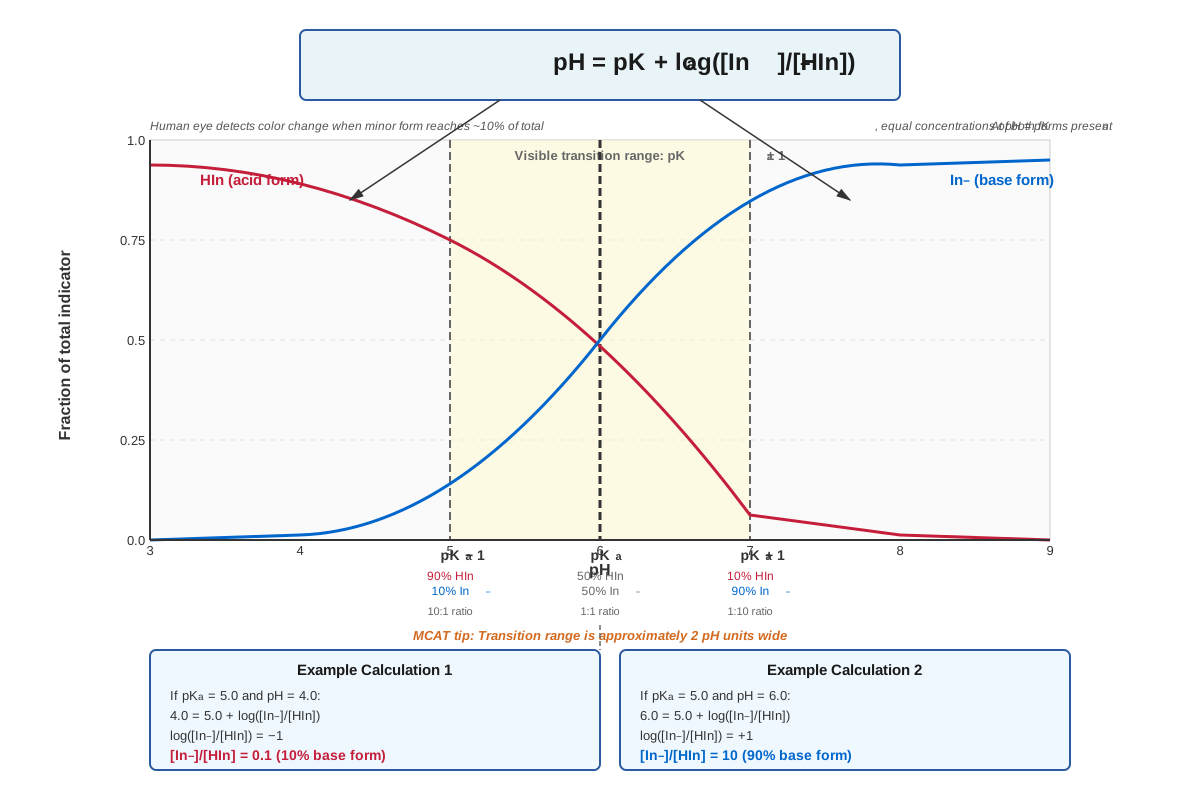
pH = pKIn + log([In⁻]/[HIn])When pH = pKIn, the ratio [In⁻]/[HIn] equals 1, meaning equal concentrations of both forms exist. However, the human eye cannot detect subtle color changes when both forms are present in similar amounts. The transition range (also called the color change interval) typically spans approximately 2 pH units centered on the pKIn:
Transition range ≈ pKIn ± 1This range corresponds to ratios of [In⁻]/[HIn] from approximately 1:10 to 10:1. Outside this range, one form predominates so strongly that the solution appears to be a single color.
Common Indicators and Their Properties
| Indicator | pKIn | Acidic Color | Basic Color | Transition Range (pH) | Typical Use |
|---|---|---|---|---|---|
| Methyl orange | 3.7 | Red | Yellow | 3.1-4.4 | Strong acid-weak base titrations |
| Methyl red | 5.1 | Red | Yellow | 4.4-6.2 | Weak acid-strong base titrations (low pH) |
| Bromothymol blue | 7.0 | Yellow | Blue | 6.0-7.6 | Neutral titrations, buffer solutions |
| Phenolphthalein | 9.3 | Colorless | Pink | 8.3-10.0 | Weak acid-strong base titrations |
| Thymol blue | 8.9 | Yellow | Blue | 8.0-9.6 | Weak acid-strong base titrations |
Phenolphthalein is the most frequently tested indicator on the MCAT. Its colorless-to-pink transition makes it ideal for weak acid-strong base titrations, where the equivalence point occurs in the basic pH range (typically pH 8-10).
Indicator Selection for Titrations
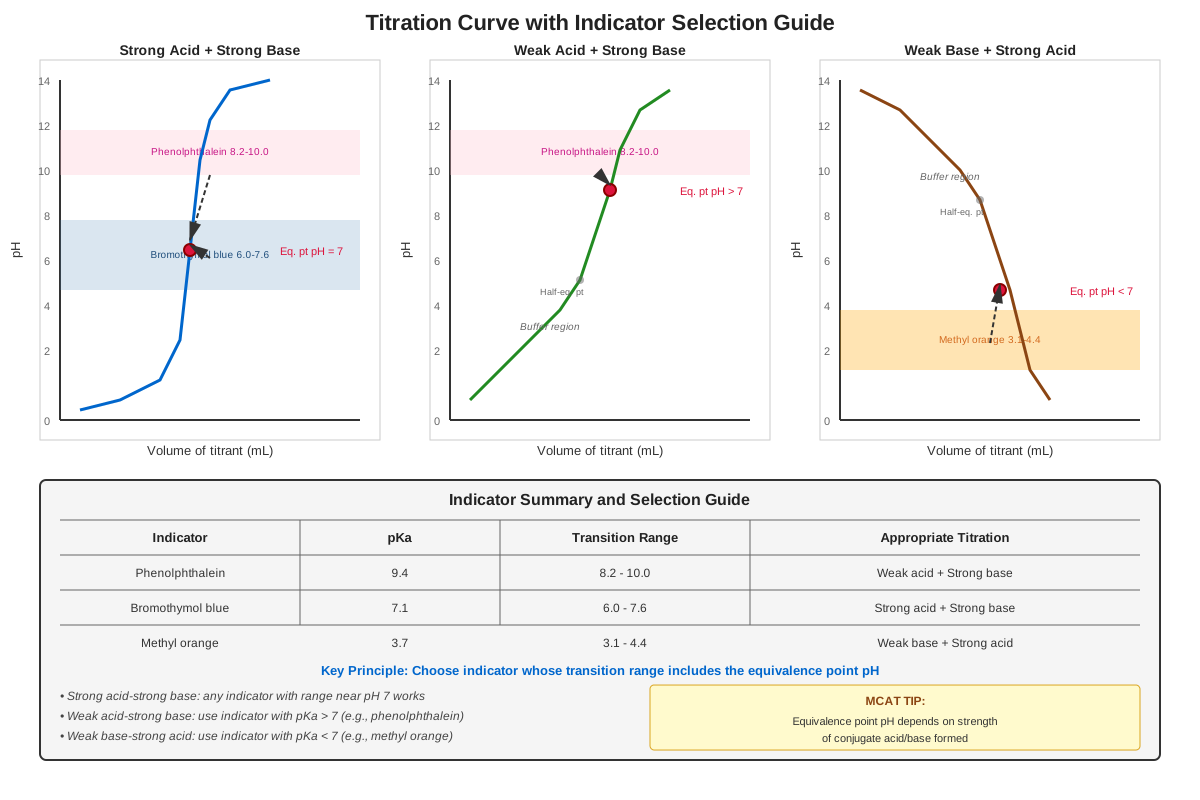
Selecting an appropriate indicator requires matching the indicator's transition range to the equivalence point pH of the titration. The equivalence point pH depends on the strength of the acid and base being titrated:
- Strong acid-strong base titrations: Equivalence point at pH 7. Indicators with transition ranges near pH 7 (bromothymol blue, phenol red) work well, though many indicators are acceptable due to the steep pH change near equivalence.
- Weak acid-strong base titrations: Equivalence point at pH > 7 (typically 8-10). The conjugate base formed at equivalence is weakly basic. Use indicators with pKIn values in the basic range, such as phenolphthalein (pKIn = 9.3).
- Strong acid-weak base titrations: Equivalence point at pH < 7 (typically 3-6). The conjugate acid formed at equivalence is weakly acidic. Use indicators with pKIn values in the acidic range, such as methyl orange (pKIn = 3.7).
- Weak acid-weak base titrations: These titrations lack a sharp pH change at equivalence, making indicator selection unreliable. Such titrations are typically avoided or require instrumental pH measurement.
Exam Tip: The MCAT often presents titration curves and asks which indicator is most appropriate. Look for the indicator whose pKIn falls within the steep vertical portion of the curve near the equivalence point.
Molecular Basis of Color Change
Indicators are typically complex organic molecules with extended conjugated systems. The color change results from structural rearrangements that occur upon protonation or deprotonation. For example, phenolphthalein exists as a colorless lactone structure in acidic solution. In basic solution, the lactone ring opens, creating an extended conjugated system that absorbs visible light, producing the characteristic pink color.
The chromophore (color-producing portion) of an indicator molecule changes its electronic structure when pH changes. Protonation typically disrupts conjugation or alters the electron distribution, shifting the wavelength of maximum absorption. This shift moves the absorption either into or out of the visible spectrum, causing the observed color change.
Multiple Indicator Systems and Universal Indicators
Universal indicators are mixtures of several indicators with different pKIn values, designed to display a continuous range of colors across the entire pH scale. These mixtures provide approximate pH values through color matching but lack the precision of single indicators for specific applications. The MCAT rarely tests universal indicators in detail but may present them in experimental passages.
Limitations and Practical Considerations
Several factors limit indicator effectiveness:
- Temperature dependence: KIn values change with temperature, shifting transition ranges
- Ionic strength effects: High salt concentrations can alter indicator equilibria
- Protein binding: In biological samples, indicators may bind to proteins, affecting color
- Interfering substances: Colored compounds in solution can mask indicator colors
- Concentration effects: Indicator concentration must be low enough not to affect the titration but high enough to produce visible color
Concept Relationships
The behavior of indicators directly demonstrates acid-base equilibrium principles. When pH changes, Le Châtelier's principle predicts that the indicator equilibrium shifts to counteract the change. Adding acid (decreasing pH) shifts the equilibrium toward the protonated form (HIn), while adding base shifts it toward the deprotonated form (In⁻).
Indicators → Henderson-Hasselbalch equation: The quantitative relationship between pH and indicator color requires applying the Henderson-Hasselbalch equation to the indicator equilibrium. This connection reinforces buffer calculations and pH determination skills.
Titration curves → Indicator selection: Understanding titration curves (plots of pH vs. volume of titrant added) enables appropriate indicator selection. The equivalence point pH, determined by the hydrolysis of the salt formed, must fall within the indicator's transition range.
Conjugate acid-base pairs → Indicator forms: Each indicator exists as a conjugate acid-base pair. The relative strengths of these forms (quantified by pKIn) determine the pH at which color change occurs, connecting to broader concepts of acid-base strength.
Buffer systems → Indicator behavior: Indicators themselves act as weak buffers, though their low concentrations typically make this effect negligible. However, understanding buffer capacity helps explain why indicators don't significantly affect solution pH during titrations.
Spectroscopy → Color perception: The molecular basis of indicator color changes connects to spectroscopy concepts. Different conjugated systems absorb different wavelengths, producing complementary colors that the eye perceives.
High-Yield Facts
⭐ The transition range of an indicator is approximately pKIn ± 1, corresponding to a 10:1 ratio of the two forms in either direction.
⭐ Phenolphthalein (pKIn = 9.3) is colorless in acid and pink in base, making it ideal for weak acid-strong base titrations where the equivalence point is basic.
⭐ For weak acid-strong base titrations, the equivalence point pH > 7, requiring indicators with pKIn values in the basic range.
⭐ For strong acid-weak base titrations, the equivalence point pH < 7, requiring indicators with pKIn values in the acidic range.
⭐ At pH = pKIn, the indicator is exactly 50% in each form ([HIn] = [In⁻]), displaying an intermediate color.
- Methyl orange (pKIn = 3.7) changes from red to yellow and is used for strong acid-weak base titrations.
- Bromothymol blue (pKIn = 7.0) is suitable for strong acid-strong base titrations and buffer solutions near neutral pH.
- Indicators are weak acids or bases themselves, but their concentrations are kept low (typically 10⁻⁵ to 10⁻⁶ M) to avoid affecting the pH of the solution being measured.
- The color change is gradual over the transition range, not instantaneous at a single pH value.
- Litmus paper contains a mixture of indicators and changes from red (pH < 4.5) to blue (pH > 8.3), with purple in between.
- Indicators cannot be used effectively for weak acid-weak base titrations because these lack a sharp equivalence point.
- The molecular structure of indicators typically includes aromatic rings with electron-donating or electron-withdrawing groups that stabilize different forms.
Quick check — test yourself on Indicators so far.
Try Flashcards →Common Misconceptions
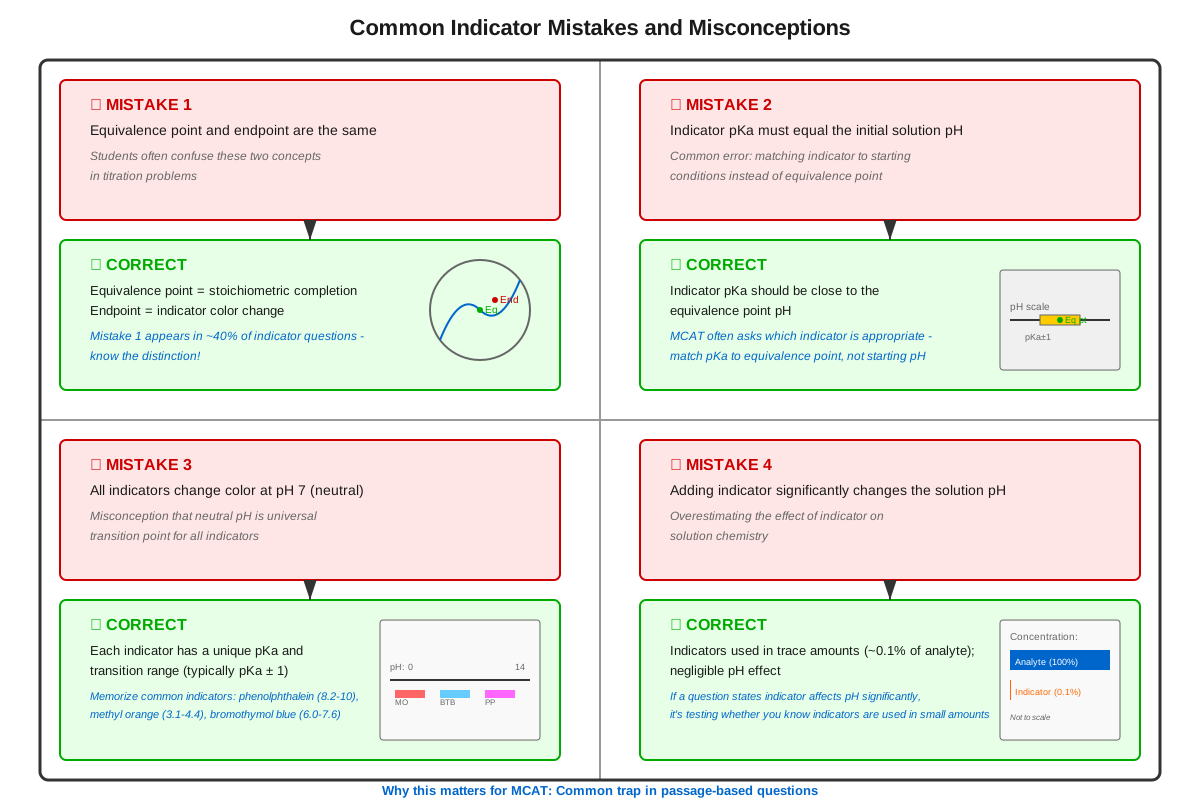
Misconception: Indicators change color exactly at their pKIn value.
Correction: Indicators change color gradually over a range of approximately pKIn ± 1. At exactly pH = pKIn, the solution contains equal amounts of both forms and displays an intermediate color. The human eye perceives a "complete" color change when one form is present at about 10 times the concentration of the other.
Misconception: Any indicator can be used for any titration as long as you watch for a color change.
Correction: Indicator selection must match the equivalence point pH of the specific titration. Using an indicator with a transition range far from the equivalence point will cause the color change to occur too early or too late, introducing significant error in determining the endpoint.
Misconception: The equivalence point and endpoint of a titration are always the same.
Correction: The equivalence point is the theoretical point where stoichiometrically equivalent amounts of acid and base have reacted. The endpoint is the observed point where the indicator changes color. These coincide only when the indicator is properly chosen so its transition range includes the equivalence point pH.
Misconception: Phenolphthalein turns pink in acidic solutions.
Correction: Phenolphthalein is colorless in acidic and neutral solutions (pH < 8.3) and turns pink in basic solutions (pH > 10.0). This is a frequently tested fact on the MCAT, often appearing in questions that require students to identify solution pH based on indicator color.
Misconception: Adding more indicator makes the color change easier to see and improves accuracy.
Correction: While more indicator does intensify the color, indicators are themselves weak acids or bases. Using too much indicator can affect the pH of the solution being measured, especially in dilute solutions or those with low buffer capacity. Standard practice uses minimal indicator concentration sufficient for visual detection.
Misconception: All indicators are acids.
Correction: While many common indicators are weak acids (like phenolphthalein and methyl orange), some indicators are weak bases. The key principle is that indicators exist in two forms with different colors, and the equilibrium between these forms is pH-dependent.
Worked Examples
Example 1: Selecting an Appropriate Indicator
Question: A student is titrating 25.0 mL of 0.100 M acetic acid (Ka = 1.8 × 10⁻⁵) with 0.100 M NaOH. Which indicator would be most appropriate for this titration: methyl orange (pKIn = 3.7), bromothymol blue (pKIn = 7.0), or phenolphthalein (pKIn = 9.3)?
Solution:
Step 1: Identify the type of titration. This is a weak acid-strong base titration (acetic acid is a weak acid, NaOH is a strong base).
Step 2: Determine the equivalence point pH. At equivalence, all acetic acid has been converted to acetate ion (CH₃COO⁻), which is a weak base. The solution will be basic, with pH > 7.
Step 3: Calculate the approximate equivalence point pH. At equivalence, we have 0.0500 M acetate (diluted to 50.0 mL total volume). Using the Kb of acetate:
Kb = Kw/Ka = (1.0 × 10⁻¹⁴)/(1.8 × 10⁻⁵) = 5.6 × 10⁻¹⁰For the hydrolysis of acetate:
[OH⁻] = √(Kb × C) = √(5.6 × 10⁻¹⁰ × 0.0500) = 5.3 × 10⁻⁶ M
pOH = 5.28
pH = 14 - 5.28 = 8.72
Step 4: Select the indicator whose pKIn is closest to the equivalence point pH. The equivalence point is at pH 8.72. Checking the indicators:
- Methyl orange: pKIn = 3.7 (transition range 3.1-4.4) — too acidic
- Bromothymol blue: pKIn = 7.0 (transition range 6.0-7.6) — too low
- Phenolphthalein: pKIn = 9.3 (transition range 8.3-10.0) — includes pH 8.72 ✓
Answer: Phenolphthalein is the most appropriate indicator because its transition range (8.3-10.0) includes the equivalence point pH of 8.72.
Key Concept: For weak acid-strong base titrations, always use an indicator with a pKIn in the basic range because the equivalence point occurs at pH > 7 due to hydrolysis of the conjugate base formed.
Example 2: Predicting Indicator Color
Question: A solution has a pH of 4.5. What color would the solution appear if a few drops of bromothymol blue (pKIn = 7.0, yellow in acid, blue in base) were added?
Solution:
Step 1: Compare the solution pH to the indicator's pKIn.
- Solution pH = 4.5
- Indicator pKIn = 7.0
- pH < pKIn by 2.5 units
Step 2: Apply the Henderson-Hasselbalch equation to determine the ratio of forms:
pH = pKIn + log([In⁻]/[HIn])
4.5 = 7.0 + log([In⁻]/[HIn])
log([In⁻]/[HIn]) = -2.5
[In⁻]/[HIn] = 10⁻²·⁵ = 3.2 × 10⁻³
Step 3: Interpret the ratio. The ratio of base form to acid form is 0.0032:1, meaning the acid form (HIn) predominates by more than 300-fold.
Step 4: Determine the color. Since the pH is well below the pKIn and far outside the transition range (6.0-7.6), the acid form completely predominates. Bromothymol blue is yellow in its acid form.
Answer: The solution would appear yellow.
Exam Strategy: When pH differs from pKIn by more than 1 unit, you can immediately conclude that one form predominates without detailed calculation. If pH < pKIn - 1, the acid form predominates; if pH > pKIn + 1, the base form predominates.
Exam Strategy
Approaching MCAT Questions on Indicators:
- Identify the question type: Is it asking about indicator selection for a titration, predicting indicator color at a given pH, or interpreting experimental data involving color changes?
- For titration questions: First determine the type of titration (strong-strong, weak acid-strong base, or strong acid-weak base), then predict whether the equivalence point will be acidic, neutral, or basic. Select the indicator whose pKIn matches the equivalence point pH.
- For color prediction questions: Compare the given pH to the indicator's pKIn. If pH < pKIn - 1, the acid form predominates; if pH > pKIn + 1, the base form predominates; if pH is within pKIn ± 1, both forms are present in significant amounts.
- Watch for these trigger words and phrases:
- "Suitable indicator" or "appropriate indicator" → indicator selection question
- "Equivalence point" → calculate or estimate the pH at equivalence
- "Color change" or "endpoint" → apply transition range concepts
- "Weak acid titrated with strong base" → expect basic equivalence point, need indicator with high pKIn
- "Phenolphthalein" → immediately recall colorless in acid, pink in base, pKIn ≈ 9
- Process of elimination tips:
- Eliminate indicators whose transition ranges don't overlap with the equivalence point pH
- For weak acid-strong base titrations, eliminate acidic indicators (methyl orange, methyl red)
- For strong acid-weak base titrations, eliminate basic indicators (phenolphthalein, thymol blue)
- If a question describes a color change occurring "too early" in a titration, the indicator's pKIn is too low
- If a question describes "no color change" near equivalence, the indicator's transition range doesn't include the equivalence point pH
- Time allocation: Straightforward indicator questions (recall of properties, simple color predictions) should take 30-45 seconds. Questions requiring calculation of equivalence point pH followed by indicator selection may take 90-120 seconds. Don't spend excessive time on precise calculations—estimate when possible.
- Common trap answers: The MCAT often includes distractors that represent common misconceptions, such as suggesting phenolphthalein for a strong acid-weak base titration or claiming that indicators change color exactly at their pKIn value.
Memory Techniques
Mnemonic for Phenolphthalein: "Phenolphthalein is Pink in PH-high" (basic solutions). This reminds you that phenolphthalein turns pink in basic conditions and has a high pKIn value.
Mnemonic for Indicator Selection: "Weak Acid needs Basic indicator" (WAB). When titrating a weak acid with strong base, use an indicator with a basic pKIn (like phenolphthalein). Conversely, "Weak Base needs Acidic indicator" (WBA).
Visualization Strategy: Picture a pH scale from 0-14. Place common indicators at their pKIn values:
- Methyl orange at 3.7 (acidic end)
- Bromothymol blue at 7.0 (middle)
- Phenolphthalein at 9.3 (basic end)
Draw transition ranges as ±1 unit around each pKIn. This mental image helps quickly match indicators to equivalence points.
Acronym for Transition Range: "TEN to ONE" reminds you that the transition range corresponds to a 10:1 ratio in either direction (10:1 and 1:10), which spans approximately 2 pH units (pKIn ± 1).
Color Memory Aid: For bromothymol blue, remember "Blue in Base, Yellow when Yucky (acidic)." The alliteration helps recall which color corresponds to which pH condition.
Henderson-Hasselbalch Quick Check: When pH = pKIn, the log term equals zero (because log(1) = 0), meaning equal concentrations of both forms. This is the midpoint of the color change.
Summary
Indicators are weak acids or bases that undergo observable color changes in response to pH changes, making them essential tools for visualizing acid-base reactions and determining titration endpoints. The color change occurs because the protonated and deprotonated forms of the indicator molecule have different electronic structures and thus absorb different wavelengths of light. Each indicator is characterized by its pKIn value, which determines the pH at which the color change occurs, and its transition range (approximately pKIn ± 1), over which the color change is visible. Selecting an appropriate indicator for a titration requires matching the indicator's transition range to the equivalence point pH, which depends on the strengths of the acid and base being titrated. Weak acid-strong base titrations have basic equivalence points and require indicators with high pKIn values like phenolphthalein, while strong acid-weak base titrations have acidic equivalence points and require indicators with low pKIn values like methyl orange. The Henderson-Hasselbalch equation quantitatively describes the relationship between pH and the ratio of indicator forms, enabling precise predictions of indicator behavior at any pH.
Key Takeaways
- Indicators are weak acids or bases that exist in two forms with different colors; the equilibrium between these forms is pH-dependent and described by the indicator constant (KIn).
- The transition range of an indicator is approximately pKIn ± 1, corresponding to a 10:1 ratio of the two forms in either direction; outside this range, one form predominates completely.
- Indicator selection for titrations requires matching the transition range to the equivalence point pH: use basic indicators (high pKIn) for weak acid-strong base titrations and acidic indicators (low pKIn) for strong acid-weak base titrations.
- Phenolphthalein (pKIn = 9.3) is colorless in acid and pink in base, making it the most commonly used indicator for weak acid-strong base titrations and a high-yield fact for the MCAT.
- The Henderson-Hasselbalch equation (pH = pKIn + log([In⁻]/[HIn])) quantitatively relates pH to the ratio of indicator forms, enabling calculation of predominant forms at any pH.
- The equivalence point (stoichiometric completion) and endpoint (indicator color change) are different: they coincide only when the indicator is properly selected.
- Weak acid-weak base titrations cannot reliably use indicators because they lack a sharp pH change at equivalence, requiring instrumental pH measurement instead.
Related Topics
Buffer Systems: Understanding how buffers resist pH changes connects directly to indicator behavior, as indicators themselves are weak acid-base systems. Mastering buffers enables deeper comprehension of why indicators don't significantly affect solution pH during titrations.
Titration Curves: Detailed analysis of pH vs. volume plots for various titration types provides the foundation for indicator selection. Studying titration curves reveals why equivalence point pH varies with acid-base strength.
Acid-Base Strength and Ka/Kb Values: The strength of acids and bases determines equivalence point pH, which in turn dictates appropriate indicator selection. Strengthening skills in comparing acid-base strengths improves indicator selection accuracy.
Spectroscopy and Light Absorption: The molecular basis of indicator color changes involves electronic transitions and light absorption. Exploring spectroscopy concepts deepens understanding of why structural changes produce color changes.
Le Châtelier's Principle: Indicator equilibria respond to pH changes according to Le Châtelier's principle. Mastering this principle enables prediction of how indicators respond to acid or base addition.
Practice CTA
Now that you've mastered the core concepts of indicators, it's time to solidify your understanding through active practice. Work through the practice questions to test your ability to select appropriate indicators, predict colors at various pH values, and interpret experimental data. Use the flashcards to reinforce high-yield facts like indicator pKIn values and transition ranges. Remember, indicators appear frequently on the MCAT in both discrete questions and passage-based formats—consistent practice with these concepts will build the speed and accuracy you need to excel on test day. You've built a strong foundation; now apply it!
Sign up free to keep reading
Create a free AnvayaPrep account to finish this MCAT guide on Indicators — plus flashcards and practice questions.