Overview
The concept of pH stands as one of the most fundamental and frequently tested topics in General Chemistry on the MCAT. Understanding pH is essential not only for mastering acids and bases but also for comprehending biochemical processes, physiological systems, and pharmacological mechanisms that appear throughout all sections of the exam. The pH scale provides a quantitative measure of hydrogen ion concentration in aqueous solutions, allowing scientists and clinicians to predict chemical behavior, enzyme activity, drug solubility, and physiological homeostasis.
For the MCAT, pH represents a high-yield topic that appears in multiple contexts: standalone General Chemistry questions, passage-based problems involving buffer systems, biochemistry questions about enzyme kinetics and protein structure, and biological sciences passages discussing respiratory and renal physiology. The ability to rapidly calculate pH values, interpret pH changes, and predict the behavior of acids and bases under various conditions separates high-scoring students from average performers. Questions involving pH often integrate mathematical reasoning with conceptual understanding, requiring both computational fluency and deep comprehension of acid-base equilibria.
The relationship between pH and other General Chemistry concepts extends throughout the curriculum. pH calculations build directly on logarithmic mathematics, equilibrium constants, and solution chemistry. Understanding pH enables mastery of buffer systems, titration curves, solubility equilibria, and electrochemistry. In biological contexts, pH connects to amino acid structure, protein folding, enzyme function, metabolic pathways, and physiological regulation. This interconnectedness makes pH a cornerstone concept that supports learning across multiple MCAT domains, making thorough mastery essential for exam success.
Learning Objectives
- [ ] Define pH using accurate General Chemistry terminology
- [ ] Explain why pH matters for the MCAT
- [ ] Apply pH to exam-style questions
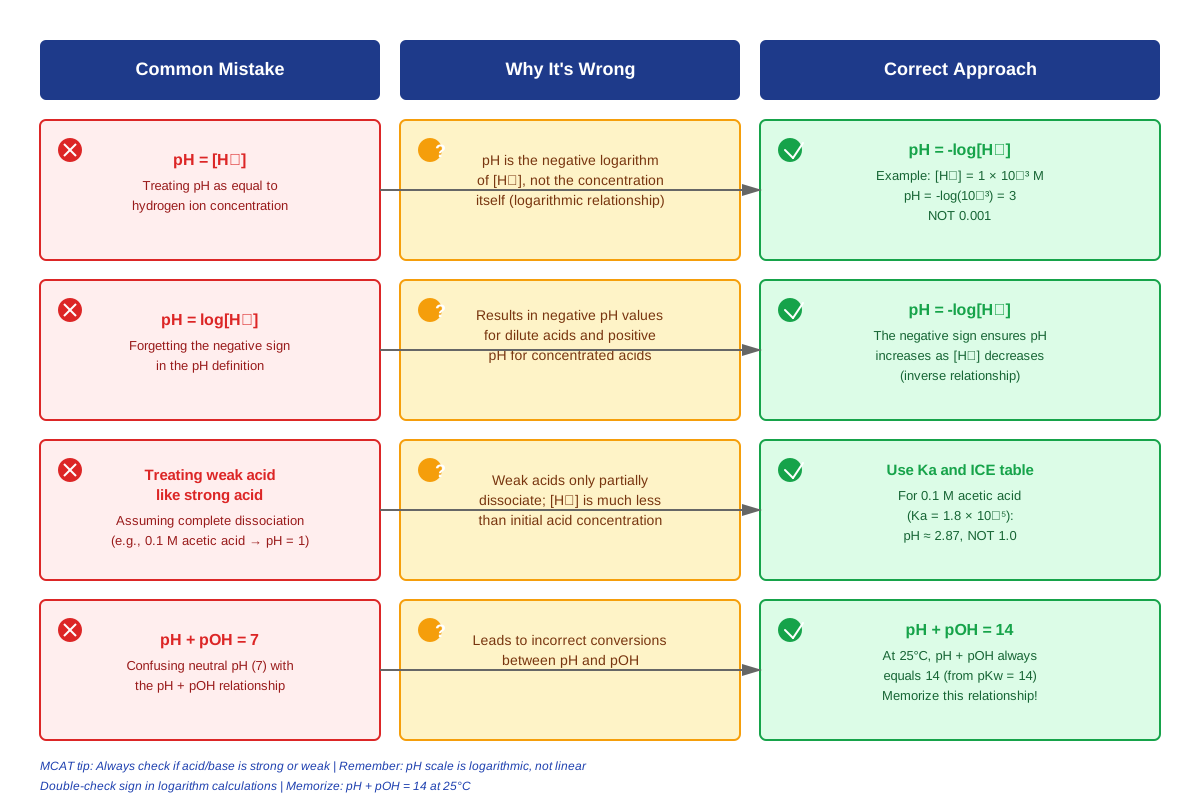
- [ ] Identify common mistakes related to pH
- [ ] Connect pH to related General Chemistry concepts
- [ ] Calculate pH and pOH values from hydrogen and hydroxide ion concentrations with and without a calculator
- [ ] Interconvert between pH, pOH, [H⁺], and [OH⁻] using the appropriate mathematical relationships
- [ ] Predict the relative acidity or basicity of solutions based on pH values and chemical structure
- [ ] Analyze how pH changes affect chemical equilibria, solubility, and biological systems
Prerequisites
- Logarithmic functions and properties: pH calculations require facility with log₁₀ and its inverse (10^x), as pH is defined as the negative logarithm of hydrogen ion concentration
- Scientific notation: Hydrogen ion concentrations span many orders of magnitude (10⁻¹⁴ to 10⁰ M), requiring comfort with exponential notation
- Molarity and solution concentration: pH relates to the molar concentration of hydrogen ions in aqueous solution
- Basic acid-base definitions: Understanding Arrhenius, Brønsted-Lowry, and Lewis acid-base theories provides the foundation for pH concepts
- Equilibrium constants: The relationship between Ka, Kb, and Kw underlies pH calculations for weak acids and bases
- Water autoionization: The equilibrium H₂O ⇌ H⁺ + OH⁻ with Kw = 1.0 × 10⁻¹⁴ at 25°C forms the basis for the pH scale
Why This Topic Matters
Clinical and Real-World Significance
pH regulation represents one of the most critical homeostatic functions in human physiology. Blood pH must remain within the narrow range of 7.35-7.45 for survival; deviations outside 6.8-7.8 are typically fatal. Conditions like acidosis and alkalosis result from pH dysregulation and appear frequently in MCAT passages. Drug design and pharmacokinetics depend heavily on pH, as the ionization state of medications determines their absorption, distribution, and excretion. Environmental chemistry, industrial processes, and agricultural science all rely on pH control. Understanding pH enables interpretation of arterial blood gas results, prediction of drug behavior in different body compartments, and comprehension of metabolic disorders.
Exam Statistics and Question Types
pH appears in approximately 15-20% of General Chemistry questions on the MCAT and features prominently in biochemistry and biology passages. The topic appears in multiple question formats: direct calculation problems, conceptual questions about acid-base behavior, passage-based questions integrating pH with buffer systems or titrations, and interdisciplinary questions connecting pH to enzyme activity, protein structure, or physiological regulation. High-yield question types include calculating pH from concentration data, predicting pH changes during titrations, analyzing buffer capacity at different pH values, and interpreting the effect of pH on biological molecules.
Common Exam Contexts
MCAT passages frequently present pH in the following contexts: enzyme kinetics experiments showing activity versus pH curves, physiological scenarios involving respiratory or metabolic acid-base disorders, organic chemistry reactions where pH affects mechanism or product distribution, biochemistry passages discussing protein purification using pH-dependent charge properties, and experimental passages requiring interpretation of pH measurements. Recognizing these patterns allows students to anticipate question types and activate relevant knowledge efficiently during the exam.
Core Concepts
Definition and Mathematical Foundation of pH
The pH of a solution is defined as the negative base-10 logarithm of the hydrogen ion concentration (more precisely, the hydronium ion concentration, H₃O⁺):
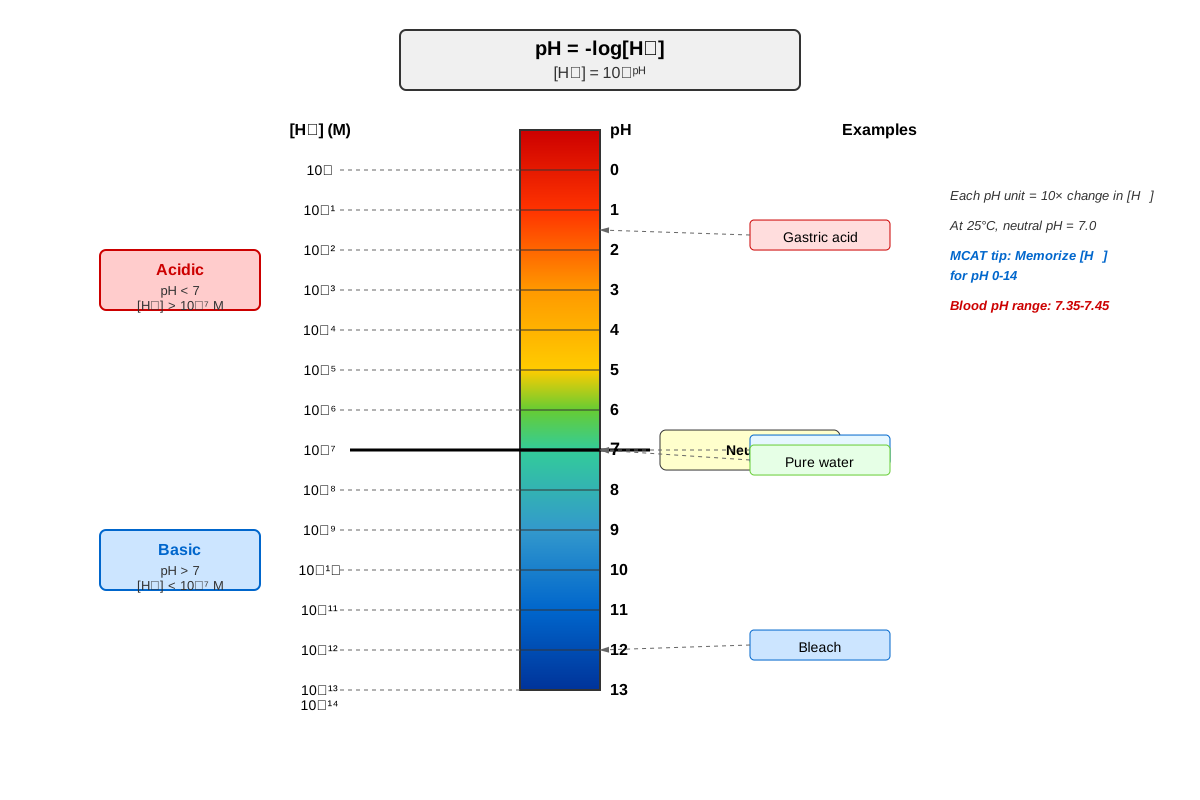
pH = -log₁₀[H⁺]This logarithmic scale compresses the wide range of possible hydrogen ion concentrations into a manageable numerical scale, typically ranging from 0 to 14 in aqueous solutions at 25°C. Each unit change in pH represents a tenfold change in hydrogen ion concentration. A solution with pH 3 has ten times more H⁺ ions than a solution with pH 4, and one hundred times more than a solution with pH 5.
The inverse relationship allows calculation of hydrogen ion concentration from pH:
[H⁺] = 10^(-pH)For example, a solution with pH 5.0 has [H⁺] = 10⁻⁵ M = 0.00001 M. This mathematical relationship is fundamental to all pH calculations and must be thoroughly internalized for rapid problem-solving on the MCAT.
The pH Scale and Solution Classification
The pH scale classifies aqueous solutions into three categories based on their relationship to neutral water:
| pH Range | Classification | [H⁺] vs [OH⁻] | Example |
|---|---|---|---|
| pH < 7 | Acidic | [H⁺] > [OH⁻] | Gastric juice (pH ~2) |
| pH = 7 | Neutral | [H⁺] = [OH⁻] | Pure water at 25°C |
| pH > 7 | Basic/Alkaline | [H⁺] < [OH⁻] | Blood (pH ~7.4) |
At 25°C, pure water has pH 7.0 because the autoionization equilibrium produces equal concentrations of H⁺ and OH⁻ ions (1.0 × 10⁻⁷ M each). This neutral point shifts with temperature because Kw is temperature-dependent, but MCAT problems typically assume 25°C unless otherwise stated.
The Relationship Between pH and pOH
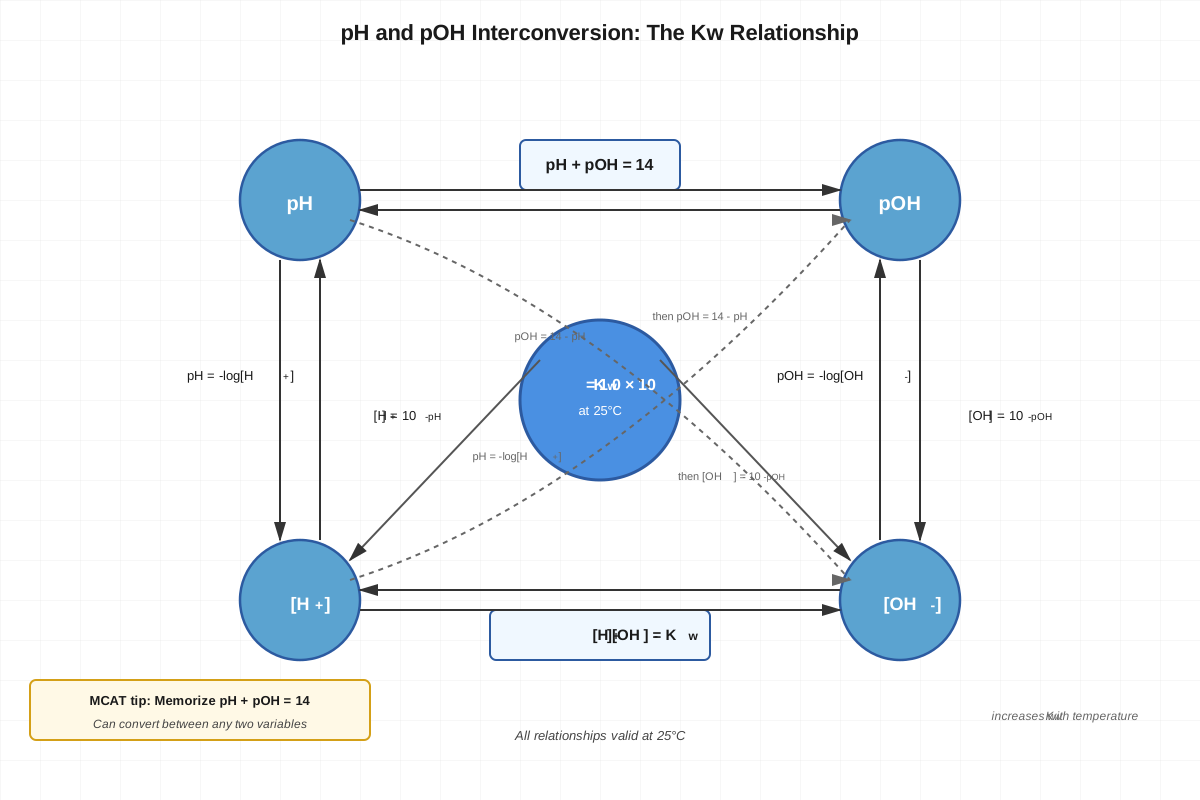
Just as pH quantifies hydrogen ion concentration, pOH quantifies hydroxide ion concentration:
pOH = -log₁₀[OH⁻]The water autoionization equilibrium constant at 25°C is:
Kw = [H⁺][OH⁻] = 1.0 × 10⁻¹⁴Taking the negative logarithm of both sides yields the fundamental relationship:
pH + pOH = 14.00This relationship allows interconversion between pH and pOH, which is particularly useful when working with basic solutions where hydroxide concentration is more readily available than hydrogen ion concentration. For example, if [OH⁻] = 1.0 × 10⁻³ M, then pOH = 3.00, and pH = 14.00 - 3.00 = 11.00.
Calculating pH for Strong Acids and Bases
Strong acids completely dissociate in aqueous solution, so the hydrogen ion concentration equals the initial acid concentration (assuming monoprotic acids):
For HCl, HBr, HI, HNO₃, H₂SO₄ (first proton), HClO₄:
[H⁺] = [acid]initial
pH = -log[acid]initial
Example: 0.01 M HCl solution has [H⁺] = 0.01 M = 1.0 × 10⁻² M, so pH = -log(10⁻²) = 2.00
Strong bases completely dissociate to produce hydroxide ions:
For NaOH, KOH, Ca(OH)₂, Ba(OH)₂:
[OH⁻] = n × [base]initialwhere n is the number of hydroxide ions per formula unit (1 for NaOH, 2 for Ca(OH)₂)
Example: 0.001 M NaOH solution has [OH⁻] = 0.001 M = 1.0 × 10⁻³ M, so pOH = 3.00 and pH = 11.00
pH Calculations Without a Calculator
MCAT test-takers must estimate pH values without a calculator. Key approximations include:
- log(1) = 0
- log(10) = 1
- log(2) ≈ 0.3
- log(3) ≈ 0.5
- log(5) ≈ 0.7
For concentrations between powers of 10, interpolate: a solution with [H⁺] = 3 × 10⁻⁵ M has pH between 4 and 5, closer to 5 (approximately 4.5).
When [H⁺] = 2 × 10⁻⁴ M:
pH = -log(2 × 10⁻⁴) = -log(2) - log(10⁻⁴) = -0.3 - (-4) = 4 - 0.3 = 3.7
pH of Weak Acids and Bases
Weak acids and bases only partially dissociate, requiring equilibrium calculations. For a weak acid HA with acid dissociation constant Ka:
Ka = [H⁺][A⁻]/[HA]When the initial concentration C is much larger than Ka (typically C/Ka > 100), the approximation [H⁺] ≈ √(Ka × C) applies:
pH ≈ ½(pKa - log C)For weak bases, the analogous relationship uses Kb:
pOH ≈ ½(pKb - log C)
pH = 14 - pOH
These approximations allow rapid estimation of pH for weak acid and base solutions, which is essential for time-efficient MCAT problem-solving.
The Henderson-Hasselbalch Equation
When both a weak acid and its conjugate base are present (buffer solutions), the Henderson-Hasselbalch equation provides pH:
pH = pKa + log([A⁻]/[HA])This equation is crucial for buffer problems and appears frequently on the MCAT. When [A⁻] = [HA], the log term equals zero and pH = pKa. This represents the optimal buffering point where the buffer has maximum capacity to resist pH changes.
pH and Biological Systems
Physiological pH regulation involves multiple buffer systems, primarily the bicarbonate buffer (H₂CO₃/HCO₃⁻) in blood. The pH of blood (7.35-7.45) is maintained through respiratory control of CO₂ and renal regulation of bicarbonate. Acidosis (pH < 7.35) and alkalosis (pH > 7.45) represent dangerous conditions that appear in MCAT passages.
Enzyme activity depends critically on pH because ionizable amino acid residues in the active site must maintain specific protonation states. Most enzymes have optimal activity within narrow pH ranges, and pH-activity curves frequently appear in MCAT biochemistry passages.
Protein structure depends on pH through the ionization states of acidic (Asp, Glu) and basic (Lys, Arg, His) amino acids. At the isoelectric point (pI), a protein has no net charge, which affects solubility and electrophoretic mobility—concepts that appear in biochemistry passages involving protein purification.
Concept Relationships
The pH concept forms a central node connecting multiple areas of General Chemistry and biochemistry. The mathematical definition of pH (pH = -log[H⁺]) builds directly on logarithmic functions and connects to the parallel concept of pOH through the water autoionization constant Kw. This relationship (pH + pOH = 14) enables bidirectional conversion between measures of acidity and basicity.
pH calculations for strong acids and bases → lead to → understanding of complete dissociation → which contrasts with → weak acid/base equilibria → requiring → Ka and Kb equilibrium constants → which connect to → pKa and pKb values → enabling → Henderson-Hasselbalch equation applications → essential for → buffer system analysis.
The pH concept extends beyond General Chemistry into biochemistry through enzyme kinetics (pH affects reaction rates), protein chemistry (pH determines charge state and solubility), and metabolic regulation (pH influences pathway flux). In physiology, pH connects to respiratory function (CO₂ elimination), renal function (H⁺ and HCO₃⁻ regulation), and metabolic disorders (acidosis and alkalosis).
Understanding pH enables mastery of titration curves, where pH changes as acid or base is added, revealing equivalence points and buffer regions. pH also affects solubility equilibria (through the common ion effect and pH-dependent solubility), electrochemistry (through the Nernst equation), and organic reaction mechanisms (where pH determines protonation states of reactants and intermediates).
High-Yield Facts
⭐ pH is defined as -log[H⁺], meaning each unit decrease in pH represents a tenfold increase in hydrogen ion concentration
⭐ At 25°C, pH + pOH = 14.00, allowing rapid interconversion between measures of acidity and basicity
⭐ For strong acids, pH = -log[acid]; for strong bases, calculate pOH from [OH⁻], then use pH = 14 - pOH
⭐ The Henderson-Hasselbalch equation (pH = pKa + log([A⁻]/[HA])) applies to buffer solutions and shows that pH = pKa when [acid] = [conjugate base]
⭐ Blood pH must remain between 7.35-7.45; values outside this range indicate acidosis or alkalosis
- For weak acids with C >> Ka, use the approximation [H⁺] ≈ √(Ka × C) to estimate pH quickly
- The pH scale typically ranges from 0-14 in aqueous solutions, but values outside this range are possible for very concentrated acids or bases
- Neutral pH equals 7.0 only at 25°C; the neutral point shifts with temperature because Kw is temperature-dependent
- Polyprotic acids have multiple pKa values corresponding to sequential proton dissociations
- The isoelectric point (pI) of amino acids and proteins is the pH at which the molecule has zero net charge
- Enzyme activity typically shows a bell-shaped curve when plotted against pH, with maximum activity at the optimal pH
- Gastric juice has pH ~2, saliva has pH ~6.5-7.5, and pancreatic secretions have pH ~8, reflecting their different physiological functions
- pH indicators are weak acids or bases that change color at specific pH ranges, useful for visualizing pH changes during titrations
Quick check — test yourself on pH so far.
Try Flashcards →Common Misconceptions
Misconception: pH and pOH are independent variables that can be set arbitrarily.
Correction: pH and pOH are linked through the relationship pH + pOH = 14 (at 25°C). Changing one automatically changes the other because they both derive from the constant product Kw = [H⁺][OH⁻] = 1.0 × 10⁻¹⁴.
Misconception: A solution with pH 2 is twice as acidic as a solution with pH 4.
Correction: Because pH is a logarithmic scale, a solution with pH 2 has 100 times more hydrogen ions than a solution with pH 4 (10² = 100). Each unit change represents a tenfold difference in [H⁺].
Misconception: Adding water to an acidic solution always increases pH toward 7.
Correction: While dilution does increase pH (decreases [H⁺]), the pH approaches but never exceeds 7 when diluting an acidic solution. Similarly, diluting a basic solution decreases pH but never below 7. Dilution moves pH toward neutrality but cannot cross it.
Misconception: Strong acids always have low pH values (0-3), and weak acids always have moderate pH values (4-6).
Correction: pH depends on both acid strength (Ka) and concentration. A very dilute strong acid can have pH 5 or 6, while a concentrated weak acid might have pH 2 or 3. Acid strength determines the degree of dissociation, but concentration determines the absolute amount of H⁺ produced.
Misconception: The Henderson-Hasselbalch equation applies to all acid-base systems.
Correction: The Henderson-Hasselbalch equation specifically applies to buffer solutions containing both a weak acid and its conjugate base (or a weak base and its conjugate acid). It does not apply to strong acids, strong bases, or solutions containing only a weak acid or weak base without its conjugate partner.
Misconception: pH 7 is always neutral regardless of temperature.
Correction: Neutral pH (where [H⁺] = [OH⁻]) equals 7.0 only at 25°C. At higher temperatures, Kw increases, so neutral pH decreases (becomes less than 7). At lower temperatures, neutral pH increases (becomes greater than 7). However, MCAT problems typically assume 25°C unless stated otherwise.
Misconception: Mixing equal volumes of pH 3 and pH 5 solutions gives pH 4.
Correction: pH values cannot be averaged arithmetically because pH is logarithmic. The resulting pH depends on the actual [H⁺] concentrations. Mixing equal volumes of 10⁻³ M and 10⁻⁵ M H⁺ gives (10⁻³ + 10⁻⁵)/2 ≈ 5 × 10⁻⁴ M, which has pH ≈ 3.3, not 4.
Worked Examples
Example 1: Multi-Step pH Calculation for a Strong Base
Problem: Calculate the pH of a solution prepared by dissolving 0.74 g of Ca(OH)₂ (molar mass = 74 g/mol) in water to make 500 mL of solution.
Solution:
Step 1: Calculate moles of Ca(OH)₂
moles = mass/molar mass = 0.74 g / 74 g/mol = 0.01 molStep 2: Calculate molarity of Ca(OH)₂
M = moles/volume(L) = 0.01 mol / 0.5 L = 0.02 MStep 3: Determine [OH⁻]
Ca(OH)₂ is a strong base that completely dissociates: Ca(OH)₂ → Ca²⁺ + 2OH⁻
Each mole of Ca(OH)₂ produces 2 moles of OH⁻
[OH⁻] = 2 × 0.02 M = 0.04 M = 4 × 10⁻² MStep 4: Calculate pOH
pOH = -log[OH⁻] = -log(4 × 10⁻²)
pOH = -log(4) - log(10⁻²) = -0.6 - (-2) = 2 - 0.6 = 1.4
Step 5: Calculate pH
pH = 14.00 - pOH = 14.00 - 1.4 = 12.6Key Learning Points: This problem integrates stoichiometry, molarity calculations, and pH concepts. Remember that polyhydroxy bases produce multiple OH⁻ ions per formula unit. The high pH (>12) confirms this is a strongly basic solution. This type of multi-step problem frequently appears on the MCAT, testing both computational skills and conceptual understanding.
Example 2: Buffer System Analysis Using Henderson-Hasselbalch
Problem: A buffer solution contains 0.15 M acetic acid (CH₃COOH, pKa = 4.76) and 0.30 M sodium acetate (CH₃COONa). (a) Calculate the pH of this buffer. (b) Qualitatively predict how the pH changes if a small amount of HCl is added.
Solution:
Part (a): Calculate buffer pH
Step 1: Identify the conjugate acid-base pair
Acetic acid (CH₃COOH) is the weak acid [HA]
Acetate ion (CH₃COO⁻) is the conjugate base [A⁻]
Step 2: Apply the Henderson-Hasselbalch equation
pH = pKa + log([A⁻]/[HA])
pH = 4.76 + log(0.30/0.15)
pH = 4.76 + log(2)
pH = 4.76 + 0.3 = 5.06
Part (b): Predict pH change upon HCl addition
When HCl (a strong acid) is added to the buffer:
- H⁺ from HCl reacts with acetate ion: CH₃COO⁻ + H⁺ → CH₃COOH
- This consumes some conjugate base and produces more weak acid
- The ratio [A⁻]/[HA] decreases, making the log term more negative
- Therefore, pH decreases slightly, but the buffer resists large pH changes
The buffer capacity is greatest when [A⁻] = [HA] (pH = pKa). In this problem, [A⁻] = 2[HA], so the buffer is reasonably effective but has more capacity to neutralize added acid than added base.
Key Learning Points: The Henderson-Hasselbalch equation is essential for buffer problems. Notice that doubling the concentration ratio ([A⁻]/[HA] = 2) adds log(2) ≈ 0.3 to the pKa. Understanding buffer mechanism (conjugate base neutralizes added acid; weak acid neutralizes added base) allows qualitative prediction of pH changes. MCAT passages often present enzyme activity or biological processes occurring in buffered solutions, requiring this type of analysis.
Exam Strategy
Approaching pH Questions on the MCAT
When encountering pH problems, first classify the system: Is it a strong acid, strong base, weak acid, weak base, or buffer? This classification determines which equations and approximations apply. For strong acids and bases, use direct calculations (pH = -log[H⁺] or pH = 14 - pOH). For weak acids and bases, check whether the approximation C/Ka > 100 holds; if so, use √(Ka × C). For buffers, immediately think Henderson-Hasselbalch.
Trigger Words and Phrases
Watch for these high-yield terms that signal specific approaches:
- "Strong acid/base": Complete dissociation; [H⁺] = [acid] or [OH⁻] = [base]
- "Buffer," "conjugate acid-base pair": Henderson-Hasselbalch equation
- "Weak acid/base": Equilibrium calculation or square root approximation
- "Dilution": pH moves toward 7 but cannot cross it
- "Equivalence point": In titrations, moles acid = moles base; pH depends on the salt formed
- "Half-equivalence point": pH = pKa for weak acid titrations
- "Physiological pH," "blood pH": Expect pH ≈ 7.4; questions about acidosis/alkalosis
- "Optimal pH," "enzyme activity": pH affects protonation states in active sites
Process of Elimination Tips
For conceptual pH questions, eliminate answers that violate fundamental principles:
- Acidic solutions must have pH < 7; basic solutions must have pH > 7
- Diluting an acid cannot produce a basic solution (pH cannot exceed 7)
- Adding acid to a solution cannot increase pH; adding base cannot decrease pH
- pH values outside 0-14 are rare in aqueous solutions at standard concentrations
- When comparing acids of equal concentration, the stronger acid (larger Ka, smaller pKa) has lower pH
For calculation questions, estimate the answer before looking at choices:
- Round concentrations to the nearest power of 10 for quick pH estimation
- Use benchmark values: [H⁺] = 10⁻⁷ M gives pH 7; [H⁺] = 10⁻³ M gives pH 3
- Eliminate answers that differ by more than 1-2 pH units from your estimate
Time Allocation
Simple pH calculations (strong acids/bases) should take 30-45 seconds. Buffer problems using Henderson-Hasselbalch require 60-90 seconds. Complex multi-step problems involving dilutions or mixing solutions may require 2-3 minutes. If a calculation becomes too complex, consider whether a qualitative approach or estimation would suffice. The MCAT rewards efficient problem-solving; perfect precision is rarely necessary when answer choices are well-separated.
Memory Techniques
Mnemonics for pH Relationships
"Please Help Our Homework" for pH + pOH = 14
- Please = pH
- Help = H⁺ (hydrogen)
- Our = OH⁻ (hydroxide)
- Homework = 14 (the sum)
"Strong Acids Can't Hold Ions" for the six common strong acids:
- HCl (hydrochloric acid)
- HBr (hydrobromic acid)
- HI (hydroiodic acid)
- HNO₃ (nitric acid)
- H₂SO₄ (sulfuric acid, first proton)
- HClO₄ (perchloric acid)
Visualization Strategy for pH Scale
Visualize the pH scale as a number line from 0 to 14 with key reference points:
- 0-2: Strong acids, gastric juice (pH ~2)
- 3-6: Weak acids, coffee (pH ~5), rain (pH ~5.6)
- 7: Neutral, pure water
- 8-10: Weak bases, baking soda solution (pH ~8.3)
- 11-14: Strong bases, bleach (pH ~12.5)
Mentally place biological fluids on this scale: blood (7.4), saliva (6.5-7.5), urine (4.5-8.0), pancreatic juice (8.0). This contextualizes pH values and helps with passage-based questions.
Acronym for Buffer Calculations
HH = Happy Helpers for Henderson-Hasselbalch equation components:
- HH = Henderson-Hasselbalch
- Happy = pH (what you're solving for)
- Helpers = pKa and log([A⁻]/[HA]) (what helps you solve it)
Remember: When [A⁻] = [HA], the log term = 0, so pH = pKa (the buffer's "happy place" with maximum capacity).
Mathematical Approximations Rhyme
"Log of two is point three,
Log of three is point five, you see,
Log of five is point seven, it's true,
These approximations will help you through!"
This rhyme encodes the essential logarithm approximations for calculator-free pH estimation on the MCAT.
Summary
The pH concept represents a cornerstone of General Chemistry and biochemistry on the MCAT, quantifying hydrogen ion concentration through the relationship pH = -log[H⁺]. Mastery requires understanding the logarithmic nature of the pH scale, where each unit represents a tenfold change in [H⁺], and the complementary relationship pH + pOH = 14 that enables interconversion between acidity and basicity measures. Strong acids and bases undergo complete dissociation, allowing direct calculation of pH from concentration, while weak acids and bases require equilibrium analysis or approximations. Buffer solutions containing conjugate acid-base pairs resist pH changes and are analyzed using the Henderson-Hasselbalch equation (pH = pKa + log([A⁻]/[HA])). Biological systems maintain tight pH control, with blood pH of 7.35-7.45 being essential for survival, and enzyme activity depending critically on pH through effects on active site ionization. MCAT questions test both computational skills (calculating pH from various starting information) and conceptual understanding (predicting pH changes, interpreting physiological pH regulation, analyzing buffer behavior). Success requires facility with logarithmic calculations, recognition of problem types, and integration of pH concepts with broader acid-base chemistry, biochemistry, and physiology.
Key Takeaways
- pH = -log[H⁺] defines the pH scale; each unit change represents a tenfold change in hydrogen ion concentration, making pH a logarithmic measure of acidity
- pH + pOH = 14 at 25°C enables rapid interconversion between measures of acidity and basicity through the water autoionization constant Kw
- Strong acids and bases completely dissociate, allowing direct pH calculation, while weak acids and bases require equilibrium analysis or approximations
- The Henderson-Hasselbalch equation (pH = pKa + log([A⁻]/[HA])) is essential for buffer problems and shows that optimal buffering occurs when pH = pKa
- Physiological pH regulation (blood pH 7.35-7.45) and enzyme pH-activity relationships appear frequently in MCAT passages, connecting chemistry to biology
- Calculator-free estimation using logarithm approximations (log 2 ≈ 0.3, log 5 ≈ 0.7) and rounding to powers of 10 enables efficient problem-solving
- pH affects protein charge, solubility, and structure through ionization of acidic and basic amino acid residues, connecting to biochemistry topics
Related Topics
Buffer Systems and Capacity: Building on pH fundamentals, buffer systems resist pH changes through conjugate acid-base pairs. Understanding buffer capacity, the Henderson-Hasselbalch equation in depth, and buffer preparation connects directly to pH mastery and appears in both General Chemistry and biochemistry contexts.
Acid-Base Titrations: Titration curves plot pH versus volume of titrant added, revealing equivalence points, buffer regions, and pKa values. Mastering pH enables interpretation of titration curves and prediction of pH at various points during titration.
Amino Acid Chemistry and Protein Structure: The ionization states of amino acids depend on pH relative to their pKa values. Understanding pH enables prediction of amino acid charge, calculation of isoelectric points, and comprehension of pH effects on protein folding and stability.
Enzyme Kinetics: Enzyme activity depends on pH through effects on active site ionization and substrate binding. pH-activity curves and optimal pH values appear frequently in biochemistry passages, requiring integration of pH concepts with enzyme mechanism.
Physiological Acid-Base Balance: Respiratory and metabolic regulation of blood pH involves the bicarbonate buffer system, CO₂ elimination, and renal H⁺/HCO₃⁻ handling. Understanding pH enables interpretation of blood gas data and analysis of acidosis/alkalosis scenarios.
Solubility Equilibria: pH affects the solubility of salts containing basic anions (like carbonates or phosphates) through the common ion effect and pH-dependent equilibria. This connects pH to solubility product constants (Ksp) and precipitation reactions.
Practice CTA
Now that you have thoroughly reviewed the pH concept, reinforce your understanding by attempting practice questions and flashcards. Focus on both computational problems (calculating pH from various starting information) and conceptual questions (predicting pH changes, analyzing buffer behavior, interpreting physiological scenarios). Time yourself to build speed and efficiency. Review any mistakes carefully to identify gaps in understanding or calculation errors. Remember that pH mastery requires both mathematical facility and deep conceptual comprehension—practice both types of problems to achieve the balanced skill set needed for MCAT success. Your investment in mastering this high-yield topic will pay dividends across multiple sections of the exam!
Sign up free to keep reading
Create a free AnvayaPrep account to finish this MCAT guide on pH — plus flashcards and practice questions.