Overview
Strong acids represent one of the most fundamental and high-yield topics within General Chemistry for the MCAT. These substances completely dissociate in aqueous solution, releasing all available protons (H⁺ ions) to the surrounding water molecules. Understanding strong acids is essential not only for mastering acid-base chemistry but also for predicting pH values, understanding buffer systems, and analyzing biological processes that depend on proton transfer. The MCAT frequently tests strong acids through direct recall questions, pH calculations, and complex passage-based scenarios involving physiological systems.
The behavior of strong acids contrasts sharply with weak acids, which only partially dissociate in solution. This distinction forms the foundation for understanding acid strength, equilibrium constants, and the quantitative aspects of Acids and Bases chemistry. On the MCAT, students must rapidly identify strong acids, predict their behavior in solution, and apply this knowledge to calculate pH, determine reaction products, and analyze titration curves. The topic appears across multiple contexts, from straightforward General Chemistry questions to biochemistry passages involving gastric acid secretion and metabolic processes.
Mastery of strong acids connects directly to broader General Chemistry concepts including equilibrium, thermodynamics, electrochemistry, and solution chemistry. The complete dissociation of strong acids represents a special case where equilibrium lies so far to the right that it can be treated as irreversible. This simplification allows for straightforward pH calculations but requires students to recognize when this approximation applies versus when weak acid equilibrium expressions are necessary. The topic also bridges to organic chemistry (understanding carboxylic acid strength) and biochemistry (amino acid ionization states), making it a cornerstone concept for the entire MCAT science section.
Learning Objectives
- [ ] Define Strong acids using accurate General Chemistry terminology
- [ ] Explain why Strong acids matters for the MCAT
- [ ] Apply Strong acids to exam-style questions
- [ ] Identify common mistakes related to Strong acids
- [ ] Connect Strong acids to related General Chemistry concepts
- [ ] Memorize all six common strong acids and recognize them instantly in any chemical context
- [ ] Calculate pH values for strong acid solutions with and without dilution
- [ ] Distinguish between strong and weak acids based on molecular structure and dissociation behavior
- [ ] Predict the products and equilibrium position of reactions involving strong acids
Prerequisites
- Molarity and solution concentration: Essential for calculating the concentration of H⁺ ions released by strong acids and determining pH values
- Logarithms and pH scale: Required to convert between H⁺ concentration and pH using the relationship pH = -log[H⁺]
- Chemical equilibrium fundamentals: Provides context for understanding why strong acids represent the extreme case where K_a >> 1
- Bronsted-Lowry acid-base theory: Necessary to understand proton transfer and the definition of acids as proton donors
- Stoichiometry: Needed to determine the molar relationships in strong acid dissociation and neutralization reactions
Why This Topic Matters
Strong acids appear frequently on the MCAT, with acid-base chemistry comprising approximately 10-15% of General Chemistry questions. The topic appears in multiple question formats: discrete questions testing direct recall of strong acids, calculation-based problems requiring pH determination, and passage-based questions embedded in biological or chemical contexts. Understanding strong acids is particularly crucial for Chemical and Physical Foundations of Biological Systems passages that discuss gastric physiology, where hydrochloric acid (HCl) plays a central role in digestion and pathology.
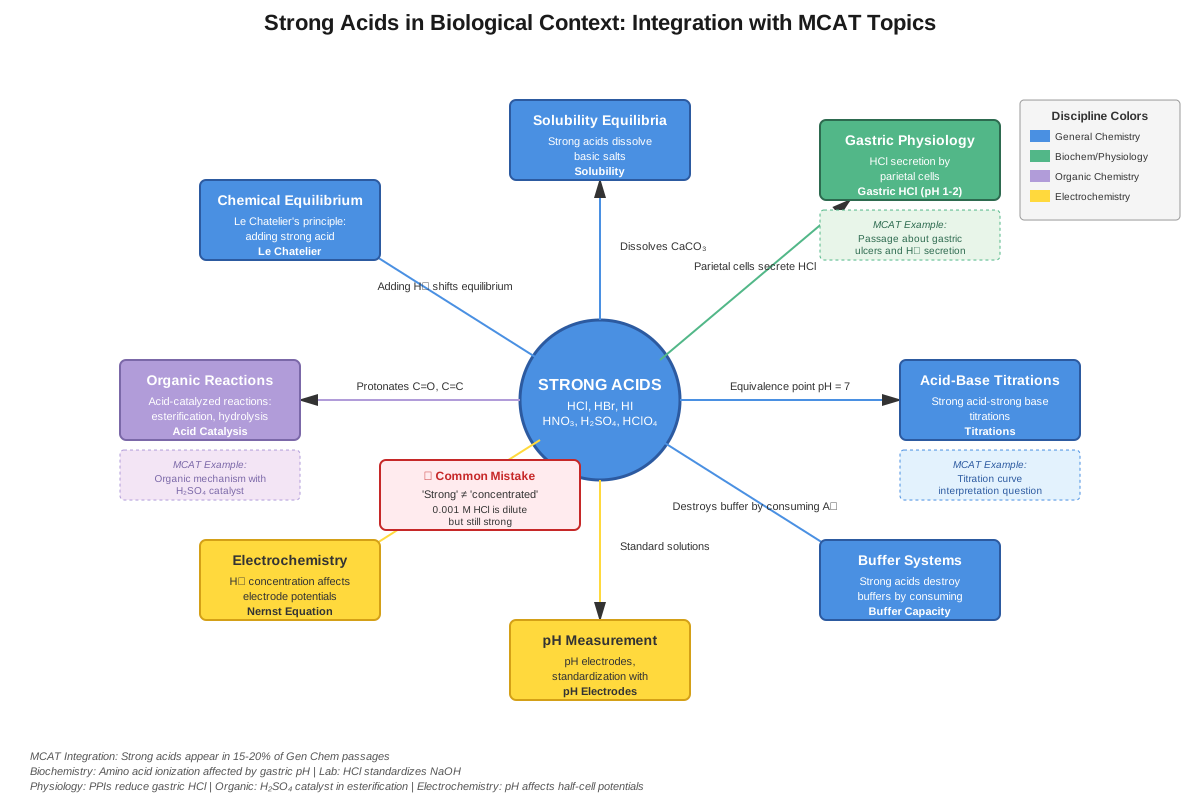
Clinically, strong acids are relevant to numerous physiological and pathological processes. Gastric acid secretion involves HCl production by parietal cells, and disorders like gastroesophageal reflux disease (GERD) and peptic ulcers directly involve strong acid chemistry. Metabolic acidosis can involve the accumulation of strong acids in blood, affecting pH homeostasis. Industrial and laboratory safety also depends on understanding strong acid behavior, as these substances cause severe chemical burns and require specific handling protocols.
The MCAT commonly presents strong acids in titration scenarios, buffer preparation passages, and questions about acid-base indicators. Students must recognize strong acids instantly to determine whether to use simple dissociation calculations or more complex equilibrium expressions. Passages may describe experimental procedures involving strong acids without explicitly stating "this is a strong acid," requiring students to identify them from chemical formulas. The ability to quickly categorize an acid as strong or weak often determines whether a student can efficiently solve a problem within the time constraints of the exam.
Core Concepts
Definition and Fundamental Properties
Strong acids are acids that undergo complete (or essentially complete) dissociation in aqueous solution, meaning they donate virtually all of their available protons to water molecules. When a strong acid HA dissolves in water, the reaction HA + H₂O → H₃O⁺ + A⁻ proceeds essentially to completion, with the equilibrium lying so far to the right that the reverse reaction is negligible. This complete dissociation distinguishes strong acids from weak acids, which establish equilibrium with significant amounts of undissociated acid remaining in solution.
The acid dissociation constant (K_a) for strong acids is extremely large (K_a >> 1), typically greater than 10³. Because the dissociation is complete, the concentration of H⁺ ions (or H₃O⁺, the hydronium ion) in solution equals the initial concentration of the strong acid. This one-to-one relationship simplifies pH calculations significantly compared to weak acids, which require equilibrium expressions and often quadratic equations.
The Six Common Strong Acids
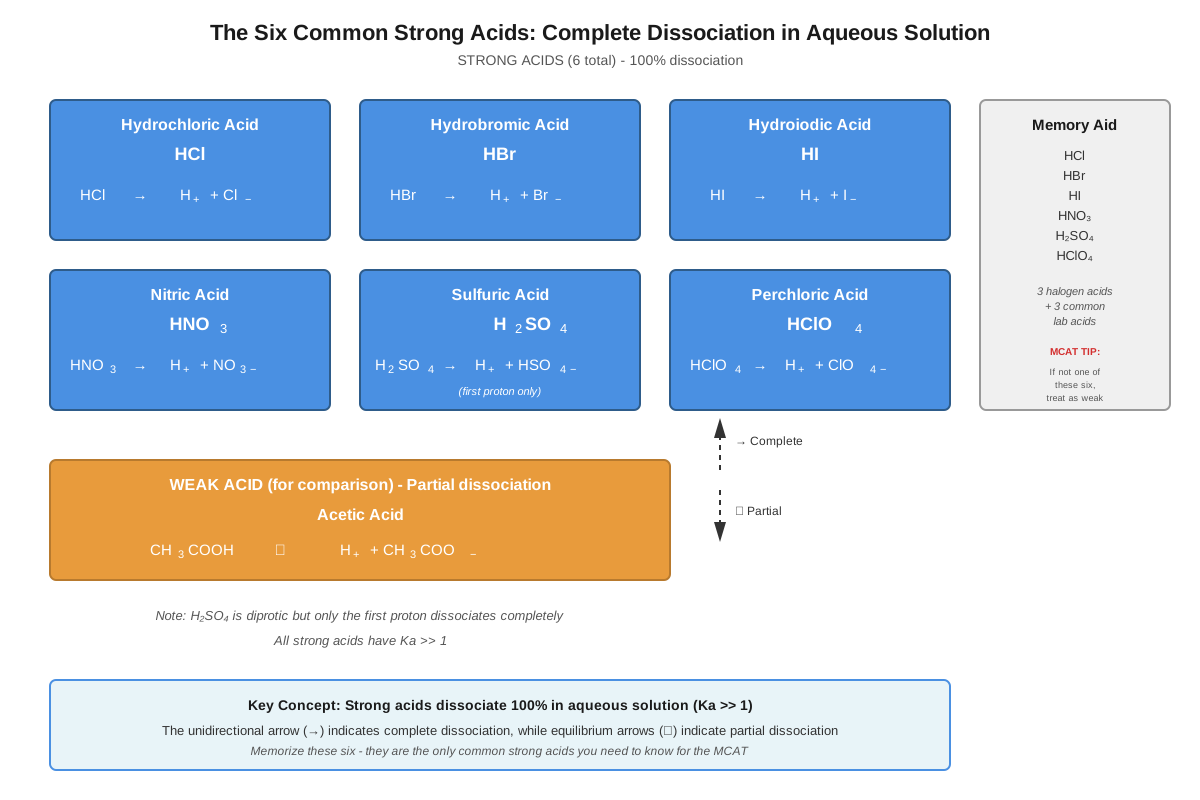
For the MCAT, students must memorize six common strong acids. These appear repeatedly on the exam, and instant recognition is essential:
| Strong Acid | Formula | Conjugate Base | Common Use/Context |
|---|---|---|---|
| Hydrochloric acid | HCl | Cl⁻ | Gastric acid, laboratory reagent |
| Hydrobromic acid | HBr | Br⁻ | Laboratory reagent |
| Hydroiodic acid | HI | I⁻ | Laboratory reagent |
| Nitric acid | HNO₃ | NO₃⁻ | Industrial processes, oxidizing agent |
| Sulfuric acid | H₂SO₄ | HSO₄⁻ (first proton only) | Battery acid, industrial processes |
| Perchloric acid | HClO₄ | ClO₄⁻ | Laboratory reagent, strongest common acid |
Note that sulfuric acid is unique among these six because it is diprotic (has two protons to donate). The first proton dissociates completely (making H₂SO₄ a strong acid), but the second proton from HSO₄⁻ dissociates only partially (making HSO₄⁻ a weak acid). For MCAT purposes, when calculating pH of dilute sulfuric acid solutions, students typically consider only the first dissociation unless specifically directed otherwise.
Complete Dissociation and pH Calculations
The complete dissociation of strong acids enables straightforward pH calculations. For a monoprotic strong acid at concentration C:
HA → H⁺ + A⁻
[H⁺] = C (initial concentration of acid)
pH = -log[H⁺] = -log(C)
For example, a 0.01 M HCl solution has [H⁺] = 0.01 M = 10⁻² M, giving pH = -log(10⁻²) = 2. This direct relationship holds for all concentrations where the acid concentration significantly exceeds the autoionization of water (generally above 10⁻⁶ M).
At very low concentrations (below 10⁻⁶ M), the autoionization of water (which produces 10⁻⁷ M H⁺) becomes significant and must be included in calculations. For a 10⁻⁸ M HCl solution, the total [H⁺] ≈ 10⁻⁷ M (from water) + 10⁻⁸ M (from HCl) ≈ 1.1 × 10⁻⁷ M, giving pH ≈ 6.96, not 8 as would be calculated ignoring water's contribution.
Molecular Structure and Acid Strength
The strength of binary acids (H-X) increases with increasing stability of the conjugate base (X⁻). Two factors determine conjugate base stability:
- Bond strength: Weaker H-X bonds release protons more easily. Down a group in the periodic table, bond strength decreases, so acid strength increases: HF < HCl < HBr < HI. This explains why HCl, HBr, and HI are strong acids while HF is weak.
- Atom size and charge distribution: Larger atoms better stabilize negative charge through charge dispersal. The larger halide ions (Cl⁻, Br⁻, I⁻) are more stable than the smaller F⁻, making their parent acids stronger.
For oxyacids (acids containing oxygen), acid strength increases with:
- More oxygen atoms bonded to the central atom (more electronegative environment)
- Higher electronegativity of the central atom
- Higher oxidation state of the central atom
This explains why HClO₄ (perchloric acid, with four oxygens) is an extremely strong acid, while HClO (hypochlorous acid, with one oxygen) is weak.
Strong Acids in Reactions
Strong acids participate in several important reaction types on the MCAT:
Neutralization reactions: Strong acids react with bases to form water and a salt. With strong bases, these reactions go to completion:
HCl + NaOH → NaCl + H₂OProtonation reactions: Strong acids can protonate weak bases, including organic compounds with lone pairs (amines, alcohols, carbonyls):
HCl + NH₃ → NH₄⁺ + Cl⁻Metal displacement reactions: Strong acids react with active metals to produce hydrogen gas:
2HCl + Zn → ZnCl₂ + H₂(g)Precipitation reactions: When strong acids provide anions that form insoluble salts with certain cations, precipitation occurs, though this is less common than with weak acids.
Leveling Effect
In aqueous solution, all strong acids appear equally strong because water acts as a leveling solvent. Any acid stronger than H₃O⁺ will completely protonate water, producing H₃O⁺ as the strongest acid that can exist in water. This means that while HClO₄ is intrinsically stronger than HCl, both appear equally strong in water because both completely dissociate. The leveling effect explains why we cannot distinguish between strong acids in aqueous solution—they all produce the same acidic species (H₃O⁺) at concentrations equal to the original acid concentration.
Concept Relationships
The concept of strong acids connects hierarchically to broader acid-base theory. Bronsted-Lowry acid-base theory defines acids as proton donors, and strong acids represent the extreme case of complete proton donation. This leads to the concept of conjugate acid-base pairs, where strong acids have extremely weak conjugate bases (Cl⁻, NO₃⁻, etc.) that have virtually no tendency to accept protons back.
Strong acid behavior contrasts directly with weak acids, which establish equilibrium with significant undissociated acid present. This distinction determines which calculation method to use: direct concentration-to-pH conversion for strong acids versus equilibrium expressions (Ka calculations) for weak acids. Understanding this difference is crucial for buffer systems, which require weak acids and cannot be created with strong acids because complete dissociation prevents the equilibrium necessary for buffering.
The relationship flows as follows:
Acid-base definitions → Strong vs. weak acid classification → Dissociation behavior → pH calculations → Titration curves → Buffer capacity
Strong acids also connect to electrochemistry through the standard hydrogen electrode, which uses H⁺ ions in solution. They relate to thermodynamics through the large negative ΔG° for their dissociation reactions, and to kinetics through the rapid, essentially instantaneous dissociation process. In organic chemistry, understanding strong acids helps predict reaction mechanisms, particularly protonation steps that activate molecules for nucleophilic attack.
Quick check — test yourself on Strong acids so far.
Try Flashcards →High-Yield Facts
⭐ The six common strong acids are HCl, HBr, HI, HNO₃, H₂SO₄ (first proton only), and HClO₄—memorize this list for instant recognition on the MCAT.
⭐ For strong acids, [H⁺] = initial acid concentration (assuming monoprotic and concentration > 10⁻⁶ M), allowing direct pH calculation without equilibrium expressions.
⭐ Strong acids have extremely weak conjugate bases that do not affect solution pH or participate in buffering.
⭐ pH of a 10⁻ⁿ M strong acid solution is approximately n (e.g., 10⁻³ M HCl has pH ≈ 3), valid for concentrations above 10⁻⁶ M.
⭐ Sulfuric acid is diprotic but only the first proton dissociates completely; HSO₄⁻ is a weak acid with Ka₂ ≈ 10⁻².
- Strong acids cannot form buffer solutions because they lack the equilibrium between HA and A⁻ necessary for buffering action.
- The leveling effect in water makes all strong acids appear equally strong because they all completely protonate water to form H₃O⁺.
- Diluting a strong acid by a factor of 10 increases pH by 1 unit (e.g., diluting 0.1 M HCl to 0.01 M changes pH from 1 to 2).
- At very low concentrations (< 10⁻⁶ M), water autoionization contributes significantly to [H⁺], and pH approaches 7 rather than exceeding it.
- Strong acid-strong base titrations have equivalence points at pH 7 because neither the conjugate acid nor conjugate base affects pH.
- Perchloric acid (HClO₄) is the strongest common acid due to maximum oxygen stabilization of the conjugate base.
- Hydrofluoric acid (HF) is NOT a strong acid despite being a halogen acid; it is weak due to strong H-F bond and small F⁻ size.
Common Misconceptions
Misconception: All acids containing halogens are strong acids.
Correction: Only HCl, HBr, and HI are strong acids. HF is a weak acid due to the strong H-F bond and poor stabilization of the small F⁻ ion. The acid strength of binary acids increases down the halogen group as bond strength decreases and anion size increases.
Misconception: Strong acids can form buffer solutions if mixed with their conjugate bases.
Correction: Strong acids cannot form buffers because they dissociate completely, leaving no significant concentration of undissociated acid (HA) to establish the HA/A⁻ equilibrium required for buffering. Buffers require weak acids with appreciable amounts of both HA and A⁻ present simultaneously.
Misconception: The pH of a 10⁻⁸ M HCl solution is 8.
Correction: At very low strong acid concentrations (below ~10⁻⁶ M), water's autoionization contributes significantly to [H⁺]. For 10⁻⁸ M HCl, the total [H⁺] ≈ 10⁻⁷ M (from water) + 10⁻⁸ M (from HCl) ≈ 1.1 × 10⁻⁷ M, giving pH ≈ 6.96. The solution remains slightly acidic, not basic.
Misconception: Both protons in H₂SO₄ dissociate completely, so 0.1 M H₂SO₄ produces 0.2 M H⁺.
Correction: Only the first proton of sulfuric acid dissociates completely. The second dissociation (HSO₄⁻ → H⁺ + SO₄²⁻) is incomplete with Ka₂ ≈ 10⁻², making HSO₄⁻ a weak acid. For most MCAT calculations, 0.1 M H₂SO₄ produces approximately 0.1 M H⁺ unless the problem specifically addresses the second dissociation.
Misconception: Strong acids are defined by having pH < 3.
Correction: Strong acids are defined by their complete dissociation in water, not by a specific pH value. A 10⁻⁵ M HCl solution (pH = 5) is still a strong acid because it dissociates completely; the pH is moderate only because the concentration is low. Acid strength refers to the extent of dissociation, not the pH of a particular solution.
Misconception: Adding a strong acid to water always significantly lowers the pH.
Correction: The pH change depends on the amount of strong acid added. Adding a tiny amount of strong acid to a large volume of water may produce a negligible pH change. Additionally, if the water contains a buffer system, the pH change will be minimized by the buffer's resistance to pH change.
Worked Examples
Example 1: pH Calculation with Dilution
Problem: A laboratory technician prepares a stock solution of 0.5 M HCl. She then takes 10 mL of this stock solution and dilutes it to a final volume of 500 mL. What is the pH of the diluted solution?
Solution:
Step 1: Identify that HCl is a strong acid that dissociates completely.
Step 2: Calculate the concentration after dilution using the dilution equation:
M₁V₁ = M₂V₂
(0.5 M)(10 mL) = M₂(500 mL)
M₂ = (0.5 M × 10 mL) / 500 mL = 0.01 M
Step 3: For a strong acid, [H⁺] = concentration of acid:
[H⁺] = 0.01 M = 10⁻² MStep 4: Calculate pH:
pH = -log[H⁺] = -log(10⁻²) = 2Answer: The pH of the diluted solution is 2.
Connection to learning objectives: This problem applies strong acid concepts to a practical calculation, demonstrating complete dissociation and the direct relationship between acid concentration and [H⁺]. It also shows how dilution affects pH in a predictable manner for strong acids.
Example 2: Identifying Strong Acids in a Passage
Problem: A passage describes an experiment where researchers test the effects of various acids on protein denaturation. The passage mentions using "hydrobromic acid, acetic acid, and nitric acid" at equal molar concentrations. A question asks: "Which of the tested acids would produce the lowest pH at 0.1 M concentration?"
A) Hydrobromic acid only
B) Nitric acid only
C) Hydrobromic acid and nitric acid equally
D) All three acids produce the same pH
Solution:
Step 1: Identify which acids are strong:
- Hydrobromic acid (HBr): strong acid (one of the six)
- Acetic acid (CH₃COOH): weak acid (not on the strong acid list)
- Nitric acid (HNO₃): strong acid (one of the six)
Step 2: Recognize that strong acids dissociate completely while weak acids do not:
- 0.1 M HBr → [H⁺] = 0.1 M, pH = 1
- 0.1 M HNO₃ → [H⁺] = 0.1 M, pH = 1
- 0.1 M CH₃COOH → [H⁺] << 0.1 M (partial dissociation), pH ≈ 2.9
Step 3: Compare pH values. Lower pH means higher [H⁺], which occurs with complete dissociation.
Step 4: Both strong acids produce equal [H⁺] and therefore equal pH values, both lower than the weak acid.
Answer: C) Hydrobromic acid and nitric acid equally
Connection to learning objectives: This problem requires instant recognition of strong acids from a list, understanding that strong acids dissociate completely to produce maximum [H⁺], and applying this knowledge to predict relative pH values. It demonstrates a common MCAT strategy of embedding strong acid identification within a passage context.
Exam Strategy
When approaching MCAT questions involving acids, the first critical step is determining whether the acid is strong or weak. Immediately scan for the six strong acids (HCl, HBr, HI, HNO₃, H₂SO₄, HClO₄) by formula or name. If the acid is not on this list, treat it as weak and use equilibrium expressions. This single decision point determines your entire solution approach and can save significant time.
Trigger words and phrases that indicate strong acid questions include:
- "Complete dissociation"
- "Hydrochloric acid" or any of the six strong acids by name
- "Gastric acid" (implies HCl)
- pH calculations without Ka values provided (suggests strong acid)
- "Titration of a strong acid with a strong base"
For process of elimination, remember that answer choices suggesting buffer formation with strong acids are incorrect. Choices indicating pH > 7 for dilute strong acid solutions (above 10⁻⁶ M) are wrong. Options that require equilibrium calculations for strong acids are unnecessarily complex and likely incorrect.
Time allocation: Strong acid pH calculations should take 30-45 seconds maximum. If you find yourself setting up complex equilibrium expressions or quadratic equations for a strong acid, stop and reconsider—you're likely overcomplicating. The simplicity of strong acid calculations is intentional; the MCAT tests whether you recognize when to use simple versus complex approaches.
For passage-based questions, strong acids often appear in experimental procedures or physiological contexts. Don't wait for the passage to explicitly state "this is a strong acid." Recognize HCl in gastric acid discussions, HNO₃ in oxidation reactions, or H₂SO₄ in industrial chemistry contexts. The ability to identify strong acids from context rather than explicit labeling distinguishes high-scoring students.
When multiple acids appear in a question, quickly categorize each as strong or weak. This allows you to predict relative pH values, buffer capacity, and titration curve shapes without detailed calculations. Strong acids will always produce lower pH at equal concentrations compared to weak acids.
Memory Techniques
Mnemonic for the six strong acids: "So I Brought No Clean Clothes"
- Sulfuric acid (H₂SO₄)
- Iodic acid (HI)
- Bromic acid (HBr)
- Nitric acid (HNO₃)
- Chloric acid (HCl)
- Chloric acid (HClO₄) - perchloric
Alternative mnemonic: "HI! BrO! ClO₄ is NO₃ SO₄ Cl" - This captures the formulas more directly by grouping the hydrohalic acids (HI, HBr, HCl) with the oxyacids (HClO₄, HNO₃, H₂SO₄).
Visualization strategy: Picture a "complete dissociation" as a molecule completely falling apart in water—no pieces remain stuck together. For weak acids, visualize some molecules staying intact, creating an equilibrium mixture. This mental image helps distinguish the two categories quickly.
Conceptual anchor: Remember that "strong" means "complete dissociation," not "dangerous" or "high concentration." A 10⁻⁵ M HCl solution is still a strong acid (complete dissociation) even though it has a moderate pH of 5. This prevents confusion between acid strength (extent of dissociation) and solution acidity (pH value).
Calculation shortcut: For strong acid pH, think "negative log of concentration." If you see 10⁻³ M HCl, immediately think pH = 3. If you see 0.01 M HNO₃, recognize this as 10⁻² M and think pH = 2. This pattern recognition speeds up calculations dramatically.
Structural memory aid: For the hydrohalic acids, remember "Cl, Br, I are strong; F is wrong" (meaning HF is not strong). The rhyme helps recall that HF is the exception among halogen acids.
Summary
Strong acids represent a fundamental concept in General Chemistry and Acids and Bases, defined by their complete dissociation in aqueous solution. The six common strong acids—HCl, HBr, HI, HNO₃, H₂SO₄ (first proton), and HClO₄—must be memorized for instant recognition on the MCAT. Their complete dissociation means [H⁺] equals the initial acid concentration, enabling straightforward pH calculations without equilibrium expressions. This behavior contrasts sharply with weak acids and explains why strong acids cannot form buffers. The molecular basis for acid strength involves conjugate base stability, determined by atom size, bond strength, and for oxyacids, the number of oxygen atoms. Strong acids appear frequently on the MCAT in pH calculations, titration scenarios, and physiological contexts like gastric acid secretion. Mastery requires instant categorization of acids as strong or weak, understanding the implications of complete dissociation, and connecting these concepts to broader acid-base chemistry, equilibrium, and biological systems.
Key Takeaways
- The six strong acids (HCl, HBr, HI, HNO₃, H₂SO₄, HClO₄) must be memorized for instant recognition; all other common acids are weak
- Complete dissociation means [H⁺] = initial acid concentration, simplifying pH calculations to pH = -log(C)
- Strong acids have extremely weak conjugate bases that do not participate in buffering or affect solution pH
- Strong acids cannot form buffer solutions due to the absence of equilibrium between HA and A⁻
- Sulfuric acid is unique as a diprotic acid where only the first proton dissociates completely
- The leveling effect in water makes all strong acids appear equally strong because they all completely protonate water
- Instant categorization of acids as strong or weak determines the entire solution approach for MCAT questions, making this recognition skill essential for exam success
Related Topics
Weak Acids and Ka: Understanding weak acids provides the contrasting case to strong acids, where equilibrium expressions and Ka values determine the extent of dissociation. Mastering strong acids first makes weak acid calculations more intuitive by highlighting what changes when dissociation is incomplete.
Buffer Systems: Buffers require weak acid/conjugate base pairs and cannot be formed with strong acids. Understanding why strong acids fail to buffer reinforces the importance of equilibrium in buffering action.
Acid-Base Titrations: Strong acid-strong base titrations have characteristic curves with equivalence points at pH 7. Comparing these to weak acid titrations reveals how acid strength affects titration curve shape and indicator selection.
pH and pOH Calculations: Strong acids provide the foundation for pH calculations, which extend to pOH, pKa, and pKb relationships throughout acid-base chemistry.
Conjugate Acid-Base Pairs: The relationship between acid strength and conjugate base weakness becomes most apparent with strong acids, whose conjugate bases are essentially inert in aqueous solution.
Practice CTA
Now that you've mastered the core concepts of strong acids, it's time to solidify your understanding through active practice. Attempt the practice questions and flashcards associated with this topic to test your ability to recognize strong acids instantly, calculate pH values efficiently, and apply these concepts to MCAT-style passages. Remember, the difference between knowing the six strong acids and being able to apply that knowledge under timed conditions comes from deliberate practice. Each practice question you complete strengthens the neural pathways that will serve you on test day. You've built the foundation—now reinforce it through application!
Sign up free to keep reading
Create a free AnvayaPrep account to finish this MCAT guide on Strong acids — plus flashcards and practice questions.