Overview
Weak acids represent one of the most frequently tested concepts in General Chemistry on the MCAT, appearing in both standalone questions and complex passage-based scenarios. Unlike strong acids that completely dissociate in aqueous solution, weak acids only partially ionize, establishing an equilibrium between the undissociated acid and its conjugate base. This equilibrium behavior forms the foundation for understanding buffer systems, pH calculations, and titration curves—all high-yield topics for the Acids and Bases section of the exam.
Mastery of weak acid chemistry is essential because the MCAT tests not only your ability to perform calculations involving equilibrium constants (Ka and pKa), but also your conceptual understanding of how weak acids behave in biological systems. The human body relies extensively on weak acid-base pairs to maintain physiological pH, making this topic particularly relevant to passages involving biochemistry, physiology, and pharmacology. Questions may ask you to predict the predominant species at a given pH, calculate percent ionization, or explain why certain drugs (many of which are weak acids) have pH-dependent absorption profiles.
Within the broader landscape of General Chemistry, weak acids serve as a bridge between equilibrium chemistry and acid-base theory. Understanding weak acids requires integration of Le Chatelier's principle, equilibrium expressions, logarithmic relationships, and molecular structure-property relationships. This topic connects directly to buffer systems, Henderson-Hasselbalch calculations, amino acid chemistry, and the behavior of biological molecules—making it one of the most interconnected and clinically relevant concepts you'll encounter on the MCAT.
Learning Objectives
- [ ] Define weak acids using accurate General Chemistry terminology
- [ ] Explain why weak acids matter for the MCAT
- [ ] Apply weak acids concepts to exam-style questions
- [ ] Identify common mistakes related to weak acids
- [ ] Connect weak acids to related General Chemistry concepts
- [ ] Calculate the pH of weak acid solutions using Ka and ICE tables
- [ ] Determine the percent ionization of a weak acid under various conditions
- [ ] Predict the effect of dilution and common ions on weak acid equilibria
- [ ] Relate molecular structure to acid strength and Ka values
Prerequisites
- Equilibrium concepts and equilibrium constants: Understanding that weak acids establish dynamic equilibria is fundamental to all calculations and predictions involving these systems
- Logarithmic functions and pH scale: The pH scale is logarithmic, and pKa values require facility with log and antilog operations
- Molarity and solution stoichiometry: Concentration calculations form the basis for all quantitative weak acid problems
- Basic acid-base definitions (Arrhenius, Brønsted-Lowry): Recognizing acids as proton donors and understanding conjugate acid-base pairs is essential
- Le Chatelier's principle: Predicting shifts in weak acid equilibria requires understanding how systems respond to stress
Why This Topic Matters
Weak acids are ubiquitous in biological systems, making them clinically and physiologically relevant beyond their pure chemistry applications. Aspirin (acetylsalicylic acid), vitamin C (ascorbic acid), and most amino acids are weak acids. The stomach produces hydrochloric acid (strong), but the body's buffering systems rely on weak acid-base pairs like carbonic acid/bicarbonate and dihydrogen phosphate/hydrogen phosphate. Understanding weak acid behavior is essential for predicting drug absorption (weak acids are better absorbed in the acidic stomach when protonated and uncharged), explaining metabolic acidosis and alkalosis, and understanding protein structure (which depends on the ionization state of amino acid side chains).
From an exam statistics perspective, weak acids appear in approximately 15-20% of General Chemistry questions on the MCAT, with additional appearances in biochemistry and biological sciences passages. Questions typically fall into three categories: (1) quantitative pH and Ka calculations, (2) qualitative predictions about equilibrium shifts and predominant species, and (3) application to biological scenarios like drug absorption or buffer function. The MCAT particularly favors questions that require conceptual understanding rather than pure calculation—for example, asking how dilution affects percent ionization or why a weak acid solution has a higher pH than a strong acid solution of the same concentration.
Common passage contexts include: experimental determination of Ka values through titration, pharmaceutical formulation and drug delivery, physiological buffer systems, environmental chemistry (acid rain, ocean acidification), and amino acid/protein chemistry. The exam writers frequently embed weak acid concepts within biochemistry passages, requiring you to recognize that amino acids, nucleotides, and other biomolecules behave as weak acids or bases.
Core Concepts
Definition and Fundamental Characteristics
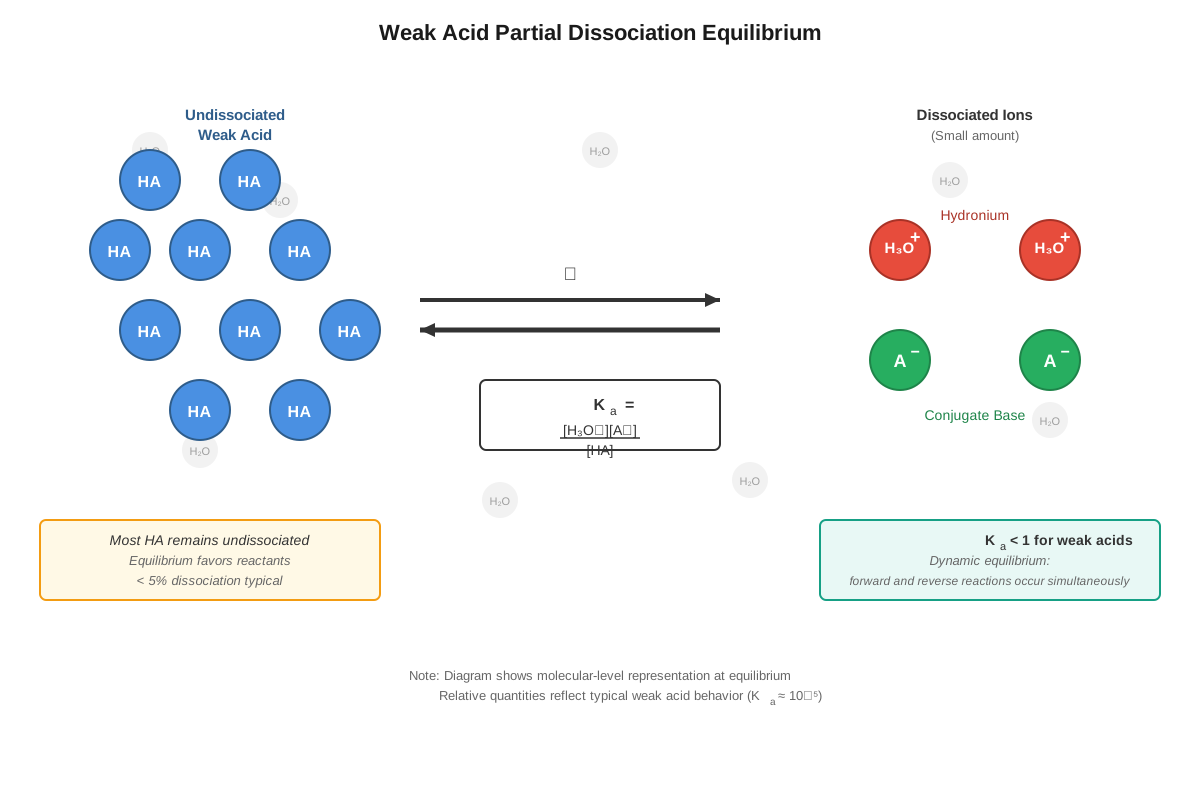
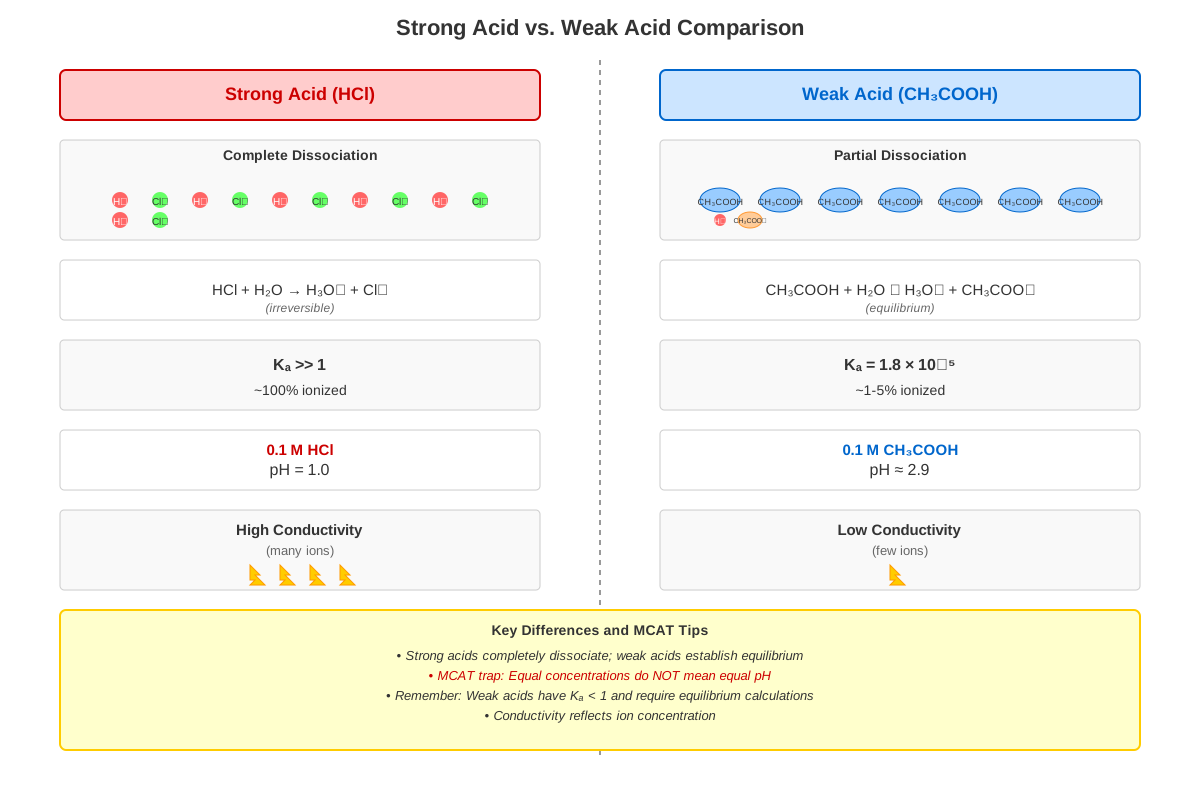
A weak acid is a substance that partially ionizes when dissolved in water, establishing an equilibrium between the undissociated acid (HA) and its dissociated ions (H⁺ and A⁻). This contrasts sharply with strong acids, which dissociate completely (>99%) in aqueous solution. The general equilibrium expression for a weak acid is:
HA(aq) ⇌ H⁺(aq) + A⁻(aq)The extent of ionization is quantified by the acid dissociation constant, Ka:
Ka = [H⁺][A⁻]/[HA]Weak acids typically have Ka values ranging from 10⁻² to 10⁻¹⁴, with smaller Ka values indicating weaker acids (less ionization). The pKa, defined as -log(Ka), provides a more convenient scale: stronger weak acids have lower pKa values (typically 2-5), while weaker acids have higher pKa values (8-14). For the MCAT, recognizing that pKa represents the pH at which exactly 50% of the acid is ionized is crucial for Henderson-Hasselbalch applications.
Equilibrium Calculations and ICE Tables
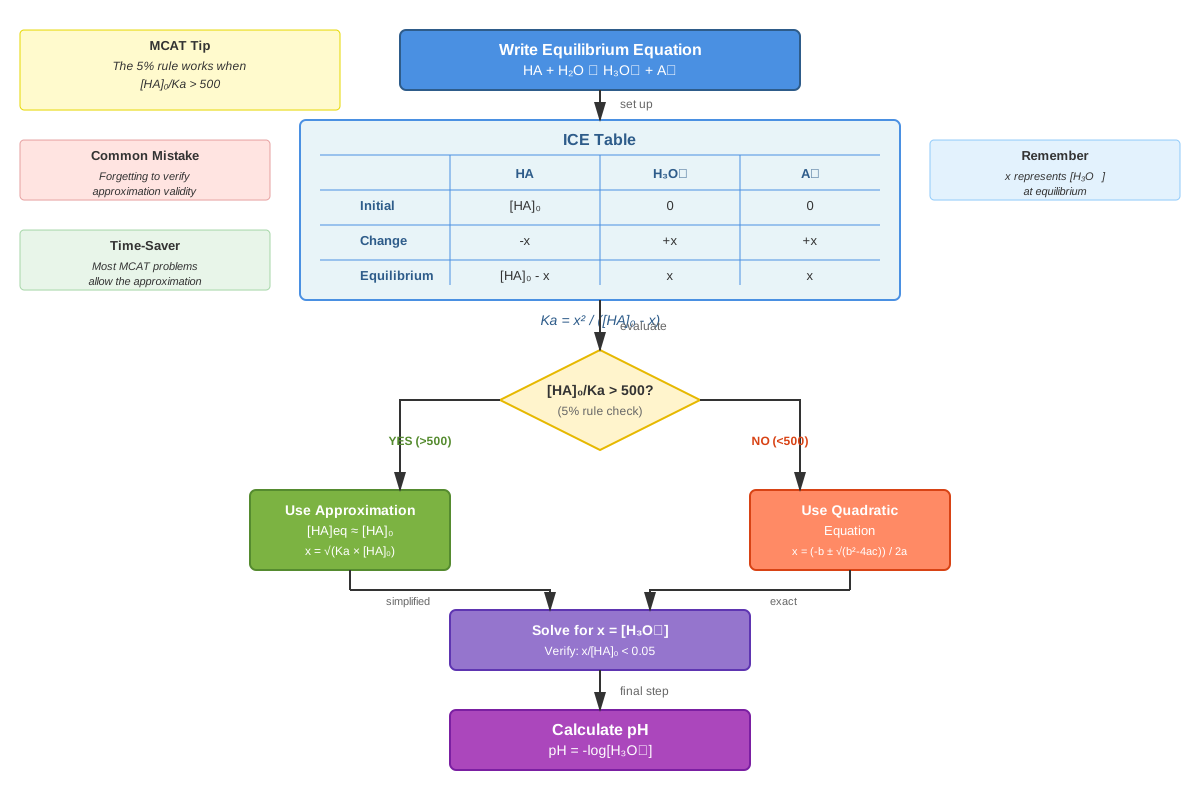
Calculating the pH of a weak acid solution requires setting up an ICE table (Initial, Change, Equilibrium) and solving the equilibrium expression. Consider a generic weak acid HA with initial concentration C and Ka:
| Species | Initial (M) | Change (M) | Equilibrium (M) |
|---|---|---|---|
| HA | C | -x | C - x |
| H⁺ | 0 | +x | x |
| A⁻ | 0 | +x | x |
Substituting into the Ka expression:
Ka = x²/(C - x)When the 5% rule applies (Ka/C < 10⁻³, or when C/Ka > 1000), the approximation C - x ≈ C simplifies the calculation:
Ka ≈ x²/C
x = √(Ka × C)
pH = -log(x)
This approximation is valid when less than 5% of the acid ionizes. For stronger weak acids or dilute solutions, the quadratic formula must be used. The MCAT typically designs questions where the approximation is valid, but recognizing when it breaks down demonstrates deeper understanding.
Percent Ionization
Percent ionization quantifies the fraction of acid molecules that dissociate:
% ionization = ([H⁺]eq/[HA]initial) × 100%A critical concept for the MCAT: percent ionization increases with dilution. As a weak acid solution becomes more dilute, a larger percentage of the acid molecules ionize, even though the absolute concentration of H⁺ decreases. This counterintuitive relationship stems from Le Chatelier's principle—dilution favors the side with more particles (the dissociated ions).
For example, a 1.0 M solution of acetic acid (Ka = 1.8 × 10⁻⁵) has approximately 0.42% ionization, while a 0.01 M solution has approximately 4.2% ionization—a tenfold increase in percent ionization despite a 100-fold dilution.
Molecular Structure and Acid Strength
The strength of a weak acid (magnitude of Ka) depends on the stability of its conjugate base. Factors that stabilize the conjugate base increase acid strength:
- Electronegativity: More electronegative atoms stabilize negative charge better. HF is a stronger acid than H₂O because fluorine is more electronegative than oxygen.
- Resonance stabilization: Carboxylic acids (RCOOH) are stronger than alcohols (ROH) because the carboxylate anion (RCOO⁻) delocalizes negative charge over two oxygen atoms through resonance.
- Inductive effects: Electron-withdrawing groups (like halogens or carbonyl groups) near the acidic proton stabilize the conjugate base through the inductive effect. Chloroacetic acid (ClCH₂COOH, pKa = 2.87) is stronger than acetic acid (CH₃COOH, pKa = 4.76).
- Atomic size: Larger atoms stabilize negative charge better because the charge is spread over a larger volume. HI is a stronger acid than HF (though HI is actually a strong acid).
Common Ion Effect
Adding a salt containing the conjugate base of a weak acid suppresses ionization through the common ion effect. If sodium acetate (NaCH₃COO) is added to an acetic acid solution, the increased concentration of acetate ions shifts the equilibrium left, decreasing the concentration of H⁺ and raising the pH. This principle underlies buffer function and is frequently tested in the context of buffer preparation or physiological systems.
Polyprotic Weak Acids
Polyprotic acids contain multiple ionizable protons, each with its own Ka value. Phosphoric acid (H₃PO₄) has three Ka values:
- Ka1 = 7.5 × 10⁻³ (H₃PO₄ ⇌ H⁺ + H₂PO₄⁻)
- Ka2 = 6.2 × 10⁻⁸ (H₂PO₄⁻ ⇌ H⁺ + HPO₄²⁻)
- Ka3 = 4.8 × 10⁻¹³ (HPO₄²⁻ ⇌ H⁺ + PO₄³⁻)
Each successive proton is harder to remove because it's being removed from an increasingly negative species. For pH calculations, the first ionization typically dominates because Ka1 >> Ka2 >> Ka3. The MCAT may ask you to identify the predominant species at a given pH or to recognize that biological phosphate buffers operate in the Ka2 range (pH ≈ 7).
Concept Relationships
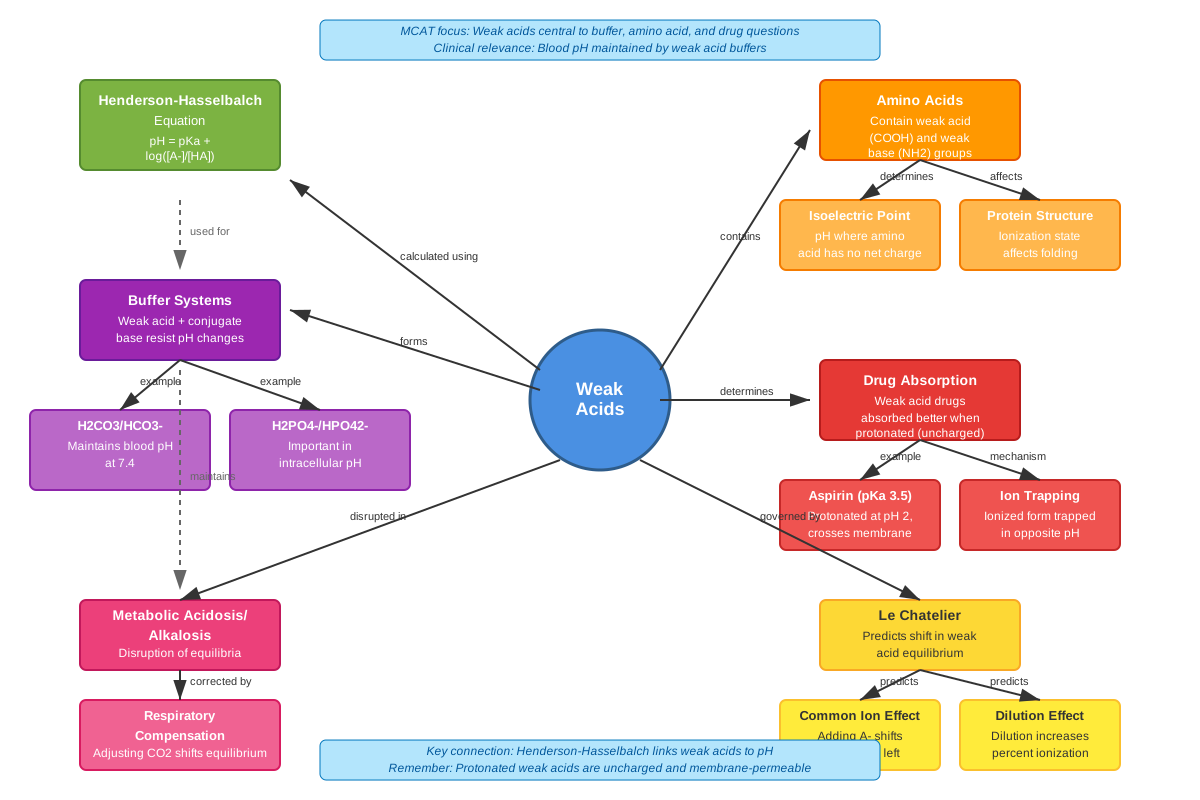
The study of weak acids integrates multiple fundamental chemistry concepts into a cohesive framework. Equilibrium principles provide the mathematical foundation—weak acid ionization is simply a specific application of equilibrium constant expressions. The Le Chatelier's principle explains how weak acid systems respond to changes in concentration, temperature, or the addition of common ions, directly connecting to buffer behavior.
Weak acids → establish equilibrium → quantified by Ka and pKa → used in Henderson-Hasselbalch equation → enables buffer calculations → explains physiological pH regulation
The relationship between molecular structure and acid strength connects weak acids to organic chemistry and biochemistry. Understanding why carboxylic acids are weak acids explains the behavior of amino acids, fatty acids, and metabolic intermediates. The ionization state of amino acid side chains (determined by comparing solution pH to the pKa of the side chain) governs protein structure and enzyme function.
Weak acids also connect forward to titration curves, where the equivalence point, buffer region, and half-equivalence point (pH = pKa) all depend on weak acid equilibrium principles. The solubility equilibria of weak acid salts (like calcium carbonate in the presence of acid) requires understanding how H⁺ shifts the weak acid equilibrium.
In biological contexts, weak acids link to drug absorption (the Henderson-Hasselbalch equation predicts the ratio of ionized to unionized drug), metabolic acidosis/alkalosis (understanding the carbonic acid-bicarbonate buffer system), and enzyme kinetics (pH affects enzyme activity by altering ionization states of active site residues).
Quick check — test yourself on Weak acids so far.
Try Flashcards →High-Yield Facts
⭐ Weak acids only partially ionize in solution, establishing an equilibrium with Ka values typically between 10⁻² and 10⁻¹⁴
⭐ At pH = pKa, exactly 50% of a weak acid is ionized and 50% remains protonated
⭐ Percent ionization of a weak acid increases with dilution, even though absolute [H⁺] decreases
⭐ The 5% approximation (C - x ≈ C) is valid when C/Ka > 1000, simplifying pH calculations to pH = ½(pKa - log C)
⭐ Resonance stabilization of the conjugate base increases acid strength; carboxylic acids are stronger than alcohols due to resonance
- The common ion effect suppresses weak acid ionization when the conjugate base is added to solution
- For polyprotic acids, Ka1 > Ka2 > Ka3, and the first ionization usually dominates pH calculations
- Electron-withdrawing groups increase acid strength through inductive effects (chloroacetic acid > acetic acid)
- Weak acids with pKa values between 6 and 8 make effective physiological buffers near pH 7.4
- The pH of a weak acid solution is always higher than the pH of a strong acid solution of equal concentration
- Acetic acid (pKa = 4.76), carbonic acid (pKa1 = 6.37), and dihydrogen phosphate (pKa2 = 7.21) are the most commonly tested weak acids on the MCAT
- Temperature increases generally increase Ka values (making acids slightly stronger) because ionization is typically endothermic
Common Misconceptions
Misconception: Weak acids are simply dilute solutions of strong acids.
Correction: Weak and strong refer to the extent of ionization, not concentration. A concentrated weak acid solution can have a higher [H⁺] than a dilute strong acid solution, but the weak acid still only partially ionizes while the strong acid completely dissociates.
Misconception: The pH of a weak acid solution can be calculated using pH = -log[HA]initial.
Correction: This approach ignores the equilibrium. The pH depends on [H⁺] at equilibrium, which must be calculated using Ka and an ICE table. Using the initial concentration would dramatically underestimate the pH.
Misconception: Adding water to a weak acid solution doesn't change the pH because you're not adding acid or base.
Correction: Dilution shifts the equilibrium toward ionization (Le Chatelier's principle), increasing percent ionization. While [H⁺] decreases, it doesn't decrease proportionally to the dilution factor, so pH increases (becomes less acidic).
Misconception: A weak acid with a very small Ka contributes negligible H⁺ to solution, so water's autoionization dominates.
Correction: This is only true for extremely weak acids (Ka < 10⁻¹²) at low concentrations. For most weak acids, even with small Ka values, the acid is still the primary source of H⁺. However, for very weak acids or very dilute solutions, water's contribution (10⁻⁷ M) cannot be ignored.
Misconception: The Ka value changes when you dilute a weak acid solution.
Correction: Ka is a constant at a given temperature and does not change with concentration. What changes is the position of equilibrium (the actual concentrations of species) and the percent ionization, but the ratio defined by Ka remains constant.
Misconception: At pH values far from the pKa, you still have significant amounts of both the acid and conjugate base forms.
Correction: When pH differs from pKa by more than 2 units, one form predominates (>99%). At pH = pKa + 2, the ratio [A⁻]/[HA] = 100:1. At pH = pKa - 2, the ratio is 1:100. This is crucial for predicting predominant species.
Worked Examples
Example 1: pH Calculation with Approximation Validation
Question: Calculate the pH of a 0.10 M solution of formic acid (HCOOH, Ka = 1.8 × 10⁻⁴).
Solution:
Step 1: Write the equilibrium expression and set up an ICE table.
HCOOH ⇌ H⁺ + HCOO⁻| Species | Initial | Change | Equilibrium |
|---|---|---|---|
| HCOOH | 0.10 | -x | 0.10 - x |
| H⁺ | 0 | +x | x |
| HCOO⁻ | 0 | +x | x |
Step 2: Check if the 5% approximation is valid.
C/Ka = 0.10/(1.8 × 10⁻⁴) = 556
Since this is less than 1000, we should verify our approximation, but we can try it first.
Step 3: Apply the approximation.
Ka = x²/(0.10 - x) ≈ x²/0.10
1.8 × 10⁻⁴ = x²/0.10
x² = 1.8 × 10⁻⁵
x = 4.24 × 10⁻³ M
Step 4: Verify the approximation.
(4.24 × 10⁻³/0.10) × 100% = 4.24%
This is less than 5%, so the approximation is valid (though borderline).
Step 5: Calculate pH.
pH = -log(4.24 × 10⁻³) = 2.37Key Insight: This problem demonstrates the importance of checking the approximation. With C/Ka around 500-1000, you're in the borderline zone. On the MCAT, if the approximation gives less than 5% ionization, it's acceptable. This connects to Learning Objective: Apply weak acids to exam-style questions.
Example 2: Percent Ionization and Dilution
Question: A 0.50 M solution of a weak acid HA has a pH of 2.70. (a) Calculate Ka for this acid. (b) If the solution is diluted to 0.050 M, what is the new pH and percent ionization?
Solution:
Part (a):
Step 1: Calculate [H⁺] from pH.
[H⁺] = 10⁻²·⁷⁰ = 2.0 × 10⁻³ MStep 2: Set up the equilibrium expression.
At equilibrium: [H⁺] = [A⁻] = 2.0 × 10⁻³ M
[HA] = 0.50 - 2.0 × 10⁻³ ≈ 0.498 M
Step 3: Calculate Ka.
Ka = (2.0 × 10⁻³)²/0.498 = 8.0 × 10⁻⁶Part (b):
Step 4: Calculate new [H⁺] at 0.050 M.
Check approximation: C/Ka = 0.050/(8.0 × 10⁻⁶) = 6250 ✓
Ka = x²/0.050
8.0 × 10⁻⁶ = x²/0.050
x² = 4.0 × 10⁻⁷
x = 6.3 × 10⁻⁴ M
Step 5: Calculate new pH.
pH = -log(6.3 × 10⁻⁴) = 3.20Step 6: Calculate percent ionization for both concentrations.
Original: (2.0 × 10⁻³/0.50) × 100% = 0.40%
Diluted: (6.3 × 10⁻⁴/0.050) × 100% = 1.26%
Key Insight: Despite a 10-fold dilution, the pH only increased by 0.50 units (not 1.0 unit as it would for a strong acid). The percent ionization more than tripled, demonstrating that dilution favors ionization. This addresses the common misconception about dilution effects and connects to Learning Objective: Determine the percent ionization of a weak acid under various conditions.
Exam Strategy
When approaching weak acid questions on the MCAT, first identify whether the question requires quantitative calculation or qualitative reasoning. The exam increasingly favors conceptual questions that test understanding over pure calculation. Look for these trigger phrases:
- "Predominant species at pH..." → Compare pH to pKa; if pH > pKa, conjugate base predominates
- "Effect of dilution on..." → Remember percent ionization increases, but [H⁺] decreases
- "Addition of the sodium salt of..." → Common ion effect; equilibrium shifts left, pH increases
- "Which acid is strongest?" → Look for structural features that stabilize the conjugate base
For calculation questions, immediately assess whether the 5% approximation applies by checking if C/Ka > 1000. If the question provides Ka and concentration, this check takes 5 seconds and can save significant time. The MCAT rarely requires quadratic formula solutions, so if you find yourself needing it, double-check your setup.
Exam Tip: If a question asks about pH changes and provides pKa values, consider whether the Henderson-Hasselbalch equation applies. Many weak acid questions are actually buffer questions in disguise.
Process-of-elimination strategies:
- Eliminate answers where pH < 0 or pH > 14 for aqueous solutions at standard conditions
- Eliminate answers where weak acid pH equals strong acid pH at the same concentration
- For structure-property questions, eliminate molecules without acidic protons or with only very weak acidic protons (like alkane C-H bonds)
- For dilution questions, eliminate answers suggesting pH decreases (becomes more acidic) upon dilution
Time allocation: Spend no more than 60-90 seconds on straightforward weak acid calculations. If a calculation is taking longer, flag it and move on—the MCAT rewards efficient test-taking. For passage-based questions, spend 30 seconds identifying what weak acid principle is being tested before diving into calculations.
Memory Techniques
Mnemonic for factors increasing acid strength: "RISE"
- Resonance stabilization of conjugate base
- Inductive effects (electron-withdrawing groups)
- Size of atom (larger atoms stabilize charge better)
- Electronegativity (more electronegative atoms stabilize negative charge)
Visualization for percent ionization: Picture a crowded room (concentrated solution) where people (acid molecules) are reluctant to leave (ionize) because it's crowded. As the room empties (dilution), a larger percentage of people are willing to leave, even though fewer total people are leaving.
Acronym for common weak acids: "CHAMP"
- Carbonic acid (H₂CO₃, pKa1 = 6.37)
- Hydrofluoric acid (HF, pKa = 3.17)
- Acetic acid (CH₃COOH, pKa = 4.76)
- Monoprotic phosphoric acid species (H₂PO₄⁻, pKa = 7.21)
- Phenol (C₆H₅OH, pKa = 10)
Memory aid for pH = pKa relationship: "Half and Half" — at pH = pKa, the solution is half acid and half conjugate base (50/50 split). This is the half-equivalence point in a titration.
Quick approximation check: "Thousand or bust" — if C/Ka isn't greater than 1000, you might need the quadratic (though 500-1000 is usually acceptable on the MCAT with verification).
Summary
Weak acids are partially ionized acids that establish equilibrium between the undissociated acid and its conjugate base, characterized by Ka values typically between 10⁻² and 10⁻¹⁴. Understanding weak acid behavior requires mastery of equilibrium calculations using ICE tables, recognition of when the 5% approximation applies (C/Ka > 1000), and conceptual understanding of how dilution, common ions, and molecular structure affect acid strength and ionization. The pKa value represents the pH at which a weak acid is 50% ionized, a critical concept for buffer and Henderson-Hasselbalch applications. Percent ionization increases with dilution due to Le Chatelier's principle, even as absolute [H⁺] decreases. Molecular factors that stabilize the conjugate base—including resonance, inductive effects, electronegativity, and atomic size—increase acid strength. For the MCAT, weak acids appear frequently in both quantitative calculations and qualitative reasoning questions, often embedded in biological contexts involving drug absorption, physiological buffers, and amino acid chemistry.
Key Takeaways
- Weak acids partially ionize in solution, establishing equilibrium characterized by Ka; smaller Ka (larger pKa) indicates weaker acid
- The 5% approximation simplifies pH calculations when C/Ka > 1000, yielding pH = ½(pKa - log C)
- Percent ionization increases with dilution, but absolute [H⁺] decreases—a counterintuitive but frequently tested concept
- At pH = pKa, a weak acid is exactly 50% ionized; when pH differs from pKa by ±2 units, one form predominates (>99%)
- Resonance stabilization, electron-withdrawing groups, and electronegativity increase acid strength by stabilizing the conjugate base
- The common ion effect suppresses weak acid ionization, forming the basis for buffer function
- Weak acids connect to numerous MCAT topics including buffers, titrations, amino acid chemistry, and drug absorption
Related Topics
Buffer Systems: Weak acid-conjugate base pairs resist pH changes; understanding weak acid equilibria is essential for Henderson-Hasselbalch calculations and predicting buffer capacity. Mastering weak acids enables you to understand how physiological buffers (carbonic acid-bicarbonate, phosphate) maintain blood pH.
Titration Curves: The shape of weak acid titration curves, including the buffer region and half-equivalence point (pH = pKa), directly derives from weak acid equilibrium principles. This topic builds on weak acid calculations to analyze neutralization reactions.
Amino Acid Chemistry: Amino acids are polyprotic weak acids with multiple pKa values. Understanding weak acid ionization is essential for predicting amino acid charge at physiological pH and explaining protein structure.
Solubility Equilibria: The solubility of weak acid salts (like calcium carbonate or calcium phosphate) depends on pH because H⁺ shifts the weak acid equilibrium, affecting the concentration of the anion available to precipitate.
Organic Acid-Base Chemistry: Carboxylic acids, phenols, and other organic functional groups behave as weak acids. Understanding structure-property relationships for weak acids enables prediction of reactivity in organic mechanisms.
Practice CTA
Now that you've mastered the core concepts of weak acids, it's time to solidify your understanding through active practice. Challenge yourself with MCAT-style practice questions that test both your calculation skills and conceptual reasoning. Focus on questions involving dilution effects, percent ionization, and structure-property relationships—these are high-yield areas where students often struggle. Use flashcards to memorize pKa values of common weak acids and the factors affecting acid strength. Remember: understanding weak acids unlocks buffer chemistry, titrations, and amino acid behavior—making this one of the highest-yield topics in General Chemistry. Your investment in mastering this material will pay dividends across multiple sections of the MCAT!
Sign up free to keep reading
Create a free AnvayaPrep account to finish this MCAT guide on Weak acids — plus flashcards and practice questions.