Overview
Strong bases are chemical species that completely dissociate in aqueous solution to produce hydroxide ions (OH⁻) or react quantitatively with water to generate hydroxide ions. Understanding strong bases is fundamental to mastering Acids and Bases in General Chemistry, as these compounds represent one extreme of the pH scale and serve as reference points for understanding base strength, equilibrium, and solution chemistry. Unlike weak bases that establish equilibrium between their protonated and deprotonated forms, strong bases undergo essentially complete ionization, making their behavior predictable and their calculations straightforward—yet this simplicity can mask conceptual nuances that the MCAT frequently tests.
For the MCAT, strong bases appear across multiple contexts within the Chemical and Physical Foundations of Biological Systems section. Questions may directly test the ability to identify strong bases, calculate pH values in strong base solutions, predict the outcomes of neutralization reactions, or analyze buffer systems where understanding the complete dissociation of strong bases becomes critical. The MCAT particularly favors questions that require distinguishing between strong and weak bases, understanding the relationship between base strength and molecular structure, and applying these concepts to biological systems where pH regulation is essential for enzyme function, protein stability, and metabolic processes.
The study of strong bases connects intimately with broader General Chemistry principles including stoichiometry, equilibrium (or the absence thereof), thermodynamics, and solution chemistry. Strong bases serve as limiting cases that help define the behavior of weak bases through comparison, and they play crucial roles in titration curves, buffer preparation, and acid-base neutralization reactions—all high-yield topics for standardized examinations. Mastering strong bases provides the foundation for understanding more complex acid-base chemistry, including polyprotic acids, buffer systems, and the Henderson-Hasselbalch equation.
Learning Objectives
- [ ] Define strong bases using accurate General Chemistry terminology
- [ ] Explain why strong bases matters for the MCAT
- [ ] Apply strong bases to exam-style questions
- [ ] Identify common mistakes related to strong bases
- [ ] Connect strong bases to related General Chemistry concepts
- [ ] Memorize and recognize all common strong bases tested on the MCAT
- [ ] Calculate pH, pOH, and hydroxide ion concentration for strong base solutions with precision
- [ ] Distinguish between strong bases and weak bases based on molecular structure and dissociation behavior
- [ ] Predict the products and calculate the pH of neutralization reactions involving strong bases
Prerequisites
- pH and pOH scales: Understanding the logarithmic relationship between hydrogen ion concentration and pH, and hydroxide ion concentration and pOH, is essential for calculating solution properties of strong bases
- Molarity and solution stoichiometry: Strong base calculations require facility with concentration units and the ability to perform dilution and stoichiometric calculations
- Equilibrium concepts: While strong bases don't establish equilibrium, understanding what equilibrium means helps appreciate why strong bases are different from weak bases
- Periodic trends: Recognizing how atomic size and electronegativity influence base strength, particularly for Group 1 and Group 2 hydroxides
- Ionic compounds and dissociation: Strong bases are typically ionic compounds that dissociate completely in water, requiring understanding of ionic bonding and solubility
Why This Topic Matters
Clinical and Real-World Significance
Strong bases play critical roles in biological and medical contexts. Sodium hydroxide (NaOH) is used in tissue digestion procedures and chemical burns from strong bases represent serious medical emergencies that require immediate intervention. The body's pH regulation systems must constantly neutralize both acidic and basic metabolites, and understanding strong bases helps explain how the kidneys regulate blood pH through bicarbonate reabsorption and excretion. Many pharmaceutical formulations require pH adjustment using strong bases, and industrial processes from soap making to petroleum refining depend on strong base chemistry.
MCAT Exam Statistics
Strong bases appear in approximately 3-5% of Chemical and Physical Foundations questions, but the concept underlies many additional questions about buffers, titrations, and acid-base equilibria. The MCAT tests strong bases through:
- Discrete questions asking for pH calculations or identification of strong bases
- Passage-based questions involving titration curves, buffer preparation, or neutralization reactions
- Biological passages discussing enzyme pH optima, metabolic acidosis/alkalosis, or drug formulation
- Organic chemistry passages involving base-catalyzed reactions where understanding base strength affects mechanism predictions
Common Exam Appearances
The MCAT integrates strong bases into passages about:
- Titration experiments with pH curves showing characteristic strong base behavior
- Physiological pH regulation and the bicarbonate buffer system
- Laboratory procedures requiring pH adjustment
- Organic reaction mechanisms where strong bases serve as nucleophiles or deprotonating agents
- Environmental chemistry involving alkaline waste or ocean pH changes
Core Concepts
Definition and Fundamental Properties
A strong base is defined as a base that completely dissociates or reacts in aqueous solution to produce hydroxide ions. This complete dissociation distinguishes strong bases from weak bases, which only partially ionize in solution and establish equilibrium between protonated and deprotonated forms. For strong bases, the dissociation reaction proceeds essentially to completion (K >> 1), meaning that in a solution of a strong base, virtually no undissociated base molecules remain.
The most common strong bases fall into two categories:
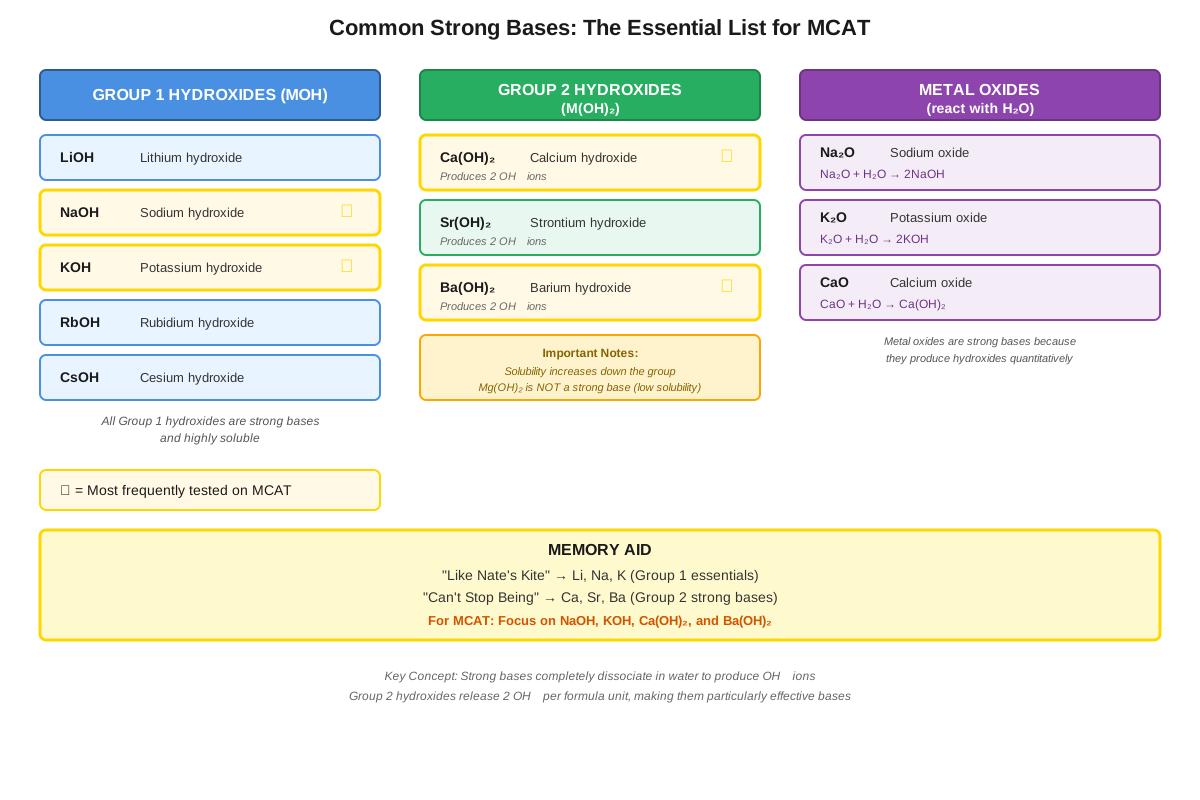
- Group 1 (alkali metal) hydroxides: LiOH, NaOH, KOH, RbOH, CsOH
- Group 2 (alkaline earth metal) hydroxides (soluble ones): Ca(OH)₂, Sr(OH)₂, Ba(OH)₂
Note that Mg(OH)₂ is often excluded from the strong base list because of its limited solubility in water, though the portion that does dissolve dissociates completely.
Dissociation Behavior
When a strong base dissolves in water, it undergoes complete dissociation. For Group 1 hydroxides:
NaOH(s) → Na⁺(aq) + OH⁻(aq) (complete dissociation)For Group 2 hydroxides, each formula unit produces two hydroxide ions:
Ba(OH)₂(s) → Ba²⁺(aq) + 2OH⁻(aq) (complete dissociation)This stoichiometry is crucial for pH calculations. A 0.01 M solution of NaOH produces 0.01 M OH⁻, but a 0.01 M solution of Ba(OH)₂ produces 0.02 M OH⁻.
pH and pOH Calculations
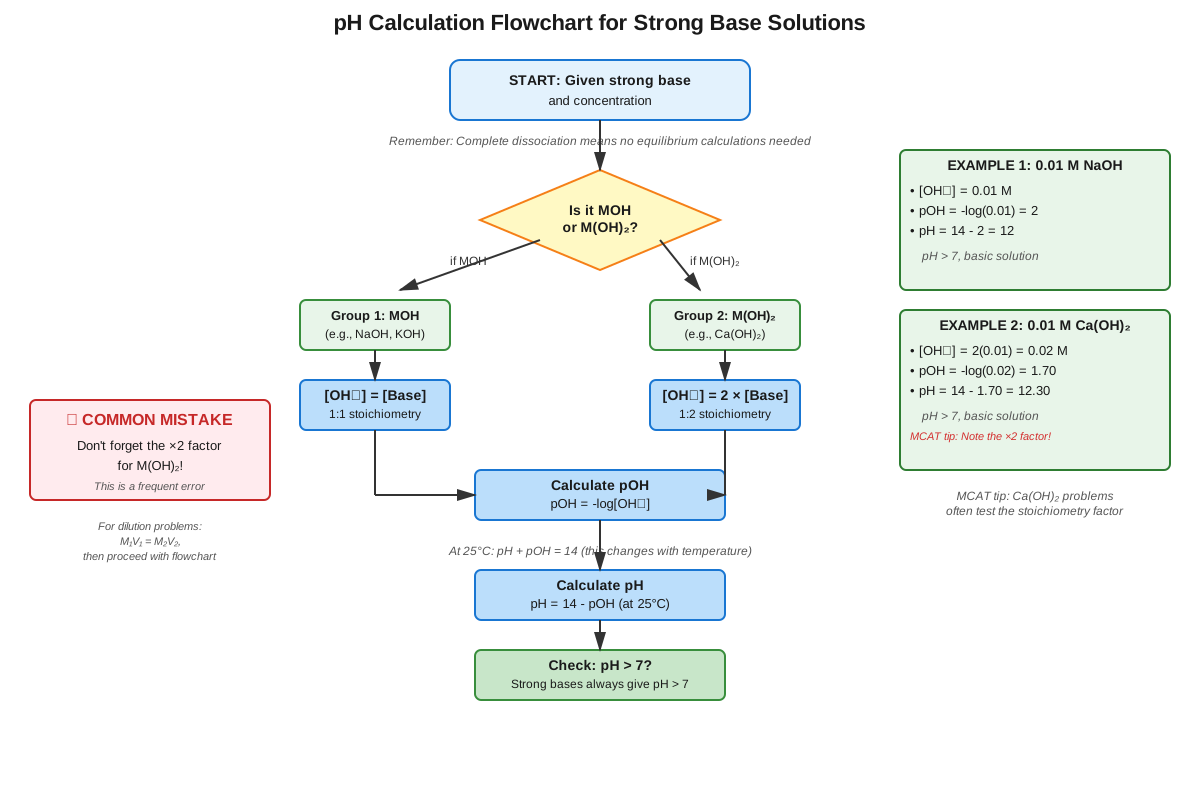
For strong base solutions, calculating pH involves several steps:
- Determine the hydroxide ion concentration [OH⁻] from the base concentration and stoichiometry
- Calculate pOH using: pOH = -log[OH⁻]
- Calculate pH using: pH = 14 - pOH (at 25°C)
Example: For a 0.005 M KOH solution:
- [OH⁻] = 0.005 M (1:1 stoichiometry)
- pOH = -log(0.005) = -log(5 × 10⁻³) = 2.30
- pH = 14 - 2.30 = 11.70
For Group 2 hydroxides, remember to account for the 1:2 stoichiometry:
Example: For a 0.005 M Ca(OH)₂ solution:
- [OH⁻] = 2 × 0.005 M = 0.010 M
- pOH = -log(0.010) = 2.00
- pH = 14 - 2.00 = 12.00
Molecular Basis of Base Strength
The strength of a base relates to its ability to accept protons or donate hydroxide ions. For metal hydroxides, base strength correlates with:
Ionic character: The more ionic the M-OH bond, the more readily the compound dissociates. Group 1 and Group 2 metals form highly ionic bonds with hydroxide due to their low electronegativity and large atomic radii.
Lattice energy vs. hydration energy: Strong bases have favorable thermodynamics for dissolution. The energy released when ions are hydrated exceeds the lattice energy holding the solid together.
Cation size: Larger cations (like Cs⁺ or Ba²⁺) form weaker electrostatic interactions with hydroxide ions, facilitating complete dissociation.
Comparison with Weak Bases
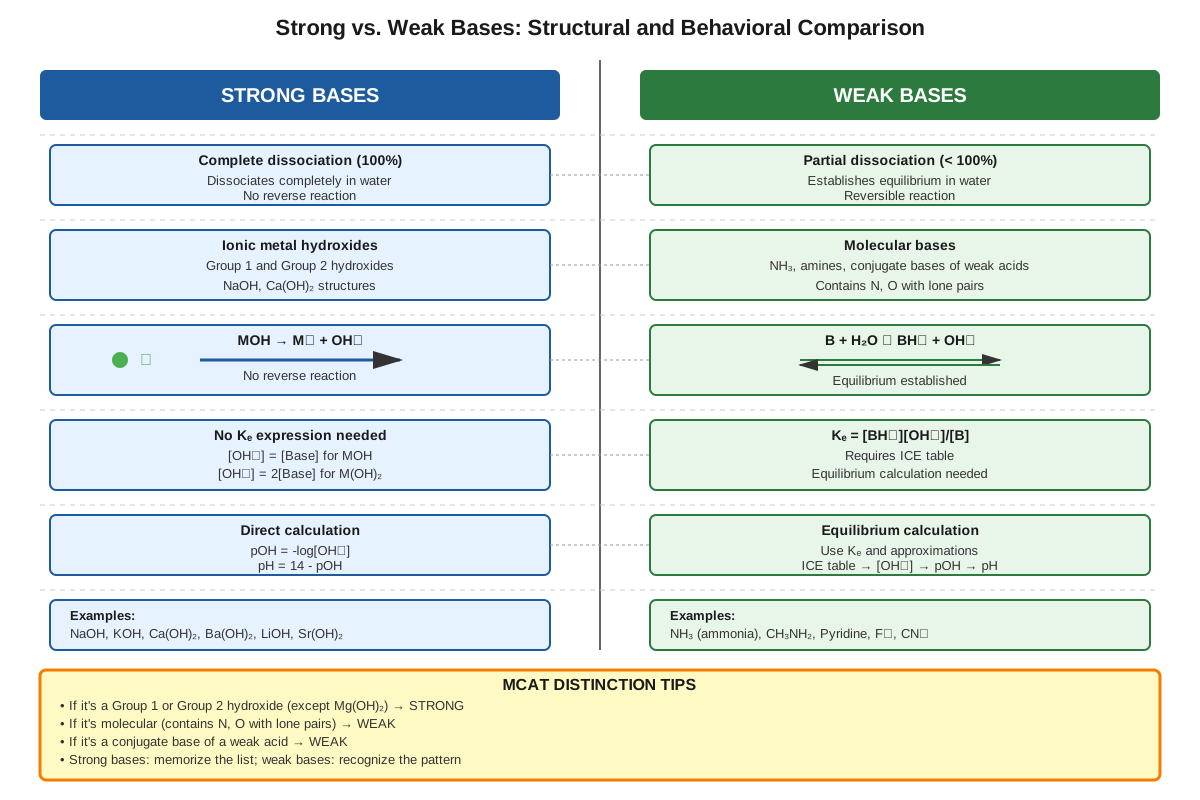
Understanding strong bases requires distinguishing them from weak bases:
| Property | Strong Bases | Weak Bases |
|---|---|---|
| Dissociation | Complete (≈100%) | Partial (<<100%) |
| Equilibrium | No equilibrium established | Equilibrium between B and BH⁺ |
| Kb value | Very large (not typically listed) | Small (Kb < 1) |
| Examples | NaOH, KOH, Ba(OH)₂ | NH₃, amines, pyridine |
| pH calculation | Direct from concentration | Requires ICE table and Kb |
| Conjugate acid | Very weak (negligible acidity) | Weak acid |
Neutralization Reactions
Strong bases react with acids in neutralization reactions that are highly exothermic and proceed to completion. The general form is:
Base + Acid → Salt + WaterFor strong base-strong acid reactions:
NaOH(aq) + HCl(aq) → NaCl(aq) + H₂O(l)The net ionic equation reveals the fundamental process:
OH⁻(aq) + H⁺(aq) → H₂O(l)When strong bases react with weak acids, the reaction still proceeds essentially to completion, but the resulting solution contains the conjugate base of the weak acid, which affects the final pH:
NaOH(aq) + CH₃COOH(aq) → CH₃COONa(aq) + H₂O(l)The acetate ion (CH₃COO⁻) is a weak base, so the solution pH will be greater than 7.
Dilution of Strong Bases
When diluting strong base solutions, use the dilution equation:
M₁V₁ = M₂V₂Since strong bases dissociate completely, the hydroxide concentration changes proportionally with dilution. However, be cautious with very dilute solutions (< 10⁻⁶ M), where the autoionization of water contributes significantly to [OH⁻].
Leveling Effect
In aqueous solution, all strong bases are "leveled" to the strength of hydroxide ion. This means that bases stronger than OH⁻ (like H⁻ or NH₂⁻) will react completely with water to produce OH⁻:
NH₂⁻(aq) + H₂O(l) → NH₃(aq) + OH⁻(aq) (complete reaction)This leveling effect explains why we cannot distinguish between the strengths of different strong bases in water—they all produce hydroxide ions quantitatively.
Concept Relationships
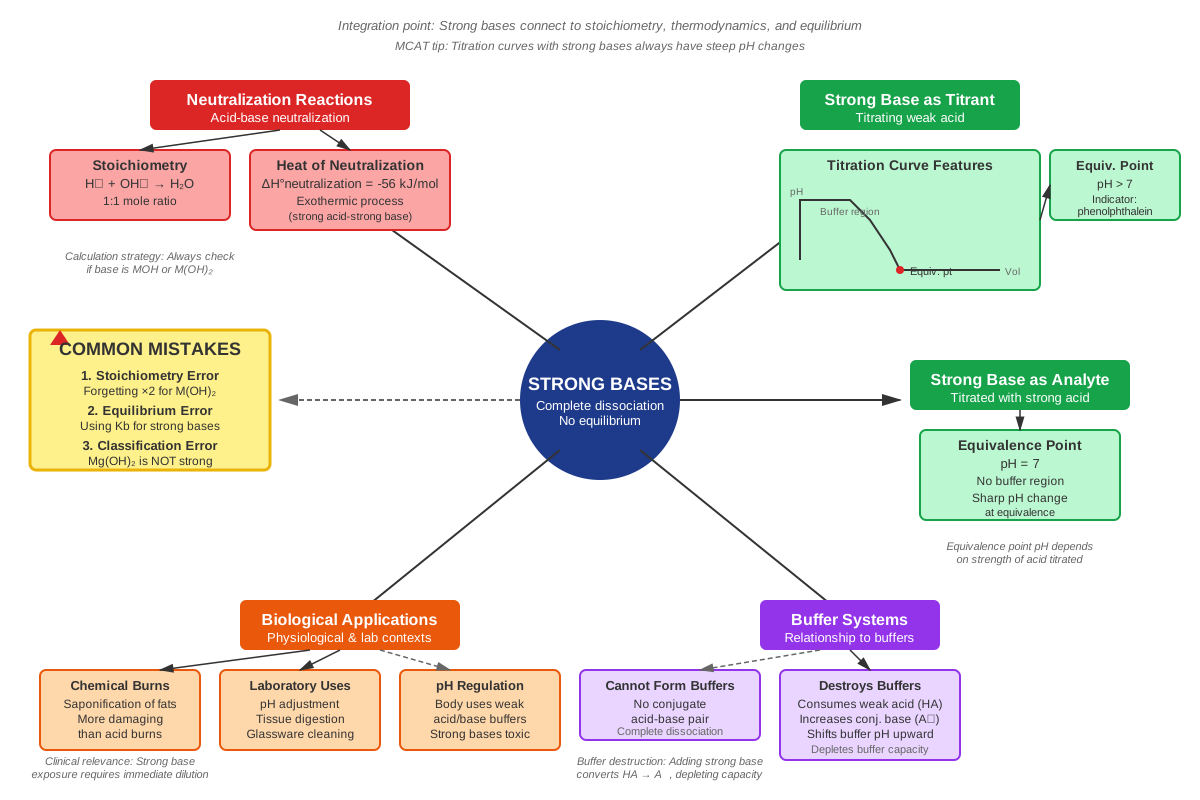
The study of strong bases connects multiple chemical concepts in a hierarchical network. Strong bases → directly determine hydroxide ion concentration → which determines pOH → which relates to pH through the water autoionization constant (Kw = 1.0 × 10⁻¹⁴ at 25°C). This pH value then influences buffer capacity, titration curve shape, and reaction equilibria in biological systems.
Strong bases contrast with weak bases, and this comparison illuminates equilibrium concepts. While weak bases require equilibrium calculations using Kb and ICE tables, strong bases simplify to stoichiometric calculations. Both strong and weak bases connect to conjugate acid-base pairs through the Brønsted-Lowry theory: strong bases have extremely weak conjugate acids that are negligible in solution.
The periodic trends in atomic size and electronegativity explain why Group 1 and Group 2 hydroxides are strong bases—larger cations with lower electronegativity form more ionic M-OH bonds that dissociate completely. This connects to solubility rules and thermodynamics, as the balance between lattice energy and hydration energy determines which hydroxides dissolve sufficiently to be classified as strong bases.
In neutralization reactions, strong bases react with both strong and weak acids, connecting to stoichiometry and thermochemistry. The products of these reactions (salts) may undergo hydrolysis, linking strong base chemistry to salt solutions and their pH properties. When strong bases are used in titrations, they create characteristic titration curves with sharp equivalence points, connecting to analytical chemistry and buffer systems.
High-Yield Facts
⭐ The common strong bases are: LiOH, NaOH, KOH, RbOH, CsOH (Group 1 hydroxides) and Ca(OH)₂, Sr(OH)₂, Ba(OH)₂ (soluble Group 2 hydroxides)
⭐ Strong bases dissociate completely in aqueous solution, meaning [OH⁻] can be calculated directly from the base concentration and stoichiometry
⭐ Group 2 hydroxides produce two moles of OH⁻ per mole of base: [OH⁻] = 2 × [M(OH)₂]
⭐ At 25°C, pH + pOH = 14, allowing conversion between pH and pOH for strong base solutions
⭐ The conjugate acids of strong bases are extremely weak and have no significant acidic properties in aqueous solution
- Strong base solutions have pH values greater than 7, typically in the range of 10-14 for common concentrations
- Mg(OH)₂ is not considered a strong base due to limited solubility, though dissolved portions dissociate completely
- Neutralization of a strong base with a strong acid produces a neutral solution (pH = 7) at the equivalence point
- Neutralization of a strong base with a weak acid produces a basic solution (pH > 7) at the equivalence point
- The leveling effect means all strong bases in water are effectively equivalent in strength to OH⁻
- Very dilute strong base solutions (< 10⁻⁶ M) require consideration of water autoionization in pH calculations
- Strong bases are excellent nucleophiles in organic chemistry reactions due to the high electron density on OH⁻
Quick check — test yourself on Strong bases so far.
Try Flashcards →Common Misconceptions
Misconception: All hydroxides are strong bases.
Correction: Only Group 1 hydroxides and the soluble Group 2 hydroxides (Ca(OH)₂, Sr(OH)₂, Ba(OH)₂) are strong bases. Mg(OH)₂ has limited solubility and is not classified as a strong base. Transition metal hydroxides like Fe(OH)₃ are insoluble and not strong bases.
Misconception: A 0.01 M solution of any strong base has the same pH.
Correction: Group 2 hydroxides produce twice as many hydroxide ions as Group 1 hydroxides. A 0.01 M Ba(OH)₂ solution produces 0.02 M OH⁻ and has a higher pH than a 0.01 M NaOH solution (which produces 0.01 M OH⁻).
Misconception: Strong bases have large Kb values that need to be looked up for calculations.
Correction: Strong bases dissociate completely, so Kb is not used in calculations. The hydroxide concentration equals the base concentration (times the stoichiometric coefficient), and pH is calculated directly without equilibrium expressions.
Misconception: When a strong base is diluted, the pH decreases proportionally to the dilution factor.
Correction: pH is a logarithmic scale. When a strong base is diluted 10-fold, the [OH⁻] decreases 10-fold, the pOH increases by 1 unit, and the pH decreases by 1 unit (not by a factor of 10).
Misconception: The equivalence point in any titration involving a strong base occurs at pH 7.
Correction: Only strong base-strong acid titrations have equivalence points at pH 7. When a strong base titrates a weak acid, the equivalence point pH is greater than 7 because the conjugate base of the weak acid undergoes hydrolysis to produce OH⁻.
Misconception: Strong bases are always more concentrated than weak bases.
Correction: "Strong" refers to the degree of dissociation, not concentration. A 0.001 M NaOH solution is dilute but still a strong base because it dissociates completely. A 1.0 M NH₃ solution is concentrated but is a weak base because it only partially ionizes.
Misconception: Adding a strong base to a buffer destroys the buffer immediately.
Correction: Buffers can neutralize small amounts of added strong base. The OH⁻ reacts with the weak acid component of the buffer. Only when the strong base exceeds the buffer capacity (typically when added moles exceed the moles of weak acid) is the buffer destroyed.
Worked Examples
Example 1: pH Calculation for Group 2 Hydroxide
Question: Calculate the pH of a 0.0025 M Ba(OH)₂ solution at 25°C.
Solution:
Step 1: Identify the base and its dissociation stoichiometry.
Ba(OH)₂ is a Group 2 hydroxide and a strong base. It dissociates completely:
Ba(OH)₂(s) → Ba²⁺(aq) + 2OH⁻(aq)Step 2: Calculate [OH⁻] from the base concentration.
Since each Ba(OH)₂ produces 2 OH⁻ ions:
[OH⁻] = 2 × [Ba(OH)₂] = 2 × 0.0025 M = 0.0050 M = 5.0 × 10⁻³ MStep 3: Calculate pOH.
pOH = -log[OH⁻] = -log(5.0 × 10⁻³)
pOH = -log(5.0) - log(10⁻³)
pOH = -0.70 + 3 = 2.30
Step 4: Calculate pH using the relationship pH + pOH = 14.
pH = 14 - pOH = 14 - 2.30 = 11.70Answer: The pH is 11.70.
Key Concept Connection: This problem directly applies the learning objective of calculating pH for strong base solutions and demonstrates the critical importance of accounting for stoichiometry with Group 2 hydroxides.
Example 2: Neutralization and Final pH
Question: A student mixes 25.0 mL of 0.100 M HCl with 25.0 mL of 0.100 M NaOH. What is the pH of the resulting solution at 25°C?
Solution:
Step 1: Calculate moles of acid and base.
moles HCl = (0.100 mol/L)(0.0250 L) = 0.00250 mol H⁺
moles NaOH = (0.100 mol/L)(0.0250 L) = 0.00250 mol OH⁻
Step 2: Determine the neutralization reaction.
H⁺(aq) + OH⁻(aq) → H₂O(l)Step 3: Calculate remaining moles after neutralization.
Since moles of H⁺ = moles of OH⁻, they completely neutralize each other:
Remaining H⁺ = 0.00250 - 0.00250 = 0 mol
Remaining OH⁻ = 0.00250 - 0.00250 = 0 mol
Step 4: Determine the pH of the solution.
With no excess acid or base, the solution contains only NaCl (a neutral salt) and water. The pH is determined by water autoionization:
pH = 7.00Answer: The pH is 7.00.
Key Concept Connection: This problem illustrates that strong base-strong acid neutralization produces a neutral solution at the equivalence point, a high-yield concept for titration questions on the MCAT.
Example 3: Dilution and pH Change
Question: A laboratory technician dilutes 10.0 mL of 0.200 M KOH to a final volume of 100.0 mL. What is the pH of the diluted solution?
Solution:
Step 1: Calculate the concentration after dilution using M₁V₁ = M₂V₂.
(0.200 M)(10.0 mL) = M₂(100.0 mL)
M₂ = (0.200 M × 10.0 mL) / 100.0 mL = 0.0200 M
Step 2: Determine [OH⁻] for the diluted solution.
KOH is a strong base with 1:1 stoichiometry:
[OH⁻] = 0.0200 M = 2.0 × 10⁻² MStep 3: Calculate pOH.
pOH = -log(2.0 × 10⁻²) = -log(2.0) - log(10⁻²)
pOH = -0.30 + 2 = 1.70
Step 4: Calculate pH.
pH = 14 - 1.70 = 12.30Answer: The pH of the diluted solution is 12.30.
Additional Insight: The original solution had [OH⁻] = 0.200 M, giving pOH = 0.70 and pH = 13.30. After 10-fold dilution, the pH decreased by 1.00 unit (from 13.30 to 12.30), demonstrating the logarithmic nature of the pH scale.
Exam Strategy
Approaching MCAT Questions on Strong Bases
Step 1: Identify whether the base is strong or weak. The MCAT will often test whether students can distinguish between strong and weak bases. Memorize the list of strong bases (Group 1 and soluble Group 2 hydroxides). If the base is not on this list, treat it as weak and use Kb calculations.
Step 2: Check the stoichiometry. For Group 1 hydroxides, [OH⁻] = [base]. For Group 2 hydroxides, [OH⁻] = 2 × [base]. This is a frequent source of errors that the MCAT exploits.
Step 3: Determine what the question asks for. Questions may ask for pH, pOH, [OH⁻], [H⁺], or the outcome of a neutralization. Convert between these using:
- pH + pOH = 14
- pH = -log[H⁺]
- pOH = -log[OH⁻]
- [H⁺][OH⁻] = 1.0 × 10⁻¹⁴
Trigger Words and Phrases
- "Completely dissociates" or "strong base": Signals direct calculation without equilibrium
- "Group 1 hydroxide" or "alkali metal hydroxide": Confirms strong base with 1:1 stoichiometry
- "Calcium hydroxide", "barium hydroxide", or "strontium hydroxide": Group 2 strong bases with 1:2 stoichiometry
- "Equivalence point": In titrations, determine whether both acid and base are strong to predict pH = 7
- "Neutralization": Signals stoichiometric calculation of acid-base reaction
- "Dilution": Use M₁V₁ = M₂V₂, then recalculate pH
Process of Elimination Tips
- Eliminate answers with pH < 7 for any solution containing excess strong base
- Eliminate answers suggesting equilibrium calculations (ICE tables, Kb values) for strong bases
- For Group 2 hydroxides, eliminate answers that don't account for the factor of 2 in hydroxide production
- In neutralization problems, eliminate answers that ignore stoichiometry (e.g., equal volumes don't mean complete neutralization unless concentrations are also equal)
- For very dilute solutions (< 10⁻⁶ M), eliminate answers that ignore water autoionization, though this is less commonly tested
Time Allocation
Strong base calculations are typically straightforward and should take 30-60 seconds for discrete questions. For passage-based questions involving titrations or complex scenarios, allocate 60-90 seconds. If a calculation is taking longer, check whether you've correctly identified the base as strong (avoiding unnecessary equilibrium calculations) and whether you've accounted for stoichiometry correctly.
Exam Tip: If you're unsure whether a hydroxide is a strong base, remember that only Group 1 and the three largest Group 2 hydroxides (Ca, Sr, Ba) are strong. When in doubt, if the problem gives you a Kb value, it's a weak base; if it doesn't, it's likely strong.
Memory Techniques
Mnemonic for Strong Bases
"Like Nasty Kids Rubbing Cats, Stray Babies"
- Li - LiOH
- Nasty - NaOH
- Kids - KOH
- Rubbing - RbOH
- Cats - CsOH
- Stray - Sr(OH)₂
- Babies - Ba(OH)₂
(Note: Ca(OH)₂ is also a strong base—remember "Cats" can also stand for Calcium)
Alternative Mnemonic: "Navy Seals"
Group 1: "Navy"
- Na, K (sounds like "nay-K")
Group 2: "Seals"
- Sr, Ba (strontium, barium)
- Ca (calcium) - "sea" lions are like seals
Visualization Strategy
Picture the periodic table with Group 1 (alkali metals) on the far left and Group 2 (alkaline earth metals) next to them. Visualize these metals bonded to OH⁻ groups. The larger the metal atom (going down each group), the weaker the M-OH bond, and the more readily it dissociates. For Group 2, imagine each metal holding TWO hydroxide ions, reminding you of the 1:2 stoichiometry.
Calculation Shortcut
For pH calculations, remember the sequence:
- Base concentration → (×2 if Group 2) → [OH⁻]
- [OH⁻] → (-log) → pOH
- pOH → (14 - pOH) → pH
Create a mental flowchart: Concentration → OH⁻ → pOH → pH
Stoichiometry Reminder
"Group 2 gives 2" - Group 2 hydroxides produce 2 moles of OH⁻ per mole of base.
Summary
Strong bases are chemical species that undergo complete dissociation in aqueous solution to produce hydroxide ions, distinguishing them fundamentally from weak bases that establish equilibrium. The common strong bases tested on the MCAT include all Group 1 hydroxides (LiOH, NaOH, KOH, RbOH, CsOH) and the soluble Group 2 hydroxides (Ca(OH)₂, Sr(OH)₂, Ba(OH)₂). Calculating pH for strong base solutions requires determining hydroxide concentration from base concentration and stoichiometry—remembering that Group 2 hydroxides produce two hydroxide ions per formula unit—then converting through pOH to pH using the relationship pH + pOH = 14 at 25°C. Strong bases participate in neutralization reactions that proceed to completion, with the equivalence point pH depending on whether the acid is strong (pH = 7) or weak (pH > 7). Understanding strong bases provides the foundation for analyzing titration curves, buffer systems, and acid-base equilibria in biological contexts. The complete dissociation of strong bases simplifies calculations compared to weak bases but requires careful attention to stoichiometry and the distinction between concentration and strength.
Key Takeaways
- Strong bases completely dissociate in water; the seven common strong bases are LiOH, NaOH, KOH, RbOH, CsOH, Ca(OH)₂, Sr(OH)₂, and Ba(OH)₂
- Group 2 hydroxides produce two moles of OH⁻ per mole of base, requiring [OH⁻] = 2 × [base] in calculations
- pH calculations for strong bases follow the sequence: [base] → [OH⁻] → pOH → pH, using pOH = -log[OH⁻] and pH = 14 - pOH
- Strong base-strong acid neutralization produces a neutral solution (pH = 7) at equivalence, while strong base-weak acid neutralization produces a basic solution (pH > 7)
- The conjugate acids of strong bases are extremely weak and have negligible acidic properties in aqueous solution
- Strong bases differ from weak bases in that they require no equilibrium calculations—hydroxide concentration is determined directly from stoichiometry
- Distinguishing strong from weak bases is a high-yield skill for MCAT questions involving pH calculations, titrations, and buffer systems
Related Topics
Weak Bases and Kb Calculations: After mastering strong bases, studying weak bases reveals how partial ionization requires equilibrium calculations using the base dissociation constant (Kb) and ICE tables, providing contrast that deepens understanding of both concepts.
Acid-Base Titrations: Strong bases serve as titrants in acid-base titrations, and understanding their complete dissociation is essential for interpreting titration curves, identifying equivalence points, and predicting pH at various stages of titration.
Buffer Systems: While strong bases themselves cannot form buffers, they are used to adjust buffer pH and can destroy buffers when added in excess, making the distinction between strong and weak bases critical for buffer problems.
Salt Hydrolysis: The products of strong base-weak acid neutralization undergo hydrolysis, connecting strong base chemistry to the pH properties of salt solutions and the behavior of conjugate acid-base pairs.
Strong Acids: Studying strong acids alongside strong bases provides symmetry in understanding complete dissociation, pH calculations, and neutralization reactions, with strong acids representing the opposite extreme of the pH scale.
Practice CTA
Now that you've mastered the core concepts of strong bases, it's time to solidify your understanding through active practice. Attempt the practice questions to test your ability to identify strong bases, perform pH calculations with correct stoichiometry, and analyze neutralization reactions. Use the flashcards to memorize the list of strong bases and key relationships between pH, pOH, and hydroxide concentration. Remember: understanding strong bases is not just about memorizing a list—it's about recognizing patterns, applying stoichiometry correctly, and connecting these concepts to broader acid-base chemistry. Your ability to quickly and accurately work with strong bases will serve you well across multiple MCAT question types. You've got this!
Sign up free to keep reading
Create a free AnvayaPrep account to finish this MCAT guide on Strong bases — plus flashcards and practice questions.