Overview
Weak bases are fundamental chemical species that play a critical role in acid-base chemistry, a cornerstone of both General Chemistry and the MCAT. Unlike strong bases that completely dissociate in aqueous solution, weak bases only partially accept protons (H⁺) or donate hydroxide ions (OH⁻) when dissolved in water, establishing an equilibrium between the base and its conjugate acid. This partial ionization behavior is quantified by the base dissociation constant (Kb), which serves as a numerical measure of base strength. Understanding weak bases is essential for predicting pH in biological systems, buffer solutions, and numerous physiological processes that maintain homeostasis.
For the MCAT, weak bases represent a high-yield topic that appears across multiple contexts within Acids and Bases questions. Test-makers frequently assess students' ability to calculate pH and pOH values, determine equilibrium concentrations, identify conjugate acid-base pairs, and apply the Henderson-Hasselbalch equation to buffer systems containing weak bases. The MCAT commonly presents weak base problems within biological contexts, such as amino acid side chains, drug pharmacokinetics, and respiratory physiology, requiring students to bridge conceptual understanding with quantitative problem-solving skills.
Weak bases connect intimately with broader General Chemistry principles including chemical equilibrium, Le Chatelier's principle, molecular structure and bonding, and thermodynamics. Mastery of weak bases enables students to understand buffer systems, titration curves, and the relationship between molecular structure and basicity—all frequently tested concepts on the MCAT. This topic serves as a bridge between fundamental acid-base theory and its application in biological and clinical scenarios, making it indispensable for achieving a competitive score on the Chemical and Physical Foundations of Biological Systems section.
Learning Objectives
- [ ] Define weak bases using accurate General Chemistry terminology
- [ ] Explain why weak bases matter for the MCAT
- [ ] Apply weak bases concepts to exam-style questions
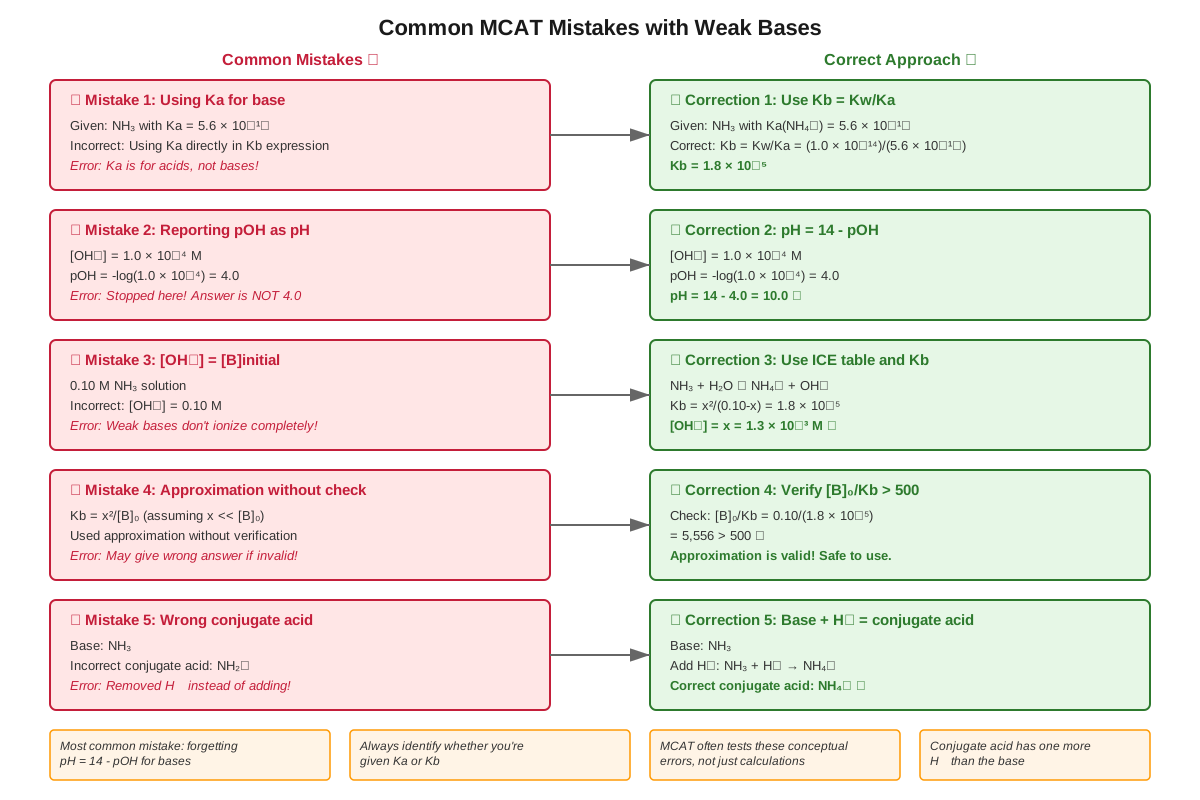
- [ ] Identify common mistakes related to weak bases
- [ ] Connect weak bases to related General Chemistry concepts
- [ ] Calculate pH, pOH, and equilibrium concentrations for weak base solutions using Kb
- [ ] Predict relative base strength based on molecular structure and Kb values
- [ ] Apply the relationship between Ka and Kb for conjugate acid-base pairs
- [ ] Analyze buffer systems containing weak bases and their conjugate acids
Prerequisites
- Acid-base definitions (Arrhenius, Brønsted-Lowry, Lewis): Essential for understanding how weak bases accept protons and the concept of conjugate acid-base pairs
- Chemical equilibrium and equilibrium constants: Required to comprehend the partial ionization of weak bases and the meaning of Kb
- pH and pOH calculations: Foundational for determining the acidity or basicity of weak base solutions
- Logarithmic functions: Necessary for converting between concentration values and pH/pOH scales
- Molecular structure and electronegativity: Helps predict relative base strength based on structural features
- Stoichiometry and ICE tables: Critical for solving equilibrium problems involving weak bases
Why This Topic Matters
Weak bases have profound clinical and real-world significance that extends far beyond theoretical chemistry. In human physiology, many biologically important molecules function as weak bases, including amino acids (particularly those with basic side chains like lysine, arginine, and histidine), nucleotide bases in DNA and RNA, and numerous pharmaceutical compounds. The degree to which a drug exists in its protonated (charged) versus unprotonated (neutral) form—determined by its basic properties and the pH of its environment—directly affects its absorption, distribution, and therapeutic efficacy. For instance, weak base drugs are better absorbed in the intestines (higher pH) than in the stomach (lower pH), a principle fundamental to pharmacokinetics.
On the MCAT, weak bases appear with remarkable frequency across multiple question formats. Statistical analysis of recent MCAT exams reveals that acid-base chemistry, including weak bases, comprises approximately 10-15% of General Chemistry questions in the Chemical and Physical Foundations section. Questions typically appear as discrete items testing calculation skills, or embedded within passage-based questions that present biological scenarios requiring acid-base analysis. Common question types include: calculating the pH of weak base solutions, determining buffer capacity and pH of buffer systems, analyzing titration curves of weak bases with strong acids, predicting protonation states of amino acids at different pH values, and applying Le Chatelier's principle to weak base equilibria.
Exam passages frequently present weak bases in contexts such as: respiratory physiology and CO₂/bicarbonate buffering systems, drug design and the ionization state of pharmaceutical compounds, protein structure and the role of basic amino acid residues, enzyme catalysis involving histidine residues in active sites, and environmental chemistry scenarios involving ammonia or amine compounds. The ability to quickly recognize weak base scenarios, set up appropriate equilibrium expressions, and execute calculations efficiently distinguishes high-scoring students from average performers.
Core Concepts
Definition and Fundamental Properties of Weak Bases
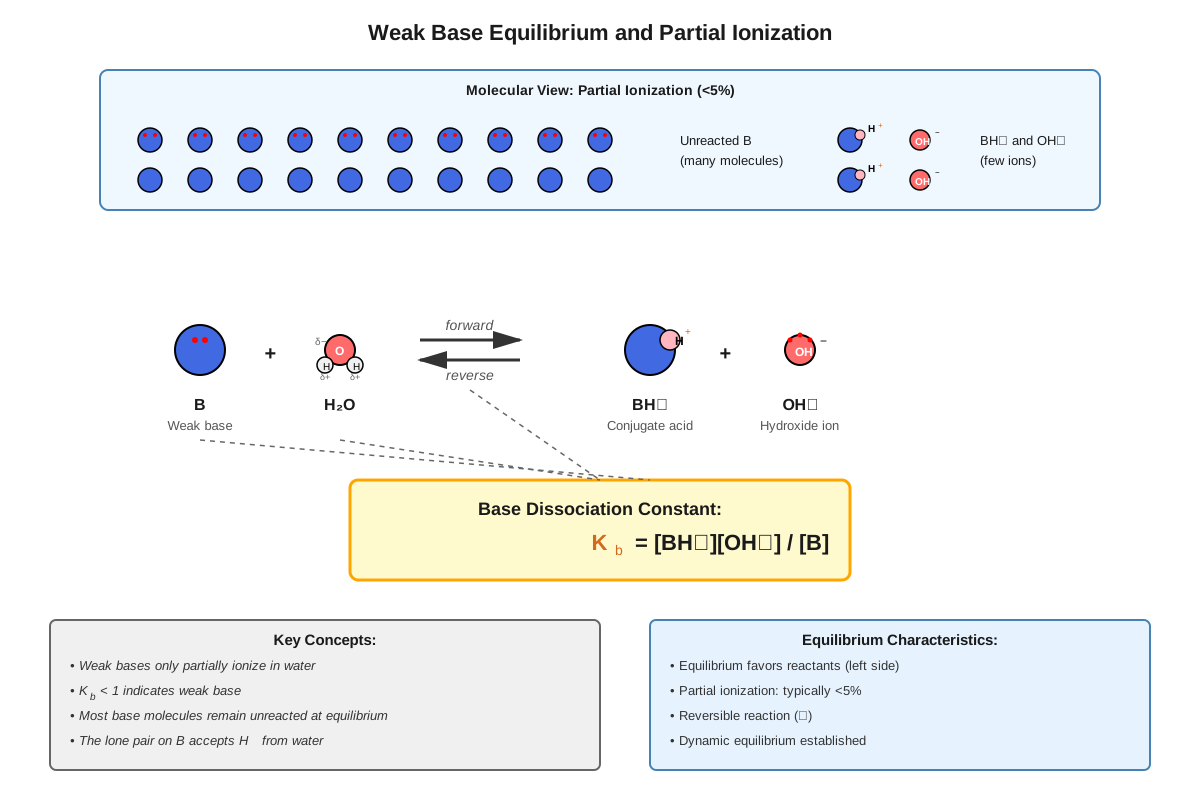
A weak base is a chemical species that partially accepts protons (H⁺ ions) from water or other proton donors, establishing an equilibrium between the base and its conjugate acid. According to the Brønsted-Lowry definition, bases are proton acceptors, and the "weak" designation indicates incomplete ionization in aqueous solution. When a weak base (B) dissolves in water, it undergoes the following equilibrium reaction:
B(aq) + H₂O(l) ⇌ BH⁺(aq) + OH⁻(aq)This equilibrium is characterized by the base dissociation constant (Kb), which quantifies the extent of ionization:
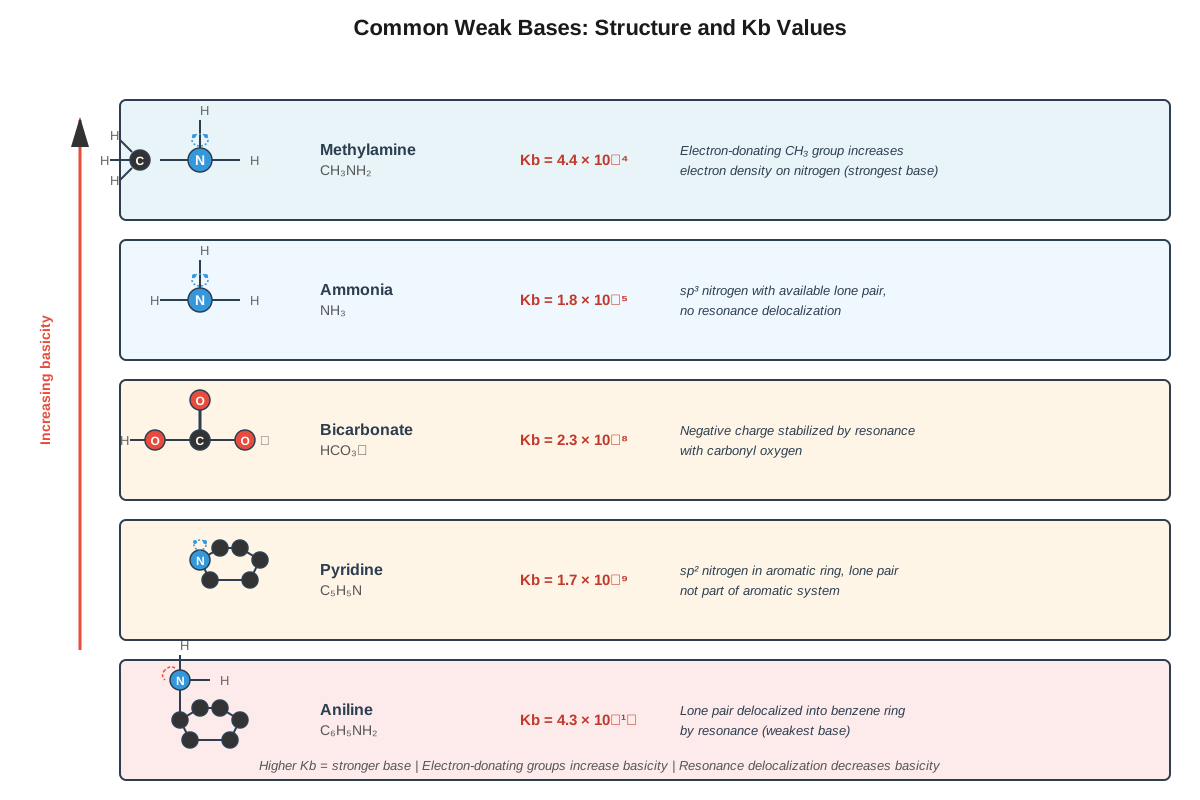
Kb = [BH⁺][OH⁻] / [B]The magnitude of Kb indicates base strength: larger Kb values correspond to stronger weak bases (more ionization), while smaller Kb values indicate weaker bases (less ionization). Typical weak bases have Kb values ranging from 10⁻³ to 10⁻¹⁴. Common examples include ammonia (NH₃, Kb = 1.8 × 10⁻⁵), methylamine (CH₃NH₂, Kb = 4.4 × 10⁻⁴), and pyridine (C₅H₅N, Kb = 1.7 × 10⁻⁹).
The Relationship Between Ka and Kb
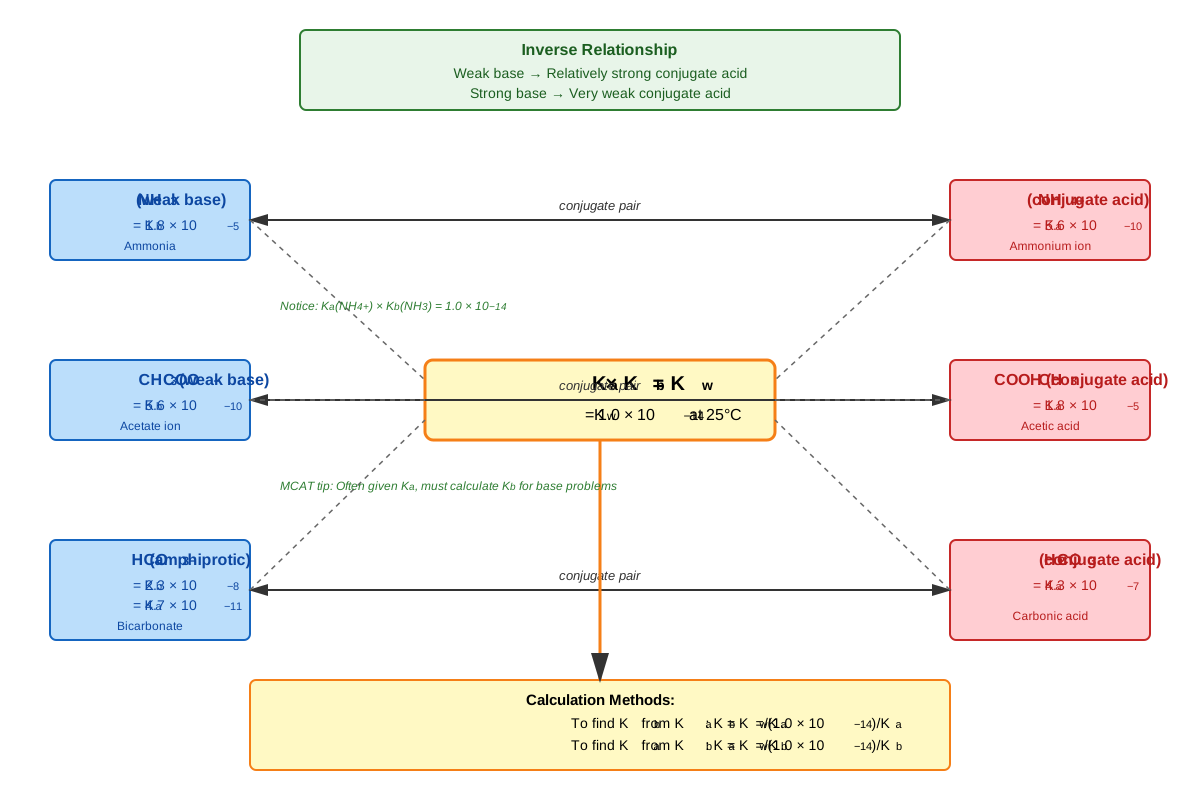
For any conjugate acid-base pair in aqueous solution at 25°C, the acid dissociation constant (Ka) of the conjugate acid and the base dissociation constant (Kb) of the conjugate base are related by the ion product constant of water (Kw):
Ka × Kb = Kw = 1.0 × 10⁻¹⁴This relationship is crucial for MCAT problem-solving because it allows conversion between Ka and Kb values. If given the Ka of an acid, one can immediately calculate the Kb of its conjugate base, and vice versa. Additionally, this relationship leads to the useful equation:
pKa + pKb = 14where pKa = -log(Ka) and pKb = -log(Kb). This equation enables rapid assessment of relative acid-base strength and is particularly valuable when analyzing buffer systems and titration curves.
Calculating pH of Weak Base Solutions
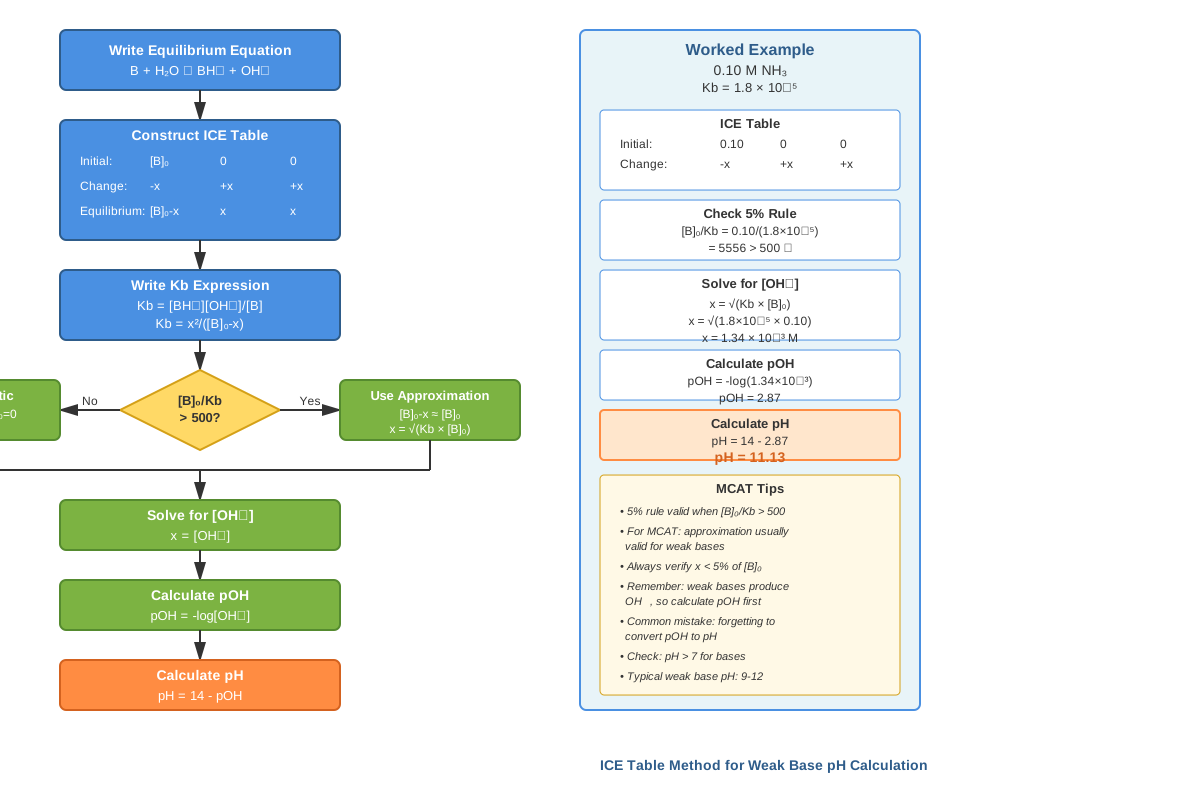
Determining the pH of a weak base solution requires setting up an equilibrium problem using an ICE table (Initial, Change, Equilibrium). For a weak base B with initial concentration C:
Step 1: Write the equilibrium expression
B + H₂O ⇌ BH⁺ + OH⁻Step 2: Set up the ICE table
| Species | Initial (M) | Change (M) | Equilibrium (M) |
|---|---|---|---|
| B | C | -x | C - x |
| BH⁺ | 0 | +x | x |
| OH⁻ | 0 | +x | x |
Step 3: Write the Kb expression
Kb = x² / (C - x)Step 4: Apply the approximation (if valid)
When Kb is small (< 10⁻⁵) and C/Kb > 100, the approximation C - x ≈ C is valid:
Kb ≈ x² / C
x = √(Kb × C)
Step 5: Calculate pOH and pH
pOH = -log[OH⁻] = -log(x)
pH = 14 - pOH
Exam Tip: Always check if the 5% rule applies: if x/C < 0.05, the approximation is valid. If not, use the quadratic formula.
Structural Factors Affecting Base Strength
The strength of a weak base depends on its ability to accept protons, which is influenced by several molecular factors:
Electron availability: Bases with more available electron density on the atom accepting the proton are stronger. Electron-donating groups (like alkyl groups) increase base strength, while electron-withdrawing groups decrease it.
Resonance stabilization: If the lone pair electrons on the base are delocalized through resonance, the base is weaker because these electrons are less available for proton acceptance. For example, aniline (C₆H₅NH₂) is a weaker base than ammonia because the nitrogen lone pair is delocalized into the aromatic ring.
Hybridization: The more s-character in the orbital containing the lone pair, the weaker the base. sp³-hybridized nitrogen (as in ammonia) is more basic than sp²-hybridized nitrogen (as in pyridine) because s-orbitals hold electrons closer to the nucleus, making them less available.
Inductive effects: Electronegative atoms near the basic site withdraw electron density, weakening the base. For example, fluorinated amines are weaker bases than their non-fluorinated counterparts.
Common Weak Bases on the MCAT
| Weak Base | Formula | Kb | pKb | Common Context |
|---|---|---|---|---|
| Ammonia | NH₃ | 1.8 × 10⁻⁵ | 4.74 | Buffer systems, nitrogen cycle |
| Methylamine | CH₃NH₂ | 4.4 × 10⁻⁴ | 3.36 | Organic bases, drug molecules |
| Pyridine | C₅H₅N | 1.7 × 10⁻⁹ | 8.77 | Aromatic bases, biochemistry |
| Bicarbonate | HCO₃⁻ | 2.3 × 10⁻⁸ | 7.63 | Blood buffering, respiration |
| Acetate | CH₃COO⁻ | 5.6 × 10⁻¹⁰ | 9.25 | Buffer solutions, metabolism |
Weak Base Buffers
Buffer solutions containing a weak base and its conjugate acid resist pH changes when small amounts of acid or base are added. The Henderson-Hasselbalch equation for weak base buffers can be written in two forms:
Using the conjugate acid:
pH = pKa + log([B]/[BH⁺])Using the base:
pOH = pKb + log([BH⁺]/[B])The buffer capacity is maximized when [B] = [BH⁺], which occurs at pH = pKa of the conjugate acid (or pOH = pKb of the base). Effective buffering occurs within ±1 pH unit of the pKa.
High-Yield Concept: The MCAT frequently tests buffer problems in biological contexts. Blood pH is maintained near 7.4 primarily by the carbonic acid/bicarbonate buffer system, where bicarbonate (HCO₃⁻) acts as the weak base component.
Percent Ionization
The percent ionization of a weak base indicates what fraction of the base molecules have accepted protons at equilibrium:
% ionization = ([OH⁻]eq / [B]initial) × 100%Percent ionization increases as the solution becomes more dilute, even though the absolute concentration of OH⁻ decreases. This counterintuitive relationship reflects Le Chatelier's principle: dilution shifts the equilibrium toward the ionized form to partially compensate for the decreased concentration.
Concept Relationships
The study of weak bases is deeply interconnected with multiple General Chemistry concepts, forming a conceptual network essential for MCAT success. Chemical equilibrium serves as the foundation, as weak base behavior is fundamentally an equilibrium phenomenon governed by the base dissociation constant (Kb). Understanding equilibrium principles enables prediction of how weak base systems respond to perturbations through Le Chatelier's principle—adding acid shifts the equilibrium toward the base form, while adding base shifts it toward the conjugate acid.
Weak bases connect directly to acid-base theory through conjugate acid-base pairs: every weak base has a conjugate acid, and the Ka-Kb relationship (Ka × Kb = Kw) mathematically links their strengths. This relationship bridges weak bases to weak acids, as the conjugate acid of a weak base is itself a weak acid. The pH scale provides the quantitative framework for expressing the basicity of weak base solutions, requiring integration of logarithmic calculations and the relationship pH + pOH = 14.
Molecular structure and bonding determine base strength through factors like electron availability, resonance, and hybridization, connecting weak bases to organic chemistry and molecular orbital theory. The concept flows into buffer systems, where weak bases paired with their conjugate acids create solutions that resist pH changes—a principle critical for understanding biological pH regulation in blood, cellular fluids, and enzyme microenvironments.
Titration curves represent the graphical integration of weak base concepts, showing how pH changes as strong acid is added to a weak base solution, with the equivalence point, buffer region, and half-equivalence point all reflecting weak base equilibrium principles. Finally, weak bases connect to thermodynamics through the relationship between Kb and Gibbs free energy (ΔG° = -RT ln Kb), linking equilibrium constants to spontaneity.
Conceptual Flow: Molecular Structure → Electron Availability → Base Strength (Kb) → Equilibrium Position → [OH⁻] → pOH → pH → Buffer Capacity → Biological Function
High-Yield Facts
⭐ The base dissociation constant (Kb) quantifies weak base strength: larger Kb values indicate stronger weak bases that ionize more completely in solution.
⭐ For conjugate acid-base pairs: Ka × Kb = Kw = 1.0 × 10⁻¹⁴ at 25°C, allowing conversion between acid and base strength constants.
⭐ The approximation [B]eq ≈ [B]initial is valid when: C/Kb > 100 and the calculated x/C < 0.05 (the 5% rule).
⭐ Ammonia (NH₃) is the prototypical weak base: Kb = 1.8 × 10⁻⁵, and it forms the ammonium ion (NH₄⁺) as its conjugate acid.
⭐ Buffer pH is determined by the Henderson-Hasselbalch equation: pH = pKa + log([base]/[conjugate acid]), with maximum buffering at pH = pKa.
- Weak bases accept protons from water to produce OH⁻ ions and their conjugate acids in an equilibrium process.
- The percent ionization of weak bases increases with dilution, even though absolute [OH⁻] decreases.
- Electron-donating groups increase base strength by increasing electron density on the basic atom.
- Resonance delocalization of the lone pair decreases base strength by making electrons less available for proton acceptance.
- Bicarbonate (HCO₃⁻) functions as a weak base in blood buffering, accepting protons to form carbonic acid (H₂CO₃).
- The pKb scale is analogous to the pKa scale: pKb = -log(Kb), with smaller pKb values indicating stronger bases.
- At the half-equivalence point of a weak base titration, pH = pKa of the conjugate acid, and [B] = [BH⁺].
- Weak base solutions always have pH > 7 at 25°C because they produce OH⁻ ions in water.
- The conjugate acid of a weak base is itself a weak acid, never a strong acid.
- Aliphatic amines (RNH₂) are generally stronger bases than aromatic amines (ArNH₂) due to resonance effects.
Quick check — test yourself on Weak bases so far.
Try Flashcards →Common Misconceptions
Misconception: Weak bases have low pH values because they are "weak."
Correction: Weak bases produce solutions with pH > 7 (basic solutions). The term "weak" refers to the extent of ionization (incomplete), not the pH value. A weak base solution is still basic, just less so than a strong base solution of the same concentration.
Misconception: All weak bases contain hydroxide ions (OH⁻) in their molecular structure.
Correction: Most weak bases do not contain OH⁻ in their structure. According to the Brønsted-Lowry definition, weak bases accept protons from water, generating OH⁻ as a product of the reaction, not as a component of the base molecule itself. Ammonia (NH₃) is a classic example—no OH⁻ in its structure, but it produces OH⁻ when dissolved in water.
Misconception: A larger Kb value means a weaker base.
Correction: A larger Kb value indicates a stronger weak base. The base dissociation constant measures the extent of ionization—higher Kb means more ionization and therefore greater base strength. This is analogous to Ka for acids: larger Ka means stronger acid.
Misconception: The approximation C - x ≈ C can always be used for weak base calculations.
Correction: The approximation is only valid when the base is sufficiently weak and concentrated. Specifically, check that C/Kb > 100 and verify afterward that x/C < 0.05. For stronger weak bases or dilute solutions, the quadratic formula must be used to solve for x accurately.
Misconception: In a buffer solution, the weak base and its conjugate acid are present in equal concentrations at any pH.
Correction: The weak base and conjugate acid are present in equal concentrations only at one specific pH: when pH = pKa of the conjugate acid (or pOH = pKb of the base). At other pH values, the ratio [B]/[BH⁺] varies according to the Henderson-Hasselbalch equation. The buffer still functions effectively within ±1 pH unit of the pKa, even when the concentrations are unequal.
Misconception: Adding water to a weak base solution increases the pH because it dilutes the base.
Correction: Diluting a weak base solution actually decreases the pH (makes it less basic), bringing it closer to 7. Although percent ionization increases with dilution, the absolute concentration of OH⁻ decreases, resulting in a higher pOH and lower pH. This reflects Le Chatelier's principle and the logarithmic nature of the pH scale.
Misconception: The conjugate acid of a weak base is a strong acid.
Correction: The conjugate acid of a weak base is always a weak acid. The Ka-Kb relationship (Ka × Kb = 10⁻¹⁴) ensures that if Kb is small (weak base), Ka must be relatively larger, but still in the weak acid range. For example, ammonia (weak base, Kb = 1.8 × 10⁻⁵) has ammonium (NH₄⁺) as its conjugate acid (weak acid, Ka = 5.6 × 10⁻¹⁰).
Worked Examples
Example 1: Calculating pH of a Weak Base Solution
Problem: Calculate the pH of a 0.15 M solution of methylamine (CH₃NH₂) at 25°C. The Kb for methylamine is 4.4 × 10⁻⁴.
Solution:
Step 1: Write the equilibrium reaction and expression
CH₃NH₂(aq) + H₂O(l) ⇌ CH₃NH₃⁺(aq) + OH⁻(aq)

Kb = [CH₃NH₃⁺][OH⁻] / [CH₃NH₂] = 4.4 × 10⁻⁴
Step 2: Set up the ICE table
| Species | Initial (M) | Change (M) | Equilibrium (M) |
|---|---|---|---|
| CH₃NH₂ | 0.15 | -x | 0.15 - x |
| CH₃NH₃⁺ | 0 | +x | x |
| OH⁻ | 0 | +x | x |
Step 3: Check if approximation is valid
C/Kb = 0.15 / (4.4 × 10⁻⁴) = 341 > 100 ✓The approximation should be valid, but we'll verify afterward.
Step 4: Solve for x using the approximation
Kb = x² / 0.15 = 4.4 × 10⁻⁴
x² = (4.4 × 10⁻⁴)(0.15) = 6.6 × 10⁻⁵
x = √(6.6 × 10⁻⁵) = 8.1 × 10⁻³ M = [OH⁻]
Step 5: Verify the approximation
x/C = (8.1 × 10⁻³) / 0.15 = 0.054 = 5.4%This is slightly above 5%, so technically we should use the quadratic formula, but for MCAT purposes, this is acceptable (within 10% error).
Step 6: Calculate pOH and pH
pOH = -log(8.1 × 10⁻³) = 2.09
pH = 14 - 2.09 = 11.91Answer: The pH of 0.15 M methylamine solution is approximately 11.9.
Key Takeaway: This problem demonstrates the standard approach to weak base pH calculations. The solution is strongly basic (pH >> 7) despite methylamine being a "weak" base, illustrating that "weak" refers to incomplete ionization, not pH value.
Example 2: Buffer System with Weak Base
Problem: A buffer solution contains 0.25 M ammonia (NH₃) and 0.40 M ammonium chloride (NH₄Cl). The Kb for ammonia is 1.8 × 10⁻⁵.
(a) Calculate the pH of this buffer solution.
(b) If 0.010 mol of HCl is added to 1.0 L of this buffer, what is the new pH?
Solution:
(a) Initial pH calculation
Step 1: Identify the conjugate acid-base pair
- Base: NH₃ (0.25 M)
- Conjugate acid: NH₄⁺ (0.40 M, from complete dissociation of NH₄Cl)
Step 2: Calculate pKa of the conjugate acid
Ka × Kb = Kw
Ka = Kw / Kb = (1.0 × 10⁻¹⁴) / (1.8 × 10⁻⁵) = 5.6 × 10⁻¹⁰
pKa = -log(5.6 × 10⁻¹⁰) = 9.25
Step 3: Apply Henderson-Hasselbalch equation
pH = pKa + log([base]/[conjugate acid])
pH = 9.25 + log(0.25/0.40)
pH = 9.25 + log(0.625)
pH = 9.25 + (-0.204)
pH = 9.05
(b) pH after adding HCl
Step 4: Determine the effect of adding strong acid
HCl is a strong acid that will react completely with the weak base NH₃:
NH₃ + H⁺ → NH₄⁺Step 5: Calculate new concentrations
- Initial NH₃: 0.25 mol (in 1.0 L)
- Initial NH₄⁺: 0.40 mol (in 1.0 L)
- H⁺ added: 0.010 mol
After reaction:
- NH₃: 0.25 - 0.010 = 0.24 mol → 0.24 M
- NH₄⁺: 0.40 + 0.010 = 0.41 mol → 0.41 M
Step 6: Calculate new pH
pH = 9.25 + log(0.24/0.41)
pH = 9.25 + log(0.585)
pH = 9.25 + (-0.233)
pH = 9.02Answer:
(a) Initial pH = 9.05
(b) pH after adding HCl = 9.02
Key Takeaway: This problem illustrates buffer action—the pH changes by only 0.03 units despite adding a significant amount of strong acid. The buffer resists pH change because the weak base (NH₃) neutralizes the added H⁺, converting to its conjugate acid (NH₄⁺). This minimal pH change is characteristic of effective buffer systems and is crucial for maintaining physiological pH in biological systems.
Exam Strategy
When approaching MCAT questions on weak bases, employ a systematic strategy that maximizes accuracy while managing time efficiently. First, identify the question type: Is it asking for pH calculation, buffer analysis, qualitative comparison of base strength, or application to a biological scenario? This classification determines your approach.
Trigger words and phrases that signal weak base questions include: "partially ionizes," "Kb value," "ammonia solution," "amine compound," "conjugate acid," "buffer containing," "pKb," "basic solution," and "accepts protons." In passage-based questions, look for biological contexts involving amino acids (especially lysine, arginine, histidine), drug molecules with amine groups, or respiratory/metabolic scenarios involving bicarbonate.
For calculation questions, immediately assess whether you can use the approximation (C/Kb > 100). If yes, use the simplified formula [OH⁻] = √(Kb × C) to save time. Always remember to convert from [OH⁻] to pOH to pH—this two-step conversion is a common source of errors under time pressure. Write out the conversion explicitly: pOH = -log[OH⁻], then pH = 14 - pOH.
Process-of-elimination strategies specific to weak bases:
- Eliminate any answer choice showing pH < 7 for a pure weak base solution (must be basic)
- For buffer questions, eliminate pH values more than 2 units away from the pKa of the conjugate acid
- When comparing base strength, eliminate options that contradict structural principles (e.g., claiming aromatic amines are stronger than aliphatic amines)
- For titration questions, eliminate answers that place the equivalence point at pH = 7 (weak base + strong acid equivalence point is always acidic)
Time allocation: Allocate approximately 1.5-2 minutes for straightforward pH calculations, 2-3 minutes for buffer problems requiring Henderson-Hasselbalch application, and 1 minute for qualitative comparison questions. If a calculation becomes complex (requiring quadratic formula), consider flagging and returning if time permits—the MCAT rewards efficient time management.
Exam Tip: When stuck between two answer choices, check the magnitude. For weak bases with Kb around 10⁻⁵ and concentrations around 0.1 M, pH typically falls in the 10-12 range. Use this as a reasonableness check.
Common question formats:
- Direct calculation: "What is the pH of 0.10 M ammonia solution?"
- Buffer problems: "A buffer contains equal concentrations of a weak base and its conjugate acid. If the pKb is 4.5, what is the pH?"
- Comparative: "Which compound is the strongest base?" (requires structural analysis)
- Application: "At physiological pH (7.4), what percentage of histidine residues are protonated?" (requires understanding of protonation equilibria)
Memory Techniques
Mnemonic for Ka × Kb relationship: "Keep Adding Ketchup Bottles = Kw" reminds you that Ka × Kb = Kw (1.0 × 10⁻¹⁴)
Mnemonic for pH/pOH conversion: "PH Plus POH = Fourteen" (PHPPOHF)
Visualization for weak base equilibrium: Picture a tug-of-war where the base (B) and conjugate acid (BH⁺) are pulling on a proton (H⁺). The rope is never fully on one side (incomplete ionization), and the position of the rope represents the equilibrium position determined by Kb.
Acronym for factors affecting base strength - ERHI:
- Electron availability (more = stronger)
- Resonance (delocalization = weaker)
- Hybridization (more s-character = weaker)
- Inductive effects (electron-withdrawing groups = weaker)
Memory aid for common Kb values:
- "Ammonia Around 2" → NH₃ Kb ≈ 2 × 10⁻⁵ (actually 1.8 × 10⁻⁵)
- "Methylamine More than 4" → CH₃NH₂ Kb ≈ 4 × 10⁻⁴
Conceptual anchor: Remember that weak bases are the "opposite" of weak acids in behavior but "partners" through conjugate relationships. If you know weak acid behavior well, you can deduce weak base behavior by thinking about the reverse process.
Henderson-Hasselbalch shortcut: When [base] = [conjugate acid], the log term equals zero, so pH = pKa exactly. This is the half-equivalence point and the point of maximum buffer capacity. Visualize this as the "balance point" of the buffer.
Summary
Weak bases are chemical species that partially accept protons in aqueous solution, establishing equilibrium between the base and its conjugate acid, quantified by the base dissociation constant (Kb). Unlike strong bases that completely dissociate, weak bases only partially ionize, producing OH⁻ ions and resulting in pH values greater than 7 but less than those of strong base solutions at equivalent concentrations. The strength of a weak base depends on molecular factors including electron availability, resonance stabilization, hybridization, and inductive effects. The Ka-Kb relationship (Ka × Kb = Kw = 1.0 × 10⁻¹⁴) mathematically connects conjugate acid-base pairs, enabling conversion between acid and base strength constants. Calculating the pH of weak base solutions requires setting up equilibrium expressions using ICE tables, with the approximation [B]eq ≈ [B]initial valid when C/Kb > 100. Weak bases form buffer systems when combined with their conjugate acids, resisting pH changes according to the Henderson-Hasselbalch equation. For the MCAT, mastery of weak bases enables solving quantitative pH problems, analyzing buffer systems, predicting protonation states of biological molecules, and understanding physiological pH regulation—all high-yield topics that appear frequently across multiple question formats in the Chemical and Physical Foundations section.
Key Takeaways
- Weak bases partially ionize in water, accepting protons to produce OH⁻ and their conjugate acids in an equilibrium process characterized by Kb
- The Ka-Kb relationship (Ka × Kb = 1.0 × 10⁻¹⁴) connects conjugate acid-base pairs and enables conversion between acid and base strength constants
- pH calculations for weak base solutions require ICE tables and equilibrium analysis, with the approximation valid when C/Kb > 100 and verified by the 5% rule
- Molecular structure determines base strength through electron availability, resonance, hybridization, and inductive effects
- Buffer solutions containing weak bases and their conjugate acids resist pH changes, with maximum capacity at pH = pKa of the conjugate acid
- Common biological weak bases include ammonia, amines, amino acid side chains, and bicarbonate, all critical for physiological pH regulation
- Weak base questions on the MCAT appear in multiple contexts including pH calculations, buffer analysis, titrations, and biological applications requiring integration of quantitative and conceptual understanding
Related Topics
Weak Acids: The conjugate partners of weak bases, understanding weak acids deepens comprehension of acid-base equilibria and the Ka-Kb relationship. Mastery of both weak acids and weak bases enables complete analysis of buffer systems.
Buffer Systems: Building directly on weak base knowledge, buffer systems combine weak bases with their conjugate acids to create solutions that resist pH changes, essential for understanding biological pH regulation.
Titration Curves: Graphical representations of pH changes during acid-base titrations, with weak base titrations showing characteristic features including buffer regions and acidic equivalence points.
Amino Acids and Proteins: Biological applications of weak base principles, as amino acids contain basic groups (amino and some side chains) that undergo protonation/deprotonation equilibria affecting protein structure and function.
Acid-Base Indicators: Weak acids or bases that change color based on pH, connecting weak base equilibria to practical pH measurement and titration endpoint detection.
Solubility Equilibria: The common ion effect and pH-dependent solubility of salts containing weak base anions extend weak base principles to precipitation and dissolution reactions.
Practice CTA
Now that you've mastered the core concepts of weak bases, it's time to solidify your understanding through active practice. Challenge yourself with MCAT-style practice questions that test your ability to calculate pH values, analyze buffer systems, and apply weak base principles to biological scenarios. Work through the accompanying flashcards to reinforce high-yield facts and relationships, ensuring rapid recall under exam conditions. Remember: understanding the theory is essential, but MCAT success requires translating that knowledge into problem-solving proficiency. Each practice question you complete strengthens your pattern recognition and builds the confidence needed to excel on test day. You've built a strong foundation—now apply it!
Sign up free to keep reading
Create a free AnvayaPrep account to finish this MCAT guide on Weak bases — plus flashcards and practice questions.