Overview
The Aufbau principle stands as one of the foundational concepts in General Chemistry that governs how electrons populate atomic orbitals. Derived from the German word "Aufbau," meaning "building up," this principle describes the systematic process by which electrons fill orbitals in atoms, starting from the lowest energy level and progressing to higher energy levels. Understanding this principle is essential for predicting electron configurations, which in turn determines an element's chemical properties, reactivity, and position within the periodic table. The Aufbau principle works in concert with Hund's rule and the Pauli exclusion principle to provide a complete picture of electron arrangement in atoms.
For MCAT preparation, mastery of the Aufbau principle is non-negotiable. This concept appears frequently in questions related to Atomic Structure and Periodic Trends, electron configuration, ionization energy, atomic radius, and chemical bonding. The MCAT tests not only rote memorization of electron configurations but also the ability to apply the Aufbau principle to predict chemical behavior, explain periodic trends, and understand molecular orbital theory. Questions may present unusual electron configurations, ask students to identify violations of the principle, or require application of the concept to transition metals and ions where electron removal follows different patterns than electron addition.
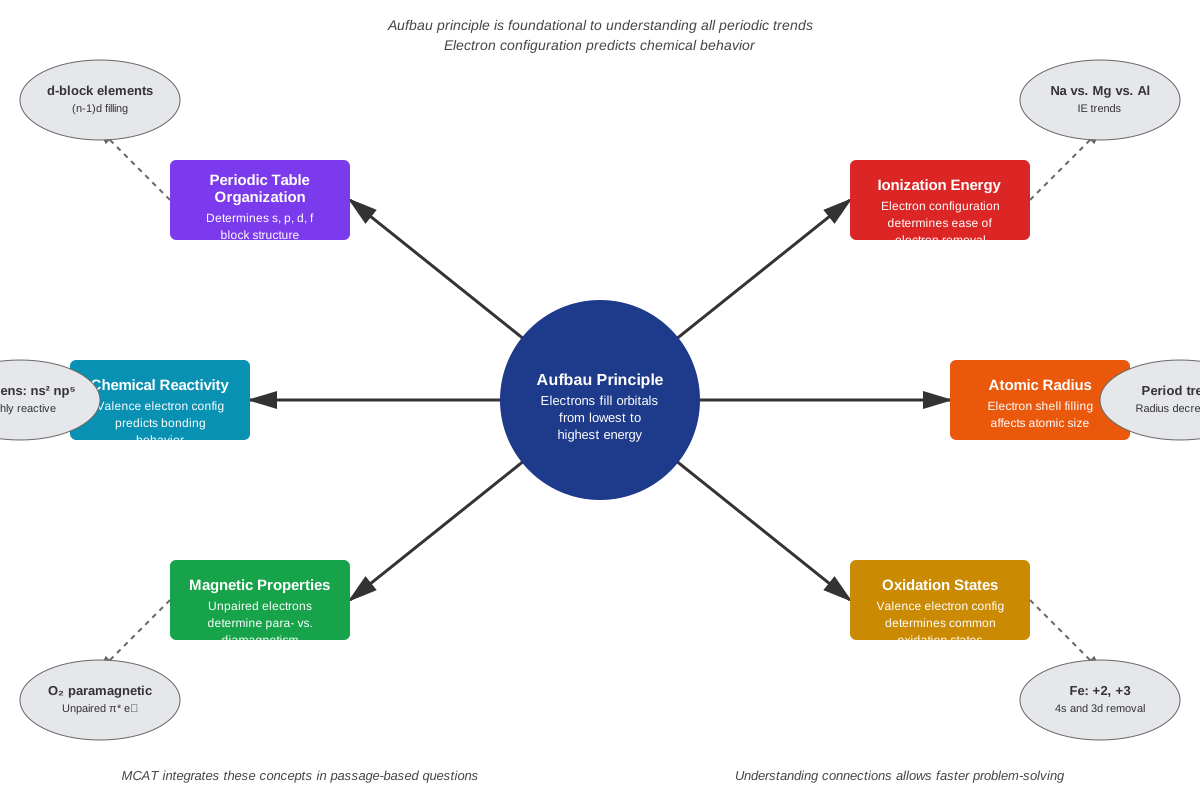
The Aufbau principle MCAT questions integrate seamlessly with broader General Chemistry topics. It serves as the bridge between quantum mechanical models of the atom and observable chemical properties. Understanding how electrons fill orbitals according to the Aufbau principle enables prediction of valence electron configurations, which directly determines bonding patterns, oxidation states, magnetic properties, and reactivity trends across the periodic table. This principle is fundamental to understanding why elements in the same group share similar chemical properties and why transition metals exhibit variable oxidation states.
Learning Objectives
- [ ] Define Aufbau principle using accurate General Chemistry terminology
- [ ] Explain why Aufbau principle matters for the MCAT
- [ ] Apply Aufbau principle to exam-style questions
- [ ] Identify common mistakes related to Aufbau principle
- [ ] Connect Aufbau principle to related General Chemistry concepts
- [ ] Predict complete electron configurations for neutral atoms and ions using the Aufbau principle
- [ ] Recognize and explain exceptions to the Aufbau principle in transition metals and their significance
- [ ] Utilize the Aufbau principle to explain periodic trends including ionization energy, atomic radius, and electronegativity
Prerequisites
- Quantum numbers and orbital shapes: Understanding s, p, d, and f orbitals is essential because the Aufbau principle describes the order in which these orbitals fill with electrons
- Energy levels and sublevels: Knowledge of principal quantum numbers (n) and sublevel designations provides the framework for understanding relative orbital energies
- Basic atomic structure: Familiarity with protons, neutrons, and electrons establishes the foundation for understanding how electrons are distributed in atoms
- Periodic table organization: Recognition of periods, groups, and blocks helps visualize how the Aufbau principle manifests in periodic table structure
- Pauli exclusion principle: Understanding that each orbital holds a maximum of two electrons with opposite spins is necessary for applying the Aufbau principle correctly
- Hund's rule: Knowledge that electrons fill degenerate orbitals singly before pairing complements the Aufbau principle in determining electron configurations
Why This Topic Matters
The Aufbau principle has profound clinical and real-world significance beyond its theoretical importance. Understanding electron configurations enables prediction of how elements will interact in biological systems. For instance, iron's ability to exist in multiple oxidation states (Fe²⁺ and Fe³⁺) due to its electron configuration makes it essential for oxygen transport in hemoglobin. Transition metal complexes in enzymes, such as zinc in carbonic anhydrase or copper in cytochrome c oxidase, function based on their specific electron configurations. Radiopharmaceuticals used in medical imaging rely on the electronic properties of elements like technetium-99m, whose behavior is predicted through the Aufbau principle.
On the MCAT, the Aufbau principle appears with moderate to high frequency across multiple question formats. Approximately 3-5% of General Chemistry questions directly test electron configuration knowledge, while another 10-15% incorporate it indirectly through periodic trends, bonding, or spectroscopy questions. The Chemical and Physical Foundations of Biological Systems section frequently presents discrete questions requiring rapid electron configuration determination, while passage-based questions may embed the concept within discussions of coordination chemistry, redox reactions, or spectroscopic analysis. Questions testing the Aufbau principle often appear as "EXCEPT" questions, asking which electron configuration violates the principle, or as application questions requiring students to predict properties based on electron configuration.
Common MCAT passage contexts include transition metal biochemistry (discussing metalloenzymes or metal cofactors), coordination chemistry in drug design, spectroscopic techniques (where electron transitions are analyzed), and periodic trend explanations. The exam particularly favors questions about exceptions to the Aufbau principle (chromium and copper configurations), electron configurations of ions (especially transition metal cations), and the relationship between electron configuration and magnetic properties (paramagnetic versus diamagnetic species).
Core Concepts
Definition and Fundamental Statement
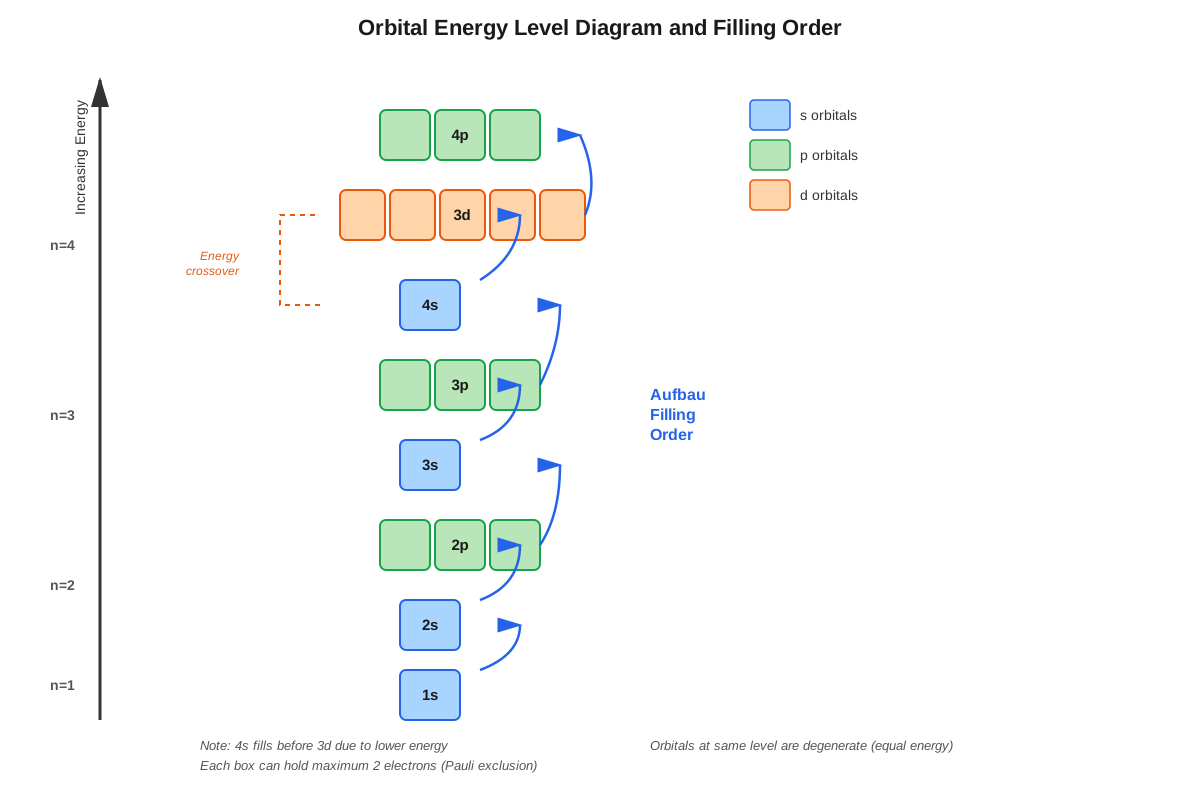
The Aufbau principle states that electrons occupy orbitals in order of increasing energy, filling the lowest energy orbitals first before proceeding to higher energy orbitals. This "building up" process follows a predictable sequence that can be determined using the n + l rule, where n represents the principal quantum number and l represents the azimuthal (angular momentum) quantum number. When two orbitals have the same n + l value, the orbital with the lower n value fills first. This principle assumes that electrons are being added to a neutral atom in its ground state, one electron at a time, until the desired electron configuration is achieved.
The theoretical basis for the Aufbau principle lies in quantum mechanics and the solution of the Schrödinger equation for multi-electron atoms. In hydrogen (a one-electron system), orbitals with the same principal quantum number have identical energies (they are degenerate). However, in multi-electron atoms, electron-electron repulsions and nuclear shielding effects cause orbitals within the same principal energy level to have different energies. The relative energies follow the pattern: s < p < d < f for orbitals within the same principal quantum number, but orbital energies from different principal quantum numbers can overlap, creating the characteristic filling order.
Orbital Filling Order
The standard orbital filling sequence for the Aufbau principle General Chemistry follows this pattern:
1s → 2s → 2p → 3s → 3p → 4s → 3d → 4p → 5s → 4d → 5p → 6s → 4f → 5d → 6p → 7s → 5f → 6d → 7p
This sequence can be memorized using the diagonal rule or the n + l rule. The diagonal rule provides a visual method: write the orbitals in rows by principal quantum number, then draw diagonal arrows from upper right to lower left to determine filling order. The n + l rule provides a mathematical approach: calculate n + l for each orbital, and fill orbitals in order of increasing n + l value.
| Orbital | n | l | n + l | Fills |
|---|---|---|---|---|
| 1s | 1 | 0 | 1 | 1st |
| 2s | 2 | 0 | 2 | 2nd |
| 2p | 2 | 1 | 3 | 3rd |
| 3s | 3 | 0 | 3 | 4th (lower n) |
| 3p | 3 | 1 | 4 | 5th |
| 4s | 4 | 0 | 4 | 6th (lower n) |
| 3d | 3 | 2 | 5 | 7th |
| 4p | 4 | 1 | 5 | 8th (lower n) |
Application to Electron Configurations
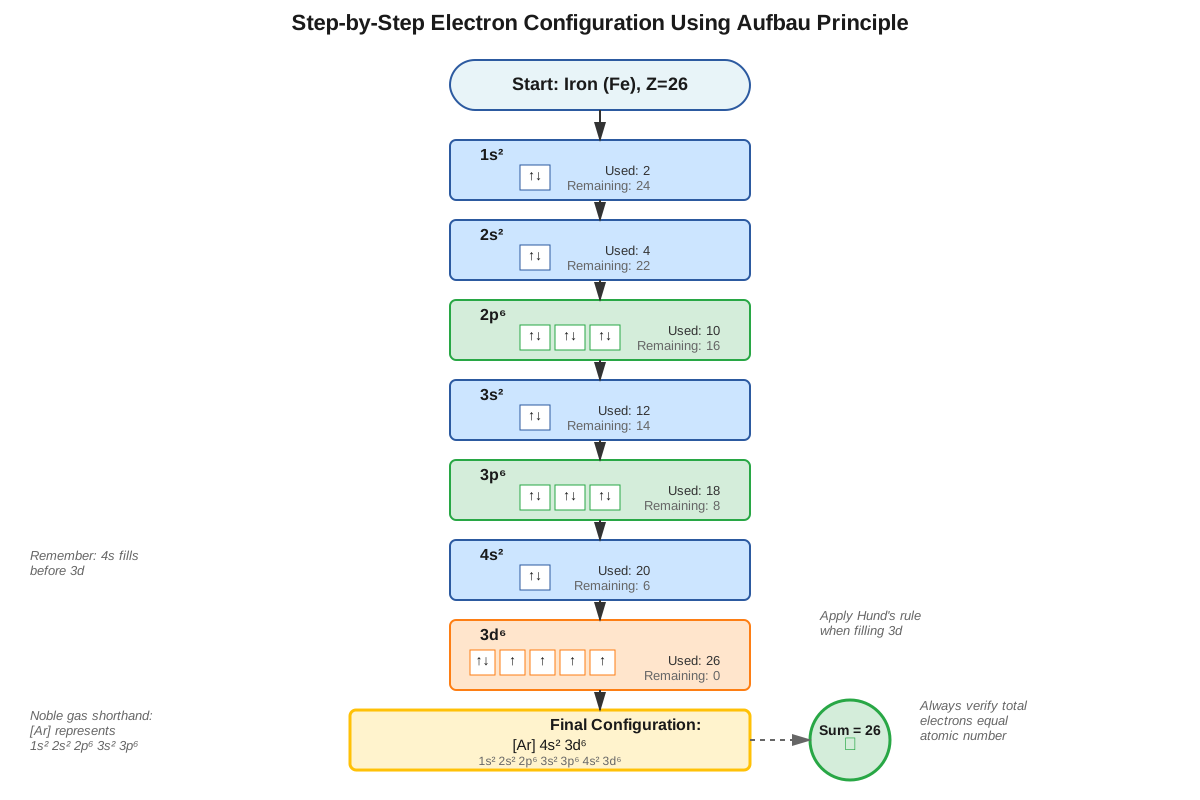
To write an electron configuration using the Aufbau principle, follow these steps:
- Determine the atomic number (Z) to know the total number of electrons in the neutral atom
- Fill orbitals in order of increasing energy according to the Aufbau sequence
- Apply the Pauli exclusion principle: each orbital holds maximum two electrons with opposite spins
- Apply Hund's rule: within degenerate orbitals (same energy), place one electron in each orbital before pairing
- Continue until all electrons are placed
For example, nitrogen (Z = 7) has the electron configuration: 1s² 2s² 2p³. The seven electrons fill the 1s orbital (2 electrons), then the 2s orbital (2 electrons), then the three 2p orbitals receive one electron each following Hund's rule. The superscript numbers indicate the number of electrons in each sublevel.
Exceptions to the Aufbau Principle
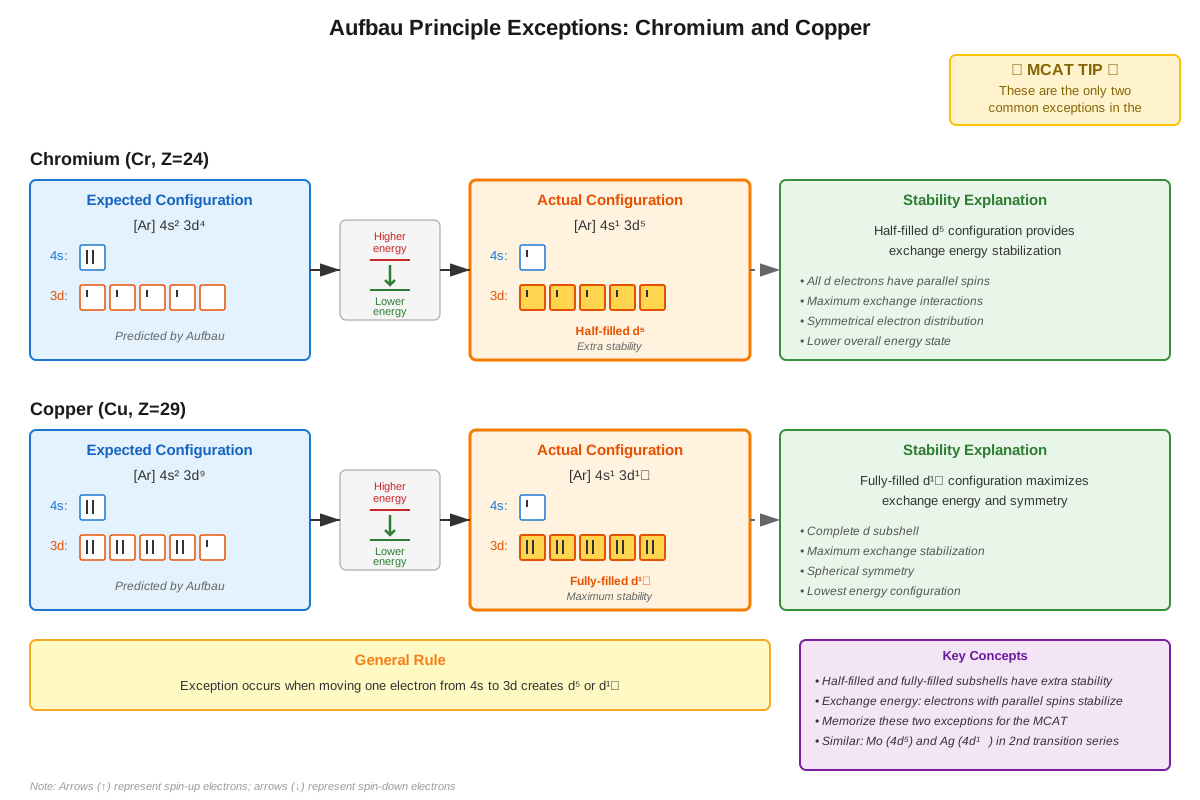
While the Aufbau principle successfully predicts electron configurations for most elements, notable exceptions exist, particularly among transition metals. These exceptions occur because half-filled and fully-filled subshells possess extra stability due to exchange energy and symmetry considerations. The most commonly tested exceptions on the MCAT include:
Chromium (Cr, Z = 24): Expected configuration would be [Ar] 4s² 3d⁴, but the actual configuration is [Ar] 4s¹ 3d⁵. The half-filled 3d subshell (five electrons in five orbitals) provides additional stability that outweighs the energy cost of promoting one electron from 4s to 3d.
Copper (Cu, Z = 29): Expected configuration would be [Ar] 4s² 3d⁹, but the actual configuration is [Ar] 4s¹ 3d¹⁰. The fully-filled 3d subshell (ten electrons in five orbitals) provides exceptional stability.
Other exceptions include molybdenum (Mo), silver (Ag), gold (Au), and several lanthanides and actinides. These exceptions demonstrate that the Aufbau principle serves as a guideline rather than an absolute rule, and that actual electron configurations reflect the lowest energy state considering all electron-electron interactions.
Electron Configurations of Ions
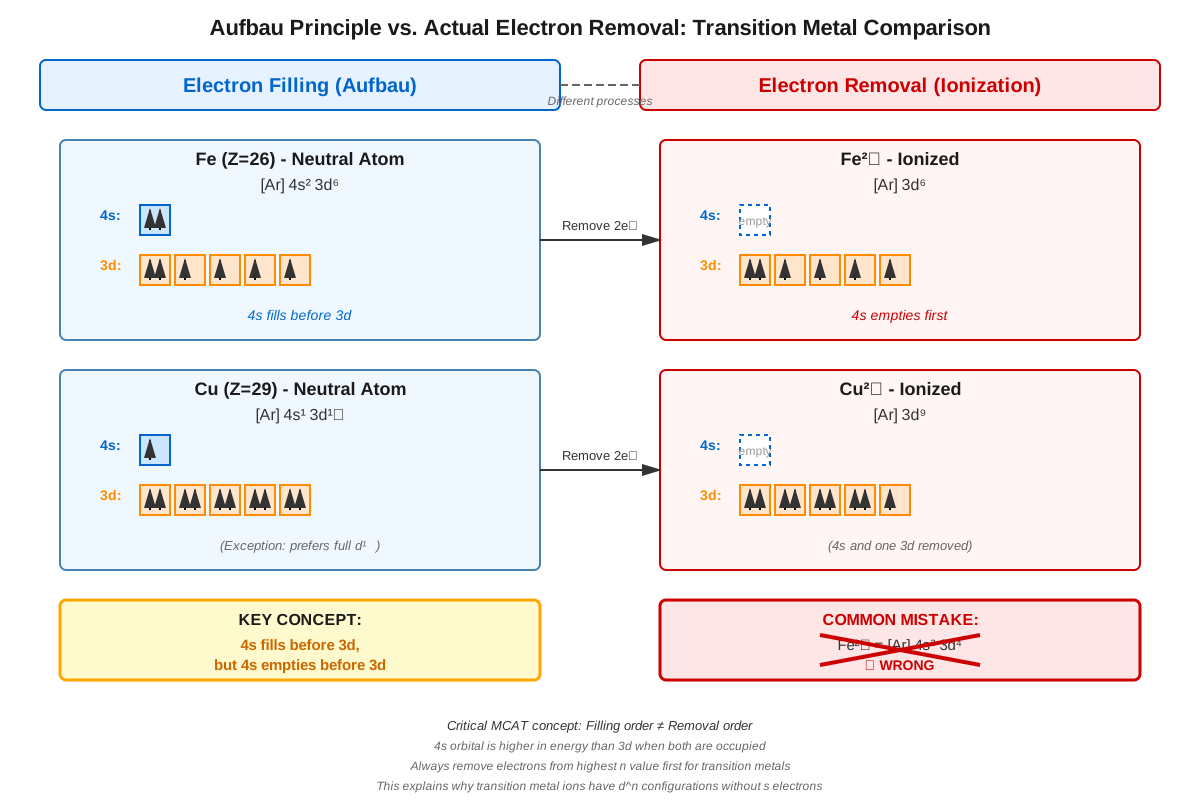
When applying the Aufbau principle to ions, a critical distinction must be made: electrons are removed from ions in a different order than they are added to neutral atoms. For main group elements, electrons are removed from the highest principal quantum number first. For transition metals, electrons are always removed from the ns orbital before the (n-1)d orbital, even though the ns orbital filled first according to the Aufbau principle.
For example, iron (Fe, Z = 26) has the neutral atom configuration [Ar] 4s² 3d⁶. When forming Fe²⁺, the two 4s electrons are removed first, yielding [Ar] 3d⁶, not [Ar] 4s² 3d⁴. When forming Fe³⁺, the two 4s electrons and one 3d electron are removed, yielding [Ar] 3d⁵. This pattern reflects the fact that once the 3d orbitals begin to fill, they become lower in energy than the 4s orbital due to increased nuclear charge and electron-electron repulsions.
Relationship to Periodic Table Structure
The periodic table's structure directly reflects the Aufbau principle. The table can be divided into blocks corresponding to the type of orbital being filled:
- s-block: Groups 1-2 (alkali and alkaline earth metals) where s orbitals are filling
- p-block: Groups 13-18 (main group elements) where p orbitals are filling
- d-block: Groups 3-12 (transition metals) where d orbitals are filling
- f-block: Lanthanides and actinides where f orbitals are filling
The period number corresponds to the principal quantum number of the valence electrons. Elements in the same group have the same valence electron configuration, which explains their similar chemical properties. This organization makes the periodic table a powerful tool for predicting electron configurations without memorizing each element individually.
Concept Relationships
The Aufbau principle forms the central organizing concept for understanding atomic electron structure, connecting quantum mechanical principles to observable chemical properties. The principle operates in conjunction with the Pauli exclusion principle (which limits each orbital to two electrons with opposite spins) and Hund's rule (which dictates that electrons occupy degenerate orbitals singly before pairing). Together, these three principles completely determine ground-state electron configurations.
The relationship flows as follows: Quantum numbers → define orbital types and energies → Aufbau principle orders orbital filling → Pauli exclusion principle limits electrons per orbital → Hund's rule determines electron distribution within degenerate orbitals → Electron configuration emerges → determines valence electrons → governs chemical properties and periodic trends.
Electron configurations determined by the Aufbau principle directly explain periodic trends. Moving left to right across a period, electrons are added to the same principal energy level, increasing effective nuclear charge and causing atomic radius to decrease and ionization energy to increase. Moving down a group, electrons are added to higher principal energy levels, increasing atomic radius and decreasing ionization energy. The Aufbau principle explains why these trends have discontinuities at certain points (such as the slight decrease in ionization energy from nitrogen to oxygen due to electron pairing in the 2p orbitals).
The principle connects to chemical bonding by determining valence electron configurations. Elements bond to achieve stable electron configurations, typically those of noble gases. Understanding which orbitals are filled and which are available for bonding enables prediction of bond formation, molecular geometry, and compound stability. For transition metals, the Aufbau principle explains variable oxidation states and the formation of coordination complexes through d-orbital involvement.
The Aufbau principle also relates to spectroscopy and electromagnetic radiation. When atoms absorb energy, electrons can be promoted from their ground-state configuration (determined by the Aufbau principle) to excited states. The energy differences between these states correspond to specific wavelengths of light, creating characteristic absorption and emission spectra. Understanding ground-state configurations is essential for interpreting spectroscopic data.
High-Yield Facts
⭐ The Aufbau principle states that electrons fill orbitals in order of increasing energy, with the lowest energy orbitals filling first.
⭐ The orbital filling order is: 1s, 2s, 2p, 3s, 3p, 4s, 3d, 4p, 5s, 4d, 5p, 6s, 4f, 5d, 6p, 7s, 5f, 6d, 7p.
⭐ Chromium ([Ar] 4s¹ 3d⁵) and copper ([Ar] 4s¹ 3d¹⁰) are the most important exceptions to the Aufbau principle due to the stability of half-filled and fully-filled d subshells.
⭐ When forming cations, electrons are removed from the highest principal quantum number first; for transition metals, ns electrons are removed before (n-1)d electrons.
⭐ The n + l rule predicts orbital filling order: orbitals with lower n + l values fill first; when n + l values are equal, the orbital with lower n fills first.
- The periodic table's block structure (s, p, d, f) directly reflects the Aufbau principle and indicates which type of orbital is being filled.
- Noble gas configurations represent completely filled outer shells and are particularly stable, driving chemical bonding patterns.
- Valence electrons (those in the outermost shell) determine chemical properties and are identified using the Aufbau principle.
- Transition metal ions typically lose s electrons before d electrons, even though s orbitals filled first in the neutral atom.
- The Aufbau principle applies to ground-state electron configurations; excited states involve electrons in higher energy orbitals than predicted by the principle.
- Half-filled subshells (such as p³, d⁵, f⁷) and fully-filled subshells (such as p⁶, d¹⁰, f¹⁴) possess extra stability due to exchange energy.
- Paramagnetic substances contain unpaired electrons (predicted by applying Aufbau principle with Hund's rule), while diamagnetic substances have all electrons paired.
Quick check — test yourself on Aufbau principle so far.
Try Flashcards →Common Misconceptions
Misconception: The Aufbau principle always predicts the correct electron configuration for every element.
Correction: The Aufbau principle is a guideline that works for most elements but has notable exceptions, particularly chromium and copper among the first-row transition metals. These exceptions occur because half-filled and fully-filled d subshells provide extra stability that can outweigh the energy cost of promoting an electron from the 4s to 3d orbital.
Misconception: Electrons are removed from ions in the same order they were added according to the Aufbau principle.
Correction: Electron removal follows a different pattern than electron addition. For transition metals, electrons are always removed from the ns orbital before the (n-1)d orbital, even though the ns orbital filled first. For example, Fe²⁺ has the configuration [Ar] 3d⁶, not [Ar] 4s² 3d⁴, because the 4s electrons are removed first.
Misconception: The 4s orbital is always lower in energy than the 3d orbital.
Correction: The relative energies of 4s and 3d orbitals change depending on the number of electrons present. In neutral atoms of scandium through zinc, the 4s orbital fills first (lower energy), but once electrons begin filling the 3d orbitals, increased nuclear charge and electron-electron repulsions cause the 3d orbitals to become lower in energy than 4s. This is why 4s electrons are removed first when forming cations.
Misconception: All elements in the same period have the same number of valence electrons.
Correction: Elements in the same period have electrons in the same outermost principal energy level, but the number of valence electrons varies. For main group elements, valence electrons increase from left to right across a period. For transition metals, the definition of valence electrons is more complex and typically includes both ns and (n-1)d electrons.
Misconception: The Aufbau principle, Pauli exclusion principle, and Hund's rule are interchangeable concepts.
Correction: These are three distinct principles that work together to determine electron configurations. The Aufbau principle determines the order of orbital filling, the Pauli exclusion principle limits each orbital to two electrons with opposite spins, and Hund's rule states that electrons occupy degenerate orbitals singly before pairing. All three must be applied to correctly determine electron configurations.
Misconception: Noble gas shorthand notation can be used for any element by simply using the previous noble gas.
Correction: Noble gas shorthand notation uses the configuration of the noble gas from the previous period as a starting point, then adds the remaining electrons. However, care must be taken with transition metals and inner transition metals to ensure the correct orbitals are being filled after the noble gas core.
Worked Examples
Example 1: Determining Electron Configuration and Identifying Valence Electrons
Question: Write the complete electron configuration for manganese (Mn, Z = 25) and identify its valence electrons. Then write the electron configuration for Mn²⁺ and explain which electrons were removed.
Solution:
Step 1: Determine the total number of electrons. Manganese has atomic number 25, so a neutral atom has 25 electrons.
Step 2: Apply the Aufbau principle to fill orbitals in order of increasing energy:
- 1s²: 2 electrons (total: 2)
- 2s²: 2 electrons (total: 4)
- 2p⁶: 6 electrons (total: 10)
- 3s²: 2 electrons (total: 12)
- 3p⁶: 6 electrons (total: 18)
- 4s²: 2 electrons (total: 20)
- 3d⁵: 5 electrons (total: 25)
Step 3: Write the complete configuration:
Mn: 1s² 2s² 2p⁶ 3s² 3p⁶ 4s² 3d⁵ or [Ar] 4s² 3d⁵
Step 4: Identify valence electrons. For transition metals, valence electrons include the outermost s electrons and the (n-1)d electrons. Manganese has 7 valence electrons (2 from 4s and 5 from 3d).
Step 5: Determine the electron configuration of Mn²⁺. When forming cations, transition metals lose ns electrons before (n-1)d electrons. Therefore, the two 4s electrons are removed first:
Mn²⁺: [Ar] 3d⁵
Step 6: Explain the removal. The 4s electrons are removed first because once the 3d orbitals begin to fill, they become lower in energy than the 4s orbital due to increased effective nuclear charge. The resulting Mn²⁺ ion has a half-filled 3d subshell, which provides additional stability.
Key Takeaway: This example demonstrates the application of the Aufbau principle to determine electron configurations, the identification of valence electrons in transition metals, and the critical distinction between electron addition (following Aufbau) and electron removal (ns before (n-1)d) when forming ions.
Example 2: Analyzing Exceptions to the Aufbau Principle
Question: A student writes the electron configuration for copper (Cu, Z = 29) as [Ar] 4s² 3d⁹. Explain why this configuration is incorrect, provide the correct configuration, and describe the principle that accounts for this exception. Then predict whether Cu⁺ or Cu²⁺ would be more stable and explain your reasoning.
Solution:
Step 1: Identify the error. The configuration [Ar] 4s² 3d⁹ follows the standard Aufbau principle prediction but is incorrect for copper.
Step 2: Provide the correct configuration. The actual electron configuration for copper is:
Cu: [Ar] 4s¹ 3d¹⁰
Step 3: Explain the exception. Copper is an exception to the Aufbau principle because a fully-filled d subshell (d¹⁰) provides exceptional stability due to exchange energy and electron symmetry. The energy gained from achieving a fully-filled 3d subshell outweighs the energy cost of promoting one electron from the 4s to the 3d orbital. This extra stability arises from:
- Exchange energy: More possible electron exchanges in a fully-filled subshell
- Symmetry: Fully-filled subshells have spherical symmetry, minimizing electron-electron repulsions
Step 4: Analyze Cu⁺ and Cu²⁺ stability.
- Cu⁺: [Ar] 3d¹⁰ (removing the single 4s electron)
- Cu²⁺: [Ar] 3d⁹ (removing the 4s electron and one 3d electron)
Step 5: Predict relative stability. Cu⁺ would be more stable than Cu²⁺ because:
- Cu⁺ maintains the fully-filled 3d¹⁰ configuration, preserving the exchange energy and symmetry benefits
- Cu²⁺ has an incomplete 3d⁹ configuration, losing the stability associated with the filled subshell
- In aqueous solution and many compounds, copper commonly exists as Cu²⁺ despite this, because other factors (such as hydration energy and lattice energy) can overcome the electronic preference
Step 6: Connect to MCAT relevance. This example illustrates that the Aufbau principle serves as a guideline, not an absolute rule. Understanding exceptions is crucial for predicting properties of transition metals, which appear frequently in biological systems (copper in cytochrome c oxidase, iron in hemoglobin, zinc in enzymes).
Key Takeaway: This example demonstrates recognition of exceptions to the Aufbau principle, understanding the underlying reasons for these exceptions (stability of filled subshells), and application of this knowledge to predict ion stability—all high-yield skills for MCAT success.
Exam Strategy
When approaching MCAT questions involving the Aufbau principle, employ a systematic strategy to maximize accuracy and efficiency. First, identify trigger words that signal Aufbau principle questions: "electron configuration," "ground state," "valence electrons," "orbital filling," "exceptions," or any question asking about specific elements' electronic structure. Questions may also indirectly test the Aufbau principle through periodic trends, ionization energy, or magnetic properties.
Time management is crucial. Electron configuration questions should take 30-60 seconds for straightforward applications. If a question requires writing out a complete electron configuration, use noble gas shorthand notation to save time. For elements beyond argon, write [Ar] and then add the remaining electrons rather than writing the entire configuration from 1s. Practice writing configurations for elements 1-36 until automatic, as these appear most frequently on the MCAT.
Process of elimination strategies specific to Aufbau principle questions:
- For configuration questions: Immediately eliminate any answer choice that violates the Pauli exclusion principle (more than two electrons in an orbital) or places electrons in orbitals out of sequence
- For exception questions: If asked about chromium or copper, eliminate standard Aufbau predictions; if asked about other first-row transition metals, eliminate configurations showing exceptions
- For ion questions: Eliminate any answer that removes (n-1)d electrons before ns electrons for transition metal cations
- For periodic trend questions: Eliminate answers that contradict the relationship between electron configuration and the property in question
Common question formats and approaches:
- "Which electron configuration represents the ground state of element X?": Apply Aufbau principle systematically, checking for exceptions if the element is Cr, Cu, or their neighbors
- "Which ion has the electron configuration [Ar] 3d⁵?": Work backwards—determine which neutral atom would have this configuration after losing electrons, remembering that ns electrons are removed first
- "Which element would have similar chemical properties to element X?": Identify X's valence electron configuration using Aufbau principle, then find elements with the same valence configuration (same group)
- "EXCEPT" questions: These often test exceptions to the Aufbau principle or unusual electron removal patterns
Red flags that should trigger careful analysis:
- Questions about chromium (Z = 24) or copper (Z = 29)—expect exceptions
- Questions about transition metal ions—remember ns electrons are removed first
- Questions comparing predicted versus actual configurations—likely testing exceptions
- Questions about stability of half-filled or fully-filled subshells
Quick checks before selecting an answer:
- Does the total number of electrons match the atomic number (for neutral atoms) or account for charge (for ions)?
- Are orbitals filled in the correct sequence according to the Aufbau principle?
- If the element is Cr or Cu, does the configuration show the expected exception?
- For ions, were electrons removed from the correct orbitals (highest n first, ns before (n-1)d for transition metals)?
Memory Techniques
Mnemonic for orbital filling order: "1s 2s 2p 3s 3p 4s 3d 4p 5s 4d 5p 6s 4f 5d 6p 7s 5f 6d 7p"
Memory sentence: "Silly People Should Purchase Snacks, Definitely Purchase Sandwiches, Don't Purchase Soda, Forget Dessert, Please"
- S = s orbital
- P = p orbital
- D = d orbital
- F = f orbital
Diagonal rule visualization: Imagine writing orbitals in a grid and drawing diagonal arrows from upper right to lower left:
1s
2s 2p
3s 3p 3d
4s 4p 4d 4f
5s 5p 5d 5f
6s 6p 6d
7s 7p
Draw arrows diagonally: 1s → 2s → 2p, 3s → 3p, 4s → 3d, 4p → 5s → 4d, 5p → 6s → 4f, 5d → 6p, etc.
Mnemonic for chromium and copper exceptions: "Chromium Craves Half, Copper Craves Full"
- Chromium (Cr): [Ar] 4s¹ 3d⁵ (half-filled d subshell)
- Copper (Cu): [Ar] 4s¹ 3d¹⁰ (fully-filled d subshell)
Mnemonic for electron removal from ions: "Newest Leaves Fall First" (ns electrons are removed before (n-1)d electrons)
Visualization for n + l rule: Create a mental table with n values down the left and l values across the top. Calculate n + l for each cell. Lower n + l values fill first; when n + l is equal, lower n fills first. This creates a mental map of orbital energies.
Acronym for the three electron configuration principles: "HAP"
- Hund's rule
- Aufbau principle
- Pauli exclusion principle
All three must be applied together to determine correct electron configurations.
Memory palace technique: Associate each orbital type with a location in a familiar building:
- 1s: Front door (first entrance, lowest energy)
- 2s, 2p: First floor rooms (second energy level)
- 3s, 3p, 3d: Second floor rooms (third energy level, but 3d comes after 4s)
- 4s: Stairway between second and third floors (fills before 3d despite higher n)
This spatial organization helps remember the unusual filling order where 4s fills before 3d.
Summary
The Aufbau principle represents a fundamental organizing concept in General Chemistry that describes how electrons populate atomic orbitals in order of increasing energy, filling the lowest energy orbitals first. This principle, working in conjunction with the Pauli exclusion principle and Hund's rule, enables prediction of ground-state electron configurations for all elements. The standard filling order (1s, 2s, 2p, 3s, 3p, 4s, 3d, 4p, etc.) can be determined using the n + l rule or the diagonal rule. Notable exceptions exist for chromium and copper, which achieve extra stability through half-filled and fully-filled d subshells respectively. When forming ions, electrons are removed from the highest principal quantum number first, with transition metals losing ns electrons before (n-1)d electrons—a pattern that differs from the Aufbau filling sequence. The principle directly explains periodic table organization, periodic trends, valence electron configurations, and chemical bonding patterns. For MCAT success, students must master both routine application of the Aufbau principle and recognition of exceptions, particularly for transition metals and their ions, as these concepts appear frequently in questions about atomic structure, periodic trends, and chemical properties.
Key Takeaways
- The Aufbau principle states that electrons fill orbitals in order of increasing energy, starting with the lowest energy orbitals first, following the sequence determined by the n + l rule
- Chromium ([Ar] 4s¹ 3d⁵) and copper ([Ar] 4s¹ 3d¹⁰) are critical exceptions due to the extra stability of half-filled and fully-filled d subshells
- When forming cations, electrons are removed from the highest principal quantum number first; for transition metals, ns electrons are always removed before (n-1)d electrons
- The Aufbau principle must be applied together with the Pauli exclusion principle (maximum two electrons per orbital with opposite spins) and Hund's rule (electrons occupy degenerate orbitals singly before pairing)
- Electron configurations determined by the Aufbau principle directly explain periodic trends, valence electron configurations, chemical bonding patterns, and the block structure of the periodic table
- Understanding the Aufbau principle enables prediction of element properties, ion formation, magnetic behavior (paramagnetic versus diamagnetic), and reactivity patterns essential for MCAT success
- The principle applies to ground-state configurations; excited states involve electrons in higher energy orbitals than predicted by the Aufbau sequence
Related Topics
Hund's Rule and Electron Spin: Explores how electrons distribute within degenerate orbitals and the significance of parallel spins for exchange energy. Mastering the Aufbau principle provides the foundation for understanding which orbitals are available for electron placement, while Hund's rule determines the specific arrangement within those orbitals.
Periodic Trends: Examines how atomic radius, ionization energy, electron affinity, and electronegativity vary across periods and down groups. The Aufbau principle explains the electron configurations that underlie these trends, making it essential prerequisite knowledge.
Quantum Numbers and Orbital Shapes: Provides deeper understanding of the quantum mechanical basis for orbital energies and the n + l rule used in the Aufbau principle. This topic explains why orbitals fill in their specific sequence.
Chemical Bonding and Lewis Structures: Applies valence electron configurations (determined by the Aufbau principle) to predict how atoms form bonds, molecular geometry, and compound stability. Understanding electron configurations is essential for predicting bonding patterns.
Transition Metal Chemistry and Coordination Complexes: Explores the unique properties of transition metals, including variable oxidation states, colored compounds, and complex formation, all of which depend on d-orbital electron configurations determined by the Aufbau principle.
Spectroscopy and Electron Transitions: Examines how electrons move between energy levels when absorbing or emitting electromagnetic radiation. The ground-state configurations determined by the Aufbau principle serve as the starting point for understanding electronic transitions.
Practice CTA
Now that you have mastered the Aufbau principle and its applications to electron configurations, periodic trends, and ion formation, reinforce your understanding by attempting practice questions and flashcards. Focus particularly on questions involving chromium and copper exceptions, transition metal ion configurations, and the relationship between electron configuration and periodic properties. The Aufbau principle appears frequently on the MCAT in both direct and indirect forms, so thorough practice with varied question types will build the automaticity needed for test-day success. Remember that understanding the "why" behind the principle—the quantum mechanical basis and stability considerations—will enable you to tackle even unfamiliar question formats with confidence. Your investment in mastering this foundational concept will pay dividends across multiple General Chemistry topics and strengthen your overall performance on the Chemical and Physical Foundations of Biological Systems section.
Sign up free to keep reading
Create a free AnvayaPrep account to finish this MCAT guide on Aufbau principle — plus flashcards and practice questions.