Overview
Lewis structures are fundamental diagrammatic representations that illustrate how valence electrons are distributed in molecules and polyatomic ions. These structural formulas, developed by Gilbert N. Lewis in 1916, use dots and lines to show bonding pairs and lone pairs of electrons, providing a visual framework for understanding molecular architecture. Mastery of Lewis structures forms the cornerstone of General Chemistry understanding, as they enable prediction of molecular geometry, polarity, reactivity, and physical properties—all critical concepts tested extensively on the MCAT.
For MCAT preparation, Lewis structures serve as the gateway to understanding Bonding and Molecular Structure, connecting electron configuration to three-dimensional molecular shape. The ability to rapidly and accurately draw Lewis structures is essential for answering questions across multiple chemistry topics, including acid-base chemistry, resonance, formal charge, VSEPR theory, hybridization, and molecular orbital theory. Questions involving Lewis structures appear not only in standalone General Chemistry passages but also integrate with organic chemistry mechanisms and biochemical pathway analysis.
The Lewis structures MCAT questions typically assess whether students can apply electron-counting rules, recognize exceptions to the octet rule, evaluate resonance contributors, and predict molecular properties from structural representations. This topic bridges fundamental atomic theory with advanced molecular concepts, making it indispensable for achieving competitive scores. Understanding Lewis structures provides the conceptual foundation for interpreting reaction mechanisms, predicting product formation, and analyzing intermolecular forces—skills tested repeatedly throughout the Chemical and Physical Foundations of Biological Systems section.
Learning Objectives
- [ ] Define Lewis structures using accurate General Chemistry terminology
- [ ] Explain why Lewis structures matters for the MCAT
- [ ] Apply Lewis structures to exam-style questions
- [ ] Identify common mistakes related to Lewis structures
- [ ] Connect Lewis structures to related General Chemistry concepts
- [ ] Construct accurate Lewis structures for molecules and polyatomic ions following systematic electron-counting procedures
- [ ] Evaluate multiple resonance structures and determine the most significant contributors using formal charge analysis
- [ ] Recognize and explain exceptions to the octet rule, including expanded octets and electron-deficient species
Prerequisites
- Electron configuration and valence electrons: Understanding which electrons participate in bonding is essential for determining how atoms share electrons in Lewis structures
- Periodic trends: Knowledge of electronegativity and atomic size helps predict bond polarity and the likelihood of expanded octets in period 3+ elements
- Basic bonding concepts: Familiarity with ionic versus covalent bonding provides context for when Lewis structures are appropriate representations
- Molecular formulas: Ability to interpret chemical formulas is necessary to know which atoms are present and in what quantities
Why This Topic Matters
Lewis structures appear in approximately 15-20% of General Chemistry questions on the MCAT, making them a medium-to-high yield topic. Beyond direct questions asking students to draw or evaluate structures, Lewis structures serve as the foundation for numerous higher-order concepts tested on the exam. Questions involving molecular geometry (VSEPR theory), bond angles, dipole moments, resonance stabilization, and reaction mechanisms all require facility with Lewis structures as a starting point.
In clinical and real-world contexts, Lewis structures help explain drug-receptor interactions, enzyme active site geometry, and the behavior of biological molecules. For example, understanding the Lewis structure of hemoglobin's heme group explains how carbon monoxide poisoning occurs through competitive binding. The structure of neurotransmitters like serotonin and dopamine can be analyzed using Lewis structures to predict their interactions with receptor proteins.
On the MCAT, Lewis structures commonly appear in several formats: discrete questions asking for the structure of a specific molecule, passage-based questions requiring structure interpretation to answer questions about reactivity or properties, and integrated questions where drawing the Lewis structure is an intermediate step toward determining geometry or polarity. Recognizing when to deploy Lewis structure analysis—even when not explicitly requested—distinguishes high-scoring students from average performers.
Core Concepts
Definition and Components of Lewis Structures
A Lewis structure (also called a Lewis dot structure or electron dot structure) is a two-dimensional representation showing the arrangement of valence electrons in a molecule or polyatomic ion. The structure uses element symbols to represent atomic nuclei and core electrons, while valence electrons appear as dots or lines. A bonding pair (two electrons shared between atoms) is typically represented as a line, while a lone pair (two non-bonding electrons on a single atom) appears as a pair of dots.
The fundamental principle underlying Lewis structures is that atoms form bonds to achieve stable electron configurations, typically following the octet rule—the tendency of atoms to gain, lose, or share electrons to achieve eight valence electrons (resembling the nearest noble gas configuration). Hydrogen is an exception, following the duet rule with only two valence electrons.
Systematic Procedure for Drawing Lewis Structures
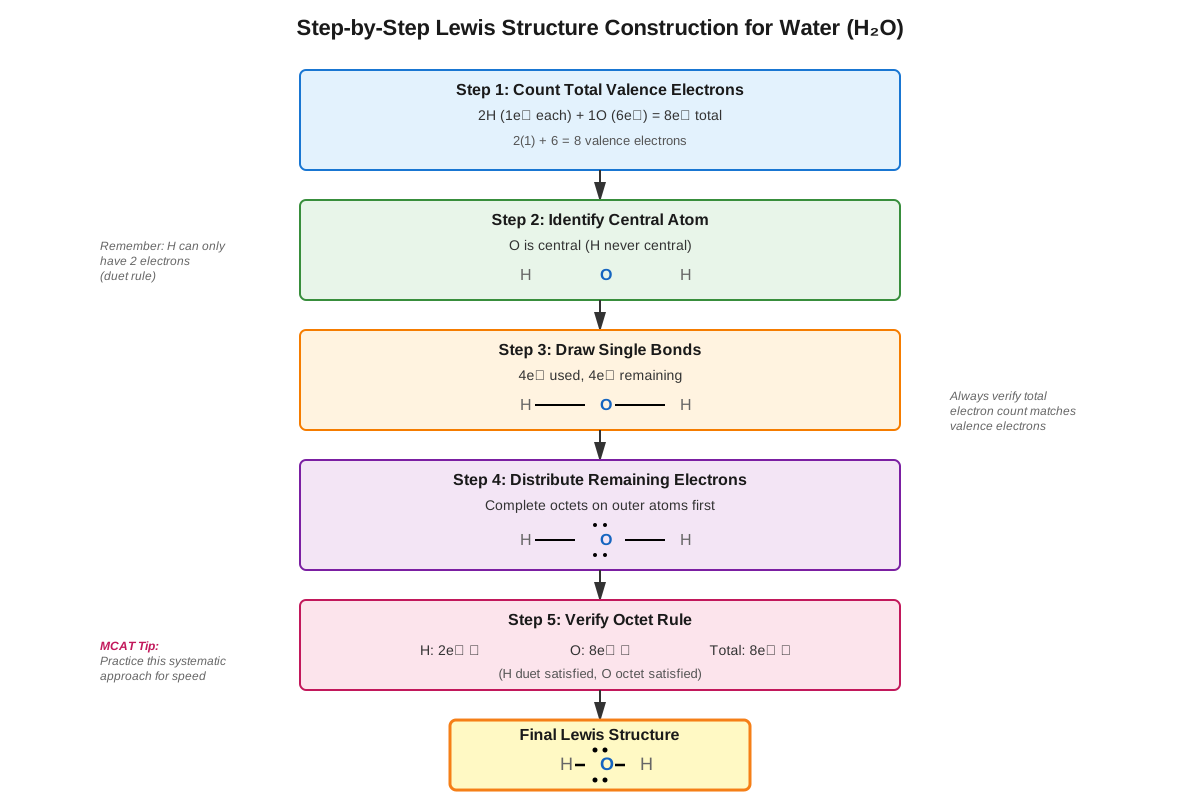
Drawing accurate Lewis structures requires a methodical approach:
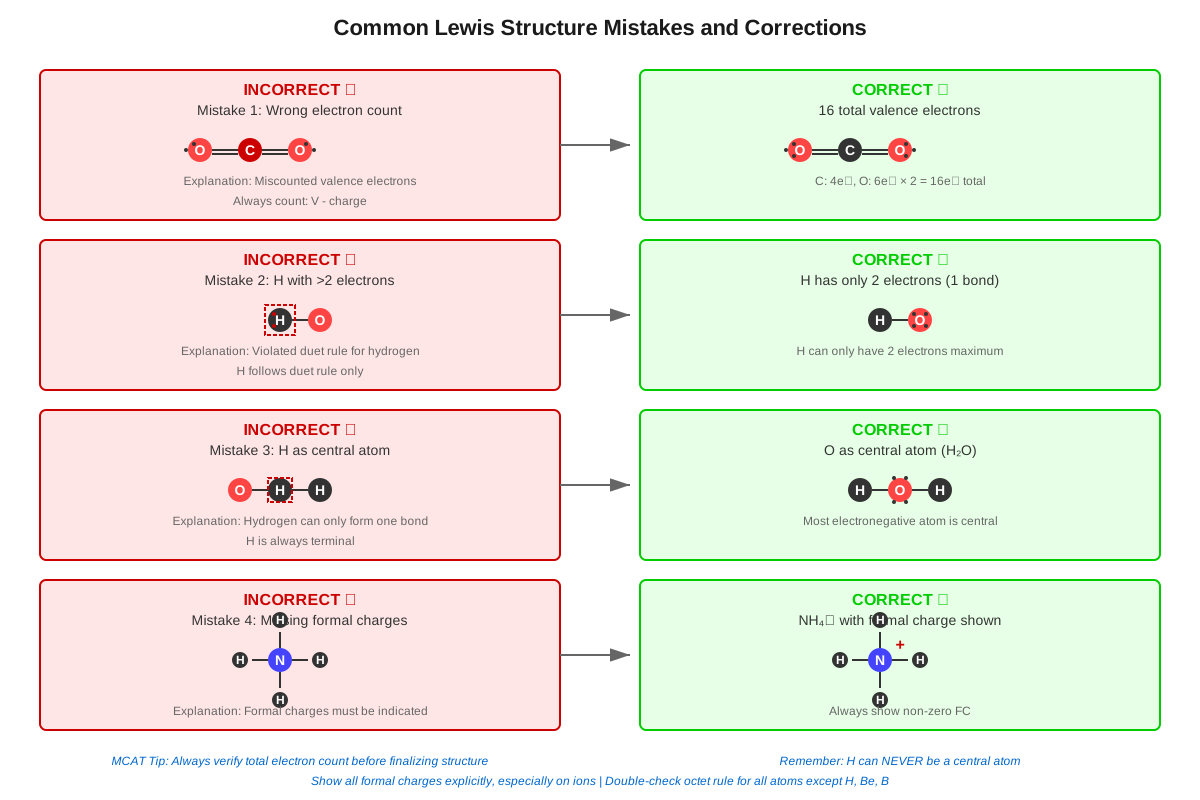
- Count total valence electrons: Sum the valence electrons from all atoms. For polyatomic ions, add electrons for negative charges or subtract for positive charges.
- Determine the central atom: Usually the least electronegative element (excluding hydrogen, which never serves as a central atom). Carbon commonly occupies central positions in organic molecules.
- Connect atoms with single bonds: Draw single bonds (one electron pair) between the central atom and surrounding atoms. Each bond uses two electrons from the total count.
- Distribute remaining electrons as lone pairs: Place remaining electrons on outer atoms first to satisfy the octet rule, then place any leftover electrons on the central atom.
- Form multiple bonds if necessary: If the central atom lacks an octet after step 4, convert lone pairs from outer atoms into double or triple bonds with the central atom.
- Verify the structure: Confirm that the total number of electrons matches the count from step 1 and that all atoms (except hydrogen and exceptions) have complete octets.
Formal Charge Calculation and Application
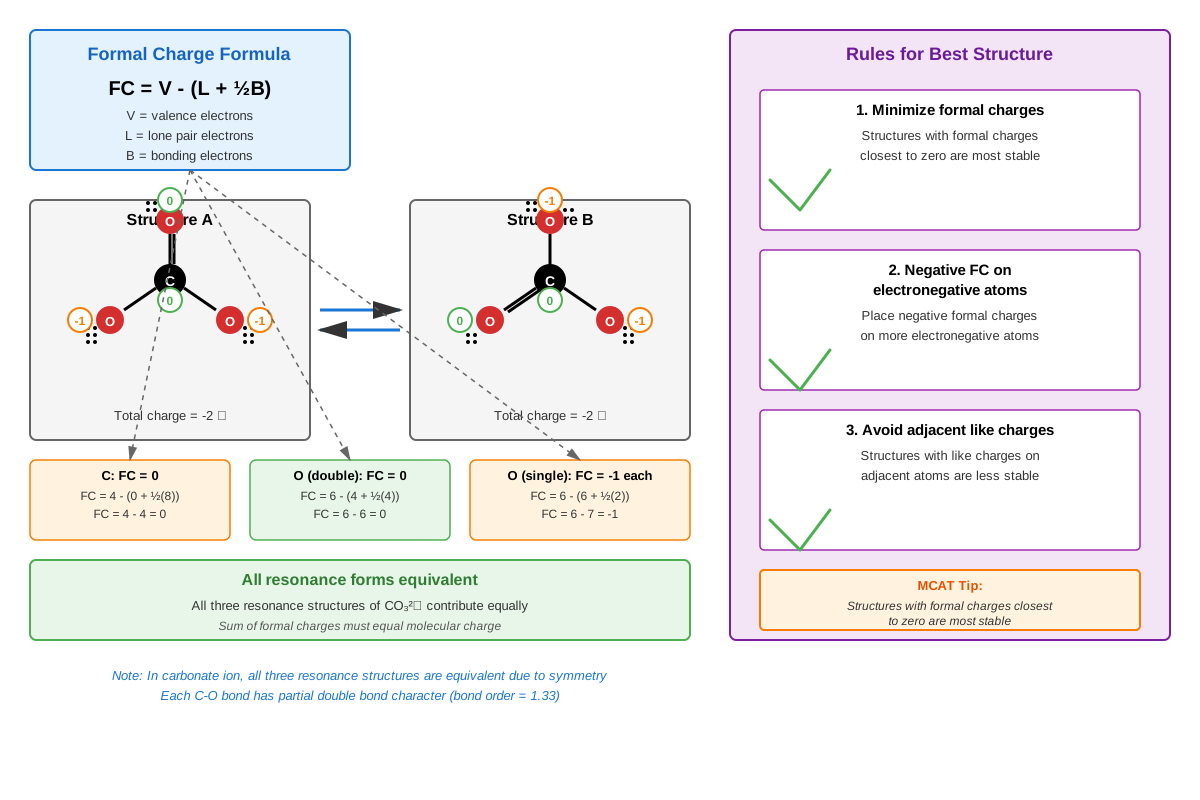
Formal charge is a bookkeeping method to track electron distribution in Lewis structures, calculated for each atom using:
Formal Charge = (Valence electrons) - (Non-bonding electrons) - (1/2 × Bonding electrons)The most stable Lewis structure typically has:
- Formal charges closest to zero on all atoms
- Negative formal charges on more electronegative atoms
- Minimal charge separation
Formal charge analysis becomes critical when evaluating resonance structures—multiple valid Lewis structures for the same molecule differing only in electron position (not atom position). The actual molecular structure is a resonance hybrid, a weighted average of all resonance contributors, with structures having lower formal charges contributing more significantly.
Exceptions to the Octet Rule
Three major categories of exceptions exist:
Electron-deficient molecules: Species like BH₃, BF₃, and AlCl₃ have central atoms with fewer than eight electrons. Boron commonly forms stable compounds with only six valence electrons.
Odd-electron species: Free radicals like NO, NO₂, and ClO₂ contain an odd number of total electrons, making a complete octet impossible for all atoms.
Expanded octets: Elements in period 3 and beyond can accommodate more than eight electrons using available d orbitals. Common examples include PCl₅ (10 electrons), SF₆ (12 electrons), and XeF₄ (12 electrons). Expanded octets are only possible for elements with principal quantum number n ≥ 3.
Multiple Bonds and Bond Order
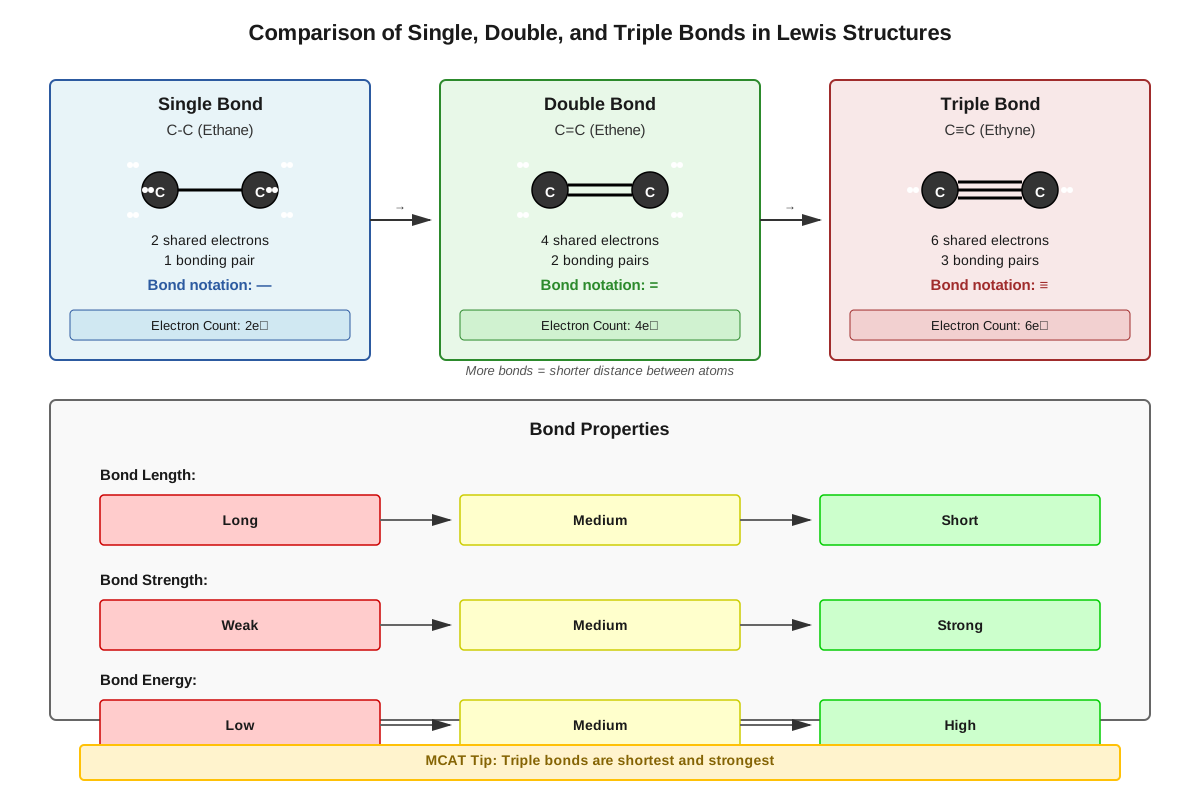
Bond order represents the number of electron pairs shared between two atoms:
- Single bond: bond order = 1
- Double bond: bond order = 2
- Triple bond: bond order = 3
Higher bond order correlates with:
- Shorter bond length
- Greater bond energy
- Increased bond strength
In resonance structures, fractional bond orders occur. For example, in the carbonate ion (CO₃²⁻), three resonance structures show one C=O double bond and two C-O single bonds in different positions, resulting in an average bond order of 4/3 for each C-O bond.
Polyatomic Ions and Charge Distribution
When drawing Lewis structures for polyatomic ions, the total charge must be accounted for in the electron count. Brackets typically enclose the structure with the charge indicated as a superscript outside. Common polyatomic ions tested on the MCAT include:
| Ion | Formula | Total Valence Electrons |
|---|---|---|
| Ammonium | NH₄⁺ | 8 |
| Hydroxide | OH⁻ | 8 |
| Carbonate | CO₃²⁻ | 24 |
| Nitrate | NO₃⁻ | 24 |
| Sulfate | SO₄²⁻ | 32 |
| Phosphate | PO₄³⁻ | 32 |
Concept Relationships
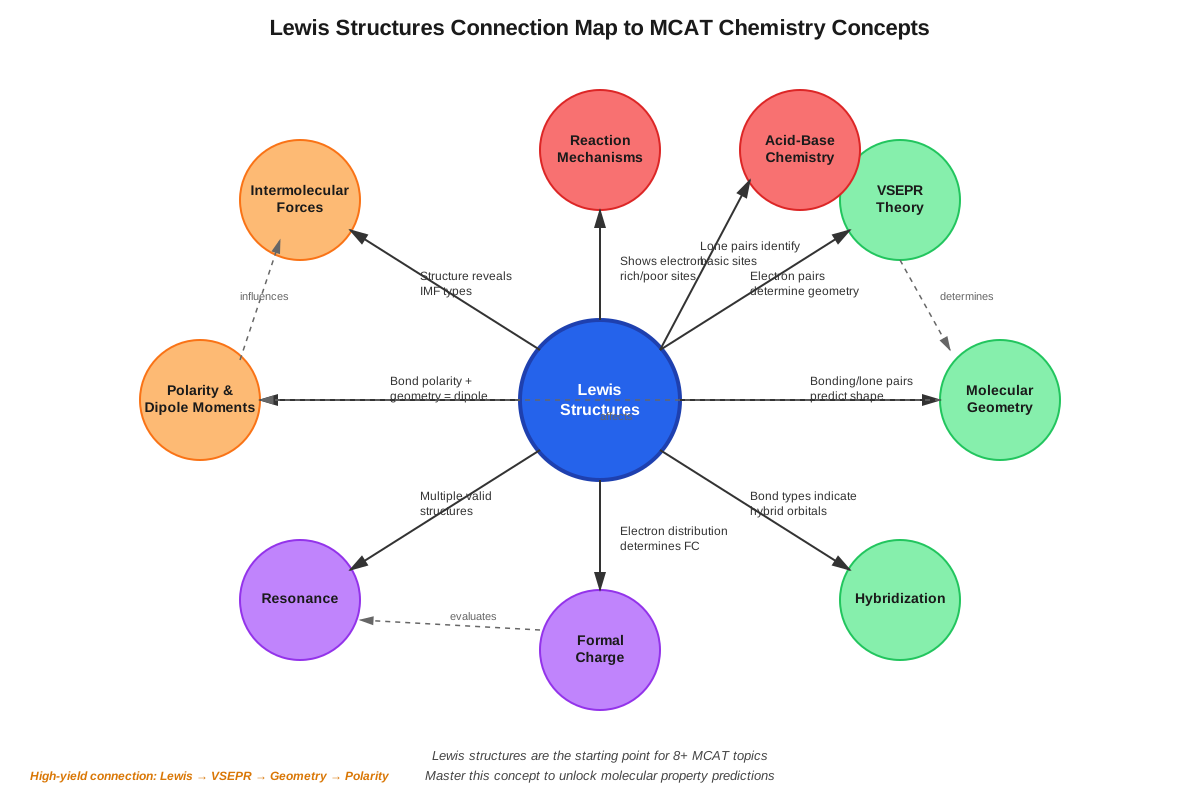
Lewis structures serve as the conceptual bridge connecting atomic-level electron configuration to molecular-level properties. The relationship flow proceeds as follows:
Electron configuration → determines → Valence electrons → used to construct → Lewis structures → predict → Molecular geometry (VSEPR) → determines → Molecular polarity → influences → Intermolecular forces → affects → Physical properties
Within Lewis structure analysis itself, several interconnected concepts operate simultaneously. Formal charge calculations guide selection among possible structures, while resonance recognition reveals electron delocalization that stabilizes molecules. Both concepts depend on accurate electron counting and proper bond placement.
The octet rule connects to periodic trends: elements in period 2 strictly follow the octet rule due to the absence of d orbitals, while period 3+ elements can form expanded octets. This relationship between electron shell structure and bonding capacity explains why phosphorus forms PCl₅ but nitrogen cannot form NCl₅.
Lewis structures also connect forward to organic chemistry mechanisms, where curved arrows show electron movement between Lewis structures representing different reaction intermediates. Understanding resonance in Lewis structures directly translates to recognizing resonance stabilization in carbocations, carbanions, and aromatic systems.
High-Yield Facts
⭐ The total number of valence electrons in a Lewis structure equals the sum of valence electrons from all atoms, adjusted for ionic charge (add electrons for negative charges, subtract for positive charges).
⭐ Formal charge = (valence electrons) - (non-bonding electrons) - (½ × bonding electrons); the most stable structure minimizes formal charges and places negative charges on electronegative atoms.
⭐ Resonance structures differ only in electron positions, not atom positions; the actual structure is a resonance hybrid with properties intermediate between contributors.
⭐ Elements in period 2 (C, N, O, F) cannot exceed eight valence electrons; elements in period 3+ (P, S, Cl, etc.) can form expanded octets using d orbitals.
⭐ Carbon forms four bonds, nitrogen forms three bonds (plus one lone pair), oxygen forms two bonds (plus two lone pairs), and halogens form one bond (plus three lone pairs) in neutral molecules.
- Hydrogen always forms exactly one bond and never has lone pairs or serves as a central atom
- Double bonds are shorter and stronger than single bonds; triple bonds are shorter and stronger than double bonds
- In resonance structures, the major contributor has the lowest formal charges and follows the octet rule most closely
- Boron and aluminum commonly form electron-deficient compounds with only six valence electrons
- Bond order in resonance hybrids equals (total number of bonds between two atoms) / (number of resonance structures)
Quick check — test yourself on Lewis structures so far.
Try Flashcards →Common Misconceptions
Misconception: All atoms must have eight electrons in their Lewis structure.
Correction: While the octet rule applies to most main-group elements, hydrogen follows the duet rule (2 electrons), boron often has only 6 electrons, and elements in period 3+ can have expanded octets with 10, 12, or more electrons.
Misconception: Resonance structures represent different molecules that interconvert rapidly.
Correction: Resonance structures are different representations of the same molecule. The actual molecule is a single species (resonance hybrid) with electron density distributed as an average of all valid resonance contributors. Electrons do not move between positions.
Misconception: Formal charge represents the actual charge on an atom.
Correction: Formal charge is a bookkeeping tool assuming equal electron sharing in bonds. Actual electron distribution depends on electronegativity differences. Formal charge helps identify the most stable Lewis structure but doesn't indicate true charge distribution.
Misconception: The central atom is always the first atom written in the molecular formula.
Correction: The central atom is typically the least electronegative element (excluding hydrogen). In formulas like H₂SO₄, sulfur is central despite being written in the middle. Structural context and chemical knowledge determine central atom placement.
Misconception: Multiple bonds can form between any two atoms to satisfy the octet rule.
Correction: Multiple bonds typically form between C, N, O, and S atoms. Highly electronegative atoms like fluorine rarely form multiple bonds. Additionally, atoms separated by single bonds in the skeletal structure cannot arbitrarily form multiple bonds without considering molecular geometry.
Misconception: All resonance structures contribute equally to the resonance hybrid.
Correction: Resonance structures with lower formal charges, complete octets, and negative charges on electronegative atoms contribute more significantly to the hybrid. Major contributors have greater weight in determining the actual electron distribution.
Worked Examples
Example 1: Drawing the Lewis Structure of Nitrate Ion (NO₃⁻)
Problem: Draw the complete Lewis structure for the nitrate ion, including all resonance structures, and determine the formal charge on each atom.
Solution:
Step 1 - Count valence electrons:
- Nitrogen: 5 valence electrons
- Oxygen (×3): 6 × 3 = 18 valence electrons
- Negative charge: +1 electron
- Total: 5 + 18 + 1 = 24 valence electrons
Step 2 - Determine central atom:
Nitrogen is less electronegative than oxygen, so nitrogen is central.
Step 3 - Connect atoms with single bonds:
Draw N-O single bonds to three oxygen atoms. This uses 6 electrons (3 bonds × 2 electrons), leaving 18 electrons.
Step 4 - Distribute remaining electrons:
Place electrons on oxygen atoms to complete octets: each oxygen needs 6 more electrons (3 lone pairs). This uses all 18 remaining electrons.
Step 5 - Check central atom octet:
Nitrogen has only 6 electrons (3 bonds). Convert one lone pair from one oxygen to form a N=O double bond.
Step 6 - Calculate formal charges:
- Nitrogen: 5 - 0 - (8/2) = +1
- Double-bonded oxygen: 6 - 4 - (4/2) = 0
- Single-bonded oxygens (×2): 6 - 6 - (2/2) = -1
Step 7 - Draw resonance structures:
Three equivalent resonance structures exist, each with the double bond to a different oxygen atom. The resonance hybrid has three equivalent N-O bonds with bond order 4/3, and the negative charge distributed equally across all three oxygen atoms (⅓ negative charge each).
This example demonstrates the systematic approach to Lewis structures and illustrates how resonance distributes charge and bonding across equivalent atoms.
Example 2: Identifying the Correct Lewis Structure Using Formal Charge
Problem: Two possible Lewis structures for carbon monoxide are shown below. Determine which is more stable and explain why.
Structure A: :C≡O: (triple bond with one lone pair on C, one on O)
Structure B: :C=O: (double bond with two lone pairs on C, two on O)
Solution:
Calculate formal charges for Structure A:
- Carbon: 4 - 2 - (6/2) = -1
- Oxygen: 6 - 2 - (6/2) = +1
Calculate formal charges for Structure B:
- Carbon: 4 - 4 - (4/2) = -2
- Oxygen: 6 - 4 - (4/2) = 0
Analysis:
Structure A is more stable because:
- The formal charges are smaller in magnitude (+1/-1 vs. -2/0)
- Although oxygen is more electronegative and "should" carry the negative charge, the smaller charge separation in Structure A outweighs this consideration
- The triple bond in Structure A is consistent with the observed bond length and bond energy of CO, which are characteristic of triple bonds
This example illustrates how formal charge analysis guides selection of the best Lewis structure when multiple possibilities exist, and demonstrates that the most stable structure balances multiple factors including charge magnitude, charge separation, and electronegativity considerations.
Exam Strategy
When approaching Lewis structures MCAT questions, implement this systematic strategy:
Trigger words to recognize: "Draw the structure," "formal charge," "resonance," "most stable structure," "bond order," "electron distribution," "octet rule exception." These phrases signal that Lewis structure analysis is required, even if not explicitly stated.
Time management: Allocate 30-45 seconds for straightforward Lewis structure questions, up to 90 seconds for complex resonance or formal charge comparisons. If a question requires drawing a structure as an intermediate step, quickly sketch it rather than perfecting every detail.
Process-of-elimination approach:
- Immediately eliminate structures with incorrect electron counts (verify total electrons match the required number)
- Eliminate structures violating the octet rule for period 2 elements (unless dealing with radicals)
- Among remaining options, favor structures with formal charges closest to zero
- For resonance questions, eliminate structures with atoms in different positions (only electron positions change in resonance)
Common question types and approaches:
- "Which structure is most stable?": Calculate formal charges for each option; select the structure with charges closest to zero and negative charges on electronegative atoms
- "How many resonance structures exist?": Draw the base structure, then systematically move electrons (typically π electrons and lone pairs) to generate equivalent structures; count only valid structures with complete octets
- "What is the bond order?": If resonance exists, count total bonds between the atoms across all structures and divide by the number of structures
Red flags indicating exceptions: Molecules containing B, Al, or Be likely have electron-deficient central atoms. Molecules with S, P, Cl, or other period 3+ central atoms may have expanded octets. Odd-electron species (radicals) cannot satisfy the octet rule for all atoms.
Memory Techniques
Mnemonic for valence electrons: "Clean Nails On Fridays" = Carbon (4), Nitrogen (5), Oxygen (6), Fluorine (7) valence electrons
Mnemonic for formal charge formula: "VAN" = Valence minus Alone (non-bonding) minus Number (half of bonding electrons)
Visualization strategy for resonance: Imagine electrons as a "cloud" that spreads across multiple atoms rather than fixed in one position. This mental model helps recognize that resonance structures represent one molecule with delocalized electrons, not multiple interconverting species.
Acronym for expanded octet elements: "PS ClAr" (like "P.S. Clear") = Phosphorus, Sulfur, Chlorine, Argon (and other period 3+ elements) can exceed eight electrons
Pattern recognition for common structures:
- "HONC 1234": Hydrogen forms 1 bond, Oxygen forms 2, Nitrogen forms 3, Carbon forms 4 (in neutral molecules)
- "Lone pairs = (6 - group number)" for halogens: Group 17 elements have (6-7) = 3 lone pairs when forming one bond
Memory aid for formal charge trends: "Zero is the hero" - structures with formal charges of zero on all atoms are typically most stable. When charges exist, remember "Negative on the Nasty" (negative charges belong on electronegative atoms like O, N, F).
Summary
Lewis structures provide essential two-dimensional representations of molecular electron distribution, serving as the foundation for understanding bonding and molecular structure in General Chemistry. Mastery requires systematic application of electron-counting rules: totaling valence electrons (adjusted for ionic charge), connecting atoms with single bonds, distributing remaining electrons to satisfy the octet rule, and forming multiple bonds when necessary. Formal charge calculations guide selection among possible structures, with the most stable structures minimizing formal charges and placing negative charges on electronegative atoms. Resonance structures represent electron delocalization in molecules where multiple valid Lewis structures exist, with the actual structure being a weighted hybrid of all contributors. Critical exceptions to the octet rule include electron-deficient species (B, Al), odd-electron radicals, and expanded octets in period 3+ elements. For MCAT success, students must rapidly construct accurate Lewis structures, recognize resonance, calculate formal charges, and connect these representations to molecular geometry, polarity, and reactivity—skills tested directly and indirectly throughout the General Chemistry section.
Key Takeaways
- Lewis structures systematically represent valence electron distribution using dots for lone pairs and lines for bonding pairs, following the octet rule for most atoms
- Formal charge = (valence electrons) - (non-bonding electrons) - (½ × bonding electrons); the most stable structure has formal charges nearest zero with negative charges on electronegative atoms
- Resonance structures differ only in electron positions (not atom positions), and the actual molecule is a hybrid with properties averaged across all contributors
- Period 2 elements (C, N, O, F) strictly follow the octet rule, while period 3+ elements can form expanded octets using d orbitals
- Common exceptions include electron-deficient molecules (BF₃), odd-electron radicals (NO₂), and expanded octets (SF₆, PCl₅)
- Lewis structures connect directly to VSEPR geometry, molecular polarity, resonance stabilization, and organic reaction mechanisms—making them essential for multiple MCAT topics
- Systematic electron counting and formal charge analysis enable rapid, accurate structure determination under exam time pressure
Related Topics
VSEPR Theory and Molecular Geometry: Lewis structures provide the electron-pair count needed to predict three-dimensional molecular shapes using valence shell electron pair repulsion theory. Mastering Lewis structures enables accurate geometry predictions.
Resonance and Electron Delocalization: Advanced analysis of resonance structures, including resonance stabilization energy and major/minor contributor identification, builds directly on Lewis structure fundamentals.
Formal Charge and Oxidation States: While formal charge tracks electron distribution in covalent bonds, oxidation states assume complete electron transfer. Understanding both concepts requires facility with Lewis structures.
Molecular Polarity and Dipole Moments: The arrangement of bonds and lone pairs shown in Lewis structures determines whether molecules have net dipole moments, affecting physical properties and intermolecular forces.
Hybridization and Molecular Orbital Theory: Lewis structures indicate the number and types of bonds, which correlate with hybrid orbital types (sp, sp², sp³) and molecular orbital configurations in more advanced bonding models.
Practice CTA
Now that you've mastered the fundamentals of Lewis structures, reinforce your understanding by attempting practice questions and flashcards. Focus on drawing structures systematically, calculating formal charges rapidly, and recognizing resonance patterns. The more structures you draw, the faster and more accurate you'll become—a critical skill for MCAT success. Challenge yourself with increasingly complex molecules and polyatomic ions, and always verify your structures using formal charge analysis. Your investment in mastering Lewis structures will pay dividends across multiple General Chemistry and Organic Chemistry topics on exam day!
Sign up free to keep reading
Create a free AnvayaPrep account to finish this MCAT guide on Lewis structures — plus flashcards and practice questions.