Overview
The Pauli exclusion principle stands as one of the foundational quantum mechanical rules governing electron configuration in atoms. Formulated by Wolfgang Pauli in 1925, this principle states that no two electrons in an atom can have the same set of four quantum numbers. This seemingly simple rule has profound implications for understanding atomic structure, chemical bonding, periodic trends, and the behavior of matter itself. For MCAT preparation in General Chemistry, mastering the Pauli exclusion principle is essential because it directly explains why atoms have specific electron configurations, why elements exhibit particular chemical properties, and how the periodic table is organized.
The Pauli exclusion principle MCAT questions frequently appear in contexts requiring students to determine electron configurations, explain magnetic properties of atoms and ions, or predict chemical reactivity based on valence electron arrangements. This principle works in concert with Hund's rule and the Aufbau principle to provide a complete picture of how electrons populate atomic orbitals. Understanding this concept enables students to predict bonding patterns, explain periodic trends in ionization energy and atomic radius, and interpret spectroscopic data—all high-yield topics for the MCAT Chemical and Physical Foundations section.
Within the broader framework of Atomic Structure and Periodic Trends, the Pauli exclusion principle serves as the bridge between quantum mechanics and observable chemical behavior. It explains why electron shells have specific capacities (2 electrons in s orbitals, 6 in p orbitals, 10 in d orbitals, and 14 in f orbitals) and why elements in the same group share similar chemical properties. This principle is not merely theoretical; it has practical applications in understanding paramagnetism versus diamagnetism, predicting molecular orbital filling patterns, and explaining the stability of half-filled and fully-filled subshells—concepts that regularly appear in MCAT passages and discrete questions.
Learning Objectives
- [ ] Define Pauli exclusion principle using accurate General Chemistry terminology
- [ ] Explain why Pauli exclusion principle matters for the MCAT
- [ ] Apply Pauli exclusion principle to exam-style questions
- [ ] Identify common mistakes related to Pauli exclusion principle
- [ ] Connect Pauli exclusion principle to related General Chemistry concepts
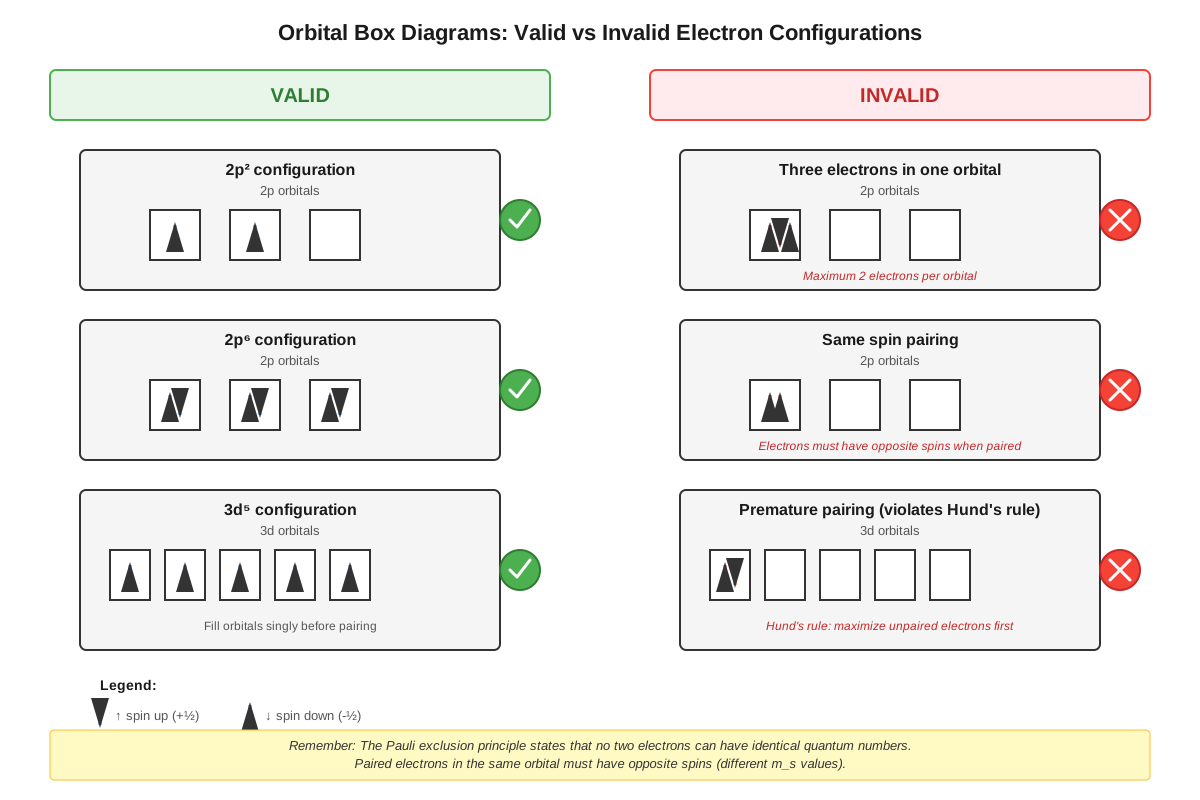
- [ ] Determine valid and invalid electron configurations based on the Pauli exclusion principle
- [ ] Predict magnetic properties of atoms and ions using the Pauli exclusion principle
- [ ] Explain the relationship between the Pauli exclusion principle and orbital capacity limits
Prerequisites
- Quantum numbers (n, l, m_l, m_s): Understanding the four quantum numbers is essential because the Pauli exclusion principle specifically states that no two electrons can share all four values
- Atomic orbitals and subshells: Knowledge of s, p, d, and f orbitals provides the framework within which the Pauli exclusion principle operates
- Electron configuration notation: Familiarity with writing electron configurations (e.g., 1s² 2s² 2p⁶) allows application of the principle to real atomic systems
- Basic quantum mechanics concepts: Understanding that electrons behave as both particles and waves provides context for why quantum restrictions exist
- Spin quantum number: Recognizing that electrons possess intrinsic spin (±½) is crucial for understanding why orbitals hold exactly two electrons
Why This Topic Matters
The Pauli exclusion principle appears in approximately 3-5% of MCAT Chemical and Physical Foundations questions, making it a medium-yield but essential topic. Questions testing this principle often appear disguised within broader contexts such as electron configuration problems, periodic trend explanations, or molecular orbital theory applications. The principle frequently appears in passage-based questions where students must interpret spectroscopic data, explain magnetic properties of coordination complexes, or predict reactivity patterns based on electronic structure.
In clinical and real-world contexts, the Pauli exclusion principle explains fundamental properties of matter. It accounts for why matter has volume and cannot be compressed indefinitely—a phenomenon called "degeneracy pressure" that prevents atoms from collapsing. In medical imaging, understanding electron configurations (governed by the Pauli exclusion principle) is essential for interpreting X-ray absorption patterns and MRI signals. The principle also explains why certain elements are paramagnetic (attracted to magnetic fields) while others are diamagnetic (repelled), which has applications in contrast agents used in medical diagnostics.
On the MCAT, this topic commonly appears in questions asking students to: (1) identify incorrect electron configurations, (2) explain why certain ions are more stable than others, (3) predict magnetic properties based on unpaired electrons, (4) explain exceptions to expected electron configurations (like chromium and copper), and (5) interpret orbital diagrams. Recognizing these question patterns allows efficient problem-solving and helps students connect the Pauli exclusion principle to broader chemical concepts tested on the exam.
Core Concepts
The Pauli Exclusion Principle Defined
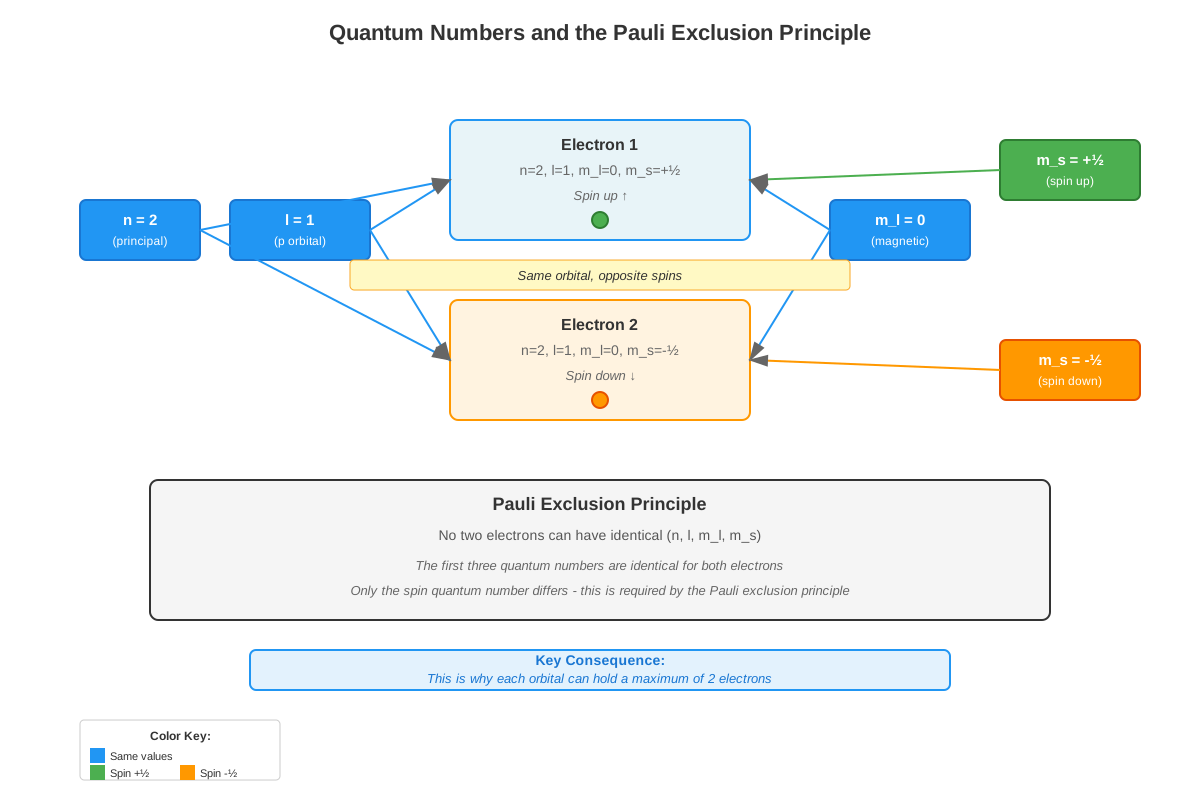
The Pauli exclusion principle states that no two electrons in a single atom can have identical values for all four quantum numbers (n, l, m_l, m_s). This fundamental rule of quantum mechanics has direct consequences for how electrons arrange themselves in atoms. Each electron in an atom must be uniquely identified by its set of quantum numbers:
- n (principal quantum number): determines the energy level and distance from nucleus
- l (azimuthal quantum number): determines the subshell shape (s, p, d, f)
- m_l (magnetic quantum number): determines the orbital orientation in space
- m_s (spin quantum number): determines the electron spin direction (+½ or -½)
Since the spin quantum number can only have two values (+½ or -½), any given orbital (defined by specific n, l, and m_l values) can hold a maximum of two electrons, and these electrons must have opposite spins. This explains the fundamental "two electrons per orbital" rule that governs all electron configurations.
Quantum Number Constraints and Orbital Capacity
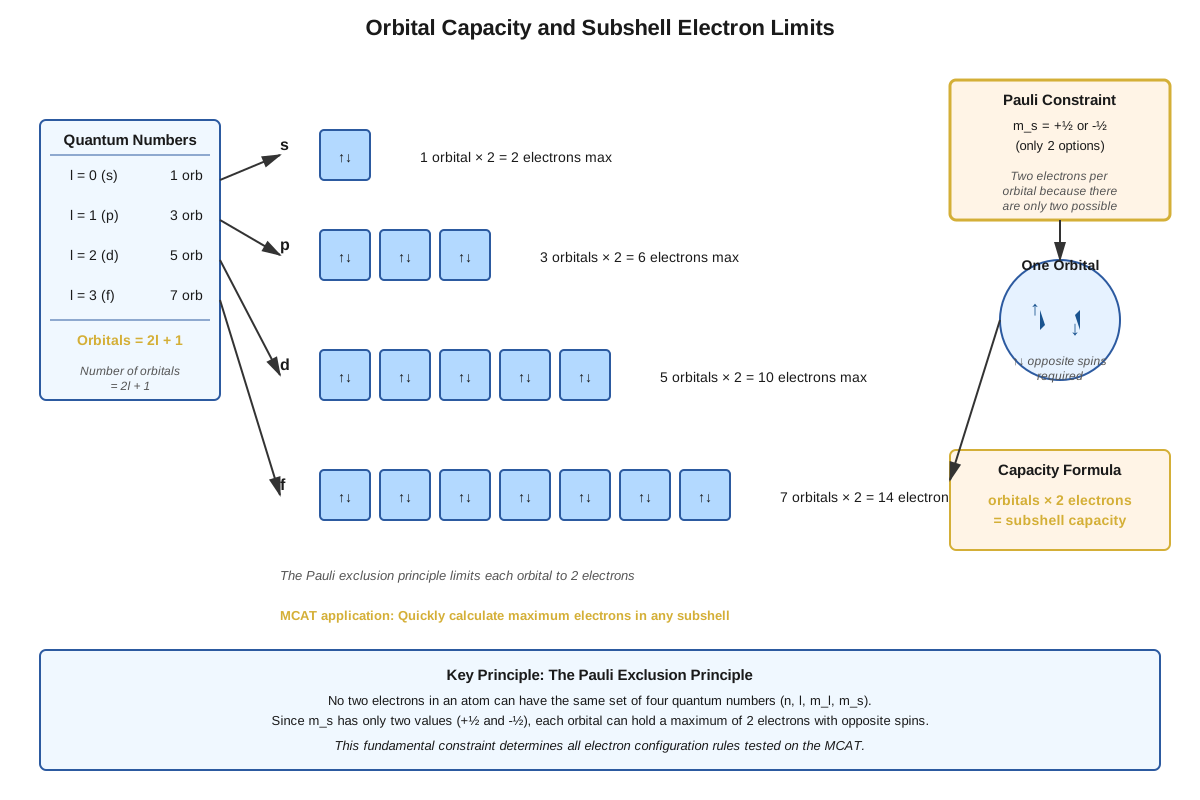
The Pauli exclusion principle directly determines the maximum number of electrons that can occupy each type of subshell:
| Subshell | l value | Number of orbitals (2l + 1) | Maximum electrons | Quantum number sets |
|---|---|---|---|---|
| s | 0 | 1 | 2 | One m_l value (0) × two spins |
| p | 1 | 3 | 6 | Three m_l values (-1, 0, +1) × two spins |
| d | 2 | 5 | 10 | Five m_l values (-2, -1, 0, +1, +2) × two spins |
| f | 3 | 7 | 14 | Seven m_l values (-3 to +3) × two spins |
Each orbital can accommodate exactly two electrons because once the n, l, and m_l quantum numbers are specified (defining a particular orbital), only two distinct sets of four quantum numbers remain possible—differing only in the spin quantum number m_s. This mathematical constraint imposed by the Pauli exclusion principle explains the electron capacity of each shell and subshell.
Electron Configuration and the Pauli Exclusion Principle
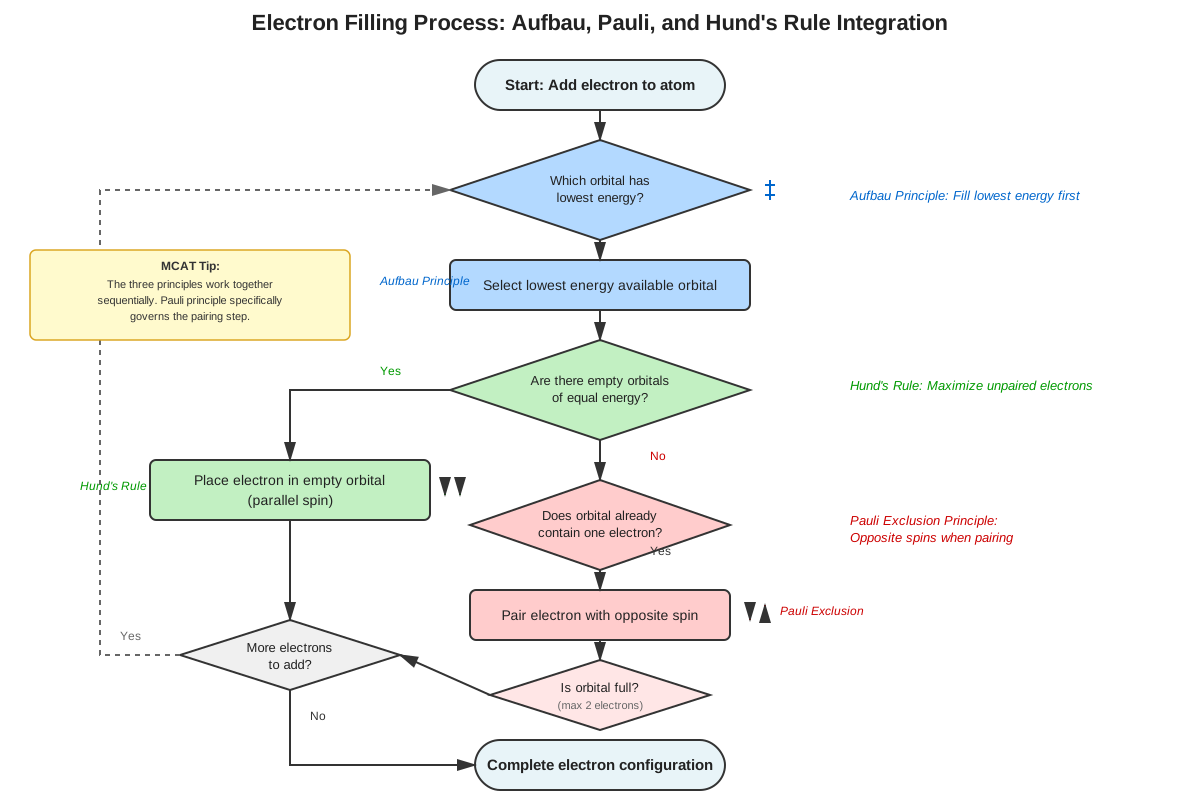
When writing electron configurations, the Pauli exclusion principle works alongside the Aufbau principle (electrons fill lowest energy orbitals first) and Hund's rule (electrons occupy orbitals singly before pairing). Consider the electron configuration of oxygen (8 electrons):
1s² 2s² 2p⁴The orbital diagram representation shows how the Pauli exclusion principle operates:
- 1s orbital: ↑↓ (two electrons with opposite spins)
- 2s orbital: ↑↓ (two electrons with opposite spins)
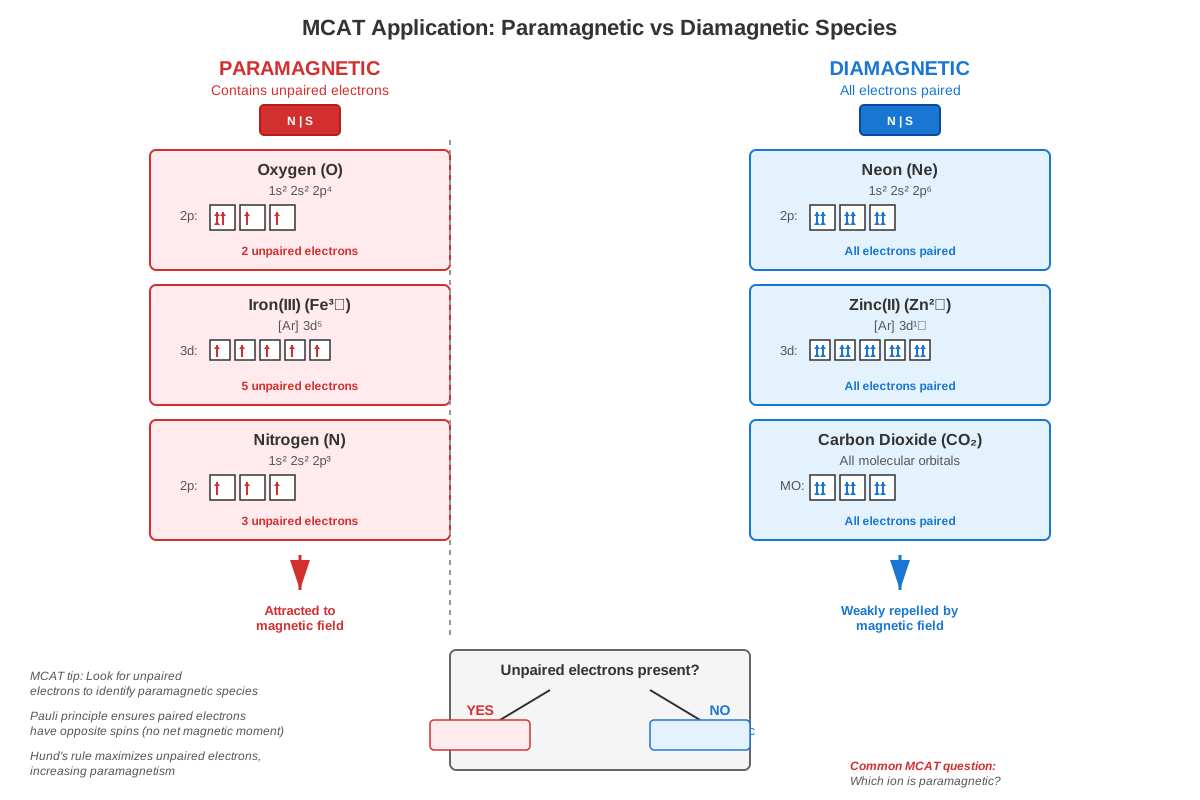
- 2p orbitals: ↑↓ ↑ ↑ (four electrons distributed across three orbitals)
In the 2p subshell, the first three electrons occupy separate orbitals with parallel spins (Hund's rule), and the fourth electron must pair with one of them, having opposite spin (Pauli exclusion principle). No two electrons share all four quantum numbers.
Spin Pairing and Magnetic Properties
The Pauli exclusion principle directly determines whether atoms and ions exhibit paramagnetic or diamagnetic behavior:
- Paramagnetic substances contain unpaired electrons and are attracted to magnetic fields
- Diamagnetic substances have all electrons paired and are weakly repelled by magnetic fields
For example, nitrogen (1s² 2s² 2p³) has three unpaired electrons in the 2p subshell, making it paramagnetic. Neon (1s² 2s² 2p⁶) has all electrons paired, making it diamagnetic. The Pauli exclusion principle ensures that when electrons pair in an orbital, they must have opposite spins, which causes their magnetic moments to cancel. MCAT questions frequently test the ability to predict magnetic properties based on electron configuration.
Exceptions and Special Stability
The Pauli exclusion principle helps explain why certain electron configurations show exceptional stability. Half-filled and fully-filled subshells (like d⁵ and d¹⁰) exhibit extra stability due to:
- Exchange energy: Electrons with parallel spins in different orbitals can exchange positions, lowering the overall energy
- Symmetry: Half-filled and fully-filled configurations have maximum symmetry
This explains the anomalous electron configurations of chromium [Ar] 3d⁵ 4s¹ (instead of expected 3d⁴ 4s²) and copper [Ar] 3d¹⁰ 4s¹ (instead of expected 3d⁹ 4s²). These atoms "promote" one 4s electron to the 3d subshell to achieve the more stable half-filled or fully-filled d subshell configuration, while still respecting the Pauli exclusion principle—no orbital contains more than two electrons with opposite spins.
Application to Multi-Electron Systems
In multi-electron atoms, the Pauli exclusion principle prevents electron collapse into the nucleus and explains why atoms have definite sizes. Without this principle, all electrons would occupy the lowest energy state (1s orbital), and atoms would be much smaller and chemistry as we know it would not exist. The principle creates the shell structure of atoms, forcing electrons to occupy higher energy levels once lower ones are filled, which in turn determines atomic radius, ionization energy, and chemical reactivity patterns across the periodic table.
Concept Relationships
The Pauli exclusion principle forms the foundation of electron configuration, which connects to virtually every other concept in atomic structure and periodic trends. The relationship flow can be mapped as follows:
Quantum Numbers → Pauli Exclusion Principle → Orbital Capacity Limits → Electron Configuration → Periodic Trends
The four quantum numbers define the "address" of each electron, and the Pauli exclusion principle uses these addresses to establish that each must be unique. This uniqueness requirement directly determines that orbitals hold exactly two electrons, which establishes the capacity of each subshell (s², p⁶, d¹⁰, f¹⁴). These capacity limits, combined with the Aufbau principle and Hund's rule, determine how electrons fill orbitals in ground-state atoms.
The Pauli exclusion principle connects to periodic trends by explaining why elements in the same group have similar valence electron configurations and therefore similar chemical properties. It explains why atomic radius decreases across a period (electrons fill the same shell, experiencing greater effective nuclear charge) and why ionization energy generally increases across a period (removing increasingly stable electrons from filled or half-filled configurations).
The principle also connects to chemical bonding through molecular orbital theory. When atomic orbitals combine to form molecular orbitals, the Pauli exclusion principle still applies—each molecular orbital can hold a maximum of two electrons with opposite spins. This explains bonding and antibonding orbital filling patterns and predicts bond order and magnetic properties of molecules.
Furthermore, the Pauli exclusion principle relates to spectroscopy by determining which electronic transitions are possible. Since electrons must occupy distinct quantum states, absorption and emission spectra reflect transitions between these allowed states. Understanding electron configuration (governed by the Pauli exclusion principle) enables prediction of spectral lines and interpretation of spectroscopic data—skills tested in MCAT passages.
Quick check — test yourself on Pauli exclusion principle so far.
Try Flashcards →High-Yield Facts
⭐ The Pauli exclusion principle states that no two electrons in an atom can have the same four quantum numbers (n, l, m_l, m_s)
⭐ Each orbital can hold a maximum of two electrons, and these electrons must have opposite spins (+½ and -½)
⭐ Atoms or ions with unpaired electrons are paramagnetic; those with all electrons paired are diamagnetic
⭐ The maximum number of electrons in a subshell equals 2(2l + 1): s holds 2, p holds 6, d holds 10, f holds 14
⭐ Chromium and copper have anomalous electron configurations ([Ar] 3d⁵ 4s¹ and [Ar] 3d¹⁰ 4s¹) to achieve stable half-filled or fully-filled d subshells
- The Pauli exclusion principle applies to all fermions (particles with half-integer spin), including electrons, protons, and neutrons
- Violation of the Pauli exclusion principle would cause all electrons to collapse into the 1s orbital, eliminating atomic structure and chemistry
- Half-filled and fully-filled subshells show enhanced stability due to exchange energy and symmetry
- When writing orbital diagrams, electrons in the same subshell should be distributed singly before pairing (Hund's rule), but once paired, must have opposite spins (Pauli exclusion principle)
- The principle explains why the periodic table has the structure it does: 2 elements in period 1, 8 in periods 2-3, 18 in periods 4-5, and 32 in periods 6-7
- Isoelectronic species (same number of electrons) have identical electron configurations but different nuclear charges, affecting their size and properties
Common Misconceptions
Misconception: The Pauli exclusion principle only applies to electrons in the same orbital.
Correction: The principle applies to ALL electrons in an atom. Every electron must have a unique set of four quantum numbers, whether in the same orbital or different orbitals. However, the most obvious consequence is that electrons in the same orbital (same n, l, m_l) must differ in spin.
Misconception: Electrons with opposite spins repel each other less than electrons with parallel spins.
Correction: Electron-electron repulsion is based on charge and distance, not spin. However, electrons with parallel spins cannot occupy the same orbital (Pauli exclusion principle) and tend to occupy different regions of space, which can reduce repulsion. The stability of half-filled subshells relates to exchange energy, not reduced repulsion.
Misconception: The Pauli exclusion principle explains why electrons fill orbitals from lowest to highest energy.
Correction: The Aufbau principle explains the order of orbital filling (lowest energy first), not the Pauli exclusion principle. The Pauli exclusion principle explains why each orbital can hold only two electrons and why they must have opposite spins.
Misconception: An orbital can hold more than two electrons if they have different quantum numbers.
Correction: An orbital is defined by three quantum numbers (n, l, m_l). Once these are specified, only the spin quantum number can vary, which has only two possible values (+½ and -½). Therefore, an orbital can hold exactly two electrons maximum, regardless of any other considerations.
Misconception: Paramagnetic substances have more electrons than diamagnetic substances.
Correction: Paramagnetism depends on the presence of unpaired electrons, not total electron count. An atom with many electrons can be diamagnetic if all are paired (like xenon), while an atom with fewer electrons can be paramagnetic if any are unpaired (like nitrogen).
Misconception: The anomalous electron configurations of chromium and copper violate the Pauli exclusion principle.
Correction: These configurations fully respect the Pauli exclusion principle—no orbital contains more than two electrons with opposite spins. The anomaly relates to the Aufbau principle (expected filling order) being overridden by the stability of half-filled and fully-filled d subshells, but the Pauli exclusion principle is never violated.
Worked Examples
Example 1: Identifying Invalid Electron Configurations
Question: Which of the following electron configurations violates the Pauli exclusion principle?
A) 1s² 2s² 2p⁶ 3s¹
B) 1s² 2s² 2p⁷
C) 1s² 2s¹ 2p⁶ 3s¹
D) 1s² 2s² 2p⁵
Solution:
Step 1: Recall that the Pauli exclusion principle limits each orbital to two electrons maximum.
Step 2: Determine the number of orbitals in each subshell:
- s subshell: 1 orbital → maximum 2 electrons
- p subshell: 3 orbitals → maximum 6 electrons
- d subshell: 5 orbitals → maximum 10 electrons
Step 3: Examine each option:
- Option A: 1s² (valid), 2s² (valid), 2p⁶ (valid), 3s¹ (valid) ✓
- Option B: 1s² (valid), 2s² (valid), 2p⁷ (INVALID—p subshell can hold maximum 6 electrons) ✗
- Option C: 1s² (valid), 2s¹ (valid), 2p⁶ (valid), 3s¹ (valid) ✓
- Option D: 1s² (valid), 2s² (valid), 2p⁵ (valid) ✓
Step 4: Option B violates the Pauli exclusion principle because it places 7 electrons in the 2p subshell, which has only 3 orbitals and can accommodate a maximum of 6 electrons (2 per orbital).
Answer: B
Connection to learning objectives: This example demonstrates application of the Pauli exclusion principle to identify invalid electron configurations, a common MCAT question type.
Example 2: Predicting Magnetic Properties
Question: A researcher is studying the magnetic properties of various ions. Which of the following ions is paramagnetic?
A) Ca²⁺ (Z = 20)
B) Zn²⁺ (Z = 30)
C) Cu²⁺ (Z = 29)
D) Mg²⁺ (Z = 12)
Solution:
Step 1: Recall that paramagnetic species have unpaired electrons, while diamagnetic species have all electrons paired.
Step 2: Write the electron configuration for each ion:
Ca²⁺: Calcium has 20 electrons; Ca²⁺ has 18 electrons
Configuration: 1s² 2s² 2p⁶ 3s² 3p⁶
All electrons are paired → diamagnetic
Zn²⁺: Zinc has 30 electrons; Zn²⁺ has 28 electrons
Configuration: 1s² 2s² 2p⁶ 3s² 3p⁶ 3d¹⁰
All electrons are paired (d¹⁰ is fully filled) → diamagnetic
Cu²⁺: Copper has 29 electrons; Cu²⁺ has 27 electrons
Configuration: 1s² 2s² 2p⁶ 3s² 3p⁶ 3d⁹
The 3d⁹ configuration has one unpaired electron → paramagnetic
Mg²⁺: Magnesium has 12 electrons; Mg²⁺ has 10 electrons
Configuration: 1s² 2s² 2p⁶
All electrons are paired → diamagnetic
Step 3: Apply the Pauli exclusion principle understanding: In the 3d⁹ configuration of Cu²⁺, five d orbitals hold 9 electrons. Four orbitals contain paired electrons (8 electrons total), and one orbital contains a single unpaired electron. This unpaired electron makes Cu²⁺ paramagnetic.
Answer: C
Connection to learning objectives: This example connects the Pauli exclusion principle to magnetic properties and demonstrates how to apply electron configuration knowledge to predict observable physical properties—a high-yield MCAT skill.
Exam Strategy
When approaching MCAT questions involving the Pauli exclusion principle, follow this systematic strategy:
Step 1: Identify trigger words and phrases
- "Electron configuration"
- "Paramagnetic" or "diamagnetic"
- "Unpaired electrons"
- "Orbital diagram"
- "Quantum numbers"
- "Maximum number of electrons"
- "Violates quantum mechanical principles"
Step 2: Determine what the question is really asking
- Is it testing orbital capacity limits? (Remember: s², p⁶, d¹⁰, f¹⁴)
- Is it asking about magnetic properties? (Unpaired electrons = paramagnetic)
- Is it testing electron configuration validity? (Check for overfilled orbitals)
- Is it asking about quantum number sets? (All four must be unique for each electron)
Step 3: Use process of elimination effectively
- Eliminate any configuration that exceeds orbital capacity (most common wrong answer)
- Eliminate diamagnetic options when the question describes magnetic attraction
- Eliminate configurations that violate the Aufbau principle or Hund's rule if those are being tested alongside Pauli exclusion principle
- Watch for answer choices that confuse the three principles (Aufbau, Hund's, Pauli)
Step 4: Time allocation
- Discrete questions on electron configuration: 30-45 seconds
- Passage-based questions requiring electron configuration analysis: 60-90 seconds
- Questions requiring orbital diagrams or detailed quantum number analysis: 90-120 seconds
Exam Tip: If a question asks which configuration "violates quantum mechanical principles," check the Pauli exclusion principle first—it's the most commonly violated principle in wrong answer choices. Look for overfilled orbitals (like p⁷ or d¹¹).
Step 5: Common question patterns
- Pattern 1: "Which electron configuration is impossible?" → Check orbital capacities
- Pattern 2: "Which species is paramagnetic?" → Count unpaired electrons
- Pattern 3: "Why does chromium have the configuration [Ar] 3d⁵ 4s¹?" → Stability of half-filled subshells
- Pattern 4: "How many electrons can have n=3, l=1?" → Calculate orbital capacity (2(2l+1) = 6)
Memory Techniques
Mnemonic for orbital capacities: "Sally Packed Dozen Fourteen"
- Subshell holds 2 electrons
- Psubshell holds 6 electrons
- Dsubshell holds 10 electrons (close to a dozen)
- Fsubshell holds 14 electrons
Mnemonic for the Pauli exclusion principle: "No Lazy Mice Sleep" (representing n, l, m_l, m_s)
- Reminds you that all four quantum numbers must be different for each electron
- "No two mice sleep in exactly the same way" → no two electrons share all four quantum numbers
Visualization for spin pairing: Picture electrons as tiny bar magnets in an orbital. The Pauli exclusion principle requires them to point in opposite directions (↑↓) so their magnetic fields partially cancel. This visual helps remember why paired electrons are diamagnetic.
Acronym for anomalous configurations: "Chromium and Copper Crave Stability"
- Reminds you that Cr and Cu have anomalous configurations
- Both "steal" an electron from the 4s to achieve stable d⁵ or d¹⁰ configurations
Memory aid for paramagnetic vs. diamagnetic: "Paramagnetic has unparalleled electrons" (unpaired electrons)
- The word "para" connects to "unpaired"
- If all electrons are paired → diamagnetic (opposite of paramagnetic)
Counting trick for maximum electrons: For any shell with principal quantum number n, the maximum number of electrons is 2n². This derives from the Pauli exclusion principle combined with the rules for quantum numbers:
- n=1: 2(1)² = 2 electrons
- n=2: 2(2)² = 8 electrons
- n=3: 2(3)² = 18 electrons
Summary
The Pauli exclusion principle is a fundamental quantum mechanical rule stating that no two electrons in an atom can possess identical sets of all four quantum numbers (n, l, m_l, m_s). This principle directly determines that each orbital can accommodate exactly two electrons with opposite spins, establishing the capacity limits for all subshells: s², p⁶, d¹⁰, and f¹⁴. For MCAT success, students must understand how this principle governs electron configurations, explains magnetic properties (paramagnetic species have unpaired electrons; diamagnetic species have all electrons paired), and accounts for periodic trends. The principle works in concert with the Aufbau principle and Hund's rule to predict ground-state electron configurations, though it can explain anomalous configurations like those of chromium and copper, which achieve extra stability through half-filled or fully-filled d subshells. MCAT questions test this concept through electron configuration validity, magnetic property predictions, quantum number analysis, and connections to periodic trends. Mastering the Pauli exclusion principle enables students to confidently approach questions involving atomic structure, chemical bonding, and spectroscopy—making it an essential component of MCAT General Chemistry preparation.
Key Takeaways
- The Pauli exclusion principle requires that no two electrons in an atom share all four quantum numbers, limiting each orbital to two electrons with opposite spins
- Orbital capacity follows directly from the principle: s holds 2, p holds 6, d holds 10, and f holds 14 electrons maximum
- Paramagnetic substances contain unpaired electrons and are attracted to magnetic fields; diamagnetic substances have all electrons paired
- The principle explains the structure of the periodic table and why elements in the same group exhibit similar chemical properties
- Chromium [Ar] 3d⁵ 4s¹ and copper [Ar] 3d¹⁰ 4s¹ have anomalous configurations due to the stability of half-filled and fully-filled d subshells, but still obey the Pauli exclusion principle
- MCAT questions commonly test the principle through electron configuration validity, magnetic property predictions, and connections to periodic trends
- Understanding the Pauli exclusion principle is essential for predicting chemical reactivity, bonding patterns, and spectroscopic properties
Related Topics
Hund's Rule: After mastering the Pauli exclusion principle, students should study Hund's rule, which explains how electrons distribute among orbitals of equal energy within a subshell. Together, these principles provide complete understanding of ground-state electron configurations.
Aufbau Principle: This principle describes the order in which orbitals fill with electrons (lowest energy first). Combined with the Pauli exclusion principle and Hund's rule, it enables prediction of any element's electron configuration.
Effective Nuclear Charge and Shielding: Understanding how the Pauli exclusion principle creates electron shells helps explain why inner electrons shield outer electrons from nuclear charge, affecting atomic radius and ionization energy trends.
Molecular Orbital Theory: The Pauli exclusion principle applies equally to molecular orbitals, where each MO can hold two electrons with opposite spins. This connection is essential for understanding bonding, antibonding orbitals, and bond order.
Periodic Trends: Mastery of the Pauli exclusion principle enables deeper understanding of atomic radius, ionization energy, electron affinity, and electronegativity trends across periods and down groups.
Spectroscopy: Electronic transitions between energy levels (governed by electron configurations determined by the Pauli exclusion principle) produce absorption and emission spectra, making this principle foundational for interpreting spectroscopic data.
Practice CTA
Now that you've mastered the Pauli exclusion principle, it's time to reinforce your understanding through active practice. Challenge yourself with the practice questions and flashcards designed specifically for this topic. Focus on questions involving electron configuration validity, magnetic property predictions, and quantum number analysis—these are the highest-yield question types for the MCAT. Remember, understanding the principle conceptually is only the first step; applying it rapidly and accurately under exam conditions requires deliberate practice. Each practice question you complete strengthens your ability to recognize patterns and avoid common traps. You've built a solid foundation—now transform that knowledge into test-day confidence through consistent practice!
Sign up free to keep reading
Create a free AnvayaPrep account to finish this MCAT guide on Pauli exclusion principle — plus flashcards and practice questions.