Overview
Effective nuclear charge (often abbreviated as Z_eff) represents one of the most fundamental concepts in General Chemistry and serves as a cornerstone for understanding Atomic Structure and Periodic Trends. This concept explains the net positive charge experienced by an electron in a multi-electron atom, accounting for both the attractive force from the nucleus and the repulsive forces from other electrons. Unlike the simple nuclear charge (Z), which only counts protons, effective nuclear charge provides a more realistic picture of the electrostatic environment within an atom. Mastering this concept is essential for predicting and explaining periodic trends such as atomic radius, ionization energy, electron affinity, and electronegativity—all of which appear frequently on the MCAT.
The effective nuclear charge concept bridges the gap between simple atomic theory and the complex reality of multi-electron systems. When students first learn about atomic structure, they often imagine electrons orbiting a nucleus in a straightforward manner. However, the presence of multiple electrons creates a screening or shielding effect that reduces the full nuclear attraction experienced by outer electrons. This shielding phenomenon is quantified through effective nuclear charge calculations and explains why electrons in the same shell experience different attractive forces depending on their orbital type (s, p, d, f). Understanding Z_eff allows test-takers to predict chemical behavior, bond formation tendencies, and reactivity patterns across the periodic table.
For the MCAT, effective nuclear charge appears not only in standalone General Chemistry questions but also integrates into passages involving chemical bonding, molecular structure, and even biochemical contexts where understanding electron distribution matters. The concept frequently appears in questions asking students to compare properties across periods or down groups, to explain anomalies in periodic trends, or to predict relative reactivity of elements. A solid grasp of Effective nuclear charge General Chemistry principles enables students to approach these questions systematically rather than relying on memorization alone, making it a high-yield topic for efficient MCAT preparation.
Learning Objectives
- [ ] Define Effective nuclear charge using accurate General Chemistry terminology
- [ ] Explain why Effective nuclear charge matters for the MCAT
- [ ] Apply Effective nuclear charge to exam-style questions
- [ ] Identify common mistakes related to Effective nuclear charge
- [ ] Connect Effective nuclear charge to related General Chemistry concepts
- [ ] Calculate effective nuclear charge using Slater's rules for any electron in an atom
- [ ] Predict and explain periodic trends using effective nuclear charge principles
- [ ] Distinguish between shielding effects of different electron shells and subshells
- [ ] Analyze how effective nuclear charge influences chemical reactivity and bonding
Prerequisites
- Atomic structure fundamentals: Understanding protons, neutrons, electrons, and their locations is essential because effective nuclear charge describes the electrostatic interactions between these particles
- Electron configuration: Knowledge of how electrons fill orbitals (1s, 2s, 2p, etc.) is necessary because shielding depends on which electrons occupy which orbitals
- Coulomb's Law: Familiarity with electrostatic attraction and repulsion provides the physical basis for understanding why nuclear charge is "reduced" by electron-electron repulsion
- Periodic table organization: Understanding periods, groups, and the arrangement of elements enables application of Z_eff trends across the table
- Quantum numbers: Basic knowledge of n, l, m_l, and m_s helps explain why electrons in different orbitals shield differently
Why This Topic Matters
Clinical and Real-World Significance
Effective nuclear charge principles underlie numerous phenomena in medicine and biochemistry. The ability of hemoglobin to bind oxygen depends on the electronic properties of iron, which are governed by effective nuclear charge. Drug design relies on understanding how atoms will interact based on their electron distributions and effective nuclear charges—atoms with higher Z_eff values tend to be more electronegative and form stronger bonds with electron-rich sites. Radiopharmaceuticals used in diagnostic imaging depend on the nuclear and electronic properties of specific isotopes, where effective nuclear charge influences chemical behavior even when nuclear composition varies. Understanding why certain elements are essential nutrients (like calcium and magnesium) while others are toxic (like lead and mercury) relates directly to their effective nuclear charges and resulting chemical properties.
MCAT Exam Statistics
Effective nuclear charge appears in approximately 3-5% of General Chemistry questions on the MCAT, but its influence extends much further because it underlies questions about periodic trends (8-12% of questions), chemical bonding (10-15%), and molecular properties. Questions may directly ask students to compare Z_eff values, but more commonly, they require students to apply Z_eff concepts to explain why one element has a larger atomic radius than another, why ionization energy increases across a period, or why certain atoms form specific types of bonds. The topic appears in both discrete questions and passage-based questions, particularly in passages discussing transition metals, main group chemistry, or comparative elemental properties.
Common Exam Presentations
The MCAT presents effective nuclear charge concepts in several characteristic ways. Passages may provide data tables showing atomic radii or ionization energies across a period and ask students to explain the trends. Questions might present two elements and ask which experiences greater effective nuclear charge, requiring students to consider both nuclear charge and shielding. Some questions embed Z_eff concepts within larger contexts, such as asking why a particular metal ion has a specific coordination number or why one halogen is more reactive than another. Recognizing these presentations helps students identify when to apply effective nuclear charge reasoning even when the term isn't explicitly mentioned.
Core Concepts
Definition and Fundamental Equation
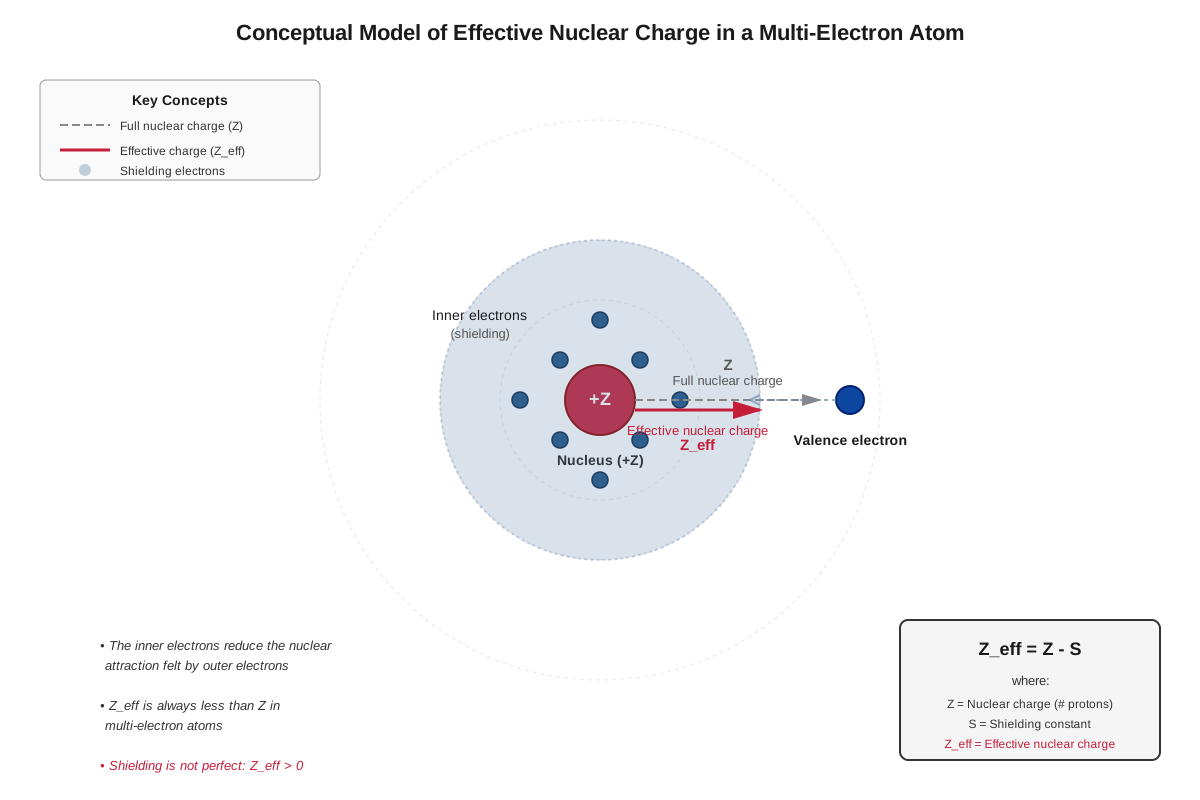
Effective nuclear charge (Z_eff) is the net positive charge experienced by a specific electron in a multi-electron atom. It represents the actual attractive force an electron "feels" from the nucleus after accounting for the repulsive shielding effects of other electrons. The basic equation for effective nuclear charge is:
Z_eff = Z - SWhere:
- Z = actual nuclear charge (number of protons)
- S = shielding constant (also called screening constant)
- Z_eff = effective nuclear charge
This deceptively simple equation captures a complex physical reality. The shielding constant (S) quantifies how much the electron-electron repulsion reduces the full nuclear attraction. Electrons closer to the nucleus and in the same shell partially block outer electrons from experiencing the full positive charge of the nucleus. The shielding is not complete—outer electrons still experience significant nuclear attraction—but it is substantial enough to dramatically affect atomic properties.
Shielding and Penetration
Shielding (or screening) occurs because electrons repel each other due to their negative charges. Inner electrons, being closer to the nucleus, create an electron density that partially cancels the nuclear charge from the perspective of outer electrons. However, not all electrons shield equally effectively. The extent of shielding depends on two key factors: the distance of the shielding electrons from the nucleus and the orbital shape of both the shielding and shielded electrons.
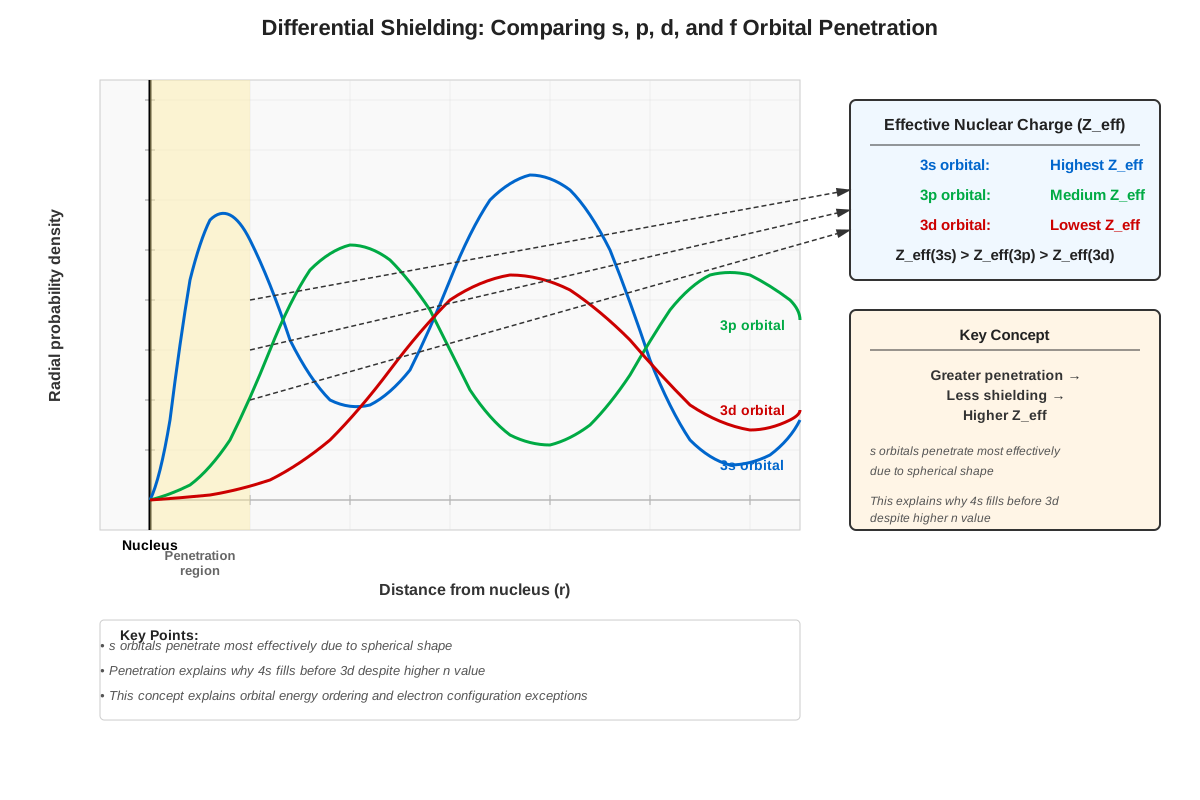
Penetration refers to the ability of an electron to approach the nucleus closely, experiencing less shielding. Electrons in s orbitals penetrate more effectively than p orbitals, which penetrate more than d orbitals, which penetrate more than f orbitals. This penetration order (s > p > d > f) means that for electrons in the same shell, those in s orbitals experience higher effective nuclear charge than those in p orbitals. This explains why, for example, a 3s electron is lower in energy than a 3p electron despite having the same principal quantum number.
The penetration effect arises from orbital shapes. The s orbital has significant electron density near the nucleus (it has no angular nodes), allowing the electron to "penetrate" through inner electron shells and experience more of the nuclear charge. In contrast, p orbitals have a node at the nucleus and spend more time farther away, experiencing greater shielding from inner electrons.
Slater's Rules for Calculating Effective Nuclear Charge
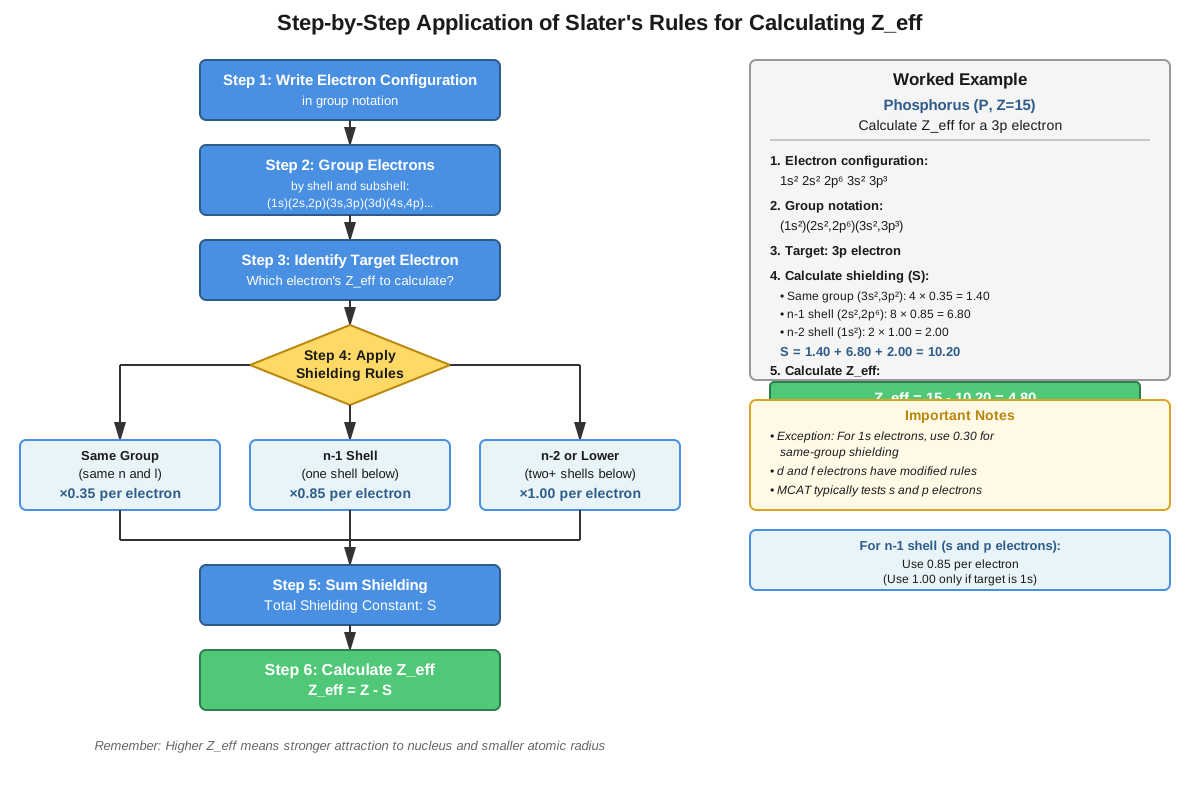
While the conceptual understanding of Z_eff is most important for the MCAT, familiarity with Slater's rules provides a systematic method for calculating shielding constants. These rules assign different shielding values based on which electrons are doing the shielding:
- Write the electron configuration in the following group order: (1s) (2s,2p) (3s,3p) (3d) (4s,4p) (4d) (4f) (5s,5p), etc.
- Electrons in groups to the right of the electron of interest contribute nothing to S (they don't shield inner electrons)
- For electrons in the same group (n,l):
- Each other electron contributes 0.35 to S
- Exception: for 1s electrons, the other 1s electron contributes 0.30
- For electrons in the n-1 shell:
- Each electron contributes 0.85 to S (for s and p electrons)
- Each electron contributes 1.00 to S (for d and f electrons)
- For electrons in shells n-2 or lower:
- Each electron contributes 1.00 to S
These rules provide reasonable approximations of effective nuclear charge, though they simplify the complex quantum mechanical reality. For MCAT purposes, understanding the trends these rules predict is more important than memorizing the exact coefficients.
Periodic Trends in Effective Nuclear Charge
Effective nuclear charge exhibits clear and predictable trends across the periodic table, making it a powerful tool for explaining other periodic properties:
| Direction | Z_eff Trend | Explanation |
|---|---|---|
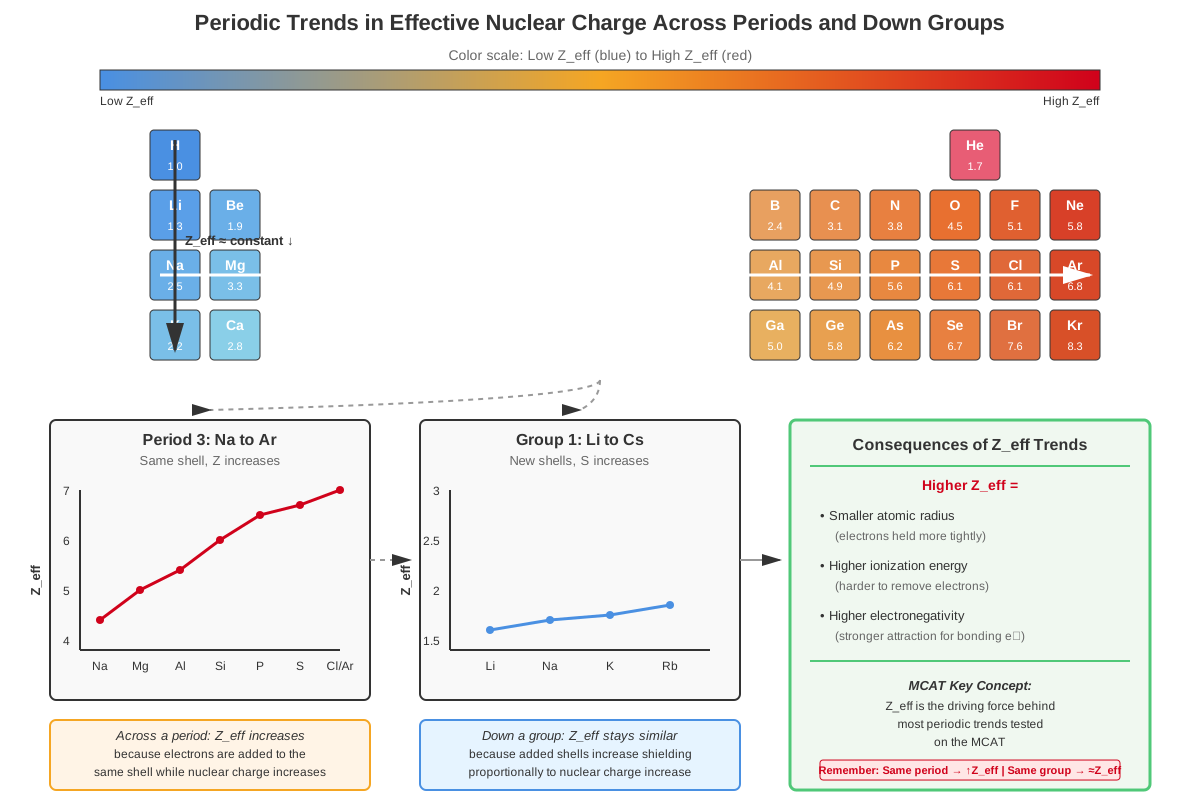
| Across a period (left to right) | Increases | Nuclear charge increases by +1 for each element, but shielding increases only slightly because added electrons enter the same shell |
| Down a group | Increases slightly or stays approximately constant | Nuclear charge increases substantially, but shielding also increases as complete inner shells are added; the two effects largely cancel |
| Same period, different subshell | s > p > d > f (for same n) | Penetration differences cause s electrons to experience higher Z_eff than p electrons in the same shell |
The increase in Z_eff across a period is particularly important for the MCAT. As you move from sodium (Na) to argon (Ar) in the third period, each element has one more proton, but the added electrons all enter the 3s or 3p subshells. These electrons in the same shell shield each other only weakly (approximately 0.35 per electron in Slater's rules), so the effective nuclear charge increases by roughly 0.65 for each step across the period. This increasing Z_eff pulls the electron cloud closer to the nucleus, explaining why atomic radius decreases and ionization energy increases across a period.
Down a group, the trend is more subtle. While nuclear charge increases significantly (for example, from lithium with Z=3 to cesium with Z=55), complete inner electron shells are added that provide substantial shielding. The outermost electron in cesium experiences an effective nuclear charge only slightly higher than that in lithium because the 54 inner electrons shield most of the 55 protons. This explains why chemical properties remain similar down a group—the valence electrons experience similar effective nuclear charges.
Relationship to Atomic Radius
Atomic radius and effective nuclear charge have an inverse relationship: as Z_eff increases, atomic radius decreases. This relationship is intuitive from Coulomb's Law—a stronger attractive force (higher Z_eff) pulls electrons closer to the nucleus, reducing the size of the electron cloud.
Across a period, increasing Z_eff causes the dramatic decrease in atomic radius from left to right. For example, sodium (Na) has a much larger atomic radius than chlorine (Cl) because chlorine's valence electrons experience a much higher effective nuclear charge, pulling them closer to the nucleus despite both elements having their valence electrons in the n=3 shell.
Down a group, atomic radius increases despite slightly increasing Z_eff because electrons are added to shells with higher principal quantum numbers (n). The increased distance from the nucleus due to higher n values outweighs the small increase in effective nuclear charge, resulting in larger atoms as you descend a group.
Relationship to Ionization Energy
Ionization energy (the energy required to remove an electron) correlates directly with effective nuclear charge. Higher Z_eff means electrons are held more tightly, requiring more energy to remove them. This explains the general trend of increasing ionization energy across a period—as Z_eff increases, electrons become progressively harder to remove.
The relationship is quantified approximately by:
IE ∝ Z_eff² / n²This relationship shows that ionization energy depends on both the effective nuclear charge and the principal quantum number of the electron being removed. The n² term in the denominator explains why ionization energy decreases down a group despite slightly increasing Z_eff—the increasing distance (higher n) has a stronger effect than the small increase in effective charge.
Relationship to Electronegativity
Electronegativity, the ability of an atom to attract electrons in a chemical bond, increases with effective nuclear charge. Atoms with higher Z_eff more strongly attract bonding electrons toward themselves. This explains why electronegativity increases across a period (following the Z_eff increase) and decreases down a group (where the distance effect outweighs the small Z_eff increase).
Fluorine, the most electronegative element, combines high effective nuclear charge with small atomic size (n=2 valence shell), creating an extremely strong attraction for bonding electrons. In contrast, cesium has low electronegativity despite its large nuclear charge because extensive shielding and large atomic size (n=6 valence shell) result in relatively low effective nuclear charge experienced by bonding electrons.
Concept Relationships
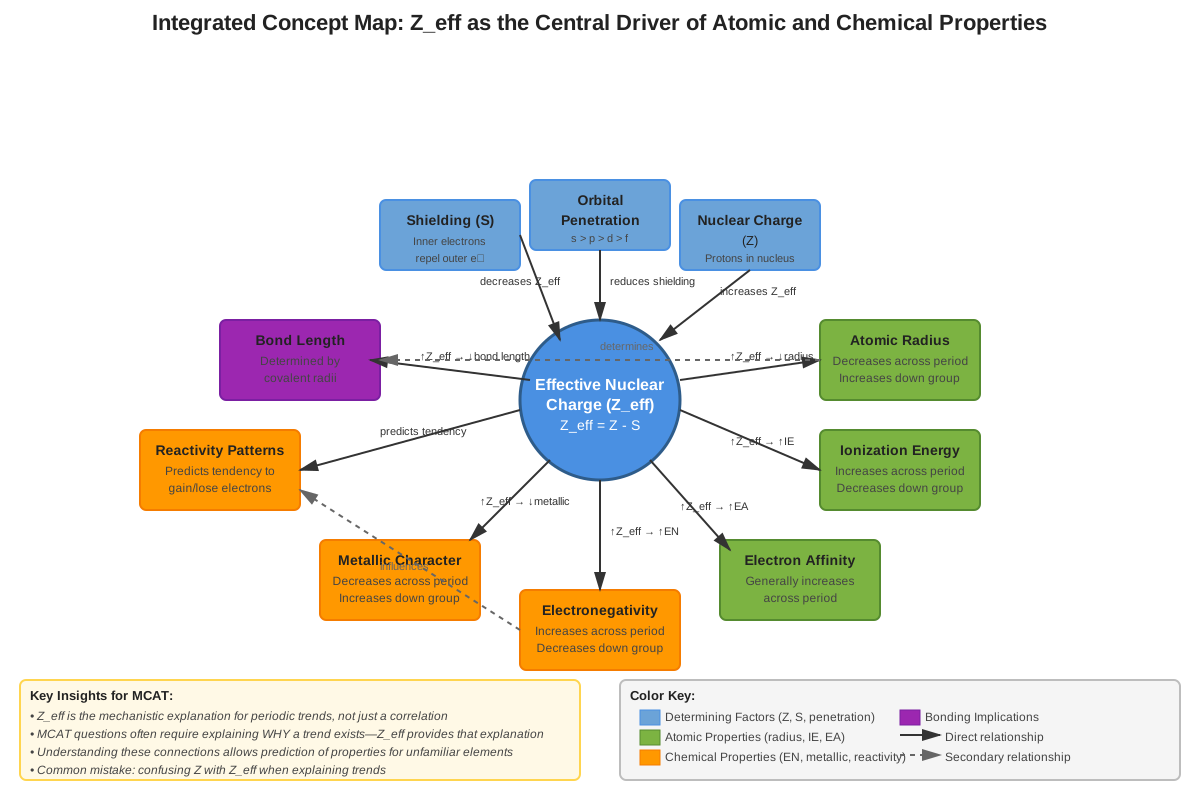
Effective nuclear charge serves as the central organizing principle connecting multiple atomic properties and periodic trends. The relationship map flows as follows:
Nuclear charge (Z) and electron configuration → determine → shielding (S) → which combines to give → effective nuclear charge (Z_eff) → which directly influences → atomic radius (inverse relationship), ionization energy (direct relationship), electron affinity (direct relationship), and electronegativity (direct relationship) → these properties collectively determine → chemical reactivity and bonding behavior.
Within the topic itself, the concepts connect hierarchically. Understanding shielding requires knowledge of electron configuration and penetration. These feed into calculating or estimating Z_eff using Slater's rules or conceptual reasoning. The calculated or estimated Z_eff then explains periodic trends in multiple properties simultaneously.
The concept also connects backward to prerequisite knowledge. Coulomb's Law from physics provides the theoretical foundation for why effective nuclear charge matters—it quantifies the electrostatic force between charged particles. Quantum numbers explain why different orbitals shield differently (penetration effects). Electron configuration rules determine which electrons are present to provide shielding.
Forward connections extend to chemical bonding topics. Effective nuclear charge differences between atoms explain bond polarity—the atom with higher Z_eff attracts shared electrons more strongly. It influences ionic vs. covalent bonding tendencies—elements with very different Z_eff values tend to form ionic bonds, while those with similar Z_eff form covalent bonds. Understanding Z_eff also helps predict oxidation states and coordination chemistry behavior in transition metals.
Quick check — test yourself on Effective nuclear charge so far.
Try Flashcards →High-Yield Facts
⭐ Effective nuclear charge increases across a period because nuclear charge increases by +1 for each element while shielding increases only slightly (electrons added to the same shell shield weakly)
⭐ Effective nuclear charge remains approximately constant or increases only slightly down a group because added protons are largely offset by added inner shell electrons that provide strong shielding
⭐ For electrons in the same shell, Z_eff follows the order: s > p > d > f due to differences in orbital penetration (s orbitals penetrate closest to the nucleus)
⭐ Atomic radius decreases as Z_eff increases because stronger nuclear attraction pulls electrons closer to the nucleus
⭐ Ionization energy increases as Z_eff increases because electrons held more tightly by higher effective nuclear charge require more energy to remove
- Shielding is most effective by electrons in inner shells (lower n values) and least effective by electrons in the same shell
- The shielding constant (S) is always less than the nuclear charge (Z), meaning Z_eff is always positive
- Electrons in the same subshell shield each other only partially (approximately 0.35 per electron in Slater's rules)
- Effective nuclear charge explains why 4s fills before 3d: the 4s electron experiences higher Z_eff due to better penetration
- Transition metals show smaller changes in Z_eff across a period compared to main group elements because added electrons enter inner d orbitals that shield outer s electrons
- Noble gases have the highest effective nuclear charge in their respective periods, contributing to their stability and low reactivity
- Anomalies in periodic trends (such as the slight decrease in ionization energy from nitrogen to oxygen) can be explained by electron-electron repulsion effects that modify effective nuclear charge
Common Misconceptions
Misconception: Effective nuclear charge equals the number of valence electrons or the group number.
Correction: Effective nuclear charge is calculated as Z - S (nuclear charge minus shielding constant) and typically ranges from about 1 to 10 for main group elements. It is not directly equal to the number of valence electrons, though both increase across a period.
Misconception: Electrons in the same shell provide no shielding to each other.
Correction: Electrons in the same shell do shield each other, though less effectively than inner shell electrons. In Slater's rules, same-shell electrons contribute approximately 0.35 to the shielding constant, representing partial shielding.
Misconception: Effective nuclear charge decreases down a group because atoms get larger.
Correction: Effective nuclear charge actually increases slightly or remains approximately constant down a group. While atoms do get larger, this is because electrons are added to higher energy levels (higher n), not because Z_eff decreases. The increased size occurs despite slightly higher Z_eff because the distance effect (higher n) dominates.
Misconception: All inner electrons shield outer electrons equally and completely.
Correction: Inner electrons provide strong but not complete shielding (approximately 0.85-1.00 per electron in Slater's rules). If shielding were complete, outer electrons would experience Z_eff = +1 regardless of the actual nuclear charge, which is not the case. Additionally, penetration allows outer electrons to "reach through" inner shells to some extent.
Misconception: Effective nuclear charge is the same for all electrons in an atom.
Correction: Different electrons in the same atom experience different effective nuclear charges depending on their shell and subshell. For example, in a sodium atom, the 1s electrons experience much higher Z_eff than the 3s electron because they have no inner electrons shielding them and are much closer to the nucleus.
Misconception: Adding more protons always increases the effective nuclear charge experienced by valence electrons proportionally.
Correction: The increase in Z_eff depends on where the additional electrons (that accompany the additional protons in neutral atoms) are placed. If they enter inner shells, Z_eff for outer electrons increases only slightly. If they enter the same shell as the electron of interest, Z_eff increases more substantially (by approximately 0.65 per proton across a period).
Misconception: Effective nuclear charge can be negative.
Correction: Z_eff is always positive because shielding is never complete. Even the outermost electron in the largest atom experiences net attraction to the nucleus. If Z_eff were negative or zero, the electron would not be bound to the atom.
Worked Examples
Example 1: Comparing Effective Nuclear Charge Across a Period
Question: Compare the effective nuclear charge experienced by the outermost electron in nitrogen (N, atomic number 7) and oxygen (O, atomic number 8). Use Slater's rules to calculate Z_eff for each, and explain the significance of your result.
Solution:
Step 1: Write electron configurations
- Nitrogen: 1s² 2s² 2p³
- Oxygen: 1s² 2s² 2p⁴
Step 2: Identify the electron of interest (outermost electron)
- For both atoms, we're examining a 2p electron
Step 3: Apply Slater's rules to calculate shielding constant (S)
For nitrogen's 2p electron:
- Group the configuration: (1s²)(2s²,2p³)
- Electrons in the same group (2s²,2p²): 4 electrons × 0.35 = 1.40
- Electrons in n-1 shell (1s²): 2 electrons × 0.85 = 1.70
- Total S = 1.40 + 1.70 = 3.10
For oxygen's 2p electron:
- Group the configuration: (1s²)(2s²,2p⁴)
- Electrons in the same group (2s²,2p³): 5 electrons × 0.35 = 1.75
- Electrons in n-1 shell (1s²): 2 electrons × 0.85 = 1.70
- Total S = 1.75 + 1.70 = 3.45
Step 4: Calculate Z_eff
- Nitrogen: Z_eff = 7 - 3.10 = 3.90
- Oxygen: Z_eff = 8 - 3.45 = 4.55
Step 5: Interpret the results
Oxygen's outermost electron experiences a higher effective nuclear charge (4.55 vs. 3.90), an increase of 0.65. This follows the expected trend of increasing Z_eff across a period. The increase is less than 1.0 because the additional electron in oxygen provides some shielding (0.35) that partially offsets the additional proton. This higher Z_eff in oxygen explains why oxygen has a smaller atomic radius and higher ionization energy than nitrogen (with the exception of the slight anomaly in first ionization energy due to electron pairing effects).
Connection to learning objectives: This example demonstrates how to calculate effective nuclear charge using proper terminology, apply the concept to compare elements, and connect Z_eff to periodic trends.
Example 2: Explaining an Anomaly Using Effective Nuclear Charge
Question: The first ionization energy of magnesium (Mg, Z=12) is higher than that of aluminum (Al, Z=13), even though aluminum is to the right of magnesium in the periodic table. Use effective nuclear charge concepts to explain this apparent violation of periodic trends.
Solution:
Step 1: Identify the expected trend
Ionization energy typically increases across a period due to increasing effective nuclear charge. Therefore, we would expect aluminum to have higher ionization energy than magnesium.
Step 2: Write electron configurations and identify which electron is removed
- Magnesium: 1s² 2s² 2p⁶ 3s² → removes a 3s electron
- Aluminum: 1s² 2s² 2p⁶ 3s² 3p¹ → removes a 3p electron
Step 3: Calculate or estimate Z_eff for the electron being removed
For magnesium's 3s electron:
- Shielding from 10 inner electrons (1s² 2s² 2p⁶): 10 × 0.85 = 8.50
- Shielding from the other 3s electron: 1 × 0.35 = 0.35
- S = 8.85
- Z_eff = 12 - 8.85 = 3.15
For aluminum's 3p electron:
- Shielding from 10 inner electrons (1s² 2s² 2p⁶): 10 × 0.85 = 8.50
- Shielding from 3s² and the other 3p electrons: 2 × 0.35 = 0.70
- S = 9.20
- Z_eff = 13 - 9.20 = 3.80
Step 4: Resolve the apparent contradiction
Although aluminum's 3p electron experiences higher Z_eff (3.80) than magnesium's 3s electron (3.15), the 3p electron is easier to remove. This is because:
- Subshell energy differences: The 3p orbital is higher in energy than the 3s orbital due to less penetration. Despite experiencing higher Z_eff, the 3p electron is less tightly bound because it spends more time farther from the nucleus.
- Shielding by same-shell electrons: The 3p electron is partially shielded by the two 3s electrons, which are closer to the nucleus on average. This additional shielding effect is not fully captured in the simple Z_eff calculation.
- Orbital penetration: The 3s electron penetrates closer to the nucleus than the 3p electron, experiencing the nuclear charge more directly despite the calculated Z_eff values.
Step 5: General principle
This example illustrates that while Z_eff is a powerful predictor of periodic trends, other factors (orbital energy levels, penetration, and electron-electron repulsion) also influence properties. The general trend of increasing ionization energy across a period holds, but small anomalies occur at subshell boundaries.
Connection to learning objectives: This example demonstrates how to apply effective nuclear charge to explain periodic trends, identify when other factors modify simple Z_eff predictions, and connect the concept to electron configuration and orbital theory.
Exam Strategy
Approaching MCAT Questions on Effective Nuclear Charge
When encountering questions involving effective nuclear charge, follow this systematic approach:
- Identify whether Z_eff is explicitly mentioned or implied: Many questions test Z_eff concepts without using the term. Look for questions about periodic trends, atomic size, ionization energy, or electronegativity—all involve Z_eff reasoning.
- Determine what comparison is being asked: Most questions ask you to compare two or more elements. Identify whether they're in the same period (expect significant Z_eff differences) or same group (expect similar Z_eff).
- Consider both nuclear charge and shielding: Don't just count protons. Ask yourself: "What electrons are present to provide shielding?" and "How effective is that shielding?"
- Remember the penetration order: When comparing electrons in the same shell, recall that s > p > d > f in terms of Z_eff experienced.
Trigger Words and Phrases
Watch for these terms that signal effective nuclear charge concepts:
- "Across the period" or "left to right" → expect increasing Z_eff
- "Down the group" → expect approximately constant Z_eff
- "Nuclear attraction" or "nuclear pull" → direct references to Z_eff
- "Shielding" or "screening" → key component of Z_eff
- "Valence electrons experience" → asking about Z_eff for outer electrons
- "Penetration" → explains Z_eff differences within a shell
- "Holds electrons more tightly" → higher Z_eff
- "Easier to remove" → lower Z_eff
Process of Elimination Tips
When using POE on Z_eff questions:
- Eliminate answers that violate basic trends: If an answer suggests Z_eff decreases across a period or that atoms get smaller as Z_eff decreases, eliminate it immediately.
- Watch for answers that ignore shielding: If an answer treats effective nuclear charge as equal to nuclear charge (number of protons), it's likely wrong.
- Be suspicious of extreme statements: Answers suggesting "complete shielding" or "no shielding" are usually incorrect—shielding is partial.
- Check for subshell awareness: Correct answers about electrons in the same shell should acknowledge that s electrons experience higher Z_eff than p electrons.
Time Allocation
Effective nuclear charge questions typically require 60-90 seconds:
- 15-20 seconds: Read and identify what's being asked
- 20-30 seconds: Analyze the elements or situations being compared
- 20-30 seconds: Apply Z_eff reasoning to determine the answer
- 10-15 seconds: Verify your answer makes sense with periodic trends
Don't spend time calculating exact Z_eff values using Slater's rules unless explicitly required. The MCAT tests conceptual understanding more than calculation ability. Qualitative reasoning about "higher" or "lower" Z_eff is usually sufficient.
Exam Tip: If a question seems to require detailed Slater's rule calculations, first check if you can answer it using periodic trend reasoning alone. The MCAT rarely requires precise numerical calculations for Z_eff.
Memory Techniques
Mnemonics
"SPIN" for penetration order: Super Powerful In Nucleus-approaching
- S orbitals penetrate most
- P orbitals penetrate less
- (I) d orbitals penetrate even less
- (N) f orbitals penetrate least
"ZAPS" for Z_eff effects: Z_eff Affects Properties Systematically
- Z_eff increases → Atomic radius decreases
- Z_eff increases → Ionization energy increases
- Z_eff increases → Electronegativity increases
"SHIELD" for shielding effectiveness: Same-shell Helps Inadequately, Earlier Layers Do better
- Same-shell electrons shield weakly (~0.35)
- Inner shells shield strongly (~0.85-1.00)
Visualization Strategies
The "Tug-of-War" Model: Visualize the nucleus as pulling on an outer electron (attractive force) while inner electrons push against it (repulsive force). The net pull the outer electron experiences is Z_eff. As you move across a period, imagine the nucleus getting stronger (more protons) while the opposing team (shielding electrons) grows only slightly, so the net pull increases.
The "Layers of Protection" Model: Think of inner electron shells as layers of shielding protecting outer electrons from the full nuclear charge. Each layer blocks some but not all of the nuclear "radiation." Electrons in the same layer provide only thin protection to each other, while complete inner layers provide thick protection.
The "Penetration Depth" Model: Visualize s orbitals as submarines that can dive deep (penetrate close to the nucleus), p orbitals as ships that stay at medium depth, and d/f orbitals as surface vessels. The deeper you can go, the more of the nuclear "signal" you receive (higher Z_eff).
Acronyms
RISE: Right Increases, Same Experience
- Moving right (across a period), Z_eff increases
- Same group elements experience similar Z_eff
CORE: Core electrons Obstruct, Reducing Effective charge
- Core (inner) electrons are what create shielding
- They reduce the effective charge experienced by outer electrons
Summary
Effective nuclear charge (Z_eff) represents the net positive charge experienced by an electron after accounting for shielding by other electrons, calculated as Z_eff = Z - S. This concept serves as the fundamental explanation for periodic trends in atomic properties. Across a period, Z_eff increases substantially because nuclear charge increases while shielding increases only slightly, causing atoms to become smaller, ionization energies to increase, and electronegativity to increase. Down a group, Z_eff remains approximately constant because added protons are offset by added inner-shell electrons that provide strong shielding. Within the same shell, electrons in s orbitals experience higher Z_eff than those in p orbitals due to greater penetration. Understanding effective nuclear charge enables students to predict and explain chemical behavior systematically rather than memorizing isolated facts. For the MCAT, recognizing when questions involve Z_eff concepts—even when not explicitly stated—and applying the principle that higher Z_eff means stronger nuclear attraction and altered atomic properties is essential for success on General Chemistry questions involving atomic structure and periodic trends.
Key Takeaways
- Effective nuclear charge (Z_eff = Z - S) quantifies the net nuclear attraction experienced by an electron after accounting for shielding by other electrons
- Z_eff increases significantly across a period (left to right) because each added proton increases nuclear charge more than each added electron increases shielding
- Z_eff remains approximately constant down a group because added protons are largely offset by added inner-shell electrons that provide strong shielding
- Higher Z_eff correlates with smaller atomic radius, higher ionization energy, and higher electronegativity because electrons are held more tightly
- Penetration effects cause s > p > d > f in terms of Z_eff experienced within the same shell, explaining subshell energy differences
- Shielding is most effective by inner-shell electrons and least effective by same-shell electrons, with inner electrons contributing approximately 0.85-1.00 and same-shell electrons contributing approximately 0.35 to the shielding constant
- Effective nuclear charge concepts explain periodic trends and chemical reactivity, making it a unifying principle in General Chemistry that appears throughout the MCAT
Related Topics
Ionization Energy and Electron Affinity: These properties directly depend on effective nuclear charge. Mastering Z_eff provides the foundation for understanding why removing or adding electrons requires specific amounts of energy and how these energies vary across the periodic table.
Atomic and Ionic Radii: The size of atoms and ions is inversely related to effective nuclear charge. Understanding Z_eff enables prediction of size trends and explanation of why cations are smaller and anions are larger than their parent atoms.
Electronegativity and Bond Polarity: Differences in effective nuclear charge between bonded atoms determine bond polarity and predict molecular properties. This connects atomic-level Z_eff concepts to molecular-level behavior.
Electron Configuration and Orbital Theory: Effective nuclear charge explains why orbitals fill in specific orders and why certain configurations are more stable. This deepens understanding of the aufbau principle and Hund's rule.
Chemical Bonding and Molecular Structure: Z_eff influences bonding tendencies, bond strengths, and molecular geometries. Elements with similar Z_eff tend to form covalent bonds, while those with very different Z_eff form ionic bonds.
Transition Metal Chemistry: The unique properties of transition metals, including variable oxidation states and colored compounds, relate to how d electrons experience effective nuclear charge differently than s and p electrons.
Practice CTA
Now that you've mastered the core concepts of effective nuclear charge, it's time to solidify your understanding through active practice. Attempt the practice questions and flashcards associated with this topic to test your ability to apply Z_eff reasoning to MCAT-style questions. Focus on questions that require you to compare elements, explain periodic trends, and predict atomic properties—these represent the most common ways effective nuclear charge appears on the exam. Remember that understanding the "why" behind periodic trends through Z_eff concepts is far more powerful than memorizing isolated facts. Each practice question you complete strengthens your ability to recognize Z_eff concepts in various contexts and builds the pattern recognition skills essential for MCAT success. You've built a strong foundation—now reinforce it through deliberate practice!
Sign up free to keep reading
Create a free AnvayaPrep account to finish this MCAT guide on Effective nuclear charge — plus flashcards and practice questions.