Overview
Valence electrons are the electrons occupying the outermost shell of an atom and are fundamentally responsible for an element's chemical behavior. These electrons determine how atoms interact, bond, and form molecules—making them one of the most critical concepts in General Chemistry. For the MCAT, understanding valence electrons is not merely an exercise in counting electrons; it is the foundation for predicting molecular geometry, understanding periodic trends, explaining chemical reactivity, and solving problems across general chemistry, organic chemistry, and biochemistry sections.
The concept of valence electrons bridges atomic structure with chemical bonding. When students master this topic within Atomic Structure and Periodic Trends, they unlock the ability to predict bond formation, understand electronegativity patterns, explain ionization energies, and rationalize the structure of the periodic table itself. The MCAT frequently tests this concept both directly—through questions asking students to identify the number of valence electrons in an element or ion—and indirectly, through questions about Lewis structures, formal charge, molecular polarity, and reaction mechanisms.
Understanding valence electrons provides the conceptual framework for nearly every subsequent topic in chemistry. From predicting which elements will form ionic versus covalent bonds to understanding why noble gases are unreactive, valence electrons explain the "why" behind chemical phenomena. This topic appears across multiple MCAT sections, including Chemical and Physical Foundations of Biological Systems and Biological and Biochemical Foundations of Living Systems, making it a high-yield investment of study time. Mastery here translates directly into points on test day.
Learning Objectives
- [ ] Define valence electrons using accurate General Chemistry terminology
- [ ] Explain why valence electrons matters for the MCAT
- [ ] Apply valence electrons to exam-style questions
- [ ] Identify common mistakes related to valence electrons
- [ ] Connect valence electrons to related General Chemistry concepts
- [ ] Determine the number of valence electrons for any main group or transition metal element using the periodic table
- [ ] Predict chemical reactivity and bonding behavior based on valence electron configuration
- [ ] Calculate the number of valence electrons in polyatomic ions and use this information to construct Lewis structures
Prerequisites
- Atomic structure basics: Understanding protons, neutrons, electrons, and their arrangement in atoms is essential because valence electrons are a specific subset of the total electron population
- Electron configuration notation: Familiarity with s, p, d, f orbitals and how to write electron configurations enables identification of which electrons occupy the outermost shell
- Periodic table organization: Knowledge of groups, periods, and the distinction between main group and transition elements is necessary to quickly determine valence electron counts
- Basic quantum numbers: Understanding principal quantum number (n) helps identify which shell constitutes the "valence" shell for a given atom
Why This Topic Matters
Clinical and Real-World Significance
Valence electrons govern all chemical interactions in biological systems. When sodium and potassium ions move across cell membranes during nerve impulse transmission, their behavior is dictated by their single valence electron and resulting +1 charge. When hemoglobin binds oxygen, the interaction depends on the valence electrons of iron in the heme group. Drug-receptor interactions, enzyme catalysis, and metabolic pathways all fundamentally depend on how valence electrons participate in chemical bonding. Understanding valence electrons allows students to predict how molecules will interact in physiological contexts—a skill tested repeatedly on the MCAT.
Exam Statistics and Question Types
Valence electrons appear in approximately 8-12% of General Chemistry questions on the MCAT, either as the primary focus or as a necessary step in solving more complex problems. Questions may directly ask for the number of valence electrons in an element or ion, or they may require this knowledge to construct Lewis structures, predict molecular geometry using VSEPR theory, or explain periodic trends. Passage-based questions frequently present novel compounds or reaction mechanisms where identifying valence electrons is the first critical step toward understanding the chemistry described.
Common Exam Contexts
The MCAT presents valence electron concepts in several recurring formats: identifying the number of valence electrons in transition metals (a common trap), determining formal charges in resonance structures, predicting which atoms will form coordinate covalent bonds, explaining why certain elements violate the octet rule, and rationalizing periodic trends in ionization energy or electronegativity. Biochemistry passages may require students to understand metal cofactors in enzymes, where transition metal valence electrons participate in catalysis. Organic chemistry questions routinely require tracking valence electrons through reaction mechanisms.
Core Concepts
Definition and Fundamental Properties
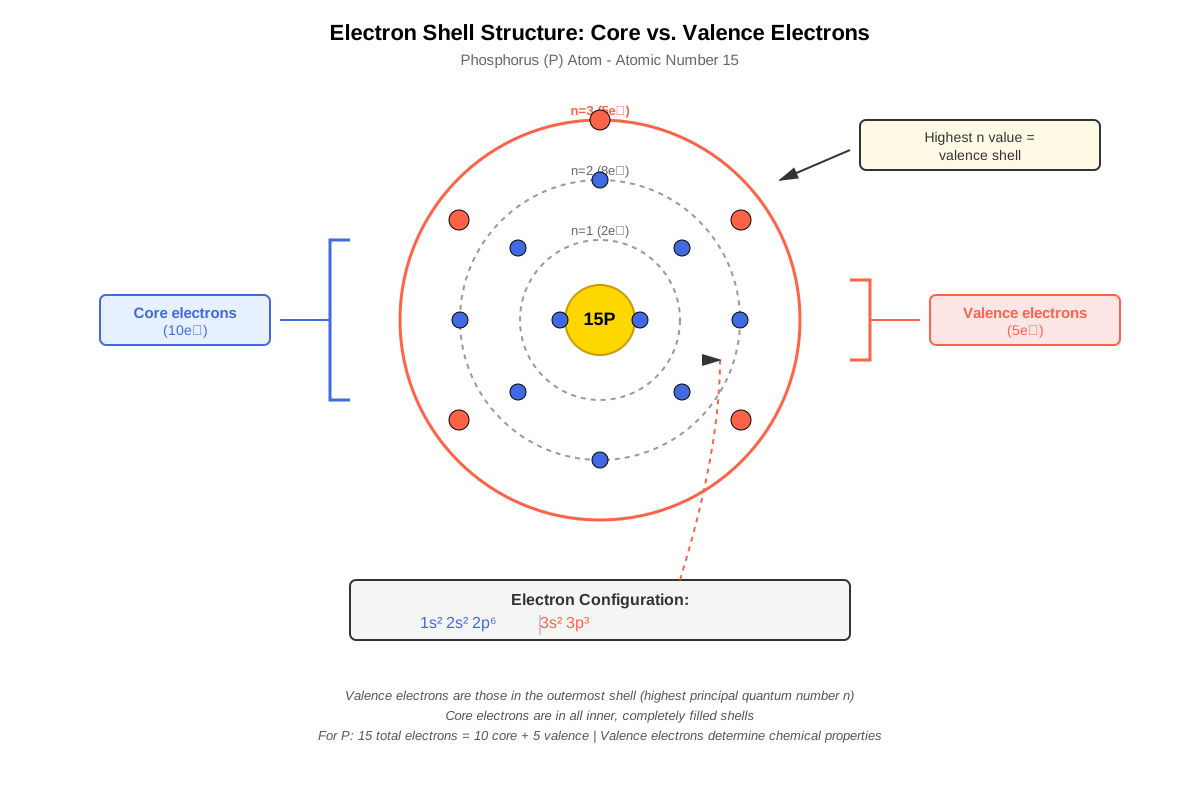
Valence electrons are the electrons in the outermost principal energy level (highest n value) of an atom. These electrons are the most loosely bound and therefore the most chemically reactive. For main group elements (Groups 1, 2, and 13-18), valence electrons include all electrons in the outermost s and p orbitals. For example, carbon (1s² 2s² 2p²) has four valence electrons—the two in the 2s orbital and the two in the 2p orbitals—because the second shell (n=2) is the outermost occupied shell.
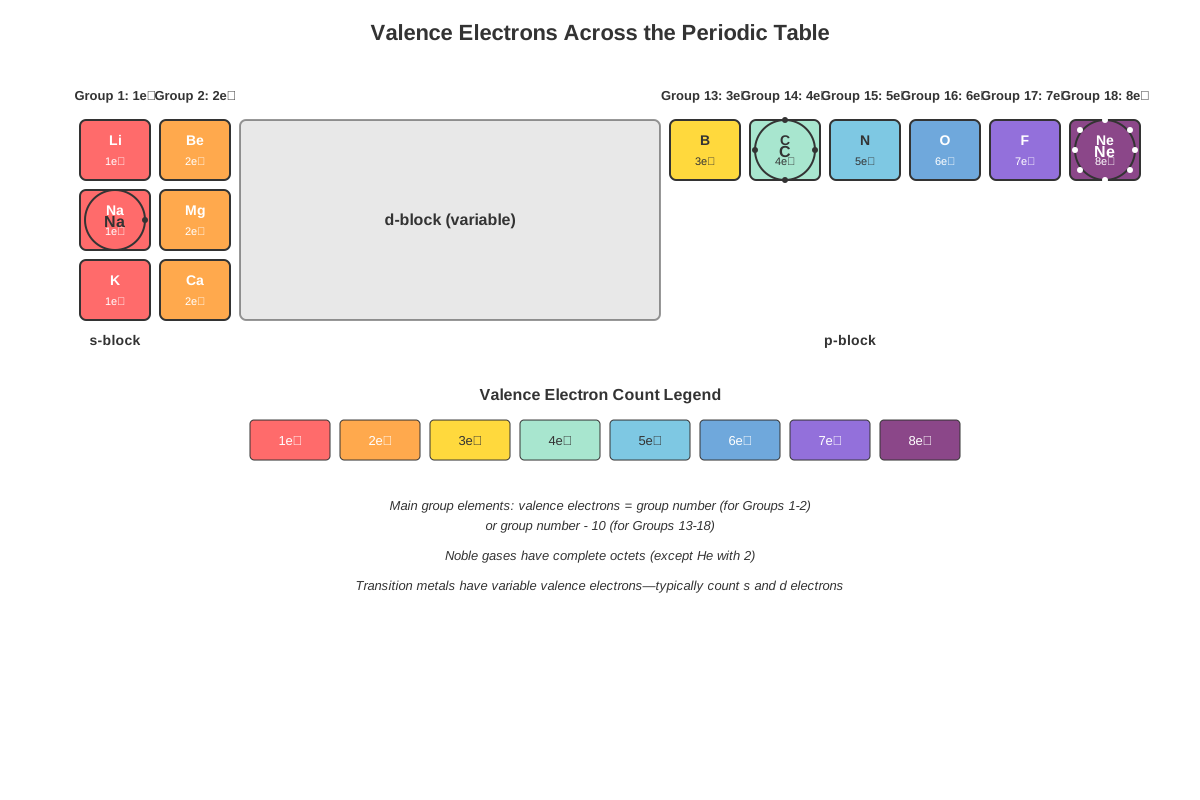
The number of valence electrons directly determines an element's position in the periodic table and its chemical properties. Elements in the same group (vertical column) have the same number of valence electrons, which explains why they exhibit similar chemical behavior. This pattern is the organizing principle of the periodic table and a high-yield concept for the MCAT.
Determining Valence Electrons for Main Group Elements
For main group elements, the group number provides a direct method for determining valence electron count:
| Group Number (Modern) | Group Number (Old) | Valence Electrons | Examples |
|---|---|---|---|
| 1 | IA | 1 | H, Li, Na, K |
| 2 | IIA | 2 | Be, Mg, Ca |
| 13 | IIIA | 3 | B, Al, Ga |
| 14 | IVA | 4 | C, Si, Ge |
| 15 | VA | 5 | N, P, As |
| 16 | VIA | 6 | O, S, Se |
| 17 | VIIA | 7 | F, Cl, Br, I |
| 18 | VIIIA | 8 | He (2), Ne, Ar |
Note that helium is an exception with only 2 valence electrons, but it behaves as a noble gas because its first shell is complete. For modern group numbering (1-18), the ones digit of the group number equals the number of valence electrons for groups 13-18 (subtract 10 from the group number).
Valence Electrons in Transition Metals
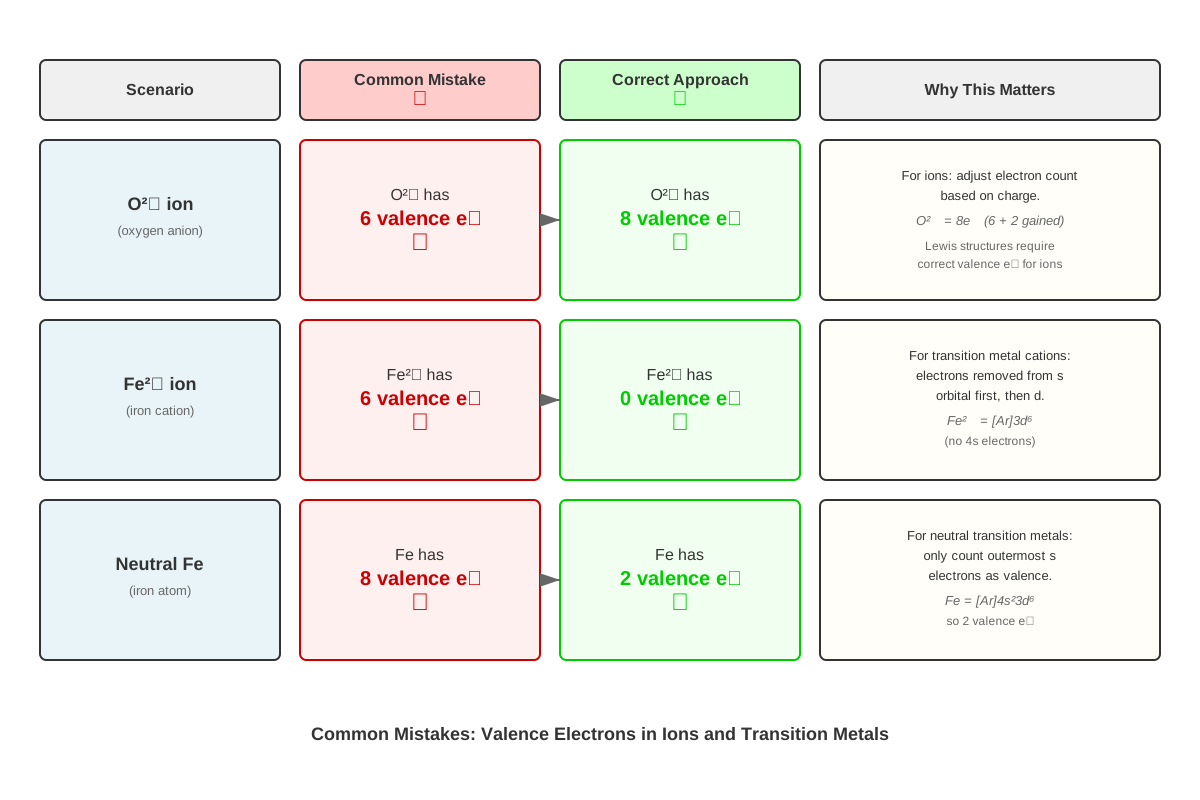
Transition metals (Groups 3-12) present additional complexity because their valence electrons include both the outermost s electrons and the d electrons from the shell immediately below. For example, iron (Fe: [Ar] 3d⁶ 4s²) has 8 total electrons that can participate in bonding (the 3d⁶ and 4s² electrons), though for many purposes, the MCAT focuses on the 4s² electrons as the primary valence electrons.
MCAT Exam Tip: When transition metals form ions, they lose their s electrons first, then d electrons. Fe²⁺ has the configuration [Ar] 3d⁶, not [Ar] 3d⁴ 4s². This is a frequent source of exam questions.
For MCAT purposes, transition metals are often treated as having 2 valence electrons (the outermost s electrons) when predicting simple ionic charges, but students must recognize that d electrons participate in bonding in coordination complexes and can be considered valence electrons in those contexts.
Valence Electrons and Chemical Bonding
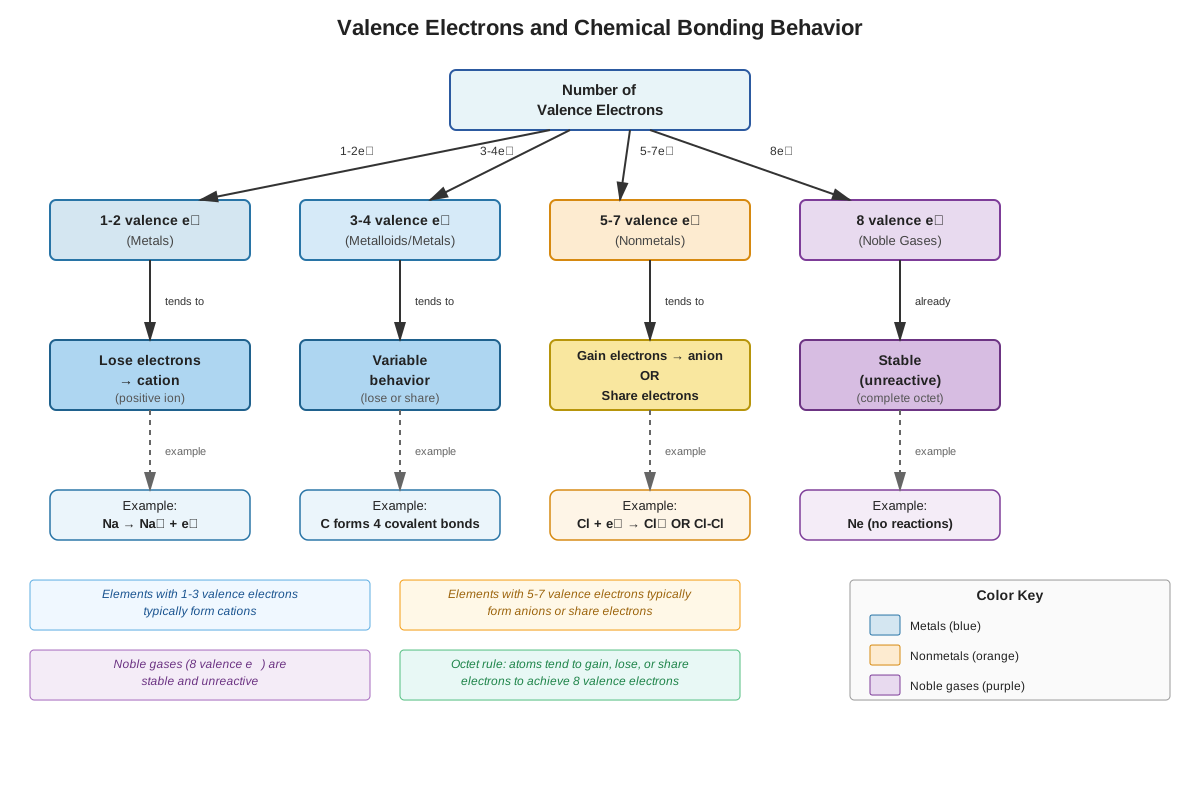
The octet rule—the tendency of atoms to gain, lose, or share electrons to achieve eight valence electrons—is directly based on valence electron behavior. Atoms with 1-3 valence electrons typically lose them to form cations, while atoms with 5-7 valence electrons typically gain electrons to form anions. Atoms with 4 valence electrons (like carbon) typically share electrons through covalent bonding.
The number of valence electrons determines bonding capacity:
- Elements with 1 valence electron form 1 bond (H, alkali metals)
- Elements with 2 valence electrons form 2 bonds (Be, Mg, Ca)
- Elements with 3 valence electrons form 3 bonds (B, Al)
- Elements with 4 valence electrons form 4 bonds (C, Si)
- Elements with 5 valence electrons form 3 bonds with 1 lone pair (N, P)
- Elements with 6 valence electrons form 2 bonds with 2 lone pairs (O, S)
- Elements with 7 valence electrons form 1 bond with 3 lone pairs (halogens)
- Elements with 8 valence electrons typically form no bonds (noble gases)
Valence Electrons in Ions
When atoms form ions, the number of valence electrons changes. To determine valence electrons in an ion:
- Start with the neutral atom's valence electron count
- Add electrons for negative charges (anions)
- Subtract electrons for positive charges (cations)
For example:
- Oxygen (O) has 6 valence electrons
- Oxide ion (O²⁻) has 8 valence electrons (6 + 2)
- Sodium (Na) has 1 valence electron
- Sodium ion (Na⁺) has 0 valence electrons in the third shell (it now has 8 in the second shell, which becomes the new valence shell)
High-Yield Concept: When main group elements form ions, they typically achieve a noble gas configuration with 8 valence electrons (or 2 for elements near helium). This is the basis for predicting ionic charges.
Lewis Structures and Valence Electrons
Lewis structures are diagrams that show valence electrons as dots around element symbols. Constructing Lewis structures requires accurate counting of total valence electrons:
- Count valence electrons for each atom
- Add electrons for negative charges
- Subtract electrons for positive charges
- Distribute electrons to satisfy the octet rule (or duet for hydrogen)
For example, water (H₂O):
- Oxygen: 6 valence electrons
- Each hydrogen: 1 valence electron
- Total: 6 + 1 + 1 = 8 valence electrons
- Structure: H-O-H with two lone pairs on oxygen
Exceptions to the Octet Rule
Several important exceptions to the octet rule are based on valence electron behavior:
- Incomplete octets: Elements with fewer than 8 valence electrons in stable compounds (B, Be, Al)
- Expanded octets: Elements in period 3 and below can accommodate more than 8 valence electrons using d orbitals (P, S, Cl in compounds like PCl₅, SF₆, ClF₃)
- Odd-electron species: Radicals like NO have an odd number of total valence electrons and cannot satisfy the octet rule for all atoms
Concept Relationships
Valence electrons serve as the central organizing concept connecting atomic structure to chemical behavior. The relationship flows as follows:
Electron Configuration → determines → Valence Electrons → determines → Group Number → predicts → Chemical Reactivity
Within this topic, several internal connections exist:
- The number of valence electrons determines bonding capacity
- Bonding capacity determines molecular structure
- Valence electron count explains periodic trends (ionization energy, electronegativity, atomic radius)
Valence electrons connect to prerequisite knowledge of atomic structure by specifying which electrons (those in the outermost shell) are most important for chemistry. They connect forward to Lewis structures, VSEPR theory, molecular orbital theory, and essentially all of chemical bonding. Understanding valence electrons enables students to predict:
- Ionic vs. covalent bonding: Elements with very different valence electron counts form ionic bonds; similar counts form covalent bonds
- Oxidation states: The number of valence electrons determines possible oxidation states
- Molecular geometry: Valence electrons (bonding and lone pairs) determine 3D structure via VSEPR
- Reactivity patterns: Elements with similar valence electron configurations react similarly
The concept also connects to periodic trends: as you move across a period, valence electrons increase, leading to increasing electronegativity and ionization energy. As you move down a group, the valence electrons occupy higher energy levels, leading to increasing atomic radius and decreasing ionization energy.
Quick check — test yourself on Valence electrons so far.
Try Flashcards →High-Yield Facts
⭐ Main group elements have valence electrons equal to their group number (for groups 1-2, use the group number directly; for groups 13-18, use the ones digit or subtract 10 from the group number)
⭐ Transition metals lose their s electrons before d electrons when forming cations
⭐ Elements in the same group have the same number of valence electrons and therefore similar chemical properties
⭐ The octet rule states that atoms tend to gain, lose, or share electrons to achieve 8 valence electrons
⭐ Noble gases have complete valence shells (8 electrons, except He with 2) and are chemically unreactive
- Carbon always has 4 valence electrons and typically forms 4 bonds in stable organic compounds
- When calculating total valence electrons for Lewis structures, add electrons for negative charges and subtract for positive charges
- Period 3 and higher elements can expand their octets using d orbitals (e.g., PCl₅ has 10 electrons around phosphorus)
- Hydrogen is an exception to the octet rule, following a "duet rule" with only 2 valence electrons when bonded
- Valence electrons in lone pairs affect molecular geometry but not molecular formula
- The number of valence electrons determines an element's position in the periodic table
- Metals typically have 1-3 valence electrons and form cations; nonmetals have 5-7 valence electrons and form anions
Common Misconceptions
Misconception: All electrons in an atom are valence electrons.
Correction: Only electrons in the outermost principal energy level are valence electrons. Core electrons (those in inner shells) do not participate in chemical bonding under normal conditions. For example, sodium has 11 total electrons but only 1 valence electron.
Misconception: Transition metals have the same number of valence electrons as their group number.
Correction: Transition metal valence electron counting is more complex. While main group elements follow the group number rule, transition metals have valence electrons in both s and d orbitals. For simple ionic charge prediction, focus on the outermost s electrons (typically 2), but recognize that d electrons can participate in bonding.
Misconception: When forming cations, atoms lose electrons from the highest energy orbital.
Correction: Atoms lose electrons from the highest principal quantum number (n value) first, which is the outermost s orbital, even though d orbitals may have been filled last. For example, Fe loses 4s electrons before 3d electrons when forming Fe²⁺.
Misconception: All atoms must achieve exactly 8 valence electrons to be stable.
Correction: While the octet rule is a useful guideline, many stable compounds violate it. Boron compounds often have only 6 valence electrons around boron, hydrogen needs only 2, and elements in period 3 and below can have expanded octets with 10, 12, or even more valence electrons.
Misconception: Valence electrons and oxidation state are the same thing.
Correction: Valence electrons are the actual electrons in the outermost shell, while oxidation state is a bookkeeping method for tracking electron distribution in compounds. An element's oxidation state can change in different compounds, but its number of valence electrons as a neutral atom remains constant. For example, sulfur always has 6 valence electrons, but can have oxidation states ranging from -2 to +6.
Misconception: Noble gases have no valence electrons.
Correction: Noble gases have 8 valence electrons (except helium with 2), which is why they are stable and unreactive. Having a complete valence shell is different from having no valence electrons.
Worked Examples
Example 1: Determining Valence Electrons and Predicting Ion Formation
Question: How many valence electrons does aluminum have, and what ion is it most likely to form? Write the electron configuration of both the neutral atom and the ion.
Solution:
Step 1: Locate aluminum on the periodic table. It is in Group 13 (or IIIA in older notation), Period 3.
Step 2: Determine valence electrons from group number. Group 13 elements have 3 valence electrons. We can verify this by writing the electron configuration.
Step 3: Write the electron configuration for neutral aluminum (atomic number 13):
Al: 1s² 2s² 2p⁶ 3s² 3p¹
The third shell (n=3) is the outermost, containing 2 + 1 = 3 electrons in the 3s and 3p orbitals. These are the valence electrons.
Step 4: Predict ion formation. Elements with 1-3 valence electrons typically lose them to achieve a noble gas configuration. Aluminum will lose 3 electrons to form Al³⁺.
Step 5: Write the electron configuration for Al³⁺:
Al³⁺: 1s² 2s² 2p⁶
This is the same configuration as neon, a noble gas. The ion has 8 electrons in its outermost shell (now the second shell), satisfying the octet rule.
Key Takeaway: This example demonstrates how valence electron count predicts ionic charge and how ions achieve noble gas configurations.
Example 2: Calculating Total Valence Electrons for Lewis Structure
Question: Determine the total number of valence electrons in the sulfate ion (SO₄²⁻) and explain how to account for the charge.
Solution:
Step 1: Identify each atom and its valence electron count.
- Sulfur (S): Group 16, so 6 valence electrons
- Oxygen (O): Group 16, so 6 valence electrons each
- There are 4 oxygen atoms
Step 2: Calculate total valence electrons from neutral atoms.
- Sulfur: 6 electrons
- Oxygen: 4 × 6 = 24 electrons
- Subtotal: 6 + 24 = 30 electrons
Step 3: Account for the charge. The 2- charge means the ion has 2 extra electrons.
- Add 2 electrons for the 2- charge
- Total: 30 + 2 = 32 valence electrons
Step 4: Verify this makes sense. In the Lewis structure of SO₄²⁻, sulfur is the central atom bonded to four oxygen atoms. With 32 total valence electrons, we can construct a structure where sulfur has an expanded octet (common for period 3 elements) with single bonds to each oxygen, and each oxygen has three lone pairs, accounting for all 32 electrons.
Key Takeaway: Always add electrons for negative charges and subtract for positive charges when calculating total valence electrons for ions. This is a critical step that students frequently forget under time pressure on the MCAT.
Exam Strategy
Approaching MCAT Questions
When encountering valence electron questions on the MCAT, follow this systematic approach:
- Identify the element's position: Immediately locate the element on the periodic table to determine its group
- Apply the group number rule: For main group elements, use the group number to determine valence electrons
- Check for ions: If the species is charged, adjust the valence electron count accordingly
- Consider the context: Determine whether the question requires simple valence electron counting or application to Lewis structures, bonding, or periodic trends
Trigger Words and Phrases
Watch for these key phrases that signal valence electron concepts:
- "Outermost electrons"
- "Electrons available for bonding"
- "Lewis structure"
- "Octet rule"
- "Noble gas configuration"
- "Chemical reactivity"
- "Group number"
- "Isoelectronic with" (meaning same number of electrons)
Process of Elimination Tips
When using process of elimination:
- Eliminate answers that violate the group number rule for main group elements
- Eliminate answers that give transition metals more than 2-3 valence electrons for simple ionic charge questions
- Eliminate answers that don't account for charge when dealing with ions
- Eliminate answers that violate the octet rule unless the question specifically involves exceptions (B, Be, Al, or expanded octets)
Time Allocation
Valence electron questions should be among the fastest to answer on the MCAT:
- Direct questions ("How many valence electrons does X have?"): 15-30 seconds
- Application questions (using valence electrons to draw Lewis structures): 45-90 seconds
- Passage-based questions requiring valence electron knowledge: 60-120 seconds
If a valence electron question is taking longer than these benchmarks, you may be overthinking it. Return to the basic group number rule and work systematically.
Memory Techniques
Mnemonic for Main Group Valence Electrons
"Groups Tell Valence": The group number tells you the valence electron count directly.
- Groups 1-2: Use the group number as-is (1 or 2 valence electrons)
- Groups 13-18: Subtract 10 from the group number (or use the ones digit)
Visualization Strategy
Picture the periodic table as a map where vertical columns (groups) represent "families" with the same number of valence electrons. Elements in the same family behave similarly because they have the same number of "hands" (valence electrons) available to "hold" other atoms.
Acronym for Octet Rule Exceptions
"BBES" - Boron, Beryllium, Expanded octets, Sulfur (and other period 3+ elements)
These are the main categories of octet rule exceptions to remember.
Memory Aid for Ion Formation
"Metals Give, Nonmetals Receive": Metals (left side, few valence electrons) give away electrons to form cations. Nonmetals (right side, many valence electrons) receive electrons to form anions.
Transition Metal Electron Loss
"S Before D Says Goodbye": When transition metals form cations, s electrons are lost before d electrons, even though d orbitals were filled last.
Summary
Valence electrons are the electrons in an atom's outermost shell that participate in chemical bonding and determine an element's chemical properties. For main group elements, the number of valence electrons equals the group number (directly for groups 1-2, or the ones digit for groups 13-18), while transition metals have more complex valence electron configurations involving both s and d orbitals. Understanding valence electrons is essential for predicting ion formation, constructing Lewis structures, explaining periodic trends, and understanding chemical reactivity. The octet rule—atoms' tendency to achieve 8 valence electrons—governs most chemical bonding, though important exceptions exist for elements like boron, beryllium, and period 3+ elements that can expand their octets. When working with ions, students must adjust valence electron counts by adding electrons for negative charges and subtracting for positive charges. Mastery of valence electrons provides the foundation for virtually all subsequent chemistry topics on the MCAT, making it a high-yield investment of study time.
Key Takeaways
- Valence electrons are the outermost electrons that determine chemical behavior and bonding capacity
- Main group elements have valence electrons equal to their group number, making the periodic table a quick reference tool
- Transition metals lose s electrons before d electrons when forming cations, a frequent MCAT trap
- The octet rule explains most bonding patterns, but important exceptions exist for B, Be, Al, and expanded octets in period 3+ elements
- When calculating valence electrons for ions, always add electrons for negative charges and subtract for positive charges
- Elements in the same group have identical valence electron counts and therefore similar chemical properties
- Valence electron mastery enables prediction of ionic charges, Lewis structures, molecular geometry, and periodic trends
Related Topics
Lewis Structures and Formal Charge: Building on valence electron counting, Lewis structures represent bonding and lone pairs, while formal charge calculations help identify the most stable resonance structures. Mastering valence electrons is the essential first step.
VSEPR Theory and Molecular Geometry: Valence electrons (both bonding pairs and lone pairs) determine three-dimensional molecular shapes through electron-electron repulsion, directly connecting to topics like polarity and intermolecular forces.
Periodic Trends: Valence electron configuration explains trends in ionization energy, electronegativity, electron affinity, and atomic radius across periods and down groups.
Chemical Bonding: Understanding valence electrons enables prediction of ionic versus covalent bonding, bond polarity, and the formation of coordinate covalent bonds.
Oxidation-Reduction Reactions: Valence electrons are the electrons transferred in redox reactions, making this concept essential for understanding oxidation states and balancing redox equations.
Practice CTA
Now that you have mastered the core concepts of valence electrons, it is time to reinforce your understanding through active practice. Attempt the practice questions and flashcards associated with this topic to test your ability to quickly identify valence electron counts, apply the octet rule, and avoid common traps. Remember, the MCAT rewards not just knowledge but also speed and accuracy—skills that develop only through deliberate practice. Each question you work through strengthens the neural pathways that will serve you on test day. You have built a solid foundation; now transform that knowledge into points through consistent, focused practice. Your future self will thank you for the effort you invest today.
Sign up free to keep reading
Create a free AnvayaPrep account to finish this MCAT guide on Valence electrons — plus flashcards and practice questions.