Overview
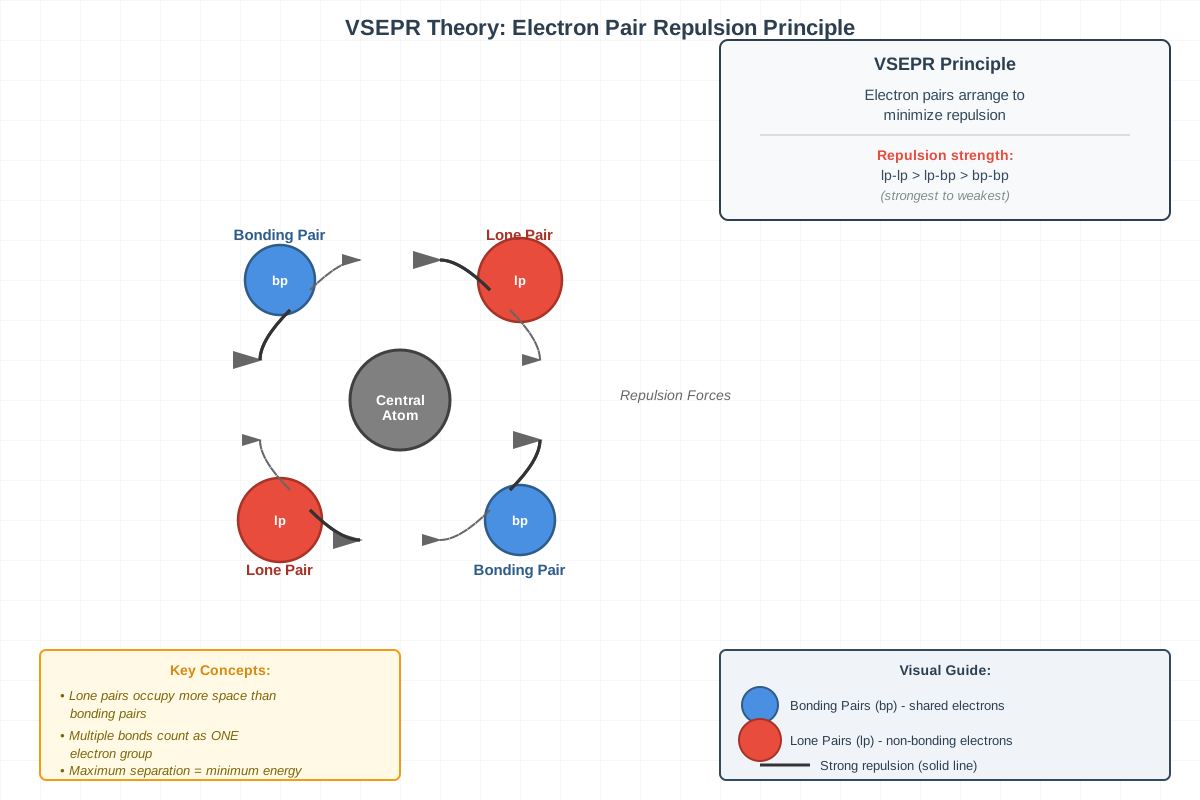
VSEPR theory (Valence Shell Electron Pair Repulsion theory) stands as one of the foundational models in General Chemistry for predicting three-dimensional molecular geometry. This theory posits that electron pairs surrounding a central atom arrange themselves to minimize repulsive forces, thereby determining the spatial arrangement of atoms in a molecule. Understanding VSEPR theory enables students to predict molecular shapes, bond angles, and polarity—all critical skills for success on the MCAT. The theory bridges the gap between Lewis structures (two-dimensional representations) and the actual three-dimensional structures that govern molecular behavior, reactivity, and biological function.
For the MCAT, VSEPR theory appears frequently in questions testing Bonding and Molecular Structure, particularly in passages involving biochemical molecules, drug-receptor interactions, and reaction mechanisms. The Chemical and Physical Foundations of Biological Systems section regularly presents molecules where students must quickly determine geometry to predict polarity, intermolecular forces, or biological activity. Mastery of VSEPR theory allows rapid visualization of molecular architecture without computational tools, a crucial skill under timed exam conditions.
This topic integrates seamlessly with other General Chemistry concepts including Lewis structures, hybridization, molecular orbital theory, and intermolecular forces. VSEPR predictions inform understanding of dipole moments, which in turn explain solubility, boiling points, and biological membrane permeability—concepts that span both the Chemical and Physical Foundations and Biological and Biochemical Foundations sections of the MCAT. The ability to rapidly sketch three-dimensional molecular structures and predict their properties represents a high-yield skill that appears across multiple question types and difficulty levels.
Learning Objectives
- [ ] Define VSEPR theory using accurate General Chemistry terminology
- [ ] Explain why VSEPR theory matters for the MCAT
- [ ] Apply VSEPR theory to exam-style questions
- [ ] Identify common mistakes related to VSEPR theory
- [ ] Connect VSEPR theory to related General Chemistry concepts
- [ ] Predict molecular geometry for molecules with 2-6 electron groups around a central atom
- [ ] Distinguish between electron geometry and molecular geometry in molecules with lone pairs
- [ ] Determine bond angles in common molecular geometries and explain deviations from ideal angles
- [ ] Use VSEPR predictions to determine molecular polarity and predict intermolecular forces
Prerequisites
- Lewis structures: VSEPR theory requires accurate Lewis structures as starting points; students must correctly count valence electrons and place them appropriately
- Bonding fundamentals: Understanding of single, double, and triple bonds is essential since VSEPR treats multiple bonds as single electron groups
- Electronegativity: Necessary for understanding how lone pairs differ from bonding pairs in their repulsive effects
- Basic geometry: Familiarity with geometric shapes (linear, trigonal, tetrahedral) helps visualize three-dimensional molecular arrangements
- Formal charge: Helps determine the most likely Lewis structure when multiple resonance structures exist, ensuring correct VSEPR predictions
Why This Topic Matters
Clinical and Real-World Significance
Molecular geometry directly determines biological function. Enzyme active sites recognize substrates based on three-dimensional shape complementarity—a concept central to biochemistry and pharmacology. Drug design relies heavily on VSEPR predictions to create molecules that fit receptor binding pockets. For example, the difference between agonists and antagonists often reduces to subtle geometric variations that VSEPR theory helps predict. Hemoglobin's oxygen-binding properties depend on the tetrahedral geometry around iron centers, while the bent geometry of water molecules creates the hydrogen bonding network essential for life.
MCAT Exam Statistics
VSEPR theory appears in approximately 3-5 discrete questions per MCAT exam and features in 10-15% of passage-based questions in the Chemical and Physical Foundations section. Questions typically present molecules in biochemical contexts, asking students to predict geometry, polarity, or intermolecular interactions. The topic frequently appears alongside hybridization questions, with approximately 60% of VSEPR questions requiring integration with other bonding concepts. Medium-difficulty questions predominate, though high-difficulty questions may combine VSEPR with resonance structures or unusual coordination geometries.
Common Exam Presentations
MCAT passages often embed VSEPR concepts within biochemistry contexts: amino acid side chains, nucleotide bases, lipid structures, or pharmaceutical compounds. Questions may present a novel molecule and ask students to predict its solubility, boiling point, or biological activity—all requiring VSEPR-based geometry predictions. Discrete questions frequently show a Lewis structure and ask for molecular shape or bond angles. Some questions present experimental data (dipole moments, spectroscopy) requiring students to work backward from properties to geometry, testing deeper understanding of VSEPR principles.
Core Concepts
Fundamental Principles of VSEPR Theory
VSEPR theory operates on a simple premise: electron pairs in the valence shell of a central atom repel each other and arrange themselves to maximize distance between electron groups. An electron group includes any region of electron density: single bonds, double bonds, triple bonds, or lone pairs. Critically, VSEPR treats all multiple bonds as single electron groups—a triple bond counts as one electron group, not three. This electron group arrangement determines the electron geometry, while the positions of atoms alone define the molecular geometry.
The theory distinguishes between two types of electron pairs: bonding pairs (shared between atoms) and lone pairs (unshared electrons localized on the central atom). Lone pairs occupy more space than bonding pairs because they experience attraction from only one nucleus rather than two, causing them to spread out more. This differential creates a hierarchy of repulsive forces: lone pair-lone pair repulsion > lone pair-bonding pair repulsion > bonding pair-bonding pair repulsion. These relative repulsions explain deviations from ideal bond angles.
Electron Geometries and Molecular Shapes
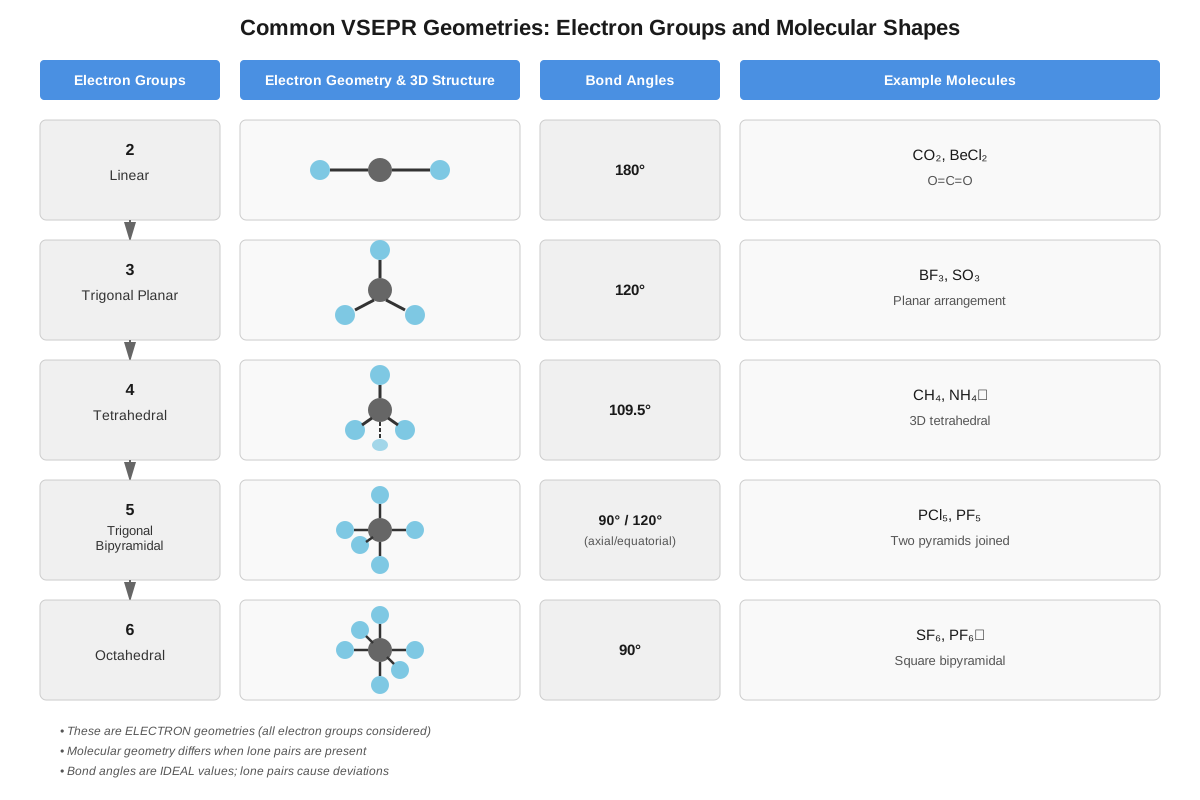
The number of electron groups around a central atom determines the electron geometry according to the following systematic pattern:
| Electron Groups | Electron Geometry | Ideal Bond Angle | Example |
|---|---|---|---|
| 2 | Linear | 180° | BeCl₂ |
| 3 | Trigonal planar | 120° | BF₃ |
| 4 | Tetrahedral | 109.5° | CH₄ |
| 5 | Trigonal bipyramidal | 90°, 120° | PCl₅ |
| 6 | Octahedral | 90° | SF₆ |
When all electron groups are bonding pairs, molecular geometry matches electron geometry. However, lone pairs create distinct molecular geometries. For four electron groups (tetrahedral electron geometry), the molecular geometries vary:
- 4 bonding, 0 lone pairs: Tetrahedral (CH₄) - 109.5°
- 3 bonding, 1 lone pair: Trigonal pyramidal (NH₃) - ~107°
- 2 bonding, 2 lone pairs: Bent (H₂O) - ~104.5°
Notice how lone pairs progressively compress bond angles below the ideal 109.5° tetrahedral angle. Each lone pair exerts greater repulsion than bonding pairs, pushing bonding pairs closer together.
Five and Six Electron Group Systems
Trigonal bipyramidal geometry (5 electron groups) introduces positional complexity. The structure contains two distinct positions: three equatorial positions (120° apart in a trigonal plane) and two axial positions (above and below the plane, 90° from equatorial positions). Lone pairs preferentially occupy equatorial positions because this minimizes 90° repulsions—equatorial positions experience two 90° interactions while axial positions experience three.
For five electron groups with varying lone pairs:
- 5 bonding, 0 lone pairs: Trigonal bipyramidal (PCl₅)
- 4 bonding, 1 lone pair: Seesaw (SF₄) - lone pair equatorial
- 3 bonding, 2 lone pairs: T-shaped (ClF₃) - both lone pairs equatorial
- 2 bonding, 3 lone pairs: Linear (XeF₂) - all three lone pairs equatorial
Octahedral geometry (6 electron groups) features all positions equivalent, each 90° from four neighbors and 180° from one opposite position:
- 6 bonding, 0 lone pairs: Octahedral (SF₆)
- 5 bonding, 1 lone pair: Square pyramidal (BrF₅)
- 4 bonding, 2 lone pairs: Square planar (XeF₄) - lone pairs occupy opposite positions to minimize repulsion
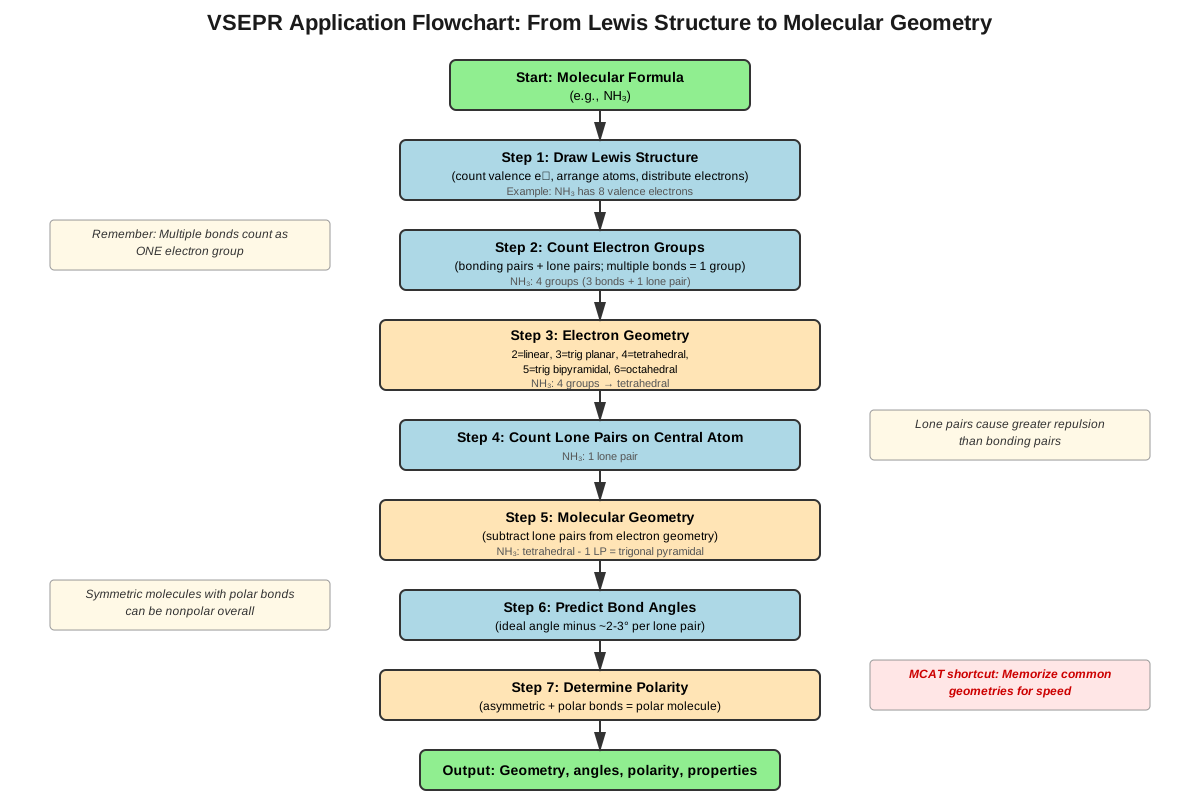
Applying VSEPR: Step-by-Step Process
- Draw the correct Lewis structure: Count total valence electrons, determine the central atom, distribute electrons to satisfy octets (or duets for hydrogen)
- Count electron groups: Identify all regions of electron density around the central atom; remember that double and triple bonds count as single groups
- Determine electron geometry: Use the electron group count to assign the basic geometric arrangement
- Identify lone pairs: Distinguish bonding pairs from lone pairs on the central atom
- Determine molecular geometry: Based on the positions of atoms only (ignoring lone pair positions)
- Predict bond angles: Start with ideal angles, then adjust downward for each lone pair present
- Assess polarity: Determine if bond dipoles cancel based on molecular symmetry
Bond Angle Modifications
Ideal bond angles serve as starting points, but several factors cause deviations. Lone pairs compress bond angles by approximately 2-3° per lone pair due to their greater spatial requirements. Multiple bonds, containing higher electron density than single bonds, also exert slightly greater repulsion than single bonds, causing small angle compressions. Electronegativity differences affect bond angles subtly: more electronegative atoms draw bonding electrons away from the central atom, reducing repulsion between those bonds and allowing slightly larger angles.
For example, comparing molecules with tetrahedral electron geometry:
- CH₄ (no lone pairs): 109.5° exactly
- NH₃ (one lone pair): 107° (2.5° compression)
- H₂O (two lone pairs): 104.5° (5° total compression)
Multiple Central Atoms
Many biologically relevant molecules contain multiple central atoms, requiring VSEPR analysis at each position independently. For ethanol (CH₃CH₂OH), analyze three central atoms: the first carbon (tetrahedral, 109.5°), the second carbon (tetrahedral, 109.5°), and oxygen (bent, ~104.5° due to two lone pairs). The overall molecular shape emerges from combining individual geometries. This approach applies to amino acids, where the central carbon exhibits tetrahedral geometry while the carboxyl carbon shows trigonal planar geometry (three electron groups from C=O, C-O, and C-C bonds).
Concept Relationships
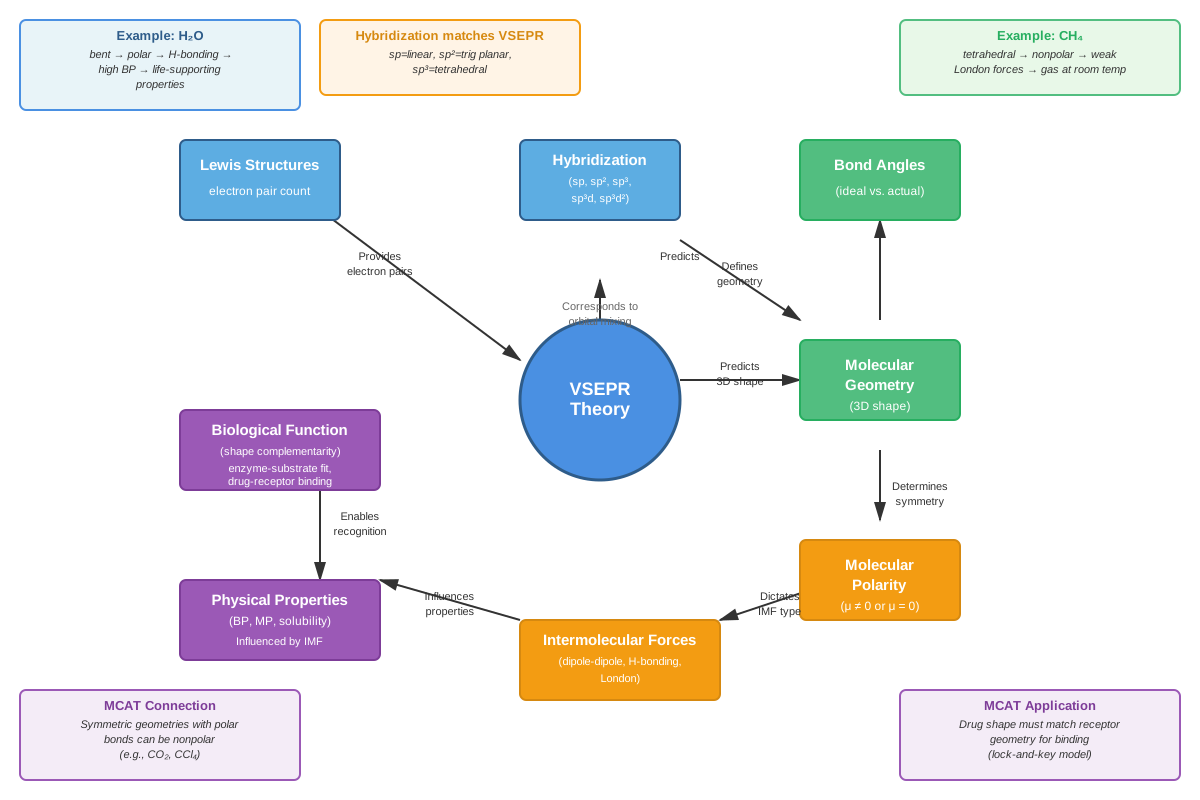
VSEPR theory builds directly upon Lewis structures, which provide the electron distribution that VSEPR organizes spatially. The electron groups identified in Lewis structures become the geometric determinants in VSEPR analysis. This relationship flows unidirectionally: Lewis structures → VSEPR geometry → molecular properties.
VSEPR predictions connect intimately with hybridization theory, an alternative model for molecular geometry. The number of electron groups in VSEPR corresponds to the number of hybrid orbitals: 2 groups = sp, 3 groups = sp², 4 groups = sp³, 5 groups = sp³d, 6 groups = sp³d². While VSEPR predicts geometry phenomenologically, hybridization explains it mechanistically through orbital mixing.
Molecular geometry determined by VSEPR directly influences molecular polarity. Symmetrical geometries (linear with identical substituents, trigonal planar with identical substituents, tetrahedral with identical substituents) produce nonpolar molecules even when individual bonds are polar, because bond dipoles cancel vectorially. Asymmetrical geometries or asymmetrical substituent arrangements create net dipole moments, producing polar molecules. This polarity determines intermolecular forces: polar molecules exhibit dipole-dipole interactions and potentially hydrogen bonding, while nonpolar molecules exhibit only London dispersion forces.
The conceptual flow proceeds: Valence electrons → Lewis structure → Electron groups → VSEPR geometry → Molecular polarity → Intermolecular forces → Physical properties (boiling point, solubility, biological activity).
High-Yield Facts
⭐ VSEPR treats all multiple bonds (double and triple) as single electron groups when counting electron density regions
⭐ Lone pairs exert greater repulsion than bonding pairs, compressing bond angles by approximately 2-3° per lone pair
⭐ Electron geometry describes the arrangement of all electron groups; molecular geometry describes only the positions of atoms
⭐ In trigonal bipyramidal geometry, lone pairs preferentially occupy equatorial positions to minimize 90° repulsions
⭐ Water's bent geometry (not linear) results from two lone pairs on oxygen creating tetrahedral electron geometry but bent molecular geometry
- Tetrahedral electron geometry produces three possible molecular geometries: tetrahedral (0 lone pairs), trigonal pyramidal (1 lone pair), or bent (2 lone pairs)
- Octahedral geometry features all positions equivalent, with 90° angles between adjacent positions and 180° between opposite positions
- Carbon dioxide is linear despite having double bonds because it has only two electron groups around the central carbon
- Ammonia's trigonal pyramidal shape makes it polar, while methane's tetrahedral shape with identical substituents makes it nonpolar
- Bond angles decrease in the series: CH₄ (109.5°) > NH₃ (107°) > H₂O (104.5°) due to increasing lone pair count
- Square planar geometry (4 bonding, 2 lone pairs in octahedral arrangement) is nonpolar when substituents are identical because bond dipoles cancel
Quick check — test yourself on VSEPR theory so far.
Try Flashcards →Common Misconceptions
Misconception: Double and triple bonds count as two or three electron groups respectively.
Correction: All multiple bonds count as single electron groups in VSEPR theory. A C=O double bond represents one electron group, not two. This is because the electron density, while greater, occupies a single region of space between the two atoms.
Misconception: Molecular geometry and electron geometry are the same thing.
Correction: Electron geometry describes the spatial arrangement of all electron groups (bonding and lone pairs), while molecular geometry describes only the positions of atoms. For H₂O, the electron geometry is tetrahedral (4 electron groups) but the molecular geometry is bent (only 2 atoms visible).
Misconception: Lone pairs don't affect molecular shape since they're not visible.
Correction: Lone pairs critically determine molecular geometry by occupying space and exerting repulsion. They're included in electron geometry and their presence changes molecular geometry from what it would be with only bonding pairs. NH₃ is pyramidal rather than trigonal planar specifically because of its lone pair.
Misconception: All tetrahedral molecules are nonpolar.
Correction: Tetrahedral geometry produces nonpolar molecules only when all four substituents are identical (like CH₄). CHCl₃ is tetrahedral but polar because the C-Cl and C-H bond dipoles don't cancel due to different substituents. Geometry determines whether dipoles can cancel, but substituent identity determines whether they do cancel.
Misconception: Bond angles in real molecules exactly match ideal VSEPR angles.
Correction: Real molecules show deviations from ideal angles due to lone pair repulsion, multiple bond repulsion, and electronegativity differences. These deviations are predictable and systematic: lone pairs compress angles, and the effect is cumulative with multiple lone pairs.
Misconception: VSEPR theory applies only to small molecules.
Correction: VSEPR applies to any central atom regardless of molecular size. Large biomolecules require analyzing each central atom independently. In a protein, each carbon, nitrogen, and oxygen can be analyzed using VSEPR to understand local geometry, which collectively determines overall three-dimensional structure.
Worked Examples
Example 1: Determining Geometry and Polarity of Sulfur Dioxide (SO₂)
Problem: Predict the molecular geometry, bond angle, and polarity of SO₂.
Solution:
Step 1 - Lewis Structure: Sulfur has 6 valence electrons, each oxygen has 6, totaling 18 electrons. Sulfur serves as the central atom. Drawing the structure with double bonds to each oxygen and lone pairs completing octets:
O=S=O with one lone pair on sulfurSulfur has one lone pair and forms two double bonds (resonance structures exist, but geometry remains consistent).
Step 2 - Count Electron Groups: Two double bonds (each counts as one group) plus one lone pair = 3 electron groups total.
Step 3 - Electron Geometry: Three electron groups → trigonal planar electron geometry.
Step 4 - Molecular Geometry: With two bonding groups and one lone pair, the molecular geometry is bent (not linear, because the lone pair occupies one of the three positions).
Step 5 - Bond Angle: Ideal trigonal planar angle is 120°. The lone pair compresses this slightly to approximately 117-119° (less than 120° but more than the 104.5° in water because there's only one lone pair and the electron geometry is trigonal planar rather than tetrahedral).
Step 6 - Polarity: The bent geometry means the two S=O bond dipoles do not cancel. The molecule has a net dipole moment pointing from sulfur toward the oxygen atoms. SO₂ is polar.
Key Insight: Even though SO₂ has double bonds and might appear symmetrical in a Lewis structure, the lone pair creates asymmetry in three-dimensional space, producing a bent geometry and polar molecule.
Example 2: Comparing Geometries in Xenon Compounds
Problem: XeF₂ and XeF₄ both contain xenon-fluorine bonds. Predict and explain the molecular geometry of each, and determine which is polar.
Solution:
XeF₂ Analysis:
Step 1 - Lewis Structure: Xenon (8 valence electrons) + 2 fluorines (7 each) = 22 electrons. Xenon forms two Xe-F single bonds, leaving 18 electrons. Placing these as lone pairs: 3 lone pairs on xenon, 3 on each fluorine.
Step 2 - Electron Groups on Xenon: 2 bonding pairs + 3 lone pairs = 5 electron groups.
Step 3 - Electron Geometry: Five electron groups → trigonal bipyramidal.
Step 4 - Lone Pair Placement: Lone pairs preferentially occupy equatorial positions (120° apart) to minimize 90° repulsions. All three lone pairs occupy equatorial positions.
Step 5 - Molecular Geometry: With atoms only in the two axial positions, the molecular geometry is linear (180° bond angle).
Step 6 - Polarity: Linear geometry with identical substituents means bond dipoles cancel. XeF₂ is nonpolar despite having polar Xe-F bonds.
XeF₄ Analysis:
Step 1 - Lewis Structure: Xenon (8) + 4 fluorines (28) = 36 electrons. Four Xe-F bonds use 8 electrons, leaving 28 for lone pairs: 2 on xenon, 3 on each fluorine.
Step 2 - Electron Groups: 4 bonding pairs + 2 lone pairs = 6 electron groups.
Step 3 - Electron Geometry: Six electron groups → octahedral.
Step 4 - Lone Pair Placement: In octahedral geometry, all positions are equivalent. To minimize repulsion, lone pairs occupy opposite positions (180° apart).
Step 5 - Molecular Geometry: With four fluorines in a plane and lone pairs above and below, the molecular geometry is square planar.
Step 6 - Polarity: Square planar geometry with identical substituents produces canceling bond dipoles. XeF₄ is nonpolar.
Key Insight: Both molecules are nonpolar despite different geometries because symmetry causes dipole cancellation. This demonstrates that polarity depends on both geometry and substituent identity. The preferential placement of lone pairs in positions that minimize repulsion is crucial for correct geometry prediction.
Exam Strategy
Question Recognition and Approach
MCAT questions testing VSEPR typically present a molecular structure (Lewis structure, condensed formula, or line-angle formula) and ask about geometry, bond angles, or polarity. Trigger phrases include "molecular shape," "bond angle," "three-dimensional structure," "geometry around the central atom," or "dipole moment." When these appear, immediately begin systematic VSEPR analysis.
For passage-based questions, VSEPR often appears embedded in biochemistry contexts. A passage might discuss enzyme-substrate binding, drug design, or molecular recognition—all requiring geometric understanding. Extract the relevant molecule, quickly sketch its Lewis structure, and apply VSEPR systematically. Don't attempt to visualize complex molecules entirely; analyze each central atom independently.
Systematic Problem-Solving Process
Always follow the same sequence: Lewis structure → count electron groups → electron geometry → identify lone pairs → molecular geometry → bond angles → polarity. Skipping steps, especially failing to distinguish electron geometry from molecular geometry, causes most errors. Write down the electron group count explicitly; this prevents miscounting.
When time is limited, prioritize identifying lone pairs. The presence and number of lone pairs determines molecular geometry more than any other factor. For a four-electron-group system, immediately categorize as tetrahedral (0 lone pairs), trigonal pyramidal (1 lone pair), or bent (2 lone pairs).
Process of Elimination Strategies
For geometry questions, eliminate options that don't match the electron group count first. If a molecule has four electron groups, immediately eliminate linear, trigonal planar, trigonal bipyramidal, and octahedral options. Then use lone pair count to select among remaining options.
For polarity questions, first check for symmetry. Perfectly symmetrical molecules with identical substituents are nonpolar. If the molecule is asymmetrical or has different substituents, it's likely polar. Watch for trap answers that confuse "contains polar bonds" with "is a polar molecule"—CO₂ contains polar C=O bonds but is nonpolar overall due to linear geometry.
Time Management
Allocate approximately 30-45 seconds for straightforward VSEPR questions. If a question requires drawing a Lewis structure from scratch, allow 60-90 seconds total. For complex molecules with multiple central atoms, analyze only the atom specified in the question—don't waste time analyzing the entire structure.
If stuck between two geometries, quickly sketch both in three dimensions and check which better accommodates the electron groups with minimal repulsion. This visualization often clarifies the correct answer within seconds.
Memory Techniques
Electron Group Mnemonic: "LTTTP-O"
Remember electron geometries in order by electron group count:
- Linear (2)
- Trigonal planar (3)
- Tetrahedral (4)
- Trigonal bipyramidal (5)
- Pentagonal bipyramidal (rare, skip for MCAT)
- Octahedral (6)
Lone Pair Effect Mnemonic: "Lone Pairs Push Down"
Visualize lone pairs as invisible hands pushing bonding pairs downward, compressing bond angles. Each lone pair "pushes" approximately 2-3°. This mental image helps remember that bond angles decrease with increasing lone pairs.
Four-Electron-Group Mnemonic: "TPBB"
For tetrahedral electron geometry, remember molecular geometries by lone pair count:
- Tetrahedral (0 lone pairs)
- Pyramidal (1 lone pair)
- Bent (2 lone pairs)
- Boring/doesn't exist (3 lone pairs—only one bond wouldn't form a stable molecule)
Trigonal Bipyramidal Positions: "Equator Equals Easy"
Lone pairs prefer equatorial positions because they're "easier" (fewer 90° repulsions). Equatorial = Easy to remember. This helps predict geometries for 5-electron-group systems.
Polarity Quick Check: "Same Symmetry = No Polarity"
If all substituents are the same AND the geometry is symmetrical (linear, trigonal planar, tetrahedral, octahedral, square planar), the molecule is nonpolar. Asymmetry in either geometry or substituents creates polarity.
Visualization Strategy
Practice drawing molecules in three dimensions using wedge-and-dash notation: solid wedges project toward you, dashed wedges project away, and lines lie in the plane of the paper. Regular practice with this notation builds spatial reasoning skills essential for rapid VSEPR analysis under exam conditions.
Summary
VSEPR theory provides a systematic method for predicting three-dimensional molecular geometry based on electron pair repulsion. The theory operates on the principle that electron groups around a central atom arrange themselves to minimize repulsive forces, with lone pairs exerting greater repulsion than bonding pairs. By counting electron groups (treating multiple bonds as single groups), determining electron geometry, identifying lone pairs, and deriving molecular geometry, students can predict bond angles and molecular polarity. The distinction between electron geometry (arrangement of all electron groups) and molecular geometry (arrangement of atoms only) is fundamental. VSEPR predictions directly inform understanding of molecular polarity, which determines intermolecular forces and physical properties critical for biological function. Mastery requires systematic application of the step-by-step process, recognition that lone pairs compress bond angles predictably, and understanding that molecular polarity depends on both geometry and substituent identity. For the MCAT, rapid VSEPR analysis enables prediction of molecular properties in biochemical contexts, making this a high-yield topic that integrates across multiple chemistry and biology concepts.
Key Takeaways
- VSEPR theory predicts molecular geometry by minimizing electron pair repulsion, with electron groups arranging themselves to maximize distance from each other
- Electron geometry describes all electron groups (bonding and lone pairs); molecular geometry describes only atom positions—this distinction is critical for molecules with lone pairs
- Lone pairs exert greater repulsion than bonding pairs, compressing bond angles by approximately 2-3° per lone pair below ideal values
- Multiple bonds (double and triple) count as single electron groups when determining geometry, not as two or three separate groups
- Molecular polarity requires both polar bonds AND asymmetrical geometry; symmetrical molecules with identical substituents are nonpolar even with polar bonds
- The systematic approach (Lewis structure → electron groups → electron geometry → lone pairs → molecular geometry → angles → polarity) prevents errors and ensures consistent accuracy
- For five-electron-group systems, lone pairs preferentially occupy equatorial positions to minimize 90° repulsions, determining molecular geometry
Related Topics
Hybridization Theory: Explains molecular geometry through orbital mixing (sp, sp², sp³, sp³d, sp³d²), providing a quantum mechanical foundation for VSEPR predictions. Mastering VSEPR enables easier understanding of hybridization since the number of electron groups equals the number of hybrid orbitals.
Molecular Orbital Theory: Advanced bonding model that explains bond order, magnetic properties, and electronic structure beyond VSEPR's geometric predictions. VSEPR provides the geometric framework that molecular orbital theory elaborates with electronic detail.
Intermolecular Forces: VSEPR-predicted polarity directly determines the types and strengths of intermolecular forces (London dispersion, dipole-dipole, hydrogen bonding), which govern physical properties like boiling point, solubility, and biological membrane permeability.
Resonance Structures: Multiple valid Lewis structures for a molecule require VSEPR analysis of the resonance hybrid. Understanding VSEPR helps predict geometry when resonance delocalizes electrons, as in carbonate or nitrate ions.
Coordination Chemistry: Transition metal complexes exhibit geometries (square planar, octahedral) explained by VSEPR principles extended to coordination compounds, relevant for understanding metalloproteins and metal-based drugs.
Practice CTA
Now that you've mastered the core concepts of VSEPR theory, it's time to solidify your understanding through active practice. Attempt the practice questions to test your ability to predict molecular geometries under timed conditions, simulating actual MCAT pressure. Use the flashcards to reinforce high-yield facts and common molecular geometries until recognition becomes automatic. Remember: VSEPR theory is a skill that improves dramatically with deliberate practice. Each problem you work through builds the pattern recognition and spatial reasoning that will make you faster and more accurate on test day. You've built the foundation—now strengthen it through application!
Sign up free to keep reading
Create a free AnvayaPrep account to finish this MCAT guide on VSEPR theory — plus flashcards and practice questions.