Overview
Coordinate covalent bonds (also called dative bonds) represent a special class of covalent bonding where both electrons in the shared pair originate from a single atom rather than one electron from each bonding partner. This concept bridges fundamental bonding theory with complex molecular structures encountered throughout General Chemistry and biochemistry. While the resulting bond is indistinguishable from a regular covalent bond once formed, understanding the formation mechanism is crucial for predicting molecular geometry, analyzing reaction mechanisms, and comprehending the behavior of transition metal complexes and biological molecules.
For the MCAT, coordinate covalent bonds appear frequently in questions involving Lewis structures, acid-base chemistry (particularly Lewis acids and bases), transition metal coordination complexes, and biochemical molecules like hemoglobin. The ability to identify when and how these bonds form distinguishes high-scoring students from those who struggle with Bonding and Molecular Structure questions. This topic integrates seamlessly with formal charge calculations, molecular geometry predictions using VSEPR theory, and understanding electron-pair donor-acceptor relationships that underpin much of chemical reactivity.
Mastering coordinate covalent bonds provides essential scaffolding for understanding more advanced topics including ligand field theory, organometallic chemistry, and the molecular basis of oxygen transport in blood. The concept also reinforces the broader principle that chemical bonding exists on a continuum rather than in discrete categories, preparing students for the nuanced thinking required on standardized examinations. This 30-minute focused study session will equip students with the conceptual framework and problem-solving strategies needed to confidently tackle Coordinate covalent bonds MCAT questions.
Learning Objectives
- [ ] Define coordinate covalent bonds using accurate General Chemistry terminology
- [ ] Explain why coordinate covalent bonds matters for the MCAT
- [ ] Apply coordinate covalent bonds to exam-style questions
- [ ] Identify common mistakes related to coordinate covalent bonds
- [ ] Connect coordinate covalent bonds to related General Chemistry concepts
- [ ] Predict which species can form coordinate covalent bonds based on electron availability and orbital vacancy
- [ ] Draw Lewis structures that accurately represent coordinate covalent bond formation
- [ ] Distinguish between coordinate covalent bonds and regular covalent bonds in complex molecular structures
Prerequisites
- Lewis structures and electron dot diagrams: Essential for visualizing lone pairs available for donation and empty orbitals that can accept electron pairs
- Formal charge calculations: Required to evaluate the stability and most likely structure of molecules containing coordinate covalent bonds
- Octet rule and exceptions: Necessary to understand when atoms can accept additional electron pairs beyond typical valence configurations
- Electronegativity and polarity: Helps predict which atoms are likely electron pair donors versus acceptors
- Basic acid-base theory (Brønsted-Lowry): Provides foundation for understanding Lewis acid-base theory, which is intimately connected to coordinate covalent bonding
- Molecular geometry and VSEPR theory: Coordinate covalent bonds count as bonding pairs when determining molecular shape
Why This Topic Matters
Clinical and Real-World Significance
Coordinate covalent bonds are fundamental to numerous biological processes and medical applications. Hemoglobin's ability to transport oxygen depends on coordinate covalent bonds between iron(II) ions and nitrogen atoms in the porphyrin ring, as well as with oxygen molecules. Many pharmaceutical drugs function through coordinate covalent interactions with metal ions in enzyme active sites. Chelation therapy for heavy metal poisoning (such as lead or mercury toxicity) relies on molecules that form multiple coordinate covalent bonds with toxic metal ions, facilitating their excretion. Magnetic resonance imaging (MRI) contrast agents like gadolinium complexes utilize coordinate covalent bonds to stabilize otherwise toxic metal ions while allowing them to enhance image quality.
MCAT Exam Statistics
Coordinate covalent bonds appear in approximately 3-5% of General Chemistry questions on the MCAT, with additional indirect appearances in Biochemistry passages involving metalloproteins and enzyme mechanisms. Questions typically test this concept through:
- Discrete questions asking students to identify coordinate covalent bonds in Lewis structures or predict their formation
- Passage-based questions involving transition metal complexes, coordination chemistry, or metalloenzymes
- Biochemistry passages featuring hemoglobin, myoglobin, cytochromes, or other metalloproteins
- Organic chemistry questions involving reaction mechanisms where coordinate covalent bonds form as intermediates
Common Exam Contexts
The MCAT frequently embeds coordinate covalent bond questions within passages about:
- Oxygen transport and carbon monoxide poisoning
- Enzyme catalysis involving metal cofactors (zinc fingers, iron-sulfur clusters)
- Complex ion formation and solubility
- Lewis acid-base reactions
- Transition metal chemistry in biological systems
Core Concepts
Definition and Formation Mechanism
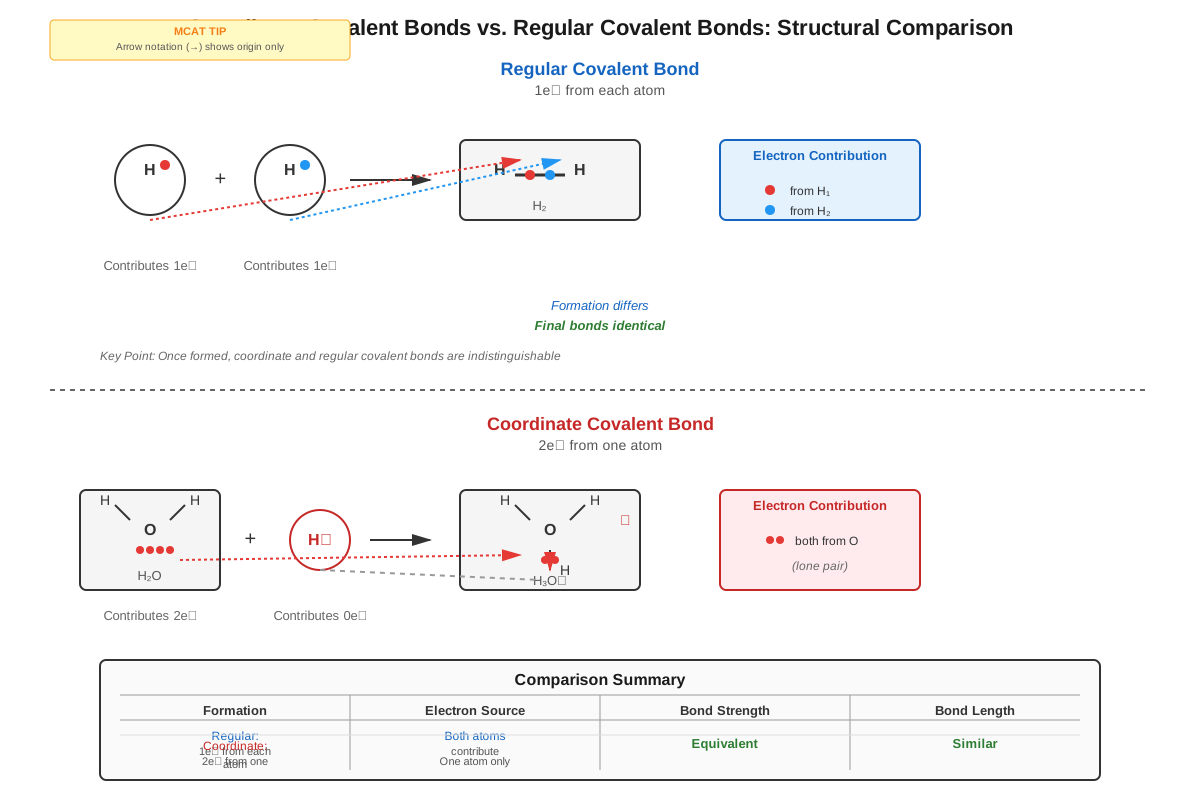
A coordinate covalent bond (or dative bond) is a covalent bond in which both electrons in the bonding pair originate from the same atom. This contrasts with typical covalent bonds where each bonding atom contributes one electron to the shared pair. The atom donating both electrons is called the Lewis base or electron pair donor, while the atom accepting the electron pair is called the Lewis acid or electron pair acceptor.
The formation of a coordinate covalent bond requires two conditions:
- One atom must possess a lone pair of electrons available for donation
- Another atom must have an empty orbital capable of accepting the electron pair
Once formed, a coordinate covalent bond is functionally identical to a regular covalent bond—it has the same bond strength, length, and properties. The distinction lies solely in the formation mechanism, not in the final bond characteristics. This is a crucial point often tested on the MCAT.
Lewis Acid-Base Theory
Lewis acid-base theory provides the theoretical framework for understanding coordinate covalent bonds. Gilbert N. Lewis expanded the definition of acids and bases beyond proton transfer:
- Lewis acid: An electron pair acceptor (has empty orbitals)
- Lewis base: An electron pair donor (has lone pairs)
When a Lewis base donates an electron pair to a Lewis acid, a coordinate covalent bond forms, creating a Lewis acid-base adduct or coordination complex.
Common Lewis acids include:
- Metal cations (especially transition metals): Fe³⁺, Cu²⁺, Zn²⁺
- Molecules with incomplete octets: BF₃, AlCl₃
- Molecules with atoms that can expand their octets: SF₄, PCl₅
Common Lewis bases include:
- Molecules with lone pairs: NH₃, H₂O, ROH, R₂O
- Anions: Cl⁻, OH⁻, CN⁻
- Molecules with π bonds (less common): alkenes, aromatic rings
Notation and Representation
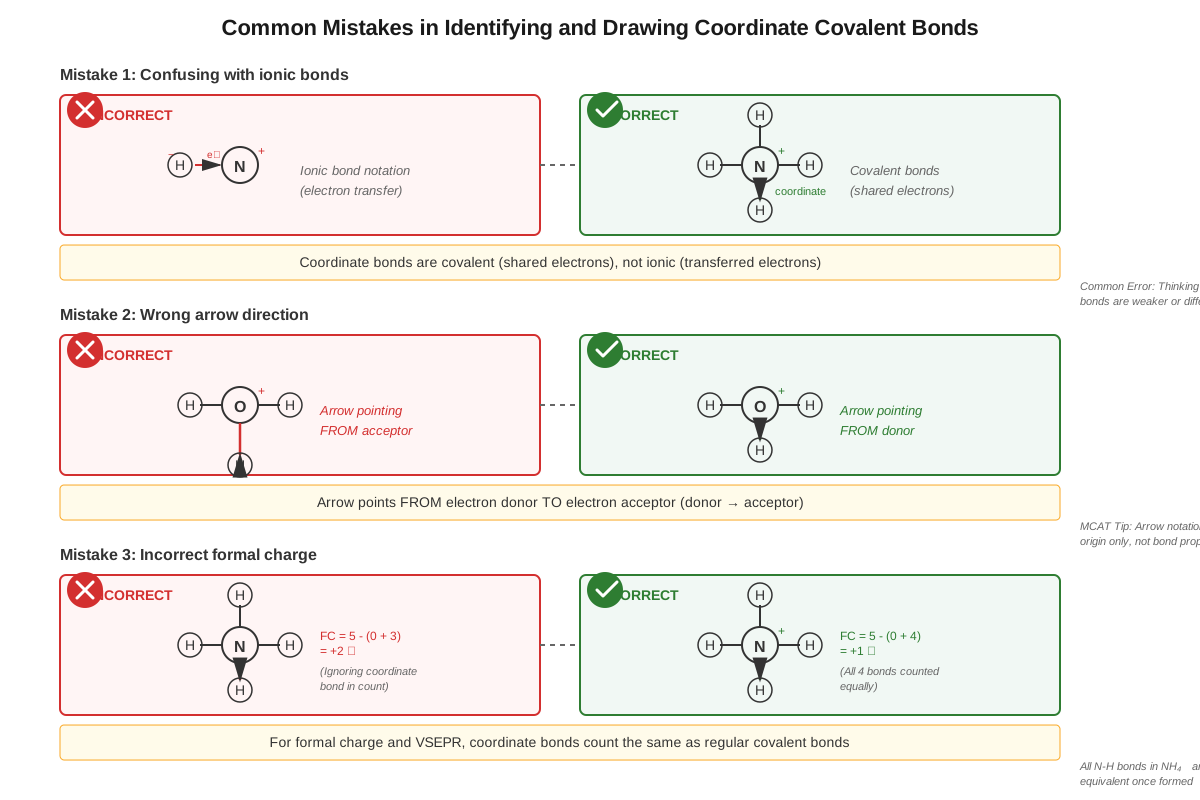
In Lewis structures, coordinate covalent bonds are sometimes represented with an arrow (→) pointing from the electron donor to the acceptor, though this notation is optional. The arrow emphasizes the origin of the electron pair but does not indicate any difference in the final bond.
For example, the formation of the ammonium ion:
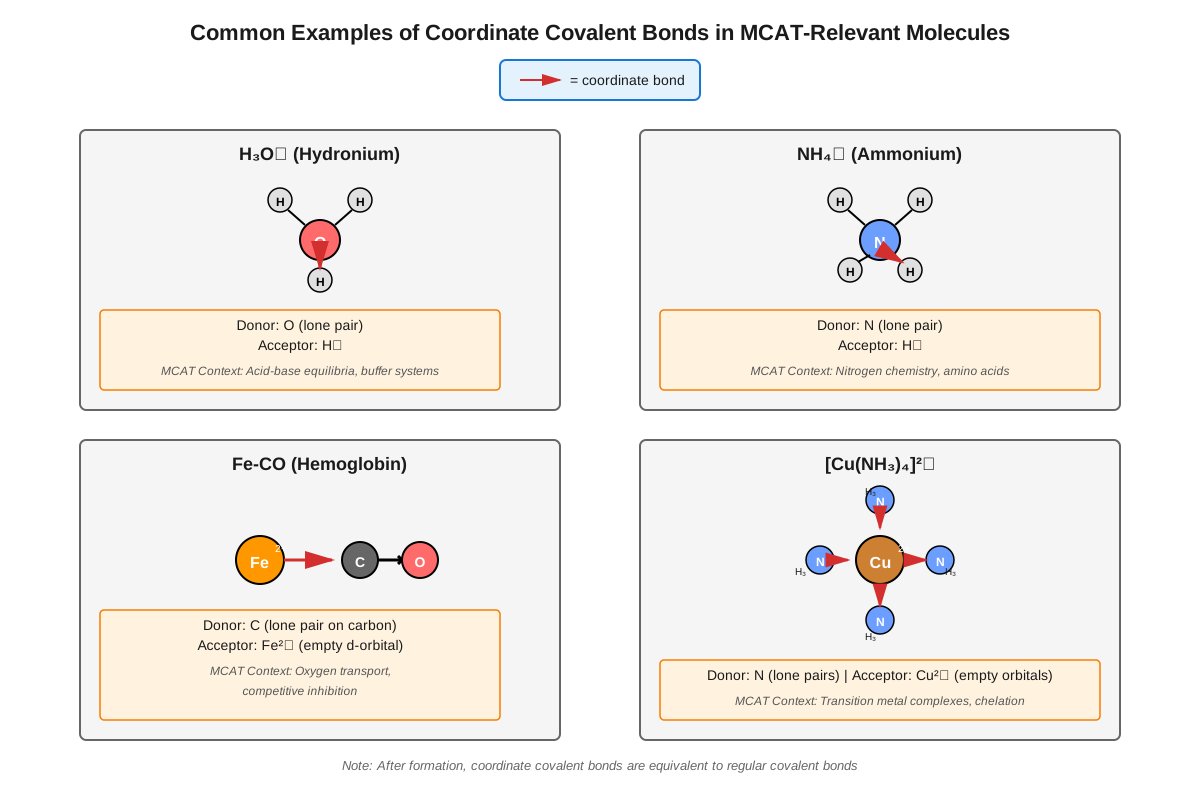
H₃N: + H⁺ → [H₃N→H]⁺ or simply [NH₄]⁺The nitrogen atom in ammonia donates its lone pair to the hydrogen ion (which has an empty 1s orbital), forming a coordinate covalent bond. In the final ammonium ion, all four N-H bonds are equivalent—there is no way to distinguish which bond formed through coordinate covalent bonding.
Complex Ion Formation
Coordination complexes or complex ions form when a central metal ion accepts electron pairs from multiple ligands (Lewis bases) through coordinate covalent bonds. The number of coordinate covalent bonds formed is called the coordination number.
| Metal Ion | Common Coordination Number | Example Complex |
|---|---|---|
| Ag⁺ | 2 | [Ag(NH₃)₂]⁺ |
| Cu²⁺ | 4 | [Cu(NH₃)₄]²⁺ |
| Fe²⁺/Fe³⁺ | 6 | [Fe(CN)₆]⁴⁻ |
| Zn²⁺ | 4 | [Zn(OH)₄]²⁻ |
| Co³⁺ | 6 | [Co(NH₃)₆]³⁺ |
Common ligands in biological systems include:
- Water (H₂O)
- Ammonia (NH₃) and amines
- Carboxylate groups (COO⁻)
- Imidazole groups from histidine
- Thiol groups from cysteine
- Oxygen molecules (O₂)
Biological Examples
Hemoglobin and Myoglobin: The iron(II) ion in the heme group forms six coordinate covalent bonds—four with nitrogen atoms in the porphyrin ring, one with a nitrogen from a histidine residue, and one with either oxygen or water. When oxygen binds, it forms a coordinate covalent bond by donating electron density from its π* orbital to the iron's empty d orbital.
Carbonic Anhydrase: This enzyme contains a zinc ion coordinated to three histidine residues and a water molecule/hydroxide ion through coordinate covalent bonds. The zinc activates the water molecule for nucleophilic attack on carbon dioxide.
Vitamin B₁₂: Contains a cobalt ion at its center, coordinated to nitrogen atoms in a corrin ring structure through coordinate covalent bonds, demonstrating the importance of coordination chemistry in essential nutrients.
Formal Charge Considerations
When drawing Lewis structures involving coordinate covalent bonds, formal charge calculations help determine the most stable structure. The formal charge formula is:
Formal Charge = (Valence electrons) - (Non-bonding electrons) - ½(Bonding electrons)For the Lewis base (electron donor), donating a lone pair typically results in a more positive formal charge. For the Lewis acid (electron acceptor), accepting an electron pair typically results in a more negative formal charge. The most stable structures minimize formal charges and place negative formal charges on more electronegative atoms.
Distinguishing Features in Molecular Structure
While coordinate covalent bonds are indistinguishable from regular covalent bonds once formed, recognizing their formation helps in:
- Predicting reactivity: Identifying potential Lewis acid-base reaction sites
- Understanding mechanism: Tracking electron movement in reaction mechanisms
- Analyzing stability: Evaluating why certain complexes form preferentially
- Determining geometry: Counting electron pairs for VSEPR predictions (coordinate covalent bonds count as bonding pairs)
Concept Relationships
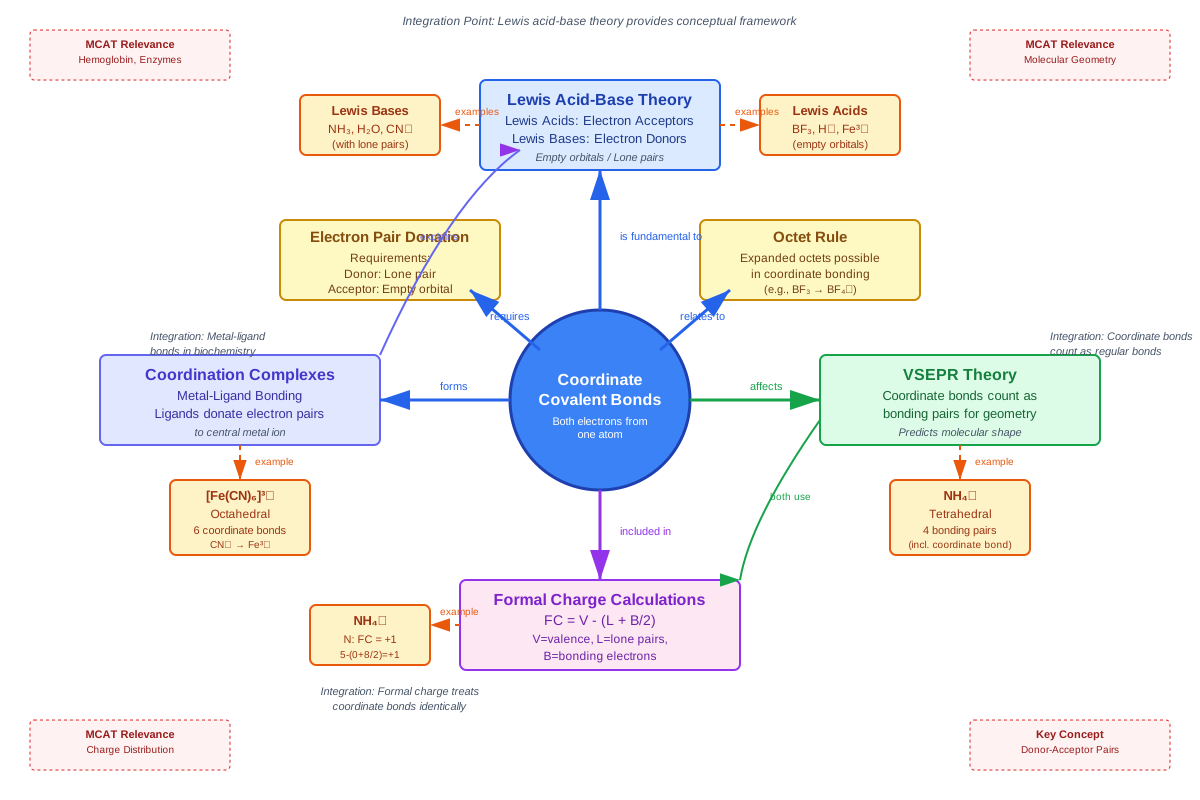
The concept of coordinate covalent bonds serves as a central hub connecting multiple areas of General Chemistry. Understanding Lewis structures and formal charge (prerequisite knowledge) → enables recognition of lone pairs available for donation and empty orbitals for acceptance → which leads to predicting coordinate covalent bond formation → which connects to Lewis acid-base theory → which expands understanding beyond Brønsted-Lowry acids and bases → which applies to coordination complex formation → which is essential for understanding transition metal chemistry → which directly relates to biochemical systems like hemoglobin and metalloenzymes.
Additionally, coordinate covalent bonds connect to molecular geometry through VSEPR theory (the bonds count as electron pairs when determining shape), to resonance structures (coordinate bonds can participate in resonance), and to reaction mechanisms in organic chemistry (many mechanisms involve coordinate covalent bond formation as intermediates, such as in nucleophilic addition reactions).
The relationship between coordinate covalent bonds and other bonding types exists on a continuum: ionic bonding (complete electron transfer) ← polar covalent bonding (unequal sharing) ← covalent bonding (equal sharing) ← coordinate covalent bonding (shared pair from one atom). This continuum emphasizes that bonding classifications are conceptual tools rather than rigid categories.
High-Yield Facts
⭐ A coordinate covalent bond is identical to a regular covalent bond once formed; the only difference is in the formation mechanism where both electrons come from one atom.
⭐ Lewis bases (electron pair donors) must have lone pairs; Lewis acids (electron pair acceptors) must have empty orbitals.
⭐ All coordinate covalent bonds are Lewis acid-base interactions, but not all Lewis acid-base interactions involve coordinate covalent bond formation.
⭐ In coordination complexes, the coordination number equals the number of coordinate covalent bonds formed between the central metal and ligands.
⭐ Transition metal ions are common Lewis acids because they have empty d orbitals available to accept electron pairs.
- The ammonium ion (NH₄⁺) contains one coordinate covalent bond, but all four N-H bonds are equivalent in the final structure.
- Carbon monoxide is a stronger ligand than oxygen for hemoglobin because CO forms a stronger coordinate covalent bond with iron, leading to CO poisoning.
- Ligands can be monodentate (forming one coordinate bond), bidentate (two bonds), or polydentate (multiple bonds); EDTA is a hexadentate ligand.
- The formation of complex ions can dramatically increase the solubility of otherwise insoluble metal salts (complexation).
- Coordinate covalent bonds are crucial in catalysis, as many enzymes use metal cofactors that form coordinate bonds with substrates to activate them for reaction.
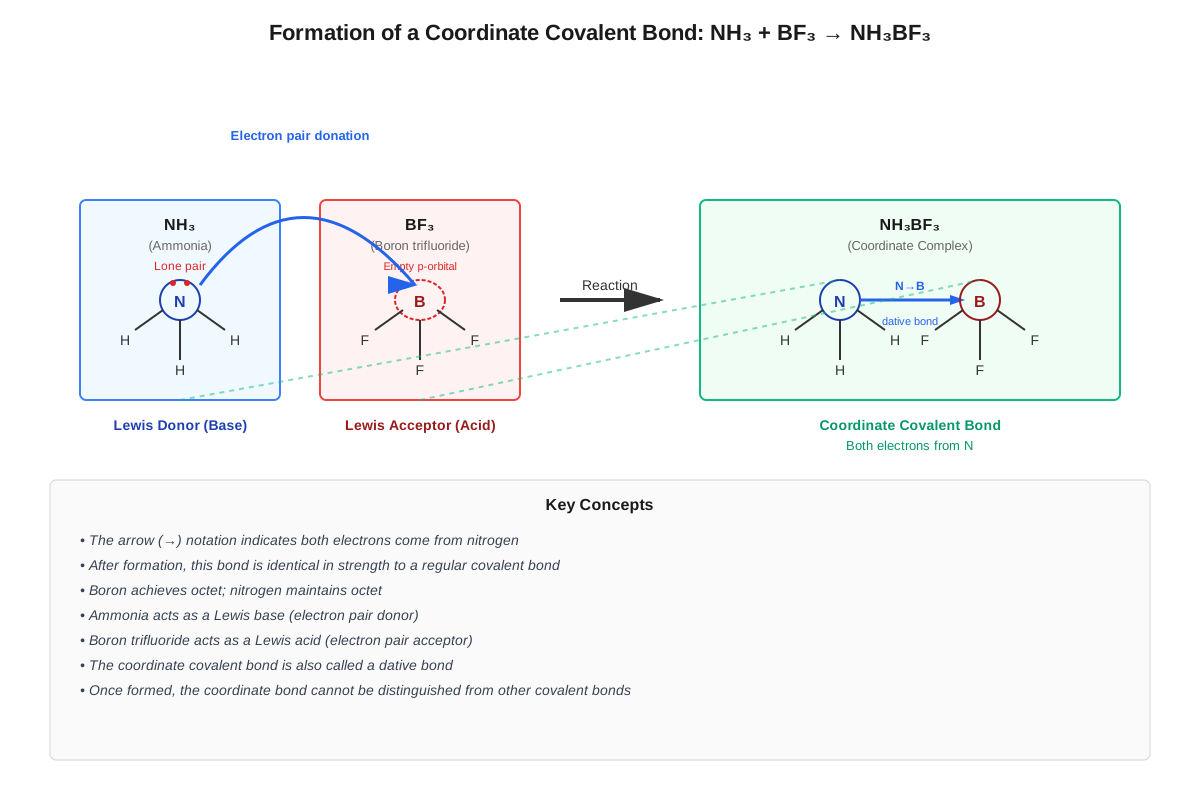
- BF₃ is a classic Lewis acid that readily forms coordinate covalent bonds with Lewis bases like NH₃ to form H₃N→BF₃.
- The stability of coordination complexes depends on factors including the charge of the metal ion, the size of the metal ion, and the nature of the ligands.
Quick check — test yourself on Coordinate covalent bonds so far.
Try Flashcards →Common Misconceptions
Misconception: Coordinate covalent bonds are weaker than regular covalent bonds.
Correction: Once formed, coordinate covalent bonds have the same strength, length, and properties as regular covalent bonds formed by equal electron contribution. The distinction is only in the formation mechanism, not the final bond characteristics.
Misconception: You can identify which specific bond in a molecule is the coordinate covalent bond by examining the final structure.
Correction: In the final molecule, all equivalent bonds are indistinguishable. For example, in NH₄⁺, all four N-H bonds are identical; you cannot determine which one formed through coordinate covalent bonding without knowing the formation history.
Misconception: Only metal ions can act as Lewis acids.
Correction: While metal ions are common Lewis acids, many non-metal compounds can also accept electron pairs, including BF₃, AlCl₃, CO₂, and any molecule with an incomplete octet or the ability to expand its octet.
Misconception: Lewis bases must be negatively charged.
Correction: Lewis bases need only possess a lone pair of electrons; they can be neutral molecules (NH₃, H₂O, amines) or anions (Cl⁻, OH⁻). The presence of a lone pair, not the overall charge, determines Lewis base character.
Misconception: Coordinate covalent bonds always result in a positive charge on the donor atom.
Correction: While donating electrons often increases the formal positive charge on the donor, the actual charge distribution depends on electronegativity differences and the overall molecular structure. Formal charge is a bookkeeping tool, not an actual charge measurement.
Misconception: All Lewis acid-base reactions form coordinate covalent bonds.
Correction: Some Lewis acid-base interactions involve electron pair donation without forming a persistent covalent bond, such as in some catalytic mechanisms where the interaction is transient or in cases where electron density is donated to an antibonding orbital.
Worked Examples
Example 1: Identifying Coordinate Covalent Bond Formation
Question: When boron trifluoride (BF₃) reacts with ammonia (NH₃), a coordinate covalent bond forms. Draw the Lewis structures of the reactants and product, identify the Lewis acid and Lewis base, and explain the bonding change.
Solution:
Step 1: Draw Lewis structures of reactants.
BF₃: Boron has 3 valence electrons, each fluorine has 7. Total = 24 valence electrons.
- Boron forms three single bonds with fluorine atoms
- Each fluorine has three lone pairs
- Boron has only 6 electrons (incomplete octet)
- Structure: F-B-F with one F above, each F has three lone pairs
NH₃: Nitrogen has 5 valence electrons, each hydrogen has 1. Total = 8 valence electrons.
- Nitrogen forms three single bonds with hydrogen atoms
- Nitrogen has one lone pair
- Structure: Pyramidal with N at center, three H atoms bonded, one lone pair on N
Step 2: Identify Lewis acid and Lewis base.
- Lewis acid: BF₃ (has empty p orbital on boron, can accept electron pair)
- Lewis base: NH₃ (has lone pair on nitrogen, can donate electron pair)
Step 3: Draw product structure.
When NH₃ donates its lone pair to BF₃, a coordinate covalent bond forms:
H₃N→BF₃ or H₃N-BF₃
In the product:
- Nitrogen now has 4 bonding pairs (3 N-H bonds and 1 N-B bond)
- Boron now has 4 bonding pairs (3 B-F bonds and 1 B-N bond)
- Boron achieves an octet
- The geometry around nitrogen remains tetrahedral (considering the lone pair was replaced by a bond)
- The geometry around boron changes from trigonal planar to tetrahedral
Step 4: Calculate formal charges.
In NH₃: N formal charge = 5 - 2 - ½(6) = 0
In BF₃: B formal charge = 3 - 0 - ½(6) = 0
In H₃N-BF₃:
- N formal charge = 5 - 0 - ½(8) = +1
- B formal charge = 3 - 0 - ½(8) = -1
The nitrogen becomes more positive (lost electron density by sharing its lone pair), and boron becomes more negative (gained electron density).
Connection to learning objectives: This example demonstrates the definition of coordinate covalent bonds, applies Lewis acid-base theory, and shows how to analyze these bonds in molecular structures.
Example 2: Coordination Complex Formation
Question: Silver ions (Ag⁺) react with ammonia to form a complex ion with the formula [Ag(NH₃)₂]⁺. Explain the bonding in this complex, determine the coordination number, and predict the geometry.
Solution:
Step 1: Identify the Lewis acid and Lewis base.
- Lewis acid: Ag⁺ (has empty orbitals, can accept electron pairs)
- Lewis base: NH₃ (has lone pair on nitrogen, can donate electron pairs)
Step 2: Describe coordinate covalent bond formation.
Each ammonia molecule donates its lone pair to the silver ion, forming a coordinate covalent bond. Since two ammonia molecules coordinate to one silver ion, two coordinate covalent bonds form:
Ag⁺ + 2NH₃ → [Ag(NH₃)₂]⁺
Step 3: Determine coordination number.
The coordination number is the number of coordinate covalent bonds formed to the central metal ion. In this case, the coordination number is 2 (two ammonia ligands bonded to silver).
Step 4: Predict geometry.
With a coordination number of 2, the geometry is linear. The two N-Ag bonds are 180° apart, minimizing electron pair repulsion:
H₃N—Ag—NH₃ (linear arrangement)
Step 5: Explain significance.
This complex ion formation is important in qualitative analysis (testing for silver ions) and in silver-based photographic processes. The formation of the complex dramatically increases the solubility of silver salts that would otherwise precipitate. This demonstrates how coordinate covalent bonding affects chemical properties beyond just molecular structure.
Step 6: Consider formal charges.
In free NH₃: N has formal charge of 0
In [Ag(NH₃)₂]⁺: Each N has formal charge of +1 (donated its lone pair)
The silver ion effectively has a formal charge of -1, but the overall complex has a +1 charge (from the original Ag⁺)
Connection to learning objectives: This example applies coordinate covalent bond concepts to complex ion formation, connects to real-world applications, and demonstrates how to analyze coordination compounds—all high-yield topics for the MCAT.
Exam Strategy
Approaching MCAT Questions
When encountering coordinate covalent bond questions on the MCAT, follow this systematic approach:
- Identify potential Lewis acids and bases: Look for species with lone pairs (potential donors) and species with empty orbitals or incomplete octets (potential acceptors)
- Track electron movement: Use curved arrows in mechanisms to show electron pair donation from base to acid
- Count electron pairs for geometry: Remember that coordinate covalent bonds count as regular bonding pairs when applying VSEPR theory
- Check formal charges: Calculate formal charges to verify reasonable structures and predict stability
- Consider biological context: In passage-based questions, coordinate covalent bonds often appear in metalloprotein discussions—connect the chemistry to the biological function
Trigger Words and Phrases
Watch for these key terms that signal coordinate covalent bond concepts:
- "Lewis acid" or "Lewis base" (direct indication)
- "Coordination complex" or "complex ion"
- "Ligand" (always forms coordinate covalent bonds with metal centers)
- "Electron pair donor/acceptor"
- "Metal cofactor" or "metalloenzyme" (in biochemistry passages)
- "Chelation" or "chelating agent"
- "Coordination number"
- "Dative bond" (synonym for coordinate covalent bond)
Process of Elimination Tips
When evaluating answer choices:
- Eliminate options that claim coordinate covalent bonds are different from regular covalent bonds in the final structure (they're identical once formed)
- Eliminate options that confuse Lewis acid-base theory with Brønsted-Lowry theory (not all Lewis acids are proton donors)
- Eliminate structures where the "Lewis acid" already has a complete octet and no ability to expand it (it cannot accept more electron pairs)
- Eliminate options that show ligands without lone pairs (they cannot act as Lewis bases)
Time Allocation
For discrete questions on coordinate covalent bonds: allocate 60-90 seconds. These questions typically require quick identification of Lewis acids/bases or recognition of coordinate bonds in structures.
For passage-based questions: allocate 90-120 seconds per question. These often require integrating the coordinate bond concept with passage information about biological systems or complex chemical equilibria.
Exam Tip: If a question asks you to identify "the coordinate covalent bond" in a symmetric molecule like NH₄⁺, recognize this as a trick question—all bonds are equivalent in the final structure, so any answer identifying a specific bond is incorrect.
Memory Techniques
Mnemonics
"LEAD" for Lewis Acid characteristics:
- Lacks electrons (incomplete octet)
- Empty orbitals available
- Accepts electron pairs
- Deficient in electron density
"BOLD" for Lewis Base characteristics:
- Base donates
- Offers electron pairs
- Lone pairs present
- Donor of electrons
Visualization Strategy
The "Handshake" Analogy: Imagine a coordinate covalent bond as a handshake where one person (Lewis base) extends both hands (both electrons) while the other person (Lewis acid) extends no hands but accepts the handshake. Once the handshake is complete, it looks like any other handshake—you can't tell who initiated it.
The "Empty Chair" Visualization: Picture Lewis acids as having an "empty chair" (empty orbital) waiting for a "guest" (electron pair). Lewis bases are "guests with their own chair" (lone pair) looking for a place to sit. When they meet, the guest brings their chair to fill the empty space.
Acronym for Common Ligands
"WATCH" for common biological ligands:
- Water (H₂O)
- Amino groups (NH₂, NH₃)
- Thiol groups (from cysteine)
- Carboxylate groups (COO⁻)
- Histidine (imidazole groups)
Pattern Recognition
Remember the pattern: Lone pair + Empty orbital = Coordinate covalent bond
For quick identification: If it has a lone pair and meets something electron-deficient, coordinate bonding is likely.
Summary
Coordinate covalent bonds represent a fundamental bonding type where both electrons in a shared pair originate from a single atom (the Lewis base or electron pair donor) rather than one electron from each bonding partner. These bonds form when a species with a lone pair encounters a species with an empty orbital (the Lewis acid or electron pair acceptor), creating a bond that is functionally identical to regular covalent bonds once formed. This concept is essential for understanding Lewis acid-base theory, coordination complexes, and numerous biological systems including oxygen transport by hemoglobin, enzyme catalysis by metalloenzymes, and the function of metal cofactors. For the MCAT, students must be able to identify potential coordinate covalent bond formation, draw accurate Lewis structures showing these bonds, calculate formal charges, predict molecular geometry including these bonds, and apply these concepts to both discrete questions and passage-based scenarios involving transition metal chemistry and biochemistry. The key distinction to remember is that while the formation mechanism is unique (both electrons from one atom), the resulting bond is indistinguishable from any other covalent bond in terms of strength, length, and properties.
Key Takeaways
- Coordinate covalent bonds form when a Lewis base (electron pair donor with lone pairs) donates both electrons to a Lewis acid (electron pair acceptor with empty orbitals)
- Once formed, coordinate covalent bonds are identical to regular covalent bonds—the distinction exists only in the formation mechanism, not in the final bond properties
- All coordinate covalent bonds represent Lewis acid-base interactions, expanding acid-base theory beyond proton transfer
- Coordination complexes form when multiple ligands create coordinate covalent bonds with a central metal ion; the coordination number equals the number of these bonds
- Coordinate covalent bonds are crucial in biological systems, particularly in metalloproteins like hemoglobin, myoglobin, and metalloenzymes
- When analyzing Lewis structures, coordinate covalent bonds count as regular bonding pairs for VSEPR geometry predictions and formal charge calculations
- Common Lewis acids include metal cations (especially transition metals), molecules with incomplete octets (BF₃, AlCl₃), and molecules that can expand their octets; common Lewis bases include molecules with lone pairs (NH₃, H₂O, amines) and anions
Related Topics
Lewis Acid-Base Theory: Provides the theoretical foundation for understanding coordinate covalent bonds and expands acid-base concepts beyond Brønsted-Lowry theory. Mastering coordinate covalent bonds enables deeper understanding of acid-base reactivity in organic mechanisms.
Transition Metal Chemistry: Coordinate covalent bonds are the primary bonding type in transition metal complexes. Understanding this topic enables progression to crystal field theory, ligand field theory, and the electronic structure of coordination compounds.
VSEPR Theory and Molecular Geometry: Coordinate covalent bonds must be counted as bonding pairs when predicting molecular shapes. This topic builds on coordinate bonding to predict three-dimensional structures.
Formal Charge and Resonance: These concepts work together with coordinate covalent bonding to determine the most stable Lewis structures and understand electron distribution in molecules.
Biochemistry of Metalloproteins: Hemoglobin, myoglobin, cytochromes, and numerous enzymes rely on coordinate covalent bonds between metal ions and protein residues. This topic applies coordinate bonding principles to biological systems.
Chelation and Complex Ion Equilibria: Understanding how multiple coordinate covalent bonds form simultaneously (chelation) and the equilibria governing complex ion formation builds on basic coordinate bonding concepts.
Practice CTA
Now that you've mastered the core concepts of coordinate covalent bonds, it's time to solidify your understanding through active practice. Challenge yourself with the practice questions and flashcards designed specifically for this topic. Focus on identifying Lewis acids and bases in various molecular contexts, drawing accurate Lewis structures showing coordinate bond formation, and applying these concepts to MCAT-style passages involving biological systems. Remember, the difference between understanding a concept and being able to apply it under exam conditions lies in deliberate practice. Each question you work through strengthens your pattern recognition and builds the confidence you need to excel on test day. You've built a strong foundation—now put it to work!
Sign up free to keep reading
Create a free AnvayaPrep account to finish this MCAT guide on Coordinate covalent bonds — plus flashcards and practice questions.