Overview
Formal charge is a fundamental concept in General Chemistry that allows chemists to evaluate the distribution of electrons in molecules and polyatomic ions. This bookkeeping method assigns a hypothetical charge to each atom in a structure, assuming that electrons in covalent bonds are shared equally between atoms. Understanding formal charge is essential for predicting molecular stability, determining the most accurate Lewis structure among multiple possibilities, and explaining chemical reactivity patterns that appear frequently on the MCAT.
For the MCAT, formal charge serves as a critical tool in the Bonding and Molecular Structure unit, bridging concepts of electron distribution, resonance structures, and molecular stability. The exam regularly tests students' ability to calculate formal charges quickly, identify the most stable resonance contributor, and predict reactive sites in organic molecules. Questions may appear as standalone items or embedded within passages discussing reaction mechanisms, molecular properties, or biochemical processes. Mastery of formal charge enables efficient problem-solving and prevents common errors in structure determination.
The concept connects intimately with Lewis structures, electronegativity, resonance theory, and molecular geometry. While oxidation states track electron transfer in redox reactions, formal charge focuses on electron distribution within covalent structures. This distinction becomes particularly important when analyzing complex organic molecules, coordination compounds, and biochemical intermediates that appear throughout the General Chemistry and Organic Chemistry sections of the MCAT. A solid grasp of formal charge calculation and interpretation provides the foundation for understanding more advanced topics in chemical bonding and reactivity.
Learning Objectives
- [ ] Define formal charge using accurate General Chemistry terminology
- [ ] Explain why formal charge matters for the MCAT
- [ ] Apply formal charge to exam-style questions
- [ ] Identify common mistakes related to formal charge
- [ ] Connect formal charge to related General Chemistry concepts
- [ ] Calculate formal charge for any atom in a Lewis structure within 10 seconds
- [ ] Rank resonance structures by stability using formal charge analysis
- [ ] Predict the most reactive sites in molecules based on formal charge distribution
Prerequisites
- Lewis structures and electron dot diagrams: Formal charge calculations require accurate Lewis structures showing all bonding and nonbonding electrons
- Valence electrons and the octet rule: Understanding electron distribution patterns is essential for determining deviations from neutral charge states
- Covalent bonding fundamentals: Formal charge assumes equal sharing of bonding electrons between atoms
- Electronegativity concepts: While formal charge ignores electronegativity differences, understanding this distinction clarifies when to use each concept
- Basic algebra: The formal charge formula requires simple arithmetic operations with positive and negative integers
Why This Topic Matters
Formal charge appears in approximately 3-5% of MCAT General Chemistry questions, either as direct calculation problems or as part of larger questions involving molecular structure, resonance, or reactivity. The concept is particularly high-yield because it integrates with multiple other topics: students must understand Lewis structures to calculate formal charge, use formal charge to evaluate resonance structures, and apply formal charge principles to predict reaction mechanisms in organic chemistry.
In clinical and biochemical contexts, formal charge helps explain why certain molecular conformations are favored in biological systems. For example, the phosphate groups in ATP carry negative formal charges that influence enzyme binding, and the protonation states of amino acid side chains (which affect formal charge) determine protein structure and function at physiological pH. Understanding charge distribution also explains drug-receptor interactions, membrane permeability, and the behavior of metabolic intermediates.
On the MCAT, formal charge questions typically appear in three formats: (1) direct calculation problems asking for the formal charge on a specific atom, (2) resonance structure ranking questions requiring stability comparisons, and (3) passage-based questions where formal charge analysis helps predict reactivity or explain experimental observations. The topic frequently appears alongside questions about acid-base chemistry, molecular polarity, and organic reaction mechanisms, making it a connector concept that enhances performance across multiple content areas.
Core Concepts
Definition and Formula
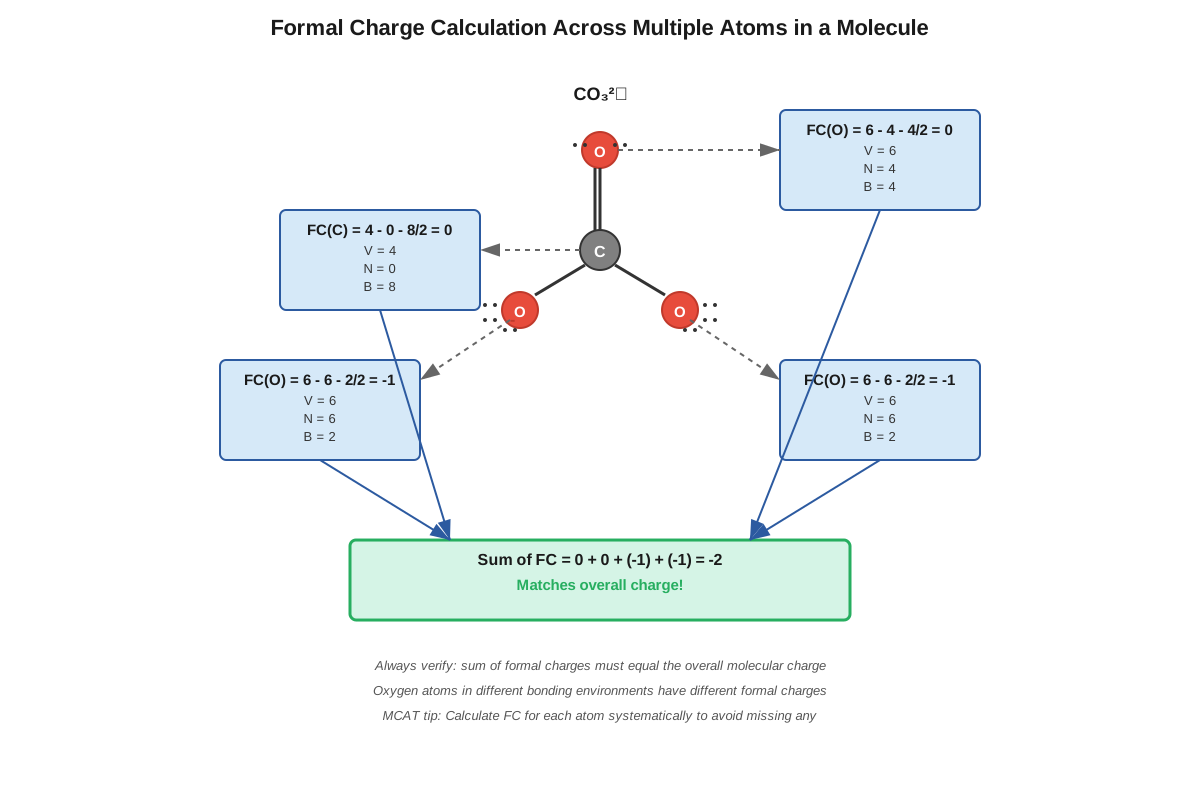
Formal charge is the hypothetical charge assigned to an atom in a molecule or polyatomic ion, calculated by comparing the number of valence electrons in the free atom to the number of electrons "owned" by that atom in the bonded structure. The fundamental formula is:
Formal Charge = (Valence Electrons) - (Nonbonding Electrons) - (1/2 × Bonding Electrons)An alternative formulation that some students find more intuitive is:
Formal Charge = (Valence Electrons) - (Lone Pair Electrons) - (Number of Bonds)Both formulas yield identical results. The key assumption underlying formal charge is that electrons in covalent bonds are shared equally between the two bonded atoms, regardless of electronegativity differences. This makes formal charge a purely theoretical construct—it does not represent the actual charge distribution in a molecule, which is better described by partial charges (δ+ and δ-) based on electronegativity.
Step-by-Step Calculation Process
To calculate formal charge systematically:
- Draw the complete Lewis structure showing all bonds (as lines or electron pairs) and all lone pairs
- Identify the atom of interest and count its valence electrons in the free, unbonded state (use the periodic table group number for main group elements)
- Count nonbonding electrons (lone pair electrons) directly on that atom in the structure
- Count bonding electrons by counting all electrons in bonds to that atom (each single bond = 2 electrons, double bond = 4 electrons, triple bond = 6 electrons)
- Apply the formula: Subtract nonbonding electrons and half the bonding electrons from the valence electron count
- Assign the charge: The result will be a positive integer, negative integer, or zero
Interpretation and Significance
The formal charge value indicates whether an atom has more or fewer electrons assigned to it compared to its neutral state:
- Formal charge = 0: The atom has the same number of electrons as the free atom (most stable situation)
- Formal charge = +1, +2, etc.: The atom has fewer electrons than the free atom (electron-deficient)
- Formal charge = -1, -2, etc.: The atom has more electrons than the free atom (electron-rich)
The sum of all formal charges in a structure must equal the overall charge of the molecule or ion. For neutral molecules, formal charges must sum to zero. For ions, they must sum to the ionic charge.
Formal Charge vs. Oxidation State
A critical distinction for the MCAT is understanding that formal charge and oxidation state are different concepts:
| Property | Formal Charge | Oxidation State |
|---|---|---|
| Electron sharing assumption | Equal sharing (50/50) | Complete transfer to more electronegative atom |
| Application | Covalent structures, resonance | Redox reactions, ionic compounds |
| Calculation basis | Actual bonding pattern | Electronegativity rules |
| Typical values | Usually -1, 0, +1 | Can be larger integers |
| Purpose | Evaluate structure stability | Track electron transfer |
For example, in carbon monoxide (CO), carbon has a formal charge of -1 and oxygen has a formal charge of +1 in the most stable Lewis structure, but the oxidation states are +2 for carbon and -2 for oxygen.
Using Formal Charge to Evaluate Resonance Structures
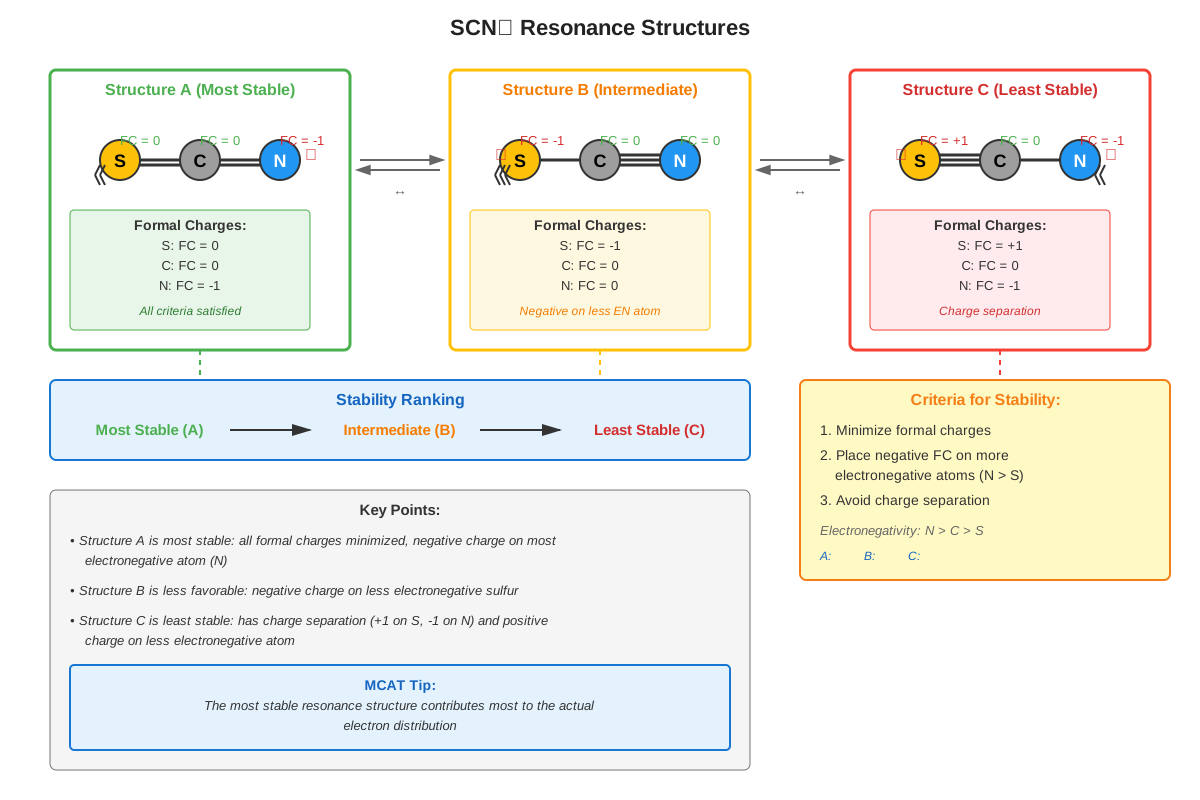
When multiple valid Lewis structures (resonance structures) can be drawn for a molecule, formal charge analysis helps identify the most significant contributor to the resonance hybrid. The most stable and thus most important resonance structure follows these guidelines:
- Minimize formal charges: Structures with formal charges closest to zero on all atoms are most stable
- Minimize charge separation: Structures with fewer atoms bearing formal charges are preferred
- Place negative formal charges on more electronegative atoms: If formal charges must exist, negative charges should reside on O, N, or F rather than C or H
- Place positive formal charges on less electronegative atoms: Positive charges are more stable on less electronegative elements
- Avoid like charges on adjacent atoms: Structures with positive charges next to positive charges (or negative next to negative) are highly unstable
Common Patterns in Formal Charge
Certain formal charge patterns appear repeatedly on the MCAT:
Carbon atoms:
- 4 single bonds, no lone pairs → formal charge = 0 (most common)
- 3 bonds, 1 lone pair → formal charge = -1 (carbanion)
- 3 bonds, no lone pairs → formal charge = +1 (carbocation)
Nitrogen atoms:
- 3 bonds, 1 lone pair → formal charge = 0 (ammonia, amines)
- 4 bonds, no lone pairs → formal charge = +1 (ammonium)
- 2 bonds, 2 lone pairs → formal charge = -1 (amide ion)
Oxygen atoms:
- 2 bonds, 2 lone pairs → formal charge = 0 (water, alcohols)
- 3 bonds, 1 lone pair → formal charge = +1 (oxonium)
- 1 bond, 3 lone pairs → formal charge = -1 (alkoxide, hydroxide)
Hydrogen atoms:
- 1 bond, no lone pairs → formal charge = 0 (only stable state for H)
Formal Charge and Molecular Stability
Structures with lower formal charges are generally more stable because they represent more even electron distribution. The ideal structure has all formal charges equal to zero. When this is impossible, the next best option minimizes the magnitude and number of formal charges. This principle explains why certain resonance structures dominate: they better represent the actual electron distribution in the molecule.
Formal charge also helps identify reactive sites. Atoms with formal charges (especially negative charges) are often nucleophilic and reactive toward electrophiles. Conversely, atoms with positive formal charges are electrophilic and attract nucleophiles. This predictive power makes formal charge invaluable for understanding organic reaction mechanisms.
Concept Relationships
Formal charge builds directly on Lewis structures, as accurate structure drawing is prerequisite to formal charge calculation. The relationship flows: valence electrons → Lewis structure → formal charge calculation → structure evaluation. Without correct Lewis structures showing all bonds and lone pairs, formal charge calculations will be incorrect.
The concept connects intimately with resonance theory. Multiple resonance structures often have different formal charge distributions, and formal charge analysis determines which structures contribute most significantly to the resonance hybrid. This relationship is bidirectional: resonance structures → formal charge analysis → stability ranking → identification of major contributor → understanding of actual electron distribution.
Electronegativity relates to formal charge through contrast: while formal charge assumes equal electron sharing, electronegativity describes unequal sharing. The most stable resonance structures often place negative formal charges on highly electronegative atoms, reconciling these two concepts. This creates the relationship: electronegativity differences → prediction of partial charges → comparison with formal charge → evaluation of structure reasonableness.
Molecular geometry and VSEPR theory depend on accurate electron counting, which formal charge helps verify. If formal charges sum incorrectly, the Lewis structure is wrong, and the predicted geometry will be incorrect. The flow is: electron counting → Lewis structure → formal charge verification → VSEPR application → geometry prediction.
In acid-base chemistry, formal charge helps predict protonation and deprotonation sites. Atoms with negative formal charges are more likely to be protonated, while atoms with positive formal charges may lose protons if possible. This connects to pKa values and conjugate acid-base pairs.
For organic chemistry mechanisms, formal charge identifies nucleophilic (negative formal charge) and electrophilic (positive formal charge) sites, predicting where reactions will occur. This relationship extends throughout organic chemistry: formal charge → reactive site identification → mechanism prediction → product formation.
High-Yield Facts
⭐ The formal charge formula is: FC = V - N - B/2, where V = valence electrons, N = nonbonding electrons, B = bonding electrons
⭐ The sum of all formal charges in a structure must equal the overall molecular or ionic charge
⭐ The most stable resonance structure has formal charges closest to zero and minimizes charge separation
⭐ Negative formal charges should be placed on more electronegative atoms (O, N, F) in the most stable structure
⭐ Formal charge assumes equal sharing of bonding electrons, while oxidation state assumes complete transfer to the more electronegative atom
- A neutral carbon atom with four single bonds has a formal charge of zero
- Nitrogen with four bonds (and no lone pairs) has a formal charge of +1, as seen in ammonium (NH₄⁺)
- Oxygen with one bond and three lone pairs has a formal charge of -1, as seen in hydroxide (OH⁻)
- Hydrogen can only have a formal charge of 0 or +1 (when it has no electrons, as in H⁺)
- Structures with adjacent like charges (both positive or both negative) are highly unstable and rarely represent significant resonance contributors
- Expanded octets (more than 8 electrons) on period 3 and higher elements often result in lower formal charges than structures obeying the octet rule
- In carbon monoxide (CO), the most stable Lewis structure has a formal charge of -1 on carbon and +1 on oxygen, despite oxygen being more electronegative
Quick check — test yourself on Formal charge so far.
Try Flashcards →Common Misconceptions
Misconception: Formal charge represents the actual charge on an atom in a molecule.
Correction: Formal charge is a bookkeeping tool that assumes equal sharing of bonding electrons. Actual charge distribution depends on electronegativity differences and is better represented by partial charges (δ+ and δ-). Formal charge helps evaluate structure stability but doesn't describe real electron density.
Misconception: Formal charge and oxidation state are the same thing.
Correction: These are distinct concepts with different assumptions. Formal charge assumes equal electron sharing in bonds, while oxidation state assumes complete electron transfer to the more electronegative atom. They often yield different values for the same atom and serve different purposes (structure evaluation vs. redox tracking).
Misconception: The most stable structure always has all formal charges equal to zero.
Correction: While zero formal charges are ideal, many stable molecules and ions necessarily have formal charges. The goal is to minimize formal charges and place them appropriately (negative on electronegative atoms), not necessarily eliminate them entirely. For example, nitrate (NO₃⁻) must have formal charges in any valid Lewis structure.
Misconception: When calculating formal charge, count all electrons in bonds to an atom.
Correction: Only count half the bonding electrons, because those electrons are shared between two atoms. Each atom "owns" only half of the electrons in its bonds for formal charge purposes. This is the most common calculation error students make.
Misconception: Hydrogen can have a negative formal charge.
Correction: Hydrogen has only one valence electron and can form only one bond. The only possible formal charges for hydrogen are 0 (when bonded) or +1 (when it has lost its electron, as in H⁺). A negative formal charge would require hydrogen to have more than one electron in its valence shell, which violates its electronic capacity.
Misconception: The structure with the most bonds is always the most stable.
Correction: While multiple bonds can increase stability, formal charge analysis is more reliable for determining the most stable structure. Sometimes a structure with fewer bonds but better formal charge distribution is more stable. For example, in some resonance structures, converting a double bond to a single bond with a lone pair may create more favorable formal charges.
Worked Examples
Example 1: Calculating Formal Charge in Nitrate Ion (NO₃⁻)
Problem: Determine the formal charge on the nitrogen atom and each oxygen atom in one resonance structure of the nitrate ion, where nitrogen forms one double bond to one oxygen and single bonds to the other two oxygens.
Solution:
Step 1: Draw the Lewis structure. Nitrogen is the central atom with one N=O double bond and two N-O single bonds. Each singly-bonded oxygen has three lone pairs, the doubly-bonded oxygen has two lone pairs, and nitrogen has no lone pairs.
Step 2: Calculate formal charge on nitrogen.
- Valence electrons for N: 5 (Group 15)
- Nonbonding electrons on N: 0 (no lone pairs)
- Bonding electrons on N: 8 (one double bond = 4 electrons, two single bonds = 2 electrons each)
- FC(N) = 5 - 0 - (8/2) = 5 - 0 - 4 = +1
Step 3: Calculate formal charge on the double-bonded oxygen.
- Valence electrons for O: 6 (Group 16)
- Nonbonding electrons: 4 (two lone pairs)
- Bonding electrons: 4 (one double bond)
- FC(O) = 6 - 4 - (4/2) = 6 - 4 - 2 = 0
Step 4: Calculate formal charge on each single-bonded oxygen.
- Valence electrons for O: 6
- Nonbonding electrons: 6 (three lone pairs)
- Bonding electrons: 2 (one single bond)
- FC(O) = 6 - 6 - (2/2) = 6 - 6 - 1 = -1
Step 5: Verify the sum equals the ionic charge.
- Sum = (+1) + (0) + (-1) + (-1) = -1 ✓
Answer: Nitrogen has a formal charge of +1, the double-bonded oxygen has a formal charge of 0, and each single-bonded oxygen has a formal charge of -1. This structure is one of three equivalent resonance structures for nitrate.
Connection to learning objectives: This example demonstrates the systematic application of the formal charge formula and shows how formal charges must sum to the overall ionic charge, addressing the objectives of defining and applying formal charge to exam-style questions.
Example 2: Comparing Resonance Structures of Carbon Monoxide
Problem: Carbon monoxide (CO) can be drawn with three different Lewis structures: (A) C≡O with a lone pair on C, (B) C=O with two lone pairs on C and two on O, and (C) C≡O with a lone pair on O. Calculate formal charges for each structure and determine which is most stable.
Solution:
Structure A: C≡O with lone pair on C
- Carbon: V=4, N=2, B=6 → FC = 4 - 2 - 3 = -1
- Oxygen: V=6, N=2, B=6 → FC = 6 - 2 - 3 = +1
- Sum: -1 + 1 = 0 ✓
Structure B: C=O with two lone pairs on each atom
- Carbon: V=4, N=4, B=4 → FC = 4 - 4 - 2 = -2
- Oxygen: V=6, N=4, B=4 → FC = 6 - 4 - 2 = 0
- Sum: -2 + 0 = -2 ✗ (This structure is invalid; formal charges don't sum to zero)
Let me recalculate Structure B correctly:
Structure B: C=O with appropriate lone pairs
- Carbon: V=4, N=2, B=4 → FC = 4 - 2 - 2 = 0
- Oxygen: V=6, N=4, B=4 → FC = 6 - 4 - 2 = 0
- Sum: 0 + 0 = 0 ✓
Structure C: C≡O with lone pair on O
- Carbon: V=4, N=0, B=6 → FC = 4 - 0 - 3 = +1
- Oxygen: V=6, N=4, B=6 → FC = 6 - 4 - 3 = -1
- Sum: +1 + (-1) = 0 ✓
Stability Analysis:
- Structure B has all formal charges = 0 (most favorable)
- Structure A has formal charges of -1 and +1, but places negative charge on less electronegative carbon (unfavorable)
- Structure C has formal charges of +1 and -1, with negative charge on more electronegative oxygen (favorable)
Answer: Structure B (C=O with double bond) would be most stable if it satisfied the octet rule for both atoms, but it leaves carbon with only 6 electrons. Structure A (C≡O with lone pair on C) is actually the most stable despite the counterintuitive formal charges, because it satisfies the octet rule for both atoms. Structure C violates the octet rule for carbon. This example illustrates that formal charge must be considered alongside the octet rule.
Connection to learning objectives: This example demonstrates how to compare resonance structures using formal charge analysis and highlights the common mistake of considering formal charge in isolation without checking octet rule satisfaction, addressing objectives about applying formal charge and identifying common mistakes.
Exam Strategy
When approaching formal charge questions on the MCAT, follow this systematic strategy:
Time management: Allocate 30-45 seconds for straightforward formal charge calculations and up to 90 seconds for resonance structure comparison questions. If a question requires drawing multiple Lewis structures, quickly sketch them and focus on the atoms where formal charges are likely to differ.
Trigger words and phrases that indicate formal charge is relevant:
- "Most stable resonance structure"
- "Charge distribution"
- "Which atom bears a formal charge"
- "Most significant contributor"
- "Electron density"
- "Reactive site"
Process-of-elimination strategies:
- Immediately eliminate any answer choice where formal charges don't sum to the overall molecular charge
- For resonance structure ranking, eliminate structures with like charges on adjacent atoms
- Eliminate structures that place negative formal charges on the least electronegative atoms when better alternatives exist
- If asked about formal charge on a specific atom, calculate it directly rather than trying to reason through answer choices
Quick calculation shortcuts:
- For common functional groups (carbonyl, carboxylate, ammonium), memorize typical formal charge patterns
- Use the alternative formula (FC = V - L - B, where L = lone pairs and B = number of bonds) for speed
- Count bonds quickly: single = 1, double = 2, triple = 3
- Verify your Lewis structure is correct before calculating formal charge
Common question formats:
- Direct calculation: "What is the formal charge on the nitrogen atom?" → Apply formula systematically
- Structure comparison: "Which resonance structure is most stable?" → Calculate formal charges for key atoms, apply stability rules
- Reactivity prediction: "Which site is most nucleophilic?" → Identify atoms with negative formal charges
- Error detection: "Which Lewis structure is incorrect?" → Check if formal charges sum correctly
Red flags that should make you double-check your work:
- Formal charges greater than ±2 (rare and usually indicate an error)
- Hydrogen with any formal charge except 0 or +1
- Sum of formal charges doesn't equal molecular charge
- Carbon with formal charge of +2 or -2 (very rare)
Memory Techniques
Mnemonic for the formal charge formula: "Very Nice Bonds"
- Valence electrons (start with these)
- Nonbonding electrons (subtract all of these)
- Bonding electrons (subtract half of these)
Mnemonic for resonance structure stability rules: "MEND"
- Minimize formal charges (closest to zero is best)
- Electronegative atoms get negative charges
- No adjacent like charges
- Distribute charges as little as possible (minimize separation)
Visualization strategy for formal charge calculation:
Imagine each atom "owns" all its lone pair electrons completely (100%) but "shares" bonding electrons equally with its bonding partner (50% each). Picture electrons as coins: lone pairs are in your pocket (all yours), bonding electrons are in a joint bank account (split 50/50).
Pattern recognition for common atoms:
- Carbon: Think "four bonds, no charge" (most common state)
- Nitrogen: Think "three bonds plus one lone pair, no charge" (ammonia pattern)
- Oxygen: Think "two bonds plus two lone pairs, no charge" (water pattern)
- Hydrogen: Think "one bond, no charge" (only normal state)
Acronym for atoms that commonly carry formal charges: "CHON"
- Carbon: carbocations (+1) and carbanions (-1)
- Hydrogen: hydronium (+1)
- Oxygen: alkoxides (-1) and oxonium (+1)
- Nitrogen: ammonium (+1) and amide ions (-1)
Memory aid for formal charge vs. oxidation state:
"Formal charge is Fair (equal sharing), Oxidation state is One-sided (complete transfer)"
Summary
Formal charge is an essential bookkeeping method in General Chemistry that assigns hypothetical charges to atoms in molecules and ions based on equal sharing of bonding electrons. Calculated using the formula FC = V - N - B/2, formal charge helps evaluate Lewis structure accuracy, rank resonance structure stability, and predict molecular reactivity. The most stable structures minimize formal charges, place negative charges on electronegative atoms, and avoid adjacent like charges. Unlike oxidation states, which assume complete electron transfer, formal charge assumes equal sharing and serves primarily to evaluate covalent structure stability. For the MCAT, students must rapidly calculate formal charges, apply stability principles to resonance structures, and recognize that formal charges must sum to the overall molecular charge. This concept integrates with Lewis structures, resonance theory, and molecular geometry, making it a high-yield connector topic. Mastery requires understanding both the mechanical calculation process and the conceptual principles governing structure stability, enabling efficient problem-solving across Bonding and Molecular Structure questions.
Key Takeaways
- The formal charge formula (FC = Valence - Nonbonding - ½Bonding) assumes equal sharing of bonding electrons and must be applied systematically to each atom
- Formal charges in any structure must sum to the overall molecular or ionic charge; if they don't, the Lewis structure is incorrect
- The most stable resonance structure minimizes formal charges, places negative charges on electronegative atoms, and avoids charge separation
- Formal charge differs fundamentally from oxidation state: formal charge assumes equal sharing while oxidation state assumes complete electron transfer
- Common formal charge patterns (C with 4 bonds = 0, N with 4 bonds = +1, O with 1 bond = -1) enable rapid structure evaluation
- Atoms with formal charges indicate reactive sites: negative formal charges suggest nucleophilic character, positive charges suggest electrophilic character
- Formal charge analysis is essential for resonance structure ranking, a high-yield MCAT skill that appears in both General Chemistry and Organic Chemistry contexts
Related Topics
Resonance structures and resonance hybrids: Formal charge analysis determines which resonance structures contribute most significantly to the actual electron distribution in molecules. Mastering formal charge enables accurate resonance structure ranking.
Lewis acids and bases: Formal charge helps identify electron-deficient (Lewis acidic) and electron-rich (Lewis basic) sites in molecules, predicting coordination chemistry behavior.
Molecular orbital theory: While formal charge uses a localized electron model, molecular orbital theory provides a more sophisticated description of electron distribution that can be compared with formal charge predictions.
Organic reaction mechanisms: Formal charge identifies nucleophilic and electrophilic sites, predicting where reactions occur and explaining curved arrow notation in mechanism diagrams.
Acid-base chemistry and pKa: Formal charge helps predict protonation and deprotonation sites, connecting to conjugate acid-base pairs and pH-dependent molecular structure.
Coordination compounds: Formal charge analysis applies to metal-ligand bonding, helping determine oxidation states and evaluate structure stability in transition metal complexes.
Practice CTA
Now that you've mastered the core concepts of formal charge, it's time to solidify your understanding through active practice. Work through the practice questions to test your ability to calculate formal charges quickly and accurately, rank resonance structures by stability, and apply these principles to MCAT-style scenarios. Use the flashcards to reinforce common formal charge patterns and stability rules until they become automatic. Remember: formal charge is a skill that improves dramatically with practice—the more structures you analyze, the faster and more confident you'll become. Your investment in mastering this foundational concept will pay dividends throughout General Chemistry, Organic Chemistry, and even Biochemistry passages on test day. You've got this!
Sign up free to keep reading
Create a free AnvayaPrep account to finish this MCAT guide on Formal charge — plus flashcards and practice questions.