Overview
Hybridization is a fundamental concept in General Chemistry that explains how atomic orbitals combine to form new hybrid orbitals with geometries that better account for observed molecular shapes and bonding patterns. This theoretical framework, essential for understanding Bonding and Molecular Structure, bridges the gap between quantum mechanical descriptions of isolated atoms and the three-dimensional reality of molecules. When carbon forms four equivalent bonds in methane, or when nitrogen adopts a trigonal pyramidal geometry in ammonia, hybridization provides the mechanistic explanation for these observations that simple atomic orbital theory cannot adequately address.
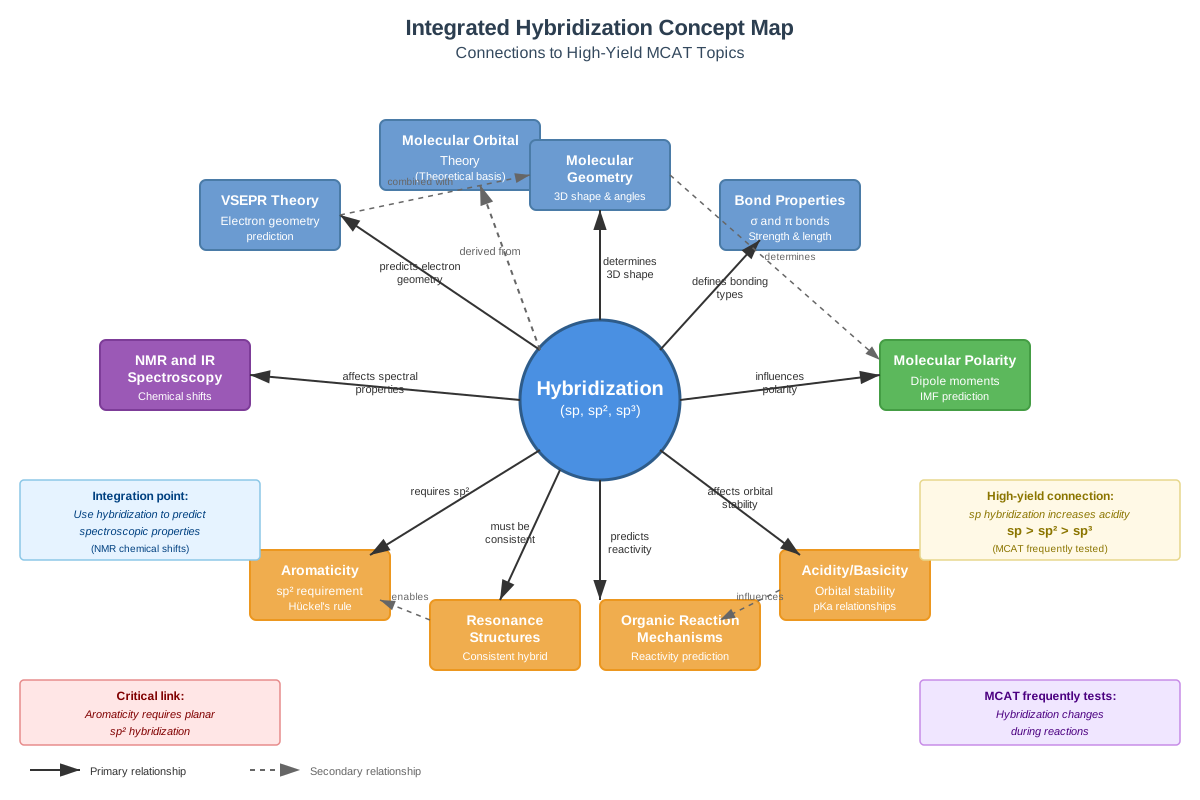
For the MCAT, hybridization serves as a critical tool for predicting molecular geometry, bond angles, and chemical reactivity—all of which appear frequently in both General Chemistry and Organic Chemistry passages. The MCAT tests hybridization not merely as an isolated concept but as an integrated framework that connects electron configuration, VSEPR theory, molecular polarity, and resonance structures. Understanding hybridization enables rapid determination of molecular properties without lengthy calculations, making it an invaluable time-saving skill during the exam.
Within the broader landscape of General Chemistry MCAT preparation, hybridization represents a pivotal concept that unifies atomic structure with molecular behavior. It directly builds upon electron configuration and orbital theory while simultaneously providing the foundation for understanding sigma and pi bonding, conjugation, aromaticity, and the three-dimensional aspects of stereochemistry. Mastery of hybridization creates a conceptual scaffold that supports advanced topics in both general and organic chemistry, making it one of the highest-yield investments of study time for test preparation.
Learning Objectives
- [ ] Define Hybridization using accurate General Chemistry terminology
- [ ] Explain why Hybridization matters for the MCAT
- [ ] Apply Hybridization to exam-style questions
- [ ] Identify common mistakes related to Hybridization
- [ ] Connect Hybridization to related General Chemistry concepts
- [ ] Determine the hybridization state of any atom in a molecule given its Lewis structure
- [ ] Predict bond angles and molecular geometry based on hybridization
- [ ] Distinguish between sigma and pi bonds in the context of hybrid orbitals
- [ ] Correlate hybridization with molecular properties including acidity, basicity, and reactivity
Prerequisites
- Electron configuration and orbital filling: Understanding s, p, d, and f orbitals is essential because hybridization involves the mathematical combination of these atomic orbitals
- Lewis structures and formal charge: Accurate Lewis structures are required to count electron domains and determine hybridization states
- VSEPR theory: The connection between electron geometry and hybridization is fundamental to predicting molecular shapes
- Basic bonding concepts: Knowledge of covalent bonds, lone pairs, and electronegativity provides context for why hybridization theory was developed
- Molecular geometry terminology: Familiarity with terms like tetrahedral, trigonal planar, and linear is necessary to describe hybridized structures
Why This Topic Matters
Hybridization appears in approximately 3-5 questions per MCAT exam, either as the primary focus or as a necessary component for solving more complex problems. Questions may directly ask for the hybridization state of a specific atom, or they may require hybridization knowledge to determine molecular geometry, predict relative acidity or basicity, explain spectroscopic properties, or identify reactive sites in organic molecules. The concept frequently appears in passage-based questions where students must analyze novel molecular structures or reaction mechanisms.
In clinical and real-world contexts, hybridization explains the three-dimensional structure of biologically important molecules. The sp³ hybridization of carbon in amino acids determines protein folding patterns, while the sp² hybridization in DNA bases enables the planar geometry necessary for base stacking and hydrogen bonding. Drug-receptor interactions depend critically on molecular geometry, which is directly determined by hybridization. Understanding why vitamin C (ascorbic acid) is acidic, why certain drugs are planar and can intercalate into DNA, or why hemoglobin can bind oxygen all trace back to hybridization principles.
The MCAT commonly tests hybridization through several question formats: identifying the hybridization of atoms in complex organic molecules, predicting bond angles in biomolecules, explaining why certain compounds are more acidic or basic than others, determining the number of sigma and pi bonds in a structure, and connecting molecular geometry to physical properties like polarity or boiling point. Passage-based questions often present novel molecules or reaction mechanisms where rapid hybridization determination is the key to unlocking the correct answer within time constraints.
Core Concepts
Definition and Theoretical Basis
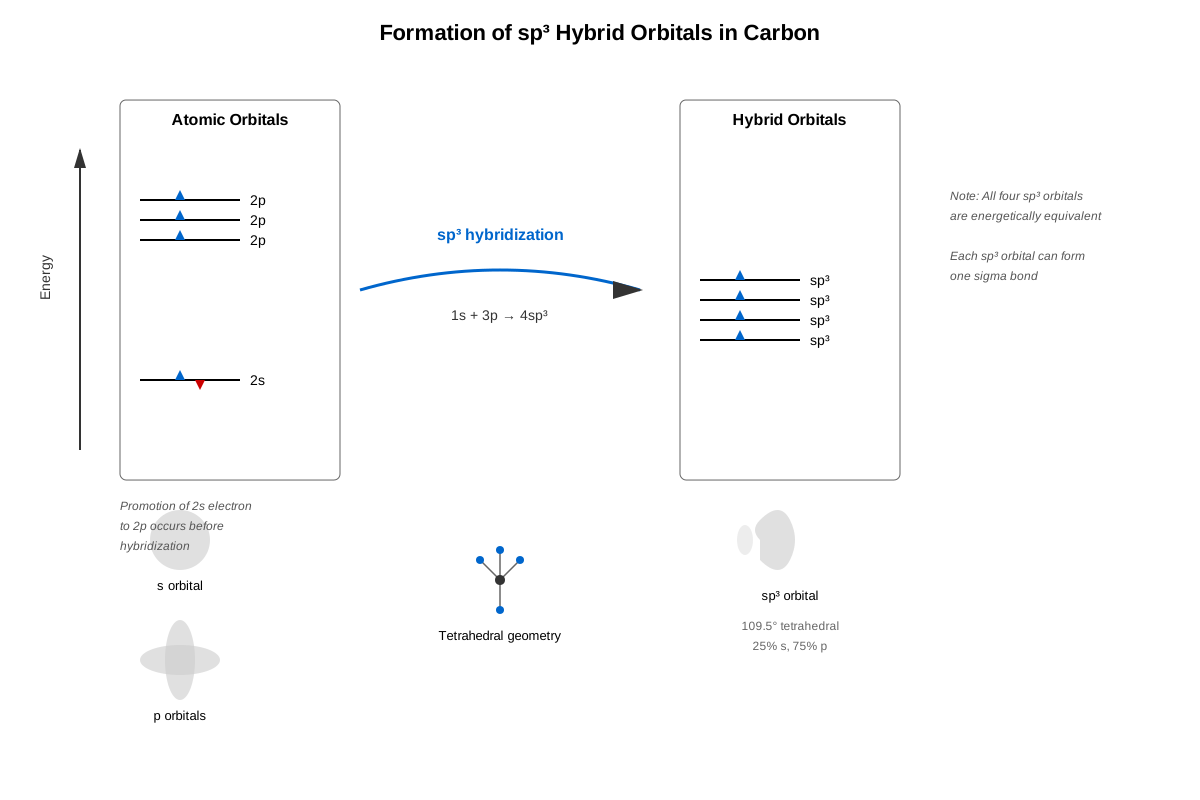
Hybridization is the mathematical mixing of atomic orbitals within an atom to form a new set of equivalent hybrid orbitals that are oriented in space to minimize electron-electron repulsion and maximize bonding efficiency. This quantum mechanical concept was developed to reconcile the observed geometries of molecules with the directional properties of atomic orbitals. In isolated atoms, s orbitals are spherical and p orbitals are dumbbell-shaped with specific orientations (px, py, pz), but these pure atomic orbitals cannot explain why carbon forms four equivalent bonds at 109.5° angles in methane.
The hybridization process involves promoting electrons (when necessary) and then combining atomic orbitals to create hybrid orbitals with specific directional properties. The number of hybrid orbitals formed always equals the number of atomic orbitals mixed. For example, combining one s orbital with three p orbitals produces four sp³ hybrid orbitals. These hybrid orbitals have intermediate characteristics between their parent atomic orbitals and are degenerate (equal in energy).
Types of Hybridization
sp³ Hybridization
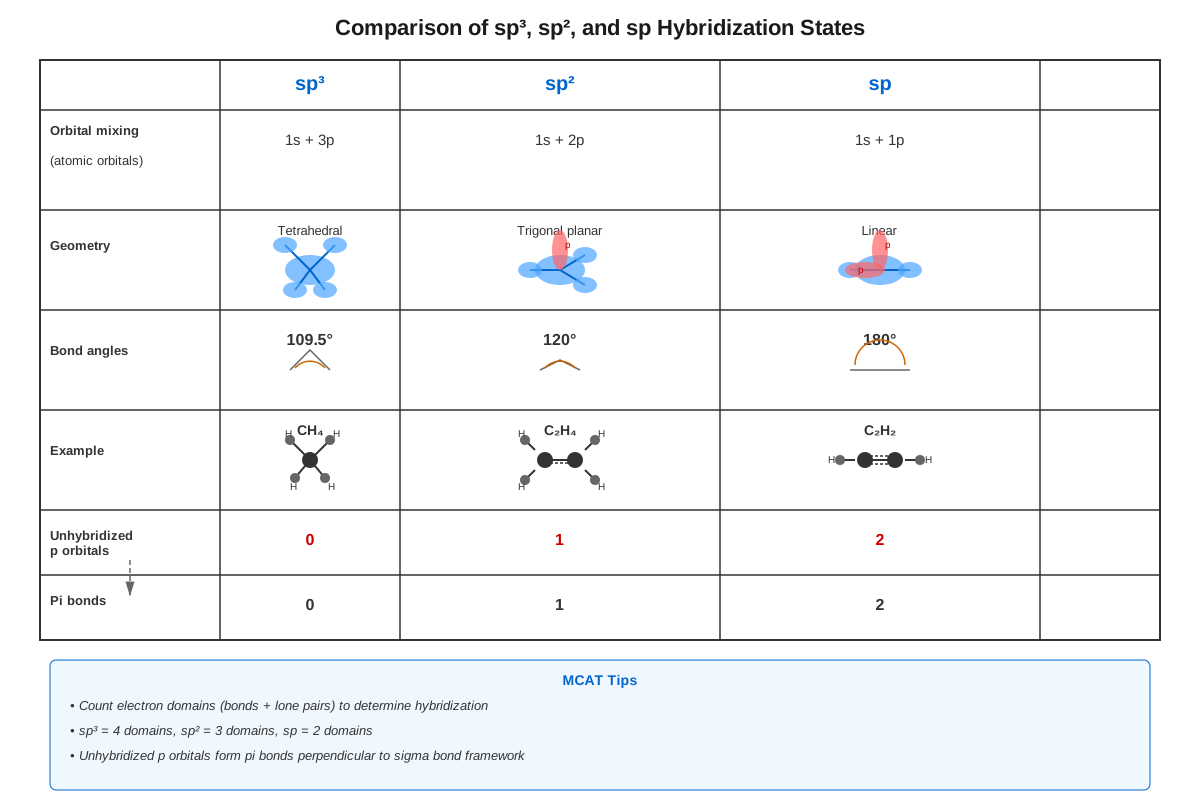
sp³ hybridization occurs when one s orbital mixes with three p orbitals to form four equivalent hybrid orbitals arranged in a tetrahedral geometry with bond angles of approximately 109.5°. This hybridization state corresponds to four electron domains around the central atom (four bonding pairs, or a combination of bonding pairs and lone pairs). Carbon in methane (CH₄), nitrogen in ammonia (NH₃), and oxygen in water (H₂O) all exhibit sp³ hybridization.
The tetrahedral arrangement minimizes electron-electron repulsion according to VSEPR theory. Each sp³ hybrid orbital contains 25% s character and 75% p character. The presence of lone pairs slightly compresses bond angles due to increased repulsion (ammonia has bond angles of 107°, water has 104.5°). All bonds formed by sp³ hybrid orbitals are sigma (σ) bonds, which are single bonds formed by end-to-end orbital overlap.
sp² Hybridization
sp² hybridization results from mixing one s orbital with two p orbitals, producing three equivalent hybrid orbitals in a trigonal planar arrangement with bond angles of 120°. One unhybridized p orbital remains perpendicular to the plane of the hybrid orbitals. This hybridization state corresponds to three electron domains around the central atom. Carbon in ethene (C₂H₄), boron in BF₃, and carbonate ion (CO₃²⁻) exemplify sp² hybridization.
The three sp² hybrid orbitals form sigma bonds, while the unhybridized p orbital participates in pi (π) bonding through side-by-side overlap with another p orbital. This explains the presence of double bonds: one sigma bond (from sp² orbital overlap) plus one pi bond (from p orbital overlap). The sp² hybrid orbitals contain 33% s character and 67% p character. The planar geometry is crucial for conjugation and resonance stabilization in aromatic systems.
sp Hybridization
sp hybridization occurs when one s orbital combines with one p orbital to form two equivalent hybrid orbitals arranged linearly with a bond angle of 180°. Two unhybridized p orbitals remain perpendicular to each other and to the axis of the hybrid orbitals. This hybridization corresponds to two electron domains. Carbon in ethyne (C₂H₂), carbon dioxide (CO₂), and nitrogen in HCN demonstrate sp hybridization.
The two sp hybrid orbitals form sigma bonds, while the two unhybridized p orbitals form two pi bonds, explaining triple bonds: one sigma bond plus two pi bonds. The sp hybrid orbitals have 50% s character and 50% p character, making them the most electronegative of the hybrid orbitals. The linear geometry creates rigid, rod-like molecular structures with restricted rotation around the triple bond.
Determining Hybridization
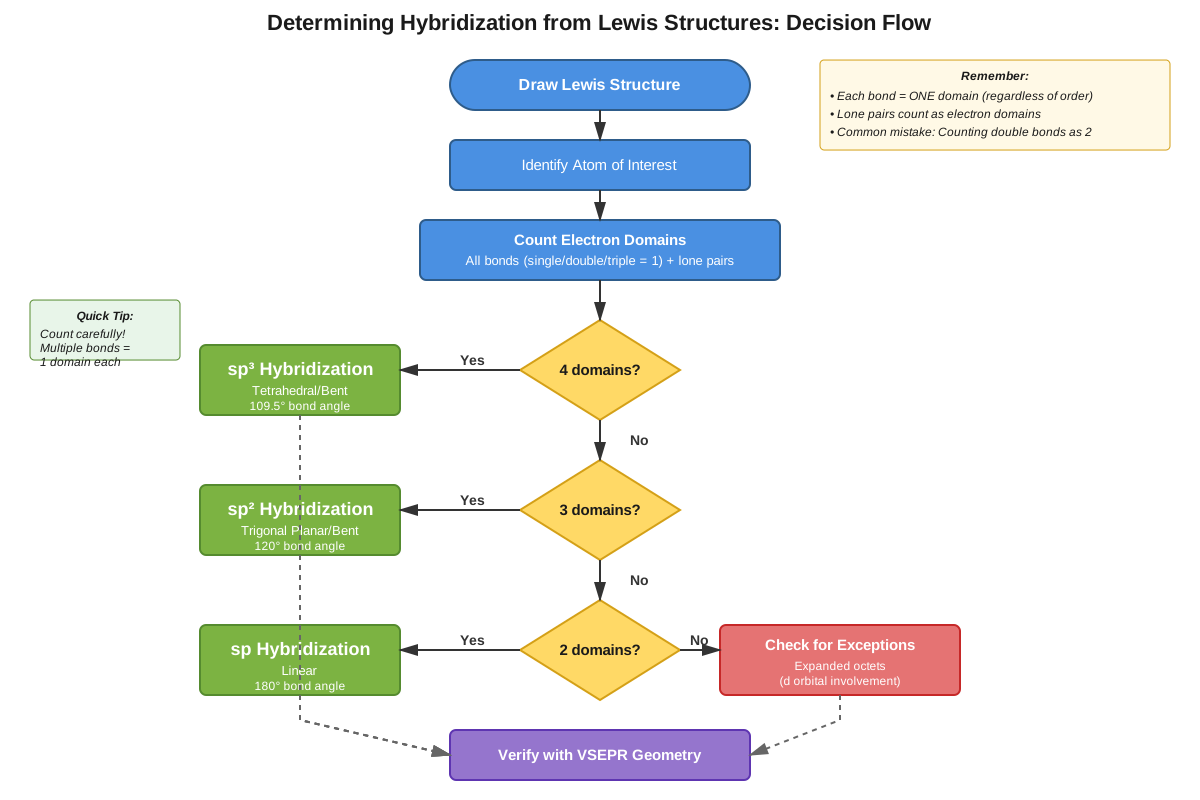
The systematic approach to determining hybridization involves counting electron domains (also called steric number) around the atom of interest. Electron domains include:
- Each single bond (counts as one domain)
- Each double bond (counts as one domain)
- Each triple bond (counts as one domain)
- Each lone pair of electrons (counts as one domain)
The relationship between electron domains and hybridization follows this pattern:
| Electron Domains | Hybridization | Electron Geometry | Example Bond Angles |
|---|---|---|---|
| 2 | sp | Linear | 180° |
| 3 | sp² | Trigonal planar | 120° |
| 4 | sp³ | Tetrahedral | 109.5° |
| 5 | sp³d | Trigonal bipyramidal | 90°, 120°, 180° |
| 6 | sp³d² | Octahedral | 90°, 180° |
Note that sp³d and sp³d² hybridization involving d orbitals are less commonly tested on the MCAT and typically only appear for main group elements in period 3 and beyond (such as phosphorus or sulfur).
Relationship Between Hybridization and Bonding
The type of hybridization directly determines the types of bonds an atom can form. Sigma bonds form from the end-to-end overlap of hybrid orbitals (or hybrid orbitals with s or p orbitals from other atoms). Pi bonds form from the side-by-side overlap of unhybridized p orbitals. This distinction is crucial:
- sp³ hybridized atoms form only single bonds (one sigma bond each)
- sp² hybridized atoms can form one double bond (one sigma + one pi) or two single bonds
- sp hybridized atoms can form one triple bond (one sigma + two pi), or one double bond plus one single bond, or two double bonds
The presence of pi bonds restricts rotation around the bond axis because rotating would break the side-by-side p orbital overlap. This rotational restriction has profound implications for stereochemistry and molecular conformation.
Hybridization and Molecular Properties
The percentage of s character in hybrid orbitals affects several molecular properties. Greater s character means electrons are held closer to the nucleus (s orbitals are closer to the nucleus than p orbitals), which influences:
Electronegativity: sp > sp² > sp³ (more s character = more electronegative)
Acidity: Compounds with more s character in the orbital holding the acidic proton are more acidic because the conjugate base is more stable. This explains why terminal alkynes (sp hybridized carbon) are more acidic than alkenes (sp²) or alkanes (sp³).
Bond length: More s character leads to shorter, stronger bonds because electrons are held closer to the nucleus. C-H bonds follow the trend: sp < sp² < sp³ in bond length.
Bond strength: Inversely related to bond length; more s character creates stronger bonds.
Concept Relationships
Hybridization serves as a central organizing principle that connects multiple fundamental concepts in General Chemistry. The concept begins with electron configuration, which determines the available atomic orbitals for hybridization. Understanding which orbitals are occupied and their relative energies is prerequisite knowledge that flows directly into hybridization theory.
Lewis structures → Electron domain counting → Hybridization determination → Molecular geometry prediction represents the primary conceptual pathway. Accurate Lewis structures with correct formal charges are essential for counting electron domains, which directly determines the hybridization state. The hybridization state then predicts the electron geometry, which combined with the presence or absence of lone pairs determines the final molecular geometry.
Hybridization theory integrates with VSEPR theory by providing the quantum mechanical explanation for why electron domains arrange themselves in specific geometries. While VSEPR predicts geometry based on electron repulsion, hybridization explains the orbital basis for these arrangements. The two theories are complementary and mutually reinforcing.
The distinction between sigma and pi bonding emerges directly from hybridization. Hybrid orbitals form sigma bonds through end-to-end overlap, while unhybridized p orbitals form pi bonds through side-by-side overlap. This connection extends to understanding resonance structures and conjugation, where overlapping p orbitals create delocalized pi systems.
Hybridization connects forward to organic chemistry concepts including stereochemistry (sp³ centers can be chiral), reaction mechanisms (nucleophiles attack sp² or sp carbons), and spectroscopy (hybridization affects IR stretching frequencies and NMR chemical shifts). It also relates to acid-base chemistry through the s character effect on acidity and basicity, and to molecular polarity through its determination of molecular shape.
Quick check — test yourself on Hybridization so far.
Try Flashcards →High-Yield Facts
⭐ The number of electron domains (steric number) directly determines hybridization: 2 domains = sp, 3 domains = sp², 4 domains = sp³
⭐ Double bonds and triple bonds each count as ONE electron domain when determining hybridization, not two or three
⭐ All single bonds are sigma bonds; double bonds contain one sigma and one pi bond; triple bonds contain one sigma and two pi bonds
⭐ Lone pairs occupy hybrid orbitals and count as electron domains when determining hybridization state
⭐ Greater s character correlates with shorter bonds, stronger bonds, and increased acidity (sp > sp² > sp³)
- sp³ hybridization corresponds to tetrahedral electron geometry with 109.5° bond angles
- sp² hybridization creates trigonal planar geometry with 120° bond angles and leaves one unhybridized p orbital for pi bonding
- sp hybridization produces linear geometry with 180° bond angles and leaves two unhybridized p orbitals for pi bonding
- Hybridization explains why carbon forms four equivalent bonds despite having electrons in different orbital types (2s² 2p²)
- The molecular geometry name differs from electron geometry when lone pairs are present (e.g., sp³ with two lone pairs gives bent molecular geometry)
- Pi bonds prevent rotation around the bond axis, creating geometric isomers (cis/trans) in alkenes
- Resonance structures must maintain the same hybridization at each atom; only pi electrons and lone pairs in p orbitals can delocalize
- Nitrogen in amines (sp³) is pyramidal and can invert, while nitrogen in amides (sp²) is planar and cannot invert due to resonance
- Oxygen typically exhibits sp³ hybridization in most organic compounds (alcohols, ethers, water) with two lone pairs
Common Misconceptions
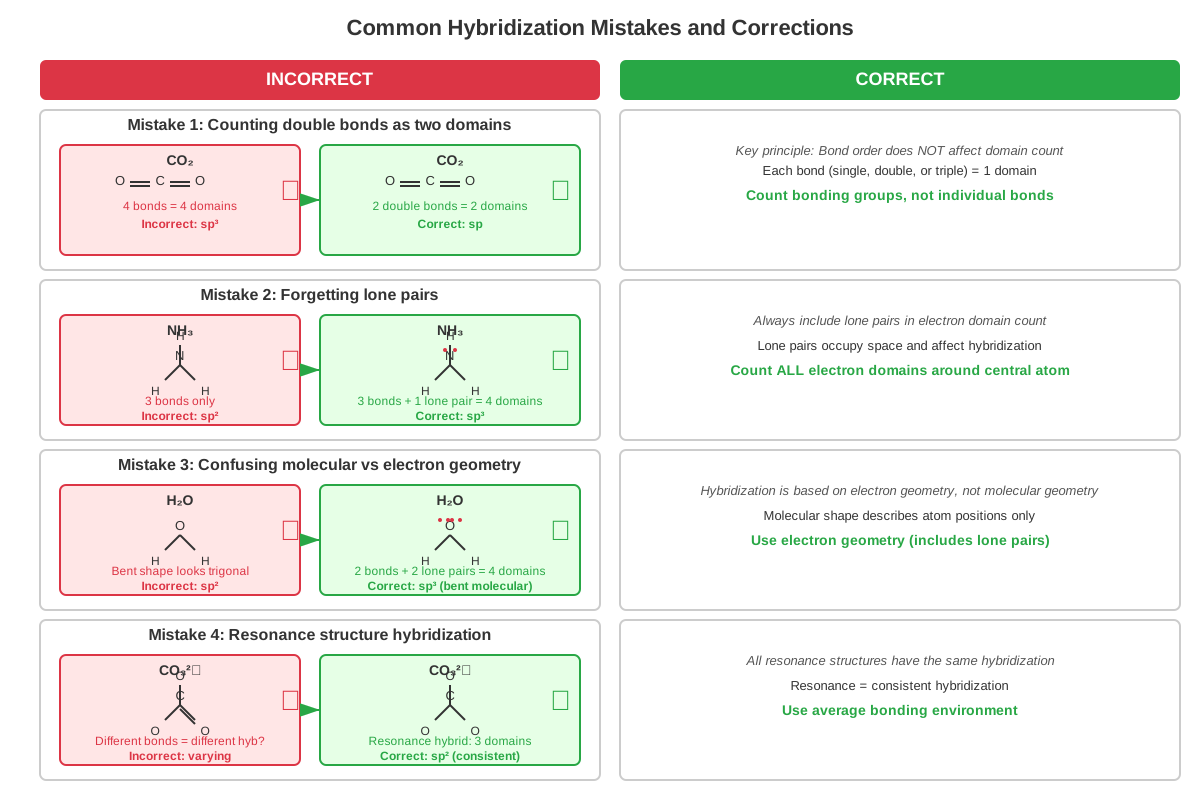
Misconception: Hybridization is a physical process that actually occurs in molecules.
Correction: Hybridization is a mathematical model used to explain observed molecular geometries and bonding patterns. Atomic orbitals don't physically "mix" in real time; hybridization is a theoretical construct that helps us understand and predict molecular structure using quantum mechanics.
Misconception: A double bond counts as two electron domains when determining hybridization.
Correction: Each multiple bond (double or triple) counts as exactly ONE electron domain regardless of how many electron pairs it contains. This is because all the electrons in a multiple bond occupy the same region of space relative to the central atom. A carbon with two single bonds and one double bond has three electron domains and is sp² hybridized.
Misconception: All sp³ hybridized molecules have tetrahedral molecular geometry.
Correction: sp³ hybridization refers to electron geometry (the arrangement of electron domains), not molecular geometry (the arrangement of atoms). Water is sp³ hybridized but has bent molecular geometry because two of the four electron domains are lone pairs. Molecular geometry depends on both hybridization and the number of lone pairs present.
Misconception: Pi bonds are weaker than sigma bonds, so double bonds are weaker than single bonds.
Correction: While an individual pi bond is typically weaker than an individual sigma bond due to less effective side-by-side overlap, a double bond (sigma + pi) is stronger overall than a single bond (sigma only). The bond dissociation energy of a C=C double bond (~146 kcal/mol) is greater than a C-C single bond (~83 kcal/mol), though not quite double.
Misconception: Hybridization can change during a chemical reaction.
Correction: Hybridization absolutely can and does change during chemical reactions. For example, when a carbonyl group (sp² carbon) is reduced to an alcohol (sp³ carbon), the hybridization changes. Recognizing these hybridization changes is crucial for understanding reaction mechanisms and is frequently tested on the MCAT.
Misconception: Only carbon undergoes hybridization.
Correction: All atoms that form covalent bonds can be described using hybridization theory. Nitrogen, oxygen, boron, and other elements all exhibit hybridization. For example, nitrogen in ammonia is sp³ hybridized, nitrogen in pyridine is sp² hybridized, and nitrogen in nitrogen gas (N₂) is sp hybridized.
Misconception: Resonance structures can have different hybridization states.
Correction: True resonance structures must maintain the same hybridization at each atom. If hybridization appears to change between structures, they are not true resonance structures but rather different compounds or tautomers. The actual molecule is a hybrid with consistent hybridization throughout.
Worked Examples
Example 1: Determining Hybridization in a Complex Molecule
Question: Determine the hybridization of each numbered carbon atom in the molecule below and predict the C-C-C bond angle at carbon 2.
        H₃C-CH=CH-C≡N
1 2 3 4Solution:
Step 1: Draw or visualize the complete Lewis structure with all bonds and lone pairs.
- Carbon 1: Forms three C-H single bonds and one C-C single bond
- Carbon 2: Forms one C-H single bond, one C-C single bond, and one C=C double bond
- Carbon 3: Forms one C-H single bond, one C=C double bond, and one C-C single bond
- Carbon 4: Forms one C≡N triple bond
Step 2: Count electron domains for each carbon.
- Carbon 1: 4 single bonds = 4 electron domains
- Carbon 2: 2 single bonds + 1 double bond = 3 electron domains (remember: double bond counts as ONE domain)
- Carbon 3: 1 single bond + 1 double bond = 3 electron domains (the H is a single bond, the double bond to C2 is one domain, and the single bond to C4 is one domain)
- Carbon 4: 1 triple bond = 2 electron domains
Step 3: Assign hybridization based on electron domains.
- Carbon 1: 4 domains → sp³ hybridization
- Carbon 2: 3 domains → sp² hybridization
- Carbon 3: 3 domains → sp² hybridization
- Carbon 4: 2 domains → sp hybridization
Step 4: Predict bond angle at carbon 2.
Carbon 2 is sp² hybridized, which corresponds to trigonal planar geometry with bond angles of approximately 120°. The C-C-C bond angle at carbon 2 will be close to 120°.
Key Insight: This example demonstrates that different carbons in the same molecule can have different hybridization states. The progression from sp³ to sp² to sp creates a molecule with varying geometries and properties along its length.
Example 2: Comparing Acidity Using Hybridization
Question: Rank the following compounds in order of increasing acidity and explain your reasoning using hybridization concepts:
A) CH₃-CH₃ (ethane)
B) CH₂=CH₂ (ethene)
C) HC≡CH (ethyne)
Solution:
Step 1: Identify which hydrogen is most acidic in each compound and determine the hybridization of the carbon bearing that hydrogen.
- Ethane: C-H bonds where carbon is sp³ hybridized
- Ethene: C-H bonds where carbon is sp² hybridized
- Ethyne: C-H bonds where carbon is sp hybridized
Step 2: Consider the conjugate base stability.
When each compound loses a proton, the conjugate base has a negative charge (lone pair) on carbon:
- Ethane → CH₃CH₂⁻ (carbanion with sp³ hybridized carbon)
- Ethene → CH₂=CH⁻ (carbanion with sp² hybridized carbon)
- Ethyne → HC≡C⁻ (carbanion with sp hybridized carbon)
Step 3: Apply the s character principle.
The stability of the conjugate base increases with greater s character because:
- sp hybridization: 50% s character
- sp² hybridization: 33% s character
- sp³ hybridization: 25% s character
Greater s character means the electrons are held closer to the nucleus in an orbital with more spherical character, making the negative charge more stable.
Step 4: Rank acidity.
More stable conjugate base = stronger acid
Answer: Increasing acidity: Ethane < Ethene < Ethyne (A < B < C)
The pKa values support this: ethane (~50), ethene (~44), ethyne (~25). Ethyne is approximately 10²⁵ times more acidic than ethane!
Key Insight: This example illustrates how hybridization directly affects chemical properties. The MCAT frequently tests this concept by asking students to compare acidity or basicity of compounds where hybridization is the key differentiating factor. This principle also explains why terminal alkynes can be deprotonated with strong bases to form nucleophilic acetylide ions, while alkanes cannot.
Exam Strategy
When approaching Hybridization MCAT questions, employ a systematic strategy that maximizes accuracy while minimizing time expenditure. Begin by quickly drawing or mentally visualizing the Lewis structure if one is not provided. Many students waste time on complex calculations when a simple electron domain count would suffice.
Trigger words that signal hybridization questions include: "molecular geometry," "bond angle," "orbital overlap," "sigma and pi bonds," "planar," "linear," "tetrahedral," and "steric number." When you encounter these terms, immediately think about hybridization as a potential solution pathway. Questions asking about acidity or basicity comparisons between similar compounds often hinge on hybridization differences.
For process of elimination, remember these key principles:
- If a molecule is described as planar, eliminate answer choices suggesting sp³ hybridization (which is tetrahedral)
- If a question mentions restricted rotation, the molecule must contain pi bonds, eliminating purely sp³ hybridized structures
- If bond angles are given, match them to hybridization: 180° = sp, 120° = sp², 109.5° = sp³
- If a carbon forms a double bond, it cannot be sp³ hybridized; eliminate such choices immediately
Time allocation for hybridization questions should be approximately 45-60 seconds for straightforward identification questions and up to 90 seconds for questions requiring multiple steps or integration with other concepts. If you find yourself spending more than 90 seconds, mark the question and move on—these questions rarely require complex calculations, so extended time usually indicates a conceptual gap rather than a need for more computation.
Exam Tip: When counting electron domains, use your fingers or make quick marks on your scratch paper. Physical counting reduces errors, especially under time pressure. Count each single bond, each multiple bond (as ONE domain), and each lone pair separately.
For passage-based questions, scan for molecular structures in figures and quickly annotate hybridization states of key atoms while reading. This proactive approach saves time when questions reference specific atoms or positions. Many MCAT passages present novel molecules, but hybridization determination follows the same rules regardless of molecular complexity.
Memory Techniques
Mnemonic for electron domains and hybridization: "2 Straight, 3 Triangles, 4 Tetrahedrons"
- 2 electron domains → sp → Straight (linear, 180°)
- 3 electron domains → sp² → Triangles (trigonal planar, 120°)
- 4 electron domains → sp³ → Tetrahedrons (tetrahedral, 109.5°)
Mnemonic for s character and acidity: "More S, More Sour"
- More s character → more acidic
- sp (50% s) > sp² (33% s) > sp³ (25% s)
Visualization strategy for pi bonds: Picture pi bonds as "bridges above and below" the sigma bond framework. The sigma bonds form the molecular skeleton (the "road"), while pi bonds are like bridges that restrict rotation. This mental image helps remember that pi bonds prevent rotation and that they're formed from unhybridized p orbitals perpendicular to the bonding axis.
Acronym for bond counting: "SOLD" - Single, One domain; Double, One domain; Triple, One domain; Lone pair, One domain. Despite the different numbers of electron pairs, each bond type counts as one domain for hybridization purposes.
Memory palace technique: Associate each hybridization type with a physical location:
- sp³ = your room (four corners like four electron domains, 3D space)
- sp² = a flat table (planar surface, three legs)
- sp = a straight hallway (linear path)
When you need to recall properties, mentally "walk" to that location and visualize the associated geometry.
Summary
Hybridization is the quantum mechanical mixing of atomic orbitals to form new hybrid orbitals that explain observed molecular geometries and bonding patterns. The number of electron domains around an atom determines its hybridization state: two domains yield sp (linear, 180°), three domains yield sp² (trigonal planar, 120°), and four domains yield sp³ (tetrahedral, 109.5°). Each multiple bond counts as one electron domain, and lone pairs also count as domains. Hybrid orbitals form sigma bonds through end-to-end overlap, while unhybridized p orbitals form pi bonds through side-by-side overlap. The percentage of s character in hybrid orbitals affects molecular properties including bond length, bond strength, electronegativity, and acidity, with greater s character correlating with shorter, stronger bonds and increased acidity. For the MCAT, rapid hybridization determination enables prediction of molecular geometry, bond angles, and chemical reactivity, making it an essential tool for both General Chemistry and Organic Chemistry questions. Mastery requires systematic electron domain counting, understanding the relationship between hybridization and bonding, and recognizing how hybridization influences molecular properties.
Key Takeaways
- Hybridization state is determined by counting electron domains (steric number): 2 = sp, 3 = sp², 4 = sp³, with each bond (single, double, or triple) and each lone pair counting as one domain
- sp³ hybridization creates tetrahedral geometry (109.5°), sp² creates trigonal planar geometry (120°), and sp creates linear geometry (180°)
- All single bonds are sigma bonds formed by hybrid orbitals; double bonds contain one sigma and one pi bond; triple bonds contain one sigma and two pi bonds
- Greater s character (sp > sp² > sp³) results in shorter, stronger bonds and increased acidity of attached hydrogens
- Lone pairs occupy hybrid orbitals and affect molecular geometry but not electron geometry
- Hybridization can change during chemical reactions, and recognizing these changes is crucial for understanding mechanisms
- The distinction between electron geometry (determined by hybridization) and molecular geometry (determined by atom positions) is essential for accurate structure prediction
Related Topics
VSEPR Theory and Molecular Geometry: Hybridization provides the orbital basis for VSEPR predictions. Mastering hybridization enables deeper understanding of why molecules adopt specific three-dimensional shapes and how to predict geometries for complex molecules.
Sigma and Pi Bonding: The distinction between these bond types emerges directly from hybridization theory. Further study of molecular orbital theory and bonding will build on the hybrid orbital framework established here.
Resonance and Conjugation: Understanding which orbitals participate in resonance (unhybridized p orbitals) versus which form the sigma framework (hybrid orbitals) is essential for advanced organic chemistry topics including aromaticity and reaction mechanisms.
Stereochemistry: sp³ hybridized carbons with four different substituents are chiral centers. The tetrahedral geometry arising from sp³ hybridization is fundamental to understanding optical isomers and stereochemical relationships.
Acid-Base Chemistry: The relationship between hybridization and acidity/basicity extends to predicting pKa values, understanding leaving group ability, and explaining nucleophilicity trends—all high-yield MCAT topics.
Spectroscopy: Hybridization affects IR stretching frequencies, NMR chemical shifts, and UV-Vis absorption. Understanding the electronic environment created by different hybridization states supports interpretation of spectroscopic data.
Practice CTA
Now that you've mastered the core concepts of hybridization, it's time to solidify your understanding through active practice. Attempt the practice questions and work through the flashcards to reinforce the systematic approach to determining hybridization states and predicting molecular properties. Remember, hybridization questions on the MCAT reward systematic thinking and pattern recognition—skills that improve dramatically with deliberate practice. Each practice problem you solve strengthens the neural pathways that will allow you to quickly and accurately answer these questions on test day. You've built the foundation; now construct the expertise through application!
Sign up free to keep reading
Create a free AnvayaPrep account to finish this MCAT guide on Hybridization — plus flashcards and practice questions.