Overview
Ionic bonds represent one of the fundamental types of chemical bonding that holds matter together, forming the basis for understanding countless biological and chemical processes tested on the MCAT. These bonds arise from the complete transfer of electrons between atoms, creating oppositely charged ions that attract each other through electrostatic forces. Unlike covalent bonds where electrons are shared, ionic bonds involve a donor atom (typically a metal) losing electrons to become a positively charged cation, and an acceptor atom (typically a nonmetal) gaining those electrons to become a negatively charged anion. This electron transfer and subsequent electrostatic attraction creates stable ionic compounds with distinctive properties including high melting points, brittleness, and the ability to conduct electricity when dissolved in water or melted.
Understanding Ionic bonds General Chemistry is crucial for MCAT success because these concepts appear across multiple sections of the exam. In the Chemical and Physical Foundations section, ionic bonding principles underpin questions about compound formation, lattice energy, solubility, and electrochemistry. In the Biological and Biochemical Foundations section, ionic interactions explain protein structure stabilization, membrane potential, nerve signal transmission, and drug-receptor binding. The MCAT frequently tests the ability to predict which elements will form ionic compounds, calculate formal charges, understand the energetics of ionic bond formation, and recognize how ionic character influences molecular properties.
Within the broader context of Bonding and Molecular Structure, ionic bonding represents one extreme on the bonding spectrum, with pure covalent bonding at the other end and polar covalent bonding occupying the middle ground. Mastering ionic bonds provides the foundation for understanding electronegativity differences, lattice structures, solubility rules, acid-base chemistry, and oxidation-reduction reactions—all high-yield topics for the MCAT. The principles governing ionic bond formation connect directly to periodic trends, thermodynamics, kinetics, and solution chemistry, making this topic a central hub in General Chemistry knowledge.
Learning Objectives
- [ ] Define Ionic bonds using accurate General Chemistry terminology
- [ ] Explain why Ionic bonds matters for the MCAT
- [ ] Apply Ionic bonds to exam-style questions
- [ ] Identify common mistakes related to Ionic bonds
- [ ] Connect Ionic bonds to related General Chemistry concepts
- [ ] Predict which pairs of elements will form ionic compounds based on electronegativity differences and position on the periodic table
- [ ] Calculate lattice energy trends and explain how ionic radius and charge affect bond strength
- [ ] Analyze the energetics of ionic bond formation using Born-Haber cycles and relate to thermodynamic stability
Prerequisites
- Atomic structure and electron configuration: Understanding how electrons are arranged in shells and subshells is essential for predicting which electrons will be transferred during ionic bond formation
- Periodic trends: Knowledge of electronegativity, ionization energy, electron affinity, and atomic radius enables prediction of ionic bond formation and properties
- Coulomb's Law: The mathematical relationship describing electrostatic attraction between charged particles forms the quantitative basis for understanding ionic bond strength
- Basic thermodynamics: Concepts of energy, enthalpy, and stability are necessary to understand why ionic bonds form and the energetics involved in the process
Why This Topic Matters
Ionic bonds MCAT questions appear with moderate frequency across multiple exam sections, making this a reliable source of points for well-prepared students. Approximately 3-5 questions per exam directly test ionic bonding concepts, with many additional questions incorporating ionic bonding principles indirectly. The MCAT presents ionic bonding through various question formats including discrete questions about bond formation and properties, passage-based questions analyzing experimental data on ionic compounds, and biochemistry passages where ionic interactions stabilize macromolecular structures.
Clinically and biologically, ionic interactions are fundamental to life processes. The sodium-potassium pump that maintains cellular membrane potential relies on ionic gradients. Nerve impulse transmission depends on the movement of ionic species across membranes. Bone structure consists primarily of calcium phosphate, an ionic compound. Many pharmaceuticals function as ionic salts to improve solubility and bioavailability. Electrolyte imbalances involving ionic species like sodium, potassium, calcium, and chloride can cause serious medical conditions including cardiac arrhythmias, muscle weakness, and neurological dysfunction.
Common MCAT passage contexts include: experimental determination of lattice energies, solubility studies of ionic compounds in various solvents, analysis of ionic compound properties compared to covalent compounds, electrochemical cells involving ionic species, and biological passages discussing ion channels, membrane transport, or electrolyte physiology. The exam frequently requires students to integrate ionic bonding concepts with solubility rules, thermodynamics, kinetics, and biochemical function, making this topic a high-yield connector between different chemistry domains.
Core Concepts
Definition and Formation of Ionic Bonds
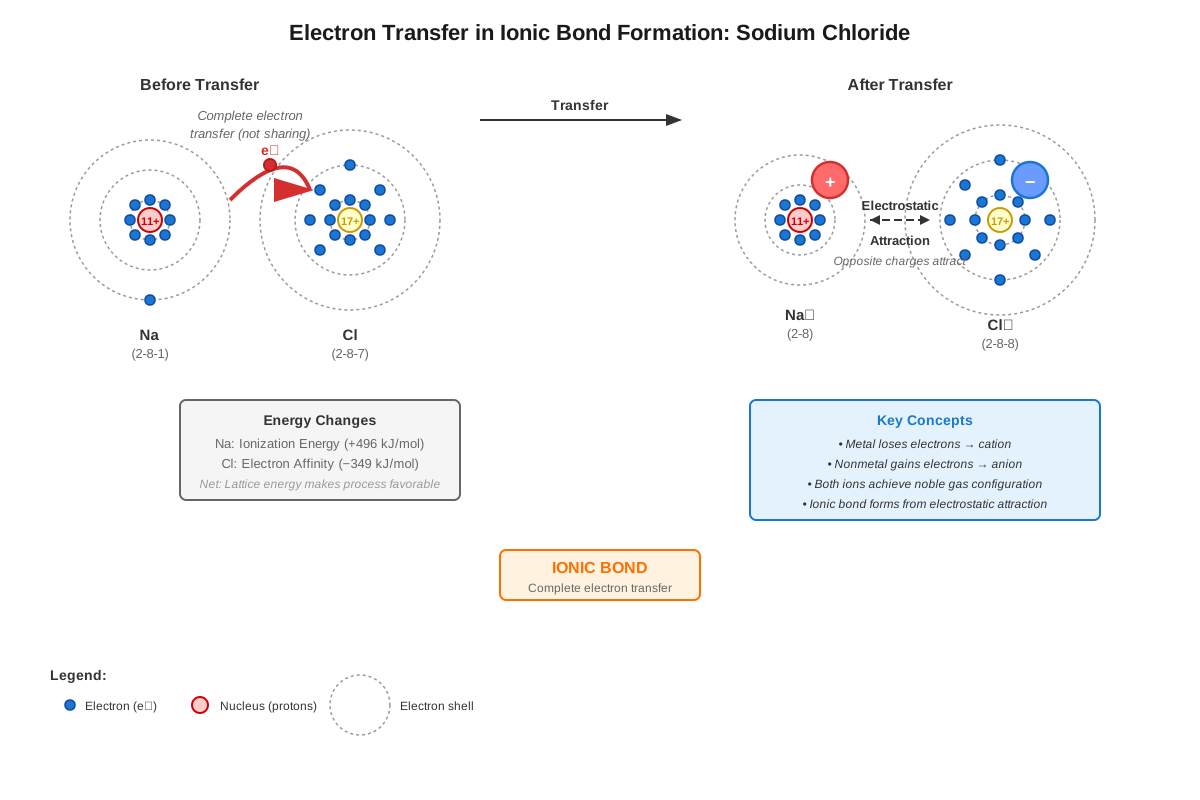
An ionic bond is the electrostatic force of attraction between oppositely charged ions formed through the complete transfer of one or more valence electrons from one atom to another. This transfer typically occurs between elements with large differences in electronegativity—generally greater than 1.7 on the Pauling scale. The atom that loses electrons becomes a cation (positively charged ion), while the atom that gains electrons becomes an anion (negatively charged ion).
The driving force behind ionic bond formation is the achievement of stable electron configurations. Metals in Groups 1 and 2 readily lose electrons to achieve the electron configuration of the nearest noble gas, while nonmetals in Groups 16 and 17 readily gain electrons for the same purpose. For example, sodium (Na) has the electron configuration [Ne]3s¹ and readily loses one electron to form Na⁺ with the stable [Ne] configuration. Chlorine (Cl) has the configuration [Ne]3s²3p⁵ and readily gains one electron to form Cl⁻ with the stable [Ar] configuration. The resulting Na⁺ and Cl⁻ ions attract each other through electrostatic forces, forming sodium chloride (NaCl).
Energetics of Ionic Bond Formation
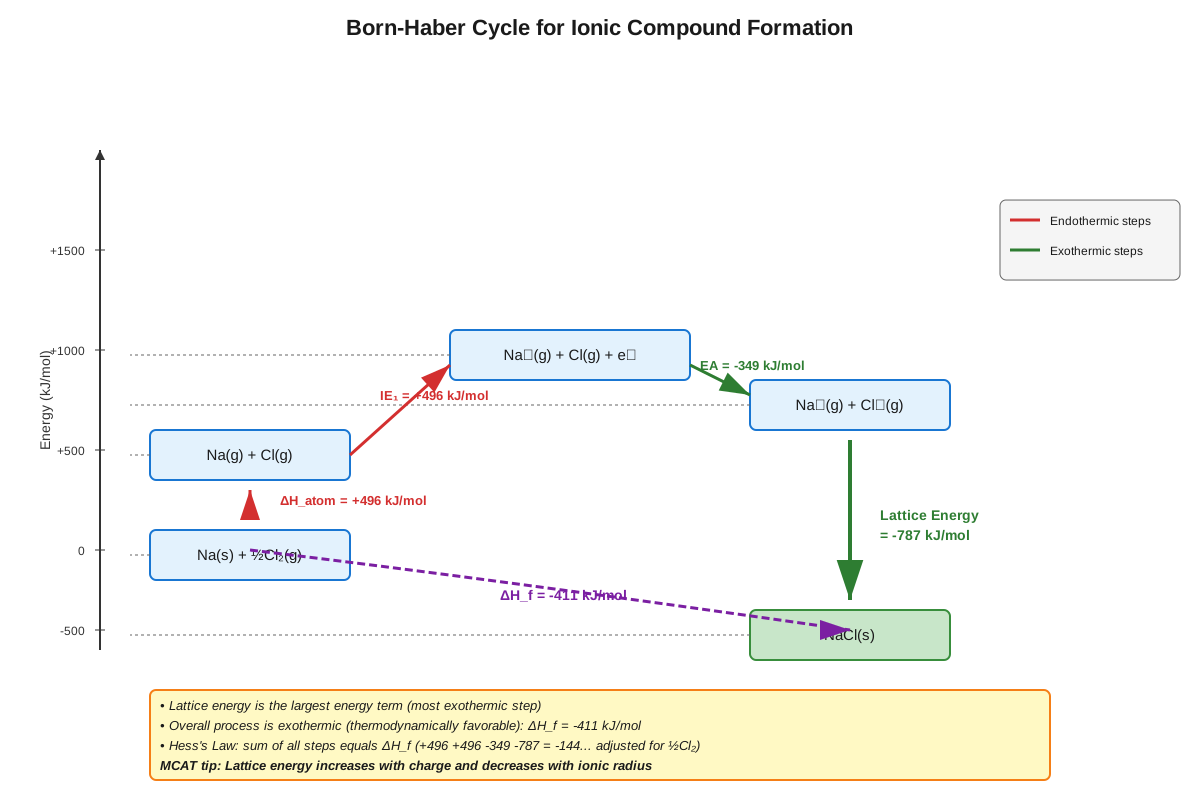
The formation of ionic bonds involves several energy changes that can be analyzed using a Born-Haber cycle, a thermodynamic cycle that breaks down the formation of an ionic compound into discrete steps:
- Sublimation/vaporization of the metal: Energy required to convert solid metal to gaseous atoms (endothermic)
- Ionization energy: Energy required to remove electrons from gaseous metal atoms to form cations (endothermic)
- Bond dissociation: Energy required to break bonds in nonmetal molecules to form gaseous atoms (endothermic for diatomic nonmetals)
- Electron affinity: Energy change when gaseous nonmetal atoms gain electrons to form anions (usually exothermic)
- Lattice energy: Energy released when gaseous ions combine to form the solid ionic compound (exothermic)
The overall process is thermodynamically favorable when the energy released (primarily from lattice energy and electron affinity) exceeds the energy required (sublimation, ionization energy, and bond dissociation). Lattice energy is typically the largest energy term and represents the energy released when one mole of an ionic solid forms from gaseous ions, or equivalently, the energy required to completely separate one mole of solid ionic compound into gaseous ions.
Lattice Energy and Ionic Bond Strength
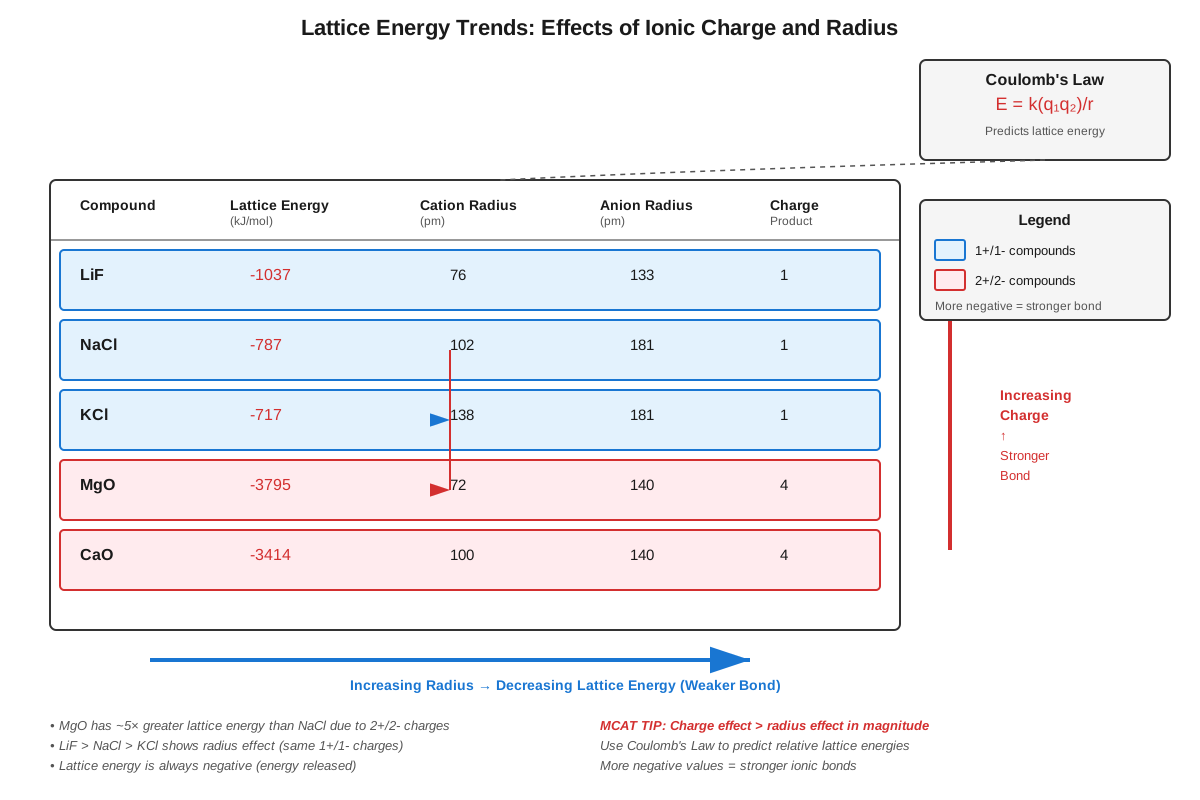
Lattice energy quantifies the strength of ionic bonding in a crystal lattice and can be estimated using a modified form of Coulomb's Law:
Lattice Energy ∝ (Q₁ × Q₂) / rWhere:
- Q₁ and Q₂ are the charges on the ions
- r is the distance between ion centers (sum of ionic radii)
This relationship reveals two critical factors affecting ionic bond strength:
Charge magnitude: Higher ionic charges produce stronger electrostatic attraction and greater lattice energy. For example, MgO (Mg²⁺ and O²⁻) has much higher lattice energy than NaCl (Na⁺ and Cl⁻) because the product of charges is four times greater (2×2 = 4 versus 1×1 = 1).
Ionic radius: Smaller ions can approach more closely, resulting in stronger attraction and higher lattice energy. For example, LiF has higher lattice energy than CsI because both Li⁺ and F⁻ are much smaller than Cs⁺ and I⁻, allowing closer approach and stronger electrostatic interaction.
| Compound | Cation Charge | Anion Charge | Approximate Ionic Radii | Relative Lattice Energy |
|---|---|---|---|---|
| LiF | +1 | -1 | Small | Very High |
| NaCl | +1 | -1 | Medium | High |
| CsI | +1 | -1 | Large | Lower |
| MgO | +2 | -2 | Small | Extremely High |
| CaS | +2 | -2 | Medium | Very High |
Properties of Ionic Compounds
Ionic compounds exhibit characteristic physical and chemical properties that distinguish them from covalent compounds:
- High melting and boiling points: The strong electrostatic forces between ions require substantial energy to overcome, resulting in high melting and boiling points. Most ionic compounds are solid at room temperature.
- Brittleness: When stress is applied to an ionic crystal, layers of ions may shift, bringing like charges into proximity. The resulting repulsion causes the crystal to fracture rather than deform.
- Electrical conductivity: Solid ionic compounds do not conduct electricity because ions are fixed in the crystal lattice. However, when melted or dissolved in water, ions become mobile and can conduct electric current.
- Solubility in polar solvents: Many ionic compounds dissolve in polar solvents like water because the polar solvent molecules can stabilize the separated ions through ion-dipole interactions. The hydration energy (energy released when ions are surrounded by water molecules) must be sufficient to overcome the lattice energy.
- Formation of crystal lattices: Ionic compounds arrange in regular, repeating three-dimensional structures that maximize attractive forces and minimize repulsive forces between ions.
Predicting Ionic Bond Formation
Several guidelines help predict when ionic bonding will occur:
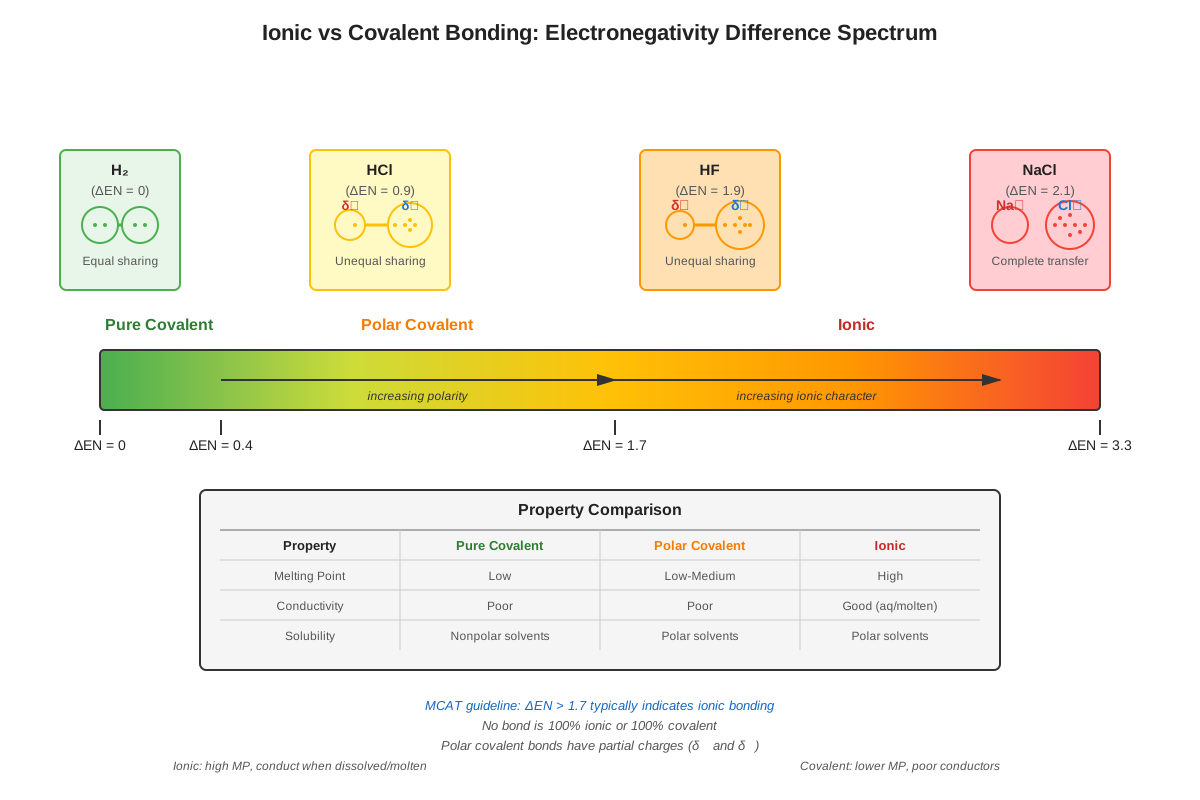
- Electronegativity difference: When the electronegativity difference between two elements exceeds approximately 1.7, electron transfer is complete enough to consider the bond ionic. Differences between 0.4 and 1.7 typically indicate polar covalent bonding.
- Metal-nonmetal combinations: Ionic bonds typically form between metals (low electronegativity, low ionization energy) and nonmetals (high electronegativity, high electron affinity).
- Group position: Elements in Groups 1 and 2 (alkali and alkaline earth metals) readily form cations, while elements in Groups 16 and 17 (chalcogens and halogens) readily form anions.
- Charge considerations: Stable ionic compounds form when the charges balance to produce electrical neutrality. For example, Mg²⁺ combines with two Cl⁻ ions to form MgCl₂, or with one O²⁻ ion to form MgO.
Ionic Character vs. Covalent Character
In reality, most bonds exist on a continuum between purely ionic and purely covalent. Even in compounds traditionally classified as ionic, there is some degree of electron sharing (covalent character), and even in covalent compounds, there may be unequal electron sharing (ionic character). The percent ionic character can be estimated from electronegativity differences, with larger differences corresponding to greater ionic character.
Polarization occurs when a cation distorts the electron cloud of an anion, introducing covalent character into what would otherwise be a purely ionic bond. Small, highly charged cations (high charge density) are particularly effective at polarizing large, easily polarizable anions. This phenomenon is described by Fajans' rules, which state that covalent character increases when:
- The cation is small and highly charged
- The anion is large and highly charged
- The cation has a non-noble gas electron configuration (transition metals)
Concept Relationships
The formation of ionic bonds begins with periodic trends—specifically electronegativity differences between elements determine whether electron transfer will occur. Elements with low ionization energy (left side of periodic table) readily lose electrons, while elements with high electron affinity (right side of periodic table) readily gain electrons. This electron transfer creates ions whose stability is explained by achieving noble gas electron configurations.
The strength of ionic bonds, quantified by lattice energy, depends on Coulomb's Law principles: charge magnitude and ionic radius. These same factors influence many properties of ionic compounds, creating a direct relationship: lattice energy → melting point, hardness, and solubility behavior. Higher lattice energy correlates with higher melting points, greater hardness, and often lower solubility in water (when lattice energy exceeds hydration energy).
Ionic bonding connects to thermodynamics through Born-Haber cycles, which demonstrate that ionic compound formation is favorable when the sum of endothermic processes (ionization energy, sublimation) is exceeded by exothermic processes (electron affinity, lattice energy). This thermodynamic favorability explains why certain combinations of elements spontaneously form ionic compounds while others do not.
The properties of ionic compounds—particularly their solubility and conductivity—link directly to solution chemistry and electrochemistry. When ionic compounds dissolve, the process involves breaking ionic bonds (endothermic, requires lattice energy) and forming ion-dipole interactions with solvent molecules (exothermic, releases hydration energy). The balance between these energies determines solubility, which in turn affects acid-base chemistry, precipitation reactions, and electrochemical cells.
Relationship map: Periodic Trends → Electronegativity Differences → Electron Transfer → Ion Formation → Electrostatic Attraction (Coulomb's Law) → Ionic Bond Formation → Lattice Energy → Physical Properties (melting point, hardness, brittleness) → Solubility Behavior → Solution Chemistry → Biological Applications (membrane potential, nerve transmission, electrolyte balance)
Quick check — test yourself on Ionic bonds so far.
Try Flashcards →High-Yield Facts
⭐ Ionic bonds form when the electronegativity difference between two atoms exceeds approximately 1.7 on the Pauling scale
⭐ Lattice energy is directly proportional to the product of ionic charges and inversely proportional to the distance between ions (sum of ionic radii)
⭐ Ionic compounds conduct electricity when molten or dissolved in water, but not in the solid state
⭐ MgO has significantly higher lattice energy than NaCl due to the higher charges on Mg²⁺ and O²⁻ compared to Na⁺ and Cl⁻
⭐ Smaller ions and higher charges result in stronger ionic bonds and higher melting points
- Ionic compounds are typically brittle because shifting layers brings like charges together, causing repulsion and fracture
- The Born-Haber cycle demonstrates that lattice energy is the primary driving force making ionic compound formation thermodynamically favorable
- Group 1 metals form +1 cations, Group 2 metals form +2 cations, Group 16 nonmetals form -2 anions, and Group 17 nonmetals form -1 anions
- Hydration energy must exceed lattice energy for an ionic compound to be soluble in water
- Transition metal compounds often have significant covalent character due to polarization effects (Fajans' rules)
- The formula of an ionic compound reflects the ratio of ions needed to achieve electrical neutrality (e.g., CaCl₂, Al₂O₃)
- Ionic radius increases down a group and decreases across a period for ions with the same charge
Common Misconceptions
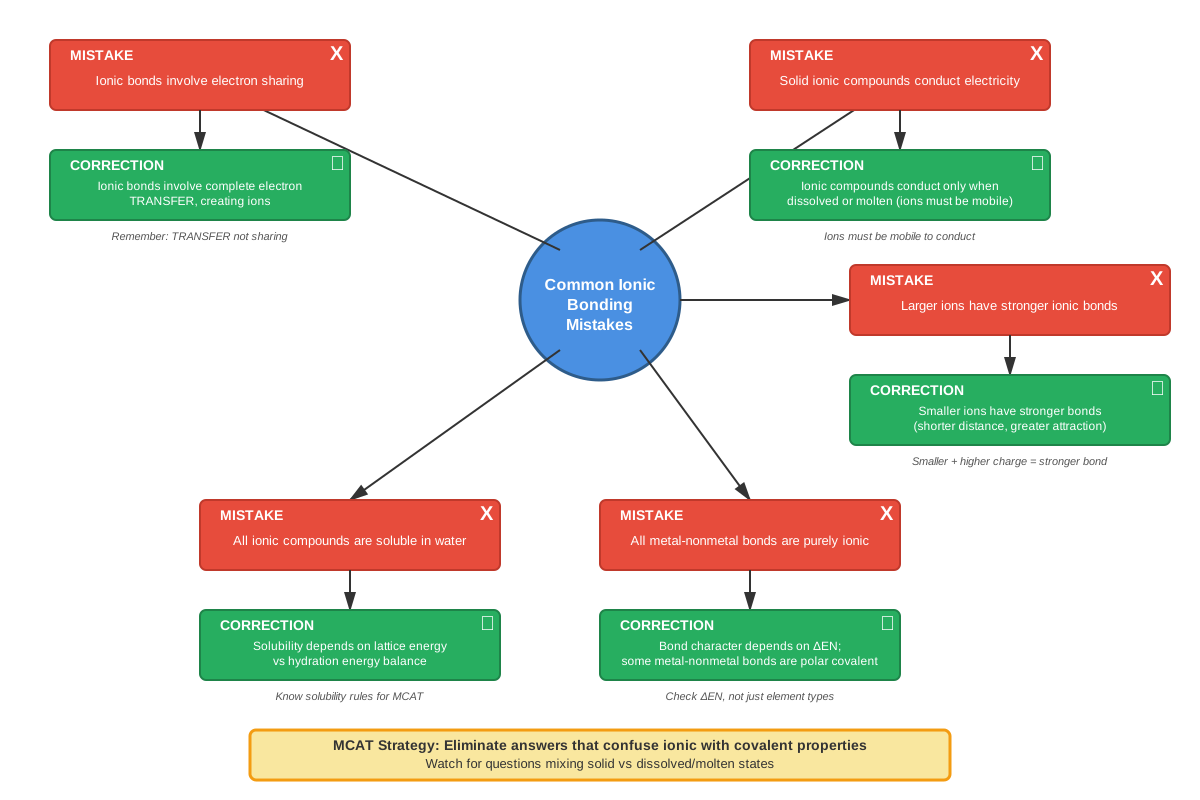
Misconception: Ionic bonds involve sharing of electrons between atoms.
Correction: Ionic bonds result from the complete transfer of electrons from one atom to another, creating oppositely charged ions that attract electrostatically. Sharing of electrons characterizes covalent bonding, not ionic bonding.
Misconception: All metal-nonmetal combinations form purely ionic bonds.
Correction: While most metal-nonmetal combinations have significant ionic character, many have partial covalent character due to polarization effects. For example, AlCl₃ has substantial covalent character because the small, highly charged Al³⁺ ion polarizes the Cl⁻ electron cloud.
Misconception: Ionic compounds with higher lattice energy are always more soluble in water.
Correction: Solubility depends on the balance between lattice energy and hydration energy. Compounds with very high lattice energy (like MgO) are often insoluble because the energy required to separate the ions exceeds the energy released when water molecules surround them. Moderate lattice energy compounds (like NaCl) are typically more soluble.
Misconception: The strength of an ionic bond depends only on the distance between ions.
Correction: Ionic bond strength depends on both the charges on the ions and the distance between them. A compound with doubly charged ions (like MgO) will have much stronger bonding than a compound with singly charged ions at the same distance (like NaF), even though the distance factor is similar.
Misconception: Solid ionic compounds conduct electricity because they contain charged particles.
Correction: Although solid ionic compounds contain charged particles, these ions are fixed in the crystal lattice and cannot move to conduct current. Electrical conductivity requires mobile charge carriers, which only exist when the ionic compound is melted or dissolved in solution.
Misconception: Ionic bonds are always stronger than covalent bonds.
Correction: While many ionic compounds have high bond energies, some covalent bonds (like C-C, C=C, and especially C≡C) are stronger than some ionic bonds. Bond strength depends on multiple factors including bond order, atomic size, and charge distribution.
Worked Examples
Example 1: Predicting Ionic Compound Formation and Properties
Question: Consider the following pairs of elements: (A) Na and Cl, (B) Mg and O, (C) C and O. For each pair, predict whether an ionic compound will form, write the formula if applicable, and rank any ionic compounds formed by lattice energy.
Solution:
Step 1: Evaluate electronegativity differences and element types.
(A) Na (electronegativity ≈ 0.9) and Cl (electronegativity ≈ 3.0): Difference = 2.1
- This is a metal-nonmetal pair with electronegativity difference > 1.7
- Prediction: Ionic compound will form
(B) Mg (electronegativity ≈ 1.2) and O (electronegativity ≈ 3.5): Difference = 2.3
- This is a metal-nonmetal pair with electronegativity difference > 1.7
- Prediction: Ionic compound will form
(C) C (electronegativity ≈ 2.5) and O (electronegativity ≈ 3.5): Difference = 1.0
- This is a nonmetal-nonmetal pair with electronegativity difference < 1.7
- Prediction: Covalent compound will form (not ionic)
Step 2: Write formulas for ionic compounds.
(A) Na loses 1 electron to form Na⁺; Cl gains 1 electron to form Cl⁻
- Formula: NaCl (1:1 ratio for charge balance)
(B) Mg loses 2 electrons to form Mg²⁺; O gains 2 electrons to form O²⁻
- Formula: MgO (1:1 ratio for charge balance)
Step 3: Rank by lattice energy using the relationship: Lattice Energy ∝ (Q₁ × Q₂) / r
For NaCl: Charge product = (+1)(-1) = 1; ionic radii are moderate
For MgO: Charge product = (+2)(-2) = 4; ionic radii are smaller than Na⁺ and Cl⁻
MgO has both a higher charge product (4× greater) and smaller ionic radii, resulting in significantly higher lattice energy.
Ranking: MgO > NaCl
Connection to learning objectives: This example demonstrates predicting ionic bond formation based on electronegativity differences, writing correct formulas based on charge balance, and applying Coulomb's Law principles to compare lattice energies.
Example 2: Analyzing Solubility Using Lattice Energy and Hydration Energy
Question: Explain why NaCl is highly soluble in water (36 g/100 mL at 25°C) while AgCl is nearly insoluble (0.0002 g/100 mL at 25°C), despite both being 1:1 ionic compounds.
Solution:
Step 1: Identify the relevant energy terms.
For an ionic compound to dissolve in water, two processes must occur:
- Breaking apart the ionic lattice (requires energy = lattice energy, endothermic)
- Hydrating the separated ions (releases energy = hydration energy, exothermic)
The compound is soluble when: Hydration Energy > Lattice Energy (overall process is exothermic or slightly endothermic)
Step 2: Compare lattice energies.
NaCl: Na⁺ and Cl⁻ are relatively small ions with +1 and -1 charges
- Moderate lattice energy (≈ 786 kJ/mol)
AgCl: Ag⁺ is similar in size to Na⁺, but has different electronic properties
- Ag⁺ has a filled d¹⁰ subshell, making it more polarizable
- The Ag⁺ ion polarizes the Cl⁻ electron cloud, introducing covalent character
- This polarization effect increases the effective lattice energy (≈ 915 kJ/mol)
Step 3: Compare hydration energies.
Na⁺: Small, highly charged ion with noble gas configuration
- Forms strong ion-dipole interactions with water
- High hydration energy
Ag⁺: Similar size but with d¹⁰ configuration
- The filled d-orbitals make Ag⁺ less effective at forming ion-dipole interactions
- Lower hydration energy compared to Na⁺
Step 4: Evaluate the energy balance.
For NaCl: Hydration energy ≈ 783 kJ/mol (close to lattice energy)
- The energy released by hydration nearly equals the energy required to break the lattice
- Result: Highly soluble
For AgCl: Hydration energy < Lattice energy (by a significant margin)
- The energy released by hydration is insufficient to overcome the lattice energy
- Result: Nearly insoluble
Conclusion: Despite both being 1:1 ionic compounds, AgCl's higher effective lattice energy (due to covalent character from polarization) and lower hydration energy (due to d¹⁰ configuration) make it insoluble, while NaCl's favorable energy balance makes it highly soluble.
Connection to learning objectives: This example applies ionic bonding concepts to explain real-world solubility differences, connects lattice energy to solubility, and demonstrates how electronic structure affects ionic compound properties—all high-yield concepts for the MCAT.
Exam Strategy
When approaching Ionic bonds MCAT questions, begin by identifying whether the question asks about bond formation, bond strength, or compound properties. Each category has specific trigger words and solution approaches.
Trigger words for bond formation questions: "predict," "which pair will form," "electronegativity difference," "electron transfer," "formula"
- Strategy: Calculate or estimate electronegativity differences (>1.7 suggests ionic). Check if the combination is metal-nonmetal. Determine charges based on group numbers and write formulas ensuring charge neutrality.
Trigger words for bond strength questions: "lattice energy," "strongest bond," "highest melting point," "compare stability," "rank"
- Strategy: Apply the lattice energy relationship (charge product divided by distance). Higher charges and smaller ions mean stronger bonds. Remember that 2+ and 2- ions create bonds approximately 4× stronger than 1+ and 1- ions at similar distances.
Trigger words for properties questions: "conduct electricity," "soluble," "brittle," "dissolve," "melting point"
- Strategy: Recall that ionic compounds conduct only when ions are mobile (molten or dissolved). Solubility requires hydration energy > lattice energy. High melting points correlate with high lattice energy.
Process of elimination tips:
- Eliminate answer choices suggesting ionic compounds conduct electricity as solids
- Eliminate choices claiming nonmetal-nonmetal pairs form ionic bonds
- Eliminate options stating that larger ions form stronger ionic bonds (opposite is true)
- Eliminate answers suggesting ionic bonds involve electron sharing
Time allocation: Discrete ionic bonding questions typically require 45-60 seconds. Passage-based questions may require 60-90 seconds depending on data interpretation needs. If a question requires complex Born-Haber cycle calculations, flag it and return if time permits—these are rare and time-intensive.
Common question patterns:
- Given electronegativity values, predict bond type
- Rank compounds by lattice energy or melting point
- Explain why a compound is soluble or insoluble
- Identify which compound conducts electricity under specific conditions
- Predict the formula of an ionic compound from constituent elements
Exam Tip: When comparing lattice energies, first compare charge products (this usually dominates), then consider ionic radii only if charges are equal. This two-step approach saves time and reduces errors.
Memory Techniques
Mnemonic for factors affecting lattice energy - "CHARGE CLOSE":
- CHARGE: Higher charges = higher lattice energy
- CLOSE: Closer ions (smaller radii) = higher lattice energy
Mnemonic for when ionic compounds conduct - "MELT or MOIST":
- MELT: Molten ionic compounds conduct
- MOIST: Moisture (dissolved in water) allows conduction
- Solid ionic compounds do NOT conduct
Mnemonic for predicting ionic bond formation - "METAL MEETS NONMETAL":
- METAL: Left side of periodic table (Groups 1, 2)
- MEETS: Electronegativity difference > 1.7
- NONMETAL: Right side of periodic table (Groups 16, 17)
Visualization for lattice energy: Picture ions as magnets. Stronger magnets (higher charges) attract more strongly. Magnets held closer together (smaller ionic radii) have stronger attraction. This mental image helps remember both factors affecting ionic bond strength.
Acronym for ionic compound properties - "HBSC":
- High melting points
- Brittle structure
- Soluble in polar solvents (many, not all)
- Conduct when molten or dissolved
Memory aid for Born-Haber cycle: Remember the cycle goes "UP then DOWN" energetically:
- UP (endothermic): Sublimation → Ionization → Bond breaking
- DOWN (exothermic): Electron affinity → Lattice formation
- The DOWN must exceed the UP for favorable formation
Summary
Ionic bonds form through the complete transfer of electrons from metals to nonmetals, creating oppositely charged ions held together by electrostatic attraction. This bonding type occurs when electronegativity differences exceed approximately 1.7 and typically involves metal-nonmetal combinations. The strength of ionic bonds, quantified by lattice energy, depends directly on the product of ionic charges and inversely on the distance between ions—making compounds with small, highly charged ions (like MgO) much stronger than those with large, singly charged ions (like CsI). Ionic compounds exhibit characteristic properties including high melting points, brittleness, and electrical conductivity only when molten or dissolved. The formation of ionic compounds is thermodynamically favorable when lattice energy and electron affinity exceed the energy costs of ionization and sublimation, as analyzed through Born-Haber cycles. Solubility in water depends on the balance between lattice energy and hydration energy. Understanding these principles enables prediction of compound formation, properties, and behavior—essential skills for MCAT success across general chemistry, biochemistry, and biological systems questions.
Key Takeaways
- Ionic bonds result from complete electron transfer between atoms with electronegativity differences greater than 1.7, typically metal-nonmetal pairs
- Lattice energy (ionic bond strength) increases with higher ionic charges and smaller ionic radii, following Coulomb's Law principles
- Ionic compounds have high melting points, are brittle, and conduct electricity only when ions are mobile (molten or dissolved in solution)
- The formula of an ionic compound reflects the ratio of ions needed to achieve electrical neutrality based on their charges
- Solubility of ionic compounds in water depends on whether hydration energy exceeds lattice energy
- Born-Haber cycles demonstrate that lattice energy is the primary thermodynamic driving force for ionic compound formation
- MgO has approximately 4× higher lattice energy than NaCl due to the squared relationship between charge and bond strength
Related Topics
Covalent Bonding: Understanding ionic bonding provides the foundation for contrasting with covalent bonding, where electrons are shared rather than transferred. Mastery of both bonding types enables analysis of polar covalent bonds, which fall between these extremes.
Electronegativity and Periodic Trends: Ionic bonding concepts directly build on electronegativity differences and periodic trends in ionization energy and electron affinity, making these topics essential prerequisites and natural extensions.
Lattice Structures and Crystal Systems: Advanced study of how ions arrange in three-dimensional crystal lattices (cubic, hexagonal, etc.) extends ionic bonding concepts to solid-state chemistry.
Solubility and Precipitation Reactions: The principles governing ionic compound solubility connect directly to predicting precipitation reactions, understanding Ksp values, and analyzing solution equilibria.
Thermodynamics and Hess's Law: Born-Haber cycles represent a specific application of Hess's Law, making ionic bonding an excellent context for reinforcing thermodynamic principles.
Acid-Base Chemistry: Many acids and bases exist as ionic compounds, and understanding ionic bonding helps explain their behavior in solution, including dissociation and neutralization reactions.
Practice CTA
Now that you have mastered the core concepts of ionic bonding, test your understanding with practice questions and flashcards. Focus on applying the lattice energy relationship to compare bond strengths, predicting compound formulas from constituent elements, and explaining properties based on ionic bonding principles. Remember that the MCAT rewards not just memorization but the ability to apply concepts to novel situations—practice with a variety of question types to build this skill. Each practice question you complete strengthens your ability to recognize patterns and solve problems efficiently under exam conditions. You've built a strong foundation in ionic bonding; now reinforce it through deliberate practice!
Sign up free to keep reading
Create a free AnvayaPrep account to finish this MCAT guide on Ionic bonds — plus flashcards and practice questions.