Overview
Electronegativity stands as one of the most fundamental concepts in General Chemistry, serving as a bridge between atomic structure and molecular behavior. This property describes the tendency of an atom to attract shared electrons in a chemical bond, and understanding it is essential for predicting bond polarity, molecular geometry, reactivity patterns, and intermolecular forces—all high-yield topics on the MCAT. The concept was first quantified by Linus Pauling in 1932, and his scale remains the most widely used measure of this atomic property. For MCAT preparation, electronegativity serves as a predictive tool that allows test-takers to rapidly assess molecular properties without memorizing countless individual facts.
The importance of electronegativity extends far beyond simple bond classification. This concept directly influences acid-base chemistry, oxidation-reduction reactions, resonance stability, and even biological macromolecule structure. When students master electronegativity trends within the periodic table, they gain the ability to predict which atoms will bear partial charges in molecules, which bonds will be most reactive, and how molecules will interact with their environment. These predictions form the foundation for understanding enzyme mechanisms, drug-receptor interactions, and metabolic pathways—all topics that appear regularly in MCAT passages.
Within the broader context of Atomic Structure and Periodic Trends, electronegativity represents the culmination of several atomic properties. It reflects the combined influence of nuclear charge, atomic radius, and electron shielding, making it an integrative concept that tests a student's understanding of fundamental atomic theory. The MCAT frequently uses electronegativity as a gateway to more complex questions about molecular structure and reactivity, making it a medium-difficulty topic with high strategic value for exam performance.
Learning Objectives
- [ ] Define Electronegativity using accurate General Chemistry terminology
- [ ] Explain why Electronegativity matters for the MCAT
- [ ] Apply Electronegativity to exam-style questions
- [ ] Identify common mistakes related to Electronegativity
- [ ] Connect Electronegativity to related General Chemistry concepts
- [ ] Predict and explain periodic trends in electronegativity values across periods and down groups
- [ ] Use electronegativity differences to classify bonds as nonpolar covalent, polar covalent, or ionic
- [ ] Analyze how electronegativity influences molecular dipole moments and intermolecular forces
- [ ] Evaluate the relationship between electronegativity and oxidation states in chemical reactions
Prerequisites
- Atomic structure fundamentals: Understanding protons, neutrons, electrons, and their arrangement is essential because electronegativity depends on nuclear charge and electron configuration
- Periodic table organization: Knowledge of periods, groups, and periodic law enables prediction of electronegativity trends
- Chemical bonding basics: Familiarity with ionic and covalent bonds provides context for how electronegativity influences bond character
- Effective nuclear charge (Zeff): This concept directly explains why electronegativity varies across the periodic table
- Electron shielding and penetration: These phenomena determine how strongly outer electrons experience nuclear attraction, affecting electronegativity values
Why This Topic Matters
Electronegativity appears in approximately 5-8% of MCAT General Chemistry questions, either as the primary focus or as a necessary concept for solving more complex problems. The MCAT tests this topic through discrete questions about periodic trends, passage-based questions involving molecular structure and reactivity, and integrated questions that require applying electronegativity to predict biological or chemical behavior. Understanding electronegativity is particularly crucial for the Chemical and Physical Foundations of Biological Systems section, where molecular interactions drive biological processes.
In clinical and research contexts, electronegativity differences explain why certain drugs bind to specific receptors, how enzymes stabilize transition states, and why some molecules cross cell membranes while others cannot. The polarity of pharmaceutical compounds—determined by electronegativity differences—affects their solubility, distribution, metabolism, and excretion (ADME properties). For example, the electronegativity difference between oxygen and hydrogen creates the polar O-H bonds in water, enabling hydrogen bonding that stabilizes protein structures and DNA double helices.
On the MCAT, electronegativity commonly appears in passages about organic reaction mechanisms, where students must identify nucleophiles and electrophiles based on electron density distribution. It also appears in questions about acid-base chemistry, where electronegativity influences the stability of conjugate bases and thus determines acid strength. Additionally, passages about spectroscopy, particularly infrared (IR) and nuclear magnetic resonance (NMR), require understanding how electronegativity affects bond vibrations and chemical shifts. The ability to quickly assess electronegativity relationships saves valuable time and improves accuracy across multiple question types.
Core Concepts
Definition and Fundamental Nature
Electronegativity is defined as the relative ability of an atom to attract shared electrons in a chemical bond toward itself. Unlike electron affinity, which measures the energy change when an isolated atom gains an electron, electronegativity describes behavior within a bonded system. The most commonly used Pauling scale assigns fluorine the highest value (3.98 or approximately 4.0) and uses this as a reference point for other elements. Electronegativity is a dimensionless quantity that reflects multiple atomic properties working in concert.
The physical basis for electronegativity lies in the balance between nuclear attraction and electron-electron repulsion. Atoms with high effective nuclear charge and small atomic radius exert stronger attractive forces on bonding electrons, resulting in higher electronegativity values. This property is not directly measurable but is calculated from bond energies, dipole moments, and other experimental data. For MCAT purposes, students should focus on relative values and trends rather than memorizing specific numbers for all elements.
Periodic Trends in Electronegativity
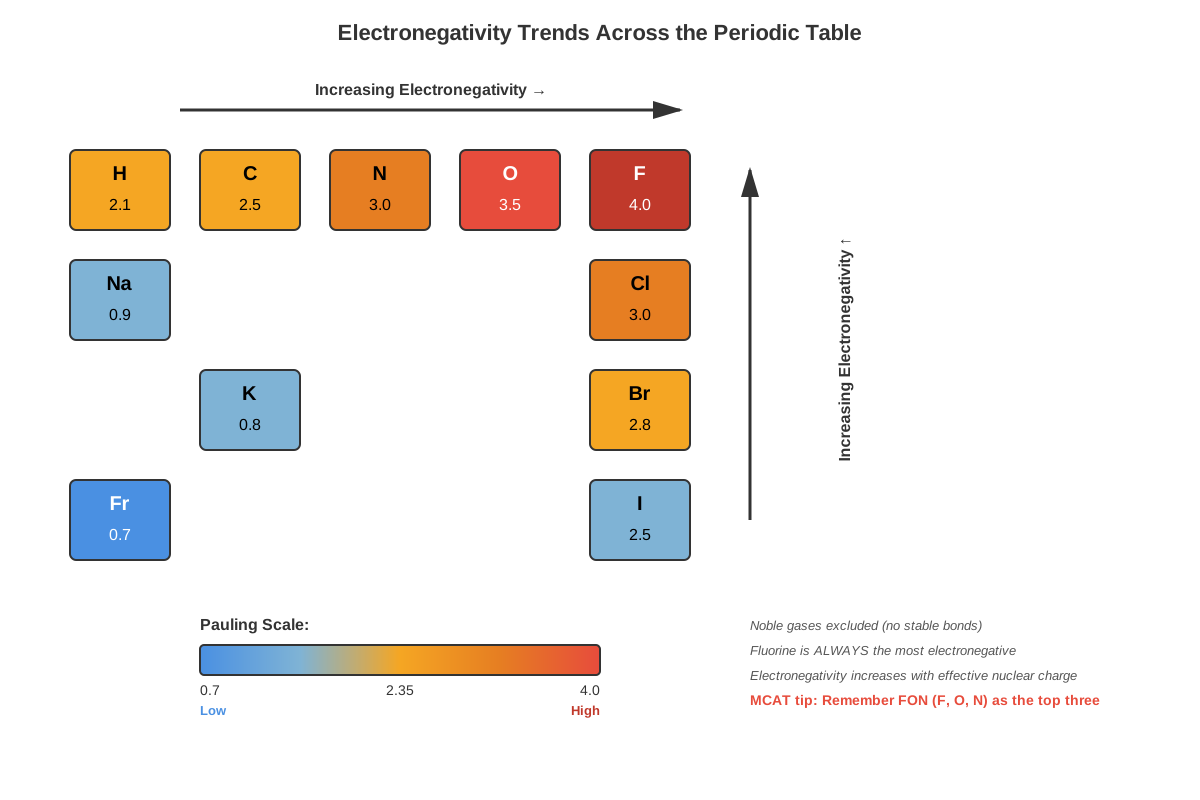
Electronegativity exhibits predictable patterns across the periodic table that mirror other atomic properties. Across a period (left to right), electronegativity increases because effective nuclear charge increases while atomic radius decreases. Electrons in the same shell experience greater nuclear attraction with minimal additional shielding, making atoms more effective at attracting bonding electrons. For example, carbon (2.55) < nitrogen (3.04) < oxygen (3.44) < fluorine (3.98) demonstrates this clear increasing trend.
Down a group (top to bottom), electronegativity decreases because atomic radius increases and additional electron shells provide greater shielding. Although nuclear charge increases down a group, the bonding electrons are farther from the nucleus and experience less net attractive force. The halogen group illustrates this trend: fluorine (3.98) > chlorine (3.16) > bromine (2.96) > iodine (2.66). These trends create a diagonal relationship where electronegativity is highest in the upper right corner of the periodic table (excluding noble gases) and lowest in the lower left corner.
| Element | Electronegativity | Position |
|---|---|---|
| Fluorine (F) | 3.98 | Highest |
| Oxygen (O) | 3.44 | Second highest |
| Nitrogen (N) | 3.04 | Third highest |
| Chlorine (Cl) | 3.16 | High |
| Carbon (C) | 2.55 | Moderate |
| Hydrogen (H) | 2.20 | Moderate |
| Sodium (Na) | 0.93 | Low |
| Cesium (Cs) | 0.79 | Among lowest |
Electronegativity and Bond Character
The difference in electronegativity between two bonded atoms (Δχ) determines the bond's character and polarity. This relationship provides a quantitative framework for classifying bonds:
- Nonpolar covalent bonds: Δχ < 0.5 (electrons shared equally or nearly equally)
- Polar covalent bonds: 0.5 ≤ Δχ < 1.7 (unequal electron sharing, partial charges develop)
- Ionic bonds: Δχ ≥ 1.7 (electron transfer, full charges develop)
These cutoffs are approximate guidelines rather than absolute rules. For example, a C-H bond (Δχ = 0.35) is considered nonpolar for most purposes, while an O-H bond (Δχ = 1.24) is distinctly polar. The H-F bond (Δχ = 1.78) sits near the ionic boundary but is typically classified as highly polar covalent because complete electron transfer does not occur.
Partial Charges and Dipole Moments
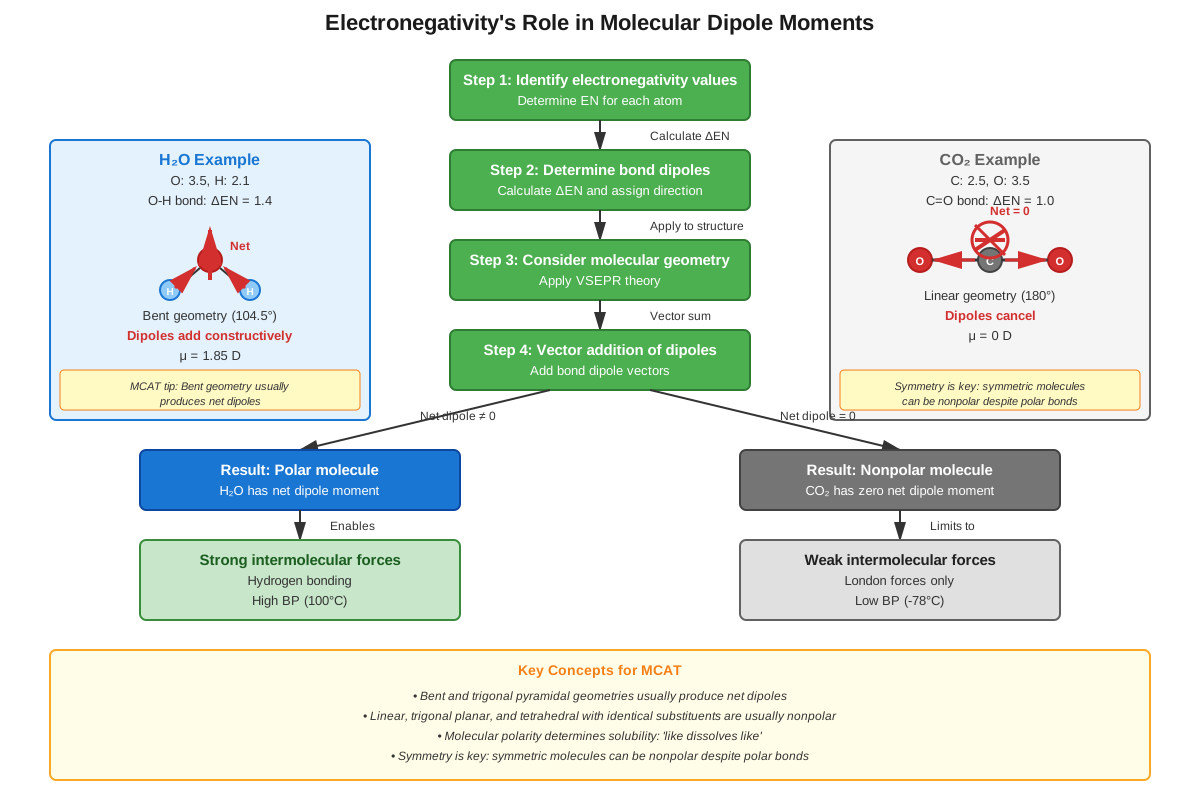
When atoms with different electronegativities form bonds, the more electronegative atom acquires a partial negative charge (δ-) while the less electronegative atom acquires a partial positive charge (δ+). These partial charges are smaller in magnitude than full ionic charges but significantly influence molecular properties. The separation of partial charges creates a bond dipole, represented by an arrow pointing from δ+ to δ- (or a crossed arrow with the cross at the positive end).
The dipole moment (μ) quantifies this charge separation and is calculated as the product of charge magnitude and distance of separation (μ = q × d). Dipole moments are measured in Debye units (D), where 1 D = 3.34 × 10⁻³⁰ C·m. For molecules with multiple bonds, individual bond dipoles combine vectorially to produce a net molecular dipole moment. Symmetrical molecules like CO₂ and CCl₄ have zero net dipole despite containing polar bonds because the individual dipoles cancel due to molecular geometry.
Electronegativity and Molecular Properties
Electronegativity differences directly influence several critical molecular properties tested on the MCAT:
- Intermolecular forces: Polar molecules (resulting from electronegativity differences) exhibit dipole-dipole interactions and potentially hydrogen bonding, leading to higher boiling points and melting points compared to nonpolar molecules of similar size
- Solubility: The principle "like dissolves like" reflects electronegativity-driven polarity; polar solvents dissolve polar solutes, while nonpolar solvents dissolve nonpolar solutes
- Reactivity patterns: Atoms with high electronegativity (O, N, halogens) often act as nucleophiles or bases, while atoms with low electronegativity can act as electrophiles
- Acid strength: More electronegative atoms stabilize negative charge better, making their conjugate bases more stable and the corresponding acids stronger
Electronegativity in Organic Chemistry
In organic molecules, electronegativity differences create inductive effects where electron density is pulled through sigma bonds toward more electronegative atoms. This effect decreases with distance but influences reactivity at nearby sites. For example, the electron-withdrawing effect of a carbonyl oxygen (C=O) makes adjacent alpha hydrogens more acidic than typical C-H bonds. Understanding these effects allows prediction of reaction mechanisms, including nucleophilic substitution and elimination reactions.
Resonance structures are also influenced by electronegativity. When drawing resonance forms, negative formal charges are more stable on more electronegative atoms, while positive formal charges are more stable on less electronegative atoms. This principle helps identify major versus minor resonance contributors, which is essential for predicting reactivity and spectroscopic properties.
Electronegativity and Oxidation States
Electronegativity provides a systematic method for assigning oxidation states in compounds. By convention, the more electronegative atom in a bond is assigned the bonding electrons when calculating oxidation numbers. For example, in H₂O, oxygen (more electronegative) is assigned both bonding electrons from each O-H bond, giving it an oxidation state of -2, while hydrogen is assigned an oxidation state of +1. This connection between electronegativity and oxidation states is crucial for balancing redox reactions and understanding electron flow in biological systems like the electron transport chain.
Concept Relationships
Electronegativity serves as a central hub connecting multiple General Chemistry concepts. It emerges from fundamental atomic properties: effective nuclear charge (Zeff) determines how strongly the nucleus attracts electrons → atomic radius affects the distance over which this attraction operates → electron shielding modulates the net force experienced by valence electrons → these factors combine to produce electronegativity values.
Moving forward from electronegativity, the concept enables prediction of bond polarity → which determines molecular dipole moments → which influence intermolecular forces (dipole-dipole, hydrogen bonding) → which ultimately determine physical properties like boiling point, melting point, and solubility. This chain of reasoning appears frequently in MCAT passages that require students to explain macroscopic observations based on molecular-level properties.
Electronegativity also connects laterally to other periodic trends. It correlates positively with ionization energy (both increase across periods and decrease down groups) because both reflect nuclear attraction for electrons. It relates inversely to atomic radius (as radius decreases, electronegativity increases). Understanding these parallel trends allows students to answer questions even when specific electronegativity values are not provided.
In the context of chemical reactions, electronegativity links to acid-base chemistry through the stability of charged species, to redox chemistry through oxidation state assignments, and to organic reaction mechanisms through identification of nucleophilic and electrophilic sites. This integrative nature makes electronegativity a high-efficiency study topic—mastering it provides tools for multiple question types.
Quick check — test yourself on Electronegativity so far.
Try Flashcards →High-Yield Facts
⭐ Fluorine is the most electronegative element (3.98), followed by oxygen (3.44), nitrogen (3.04), and chlorine (3.16)
⭐ Electronegativity increases across a period (left to right) and decreases down a group (top to bottom)
⭐ A bond is considered polar covalent when the electronegativity difference (Δχ) is between 0.5 and 1.7
⭐ The more electronegative atom in a polar bond bears a partial negative charge (δ-) and attracts electron density
⭐ Hydrogen bonding requires H bonded to N, O, or F—the three most electronegative elements that create sufficiently polar bonds
- Noble gases are typically excluded from electronegativity discussions because they rarely form bonds under normal conditions
- Carbon has an electronegativity of 2.55, making C-H bonds relatively nonpolar (Δχ = 0.35)
- Electronegativity is a relative property, not an absolute measurable quantity like ionization energy or electron affinity
- The Pauling scale is the most common, but other scales (Mulliken, Allred-Rochow) exist and may give slightly different values
- Metals generally have low electronegativity (< 2.0), while nonmetals have high electronegativity (> 2.5)
- Electronegativity differences explain why HCl is a strong acid (Cl stabilizes the negative charge) while HI is even stronger (larger I⁻ distributes charge over greater volume)
- In organic chemistry, electron-withdrawing groups (EWGs) contain highly electronegative atoms that pull electron density through bonds
- The electronegativity of an atom can vary slightly depending on its hybridization state (sp > sp² > sp³) due to s-character differences
Common Misconceptions
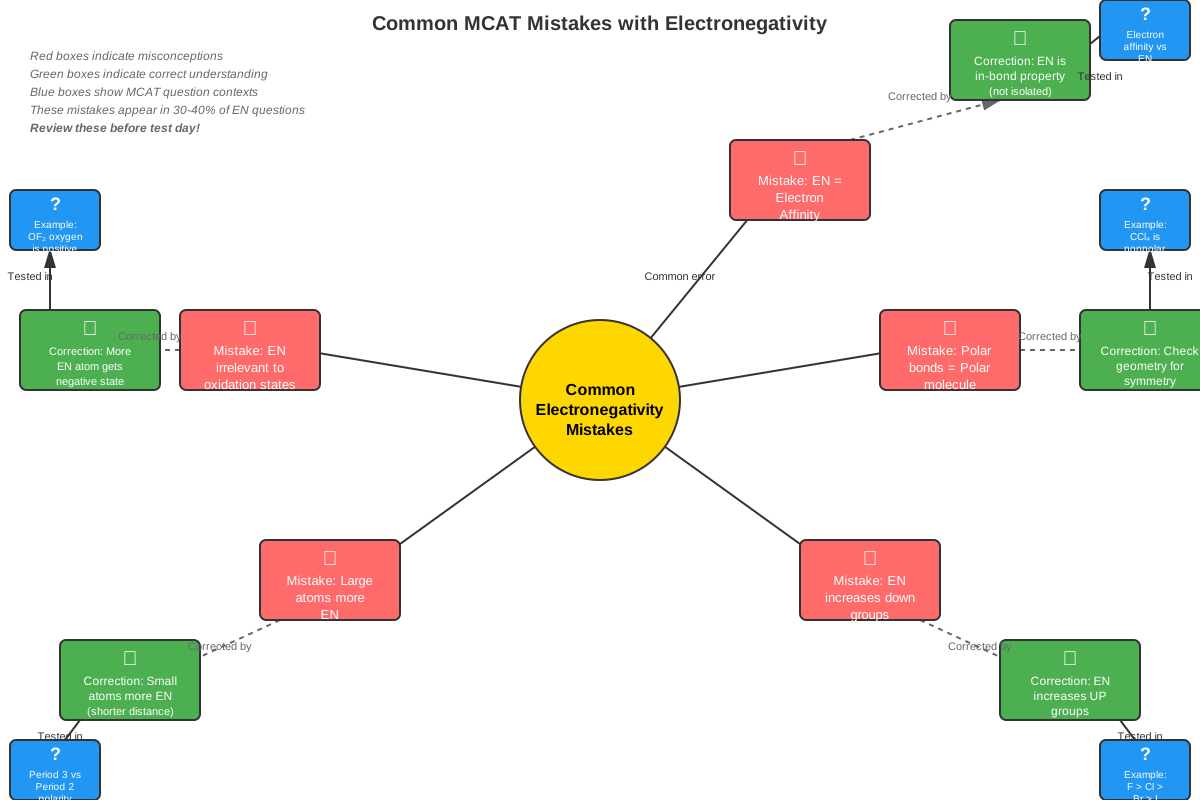
Misconception: Electronegativity and electron affinity are the same property.
Correction: Electron affinity measures the energy change when an isolated atom gains an electron (a measurable thermodynamic quantity), while electronegativity describes the tendency to attract bonding electrons in a molecule (a relative, calculated property). An atom can have high electronegativity but low or even negative electron affinity.
Misconception: All bonds with electronegativity differences are ionic.
Correction: Only bonds with Δχ ≥ 1.7 are typically classified as ionic. Most bonds with electronegativity differences are polar covalent, meaning electrons are shared unequally but not completely transferred. For example, the H-Cl bond (Δχ = 0.96) is polar covalent, not ionic.
Misconception: Hydrogen always carries a partial positive charge in compounds.
Correction: Hydrogen carries a partial positive charge only when bonded to more electronegative elements (C, N, O, F, etc.). When bonded to less electronegative elements like metals in hydrides (NaH, CaH₂), hydrogen is more electronegative and carries a partial negative charge, functioning as H⁻.
Misconception: Larger atoms are always more electronegative because they have more protons.
Correction: Electronegativity decreases with increasing atomic size despite increasing nuclear charge because the bonding electrons are farther from the nucleus and experience greater shielding. This is why fluorine (small) is more electronegative than iodine (large) even though iodine has many more protons.
Misconception: Electronegativity determines whether an element will gain or lose electrons to form ions.
Correction: While electronegativity correlates with this tendency, ionization energy and electron affinity are the properties that directly determine ion formation. Electronegativity specifically describes behavior in covalent bonds, not ionic compound formation. However, large electronegativity differences do predict ionic character.
Misconception: A molecule with polar bonds must have a net dipole moment.
Correction: Molecular geometry determines whether individual bond dipoles cancel or reinforce. Linear CO₂ and tetrahedral CCl₄ have polar bonds but zero net dipole due to symmetry. Only asymmetric molecules with polar bonds have net dipole moments.
Worked Examples
Example 1: Predicting Bond Polarity and Partial Charges
Question: Consider the molecule CH₃OH (methanol). Identify all polar bonds, assign partial charges, and predict which hydrogen is most acidic.
Solution:
Step 1: Identify all bonds and their electronegativity differences.
- C-H bonds: Δχ = |2.55 - 2.20| = 0.35 (nonpolar or weakly polar)
- C-O bond: Δχ = |3.44 - 2.55| = 0.89 (polar covalent)
- O-H bond: Δχ = |3.44 - 2.20| = 1.24 (polar covalent)
Step 2: Assign partial charges based on electronegativity.
- In C-H bonds: essentially nonpolar, minimal charge separation
- In C-O bond: oxygen is δ-, carbon is δ+
- In O-H bond: oxygen is δ-, hydrogen is δ+
Step 3: Determine most acidic hydrogen.
The O-H hydrogen is most acidic because:
- The O-H bond is highly polar, making the hydrogen more positive and easier to remove as H⁺
- The resulting conjugate base (CH₃O⁻) is stabilized by oxygen's high electronegativity, which can accommodate negative charge
- The C-H hydrogens are attached to less electronegative carbon and their removal would create an unstable carbanion
Connection to learning objectives: This example demonstrates applying electronegativity to predict molecular properties (bond polarity, acidity) and connects to acid-base chemistry, a related General Chemistry concept.
Example 2: Using Electronegativity to Predict Reaction Sites
Question: In the molecule CH₃CH₂Cl, identify the most likely site for nucleophilic attack and explain your reasoning using electronegativity principles.
Solution:
Step 1: Analyze electronegativity differences.
- Chlorine (3.16) is significantly more electronegative than carbon (2.55)
- Δχ for C-Cl bond = 0.61 (polar covalent)
Step 2: Determine charge distribution.
- The C-Cl bond is polarized with Cl as δ- and C as δ+
- The carbon bonded to chlorine bears a partial positive charge, making it electron-deficient
Step 3: Predict nucleophilic attack site.
A nucleophile (electron-rich species) will attack the electron-deficient carbon bonded to chlorine. This carbon is the electrophilic center because:
- Chlorine's high electronegativity withdraws electron density from carbon
- The resulting partial positive charge attracts electron-rich nucleophiles
- This is the basis for SN1 and SN2 reactions in organic chemistry
Step 4: Consider the leaving group.
Chlorine's high electronegativity also makes it a good leaving group because:
- It can stabilize negative charge after departure (as Cl⁻)
- The C-Cl bond is already polarized, facilitating heterolytic cleavage
Connection to learning objectives: This example shows how electronegativity predicts reactivity patterns in organic molecules, connecting atomic properties to reaction mechanisms—a high-yield integration for MCAT passages involving organic chemistry.
Exam Strategy
When approaching MCAT questions involving electronegativity, begin by identifying whether the question requires qualitative trends or quantitative comparisons. Most MCAT questions focus on trends rather than specific numerical values, so memorizing the electronegativity of every element is unnecessary. Instead, master the relative ordering of common elements: F > O > N ≈ Cl > Br > C ≈ S > H > P > metals.
Trigger words and phrases that signal electronegativity concepts include:
- "Polar bond" or "bond polarity" → calculate or estimate Δχ
- "Partial charge" or "δ+ and δ-" → identify more electronegative atom
- "Dipole moment" → consider both electronegativity differences and molecular geometry
- "Nucleophile" or "electrophile" → use electronegativity to identify electron-rich and electron-poor sites
- "Acid strength" or "base stability" → relate to electronegativity of atoms bearing charge
- "Hydrogen bonding" → requires H bonded to N, O, or F (high electronegativity)
For process-of-elimination strategies, remember that:
- Answer choices suggesting electronegativity increases down a group are incorrect
- Options claiming all bonds with electronegativity differences are ionic are incorrect
- Choices that ignore molecular geometry when discussing dipole moments are likely wrong
- Answers that confuse electronegativity with electron affinity or ionization energy should be eliminated
Time allocation: Discrete questions about electronegativity trends should take 30-45 seconds. Passage-based questions requiring electronegativity as one step in multi-step reasoning should allocate 60-90 seconds. If a question requires drawing Lewis structures and analyzing multiple bonds, budget up to 2 minutes but work efficiently by focusing on the most polar bonds first.
Exam Tip: When a passage provides electronegativity values for unfamiliar elements, immediately note their relative positions. The MCAT may test your ability to apply electronegativity principles to elements you haven't studied in detail, so focus on the logic rather than memorized facts.
Memory Techniques
Mnemonic for most electronegative elements: "Four Old Nurses Clean" represents the order F > O > N > Cl, the four most electronegative elements you must know.
Periodic trend visualization: Picture electronegativity as a mountain range with the peak at fluorine (upper right of periodic table). As you move left or down, you descend the mountain. This visual helps recall that electronegativity decreases in both directions away from fluorine.
Acronym for bond classification: "NPI" = Nonpolar (Δχ < 0.5), Polar (0.5 ≤ Δχ < 1.7), Ionic (Δχ ≥ 1.7). Remember that these cutoffs increase in the same order as the letters appear in the alphabet (N before P before I).
Partial charge assignment trick: Draw an arrow from less electronegative to more electronegative atom. The arrowhead points to δ-, and the tail indicates δ+. This prevents confusion about which atom bears which charge.
Hydrogen bonding memory device: "Never Omit Fluorine" reminds you that hydrogen bonding requires H bonded to N, O, or F—the only elements electronegative enough to create the necessary polarity.
Connecting trends: Remember "EIDE" = Electronegativity and Ionization energy Decrease Exactly together down groups. Both also increase across periods. This parallel helps you check your reasoning—if you predict one trend incorrectly, you've likely predicted the other incorrectly too.
Summary
Electronegativity represents the fundamental ability of an atom to attract shared electrons in a chemical bond, serving as a predictive tool for bond polarity, molecular properties, and chemical reactivity. This dimensionless property follows predictable periodic trends: increasing across periods due to increasing effective nuclear charge and decreasing atomic radius, and decreasing down groups due to increasing atomic radius and electron shielding. The electronegativity difference between bonded atoms determines bond character (nonpolar covalent, polar covalent, or ionic) and creates partial charges that influence molecular dipole moments, intermolecular forces, and reaction mechanisms. For MCAT success, students must master the relative electronegativity ordering of common elements (F > O > N ≈ Cl > Br > C > H), understand how electronegativity differences predict molecular behavior, and recognize connections to acid-base chemistry, organic reaction mechanisms, and biological molecular interactions. The ability to rapidly assess electronegativity relationships enables efficient problem-solving across multiple General Chemistry question types, making this a high-yield topic despite its medium difficulty level.
Key Takeaways
- Electronegativity measures an atom's ability to attract bonding electrons, with fluorine being the most electronegative element (3.98) and cesium among the least electronegative
- Periodic trends show electronegativity increasing left-to-right across periods and decreasing top-to-bottom down groups, creating maximum values in the upper right of the periodic table
- Electronegativity differences (Δχ) classify bonds: nonpolar covalent (< 0.5), polar covalent (0.5-1.7), and ionic (≥ 1.7), with the more electronegative atom bearing partial negative charge
- Molecular dipole moments result from vector addition of individual bond dipoles, requiring consideration of both electronegativity differences and molecular geometry
- Electronegativity connects to multiple high-yield MCAT topics including intermolecular forces, acid-base chemistry, organic reaction mechanisms, and oxidation-reduction reactions
- Understanding electronegativity enables prediction of reactivity patterns, with electron-rich sites (nucleophiles) attacking electron-poor sites (electrophiles) created by electronegativity differences
- The most electronegative elements (N, O, F) form hydrogen bonds when bonded to hydrogen, a critical interaction in biological systems
Related Topics
Bond Polarity and Dipole Moments: Building directly on electronegativity, this topic explores how to calculate molecular dipole moments using vector addition and predict physical properties from polarity. Mastering electronegativity provides the foundation for understanding why molecules like water have high boiling points while similar-sized nonpolar molecules do not.
Intermolecular Forces: Electronegativity-driven polarity determines the types and strengths of intermolecular forces (London dispersion, dipole-dipole, hydrogen bonding). This connection is essential for predicting physical properties and understanding biological membrane structure.
Acid-Base Chemistry: Electronegativity influences acid strength by affecting conjugate base stability—more electronegative atoms better stabilize negative charge. This relationship appears frequently in MCAT passages about organic acids and biological buffers.
Organic Reaction Mechanisms: Electronegativity differences identify nucleophilic and electrophilic sites in molecules, enabling prediction of reaction pathways. This application is crucial for the 25-30% of MCAT General Chemistry questions that involve organic molecules.
Oxidation-Reduction Reactions: Electronegativity provides the basis for assigning oxidation states, which is essential for balancing redox equations and understanding electron transport chains in biochemistry.
Practice CTA
Now that you've mastered the core concepts of electronegativity and its applications, reinforce your understanding by attempting practice questions and flashcards. Focus on questions that require you to predict trends, classify bonds, and connect electronegativity to molecular properties—these represent the most common MCAT question types. Remember that electronegativity is not just a memorization topic but a reasoning tool that will serve you across multiple sections of the exam. Each practice question you complete strengthens your ability to think like a chemist and approach novel scenarios with confidence. Your investment in understanding this foundational concept will pay dividends throughout your MCAT preparation and beyond!
Sign up free to keep reading
Create a free AnvayaPrep account to finish this MCAT guide on Electronegativity — plus flashcards and practice questions.