Overview
Precipitation reactions are a fundamental class of chemical reactions in which two soluble ionic compounds in aqueous solution combine to form an insoluble solid product called a precipitate. These reactions represent a critical intersection of solubility principles, ionic equilibria, and stoichiometric calculations that appear frequently throughout the MCAT General Chemistry section. Understanding precipitation reactions requires mastery of solubility rules, the ability to predict reaction products, and skill in writing complete and net ionic equations—all essential competencies for success on test day.
For the MCAT, precipitation reactions serve as a gateway to understanding more complex equilibrium systems, including solubility product constants (Ksp), common ion effects, and qualitative analysis techniques used in laboratory and clinical settings. The MCAT tests not only the ability to predict whether a precipitate will form but also the capacity to perform quantitative calculations involving limiting reagents, percent yield, and solution stoichiometry. These reactions frequently appear in passage-based questions that integrate multiple chemistry concepts, requiring students to apply solubility rules while simultaneously considering acid-base chemistry, redox reactions, or thermodynamic principles.
Within the broader context of Stoichiometry and Reactions, precipitation reactions exemplify how chemical principles govern real-world phenomena, from kidney stone formation to water purification processes. The topic connects directly to solution chemistry, ionic equilibria, and quantitative analysis—making it an indispensable component of MCAT preparation. Mastery of this topic enables students to tackle complex passage-based questions that require integration of multiple chemistry subdisciplines while demonstrating the practical applications of chemical principles in biological and medical contexts.
Learning Objectives
- [ ] Define precipitation reactions using accurate General Chemistry terminology
- [ ] Explain why precipitation reactions matter for the MCAT
- [ ] Apply precipitation reactions to exam-style questions
- [ ] Identify common mistakes related to precipitation reactions
- [ ] Connect precipitation reactions to related General Chemistry concepts
- [ ] Predict the formation of precipitates using solubility rules and qualitative analysis
- [ ] Write complete molecular, complete ionic, and net ionic equations for precipitation reactions
- [ ] Calculate quantities of precipitates formed using stoichiometric principles and limiting reagent analysis
- [ ] Determine whether a precipitate will form by comparing the reaction quotient (Q) to the solubility product constant (Ksp)
Prerequisites
- Ionic compounds and nomenclature: Essential for identifying the ions present in solution and predicting reaction products
- Molarity and solution concentration calculations: Required for quantitative stoichiometric calculations involving precipitation reactions
- Balancing chemical equations: Fundamental skill needed to write correct precipitation reaction equations
- Basic stoichiometry: Necessary for calculating amounts of reactants consumed and products formed
- Aqueous solution chemistry: Understanding of dissociation and ion behavior in water is critical for predicting precipitation
- Chemical bonding and polarity: Helps explain why certain ionic compounds are soluble while others precipitate
Why This Topic Matters
Precipitation reactions have profound clinical and real-world significance that extends far beyond the chemistry laboratory. In medicine, precipitation reactions explain the formation of kidney stones (calcium oxalate or calcium phosphate precipitates), gallstones, and atherosclerotic plaques. Understanding these reactions is essential for developing therapeutic strategies to prevent or dissolve pathological precipitates. In diagnostic medicine, precipitation reactions form the basis of many qualitative analysis techniques, including immunoprecipitation assays and certain drug screening tests. Water treatment facilities rely on precipitation reactions to remove heavy metals and other contaminants, while pharmaceutical manufacturing uses controlled precipitation to purify drug compounds.
On the MCAT, precipitation reactions appear with moderate to high frequency, typically in 2-4 questions per exam either as discrete questions or embedded within passage-based scenarios. The Chemical and Physical Foundations of Biological Systems section commonly presents passages describing experimental procedures involving precipitation, requiring students to predict products, calculate yields, or explain observations. Questions may appear as straightforward solubility rule applications or as complex multi-step problems integrating equilibrium constants, Le Chatelier's principle, and quantitative analysis. The MCAT particularly favors questions that test the ability to write net ionic equations and identify spectator ions—skills that distinguish high-scoring students from average performers.
Common exam presentations include: (1) experimental passages describing qualitative analysis schemes for identifying unknown ions, (2) biochemistry passages involving protein precipitation or crystallization, (3) environmental chemistry scenarios addressing water quality and heavy metal removal, and (4) physiological passages exploring mineral homeostasis and pathological calcification. The MCAT frequently combines precipitation reactions with acid-base chemistry, asking students to predict how pH changes affect precipitate formation or dissolution—a particularly high-yield integration point.
Core Concepts
Definition and Fundamental Principles
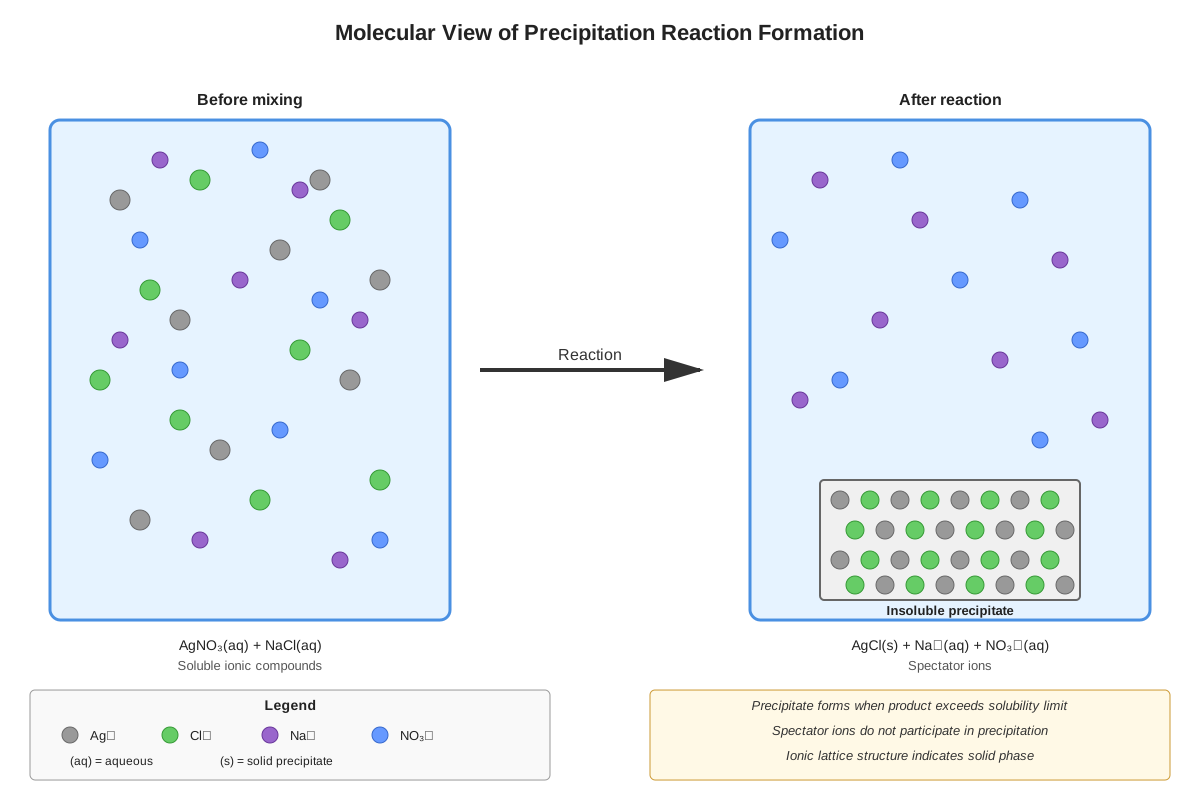
A precipitation reaction occurs when two aqueous solutions containing dissolved ions are mixed, and the combination of a cation from one solution with an anion from the other produces an insoluble ionic compound that separates from solution as a solid precipitate. These reactions are also called double displacement reactions or metathesis reactions because the cations and anions exchange partners. The general form of a precipitation reaction can be represented as:
AX(aq) + BY(aq) → AY(s) + BX(aq)where AY represents the insoluble precipitate (indicated by the solid state symbol "s") and BX remains dissolved in solution. The driving force for precipitation reactions is the formation of a stable ionic lattice with sufficiently strong electrostatic attractions that the compound's lattice energy exceeds the hydration energy of the separated ions.
Solubility Rules and Predictions
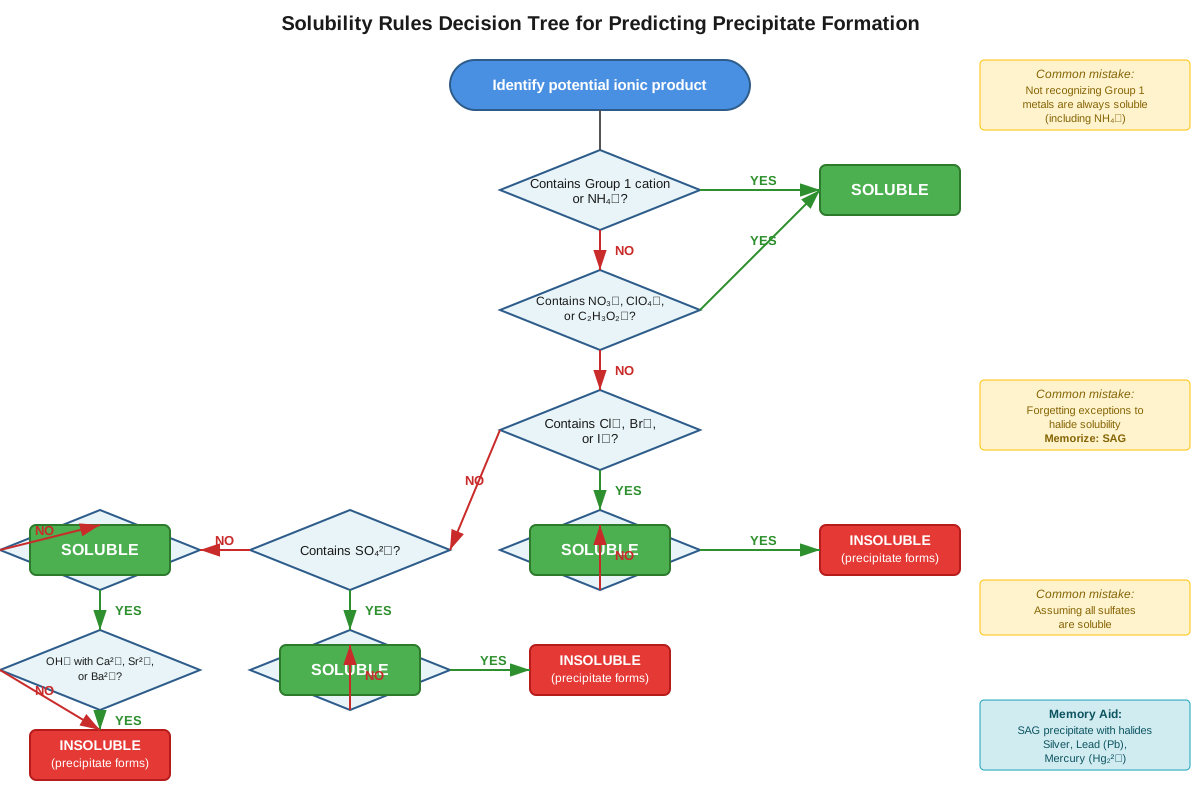
The ability to predict whether a precipitate will form requires mastery of solubility rules—empirical guidelines that indicate which ionic compounds are soluble in water and which are insoluble. These rules represent the most high-yield content for MCAT questions on precipitation reactions:
| Ion/Compound Type | Solubility | Important Exceptions |
|---|---|---|
| Group 1 (Li⁺, Na⁺, K⁺, etc.) and NH₄⁺ | Soluble | None |
| Nitrates (NO₃⁻), acetates (C₂H₃O₂⁻), perchlorates (ClO₄⁻) | Soluble | None |
| Chlorides (Cl⁻), bromides (Br⁻), iodides (I⁻) | Soluble | Ag⁺, Pb²⁺, Hg₂²⁺ |
| Sulfates (SO₄²⁻) | Soluble | Ca²⁺, Sr²⁺, Ba²⁺, Pb²⁺ |
| Carbonates (CO₃²⁻), phosphates (PO₄³⁻), sulfides (S²⁻) | Insoluble | Group 1 cations and NH₄⁺ |
| Hydroxides (OH⁻) | Insoluble | Group 1 cations, Ca²⁺, Sr²⁺, Ba²⁺ |
To predict precipitation, follow this systematic approach:
- Identify all ions present in the mixed solution
- Determine all possible cation-anion combinations
- Apply solubility rules to each potential product
- If any combination produces an insoluble compound, a precipitate forms
Writing Chemical Equations for Precipitation Reactions
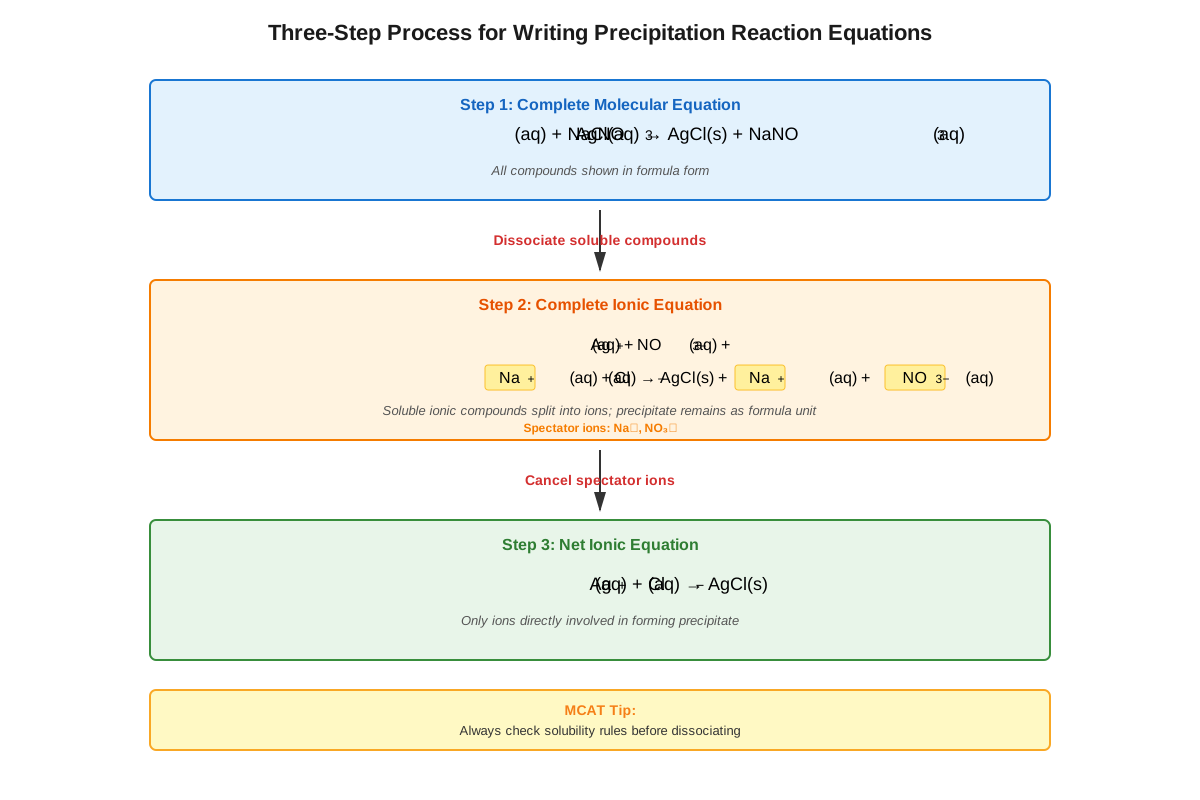
The MCAT requires proficiency in writing three types of equations for precipitation reactions:
Complete Molecular Equation: Shows all reactants and products as complete formulas, including spectator ions:
AgNO₃(aq) + NaCl(aq) → AgCl(s) + NaNO₃(aq)Complete Ionic Equation: Shows all soluble ionic compounds as separated ions:
Ag⁺(aq) + NO₃⁻(aq) + Na⁺(aq) + Cl⁻(aq) → AgCl(s) + Na⁺(aq) + NO₃⁻(aq)Net Ionic Equation: Shows only the species that actually participate in the reaction, eliminating spectator ions (ions that appear unchanged on both sides):
Ag⁺(aq) + Cl⁻(aq) → AgCl(s)The net ionic equation represents the essence of the precipitation reaction and is the most commonly requested format on the MCAT. Spectator ions (Na⁺ and NO₃⁻ in this example) do not participate in the actual precipitation process and can be canceled from both sides of the complete ionic equation.
Stoichiometric Calculations in Precipitation Reactions
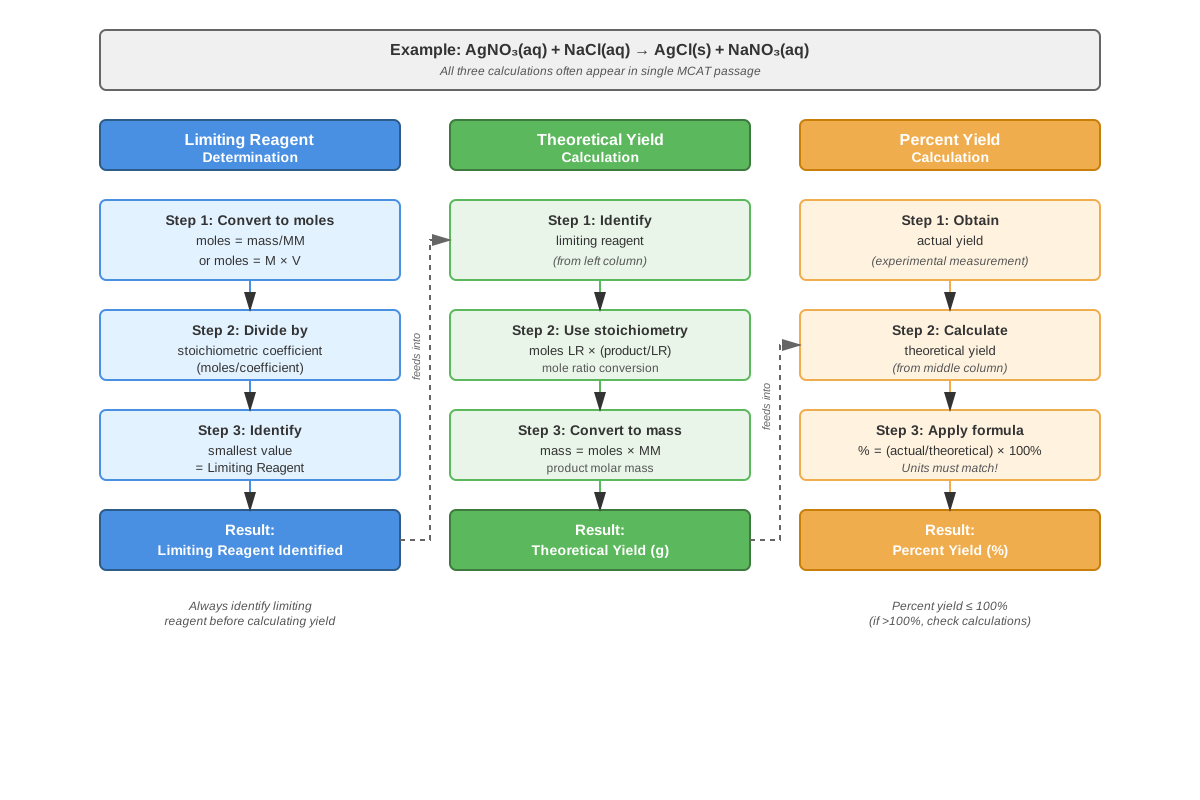
Quantitative problems involving precipitation reactions require application of standard stoichiometric principles within the context of solution chemistry. The general approach involves:
- Write the balanced equation for the precipitation reaction
- Convert solution volumes and concentrations to moles using molarity (M = mol/L)
- Identify the limiting reagent by comparing mole ratios to stoichiometric coefficients
- Calculate moles of precipitate formed based on the limiting reagent
- Convert to mass using the molar mass of the precipitate
For example, when 50.0 mL of 0.200 M Pb(NO₃)₂ is mixed with 30.0 mL of 0.300 M KI:
Pb(NO₃)₂(aq) + 2KI(aq) → PbI₂(s) + 2KNO₃(aq)Moles of Pb²⁺ = 0.0500 L × 0.200 mol/L = 0.0100 mol
Moles of I⁻ = 0.0300 L × 0.300 mol/L = 0.00900 mol
Since the reaction requires 2 moles of I⁻ per mole of Pb²⁺, and we have 0.00900 mol I⁻ (which would require only 0.00450 mol Pb²⁺), iodide is the limiting reagent. The maximum moles of PbI₂ that can form is 0.00450 mol.
Solubility Product Constant (Ksp) and Precipitation
The solubility product constant (Ksp) provides a quantitative measure of a compound's solubility and enables precise prediction of precipitation. For a generic salt MₐXᵦ that dissociates as:
MₐXᵦ(s) ⇌ aM^n+(aq) + bX^m-(aq)The Ksp expression is:
Ksp = [M^n+]^a[X^m-]^bTo predict whether precipitation will occur when solutions are mixed, calculate the reaction quotient (Q) using the same expression as Ksp but with initial ion concentrations:
- If Q < Ksp: Solution is unsaturated; no precipitate forms
- If Q = Ksp: Solution is saturated; at equilibrium
- If Q > Ksp: Solution is supersaturated; precipitate forms until Q = Ksp
This quantitative approach is particularly important for MCAT passages involving buffer systems, common ion effects, or complex equilibria where simple solubility rules are insufficient.
Common Ion Effect and Precipitation
The common ion effect describes how the presence of an ion already in solution affects the solubility of a precipitate containing that ion. Adding a common ion shifts the dissolution equilibrium toward the solid precipitate, decreasing solubility according to Le Chatelier's principle. This concept frequently appears in MCAT questions involving buffer systems or sequential precipitation procedures.
For example, the solubility of AgCl decreases significantly in a solution already containing Cl⁻ ions compared to pure water. If Ksp for AgCl is 1.8 × 10⁻¹⁰, adding NaCl to increase [Cl⁻] forces the equilibrium:
AgCl(s) ⇌ Ag⁺(aq) + Cl⁻(aq)to shift left, reducing [Ag⁺] and causing more AgCl to precipitate.
Concept Relationships
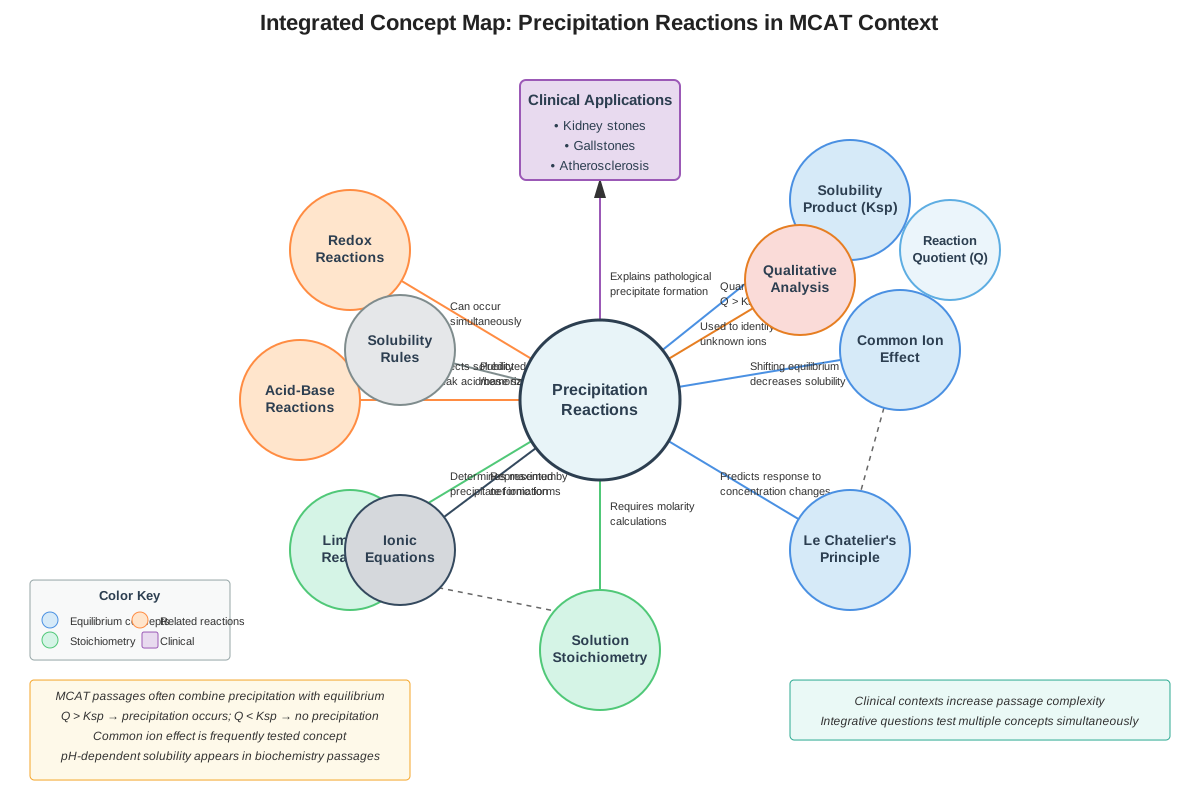
The concepts within precipitation reactions form an interconnected web of chemical principles. Solubility rules serve as the foundation, enabling prediction of which ionic combinations will form precipitates. These rules connect directly to ionic equation writing, as identifying the precipitate determines which ions are removed from solution and which remain as spectators. The ability to write net ionic equations then feeds into stoichiometric calculations, where the balanced equation provides mole ratios needed for quantitative analysis.
Stoichiometry connects to limiting reagent analysis, which determines the maximum amount of precipitate that can form—a critical skill for MCAT calculation questions. This quantitative approach extends to Ksp calculations, where the solubility product constant provides a more precise, thermodynamic basis for predicting precipitation beyond simple solubility rules. The common ion effect represents an application of both Ksp principles and Le Chatelier's principle, demonstrating how equilibrium concepts govern precipitation behavior.
The relationship map flows as: Solubility Rules → Product Prediction → Ionic Equations → Stoichiometric Calculations → Limiting Reagent Analysis → Ksp and Q Comparison → Common Ion Effect → Equilibrium Shifts. Each concept builds upon previous knowledge while enabling more sophisticated analysis of precipitation phenomena.
Connections to prerequisite topics include: molarity (required for all solution stoichiometry), ionic bonding (explains why certain compounds precipitate based on lattice energy), and chemical equilibrium (provides the theoretical framework for Ksp). Related topics that build on precipitation reactions include acid-base titrations (which may involve precipitation endpoints), complex ion formation (which can prevent precipitation), and electrochemistry (where precipitation reactions may occur at electrodes).
High-Yield Facts
⭐ All nitrates (NO₃⁻), acetates (C₂H₃O₂⁻), and compounds containing Group 1 cations or NH₄⁺ are soluble in water
⭐ Most chlorides, bromides, and iodides are soluble except those of Ag⁺, Pb²⁺, and Hg₂²⁺
⭐ Most sulfates are soluble except those of Ca²⁺, Sr²⁺, Ba²⁺, and Pb²⁺
⭐ Most carbonates, phosphates, sulfides, and hydroxides are insoluble except those with Group 1 cations or NH₄⁺
⭐ The net ionic equation includes only species that undergo chemical change; spectator ions are eliminated
- A precipitate forms when Q > Ksp, where Q is calculated using initial ion concentrations
- The common ion effect decreases the solubility of a precipitate by shifting equilibrium toward the solid phase
- In stoichiometric calculations, the limiting reagent determines the maximum amount of precipitate formed
- Silver halides (AgCl, AgBr, AgI) are classic precipitates used in qualitative analysis and photography
- Calcium oxalate (CaC₂O₄) and calcium phosphate [Ca₃(PO₄)₂] are the primary components of kidney stones
- Precipitation reactions are driven by the formation of a stable ionic lattice with high lattice energy
- The solubility of most ionic compounds increases with temperature, but some (like Ca(OH)₂) decrease
- Selective precipitation can separate ions by carefully controlling the concentration of the precipitating agent
- Washing a precipitate with cold solvent minimizes product loss due to dissolution
Quick check — test yourself on Precipitation reactions so far.
Try Flashcards →Common Misconceptions
Misconception: All ionic compounds dissolve in water because water is a polar solvent.
Correction: While water's polarity enables it to dissolve many ionic compounds through hydration, compounds with very high lattice energies (strong ionic bonds) remain insoluble because the energy required to separate the ions exceeds the hydration energy released. Solubility depends on the balance between lattice energy and hydration energy.
Misconception: Spectator ions participate in precipitation reactions and should appear in net ionic equations.
Correction: Spectator ions remain unchanged throughout the reaction, appearing identically on both sides of the complete ionic equation. They do not participate in the actual precipitation process and must be eliminated when writing net ionic equations. Only ions that form the precipitate appear in the net ionic equation.
Misconception: If a precipitate forms, all of the limiting reagent is consumed and removed from solution.
Correction: Even "insoluble" precipitates have some finite solubility described by Ksp. A small amount of the precipitate remains dissolved at equilibrium, meaning trace amounts of the ions persist in solution. The term "insoluble" is relative, not absolute.
Misconception: Adding more of either reactant will always increase the amount of precipitate formed.
Correction: Only adding more of the limiting reagent will increase precipitate formation. Adding excess reagent beyond what is needed to react with the limiting reagent will not produce additional precipitate—it will simply increase the concentration of spectator ions or unreacted excess reagent.
Misconception: Precipitation reactions are irreversible and cannot be reversed once a solid forms.
Correction: Precipitation reactions are equilibrium processes described by Ksp. Precipitates can dissolve if conditions change (dilution, temperature change, pH adjustment, or addition of complexing agents). Many precipitates can be redissolved by altering solution conditions to make Q < Ksp.
Misconception: The solubility rules have no exceptions and can be applied mechanically without considering chemical context.
Correction: While solubility rules are highly useful generalizations, they have important exceptions (like the insolubility of AgCl despite most chlorides being soluble) and may not apply in extreme conditions of pH, temperature, or in the presence of complexing agents. Understanding the underlying principles of lattice energy and hydration energy provides better predictive power than memorizing rules alone.
Worked Examples
Example 1: Predicting Precipitation and Writing Equations
Question: When aqueous solutions of calcium chloride (CaCl₂) and sodium carbonate (Na₂CO₃) are mixed, will a precipitate form? If so, write the complete molecular, complete ionic, and net ionic equations.
Solution:
Step 1: Identify all ions present in solution
- From CaCl₂: Ca²⁺ and Cl⁻
- From Na₂CO₃: Na⁺ and CO₃²⁻
Step 2: Determine possible products by exchanging partners
- CaCO₃ (calcium carbonate)
- NaCl (sodium chloride)
Step 3: Apply solubility rules
- CaCO₃: Carbonates are generally insoluble except with Group 1 cations and NH₄⁺. Since Ca²⁺ is a Group 2 cation, CaCO₃ is insoluble → precipitate forms
- NaCl: Contains Na⁺ (Group 1), so it is soluble
Step 4: Write equations
Complete molecular equation:
CaCl₂(aq) + Na₂CO₃(aq) → CaCO₃(s) + 2NaCl(aq)Complete ionic equation:
Ca²⁺(aq) + 2Cl⁻(aq) + 2Na⁺(aq) + CO₃²⁻(aq) → CaCO₃(s) + 2Na⁺(aq) + 2Cl⁻(aq)Net ionic equation (eliminating Na⁺ and Cl⁻ spectator ions):
Ca²⁺(aq) + CO₃²⁻(aq) → CaCO₃(s)Key Insight: This reaction demonstrates a classic precipitation of a carbonate salt, relevant to biological systems where calcium carbonate forms in shells, bones, and pathological calcifications.
Example 2: Quantitative Stoichiometry with Limiting Reagent
Question: A student mixes 25.0 mL of 0.150 M lead(II) nitrate [Pb(NO₃)₂] with 40.0 mL of 0.100 M potassium iodide (KI). Calculate: (a) the mass of precipitate formed, and (b) the concentration of excess reagent remaining in solution after precipitation is complete. (Molar mass of PbI₂ = 461 g/mol)
Solution:
Step 1: Write the balanced equation
Pb(NO₃)₂(aq) + 2KI(aq) → PbI₂(s) + 2KNO₃(aq)Step 2: Calculate initial moles of each reactant
Moles of Pb²⁺:
n = M × V = 0.150 mol/L × 0.0250 L = 0.00375 molMoles of I⁻:
n = M × V = 0.100 mol/L × 0.0400 L = 0.00400 molStep 3: Identify the limiting reagent
From stoichiometry, 1 mol Pb²⁺ requires 2 mol I⁻
Moles of I⁻ needed for 0.00375 mol Pb²⁺:
0.00375 mol Pb²⁺ × (2 mol I⁻/1 mol Pb²⁺) = 0.00750 mol I⁻Since we only have 0.00400 mol I⁻ available, iodide is the limiting reagent.
Step 4: Calculate moles of PbI₂ formed
From stoichiometry: 2 mol I⁻ produces 1 mol PbI₂
0.00400 mol I⁻ × (1 mol PbI₂/2 mol I⁻) = 0.00200 mol PbI₂Step 5: Convert to mass
mass = n × M = 0.00200 mol × 461 g/mol = 0.922 g PbI₂Answer (a): 0.922 g of PbI₂ precipitate forms
Step 6: Calculate excess Pb²⁺ remaining
Moles of Pb²⁺ consumed:
0.00400 mol I⁻ × (1 mol Pb²⁺/2 mol I⁻) = 0.00200 mol Pb²⁺Moles of Pb²⁺ remaining:
0.00375 mol - 0.00200 mol = 0.00175 molTotal solution volume = 25.0 mL + 40.0 mL = 65.0 mL = 0.0650 L
Concentration of excess Pb²⁺:
M = n/V = 0.00175 mol / 0.0650 L = 0.0269 MAnswer (b): The concentration of excess Pb²⁺ is 0.0269 M (or 26.9 mM)
Key Insight: This problem integrates solution stoichiometry, limiting reagent analysis, and dilution concepts—a common MCAT question format that tests multiple skills simultaneously.
Exam Strategy
When approaching precipitation reactions questions on the MCAT, employ a systematic strategy that maximizes accuracy while minimizing time expenditure. First, quickly scan the question to identify whether it requires qualitative prediction (will a precipitate form?) or quantitative calculation (how much precipitate forms?). This initial categorization determines your approach.
Trigger words and phrases that signal precipitation reaction questions include: "mixing solutions," "insoluble product," "solid forms," "precipitate," "net ionic equation," "spectator ions," "limiting reagent in solution," and "qualitative analysis." Passages describing experimental procedures with phrases like "the solution was filtered" or "a white solid appeared" almost certainly involve precipitation reactions.
For qualitative prediction questions, immediately recall the high-yield solubility rules rather than attempting to reason from first principles under time pressure. The MCAT heavily tests the exceptions to solubility rules (AgCl, BaSO₄, Ca(OH)₂), so pay special attention to these compounds. When writing net ionic equations, a time-saving strategy is to identify the precipitate first, then write only the ions that form it—don't waste time writing out all spectator ions if the question only asks for the net ionic equation.
For quantitative problems, always begin by writing the balanced equation, as this provides the stoichiometric ratios essential for all subsequent calculations. Convert all volumes and concentrations to moles immediately—this standardizes the problem and prevents unit errors. When identifying limiting reagents, use the mole ratio method rather than attempting to calculate "amounts needed" for both reagents, as this reduces calculation steps and potential errors.
Process-of-elimination strategies specific to precipitation reactions include: (1) eliminate answer choices that violate solubility rules, (2) eliminate net ionic equations that include spectator ions, (3) eliminate stoichiometric answers that exceed the theoretical yield based on the limiting reagent, and (4) eliminate Ksp predictions that contradict the direction of Q vs. Ksp comparison.
Time allocation: Allocate approximately 60-90 seconds for straightforward solubility prediction questions, 90-120 seconds for net ionic equation questions, and 2-3 minutes for complex stoichiometric calculations involving limiting reagents. If a calculation becomes overly complex, consider whether estimation or answer choice elimination might be more efficient than completing full calculations.
Exam Tip: When passages provide Ksp values, the question will almost certainly require Q vs. Ksp comparison. Calculate Q immediately using the given concentrations, then compare to Ksp to predict precipitation—this is a high-yield, frequently tested skill.
Memory Techniques
Solubility Rules Mnemonic - "NAG SAG":
- Nitrates, Acetates, and Group 1 salts are always soluble
- Sulfates are Almost all soluble, except Group 2 heavy metals (Ca, Sr, Ba) and Pb
Exception Mnemonic - "Silver Leads to Precipitates":
For halides (Cl⁻, Br⁻, I⁻), remember: Silver (Ag⁺), Lead (Pb²⁺), and Mercury (Hg₂²⁺) form precipitates
Insoluble Compounds Mnemonic - "COPS":
Most Carbonates, Oxides (and hydroxides), Phosphates, and Sulfides are insoluble (except with Group 1 and NH₄⁺)
Net Ionic Equation Strategy - "Only the Changers":
Visualize ions as people at a party. Spectator ions are wallflowers who don't interact—they don't appear in the net ionic equation. Only the ions that "dance together" (form the precipitate) appear in the net ionic equation.
Ksp vs. Q Decision Tree:
Visualize a balance scale:
- Q < Ksp: Scale tips toward "dissolved" (no precipitate)
- Q = Ksp: Scale balanced (equilibrium)
- Q > Ksp: Scale tips toward "solid" (precipitate forms)
Limiting Reagent Visualization:
Imagine making sandwiches: if you have 10 slices of bread but only 3 slices of cheese, cheese is limiting. Similarly, convert all reactants to moles and identify which runs out first based on stoichiometric ratios.
Summary
Precipitation reactions represent a critical intersection of solubility principles, ionic equilibria, and stoichiometric calculations essential for MCAT success. These reactions occur when mixing aqueous solutions produces an insoluble ionic compound that separates as a solid precipitate, driven by favorable lattice energy formation. Mastery requires fluency with solubility rules—particularly the high-yield exceptions involving silver, lead, and barium compounds—and the ability to write complete molecular, complete ionic, and net ionic equations by identifying and eliminating spectator ions. Quantitative problems demand integration of solution stoichiometry, limiting reagent analysis, and molarity calculations to determine precipitate mass and excess reagent concentrations. The solubility product constant (Ksp) provides a thermodynamic framework for predicting precipitation through Q vs. Ksp comparison, while the common ion effect demonstrates how Le Chatelier's principle governs precipitation equilibria. Understanding these concepts enables students to tackle the diverse question formats the MCAT employs, from straightforward solubility predictions to complex passage-based scenarios integrating multiple chemistry subdisciplines in clinically relevant contexts.
Key Takeaways
- Precipitation reactions occur when mixing aqueous ionic solutions produces an insoluble product, predicted using solubility rules with critical exceptions for Ag⁺, Pb²⁺, Ba²⁺, and Ca²⁺ compounds
- Net ionic equations show only species undergoing chemical change, eliminating spectator ions that appear unchanged on both sides of the complete ionic equation
- Quantitative precipitation problems require identifying the limiting reagent through mole ratio analysis, which determines the maximum amount of precipitate formed
- A precipitate forms when the reaction quotient Q exceeds the solubility product constant Ksp, providing a quantitative prediction method beyond simple solubility rules
- The common ion effect decreases precipitate solubility by shifting equilibrium toward the solid phase according to Le Chatelier's principle
- High-yield solubility rules: all nitrates, acetates, Group 1 salts, and NH₄⁺ salts are soluble; most carbonates, phosphates, sulfides, and hydroxides are insoluble
- MCAT questions frequently integrate precipitation reactions with acid-base chemistry, equilibrium concepts, and clinical scenarios involving kidney stones, water purification, or qualitative analysis
Related Topics
Solubility Equilibria and Ksp: Builds directly on precipitation reactions by providing quantitative treatment of dissolution equilibria, enabling precise solubility calculations and predictions of precipitation under varying conditions. Mastering precipitation reactions provides the conceptual foundation for understanding how Ksp values govern solubility phenomena.
Common Ion Effect and Buffer Systems: Extends precipitation concepts to acid-base equilibria, demonstrating how the presence of common ions affects both precipitate solubility and pH buffering capacity. Understanding precipitation reactions enables comprehension of how buffers resist pH changes through equilibrium shifts.
Complex Ion Formation: Explores how certain metal ions form soluble complexes with ligands, preventing precipitation that would otherwise occur based on solubility rules. This topic explains why some "insoluble" compounds dissolve in the presence of complexing agents like ammonia or EDTA.
Qualitative Analysis and Separation Techniques: Applies precipitation reactions to systematic identification of unknown ions through selective precipitation, a classical analytical chemistry technique with modern applications in environmental monitoring and clinical diagnostics.
Acid-Base Titrations: Integrates precipitation concepts with acid-base chemistry, particularly in titrations where precipitates form at equivalence points or where pH changes affect precipitate solubility through protonation/deprotonation of anions.
Practice CTA
Now that you've mastered the core concepts of precipitation reactions, it's time to solidify your understanding through active practice. Challenge yourself with the accompanying practice questions that mirror actual MCAT question formats, testing your ability to predict precipitate formation, write net ionic equations, and perform stoichiometric calculations under timed conditions. Use the flashcards to drill high-yield solubility rules and exceptions until they become automatic—this fluency will save precious seconds on test day. Remember, the difference between a good score and a great score often comes down to mastery of medium-difficulty topics like precipitation reactions that appear consistently across multiple passages. Your investment in thorough practice now will pay dividends when you encounter these concepts on exam day. You've got this!
Sign up free to keep reading
Create a free AnvayaPrep account to finish this MCAT guide on Precipitation reactions — plus flashcards and practice questions.