Overview
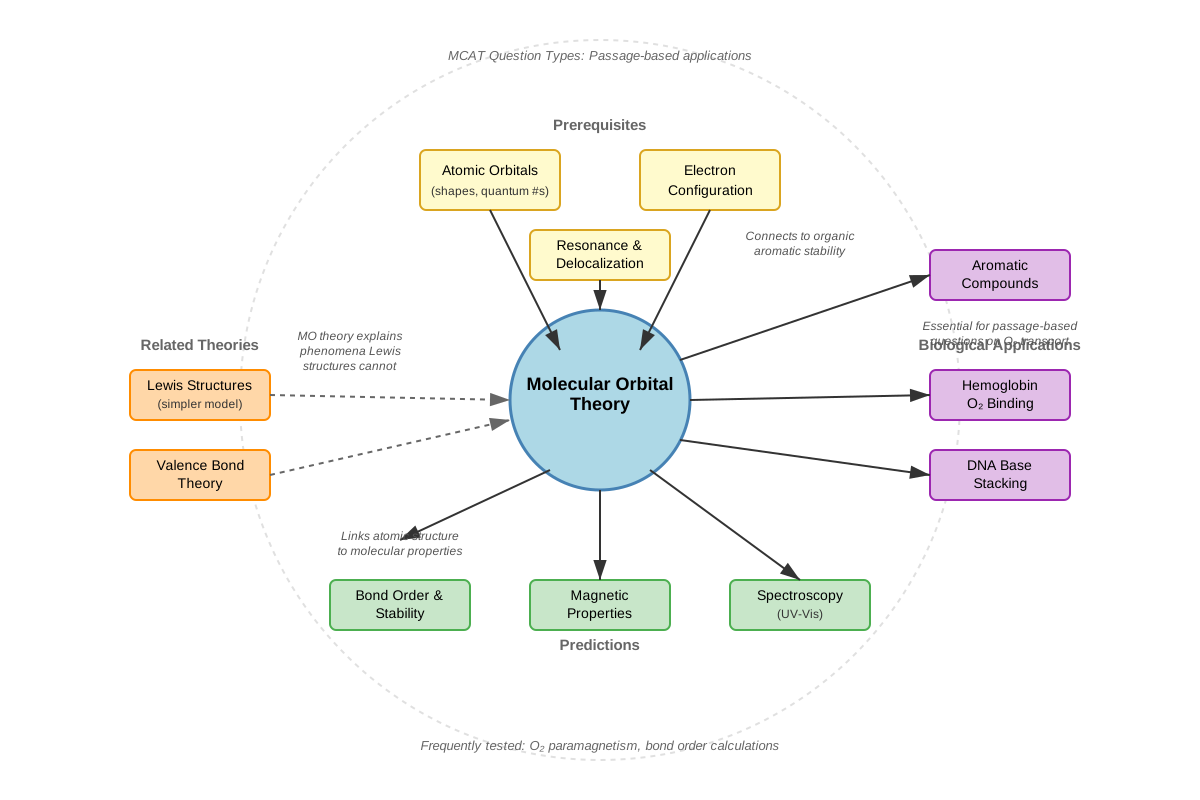
Molecular orbital theory basics represents a fundamental framework in General Chemistry that explains how atoms combine to form molecules through the overlap and combination of atomic orbitals. Unlike simpler bonding models such as Lewis structures or valence bond theory, molecular orbital theory (MO theory) provides a quantum mechanical approach that accounts for the delocalization of electrons across entire molecules rather than confining them to specific bonds or atoms. This theory is essential for understanding magnetic properties, bond order, stability, and reactivity patterns that cannot be adequately explained by other bonding models.
For the MCAT, molecular orbital theory basics serves as a critical bridge between atomic structure and molecular behavior. The exam frequently tests students' ability to predict molecular stability, explain paramagnetism versus diamagnetism, and determine relative bond strengths using MO diagrams. Questions may appear in both passage-based and discrete formats, often requiring students to apply MO theory principles to interpret experimental data or predict molecular properties. Understanding this topic enables test-takers to tackle complex questions about Bonding and Molecular Structure that go beyond simple electron-dot representations.
Within the broader context of General Chemistry MCAT preparation, molecular orbital theory basics connects atomic orbital concepts (s, p, d orbitals and their shapes) to macroscopic molecular properties. It provides the theoretical foundation for understanding resonance, aromaticity, conjugation, and spectroscopic behavior—all topics that appear throughout the Chemical and Physical Foundations of Biological Systems section. Mastery of MO theory basics equips students with a sophisticated lens through which to analyze chemical bonding in both simple diatomic molecules and more complex organic and inorganic systems encountered in biological contexts.
Learning Objectives
- [ ] Define Molecular orbital theory basics using accurate General Chemistry terminology
- [ ] Explain why Molecular orbital theory basics matters for the MCAT
- [ ] Apply Molecular orbital theory basics to exam-style questions
- [ ] Identify common mistakes related to Molecular orbital theory basics
- [ ] Connect Molecular orbital theory basics to related General Chemistry concepts
- [ ] Construct and interpret molecular orbital diagrams for homonuclear diatomic molecules
- [ ] Predict magnetic properties (paramagnetic vs. diamagnetic) using electron configurations in molecular orbitals
- [ ] Calculate bond order from molecular orbital diagrams and relate it to bond strength and stability
- [ ] Distinguish between bonding, antibonding, and nonbonding molecular orbitals and their effects on molecular stability
Prerequisites
- Atomic orbital shapes and quantum numbers: Understanding s, p, d orbital geometries is essential because molecular orbitals form from the combination of atomic orbitals
- Electron configuration and Hund's rule: Filling molecular orbitals follows the same principles as filling atomic orbitals, including aufbau principle and Hund's rule
- Basic bonding concepts (Lewis structures, bond order): MO theory provides a more sophisticated explanation for phenomena that Lewis structures introduce conceptually
- Electromagnetic spectrum and energy levels: The energy differences between molecular orbitals relate to spectroscopic transitions and molecular stability
Why This Topic Matters
Molecular orbital theory basics has significant real-world applications in understanding biological molecules and drug interactions. The delocalization of electrons in aromatic rings (explained by MO theory) is crucial for the stability and function of DNA bases, amino acids like phenylalanine and tryptophan, and numerous pharmaceutical compounds. Hemoglobin's ability to bind oxygen reversibly depends on the molecular orbital interactions between iron and oxygen, making MO theory directly relevant to understanding respiratory physiology. Additionally, the paramagnetic properties of oxygen (O₂) explained by MO theory are essential for MRI technology and understanding oxygen's reactivity in biological systems.
On the MCAT, molecular orbital theory appears with medium frequency but high impact. Approximately 2-4 questions per exam directly or indirectly test MO theory concepts, typically appearing in the Chemical and Physical Foundations section. Questions commonly ask students to: (1) predict whether a molecule is paramagnetic or diamagnetic based on its electron configuration, (2) compare bond strengths using bond order calculations, (3) explain why certain molecules are more stable than others, or (4) interpret experimental data (such as magnetic susceptibility measurements) using MO theory principles. The topic frequently appears in passage-based questions where students must apply MO concepts to novel molecular systems or experimental scenarios.
Common exam presentations include passages describing spectroscopic studies, magnetic property measurements, or bond dissociation energy comparisons. Discrete questions often present molecular orbital diagrams and ask students to identify properties or compare different species (such as O₂, O₂⁺, and O₂⁻). The ability to quickly construct and interpret MO diagrams for simple diatomic molecules represents a high-yield skill that can secure points on otherwise challenging questions.
Core Concepts
Fundamental Principles of Molecular Orbital Theory
Molecular orbital (MO) theory is a quantum mechanical model that describes chemical bonding through the combination of atomic orbitals to form molecular orbitals that extend over the entire molecule. Unlike valence bond theory, which localizes electrons between specific atoms, MO theory treats electrons as delocalized across molecular orbitals that belong to the molecule as a whole. The theory rests on several key principles:
- Linear Combination of Atomic Orbitals (LCAO): Molecular orbitals form through the mathematical combination (addition or subtraction) of atomic orbitals from bonding atoms
- Conservation of orbitals: The number of molecular orbitals formed equals the number of atomic orbitals combined
- Energy ordering: Molecular orbitals have specific energy levels, with electrons filling from lowest to highest energy
- Electron capacity: Each molecular orbital can hold a maximum of two electrons with opposite spins (Pauli exclusion principle)
Bonding and Antibonding Molecular Orbitals
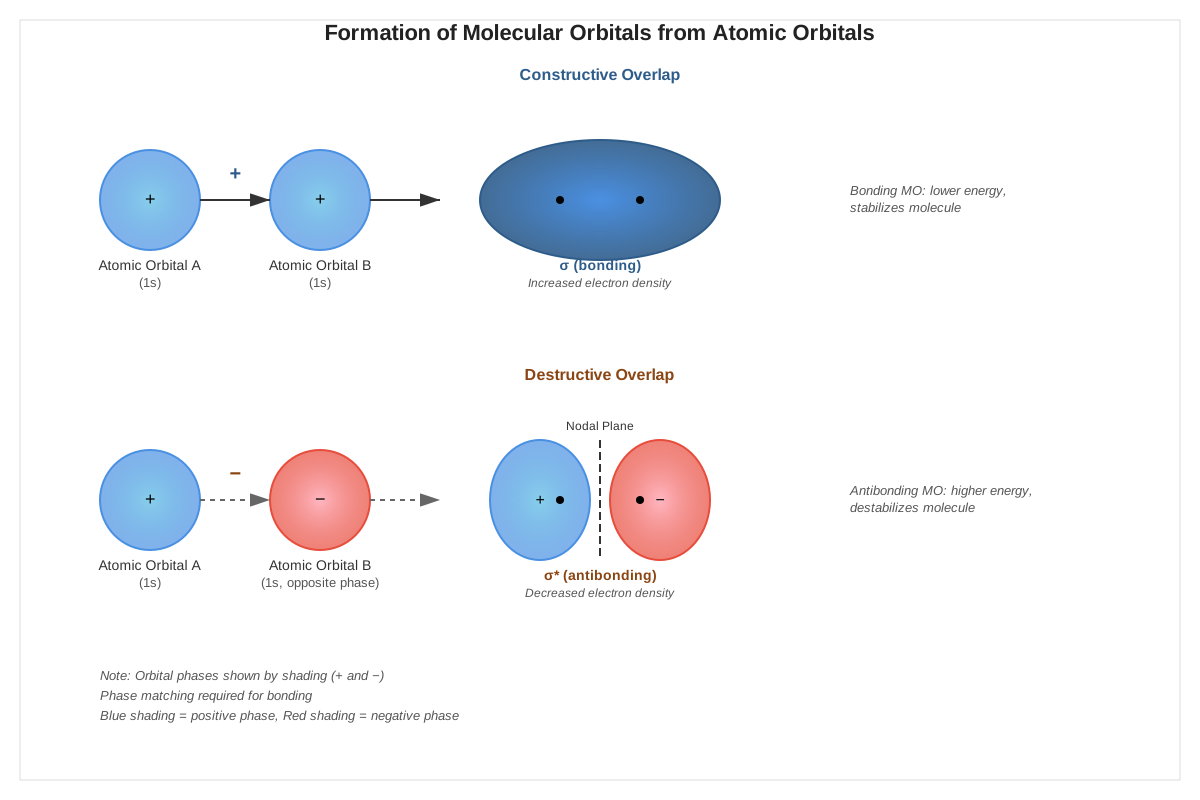
When two atomic orbitals combine, they produce two molecular orbitals: a bonding molecular orbital and an antibonding molecular orbital. The bonding orbital forms from the constructive interference (in-phase combination) of atomic orbital wave functions, resulting in increased electron density between the nuclei. This increased electron density stabilizes the molecule, lowering its energy relative to the separated atoms. Bonding orbitals are designated with the Greek letter sigma (σ) for end-on overlap or pi (π) for side-by-side overlap.
The antibonding orbital results from destructive interference (out-of-phase combination) of atomic orbital wave functions, creating a node (region of zero electron density) between the nuclei. This node reduces electron density between atoms and destabilizes the molecule, raising its energy above that of the separated atomic orbitals. Antibonding orbitals are designated with an asterisk (σ or π) to distinguish them from bonding orbitals.
The energy relationship follows this pattern:
- Antibonding orbital (σ or π): highest energy (destabilizing)
- Atomic orbitals: intermediate energy (reference point)
- Bonding orbital (σ or π): lowest energy (stabilizing)
Molecular Orbital Diagrams for Homonuclear Diatomic Molecules
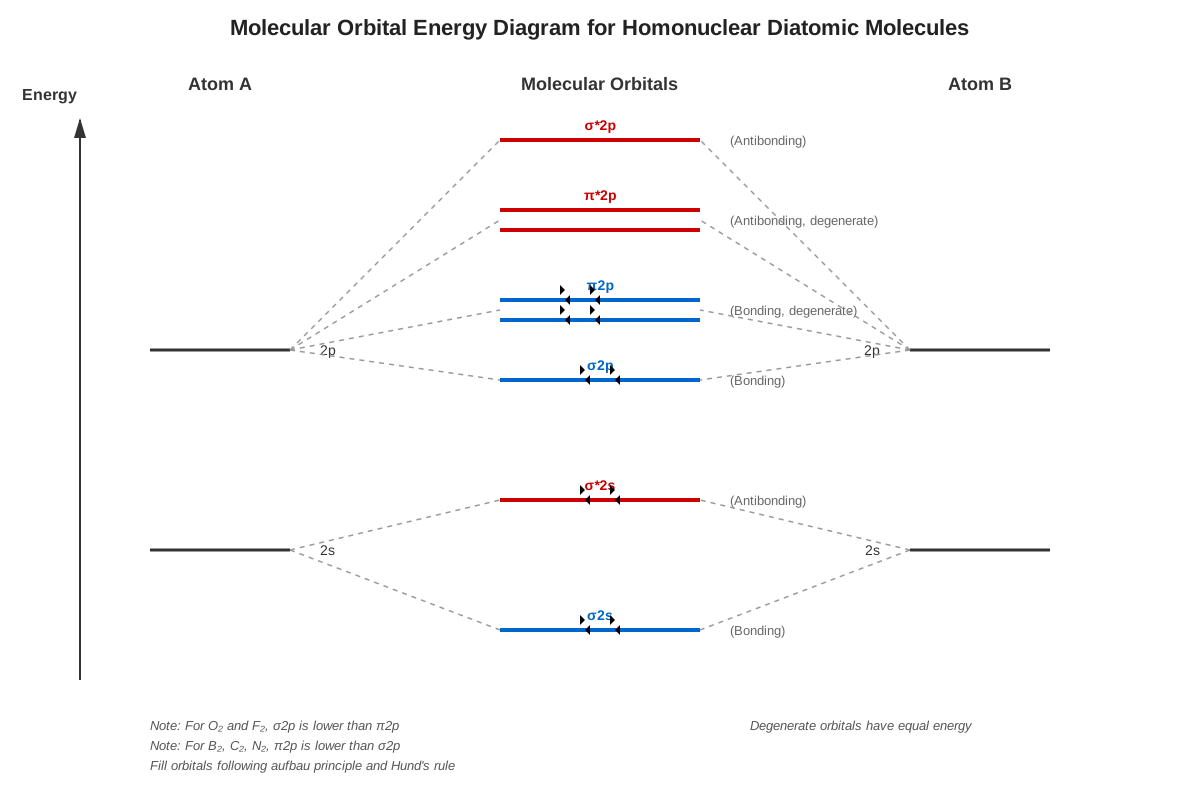
Molecular orbital diagrams provide a visual representation of the relative energies and electron occupancy of molecular orbitals. For homonuclear diatomic molecules (molecules composed of two identical atoms), the diagram shows atomic orbitals on the left and right sides with molecular orbitals in the center.
For second-period elements (Li₂ through Ne₂), the general energy ordering of molecular orbitals is:
For Li₂, Be₂, B₂, C₂, N₂ (elements with Z ≤ 7):
σ2s < σ2s < π2p < σ2p < π2p < σ*2p
For O₂, F₂, Ne₂ (elements with Z ≥ 8):
σ2s < σ2s < σ2p < π2p < π2p < σ*2p
The key difference is that for lighter elements (B₂ through N₂), the π2p orbitals are lower in energy than the σ2p orbital due to s-p mixing. This ordering reverses for O₂ and F₂ where the σ2p drops below the π2p orbitals.
Bond Order Calculation and Interpretation
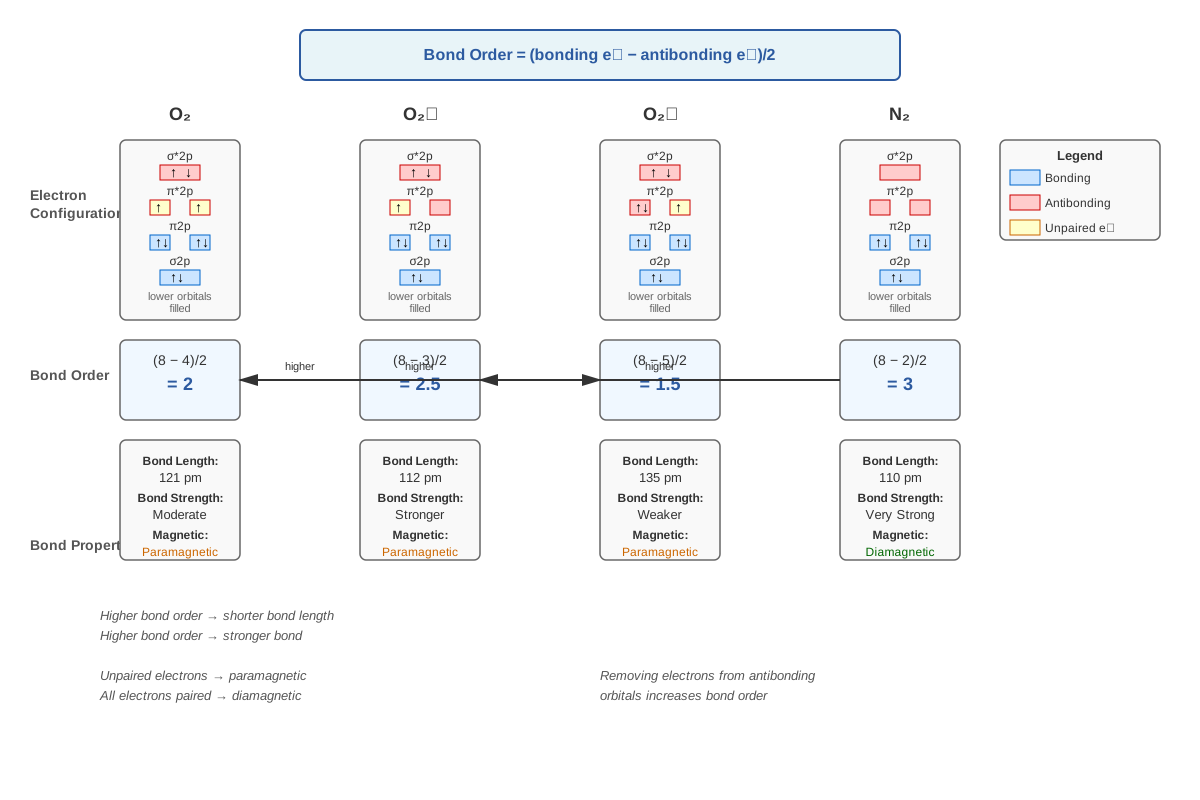
Bond order quantifies the number of chemical bonds between atoms and serves as an indicator of bond strength and stability. The formula for calculating bond order from a molecular orbital diagram is:
Bond Order = (Number of electrons in bonding orbitals - Number of electrons in antibonding orbitals) / 2Interpretation of bond order values:
- Bond order = 0: No bond forms; molecule is unstable
- Bond order = 0.5: Weak bond; molecule may exist but is highly reactive
- Bond order = 1: Single bond
- Bond order = 1.5: Bond intermediate between single and double (as in O₂⁺)
- Bond order = 2: Double bond
- Bond order = 2.5: Bond intermediate between double and triple
- Bond order = 3: Triple bond
Higher bond orders correlate with:
- Shorter bond lengths (atoms pulled closer together)
- Greater bond dissociation energies (stronger bonds require more energy to break)
- Higher vibrational frequencies (stiffer bonds vibrate faster)
Magnetic Properties: Paramagnetism and Diamagnetism
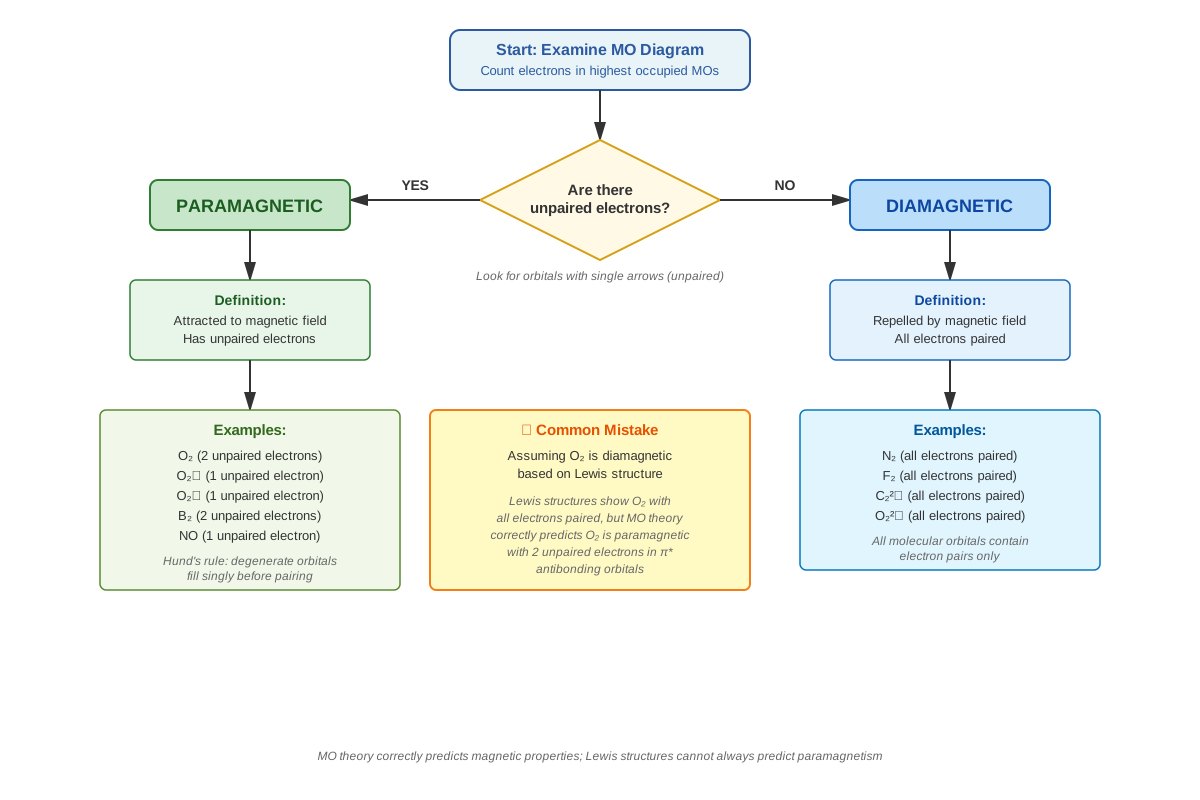
One of the most powerful applications of MO theory is predicting magnetic behavior. Paramagnetic substances contain one or more unpaired electrons and are attracted to magnetic fields. Diamagnetic substances have all electrons paired and are weakly repelled by magnetic fields.
To determine magnetic properties:
- Construct the molecular orbital diagram
- Fill electrons according to aufbau principle and Hund's rule
- Examine the highest occupied molecular orbitals
- If any unpaired electrons exist → paramagnetic
- If all electrons are paired → diamagnetic
Classic MCAT example: O₂ is paramagnetic with two unpaired electrons in the π*2p orbitals, which explains why liquid oxygen is attracted to magnets. This property cannot be explained by Lewis structures, which show all electrons paired in O₂, demonstrating the superiority of MO theory for certain predictions.
Sigma and Pi Molecular Orbitals
Sigma (σ) molecular orbitals result from head-on (end-to-end) overlap of atomic orbitals along the internuclear axis. They exhibit cylindrical symmetry around the bond axis and can form from:
- s + s overlap (σs)
- s + p overlap (σsp)
- p + p overlap along the internuclear axis (σp)
Pi (π) molecular orbitals form from side-by-side overlap of parallel p orbitals perpendicular to the internuclear axis. They have electron density above and below the internuclear axis with a nodal plane containing the bond axis. Pi orbitals are generally higher in energy (less stable) than sigma orbitals formed from the same principal quantum level because side-by-side overlap is less effective than head-on overlap.
Comparison Table: MO Theory vs. Valence Bond Theory
| Feature | Molecular Orbital Theory | Valence Bond Theory |
|---|---|---|
| Electron location | Delocalized over entire molecule | Localized between specific atoms |
| Orbital description | Molecular orbitals from LCAO | Hybrid orbitals and overlap |
| Magnetic properties | Accurately predicts para/diamagnetism | Often fails (e.g., O₂) |
| Resonance | Not needed; inherently accounts for delocalization | Requires resonance structures |
| Complexity | More mathematically complex | Simpler, more intuitive |
| Best applications | Magnetic properties, bond order, stability | Molecular geometry, hybridization |
Concept Relationships
The concepts within molecular orbital theory basics form an interconnected framework. Atomic orbitals serve as the starting point → they combine via LCAO to form bonding and antibonding molecular orbitals → these orbitals are arranged by energy in molecular orbital diagrams → electrons fill these orbitals following quantum mechanical rules → the resulting electron configuration determines bond order (which predicts bond strength and length) and magnetic properties (paramagnetic vs. diamagnetic).
The distinction between sigma and pi orbitals affects the energy ordering in MO diagrams, particularly for second-period diatomic molecules where s-p mixing influences whether π2p or σ2p orbitals are lower in energy. This energy ordering directly impacts electron configuration, which in turn determines both bond order and magnetic behavior.
MO theory basics connects to prerequisite knowledge of atomic structure by building upon orbital shapes, quantum numbers, and electron configuration rules. It extends to more advanced topics including resonance and aromaticity (where MO theory explains electron delocalization in benzene), coordination chemistry (where metal-ligand bonding involves MO interactions), and spectroscopy (where electronic transitions between molecular orbitals produce absorption spectra).
The relationship to Lewis structures and formal charge is complementary: Lewis structures provide quick qualitative predictions of bonding, while MO theory offers quantitative predictions and explains phenomena (like O₂ paramagnetism) that Lewis structures cannot. Understanding both approaches allows students to select the most appropriate model for different types of questions.
High-Yield Facts
⭐ Oxygen (O₂) is paramagnetic with two unpaired electrons in π*2p orbitals and a bond order of 2, explaining its attraction to magnetic fields
⭐ Bond order formula: (bonding electrons - antibonding electrons) / 2; higher bond order means shorter, stronger bonds
⭐ Antibonding orbitals are designated with an asterisk (*) and are higher in energy than bonding orbitals; electrons in antibonding orbitals destabilize molecules
⭐ For B₂ through N₂, the energy ordering places π2p below σ2p due to s-p mixing; for O₂ and F₂, σ2p is below π2p
⭐ Paramagnetic molecules have unpaired electrons and are attracted to magnetic fields; diamagnetic molecules have all paired electrons
- The number of molecular orbitals formed always equals the number of atomic orbitals combined (conservation of orbitals)
- Bonding orbitals have increased electron density between nuclei and lower energy than the original atomic orbitals
- He₂ does not exist as a stable molecule because its bond order is zero (equal numbers of bonding and antibonding electrons)
- N₂ has the highest bond order (3) among second-period homonuclear diatomic molecules, making it extremely stable
- Adding electrons to antibonding orbitals decreases bond order and molecular stability
- Pi bonds are generally weaker than sigma bonds because side-by-side overlap is less effective than head-on overlap
- Removing an electron from O₂ to form O₂⁺ increases bond order from 2 to 2.5, making the ion more stable with a shorter bond length
Quick check — test yourself on Molecular orbital theory basics so far.
Try Flashcards →Common Misconceptions
Misconception: All molecular orbitals are bonding orbitals that stabilize molecules.
Correction: Molecular orbitals include both bonding orbitals (which stabilize molecules by lowering energy) and antibonding orbitals (which destabilize molecules by raising energy). Electrons in antibonding orbitals counteract the stabilizing effect of bonding electrons, which is why bond order subtracts antibonding electrons.
Misconception: Lewis structures and MO theory always predict the same properties for molecules.
Correction: While both models often agree on basic bonding patterns, MO theory correctly predicts properties that Lewis structures cannot, such as the paramagnetism of O₂. Lewis structures show all electrons paired in O₂, incorrectly suggesting diamagnetism, while MO theory correctly shows two unpaired electrons in π*2p orbitals.
Misconception: The energy ordering of molecular orbitals is the same for all diatomic molecules.
Correction: The relative energies of σ2p and π2p orbitals differ between lighter (B₂-N₂) and heavier (O₂-F₂) second-period diatomic molecules due to s-p mixing effects. For B₂ through N₂, π2p is lower in energy than σ2p, but this order reverses for O₂ and F₂.
Misconception: A higher bond order always means a molecule is more stable than one with lower bond order.
Correction: While bond order indicates bond strength between two specific atoms, overall molecular stability depends on multiple factors including total energy, molecular geometry, and electronic configuration. However, comparing similar species (like O₂, O₂⁺, and O₂⁻), higher bond order does correlate with greater stability.
Misconception: Antibonding orbitals should never contain electrons in stable molecules.
Correction: Many stable molecules have electrons in antibonding orbitals (like O₂ with electrons in π*2p). What matters is the net effect: as long as there are more electrons in bonding orbitals than antibonding orbitals (positive bond order), the molecule can be stable.
Misconception: Molecular orbital diagrams are only useful for homonuclear diatomic molecules.
Correction: While MO diagrams are simplest for homonuclear diatomics, the principles extend to heteronuclear diatomic molecules (like CO and NO), polyatomic molecules, and complex systems. The MCAT focuses on homonuclear diatomics, but understanding the broader applicability enriches comprehension.
Misconception: Paramagnetic substances are strongly attracted to magnets like ferromagnetic materials.
Correction: Paramagnetic substances are weakly attracted to magnetic fields, much less strongly than ferromagnetic materials (like iron). The attraction is only noticeable with strong magnetic fields or sensitive equipment, but the principle remains testable on the MCAT.
Worked Examples
Example 1: Determining Magnetic Properties and Bond Order of O₂⁻
Question: The superoxide ion (O₂⁻) is an important reactive oxygen species in biological systems. Using molecular orbital theory, determine: (a) the bond order of O₂⁻, (b) whether it is paramagnetic or diamagnetic, and (c) how its bond length compares to neutral O₂.
Solution:
Step 1: Determine the total number of electrons.
- Each oxygen atom contributes 8 electrons
- The negative charge adds 1 additional electron
- Total electrons = 8 + 8 + 1 = 17 electrons
Step 2: Construct the MO diagram for O₂⁻ (oxygen has Z = 8, so σ2p is below π2p).
Energy ordering: σ2s < σ2s < σ2p < π2p < π2p < σ*2p
Fill 17 electrons:
- σ2s: 2 electrons
- σ*2s: 2 electrons
- σ2p: 2 electrons
- π2p: 4 electrons (2 in each of two degenerate orbitals)
- π*2p: 7 electrons (the 17th electron goes here)
Step 3: Calculate bond order.
- Bonding electrons: 2 (σ2s) + 2 (σ2p) + 4 (π2p) = 8
- Antibonding electrons: 2 (σ2s) + 7 (π2p) = 9
- Bond order = (8 - 9) / 2 = -1/2...
Wait, let me recalculate. For O₂⁻ with 17 electrons:
- π2p gets 5 electrons total (filling continues from O₂ which had 4 in π2p)
Actually, let me restart the filling more carefully:
- σ2s: 2 electrons
- σ*2s: 2 electrons
- σ2p: 2 electrons
- π2p: 4 electrons (completely fills both degenerate π2p orbitals)
- π*2p: 5 electrons (O₂ had 4, adding one more for O₂⁻)
Bonding electrons: 2 + 2 + 4 = 8
Antibonding electrons: 2 + 5 = 7
Bond order = (8 - 7) / 2 = 1.5
Step 4: Determine magnetic properties.
The π2p orbitals contain 5 electrons. With two degenerate π2p orbitals, the filling would be: ↑↓ in one orbital and ↑ in the other (or ↑↓ ↑↓ ↑ across both). This leaves one unpaired electron, making O₂⁻ paramagnetic.
Step 5: Compare bond length to O₂.
- O₂ has bond order = 2
- O₂⁻ has bond order = 1.5
- Lower bond order means weaker, longer bond
- Therefore, O₂⁻ has a longer bond length than O₂
Answer: (a) Bond order = 1.5, (b) Paramagnetic (one unpaired electron), (c) O₂⁻ has a longer bond than O₂.
Example 2: Comparing Stability of Nitrogen Species
Question: Consider N₂, N₂⁺, and N₂⁻. Using MO theory: (a) determine the bond order of each species, (b) rank them in order of increasing bond length, and (c) predict which species would require the most energy to dissociate.
Solution:
Step 1: Determine electron counts.
- N₂: 7 + 7 = 14 electrons
- N₂⁺: 14 - 1 = 13 electrons
- N₂⁻: 14 + 1 = 15 electrons
Step 2: Fill MO diagrams (nitrogen has Z = 7, so π2p is below σ2p).
Energy ordering: σ2s < σ2s < π2p < σ2p < π2p < σ*2p
For N₂ (14 electrons):
- σ2s: 2, σ2s: 2, π2p: 4, σ2p: 2, π2p: 0
- Bonding: 2 + 4 + 2 = 8
- Antibonding: 2 + 0 = 2
- Bond order = (8 - 2) / 2 = 3
For N₂⁺ (13 electrons) - removes one electron from highest occupied orbital (σ2p):
- σ2s: 2, σ2s: 2, π2p: 4, σ2p: 1, π2p: 0
- Bonding: 2 + 4 + 1 = 7
- Antibonding: 2 + 0 = 2
- Bond order = (7 - 2) / 2 = 2.5
For N₂⁻ (15 electrons) - adds one electron to lowest unoccupied orbital (π*2p):
- σ2s: 2, σ2s: 2, π2p: 4, σ2p: 2, π2p: 1
- Bonding: 2 + 4 + 2 = 8
- Antibonding: 2 + 1 = 3
- Bond order = (8 - 3) / 2 = 2.5
Step 3: Rank by bond length.
Higher bond order → shorter bond length
Bond orders: N₂ (3) > N₂⁺ = N₂⁻ (2.5)
Increasing bond length: N₂ < N₂⁺ = N₂⁻
Step 4: Determine dissociation energy.
Higher bond order → stronger bond → more energy required to break
N₂ requires the most energy to dissociate (bond order = 3)
Answer: (a) N₂: bond order 3; N₂⁺: bond order 2.5; N₂⁻: bond order 2.5. (b) Increasing bond length: N₂ < N₂⁺ ≈ N₂⁻. (c) N₂ requires the most dissociation energy due to its triple bond (highest bond order).
Exam Strategy
When approaching MCAT questions on molecular orbital theory basics, follow this systematic approach:
1. Identify the question type: Determine whether the question asks about bond order, magnetic properties, bond length/strength, or stability comparisons. This dictates which MO theory principle to apply.
2. Count electrons carefully: Many errors stem from miscounting total electrons, especially for ions. Always account for charges: add electrons for negative charges, subtract for positive charges.
3. Know the energy ordering switch: Memorize that the π2p/σ2p ordering switches at oxygen. For B₂-N₂, use π2p < σ2p. For O₂-F₂, use σ2p < π2p. This is frequently tested.
4. Use bond order as a universal comparator: Bond order connects to nearly every molecular property. Higher bond order means:
- Shorter bond length
- Greater bond strength
- Higher dissociation energy
- Higher vibrational frequency
5. Check for unpaired electrons systematically: For magnetic property questions, fill the MO diagram completely and examine the highest occupied orbitals. Even one unpaired electron makes the molecule paramagnetic.
Trigger words and phrases to watch for:
- "Attracted to a magnetic field" → paramagnetic → look for unpaired electrons
- "Bond strength" or "dissociation energy" → calculate bond order
- "Stability" → higher bond order generally means more stable
- "Compared to the neutral molecule" → you're comparing ions to their parent molecules
- "Experimental evidence shows..." → often describing magnetic or spectroscopic data that MO theory explains
Process of elimination tips:
- If a question asks about O₂ magnetism, eliminate any answer suggesting it's diamagnetic (common trap)
- For bond order questions, eliminate any answer giving bond order > 3 for second-period diatomics
- If comparing bond lengths, eliminate answers that rank them opposite to bond order ranking
- For stability questions about hypothetical molecules, eliminate any with bond order ≤ 0
Time allocation: MO theory questions typically require 60-90 seconds. If you need to construct a full MO diagram, budget 90 seconds. If you only need to recall a fact (like O₂ being paramagnetic), 30-45 seconds suffices. Don't spend excessive time drawing elaborate diagrams—a quick sketch with electron counts is usually sufficient.
Memory Techniques
Mnemonic for energy ordering (lighter elements, B₂-N₂): "Sally Sells Pi Sigma Pi Sigma"
- σ2s, σ2s, π2p, σ2p, π2p, σ*2p
Mnemonic for energy ordering (heavier elements, O₂-F₂): "Sally Sells Sigma Pi Pi Sigma"
- σ2s, σ2s, σ2p, π2p, π2p, σ*2p
Visualization for bonding vs. antibonding: Picture two waves:
- Bonding: Waves add constructively (peaks align) → electron density builds between nuclei → atoms pulled together → stable
- Antibonding: Waves cancel destructively (peak meets trough) → node between nuclei → atoms pushed apart → unstable
Acronym for bond order effects - "SLEF":
- Shorter bonds (higher bond order)
- Less length (same as shorter)
- Energy higher to break (stronger bonds)
- Frequency higher (vibrational)
Memory aid for O₂ paramagnetism: "Oxygen is Odd" - it has unpaired electrons (odd behavior for a Lewis structure that shows all paired), making it paramagnetic. This is the classic example where MO theory succeeds and Lewis structures fail.
Finger counting for bond order: Use your fingers to track bonding electrons (count up) and antibonding electrons (count down), then divide by 2. This physical action can help prevent calculation errors under test pressure.
Summary
Molecular orbital theory basics provides a quantum mechanical framework for understanding chemical bonding through the combination of atomic orbitals into molecular orbitals that extend across entire molecules. The theory explains bonding through the linear combination of atomic orbitals (LCAO), producing bonding orbitals (lower energy, stabilizing) and antibonding orbitals (higher energy, destabilizing). Bond order, calculated as (bonding electrons - antibonding electrons)/2, predicts bond strength, length, and stability. Higher bond orders correlate with shorter, stronger bonds. The energy ordering of molecular orbitals differs between lighter (B₂-N₂) and heavier (O₂-F₂) second-period diatomic molecules due to s-p mixing effects. MO theory successfully predicts magnetic properties: molecules with unpaired electrons are paramagnetic (attracted to magnetic fields), while those with all paired electrons are diamagnetic. The classic example is O₂, which MO theory correctly predicts as paramagnetic with two unpaired electrons in π*2p orbitals and a bond order of 2. For the MCAT, students must be able to construct molecular orbital diagrams, calculate bond order, predict magnetic properties, and compare molecular stability—skills that appear in both discrete questions and passage-based scenarios throughout the Chemical and Physical Foundations section.
Key Takeaways
- Molecular orbital theory explains bonding through delocalized molecular orbitals formed by combining atomic orbitals, with bonding orbitals stabilizing molecules and antibonding orbitals destabilizing them
- Bond order = (bonding electrons - antibonding electrons) / 2 predicts bond strength, length, and stability; higher bond order means shorter, stronger bonds
- O₂ is paramagnetic with bond order 2 and two unpaired electrons in π*2p orbitals—a key example where MO theory succeeds and Lewis structures fail
- Energy ordering switches at oxygen: for B₂-N₂, π2p < σ2p; for O₂-F₂, σ2p < π2p due to s-p mixing effects
- Paramagnetic molecules have unpaired electrons and are attracted to magnetic fields; diamagnetic molecules have all electrons paired
- Antibonding orbitals (marked with *) are higher in energy than bonding orbitals; electrons in antibonding orbitals reduce bond order and stability
- MO theory connects to MCAT topics including resonance, aromaticity, spectroscopy, and coordination chemistry, making it essential for understanding advanced bonding concepts
Related Topics
Valence Bond Theory and Hybridization: While MO theory treats electrons as delocalized, valence bond theory uses localized bonds and hybrid orbitals to explain molecular geometry. Understanding both approaches provides complementary perspectives on bonding.
Resonance and Delocalization: MO theory provides the theoretical foundation for understanding resonance structures and electron delocalization in molecules like benzene, carboxylate ions, and conjugated systems.
Spectroscopy (UV-Vis, IR): Electronic transitions between molecular orbitals produce absorption spectra. Understanding MO energy levels enables interpretation of spectroscopic data.
Coordination Chemistry and Crystal Field Theory: Metal-ligand bonding in coordination complexes involves molecular orbital interactions between metal d-orbitals and ligand orbitals, extending MO theory principles to inorganic systems.
Aromaticity and Hückel's Rule: The stability of aromatic compounds derives from delocalized π molecular orbitals, making MO theory essential for understanding aromatic systems in organic chemistry.
Mastering molecular orbital theory basics creates a strong foundation for these advanced topics, enabling deeper understanding of chemical bonding throughout the MCAT curriculum.
Practice CTA
Now that you've mastered the fundamentals of molecular orbital theory, it's time to reinforce your understanding through active practice. Attempt the practice questions and flashcards associated with this topic to test your ability to construct MO diagrams, calculate bond orders, and predict molecular properties under timed conditions. Remember, the MCAT rewards not just knowledge but the ability to apply concepts quickly and accurately. Each practice question you complete strengthens your pattern recognition and builds the confidence you need to excel on test day. You've built a solid foundation—now put it to work!
Sign up free to keep reading
Create a free AnvayaPrep account to finish this MCAT guide on Molecular orbital theory basics — plus flashcards and practice questions.