Overview
Pi bonds are a fundamental concept in General Chemistry and represent one of the two types of covalent bonds that form between atoms, alongside sigma bonds. While sigma bonds form through direct head-on overlap of atomic orbitals along the internuclear axis, pi bonds arise from the lateral (side-by-side) overlap of parallel p orbitals. This distinction is critical for understanding molecular geometry, reactivity, and the properties of organic and inorganic compounds that appear frequently on the MCAT.
Understanding pi bonds is essential for mastering Bonding and Molecular Structure, as they directly influence molecular shape, bond strength, and chemical reactivity. Pi bonds are always found in conjunction with sigma bonds in double and triple bonds, never existing independently. This relationship between sigma and pi bonding determines the rigidity of molecular structures, explains why certain molecules can undergo specific reactions, and provides insight into conjugation and resonance—concepts that bridge General Chemistry with Organic Chemistry on the MCAT.
For the MCAT, pi bonds appear in multiple contexts across both the Chemical and Physical Foundations of Biological Systems section and passages involving biochemical structures. Questions may test orbital overlap theory, bond energy comparisons, molecular geometry predictions using VSEPR theory, or the reactivity patterns of unsaturated compounds. A solid grasp of pi bonds General Chemistry principles enables students to quickly analyze molecular structures, predict reaction mechanisms, and understand the behavior of biologically relevant molecules such as fatty acids, amino acids, and nucleotides. This topic serves as a bridge connecting atomic structure, molecular orbital theory, hybridization, and organic reaction mechanisms—all high-yield areas for exam success.
Learning Objectives
- [ ] Define pi bonds using accurate General Chemistry terminology
- [ ] Explain why pi bonds matter for the MCAT
- [ ] Apply pi bonds to exam-style questions
- [ ] Identify common mistakes related to pi bonds
- [ ] Connect pi bonds to related General Chemistry concepts
- [ ] Distinguish between sigma and pi bonds based on orbital overlap characteristics
- [ ] Predict the number of sigma and pi bonds in a given molecular structure
- [ ] Explain how pi bonds influence molecular geometry and rotational freedom
- [ ] Analyze the relative bond strengths and lengths in single, double, and triple bonds
Prerequisites
- Atomic orbitals (s, p, d, f): Understanding orbital shapes and orientations is essential because pi bonds form specifically from p orbital overlap
- Hybridization (sp, sp², sp³): Hybridization determines which orbitals are available for pi bonding versus sigma bonding
- Lewis structures: The ability to draw Lewis structures is necessary to identify multiple bonds and count pi bonds
- VSEPR theory: Molecular geometry predictions depend on understanding how pi bonds affect electron domain geometry
- Electronegativity and bond polarity: These concepts help explain the distribution of electron density in pi bonds
Why This Topic Matters
Pi bonds have significant clinical and real-world relevance, particularly in biochemistry and pharmacology. The presence of pi bonds in unsaturated fatty acids affects membrane fluidity, which is crucial for cellular function. Conjugated pi systems in molecules like retinal (vitamin A derivative) enable vision through light absorption. Many pharmaceutical compounds contain aromatic rings with delocalized pi electrons, and their biological activity often depends on pi-stacking interactions with DNA or proteins.
On the MCAT, pi bonds appear in approximately 5-8% of General Chemistry questions and frequently in Organic Chemistry contexts. Questions typically fall into several categories: identifying the number of sigma and pi bonds in a structure, explaining why certain molecules are planar or rigid, comparing bond strengths and lengths, predicting reactivity based on bond type, and analyzing conjugated systems. Passage-based questions often embed pi bond concepts within discussions of molecular spectroscopy, reaction mechanisms, or biological macromolecules.
Common exam scenarios include: analyzing the structure of lipids and determining saturation levels, explaining why peptide bonds restrict protein folding, interpreting IR spectroscopy data where C=C and C=O stretches indicate pi bonds, predicting which bonds will break first in a reaction based on bond energy, and understanding resonance structures in aromatic compounds. The topic frequently appears in discrete questions testing fundamental bonding theory and in passages requiring application to complex biological or synthetic molecules.
Core Concepts
Definition and Formation of Pi Bonds
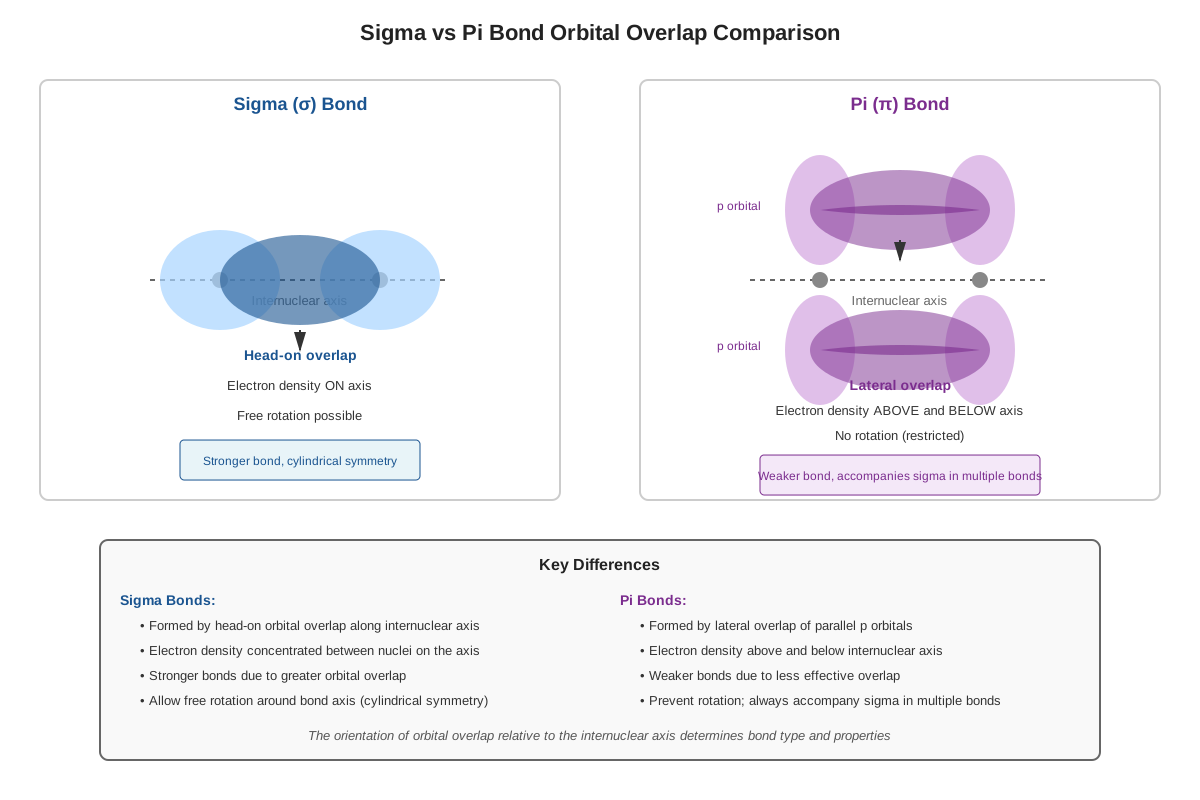
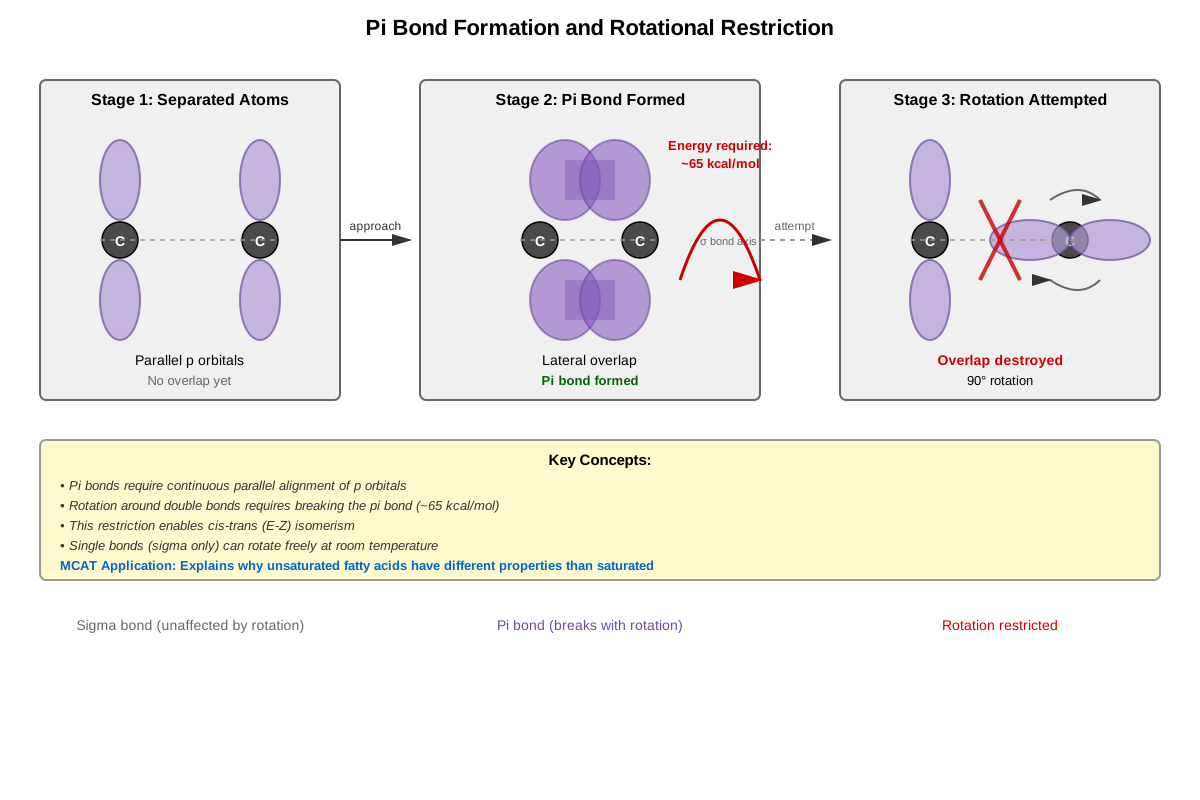
A pi bond (π bond) is a covalent bond formed by the lateral overlap of two parallel p orbitals, with electron density concentrated above and below the internuclear axis rather than along it. Unlike sigma bonds, which allow free rotation, pi bonds restrict rotational movement because rotation would break the orbital overlap. Pi bonds are always accompanied by a sigma bond—they never exist independently between two atoms.
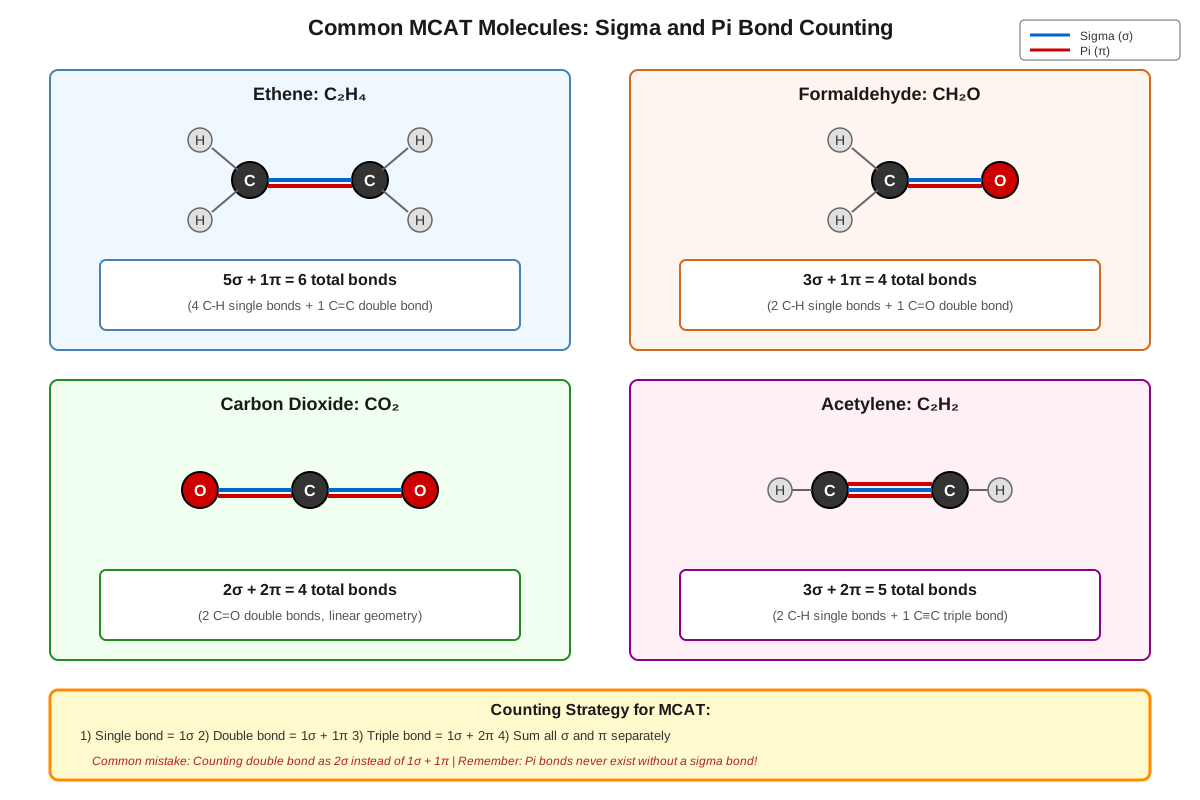
The formation of a pi bond requires that both atoms have unhybridized p orbitals available for bonding. This typically occurs when atoms use sp² or sp hybridization, leaving one or two p orbitals unhybridized. For example, in ethene (C₂H₄), each carbon atom is sp² hybridized, using three sp² hybrid orbitals to form sigma bonds (one C-C sigma bond and two C-H sigma bonds). The remaining unhybridized p orbital on each carbon overlaps laterally to form the pi bond, creating the C=C double bond.
Sigma vs. Pi Bond Comparison
Understanding the distinctions between sigma and pi bonds is crucial for MCAT success:
| Feature | Sigma (σ) Bond | Pi (π) Bond |
|---|---|---|
| Orbital overlap | Head-on (end-to-end) | Lateral (side-by-side) |
| Electron density | Along internuclear axis | Above and below internuclear axis |
| Rotation | Free rotation possible | Restricted rotation |
| Bond strength | Stronger (greater overlap) | Weaker (less overlap) |
| Occurrence | All single bonds; first bond in multiple bonds | Second and third bonds in multiple bonds |
| Orbitals involved | Any (s-s, s-p, p-p, hybrid-hybrid) | Only p orbitals (or d orbitals in advanced cases) |
Multiple Bonds and Pi Bond Count
The relationship between bond order and pi bonds follows a consistent pattern:
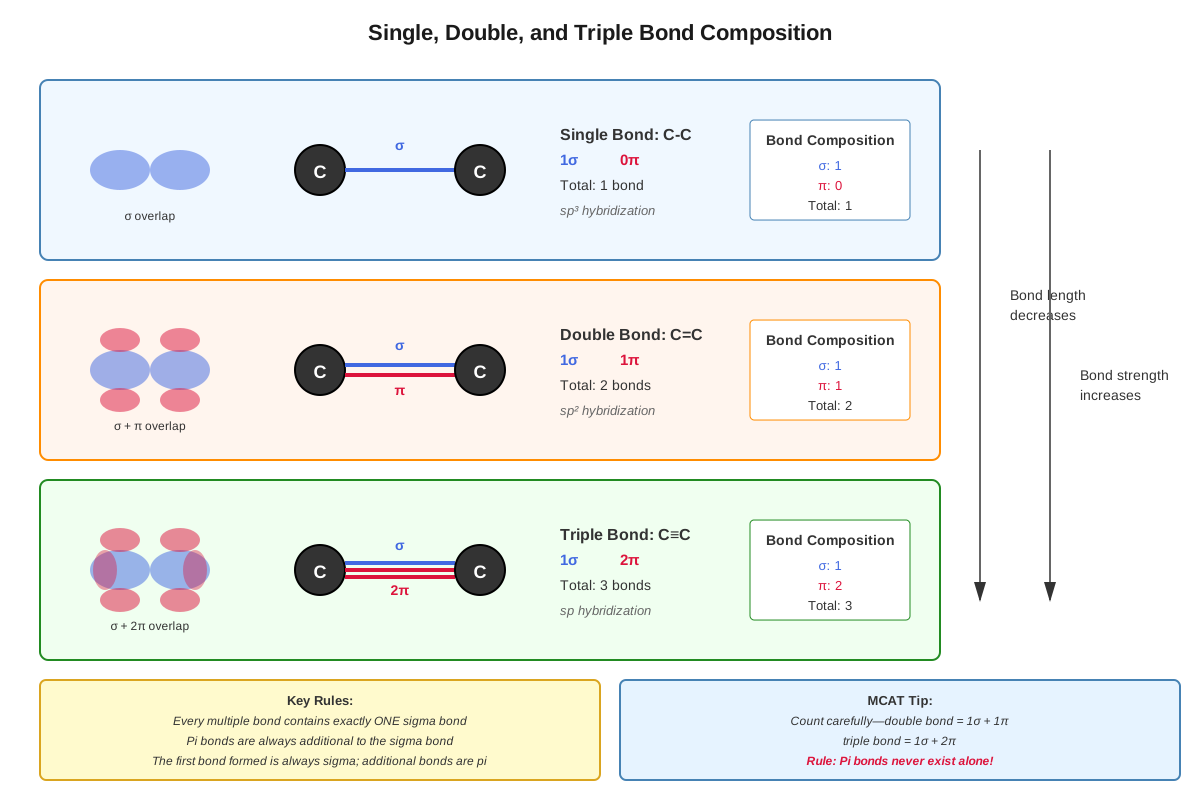
- Single bond: 1 sigma bond, 0 pi bonds
- Double bond: 1 sigma bond, 1 pi bond
- Triple bond: 1 sigma bond, 2 pi bonds
This pattern is invariant regardless of the atoms involved. For example, C=O (carbonyl), C=C (alkene), and N=N (diazene) all contain one sigma and one pi bond. Similarly, C≡C (alkyne), C≡N (nitrile), and N≡N (nitrogen gas) all contain one sigma and two pi bonds.
When counting bonds in complex molecules, systematically identify each bond type. Consider benzene (C₆H₆): each carbon forms three sigma bonds (two C-C and one C-H), and the delocalized pi system contains three pi bonds distributed across the ring structure.
Hybridization and Pi Bond Formation
The hybridization state of an atom directly determines its capacity to form pi bonds:
sp³ hybridization: All four valence orbitals are hybridized, leaving no unhybridized p orbitals. Atoms with sp³ hybridization form only sigma bonds (e.g., methane, CH₄).
sp² hybridization: Three orbitals hybridize, leaving one unhybridized p orbital available for pi bonding. This allows formation of one pi bond (e.g., ethene, C₂H₄, or formaldehyde, CH₂O).
sp hybridization: Two orbitals hybridize, leaving two unhybridized p orbitals available for pi bonding. This allows formation of two pi bonds (e.g., ethyne, C₂H₂, or carbon dioxide, CO₂).
Molecular Geometry and Rigidity
Pi bonds profoundly affect molecular geometry. The presence of a pi bond creates a region of high electron density that restricts rotation around the bond axis. This restriction has several important consequences:
- Geometric isomerism: Molecules with C=C double bonds can exhibit cis-trans (E-Z) isomerism because the groups attached to the double-bonded carbons cannot freely rotate to interchange positions.
- Planar geometry: Atoms involved in double bonds and their immediate neighbors typically lie in the same plane. For sp² hybridized atoms, the three sigma bonds arrange in a trigonal planar geometry (120° bond angles), with the pi bond perpendicular to this plane.
- Linear geometry: For sp hybridized atoms, the two sigma bonds arrange linearly (180° bond angles), with two perpendicular pi bonds.
Bond Strength and Bond Length
Pi bonds are weaker than sigma bonds due to less effective orbital overlap. Typical bond energies:
- C-C sigma bond: ~347 kJ/mol
- C=C pi bond: ~264 kJ/mol (additional energy beyond the sigma bond)
- C≡C second pi bond: ~226 kJ/mol
However, multiple bonds are stronger overall than single bonds because they contain both sigma and pi components. The total bond energy of C≡C (~839 kJ/mol) exceeds that of C=C (~614 kJ/mol), which exceeds C-C (~347 kJ/mol).
Bond length decreases as bond order increases because multiple bonds pull atoms closer together:
- C-C: ~154 pm
- C=C: ~134 pm
- C≡C: ~120 pm
This inverse relationship between bond length and bond strength is a high-yield concept for MCAT questions involving molecular structure and reactivity.
Conjugation and Resonance
When pi bonds alternate with single bonds in a molecule, the pi electrons can delocalize across multiple atoms, creating a conjugated system. This delocalization stabilizes the molecule and affects its properties. For example, 1,3-butadiene (CH₂=CH-CH=CH₂) has conjugated pi bonds that allow electron density to spread across all four carbons, lowering the overall energy compared to isolated double bonds.
Resonance structures represent different possible arrangements of pi electrons in conjugated systems. The actual structure is a hybrid of all resonance forms, with electron density distributed across the entire conjugated system. Benzene exemplifies this with six pi electrons delocalized equally around the ring, creating exceptional stability (aromatic stabilization).
Concept Relationships
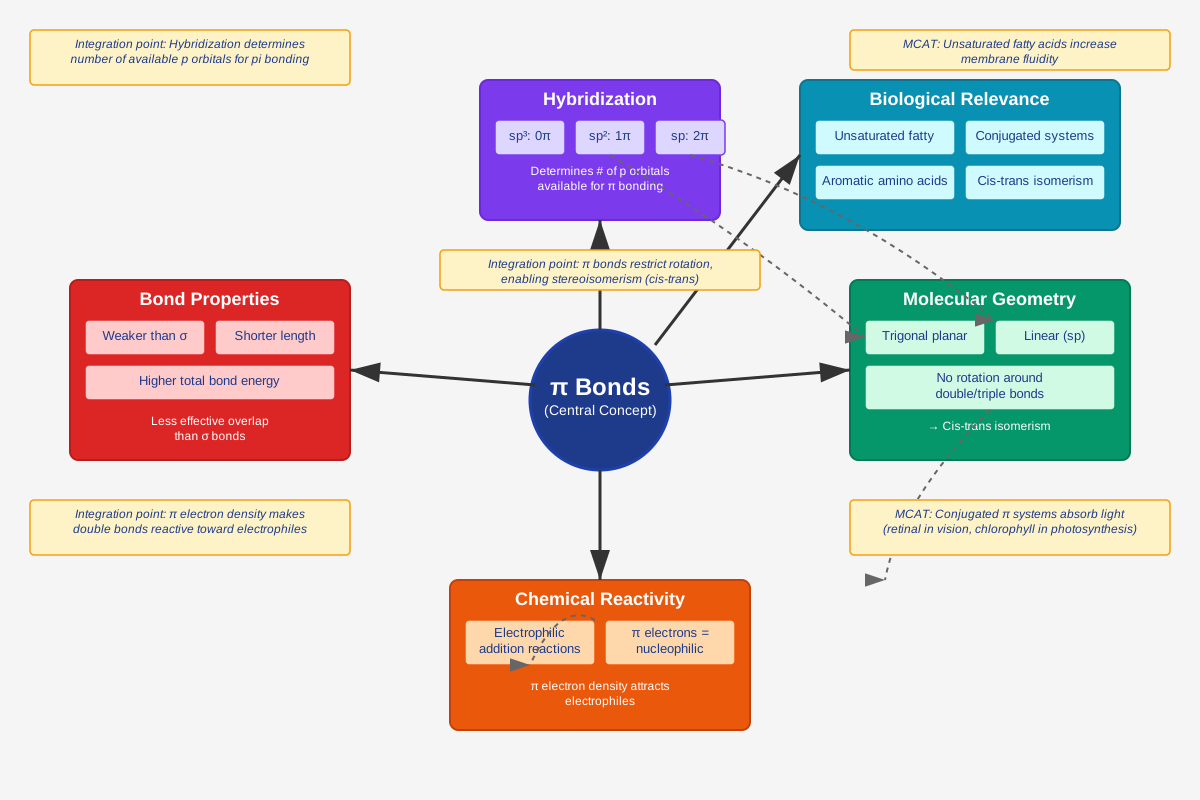
Pi bonds connect to numerous fundamental chemistry concepts in an integrated network. Atomic orbital theory provides the foundation → understanding p orbital shape and orientation enables comprehension of pi bond formation through lateral overlap. Hybridization theory determines which orbitals remain unhybridized → these unhybridized p orbitals become available for pi bonding. The presence of pi bonds directly influences molecular geometry through VSEPR theory → pi electron density creates regions that restrict rotation and enforce planarity.
Lewis structures serve as the starting point for identifying multiple bonds → each multiple bond contains one sigma and one or more pi bonds. The count of pi bonds affects bond strength and bond length → more pi bonds create shorter, stronger overall bonds but individual pi bonds remain weaker than sigma bonds. Conjugated pi systems arise when multiple pi bonds alternate with single bonds → this leads to resonance stabilization and electron delocalization.
These concepts extend into organic chemistry through reaction mechanisms → pi bonds are sites of high electron density and act as nucleophiles, making them reactive toward electrophiles. In biochemistry, pi bonds in unsaturated fatty acids affect membrane fluidity → more double bonds (pi bonds) create kinks that prevent tight packing. The peptide bond contains a pi bond with partial double bond character due to resonance → this restricts rotation and influences protein secondary structure.
Quick check — test yourself on Pi bonds so far.
Try Flashcards →High-Yield Facts
⭐ Pi bonds always occur in conjunction with sigma bonds; they never exist as the only bond between two atoms.
⭐ A double bond contains 1 sigma and 1 pi bond; a triple bond contains 1 sigma and 2 pi bonds.
⭐ Pi bonds form from the lateral overlap of parallel p orbitals, with electron density above and below the internuclear axis.
⭐ Pi bonds restrict rotation around the bond axis, enabling geometric (cis-trans) isomerism in alkenes.
⭐ Pi bonds are weaker than sigma bonds due to less effective orbital overlap (typical pi bond: ~260 kJ/mol vs. sigma bond: ~350 kJ/mol).
- Pi bonds require unhybridized p orbitals, which are available in sp² (one p orbital) and sp (two p orbitals) hybridization
- Bond length decreases with increasing bond order: single > double > triple bonds
- Conjugated pi systems (alternating double and single bonds) allow electron delocalization and provide extra stability
- Aromatic compounds contain delocalized pi electrons in cyclic, planar systems following Hückel's rule (4n+2 pi electrons)
- The presence of pi bonds makes molecules more reactive toward electrophilic addition reactions compared to saturated compounds
- Pi bonds in carbonyl groups (C=O) are polarized due to oxygen's higher electronegativity, creating a partial positive charge on carbon
- Molecules with pi bonds absorb UV-visible light, with conjugated systems absorbing at longer wavelengths
- The peptide bond has partial double bond character (~40%) due to resonance involving the nitrogen lone pair and carbonyl pi bond
Common Misconceptions
Misconception: Pi bonds are stronger than sigma bonds because double bonds are stronger than single bonds.
Correction: Individual pi bonds are weaker than sigma bonds due to less effective lateral overlap compared to head-on overlap. Double bonds are stronger overall because they contain both a sigma bond AND a pi bond, not because the pi bond itself is stronger.
Misconception: Pi bonds can exist independently between two atoms without a sigma bond.
Correction: Pi bonds always accompany sigma bonds. The first bond formed between any two atoms is always a sigma bond because it provides the primary connection along the internuclear axis. Pi bonds only form as additional bonds (second or third) in multiple bond situations.
Misconception: All p orbital overlaps create pi bonds.
Correction: Only lateral (side-by-side) overlap of parallel p orbitals creates pi bonds. When p orbitals overlap head-on (end-to-end), they form sigma bonds. The orientation of the overlap, not just the orbital type, determines the bond type.
Misconception: Rotation around double bonds is difficult but still possible with enough energy.
Correction: While technically rotation could occur with sufficient energy input (breaking the pi bond), this would require approximately 260 kJ/mol—enough energy to break the bond entirely. Under normal conditions, the pi bond effectively prevents rotation, making cis-trans isomers distinct, stable compounds rather than rapidly interconverting forms.
Misconception: The two bonds in a double bond are equivalent and interchangeable.
Correction: The sigma and pi bonds in a double bond are fundamentally different in their formation, geometry, and strength. The sigma bond forms from hybrid orbital overlap along the internuclear axis, while the pi bond forms from unhybridized p orbital overlap perpendicular to this axis. They cannot be interchanged or considered equivalent.
Misconception: sp³ hybridized atoms can form pi bonds.
Correction: sp³ hybridization uses all four valence orbitals to create hybrid orbitals, leaving no unhybridized p orbitals available for pi bonding. Only sp² and sp hybridized atoms retain unhybridized p orbitals capable of forming pi bonds.
Misconception: Benzene contains three double bonds that are localized between specific carbon pairs.
Correction: Benzene has six pi electrons delocalized equally around the entire ring, not three localized double bonds. This delocalization creates exceptional stability (aromatic stabilization) and makes all C-C bonds equivalent with a bond order of 1.5, intermediate between single and double bonds.
Worked Examples
Example 1: Counting Sigma and Pi Bonds in Complex Molecules
Question: Determine the total number of sigma bonds and pi bonds in acetic acid (CH₃COOH).
Solution:
Step 1: Draw the Lewis structure of acetic acid:
    H   O
    |   ||
H - C - C - O - H
    |
    H
Step 2: Systematically identify each bond:
- C-H bonds (methyl group): 3 sigma bonds
- C-C bond (between carbons): 1 sigma bond
- C=O bond (carbonyl): 1 sigma bond + 1 pi bond
- C-O bond (hydroxyl): 1 sigma bond
- O-H bond (hydroxyl): 1 sigma bond
Step 3: Count totals:
- Sigma bonds: 3 (C-H) + 1 (C-C) + 1 (C=O sigma) + 1 (C-O) + 1 (O-H) = 7 sigma bonds
- Pi bonds: 1 (C=O pi) = 1 pi bond
Key insight: Every single bond is a sigma bond. Every double bond adds one pi bond to the count. This systematic approach prevents errors when analyzing complex structures.
Connection to learning objectives: This example demonstrates how to apply pi bond concepts to identify bond types in molecules relevant to biochemistry (acetic acid is a metabolic intermediate), a common MCAT question format.
Example 2: Predicting Molecular Geometry and Rotation
Question: Explain why 2-butene (CH₃CH=CHCH₃) exists as distinct cis and trans isomers, but butane (CH₃CH₂CH₂CH₃) does not exhibit this type of isomerism.
Solution:
Step 1: Analyze the bonding in 2-butene:
The central C=C double bond contains one sigma bond and one pi bond. The pi bond forms from lateral overlap of unhybridized p orbitals on each carbon, creating electron density above and below the molecular plane.
Step 2: Explain rotational restriction:
Rotation around the C=C bond would require breaking the pi bond's lateral p orbital overlap. This requires approximately 260 kJ/mol of energy—enough to break the bond entirely. Under normal conditions, this rotation does not occur, so the spatial arrangement of the methyl groups (both on the same side = cis, or on opposite sides = trans) remains fixed.
Step 3: Contrast with butane:
Butane contains only C-C single bonds (sigma bonds only). Sigma bonds form from head-on orbital overlap along the internuclear axis. This type of overlap is maintained during rotation around the bond axis, allowing free rotation. Therefore, different spatial arrangements of groups in butane represent conformations (rapidly interconverting forms), not distinct isomers.
Step 4: Identify the key difference:
The presence of the pi bond in 2-butene restricts rotation and enables geometric isomerism. The absence of pi bonds in butane allows free rotation and prevents geometric isomerism.
Key insight: Pi bonds create structural rigidity that has profound consequences for molecular properties and biological function. This principle explains why unsaturated fatty acids (containing C=C bonds) have different properties than saturated fatty acids (only C-C bonds).
Connection to learning objectives: This example connects pi bond theory to molecular geometry, isomerism, and biological relevance—all high-yield topics for the MCAT. It also demonstrates how to explain chemical phenomena using bonding theory rather than just memorizing facts.
Exam Strategy
When approaching MCAT questions about pi bonds, begin by quickly drawing or visualizing the Lewis structure if one isn't provided. This allows immediate identification of multiple bonds. Remember that every line in a structural formula represents a bond, and multiple lines indicate multiple bonds containing pi bonds.
Trigger words and phrases that signal pi bond concepts include: "double bond," "triple bond," "unsaturated," "conjugated," "planar," "restricted rotation," "geometric isomers," "cis-trans," "bond strength comparison," "bond length," and "reactivity toward electrophiles." When you see these terms, immediately think about the presence and properties of pi bonds.
For process-of-elimination strategies, remember these principles:
- Eliminate any answer suggesting pi bonds are stronger than sigma bonds
- Eliminate options claiming sp³ hybridized atoms can form pi bonds
- Eliminate answers suggesting free rotation around double bonds
- Eliminate choices that count multiple bonds as only one bond when asked for total bond count
- Eliminate options that place pi electron density along the internuclear axis
Time allocation: Most pi bond questions are straightforward if you understand the core concepts. Allocate 60-90 seconds for discrete questions asking you to count bonds or identify hybridization. For passage-based questions requiring application to complex molecules or reaction mechanisms, allocate 90-120 seconds. If a question asks you to draw or visualize a structure, invest the time to do so accurately—this prevents cascading errors.
Common question formats include:
- Counting sigma and pi bonds in a given structure
- Comparing bond strengths or lengths
- Explaining why certain molecules are planar or exhibit geometric isomerism
- Predicting reactivity based on bond type
- Identifying hybridization states from molecular structure
- Analyzing conjugated systems and resonance
When faced with complex molecules in passages, focus on the specific region relevant to the question rather than analyzing the entire structure. The MCAT often presents large biological molecules but asks about a specific functional group or bond type.
Memory Techniques
Mnemonic for bond counting: "Single Sigma, Double Duo (1σ + 1π), Triple Trio (1σ + 2π)"
- Single = Sigma only
- Double = Duo of bonds (sigma + pi)
- Triple = Trio of bonds (sigma + two pi)
Visualization strategy for pi bonds: Picture a "sandwich" with the sigma bond as the filling along the center and the pi bond as the bread slices above and below. This helps remember that pi electron density exists above and below the internuclear axis, not along it.
Acronym for pi bond properties: WALRUS
- Weaker than sigma bonds
- Above and below axis (electron density)
- Lateral overlap (side-by-side)
- Restricts rotation
- Unhybridized p orbitals required
- Second and third bonds in multiple bonds
Hybridization and pi bond capacity: Remember "3-2-1 countdown"
- sp³ = 3 in superscript = 0 pi bonds possible (all orbitals hybridized)
- sp² = 2 in superscript = 1 pi bond possible (one p orbital unhybridized)
- sp = 1 in superscript = 2 pi bonds possible (two p orbitals unhybridized)
Bond strength and length relationship: "Short and Strong, Long and Weak"
- Shorter bonds (triple < double < single) are stronger
- Longer bonds are weaker
- More pi bonds = shorter and stronger overall
Summary
Pi bonds represent a fundamental bonding type in General Chemistry, formed through lateral overlap of parallel p orbitals with electron density concentrated above and below the internuclear axis. These bonds always accompany sigma bonds in double and triple bonds, never existing independently. Understanding pi bonds is essential for predicting molecular geometry, explaining rotational restrictions that enable geometric isomerism, and analyzing the reactivity of unsaturated compounds. Pi bonds are individually weaker than sigma bonds due to less effective overlap, but multiple bonds containing pi bonds are stronger overall than single bonds. The presence of pi bonds requires unhybridized p orbitals, which are available only in sp² and sp hybridized atoms. For MCAT success, students must be able to count sigma and pi bonds in complex structures, predict molecular properties based on bond types, and connect pi bond concepts to biological molecules and reaction mechanisms. This topic bridges atomic structure, molecular geometry, and organic chemistry, making it a high-yield area for comprehensive exam preparation.
Key Takeaways
- Pi bonds form from lateral overlap of parallel p orbitals, creating electron density above and below the internuclear axis, and always occur with an accompanying sigma bond
- Double bonds contain 1 sigma + 1 pi bond; triple bonds contain 1 sigma + 2 pi bonds; this pattern is invariant across all elements
- Pi bonds restrict rotation around the bond axis, enabling geometric (cis-trans) isomerism and enforcing planar geometry in molecules
- Individual pi bonds are weaker (~260 kJ/mol) than sigma bonds (~350 kJ/mol), but multiple bonds are stronger overall due to the combined effect
- Only sp² and sp hybridized atoms can form pi bonds because they retain unhybridized p orbitals; sp³ hybridized atoms cannot form pi bonds
- Bond length decreases with increasing bond order (single > double > triple) due to the additional attractive forces from pi bonds pulling atoms closer
- Conjugated pi systems and aromatic compounds exhibit electron delocalization that provides extra stability and affects chemical and physical properties
Related Topics
Molecular Orbital Theory: Provides an alternative, more advanced explanation of pi bonding through the combination of atomic orbitals to form bonding and antibonding molecular orbitals. Mastering pi bonds in valence bond theory provides the foundation for understanding MO diagrams.
Resonance and Electron Delocalization: Builds directly on pi bond concepts to explain how pi electrons can be distributed across multiple atoms in conjugated systems, affecting stability and reactivity.
Organic Reaction Mechanisms: Pi bonds serve as nucleophilic sites in many reactions, including electrophilic addition, and understanding their electron density distribution is crucial for predicting reaction outcomes.
Spectroscopy (IR and UV-Vis): Pi bonds have characteristic absorption frequencies in infrared spectroscopy and absorb UV-visible light, with conjugated pi systems showing distinctive spectral patterns.
Biochemical Structure and Function: Pi bonds in unsaturated fatty acids, peptide bonds, and aromatic amino acids directly influence the structure and function of biological macromolecules.
Practice CTA
Now that you've mastered the fundamental concepts of pi bonds, it's time to reinforce your understanding through active practice. Attempt the practice questions and work through the flashcards to solidify these concepts in your memory. Remember, the MCAT rewards not just knowledge but the ability to apply concepts quickly and accurately under time pressure. Each practice question you complete builds the pattern recognition and analytical skills that will serve you on exam day. You've built a strong foundation—now strengthen it through deliberate practice!
Sign up free to keep reading
Create a free AnvayaPrep account to finish this MCAT guide on Pi bonds — plus flashcards and practice questions.