Overview
Resonance structures are multiple valid Lewis structures that represent the same molecule, differing only in the placement of electrons (particularly π electrons and lone pairs) while maintaining the same atomic positions. This fundamental concept in General Chemistry explains how electron density is distributed across certain molecules and polyatomic ions, providing a more accurate picture of molecular structure than any single Lewis structure could convey. The true electronic structure of such molecules is a resonance hybrid—a weighted average of all contributing resonance forms—where electrons are delocalized rather than confined to specific bonds or atoms.
Understanding resonance structures is essential for the MCAT because it directly impacts predictions about molecular stability, reactivity, bond lengths, and chemical behavior. The MCAT frequently tests this concept within the context of Bonding and Molecular Structure, particularly when evaluating organic molecules, carboxylate ions, aromatic compounds, and other species where electron delocalization plays a critical role. Questions may ask students to identify valid resonance contributors, rank structures by stability, or predict molecular properties based on resonance stabilization.
This topic bridges multiple areas of General Chemistry and organic chemistry. It builds upon Lewis structures, formal charge calculations, and electronegativity concepts while providing the foundation for understanding aromatic stability, acid-base chemistry (particularly carboxylic acid acidity), conjugated systems, and reaction mechanisms. Mastery of resonance structures MCAT questions requires both conceptual understanding and the ability to rapidly draw and evaluate multiple electron arrangements—skills that appear across all chemistry sections of the exam.
Learning Objectives
- [ ] Define Resonance structures using accurate General Chemistry terminology
- [ ] Explain why Resonance structures matters for the MCAT
- [ ] Apply Resonance structures to exam-style questions
- [ ] Identify common mistakes related to Resonance structures
- [ ] Connect Resonance structures to related General Chemistry concepts
- [ ] Draw all significant resonance contributors for a given molecule or ion
- [ ] Evaluate the relative stability of different resonance structures using formal charge and electronegativity principles
- [ ] Predict molecular properties (bond length, stability, reactivity) based on resonance delocalization
Prerequisites
- Lewis structures and electron dot diagrams: Resonance structures are alternative Lewis structures, so proficiency in drawing basic Lewis structures with correct bonding and lone pairs is essential
- Formal charge calculation: Determining which resonance contributors are most stable requires calculating and comparing formal charges across different structures
- Octet rule and exceptions: Understanding when atoms satisfy or violate the octet rule helps identify valid versus invalid resonance forms
- Electronegativity trends: Predicting where negative formal charges should preferentially reside depends on relative electronegativity values
- Bond order concepts: Resonance affects bond lengths and strengths, requiring understanding of single, double, and triple bond characteristics
Why This Topic Matters
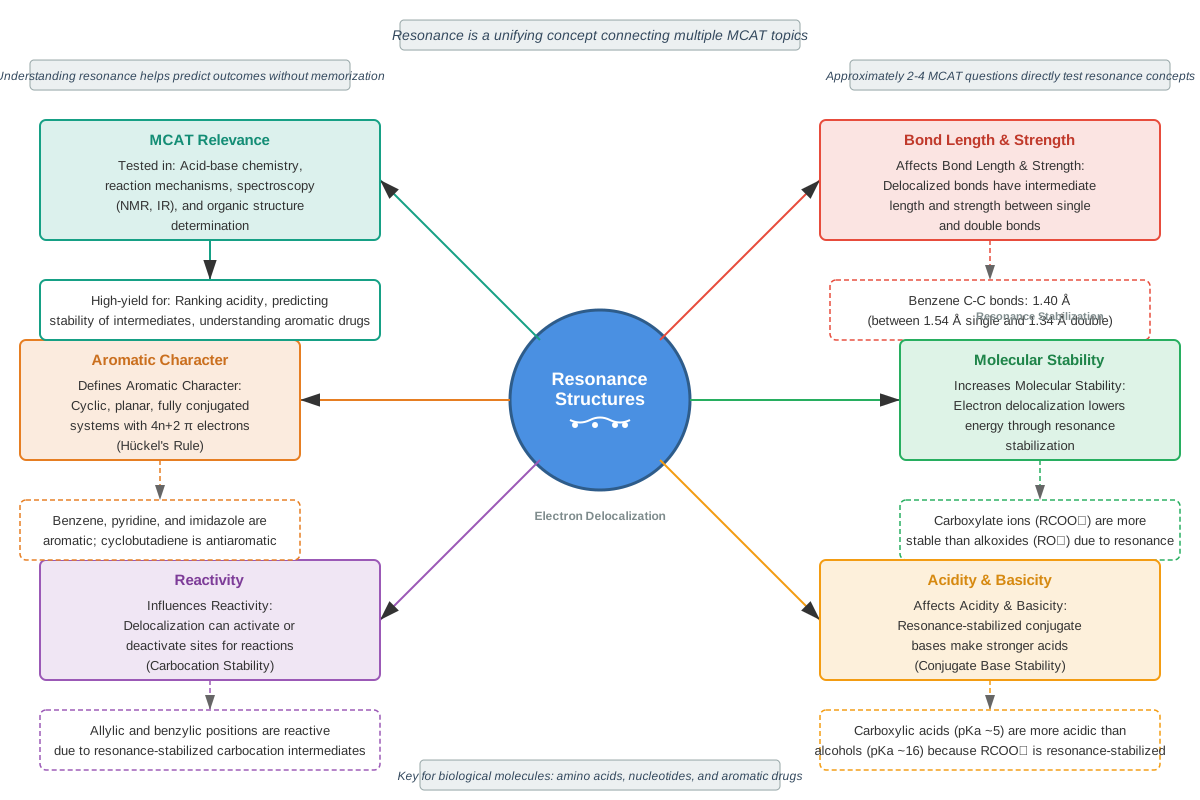
Resonance structures appear with moderate frequency on the MCAT, typically in 2-4 questions per exam either as the primary focus or as supporting knowledge for organic chemistry passages. The concept is particularly important because it underlies many higher-level topics tested on the exam, including aromatic stability (benzene and heterocycles), carboxylic acid acidity, enolate chemistry, and nucleophilic substitution reactions. Understanding resonance allows students to predict relative acidity and basicity—a high-yield skill for both General Chemistry and organic chemistry sections.
In real-world and clinical contexts, resonance stabilization explains the behavior of many biologically important molecules. The carboxylate groups in amino acids are resonance-stabilized, contributing to protein structure and function. The peptide bond exhibits partial double-bond character due to resonance, restricting rotation and determining protein secondary structure. Aromatic amino acids (phenylalanine, tyrosine, tryptophan) derive their stability from resonance in their ring systems. Drug molecules often contain resonance-stabilized functional groups that affect their acidity, solubility, and ability to cross biological membranes.
On the MCAT, resonance questions commonly appear in several formats: discrete questions asking students to identify valid resonance structures or rank them by stability; passage-based questions where understanding resonance explains experimental observations about molecular stability or reactivity; and organic chemistry mechanism questions where resonance stabilization of intermediates determines reaction pathways. Recognizing when resonance applies and quickly evaluating its consequences is a time-saving skill that distinguishes high-scoring students.
Core Concepts
Definition and Fundamental Principles
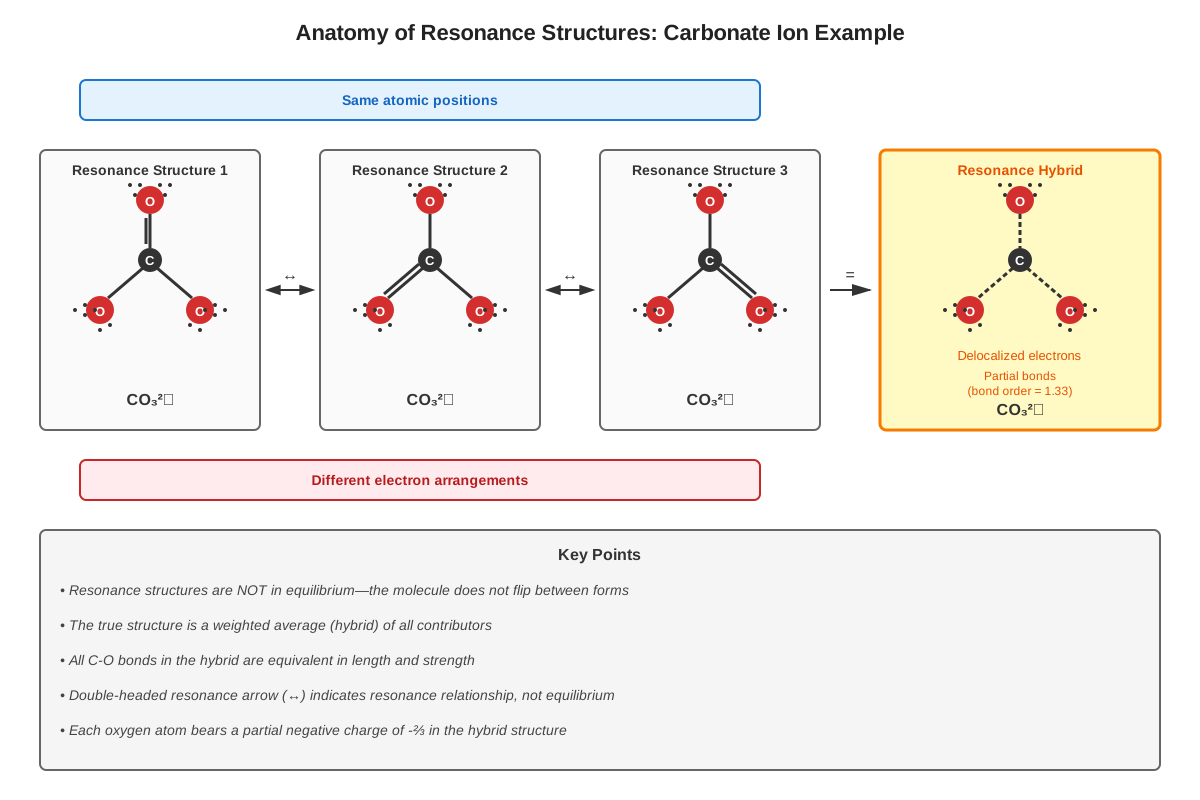
Resonance structures (also called resonance contributors or resonance forms) are two or more Lewis structures for a single molecule or ion that differ only in the position of electrons, not in the position of atoms. The actual molecule does not oscillate between these forms; instead, the true structure is a resonance hybrid that represents a weighted average of all contributors. Electrons in resonance-stabilized molecules are delocalized, meaning they are spread over multiple atoms rather than localized in specific bonds.
The key principle is that resonance structures are not different molecules or isomers—they are different representations of the same species. The molecule exists as a single entity with properties intermediate between the contributing structures. For example, the carbonate ion (CO₃²⁻) has three equivalent resonance structures, each showing a C=O double bond in a different position. The actual structure has three equivalent C-O bonds, each with a bond order of 1.33 (between single and double).
Rules for Drawing Valid Resonance Structures
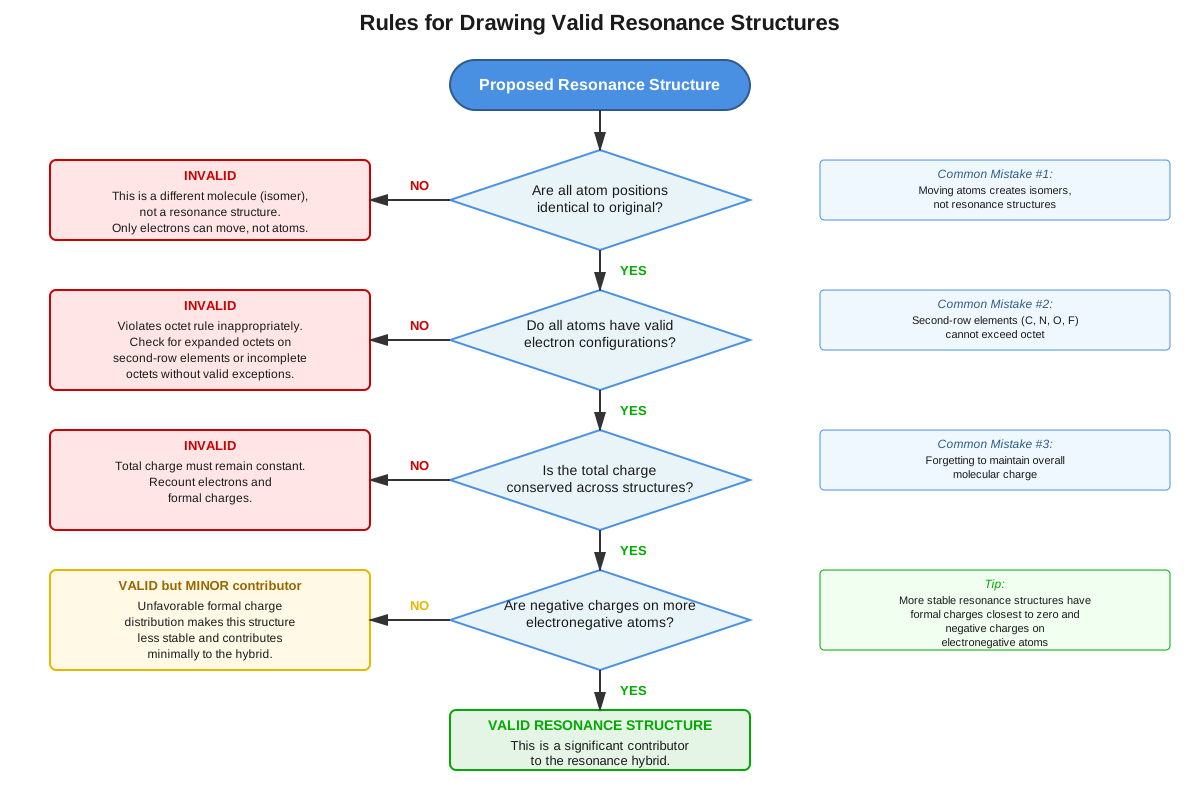
Valid resonance structures must follow specific rules:
- Atoms must remain in the same positions: Only electrons (π electrons and lone pairs) can move; atomic nuclei stay fixed
- The total number of electrons must remain constant: You cannot add or remove electrons when drawing resonance forms
- The overall charge must remain the same: Individual formal charges may shift, but the total molecular or ionic charge is invariant
- Octet rule preferences apply: While exceptions exist, structures that satisfy the octet rule for second-row elements are generally more stable
- Only electrons in π bonds and lone pairs can be moved: σ bonds cannot participate in resonance
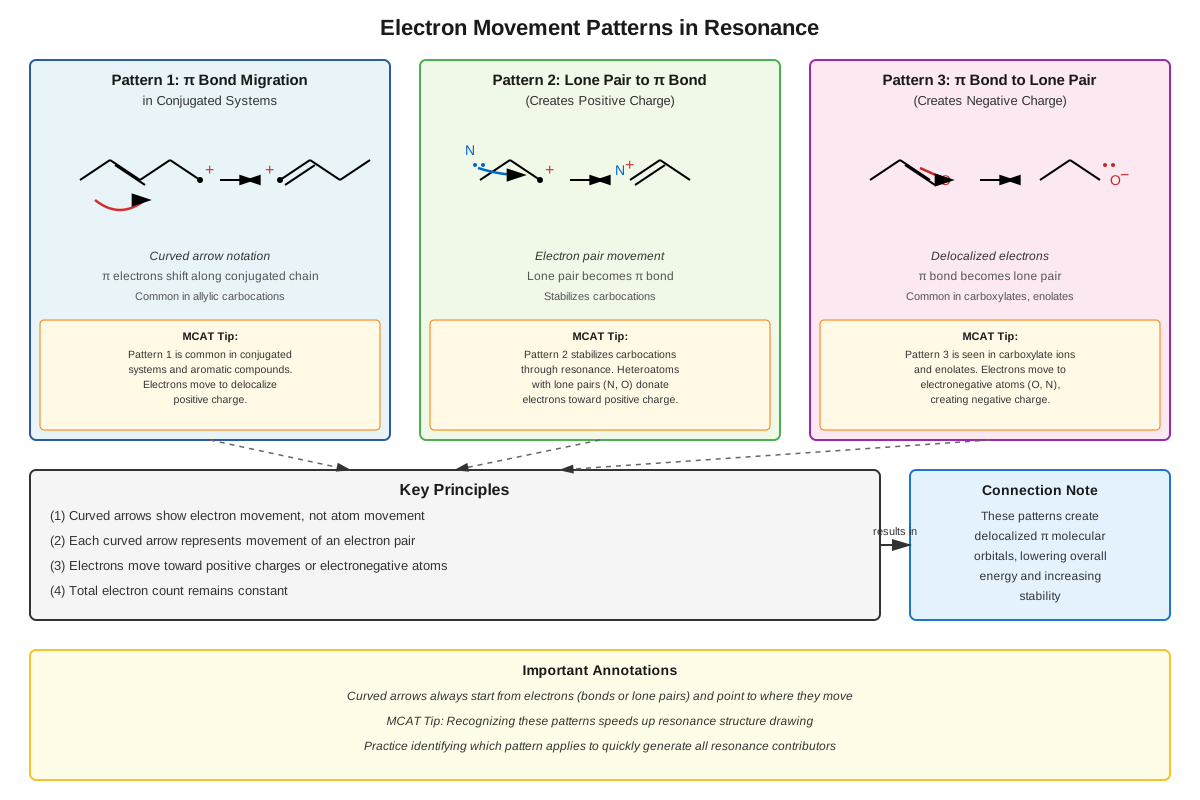
To draw resonance structures, identify regions where π electrons or lone pairs can be redistributed. Common patterns include:
- Lone pair to π bond: A lone pair on an atom adjacent to a π bond can form a new π bond
- π bond to lone pair: A π bond can break, with both electrons moving to one atom as a lone pair
- π bond to π bond: In conjugated systems, π electrons can shift along alternating single and double bonds
Curved Arrow Notation
Curved arrows are the standard notation for showing electron movement between resonance structures. Each curved arrow represents the movement of two electrons (an electron pair). The arrow starts at the current location of the electrons (a lone pair or a bond) and points to where those electrons will move (forming a new bond or becoming a lone pair).
Key conventions:
- Arrow tail begins at electrons (lone pair dots or center of a bond)
- Arrow head points to where electrons will go (between two atoms for a new bond, or to a single atom for a new lone pair)
- Double-headed arrows (↔) connect different resonance structures, indicating they are resonance contributors
- Never use equilibrium arrows (⇌) between resonance structures—they are not in equilibrium
Evaluating Resonance Structure Stability
Not all resonance structures contribute equally to the resonance hybrid. More stable structures contribute more to the actual electronic structure. Stability is evaluated using these criteria, in order of importance:
| Priority | Criterion | Explanation |
|---|---|---|
| 1 | Octet rule satisfaction | Structures where all atoms (especially C, N, O) have complete octets are most stable |
| 2 | Formal charge minimization | Structures with fewer and smaller formal charges are more stable |
| 3 | Formal charge placement | Negative formal charges should be on more electronegative atoms; positive charges on less electronegative atoms |
| 4 | Charge separation | Structures with less charge separation (fewer separated charges) are more stable |
| 5 | Like charges | Structures with like charges on adjacent atoms are highly unstable |
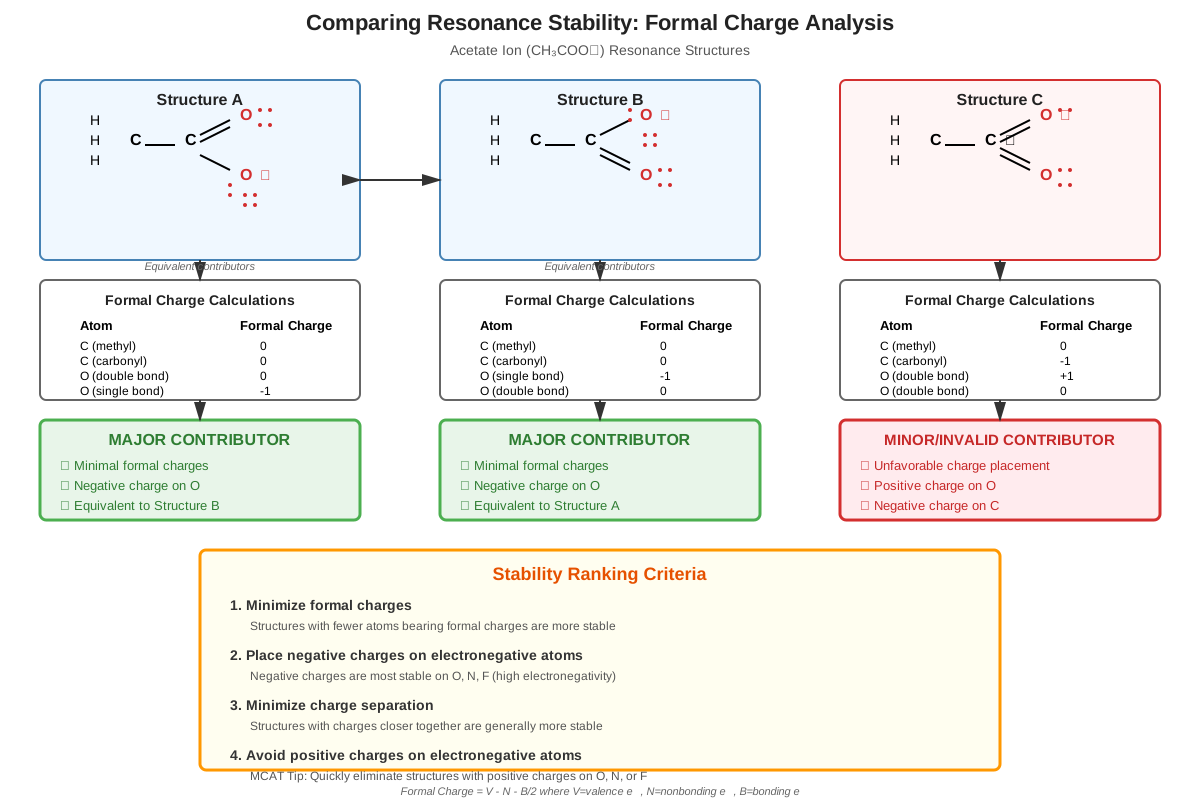
Formal charge is calculated as: Formal charge = (valence electrons) - (non-bonding electrons) - ½(bonding electrons)
Major versus Minor Contributors
Major contributors are resonance structures that are significantly more stable and thus contribute more to the resonance hybrid. Minor contributors are less stable structures that contribute less to the actual electronic structure but may still be drawn to show complete electron delocalization.
For example, in the acetate ion (CH₃COO⁻), the two structures with the negative charge on oxygen atoms are equivalent major contributors. A hypothetical structure with the negative charge on carbon would be a very minor contributor (if valid at all) because oxygen is more electronegative than carbon.
Resonance Stabilization Energy
Molecules with resonance are more stable than any single contributing structure would predict. This extra stability is called resonance stabilization energy or delocalization energy. The more resonance structures a molecule has (particularly equivalent or near-equivalent structures), the greater its resonance stabilization.
This concept explains many chemical phenomena:
- Benzene is exceptionally stable due to six equivalent resonance structures
- Carboxylate ions are more stable than alkoxide ions because the negative charge is delocalized over two oxygen atoms
- Allylic carbocations are more stable than simple alkyl carbocations due to resonance delocalization
Effect on Molecular Properties
Resonance affects observable molecular properties:
Bond lengths: Bonds involved in resonance have intermediate lengths. In the carbonate ion, C-O bonds are shorter than typical C-O single bonds but longer than typical C=O double bonds.
Bond strength: Delocalized bonds are generally stronger than single bonds but weaker than double bonds, with strength proportional to bond order.
Molecular stability: Resonance-stabilized molecules are thermodynamically more stable, affecting reaction equilibria and product distributions.
Reactivity: Resonance stabilization of intermediates (carbocations, carbanions, radicals) affects reaction rates and mechanisms.
Concept Relationships
The concept of resonance structures builds directly on Lewis structures and formal charge calculations—students must first master drawing single Lewis structures before attempting to generate alternative electron arrangements. Formal charge evaluation then becomes the primary tool for ranking resonance contributors by stability.
Resonance connects forward to numerous advanced topics: Aromaticity is fundamentally a resonance phenomenon, where cyclic conjugated systems achieve exceptional stability through electron delocalization. Acid-base chemistry relies heavily on resonance, as the stability of conjugate bases (through resonance stabilization of negative charges) determines acid strength. Reaction mechanisms in organic chemistry frequently involve resonance-stabilized intermediates, where carbocation or carbanion stability determines reaction pathways and rates.
The relationship flow can be mapped as:
Lewis Structures → Formal Charge → Resonance Structures → Resonance Hybrid → Molecular Stability → Reactivity Predictions → Mechanism Understanding → Product Prediction
Within the topic itself, the concepts connect hierarchically: Understanding what constitutes a valid resonance structure → Drawing multiple contributors → Evaluating relative stability → Predicting the weighted resonance hybrid → Applying to molecular properties and reactivity.
Quick check — test yourself on Resonance structures so far.
Try Flashcards →High-Yield Facts
⭐ Resonance structures differ only in electron positions, never in atom positions—if atoms move, you have drawn an isomer, not a resonance structure
⭐ The true structure is a resonance hybrid, not a mixture or equilibrium of contributing structures—the molecule exists as a single entity with delocalized electrons
⭐ Structures with complete octets on all atoms are more stable than those with incomplete octets (most important stability criterion for second-row elements)
⭐ Negative formal charges are most stable on the most electronegative atoms (O > N > C), while positive charges are most stable on the least electronegative atoms
⭐ Equivalent resonance structures contribute equally to the resonance hybrid, resulting in maximum stabilization (e.g., the two structures of acetate ion, the three structures of carbonate ion)
- Curved arrows show electron pair movement: tail at electron source, head at electron destination
- Only π electrons and lone pairs can move in resonance; σ bonds remain fixed
- Resonance stabilization lowers the energy of a molecule, making it more thermodynamically stable
- Bond order in resonance hybrids equals the average bond order across all significant contributors
- Conjugated systems (alternating single and double bonds) allow extended resonance delocalization
- Resonance stabilization of conjugate bases increases acid strength (e.g., carboxylic acids are more acidic than alcohols)
- Allylic and benzylic carbocations/radicals are stabilized by resonance with adjacent π systems
- The more resonance structures a species has, the more stable it is (assuming structures are of comparable stability)
- Aromatic compounds have exceptional resonance stabilization, requiring cyclic, planar, fully conjugated systems with 4n+2 π electrons
- Resonance cannot occur across sp³-hybridized atoms, which lack p orbitals for π overlap
Common Misconceptions
Misconception: Resonance structures are different molecules that interconvert or exist in equilibrium.
Correction: Resonance structures are different representations of a single molecule. The actual molecule is a resonance hybrid with delocalized electrons, not a mixture of structures. The double-headed arrow (↔) indicates resonance, not equilibrium.
Misconception: Atoms can move when drawing resonance structures.
Correction: Only electrons move in resonance structures. If you change atomic positions, you have drawn a constitutional isomer or conformer, not a resonance structure. The molecular skeleton must remain identical.
Misconception: All resonance structures contribute equally to the resonance hybrid.
Correction: Resonance structures contribute in proportion to their stability. More stable structures (those with complete octets, minimal formal charges, and appropriate charge placement) are major contributors, while less stable structures are minor contributors or may be negligible.
Misconception: Resonance structures with more bonds are always more stable.
Correction: While additional bonding is generally stabilizing, formal charge considerations often dominate. A structure with an extra bond but poor formal charge distribution (e.g., negative charge on carbon instead of oxygen) may be less stable than one with fewer bonds but better charge placement.
Misconception: You can move any electrons to create resonance structures.
Correction: Only π electrons (in double or triple bonds) and lone pairs on atoms adjacent to π systems can participate in resonance. Electrons in σ bonds cannot move, and lone pairs on isolated atoms (not adjacent to π systems) cannot participate in resonance.
Misconception: Resonance only occurs in organic molecules.
Correction: Resonance is common in inorganic ions as well, including carbonate (CO₃²⁻), nitrate (NO₃⁻), sulfate (SO₄²⁻), and ozone (O₃). Any species with appropriate π bonding and lone pairs can exhibit resonance.
Misconception: Drawing more resonance structures always means greater stability.
Correction: Only significant (relatively stable) resonance structures contribute meaningfully to stabilization. Drawing highly unstable structures with violated octets or inappropriate charge placement does not increase molecular stability—these are negligible contributors.
Worked Examples
Example 1: Drawing and Evaluating Resonance Structures of the Acetate Ion
Problem: Draw all significant resonance structures for the acetate ion (CH₃COO⁻) and identify which are major contributors.
Solution:
Step 1: Draw the initial Lewis structure
The acetate ion has a central carbon bonded to three hydrogens (methyl group) and a carboxylate group with one C=O double bond and one C-O⁻ single bond.
Step 2: Identify movable electrons
The π electrons in the C=O double bond can move, and the lone pairs on the negatively charged oxygen can potentially form a π bond.
Step 3: Draw resonance structures using curved arrows
- Move the π electrons from the C=O bond to become a lone pair on oxygen
- Simultaneously, move a lone pair from the O⁻ to form a new π bond with carbon
This generates a second structure where the double bond and negative charge have switched positions.
Step 4: Evaluate stability
Both structures have:
- Complete octets on all non-hydrogen atoms ✓
- Minimal formal charges (one -1 charge total) ✓
- Negative charge on oxygen (highly electronegative) ✓
- Same number of bonds ✓
Conclusion: Both structures are equivalent major contributors. The actual acetate ion has two C-O bonds of equal length (intermediate between single and double bonds), with the negative charge equally distributed over both oxygen atoms. This resonance stabilization makes acetate much more stable than a simple alkoxide, explaining why acetic acid is more acidic than ethanol.
Example 2: Resonance in the Nitrate Ion and Predicting Bond Properties
Problem: Draw all resonance structures for the nitrate ion (NO₃⁻) and predict the N-O bond length compared to typical N-O single and N=O double bonds.
Solution:
Step 1: Draw the initial Lewis structure
Nitrogen (central atom) is bonded to three oxygen atoms. One N=O double bond and two N-O single bonds, with the single-bonded oxygens each carrying a -1 formal charge. Total charge: -1.
Step 2: Generate resonance structures
The π bond can be placed between nitrogen and any of the three oxygen atoms, generating three resonance structures. Use curved arrows to show π electrons moving to oxygen (becoming a lone pair) while a lone pair from a different oxygen forms a new π bond with nitrogen.
Step 3: Evaluate equivalence
All three structures are completely equivalent:
- Same number of bonds
- Same formal charge distribution (N: +1, double-bonded O: 0, single-bonded O: -1)
- Complete octets on all atoms
- Same connectivity
Step 4: Determine resonance hybrid properties
Since three equivalent structures exist, each N-O bond has a bond order of 1.33 (one double bond distributed over three positions: 4 bonds ÷ 3 positions = 1.33).
Prediction: Each N-O bond in nitrate will be shorter than a typical N-O single bond (bond order 1) but longer than a typical N=O double bond (bond order 2). The bond length will be approximately one-third of the way from double bond length toward single bond length. All three N-O bonds are identical in length and strength.
MCAT Connection: This type of reasoning appears in questions asking about bond properties in resonance-stabilized species or explaining spectroscopic data showing equivalent bonds where the Lewis structure suggests different bond types.
Exam Strategy
When approaching resonance structures MCAT questions, begin by quickly assessing whether resonance is relevant—look for π bonds adjacent to lone pairs, conjugated systems, or charged species with multiple electronegative atoms. This initial recognition saves time by focusing your analysis appropriately.
Trigger words and phrases that signal resonance questions include:
- "Draw all resonance structures"
- "Most stable resonance contributor"
- "Delocalized electrons"
- "Resonance stabilization"
- "Equivalent bonds" or "equal bond lengths"
- "Conjugated system"
- Questions about carboxylate ions, aromatic compounds, or allylic systems
Systematic approach for drawing resonance structures:
- Draw a correct Lewis structure as your starting point
- Identify all π bonds and lone pairs on atoms adjacent to π bonds
- Use curved arrows to show one electron movement at a time
- Check that each new structure maintains the same total charge and atom positions
- Evaluate stability using the hierarchy: octet rule > formal charge minimization > charge placement > charge separation
Process-of-elimination strategies:
- Immediately eliminate any structure with moved atoms (these are isomers, not resonance structures)
- Eliminate structures with incorrect total charge
- Eliminate structures with broken octet rules on second-row elements (unless the question specifically involves exceptions)
- Among remaining structures, eliminate those with positive charges on highly electronegative atoms or negative charges on electropositive atoms as major contributors
Time allocation: For discrete questions on resonance, allocate 45-60 seconds. Drawing structures should take 20-30 seconds, evaluation another 15-20 seconds, and selecting the answer 10 seconds. For passage-based questions where resonance is supporting knowledge, spend only 15-20 seconds recalling the relevant principle rather than drawing complete structures unless specifically required.
Exam Tip: If a question asks for the "most stable" resonance structure, immediately look for complete octets first, then minimal formal charges. If multiple structures satisfy these criteria, the one with negative charge on the most electronegative atom wins.
Memory Techniques
Mnemonic for stability criteria - "Oh, Frankly, Cats Prefer Salmon":
- Octet rule (most important)
- Formal charge (minimize)
- Charge placement (negative on electronegative)
- Proximity (minimize charge separation)
- Same charges (avoid adjacent like charges)
Visualization strategy: Picture resonance structures as "electron pushing" where π electrons and lone pairs flow like water through a conjugated system. The electrons seek the most stable arrangement, flowing toward electronegative atoms and away from electropositive ones.
Curved arrow mnemonic - "Tail at Treasure, Head at Home":
- Tail at Treasure: Arrow tail starts at the electrons (the "treasure")
- Head at Home: Arrow head points to where electrons will "live" next
For remembering delocalization: Think "SPREAD" - Stabilization through Partial Resonance Electron Allocation Distributes charge, making molecules more stable.
Resonance vs. Isomers: "Electrons Roam, Atoms Stay" - In resonance, only electrons move; atoms remain in place.
Summary
Resonance structures are alternative Lewis structures representing the same molecule, differing only in electron positions while maintaining fixed atomic positions. The actual molecular structure is a resonance hybrid—a weighted average of all contributors—with delocalized electrons distributed across multiple atoms. Valid resonance structures follow strict rules: atoms cannot move, total charge remains constant, and only π electrons and lone pairs can be redistributed. Stability of resonance contributors is evaluated hierarchically, with octet rule satisfaction being paramount, followed by formal charge minimization and appropriate charge placement on electronegative atoms. Equivalent resonance structures contribute equally to the hybrid, providing maximum stabilization. Resonance affects molecular properties including bond lengths (intermediate between single and double bonds), stability (resonance-stabilized species are lower in energy), and reactivity (stabilization of intermediates affects reaction pathways). This concept is essential for understanding acid-base chemistry, aromatic stability, and organic reaction mechanisms—all high-yield topics for the MCAT.
Key Takeaways
- Resonance structures are different electron arrangements of the same molecule; the true structure is a resonance hybrid with delocalized electrons, not a mixture of forms
- Only π electrons and lone pairs can move between resonance structures; σ bonds and atomic positions remain fixed
- Stability ranking follows the hierarchy: complete octets > minimal formal charges > negative charges on electronegative atoms > minimal charge separation
- Equivalent resonance structures provide maximum stabilization and result in equal bond lengths and properties
- Resonance stabilization explains key MCAT concepts including carboxylic acid acidity, aromatic stability, and carbocation/carbanion stability in reaction mechanisms
- Use curved arrows correctly: tail at electron source, head at electron destination, with double-headed arrows (↔) connecting resonance contributors
- Bond properties in resonance hybrids are averages: bond lengths intermediate between contributing structures, bond order equals average across all forms
Related Topics
Aromaticity and Hückel's Rule: Resonance provides the foundation for understanding aromatic stability. Benzene's exceptional stability arises from six equivalent resonance structures, and Hückel's rule (4n+2 π electrons) predicts which cyclic conjugated systems achieve aromatic stabilization.
Acid-Base Chemistry and pKa Predictions: Resonance stabilization of conjugate bases is the primary factor determining acid strength. Carboxylic acids are more acidic than alcohols because carboxylate ions are resonance-stabilized, while alkoxide ions are not.
Carbocation Stability and Reaction Mechanisms: Allylic and benzylic carbocations are stabilized by resonance with adjacent π systems, affecting SN1 reaction rates and product distributions. Understanding resonance in intermediates is essential for predicting reaction pathways.
Molecular Orbital Theory: Resonance is a valence bond theory concept; molecular orbital theory provides a complementary description of electron delocalization through π molecular orbitals extending over multiple atoms.
Conjugated Systems and UV-Vis Spectroscopy: Extended conjugation through resonance affects electronic transitions, explaining why conjugated molecules absorb at longer wavelengths than isolated double bonds—a concept tested in spectroscopy passages.
Practice CTA
Now that you have mastered the core concepts of resonance structures, it's time to solidify your understanding through active practice. Attempt the practice questions to test your ability to draw, evaluate, and apply resonance structures in exam-style scenarios. Use the flashcards to reinforce high-yield facts and stability criteria until they become automatic. Remember, the difference between understanding resonance conceptually and applying it rapidly under exam conditions comes from deliberate practice. Each practice question you work through builds the pattern recognition and speed you need to excel on test day. You've built a strong foundation—now strengthen it through application!
Sign up free to keep reading
Create a free AnvayaPrep account to finish this MCAT guide on Resonance structures — plus flashcards and practice questions.