Overview
Electrolytic cells represent a fundamental concept in electrochemistry that appears frequently on the MCAT, particularly in the Chemical and Physical Foundations of Biological Systems section. Unlike galvanic (voltaic) cells that spontaneously generate electrical energy from chemical reactions, electrolytic cells use external electrical energy to drive non-spontaneous chemical reactions. This process, known as electrolysis, is the cornerstone of numerous industrial applications including metal purification, electroplating, and the production of essential chemicals like chlorine and sodium hydroxide. Understanding electrolytic cells requires mastery of oxidation-reduction reactions, thermodynamics, and the relationship between electrical energy and chemical change.
For the MCAT, electrolytic cells serve as a critical bridge between multiple General Chemistry concepts including redox reactions, thermodynamics (particularly Gibbs free energy), and stoichiometry. The MCAT frequently tests students' ability to distinguish between galvanic and electrolytic cells, predict products at electrodes, calculate quantities of substances produced during electrolysis, and understand the energetics of these processes. Questions may appear as standalone discrete items or embedded within passages describing industrial processes, biological applications, or experimental setups.
The conceptual framework of electrolytic cells extends beyond pure chemistry into biological contexts that are particularly relevant for medical school preparation. Electrolysis principles underlie medical technologies such as iontophoresis (drug delivery through skin using electrical current) and certain surgical techniques. Additionally, understanding how electrical energy can drive unfavorable reactions provides insight into active transport mechanisms in cells, where ATP hydrolysis (a favorable reaction) drives unfavorable ion movement across membranes—a conceptual parallel that strengthens interdisciplinary understanding essential for MCAT success.
Learning Objectives
- [ ] Define electrolytic cells using accurate General Chemistry terminology
- [ ] Explain why electrolytic cells matter for the MCAT
- [ ] Apply electrolytic cells concepts to exam-style questions
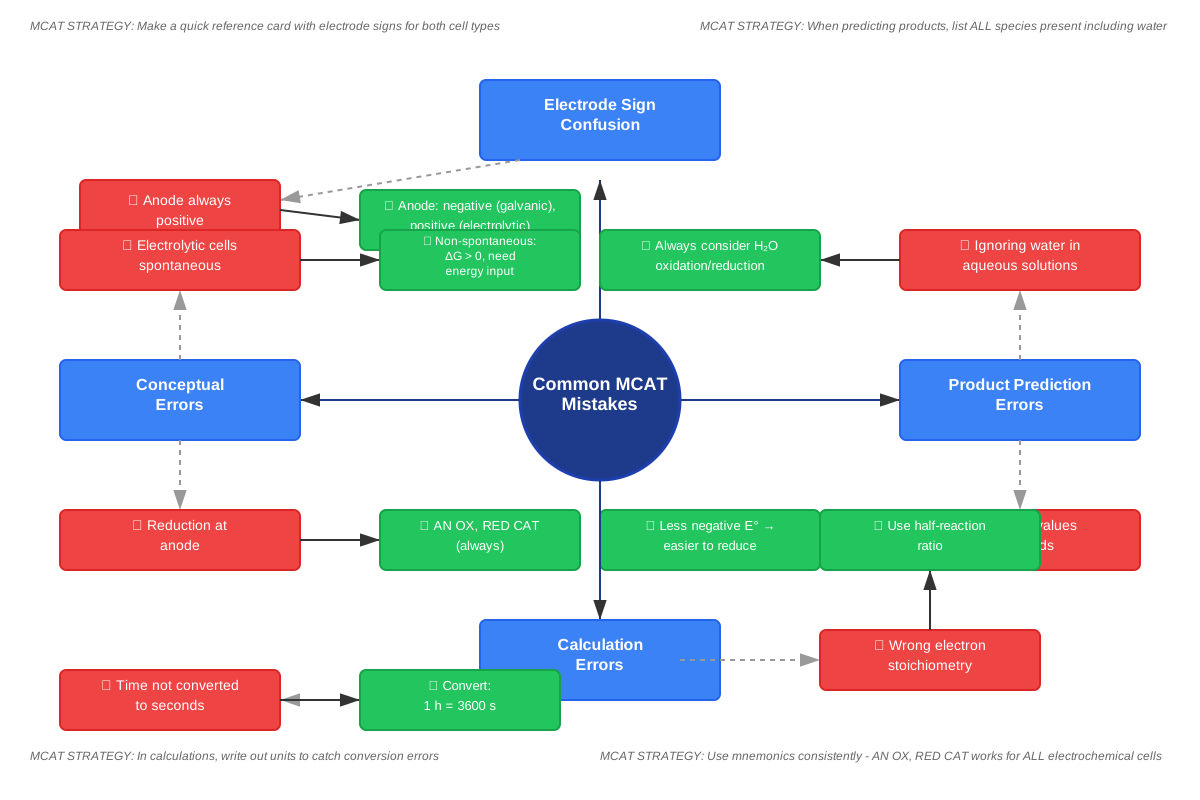
- [ ] Identify common mistakes related to electrolytic cells
- [ ] Connect electrolytic cells to related General Chemistry concepts
- [ ] Distinguish between electrolytic and galvanic cells based on thermodynamic principles
- [ ] Calculate the mass or volume of products formed during electrolysis using Faraday's laws
- [ ] Predict the products formed at the anode and cathode during electrolysis of various solutions
- [ ] Analyze the relationship between applied voltage, cell potential, and spontaneity in electrolytic processes
Prerequisites
- Oxidation-reduction (redox) reactions: Essential for understanding electron transfer at electrodes and identifying which species undergo oxidation versus reduction
- Standard reduction potentials (E°): Required to predict which reactions occur at each electrode and calculate cell potentials
- Gibbs free energy (ΔG) and spontaneity: Necessary to understand why electrolytic cells require external energy input (ΔG > 0)
- Stoichiometry and mole concepts: Critical for quantitative calculations involving Faraday's laws and product formation
- Basic electrical concepts: Understanding of current, voltage, and charge facilitates comprehension of the relationship between electrical and chemical quantities
- Galvanic/voltaic cells: Provides the contrasting framework necessary to fully appreciate electrolytic cell characteristics
Why This Topic Matters
Clinical and Real-World Significance
Electrolytic processes have profound practical applications that extend into medical and biological contexts. The production of pure metals through electrolytic refining creates the high-grade materials used in surgical instruments and medical implants. Electroplating techniques produce corrosion-resistant surfaces on medical devices. In analytical chemistry, electrolysis-based techniques help detect and quantify substances in biological samples. The principle of using electrical energy to drive unfavorable processes mirrors biological active transport, where cells expend ATP to move ions against concentration gradients—a concept frequently tested on the MCAT in biochemistry and physiology contexts.
MCAT Exam Statistics
Electrochemistry, including electrolytic cells, appears in approximately 5-8% of Chemical and Physical Foundations questions. This topic typically generates 2-4 questions per exam, appearing both as discrete questions and within passages. The MCAT particularly favors questions that require students to integrate multiple concepts: distinguishing cell types, applying Faraday's laws, predicting electrode reactions, and connecting electrochemistry to thermodynamics. Data from recent exams indicates that questions involving electrolytic cells often serve as "medium-difficulty discriminators"—questions that separate high-scoring students from average performers.
Common Exam Presentations
The MCAT presents electrolytic cells in several characteristic formats. Passage-based questions often describe industrial processes (chlor-alkali process, aluminum production, electrorefining) or experimental setups where students must identify components and predict outcomes. Discrete questions frequently test the fundamental distinction between galvanic and electrolytic cells, electrode identification, or quantitative calculations using Faraday's laws. Pseudo-discrete questions may present a diagram of an electrochemical cell and ask students to determine whether it's operating galvanically or electrolytically based on voltage values or spontaneity. Interdisciplinary questions sometimes connect electrolysis to biological systems, particularly in the context of energy coupling or membrane transport.
Core Concepts
Definition and Fundamental Characteristics
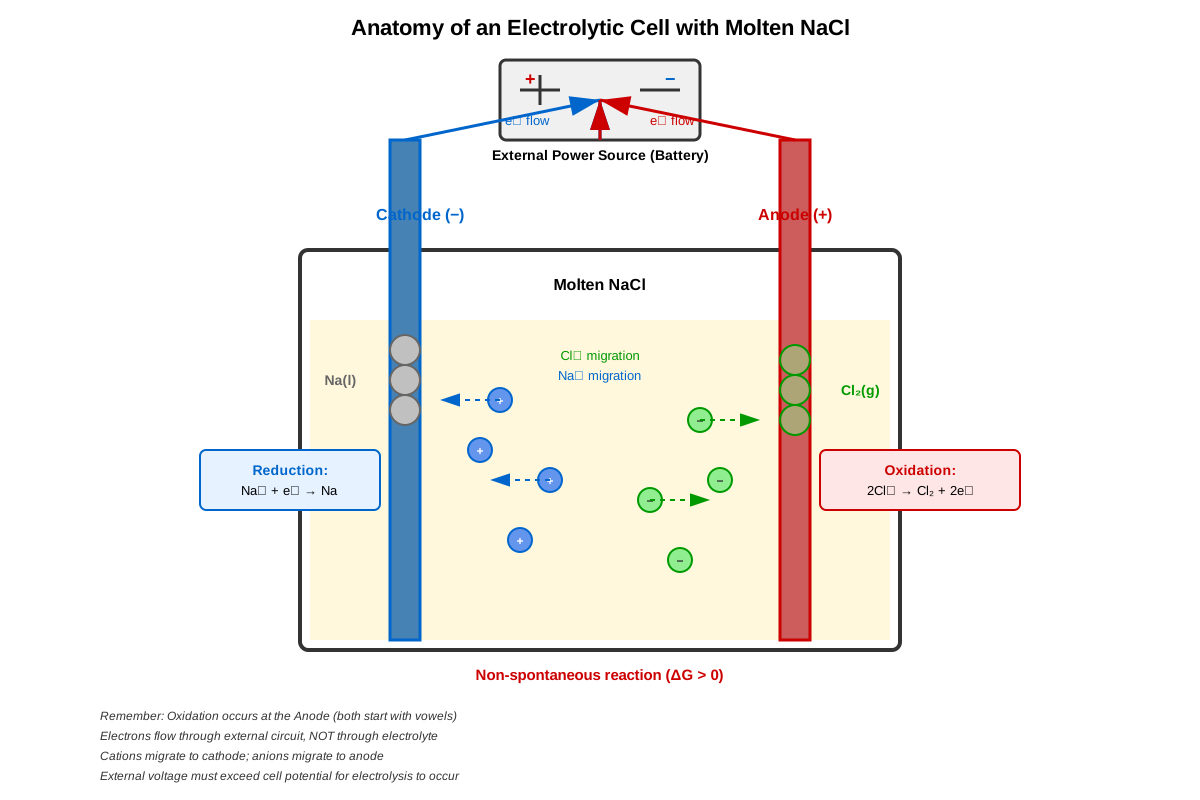
An electrolytic cell is an electrochemical device that uses electrical energy from an external power source to drive a non-spontaneous chemical reaction (ΔG > 0, E°cell < 0). The external voltage supplied must exceed the cell's natural potential to force electrons to flow in the non-spontaneous direction. This process, called electrolysis, converts electrical energy into chemical energy stored in the products of the reaction.
The key distinguishing features of electrolytic cells include:
- Requirement for an external power source (battery or DC power supply)
- Negative cell potential under standard conditions (E°cell < 0)
- Positive Gibbs free energy change (ΔG > 0)
- Non-spontaneous reaction that proceeds only when external voltage is applied
- Electrical energy is consumed rather than produced
Electrode Identification and Reactions
In electrolytic cells General Chemistry, electrode designation follows specific conventions that differ from galvanic cells in important ways:
Anode (Oxidation Site):
- Connected to the positive terminal of the external power source
- Oxidation occurs here (loss of electrons)
- Electrons are pulled away from this electrode by the external circuit
- Anions (negative ions) migrate toward the anode in solution
- Common mnemonic: "AN OX" (Anode = Oxidation)
Cathode (Reduction Site):
- Connected to the negative terminal of the external power source
- Reduction occurs here (gain of electrons)
- Electrons are forced into this electrode by the external circuit
- Cations (positive ions) migrate toward the cathode in solution
- Common mnemonic: "RED CAT" (Reduction = Cathode)
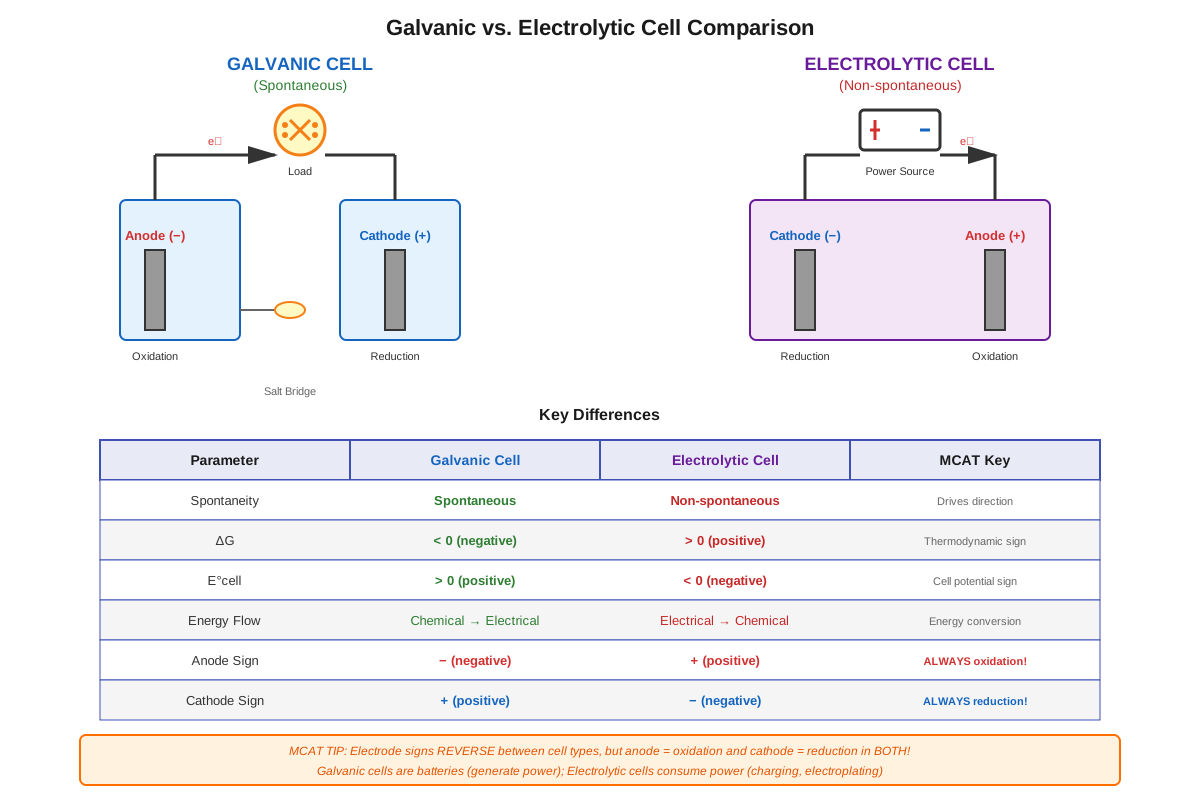
MCAT Exam Tip: While oxidation always occurs at the anode and reduction at the cathode in both cell types, the polarity is reversed between galvanic and electrolytic cells. In galvanic cells, the anode is negative; in electrolytic cells, the anode is positive.
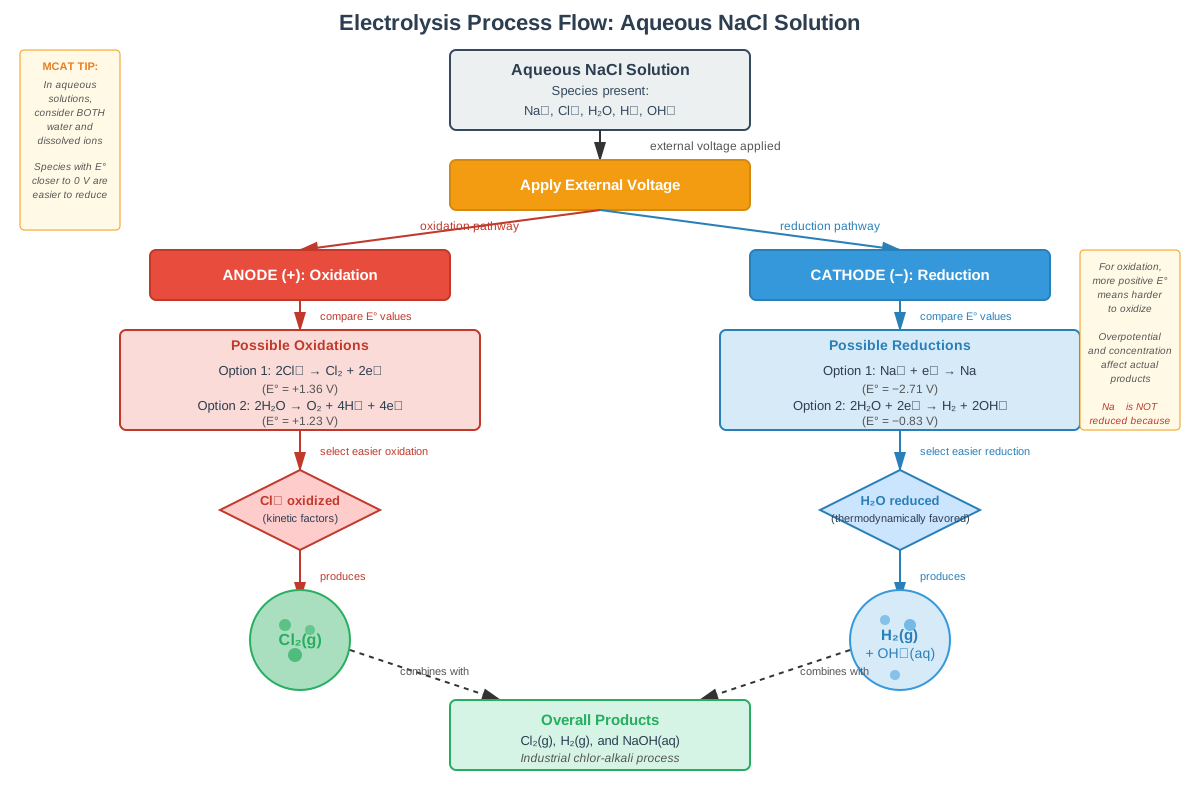
Predicting Electrolysis Products
Determining which species undergo oxidation and reduction during electrolysis requires systematic analysis of the solution composition and reduction potentials:
At the Cathode (Reduction):
- Identify all cations present (including H⁺ from water)
- The species with the most positive (least negative) reduction potential is preferentially reduced
- In aqueous solutions, water can be reduced: 2H₂O + 2e⁻ → H₂(g) + 2OH⁻ (E° = -0.83 V)
- Metal cations with reduction potentials more positive than -0.83 V will be reduced preferentially over water
At the Anode (Oxidation):
- Identify all anions present (including OH⁻ from water)
- The species with the least positive (most negative) reduction potential is preferentially oxidized (easiest to oxidize)
- In aqueous solutions, water can be oxidized: 2H₂O → O₂(g) + 4H⁺ + 4e⁻ (E° = +1.23 V)
- Common anions and their oxidation tendencies:
- Halides (except F⁻) are typically oxidized before water
- Sulfate (SO₄²⁻) and nitrate (NO₃⁻) are generally not oxidized; water oxidizes instead
- Fluoride (F⁻) is not oxidized; water oxidizes instead
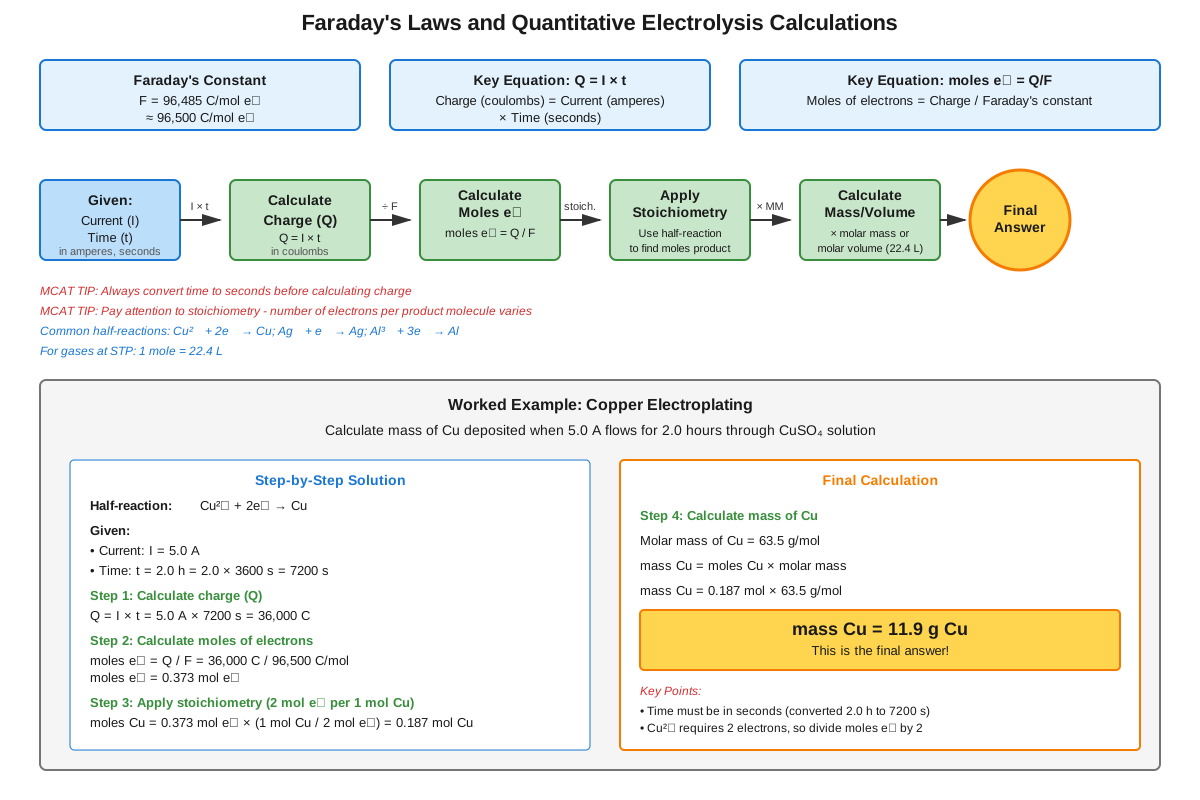
Quantitative Relationships: Faraday's Laws
Faraday's laws of electrolysis establish the quantitative relationship between electrical charge passed through a cell and the amount of chemical change produced:
First Law: The mass of substance produced at an electrode is directly proportional to the quantity of electricity (charge) passed through the cell.
Second Law: For a given quantity of electricity, the mass of substance produced is proportional to its equivalent weight (molar mass divided by number of electrons transferred).
The mathematical framework uses these key relationships:
Q = I × tWhere Q = charge (coulombs), I = current (amperes), t = time (seconds)
moles of electrons = Q / FWhere F = Faraday's constant = 96,485 C/mol e⁻ (often approximated as 96,500 C/mol for MCAT calculations)
moles of product = (moles of electrons) / (electrons per product molecule)mass of product = moles of product × molar massThermodynamics and Cell Potential
The relationship between Gibbs free energy and cell potential is crucial for understanding why electrolytic cells require external energy:
ΔG = -nFE_cellFor electrolytic cells:
- E°cell < 0 (negative cell potential under standard conditions)
- ΔG > 0 (positive, non-spontaneous)
- External voltage (E_applied) must exceed |E°cell| to drive the reaction
- The minimum voltage required is E_applied = -E°cell (in practice, overvoltage is needed)
Comparison Table: Galvanic vs. Electrolytic Cells
| Feature | Galvanic Cell | Electrolytic Cell |
|---|---|---|
| Spontaneity | Spontaneous (ΔG < 0) | Non-spontaneous (ΔG > 0) |
| E°cell | Positive (> 0) | Negative (< 0) |
| Energy conversion | Chemical → Electrical | Electrical → Chemical |
| External power | Not required | Required |
| Anode polarity | Negative (-) | Positive (+) |
| Cathode polarity | Positive (+) | Negative (-) |
| Anode process | Oxidation | Oxidation |
| Cathode process | Reduction | Reduction |
| Electron flow | Anode → Cathode (external) | Cathode ← Anode (forced) |
| Salt bridge | Required | Not always required |
Common Electrolytic Processes
Electrolysis of Molten Salts:
When ionic compounds are melted and electrolyzed, only the cation and anion of the salt are present:
- Cathode: Metal cation is reduced to metal (e.g., Na⁺ + e⁻ → Na)
- Anode: Anion is oxidized (e.g., 2Cl⁻ → Cl₂ + 2e⁻)
- Example: Molten NaCl produces sodium metal at cathode and chlorine gas at anode
Electrolysis of Aqueous Solutions:
Water introduces additional species (H⁺, OH⁻, H₂O) that may compete for oxidation or reduction:
- Must compare reduction potentials to predict actual products
- Example: Electrolysis of aqueous NaCl produces H₂ at cathode (not Na) and Cl₂ at anode
Electroplating:
A specific application where a metal is deposited onto a conductive surface:
- Object to be plated serves as the cathode
- Metal cations in solution are reduced and deposit on the cathode surface
- Anode is often made of the plating metal, which oxidizes to replenish cations
Electrorefining:
Purification of metals using electrolysis:
- Impure metal serves as the anode (oxidizes)
- Pure metal deposits at the cathode
- Impurities either remain in solution or form "anode mud"
Concept Relationships
The understanding of electrolytic cells MCAT concepts builds upon and connects to multiple areas of General Chemistry. At the foundation, redox reactions provide the chemical basis—every electrolytic process involves oxidation at the anode and reduction at the cathode. The ability to identify oxidation states and balance redox equations is prerequisite to predicting electrolysis products.
Thermodynamics directly determines whether a cell operates galvanically or electrolytically. The relationship ΔG = -nFE_cell creates a bridge: when E_cell is negative, ΔG is positive, indicating non-spontaneity and the need for external energy input. This connection reinforces the broader principle that energy must be supplied to drive unfavorable processes.
Standard reduction potentials serve as the predictive tool for electrode reactions. By comparing E° values, students can determine which species will be reduced at the cathode and which will be oxidized at the anode. This connects to the broader concept of electrochemical series and the relative reactivity of elements.
Stoichiometry becomes essential when applying Faraday's laws. The electron flow (quantified as charge) must be converted to moles of electrons, then to moles of products using balanced half-reactions, and finally to mass or volume. This multi-step process integrates dimensional analysis, molar relationships, and gas laws (when gaseous products form).
The conceptual flow can be mapped as:
Redox fundamentals → Reduction potentials → Predicting electrode reactions → Cell potential calculation → Thermodynamic analysis (ΔG) → Determining spontaneity → Identifying cell type → Quantitative analysis via Faraday's laws
Additionally, electrolytic cells connect forward to biochemistry through the concept of energy coupling—just as external voltage drives unfavorable reactions in electrolytic cells, ATP hydrolysis drives unfavorable biological processes. This parallel strengthens interdisciplinary understanding crucial for MCAT success.
Quick check — test yourself on Electrolytic cells so far.
Try Flashcards →High-Yield Facts
⭐ Electrolytic cells require external electrical energy to drive non-spontaneous reactions (ΔG > 0, E°cell < 0)
⭐ In electrolytic cells, the anode is positive and the cathode is negative (opposite of galvanic cells)
⭐ Oxidation always occurs at the anode; reduction always occurs at the cathode (true for both cell types)
⭐ The species with the most positive reduction potential is preferentially reduced at the cathode
⭐ Faraday's constant (F) = 96,485 C/mol e⁻, relating charge to moles of electrons
- In aqueous electrolysis, water may be oxidized or reduced instead of dissolved ions, depending on reduction potentials
- The minimum applied voltage must exceed |E°cell| to drive electrolysis; additional overvoltage is typically required in practice
- During electrolysis of molten NaCl, sodium metal forms at the cathode and chlorine gas at the anode
- During electrolysis of aqueous NaCl, hydrogen gas forms at the cathode (not sodium) and chlorine gas at the anode
- One mole of electrons (1 Faraday) carries 96,485 coulombs of charge
- Cations migrate toward the cathode; anions migrate toward the anode during electrolysis
- Electroplating deposits metal onto the cathode surface from metal cations in solution
- The relationship Q = I × t connects current (amperes), time (seconds), and total charge (coulombs)
- Inert electrodes (platinum, graphite) do not participate in the reaction; active electrodes may oxidize or reduce
- The number of electrons required per product molecule determines the stoichiometric relationship in Faraday's law calculations
Common Misconceptions
Misconception: The anode is always negative and the cathode is always positive.
Correction: While this is true for galvanic cells, in electrolytic cells the polarity is reversed—the anode is positive (connected to the positive terminal of the power source) and the cathode is negative. The key is to remember that oxidation always occurs at the anode and reduction at the cathode, regardless of polarity.
Misconception: Electrolytic cells produce electrical energy like batteries.
Correction: Electrolytic cells consume electrical energy to drive non-spontaneous reactions. They convert electrical energy into chemical energy, which is the opposite of galvanic cells that convert chemical energy into electrical energy. The external power source is essential for operation.
Misconception: The species present in highest concentration will always be oxidized or reduced first.
Correction: Electrode reactions are determined by reduction potentials, not concentration (under standard conditions). The species with the most favorable thermodynamics (most positive E° for reduction, most negative E° for oxidation) will react preferentially, regardless of concentration. Concentration affects reaction rates but not which reaction occurs.
Misconception: During electrolysis of aqueous NaCl, sodium metal forms at the cathode.
Correction: In aqueous solution, water is preferentially reduced over Na⁺ because water has a more positive reduction potential (-0.83 V) than Na⁺ (-2.71 V). Therefore, H₂ gas forms at the cathode, not sodium metal. Sodium metal only forms during electrolysis of molten NaCl where water is absent.
Misconception: One Faraday of charge will produce one mole of any product.
Correction: One Faraday (one mole of electrons) produces one mole of product only if the product requires one electron per molecule. For products requiring multiple electrons (e.g., Cu²⁺ + 2e⁻ → Cu), one Faraday produces only 0.5 moles of product. The stoichiometry of the half-reaction determines the relationship.
Misconception: A salt bridge is always required in electrolytic cells.
Correction: Unlike galvanic cells where a salt bridge is essential to maintain electrical neutrality in separate half-cells, many electrolytic cells operate with both electrodes in the same solution. The external power source drives electron flow regardless of ion migration within the solution. Salt bridges are only needed when half-cells are physically separated.
Misconception: The applied voltage in an electrolytic cell equals the negative of E°cell.
Correction: While the minimum theoretical voltage equals -E°cell, practical electrolysis requires additional "overvoltage" to overcome kinetic barriers and resistance. The actual applied voltage is always greater than the theoretical minimum. Additionally, non-standard conditions affect the required voltage through the Nernst equation.
Worked Examples
Example 1: Predicting Products and Calculating Mass
Question: A solution of copper(II) sulfate (CuSO₄) is electrolyzed using inert platinum electrodes. A current of 2.50 A is passed through the solution for 1.50 hours. (a) Identify the products at each electrode. (b) Calculate the mass of copper deposited at the cathode. (F = 96,500 C/mol)
Solution:
(a) Predicting products:
At the cathode (reduction), we must compare possible reductions:
- Cu²⁺ + 2e⁻ → Cu (E° = +0.34 V)
- 2H₂O + 2e⁻ → H₂ + 2OH⁻ (E° = -0.83 V)
Since Cu²⁺ has a more positive reduction potential, copper metal will be reduced and deposited at the cathode.
At the anode (oxidation), we must compare possible oxidations:
- SO₄²⁻ is very difficult to oxidize (not favored)
- 2H₂O → O₂ + 4H⁺ + 4e⁻ (E° = +1.23 V)
Since sulfate is not easily oxidized, water will be oxidized, producing oxygen gas at the anode.
Products: Copper metal at cathode; oxygen gas at anode
(b) Calculating mass of copper:
Step 1: Calculate total charge passed
Q = I × t = 2.50 A × (1.50 h × 3600 s/h) = 2.50 × 5400 = 13,500 CStep 2: Calculate moles of electrons
moles e⁻ = Q / F = 13,500 C / 96,500 C/mol = 0.140 mol e⁻Step 3: Use stoichiometry from half-reaction (Cu²⁺ + 2e⁻ → Cu)
moles Cu = 0.140 mol e⁻ × (1 mol Cu / 2 mol e⁻) = 0.0700 mol CuStep 4: Calculate mass
mass Cu = 0.0700 mol × 63.5 g/mol = 4.45 gAnswer: 4.45 g of copper will be deposited at the cathode.
Connection to Learning Objectives: This problem integrates electrode prediction (using reduction potentials), quantitative application of Faraday's laws, and demonstrates the systematic approach required for MCAT electrochemistry questions.
Example 2: Determining Cell Type and Minimum Voltage
Question: Consider an electrochemical cell with the following half-reactions:
- Anode: 2Cl⁻ → Cl₂ + 2e⁻ (E° = +1.36 V)
- Cathode: Zn²⁺ + 2e⁻ → Zn (E° = -0.76 V)
(a) Is this cell galvanic or electrolytic under standard conditions? (b) What minimum voltage must be applied to drive this reaction?
Solution:
(a) Determining cell type:
Step 1: Calculate E°cell
E°cell = E°cathode - E°anode = (-0.76 V) - (+1.36 V) = -2.12 VStep 2: Determine spontaneity
Since E°cell is negative, ΔG is positive (ΔG = -nFE°cell), indicating a non-spontaneous reaction.
Step 3: Identify cell type
A non-spontaneous reaction requires external energy input, so this is an electrolytic cell.
(b) Calculating minimum voltage:
The minimum applied voltage must overcome the negative cell potential:
E_applied(min) = -E°cell = -(-2.12 V) = +2.12 VIn practice, additional overvoltage would be required, so the actual applied voltage would exceed 2.12 V.
Answer: (a) Electrolytic cell; (b) Minimum voltage = 2.12 V
Connection to Learning Objectives: This problem demonstrates the critical distinction between cell types based on thermodynamic principles, reinforces the relationship between E°cell and spontaneity, and shows how to calculate the minimum voltage required for electrolysis—all high-yield MCAT concepts.
Exam Strategy
Approaching MCAT Questions
When encountering electrochemistry questions on the MCAT, follow this systematic approach:
- Identify the cell type first: Look for clues about spontaneity (ΔG sign, E°cell sign) or explicit mention of external power sources. This determines whether you're dealing with a galvanic or electrolytic cell.
- Establish electrode identities: Remember that oxidation always occurs at the anode and reduction at the cathode, but polarity differs between cell types. Draw a simple diagram if needed.
- For product prediction: List all species present, write possible half-reactions with their E° values, and apply the "most positive reduces, most negative oxidizes" rule.
- For calculations: Write out the step-by-step process (Q = I×t → moles e⁻ → moles product → mass/volume) before plugging in numbers. This prevents errors and helps if you need to backtrack.
Trigger Words and Phrases
Watch for these key terms that signal electrolytic cell questions:
- "External power source," "battery connected," "voltage applied"
- "Electroplating," "electrorefining," "electrolysis"
- "Non-spontaneous reaction," "ΔG > 0," "negative E°cell"
- "Charging" (as in charging a battery—this is electrolysis)
- "Current passed through," "charge delivered"
Process of Elimination Tips
When evaluating answer choices:
- Eliminate options that violate fundamental rules: If an answer suggests reduction at the anode or oxidation at the cathode, eliminate immediately.
- Check polarity carefully: If the question asks about an electrolytic cell and an answer describes the anode as negative, eliminate it.
- Verify stoichiometry: In calculation questions, eliminate answers that don't account for the electron stoichiometry in the half-reaction.
- Consider water competition: In aqueous electrolysis questions, eliminate answers that ignore water as a potential reactant.
Time Allocation
For discrete questions on electrolytic cells, allocate 60-90 seconds. For passage-based questions, spend 30-45 seconds per question after reading the passage. If a calculation appears complex, quickly estimate the order of magnitude to eliminate unreasonable answers before performing detailed calculations. Remember that MCAT calculations are designed to be completed without a calculator, so if your approach requires complex math, reconsider your method.
Memory Techniques
Mnemonics
"AN OX and RED CAT": Anode = Oxidation, Reduction = Cathode (works for both cell types)
"PANG": Positive Anode = Non-spontaneous (electrolytic), Galvanic has negative anode
"LEO says GER": Loss of Electrons = Oxidation, Gain of Electrons = Reduction
"FAT CAT": Faraday's (constant) At The Cathode Attracts Tons (of cations)
Visualization Strategy
Create a mental image of an electrolytic cell as a "chemical pump" that uses electrical energy to push electrons "uphill" against their natural tendency. Visualize the external battery as the pump motor, forcing electrons to flow in the non-spontaneous direction. The anode is connected to the positive terminal (like the high-pressure side of a pump), and electrons are pulled away from it. The cathode is connected to the negative terminal (like the low-pressure side), and electrons are forced into it.
Comparison Anchor
Always anchor electrolytic cells against galvanic cells using this simple comparison:
- Galvanic = Generator (produces electricity, spontaneous, like a battery)
- Electrolytic = Consumer (uses electricity, non-spontaneous, like charging a battery)
Faraday's Law Sequence
Remember the calculation sequence with "QMMS":
- Quantity of charge (Q = I × t)
- Moles of electrons (divide by F)
- Moles of product (use stoichiometry)
- Substance mass or volume (multiply by molar mass or use gas laws)
Summary
Electrolytic cells are electrochemical devices that use external electrical energy to drive non-spontaneous chemical reactions, characterized by negative cell potentials (E°cell < 0) and positive Gibbs free energy changes (ΔG > 0). Unlike galvanic cells that generate electricity, electrolytic cells consume it, with the anode connected to the positive terminal (where oxidation occurs) and the cathode connected to the negative terminal (where reduction occurs). Predicting electrolysis products requires comparing reduction potentials of all species present, including water in aqueous solutions. Quantitative analysis uses Faraday's laws, relating electrical charge (Q = I × t) to moles of electrons (Q/F) and ultimately to product mass through stoichiometric relationships. The MCAT frequently tests the distinction between cell types, electrode identification, product prediction, and calculations involving Faraday's constant. Mastery requires integrating redox fundamentals, thermodynamics, reduction potentials, and stoichiometry into a cohesive framework that enables rapid problem-solving under exam conditions.
Key Takeaways
- Electrolytic cells require external power to drive non-spontaneous reactions (ΔG > 0, E°cell < 0), converting electrical energy into chemical energy
- In electrolytic cells, the anode is positive and the cathode is negative—opposite of galvanic cells—but oxidation still occurs at the anode and reduction at the cathode
- Product prediction depends on reduction potentials: the species with the most positive E° is reduced at the cathode; the species with the most negative E° is oxidized at the anode
- Faraday's constant (96,485 C/mol e⁻) connects electrical charge to chemical quantities through the relationship Q = I × t, enabling calculation of product mass or volume
- Water can compete for oxidation or reduction in aqueous electrolysis, often being reduced instead of metal cations with very negative reduction potentials
- The minimum applied voltage must exceed |E°cell| to drive electrolysis, with additional overvoltage required in practice
- Common MCAT applications include electroplating, electrorefining, and electrolysis of molten salts or aqueous solutions
Related Topics
Galvanic (Voltaic) Cells: Understanding spontaneous electrochemical cells provides the essential contrast to electrolytic cells and reinforces the relationship between thermodynamics and cell type. Mastering both cell types enables comprehensive electrochemistry problem-solving.
Nernst Equation: This equation relates cell potential to non-standard conditions (concentration, temperature, pressure), extending electrolytic cell analysis beyond standard state and enabling prediction of voltage requirements under various conditions.
Concentration Cells: A special type of galvanic cell where both electrodes are the same material but in different concentrations, bridging electrochemistry and thermodynamics concepts.
Corrosion and Oxidation-Reduction in Biological Systems: Understanding electrolytic principles facilitates comprehension of metal corrosion (essentially reverse electroplating) and biological redox reactions, including electron transport chains.
Thermodynamics and Free Energy: Deeper exploration of the relationship between ΔG, ΔH, ΔS, and electrochemical processes strengthens the theoretical foundation for predicting spontaneity and calculating energy requirements.
Practice CTA
Now that you've mastered the core concepts of electrolytic cells, it's time to solidify your understanding through active practice. Attempt the practice questions and flashcards designed specifically for this topic—they'll challenge you to apply these principles in MCAT-style scenarios and identify any remaining knowledge gaps. Remember, electrochemistry questions are high-yield and frequently serve as score differentiators on the MCAT. Each practice problem you work through builds the pattern recognition and problem-solving speed essential for test day success. You've built a strong conceptual foundation—now transform that knowledge into points through deliberate practice!
Sign up free to keep reading
Create a free AnvayaPrep account to finish this MCAT guide on Electrolytic cells — plus flashcards and practice questions.