Overview
Galvanic cells (also called voltaic cells) represent one of the most fundamental and clinically relevant topics in electrochemistry for the MCAT. These spontaneous electrochemical devices convert chemical energy into electrical energy through redox reactions, forming the basis for batteries, fuel cells, and biological electron transport systems. Understanding galvanic cells requires integrating knowledge of oxidation-reduction reactions, thermodynamics, and solution chemistry—making this a high-integration topic that frequently appears in both standalone questions and passage-based items on the MCAT.
The importance of Galvanic cells in General Chemistry extends beyond memorizing cell diagrams. Students must understand the directionality of electron flow, the relationship between cell potential and spontaneity, and how concentration changes affect voltage. These concepts connect directly to thermodynamics (ΔG and spontaneity), kinetics (reaction rates at electrodes), and even biological systems (mitochondrial electron transport chains). The MCAT tests not just recognition of galvanic cell components, but the ability to predict behavior, calculate potentials, and troubleshoot experimental scenarios.
Mastery of Galvanic cells MCAT content provides the foundation for understanding electrolytic cells (their non-spontaneous counterparts), concentration cells, and electrochemical measurement techniques. This topic appears in approximately 2-4 questions per MCAT exam, often embedded in passages about energy storage, corrosion, or biological redox processes. The ability to quickly identify anode versus cathode, determine electron flow direction, and calculate cell potentials under non-standard conditions represents essential skills for achieving a competitive score in the Chemical and Physical Foundations section.
Learning Objectives
- [ ] Define Galvanic cells using accurate General Chemistry terminology
- [ ] Explain why Galvanic cells matters for the MCAT
- [ ] Apply Galvanic cells to exam-style questions
- [ ] Identify common mistakes related to Galvanic cells
- [ ] Connect Galvanic cells to related General Chemistry concepts
- [ ] Calculate standard cell potentials using reduction potential tables
- [ ] Predict the direction of electron flow and ion migration in galvanic cells
- [ ] Apply the Nernst equation to determine cell potentials under non-standard conditions
- [ ] Interpret cell notation (line notation) and construct cell diagrams from written descriptions
Prerequisites
- Oxidation-reduction (redox) reactions: Essential for understanding which species loses electrons (oxidation at anode) and which gains electrons (reduction at cathode)
- Standard reduction potentials (E°): Required to calculate cell potentials and predict spontaneity of electrochemical reactions
- Thermodynamics fundamentals (ΔG, spontaneity): Necessary to connect cell potential with Gibbs free energy and reaction spontaneity
- Solution chemistry and concentration: Important for applying the Nernst equation and understanding concentration effects on cell potential
- Basic electrical concepts (voltage, current, charge): Needed to understand electron flow, potential difference, and the relationship between charge and moles of electrons
Why This Topic Matters
Clinical and Real-World Significance
Galvanic cells power countless medical devices, from pacemakers to portable defibrillators. The principles governing these cells explain how neurons maintain resting membrane potentials and generate action potentials—processes fundamental to neuroscience passages on the MCAT. Biological electron transport chains in mitochondria and chloroplasts function as biological galvanic cells, converting chemical energy from nutrients into ATP. Understanding galvanic cells also explains corrosion processes (like rusting), which has implications for medical implants and surgical instruments.
MCAT Exam Statistics
Electrochemistry questions, with galvanic cells as the centerpiece, appear in 3-5% of Chemical and Physical Foundations questions. This topic most commonly appears in:
- Passage-based questions (60% of electrochemistry items): Often embedded in experimental scenarios involving battery design, corrosion studies, or biological redox systems
- Discrete questions (40%): Typically testing cell potential calculations, electron flow direction, or cell notation interpretation
- Interdisciplinary passages: Frequently connected to biochemistry (electron transport), physics (electrical circuits), or organic chemistry (redox reactions of organic molecules)
Common Exam Presentations
The MCAT presents galvanic cells through various contexts: comparing different battery types, analyzing experimental electrochemical setups, troubleshooting malfunctioning cells, or connecting to biological systems. Questions often require students to integrate multiple concepts—calculating E°cell, determining spontaneity, predicting concentration effects, and identifying components simultaneously. The exam favors questions that test conceptual understanding over pure memorization, such as predicting what happens when salt bridge composition changes or when electrode surface area varies.
Core Concepts
Definition and Fundamental Principles
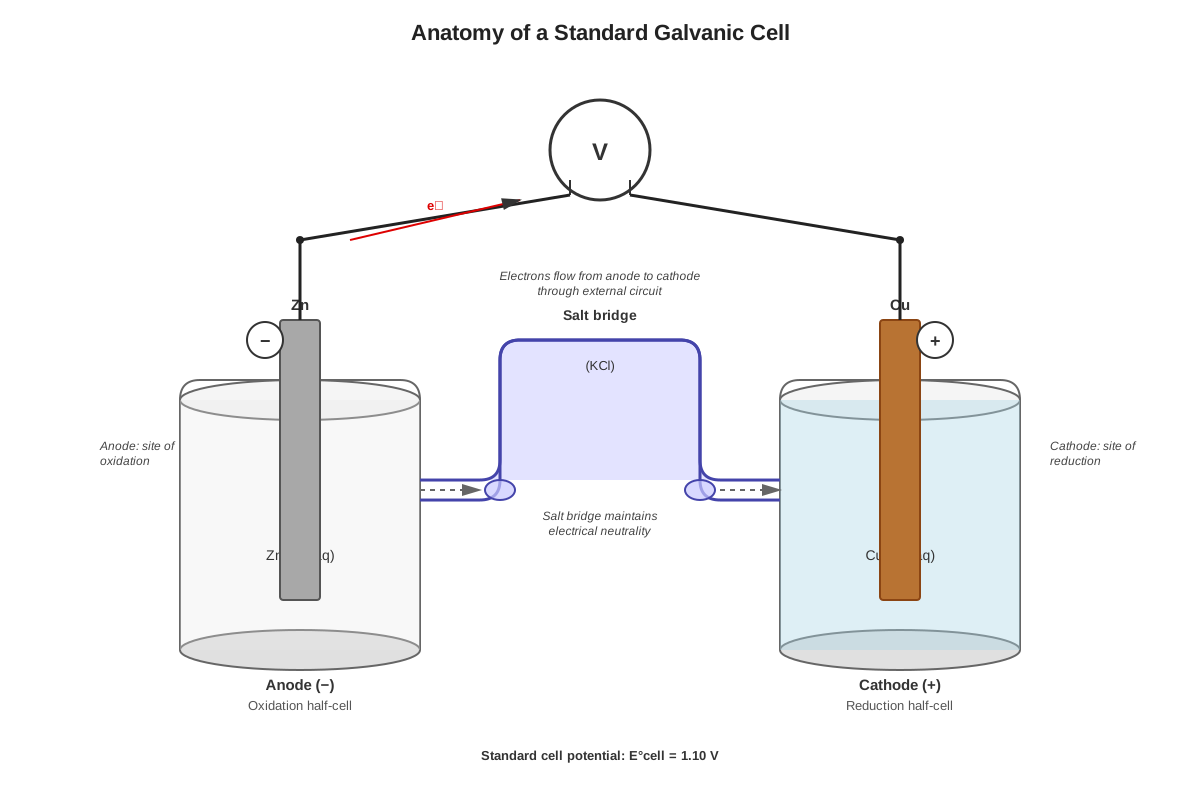
A galvanic cell (or voltaic cell) is an electrochemical cell that generates electrical energy from spontaneous redox reactions. The cell consists of two half-cells, each containing an electrode immersed in an electrolyte solution. The key characteristic distinguishing galvanic cells from electrolytic cells is spontaneity: galvanic cells have positive cell potentials (E°cell > 0) and negative Gibbs free energy changes (ΔG < 0), meaning they proceed without external energy input.
The driving force behind galvanic cell operation is the difference in reduction potentials between two half-reactions. Species with higher reduction potentials preferentially gain electrons (undergo reduction), while species with lower reduction potentials lose electrons (undergo oxidation). This potential difference creates a voltage that can drive electrons through an external circuit, performing electrical work.
Cell Components and Architecture
Every galvanic cell contains four essential components:
- Anode: The electrode where oxidation occurs (electrons are lost)
- Cathode: The electrode where reduction occurs (electrons are gained)
- Salt bridge: An ionic conductor that maintains electrical neutrality by allowing ion migration
- External circuit: The conductive pathway through which electrons flow from anode to cathode
The electrodes may be inert (like platinum or graphite) or active participants in the redox reaction (like zinc or copper metal). The electrolyte solutions contain ions of the species undergoing redox reactions, and their concentrations affect cell potential through the Nernst equation.
Electron Flow and Current Direction
Understanding directional flow is critical for MCAT success:
- Electrons flow from anode to cathode through the external circuit (following the path of lower potential energy)
- Conventional current flows from cathode to anode (opposite to electron flow, by historical convention)
- Anions migrate toward the anode through the salt bridge (to balance positive charge from oxidation)
- Cations migrate toward the cathode through the salt bridge (to balance negative charge from reduction)
MCAT Exam Tip: Remember "An Ox, Red Cat" (Anode Oxidation, Reduction Cathode). Electrons always flow from anode to cathode in the external circuit.
Standard Cell Potential Calculation
The standard cell potential (E°cell) represents the voltage produced under standard conditions (25°C, 1 M concentrations, 1 atm pressure). Calculate E°cell using:
E°cell = E°cathode - E°anodeAlternatively, since the anode undergoes oxidation (the reverse of its reduction half-reaction):
E°cell = E°reduction + E°oxidationWhere E°oxidation = -E°reduction for the species being oxidized.
Important: Always use reduction potentials from tables. The more positive reduction potential identifies the cathode (where reduction occurs), while the less positive (or more negative) reduction potential identifies the anode (where oxidation occurs).
Standard Reduction Potentials Table
| Half-Reaction | E° (V) |
|---|---|
| F₂ + 2e⁻ → 2F⁻ | +2.87 |
| Au³⁺ + 3e⁻ → Au | +1.50 |
| Cl₂ + 2e⁻ → 2Cl⁻ | +1.36 |
| O₂ + 4H⁺ + 4e⁻ → 2H₂O | +1.23 |
| Ag⁺ + e⁻ → Ag | +0.80 |
| Cu²⁺ + 2e⁻ → Cu | +0.34 |
| 2H⁺ + 2e⁻ → H₂ | 0.00 |
| Pb²⁺ + 2e⁻ → Pb | -0.13 |
| Ni²⁺ + 2e⁻ → Ni | -0.25 |
| Zn²⁺ + 2e⁻ → Zn | -0.76 |
| Li⁺ + e⁻ → Li | -3.05 |
Species at the top (high positive E°) are strong oxidizing agents (readily gain electrons). Species at the bottom (large negative E°) are strong reducing agents (readily lose electrons).
Cell Notation (Line Notation)
Electrochemists use standardized line notation to represent galvanic cells concisely:
Anode | Anode solution || Cathode solution | CathodeThe single vertical line (|) represents a phase boundary, while the double vertical line (||) represents the salt bridge. By convention, the anode appears on the left and cathode on the right.
Example: For a zinc-copper cell:
Zn(s) | Zn²⁺(aq) || Cu²⁺(aq) | Cu(s)This notation indicates zinc metal oxidizes to Zn²⁺ at the anode, while Cu²⁺ reduces to copper metal at the cathode.
Relationship Between Cell Potential and Gibbs Free Energy
The connection between electrochemistry and thermodynamics is quantified by:
ΔG° = -nFE°cellWhere:
- ΔG° = standard Gibbs free energy change (J/mol)
- n = number of moles of electrons transferred
- F = Faraday's constant (96,485 C/mol e⁻)
- E°cell = standard cell potential (V)
This equation reveals that:
- Positive E°cell → Negative ΔG° → Spontaneous reaction (galvanic cell)
- Negative E°cell → Positive ΔG° → Non-spontaneous reaction (requires external energy; electrolytic cell)
The Nernst Equation
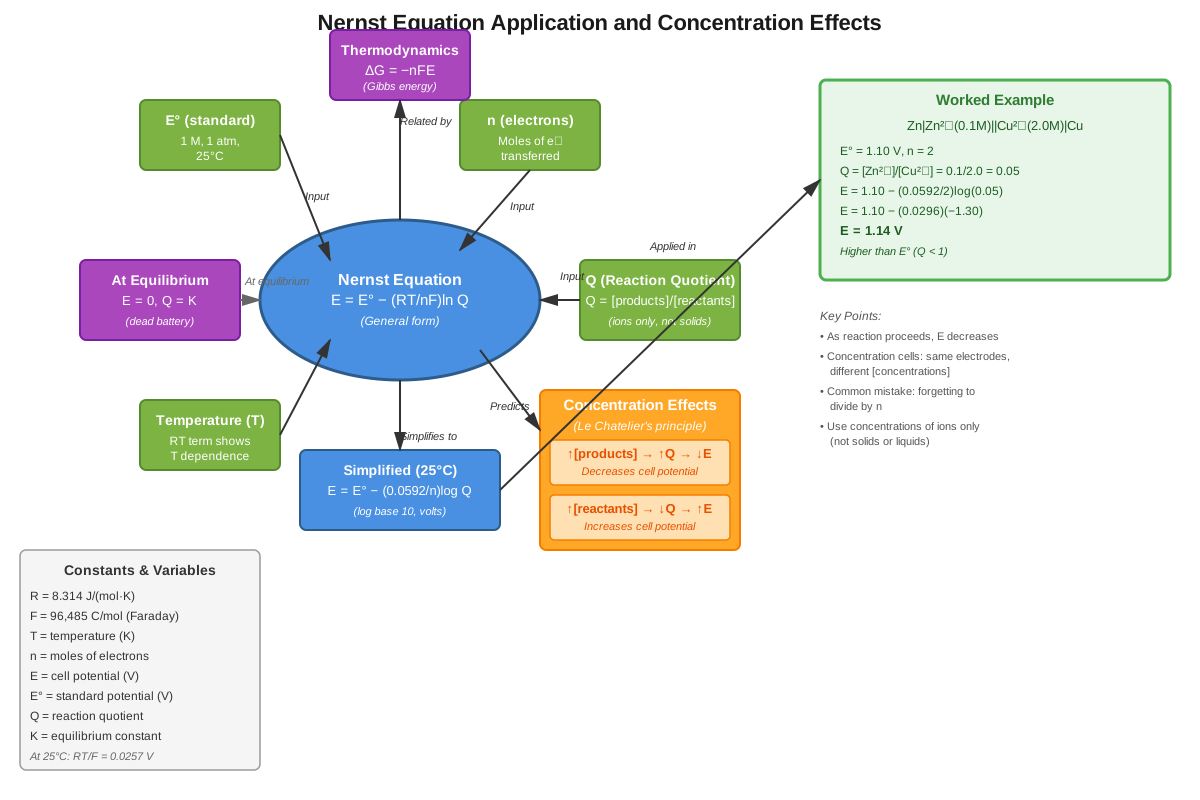
Under non-standard conditions, cell potential changes with concentration, temperature, and pressure. The Nernst equation quantifies this relationship:
Ecell = E°cell - (RT/nF) × ln(Q)At 25°C (298 K), this simplifies to:
Ecell = E°cell - (0.0592/n) × log(Q)Where Q is the reaction quotient. Key insights:
- Increasing product concentrations decreases Ecell (drives reaction backward)
- Increasing reactant concentrations increases Ecell (drives reaction forward)
- At equilibrium, Ecell = 0 and Q = K
High-Yield MCAT Connection: The Nernst equation explains concentration cells (cells with identical electrodes but different concentrations) and connects to Le Chatelier's principle.
Salt Bridge Function
The salt bridge serves two critical functions:
- Maintains electrical neutrality: As oxidation produces cations at the anode, anions from the salt bridge migrate into that solution. As reduction consumes cations at the cathode, cations from the salt bridge migrate into that solution.
- Completes the circuit: Without ionic conduction through the salt bridge, charge buildup would halt electron flow in the external circuit.
Salt bridges typically contain inert electrolytes (KCl, KNO₃, Na₂SO₄) that don't interfere with electrode reactions. The ions must be mobile and not precipitate with solution ions.
Factors Affecting Cell Potential
Several variables influence galvanic cell performance:
- Concentration: Described by the Nernst equation; affects both Ecell and reaction spontaneity
- Temperature: Higher temperatures generally increase cell potential for endothermic reactions
- Electrode surface area: Affects reaction rate (current) but not potential (intensive property)
- Electrode material: Inert electrodes (Pt, graphite) don't participate; active electrodes do
- Solution pH: Critical when H⁺ or OH⁻ appears in half-reactions
Concept Relationships
The study of galvanic cells integrates multiple General Chemistry domains. Redox reactions form the foundation—without understanding electron transfer, oxidation states, and half-reactions, galvanic cells remain incomprehensible. The standard reduction potentials determine which species undergoes oxidation versus reduction, directly establishing anode and cathode identity.
Thermodynamics connects through the ΔG°-E°cell relationship, revealing that spontaneous reactions (negative ΔG°) produce positive cell potentials. This connection extends to equilibrium concepts: when Ecell reaches zero, the system achieves equilibrium, and Q equals K. The Nernst equation mathematically links these concepts, showing how concentration changes shift both cell potential and reaction spontaneity.
Solution chemistry becomes relevant when considering electrolyte concentrations, ion migration, and salt bridge composition. The kinetics of electrode reactions determines current flow rate, though not the potential itself (an intensive property independent of reaction rate).
Within electrochemistry, galvanic cells contrast with electrolytic cells (non-spontaneous, requiring external voltage). Understanding galvanic cells enables comprehension of concentration cells (special galvanic cells with identical electrodes), fuel cells (galvanic cells with continuous reactant supply), and corrosion (unwanted galvanic processes).
Conceptual Flow: Reduction potentials → Identify anode/cathode → Calculate E°cell → Determine spontaneity (ΔG°) → Apply Nernst equation for non-standard conditions → Predict electron flow and ion migration → Understand practical applications
Quick check — test yourself on Galvanic cells so far.
Try Flashcards →High-Yield Facts
⭐ Galvanic cells have positive cell potentials (E°cell > 0) and negative Gibbs free energy changes (ΔG° < 0), making them spontaneous
⭐ Oxidation always occurs at the anode; reduction always occurs at the cathode (An Ox, Red Cat)
⭐ Electrons flow from anode to cathode through the external circuit; never through the salt bridge
⭐ E°cell = E°cathode - E°anode; the species with the more positive reduction potential becomes the cathode
⭐ The relationship ΔG° = -nFE°cell connects electrochemistry to thermodynamics
- Anions migrate toward the anode through the salt bridge; cations migrate toward the cathode
- Standard conditions for electrochemistry: 25°C, 1 M concentrations, 1 atm pressure
- The Nernst equation shows that increasing product concentration decreases cell potential
- At equilibrium, Ecell = 0 (no net electron flow) and Q = K
- Electrode surface area affects current (rate) but not voltage (potential is intensive)
- Inert electrodes (Pt, graphite) provide a surface for electron transfer without participating in reactions
- The salt bridge must contain ions that don't precipitate with solution species or interfere with electrode reactions
- Cell potential is independent of stoichiometric coefficients (intensive property), but n in ΔG° = -nFE°cell depends on balanced equation
- Concentration cells have E°cell = 0 but non-zero Ecell due to concentration differences
Common Misconceptions
Misconception: Electrons flow through the salt bridge from anode to cathode.
Correction: Electrons flow through the external circuit (wire), never through the salt bridge. The salt bridge conducts ions (anions toward anode, cations toward cathode) to maintain electrical neutrality, but electrons travel exclusively through the metallic conductor.
Misconception: The anode is always negative and the cathode is always positive.
Correction: In galvanic cells, the anode is negative (electron source) and cathode is positive (electron sink). However, in electrolytic cells, the polarity reverses: anode becomes positive and cathode becomes negative. The definitions based on oxidation/reduction remain constant across cell types.
Misconception: Doubling the stoichiometric coefficients in a half-reaction doubles the reduction potential.
Correction: Reduction potentials are intensive properties (like temperature or density) and remain unchanged regardless of stoichiometric coefficients. However, when calculating ΔG° = -nFE°cell, the value of n must match the balanced overall equation, affecting ΔG° but not E°cell.
Misconception: A larger electrode surface area increases cell potential.
Correction: Electrode surface area affects the rate of electron transfer (current) but not the potential difference (voltage). Cell potential depends on the identity of species and their concentrations, not the physical size of electrodes. Larger electrodes allow more simultaneous reactions, increasing current capacity.
Misconception: The salt bridge can be replaced with a wire to complete the circuit.
Correction: A wire conducts electrons, not ions. The salt bridge must conduct ions to prevent charge buildup in the half-cell solutions. Without ionic conduction, the anode solution would become increasingly positive (from cation production) and the cathode solution increasingly negative (from cation consumption), quickly halting the reaction.
Misconception: In the Nernst equation, Q includes all species in the cell.
Correction: The reaction quotient Q includes only species appearing in the overall balanced redox equation, using the same rules as equilibrium expressions: aqueous and gaseous species appear with their concentrations/pressures; pure solids and liquids are omitted (activity = 1).
Misconception: The species with the more negative reduction potential is always the anode.
Correction: While this is often true when comparing two half-reactions, the anode is defined as where oxidation occurs. In a cell, the species with the less positive (or more negative) reduction potential undergoes oxidation and becomes the anode. Always identify the anode by the oxidation process, not just by comparing signs.
Worked Examples
Example 1: Calculating Standard Cell Potential and Predicting Spontaneity
Problem: A galvanic cell is constructed using silver and zinc electrodes. The half-reactions are:
- Ag⁺(aq) + e⁻ → Ag(s) E° = +0.80 V
- Zn²⁺(aq) + 2e⁻ → Zn(s) E° = -0.76 V
(a) Identify the anode and cathode
(b) Calculate E°cell
(c) Determine if the reaction is spontaneous
(d) Write the cell notation
Solution:
(a) Identifying anode and cathode: The species with the more positive reduction potential undergoes reduction (becomes the cathode). Silver has E° = +0.80 V (more positive than zinc's -0.76 V), so silver is reduced at the cathode. Zinc must be oxidized at the anode.
- Cathode (reduction): Ag⁺(aq) + e⁻ → Ag(s)
- Anode (oxidation): Zn(s) → Zn²⁺(aq) + 2e⁻
(b) Calculating E°cell:
E°cell = E°cathode - E°anode
E°cell = (+0.80 V) - (-0.76 V)
E°cell = +1.56 V
(c) Determining spontaneity: Since E°cell = +1.56 V (positive), the reaction is spontaneous. We can verify using thermodynamics:
ΔG° = -nFE°cell
ΔG° = -(2 mol e⁻)(96,485 C/mol)(1.56 V)
ΔG° = -301,000 J/mol = -301 kJ/mol
The negative ΔG° confirms spontaneity.
(d) Cell notation:
Zn(s) | Zn²⁺(aq) || Ag⁺(aq) | Ag(s)The anode (zinc) appears on the left, cathode (silver) on the right, with the salt bridge (||) separating them.
Key Learning Points: This example demonstrates how to use reduction potential tables to identify anode/cathode, calculate cell potential, and connect to thermodynamic spontaneity. Notice that we didn't need to balance the overall equation to calculate E°cell (intensive property), but we did need n = 2 for the ΔG° calculation.
Example 2: Applying the Nernst Equation
Problem: A galvanic cell operates with the following half-reactions at 25°C:
- Cu²⁺(aq) + 2e⁻ → Cu(s) E° = +0.34 V
- Zn²⁺(aq) + 2e⁻ → Zn(s) E° = -0.76 V
If [Cu²⁺] = 0.10 M and [Zn²⁺] = 2.0 M, calculate the cell potential under these non-standard conditions.
Solution:
Step 1: Identify the overall reaction and E°cell.
Copper has the more positive reduction potential, so it's reduced at the cathode. Zinc is oxidized at the anode.
Overall reaction: Zn(s) + Cu²⁺(aq) → Zn²⁺(aq) + Cu(s)
E°cell = E°cathode - E°anode = (+0.34 V) - (-0.76 V) = +1.10 VStep 2: Write the reaction quotient Q.
Q = [Zn²⁺]/[Cu²⁺] = (2.0 M)/(0.10 M) = 20Note: Pure solids (Zn and Cu) are omitted from Q.
Step 3: Apply the Nernst equation.
Ecell = E°cell - (0.0592/n) × log(Q)With n = 2 (two electrons transferred):
Ecell = 1.10 V - (0.0592/2) × log(20)
Ecell = 1.10 V - (0.0296) × (1.30)
Ecell = 1.10 V - 0.038 V
Ecell = 1.06 V
Step 4: Interpret the result.
The cell potential decreased from 1.10 V (standard) to 1.06 V (actual) because the product concentration [Zn²⁺] is higher than standard (1 M) and the reactant concentration [Cu²⁺] is lower than standard. According to Le Chatelier's principle, high product concentration and low reactant concentration both oppose the forward reaction, reducing the driving force (voltage).
Key Learning Points: This example shows how to apply the Nernst equation systematically. Remember that Q follows the same rules as equilibrium expressions, and increasing Q (more products, fewer reactants) always decreases Ecell. The cell remains spontaneous (Ecell > 0) but with reduced driving force.
Exam Strategy
Approaching MCAT Galvanic Cell Questions
Step 1: Identify the question type
- Calculation (E°cell, Ecell, ΔG°)
- Conceptual (electron flow, ion migration, component identification)
- Experimental (predicting effects of changes, troubleshooting)
Step 2: Extract key information
- Locate reduction potentials (in passage or from memory)
- Note concentrations if Nernst equation applies
- Identify what's being asked (anode? cathode? voltage? spontaneity?)
Step 3: Determine anode and cathode
- More positive E° → cathode (reduction)
- Less positive E° → anode (oxidation)
- Verify with "An Ox, Red Cat"
Step 4: Calculate or reason systematically
- For calculations: Write the formula, substitute values, solve
- For conceptual questions: Use directional rules (electrons to cathode, anions to anode)
Trigger Words and Phrases
- "Spontaneous electrochemical cell" → Galvanic cell (E°cell > 0, ΔG° < 0)
- "Battery" or "voltaic cell" → Galvanic cell
- "Generates electrical energy" → Galvanic cell
- "Positive terminal" → Cathode in galvanic cell
- "Negative terminal" → Anode in galvanic cell
- "Non-standard conditions" → Use Nernst equation
- "At equilibrium" → Ecell = 0, Q = K
- "Salt bridge removed" → Cell stops functioning (charge buildup)
Process of Elimination Tips
When identifying the anode:
- Eliminate any answer showing reduction (anode = oxidation only)
- Eliminate the species with higher E° (that's the cathode)
When calculating E°cell:
- Eliminate negative values for galvanic cells (must be positive)
- Eliminate values larger than the difference between the two E° values
When predicting electron flow:
- Eliminate any path through the salt bridge (electrons use external circuit)
- Eliminate flow from cathode to anode (opposite of actual direction)
Time Allocation
- Simple E°cell calculation: 30-45 seconds
- Nernst equation problem: 60-90 seconds
- Conceptual question with diagram: 45-60 seconds
- Passage-based multi-step problem: 2-3 minutes
Exam Tip: If a question asks about both E°cell and ΔG°, calculate E°cell first (simpler), then use ΔG° = -nFE°cell. Don't try to calculate ΔG° from thermodynamic tables—the electrochemical route is faster.
Memory Techniques
Mnemonics
"An Ox, Red Cat"
- Anode = Oxidation
- Reduction = Cathode
"FAT CAT" (for electron and ion flow)
- Flow of electrons: Anode To cathode
- Cations move to Cathode; Anions move to Anode (through salt bridge)
"LEO says GER" (for redox)
- Lose Electrons = Oxidation
- Gain Electrons = Reduction
Visualization Strategy
Mental Image for Galvanic Cell:
Picture a "Z" shape:
- Top left: Zinc anode (oxidation, electron source, negative terminal)
- Diagonal: Electrons flowing through wire (external circuit)
- Top right: Copper cathode (reduction, electron sink, positive terminal)
- Bottom: Salt bridge connecting the solutions (ions migrating)
The "Z" reminds you that Zinc is typically the anode in common examples, and the diagonal represents electron flow direction.
Acronym for Standard Conditions
"STOP" for Standard Temperature, One molar, one atm Pressure
- Standard Temperature: 25°C (298 K)
- One molar: 1 M concentrations
- Pressure: 1 atm
Nernst Equation Memory Aid
"Nernst Needs Products on Top"
Reminds you that Q = [products]/[reactants], and increasing Q (more products) decreases Ecell.
Summary
Galvanic cells are spontaneous electrochemical devices that convert chemical energy into electrical energy through spatially separated redox reactions. The fundamental architecture includes an anode (where oxidation occurs), a cathode (where reduction occurs), a salt bridge (maintaining electrical neutrality through ion migration), and an external circuit (conducting electrons from anode to cathode). The species with the more positive reduction potential undergoes reduction at the cathode, while the species with less positive reduction potential undergoes oxidation at the anode. Standard cell potential (E°cell) equals the difference between cathode and anode reduction potentials, and positive E°cell values indicate spontaneous reactions. The relationship ΔG° = -nFE°cell connects electrochemistry to thermodynamics, confirming that positive cell potentials correspond to negative Gibbs free energy changes. Under non-standard conditions, the Nernst equation quantifies how concentration changes affect cell potential, with increased product concentrations decreasing voltage and increased reactant concentrations increasing voltage. Mastery of galvanic cells requires understanding directional flows (electrons through external circuit, ions through salt bridge), performing calculations (E°cell, ΔG°, Nernst equation), and connecting concepts across General Chemistry domains.
Key Takeaways
- Galvanic cells are spontaneous (E°cell > 0, ΔG° < 0) and generate electrical energy from redox reactions
- Oxidation always occurs at the anode (electron loss); reduction always occurs at the cathode (electron gain)
- Electrons flow from anode to cathode through the external circuit; ions migrate through the salt bridge to maintain neutrality
- Calculate E°cell = E°cathode - E°anode using the more positive reduction potential as the cathode
- The relationship ΔG° = -nFE°cell connects electrochemical potential to thermodynamic spontaneity
- The Nernst equation (Ecell = E°cell - (0.0592/n)log Q) describes how concentration affects cell potential under non-standard conditions
- Cell potential is an intensive property independent of stoichiometric coefficients and electrode surface area
Related Topics
Electrolytic Cells: Non-spontaneous electrochemical cells requiring external voltage to drive reactions; understanding galvanic cells provides the foundation for recognizing the key differences (negative E°cell, reversed spontaneity, external power source).
Concentration Cells: Special galvanic cells with identical electrodes but different concentrations; mastery of the Nernst equation enables calculation of voltage generated purely from concentration gradients.
Corrosion and Electrochemical Series: Unwanted galvanic processes where metals oxidize in the presence of oxygen and water; understanding reduction potentials predicts which metals corrode and how to prevent degradation.
Biological Redox Systems: Electron transport chains in mitochondria and chloroplasts function as biological galvanic cells; the principles of electron flow and potential differences apply to ATP synthesis.
Thermodynamics and Equilibrium: The connection between E°cell, ΔG°, and K deepens understanding of spontaneity and equilibrium; galvanic cells provide a practical application of thermodynamic principles.
Practice CTA
Now that you've mastered the core concepts of galvanic cells, it's time to solidify your understanding through active practice. Attempt the practice questions to test your ability to calculate cell potentials, predict electron flow, and apply the Nernst equation under exam conditions. Use the flashcards to reinforce high-yield facts and directional rules until they become automatic. Remember: electrochemistry questions reward systematic thinking and careful attention to signs and directions. With focused practice, you'll develop the confidence to tackle any galvanic cell question the MCAT presents. Your investment in mastering this high-yield topic will pay dividends across multiple questions on test day!
Sign up free to keep reading
Create a free AnvayaPrep account to finish this MCAT guide on Galvanic cells — plus flashcards and practice questions.