Overview
Standard reduction potentials represent one of the most quantitative and predictive concepts in electrochemistry, providing a systematic method to determine the spontaneity and voltage of redox reactions. In the context of General Chemistry for the MCAT, this topic bridges thermodynamics, kinetics, and practical applications ranging from biological electron transport chains to industrial battery design. Understanding standard reduction potentials allows students to predict which species will be oxidized or reduced in any given electrochemical cell, calculate cell potentials, and relate electrical energy to Gibbs free energy changes.
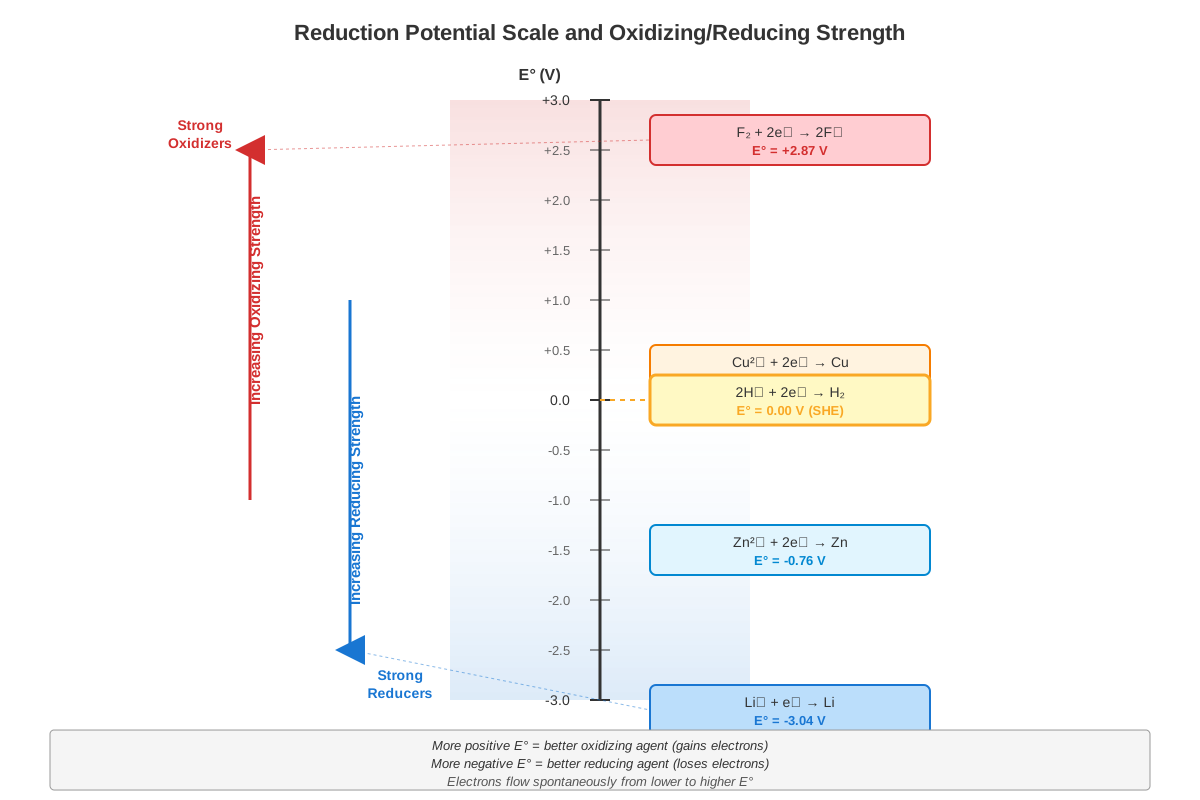
The standard reduction potential (E°) is defined as the voltage associated with a reduction half-reaction measured under standard conditions (25°C, 1 M concentration for aqueous species, 1 atm pressure for gases) relative to the standard hydrogen electrode (SHE), which is assigned a potential of exactly 0.00 V. These potentials are tabulated values that serve as a universal reference system, enabling chemists and test-takers alike to compare the relative oxidizing and reducing strengths of different chemical species. A more positive E° indicates a stronger oxidizing agent (greater tendency to gain electrons), while a more negative E° indicates a stronger reducing agent (greater tendency to lose electrons).
For the MCAT, standard reduction potentials appear frequently in both discrete questions and passage-based scenarios, particularly in General Chemistry and Biological Sciences sections where metabolism, respiration, and photosynthesis involve electron transfer. Mastery of this topic enables students to quickly determine cell voltages, predict reaction spontaneity using the relationship between E°cell and ΔG°, and understand concentration effects through the Nernst equation. This topic integrates seamlessly with thermodynamics, equilibrium, and kinetics, making it a high-yield area that rewards systematic study and practice.
Learning Objectives
- [ ] Define standard reduction potentials using accurate General Chemistry terminology
- [ ] Explain why standard reduction potentials matter for the MCAT
- [ ] Apply standard reduction potentials to exam-style questions
- [ ] Identify common mistakes related to standard reduction potentials
- [ ] Connect standard reduction potentials to related General Chemistry concepts
- [ ] Calculate standard cell potentials from tabulated reduction potentials
- [ ] Predict the spontaneity of redox reactions using E°cell values
- [ ] Determine which species acts as the oxidizing agent and which as the reducing agent in an electrochemical cell
- [ ] Relate standard reduction potentials to equilibrium constants and Gibbs free energy
Prerequisites
- Oxidation-reduction (redox) reactions: Understanding electron transfer, oxidation states, and balancing redox equations is essential for interpreting half-reactions and combining them to form complete electrochemical cells
- Thermodynamics fundamentals: Knowledge of Gibbs free energy (ΔG), spontaneity, and the relationship between ΔG and equilibrium constants provides the conceptual foundation for understanding why certain reactions proceed
- Basic electrochemistry terminology: Familiarity with terms like anode, cathode, oxidation, reduction, galvanic cells, and electrolytic cells ensures efficient comprehension of how reduction potentials apply to different cell types
- Standard conditions: Understanding what constitutes standard state (1 M, 1 atm, 25°C) is necessary for correctly interpreting tabulated E° values
Why This Topic Matters
Standard reduction potentials have profound clinical and real-world significance. In biological systems, the electron transport chain in mitochondria operates as a series of coupled redox reactions, each with characteristic reduction potentials that determine the direction and efficiency of electron flow. The reduction potential difference between NADH and oxygen drives ATP synthesis, the fundamental energy currency of cells. Understanding these potentials helps explain why certain toxins (like cyanide) are lethal—they disrupt the electron transport chain by interfering with specific redox couples.
On the MCAT, standard reduction potentials appear in approximately 3-5% of General Chemistry questions and frequently in biochemistry passages involving metabolism. Questions typically fall into three categories: (1) calculation-based problems requiring students to determine E°cell from tabulated values, (2) conceptual questions asking students to predict spontaneity or identify oxidizing/reducing agents, and (3) passage-based scenarios involving biological electron carriers like NAD+/NADH, FAD/FADH₂, or cytochromes. The AAMC consistently tests the ability to integrate reduction potentials with thermodynamic principles, particularly the relationship E°cell = (RT/nF)ln(K) and ΔG° = -nFE°cell.
Common passage contexts include fuel cells, corrosion processes, battery technologies, and biological redox systems. Students must be prepared to extract reduction potentials from tables, manipulate half-reactions (including reversing them and changing signs appropriately), and apply the Nernst equation to non-standard conditions. The ability to quickly identify which half-reaction should be reversed to create a spontaneous cell (positive E°cell) is a high-yield skill that distinguishes top scorers.
Core Concepts
Definition and Standard Conditions
The standard reduction potential (E°) quantifies the tendency of a chemical species to gain electrons (be reduced) under standard conditions. By convention, all reduction potentials are tabulated as reduction half-reactions, meaning electrons appear on the reactant side. Standard conditions include:
- Temperature: 25°C (298 K)
- Concentration: 1 M for all aqueous species
- Pressure: 1 atm for all gases
- Activity: Pure solids and liquids have activity = 1
The standard hydrogen electrode (SHE) serves as the universal reference point, defined as:
2H⁺(aq) + 2e⁻ → H₂(g) E° = 0.00 VAll other reduction potentials are measured relative to this reference. A positive E° indicates the species is more easily reduced than H⁺, while a negative E° indicates it is less easily reduced than H⁺.
Interpreting Reduction Potential Values
The magnitude and sign of E° reveal critical information about chemical behavior:
| E° Value | Interpretation | Example |
|---|---|---|
| Large positive (>+1.0 V) | Strong oxidizing agent; readily gains electrons | F₂/F⁻ (+2.87 V) |
| Small positive (0 to +1.0 V) | Moderate oxidizing agent | Cu²⁺/Cu (+0.34 V) |
| Small negative (0 to -1.0 V) | Moderate reducing agent | Zn²⁺/Zn (-0.76 V) |
| Large negative (<-1.0 V) | Strong reducing agent; readily loses electrons | Li⁺/Li (-3.04 V) |
Oxidizing agents are species that get reduced (gain electrons), found on the left side of reduction half-reactions. Reducing agents are species that get oxidized (lose electrons), found on the right side of reduction half-reactions. The strongest oxidizing agents have the most positive E° values, while the strongest reducing agents have the most negative E° values.
Calculating Standard Cell Potential
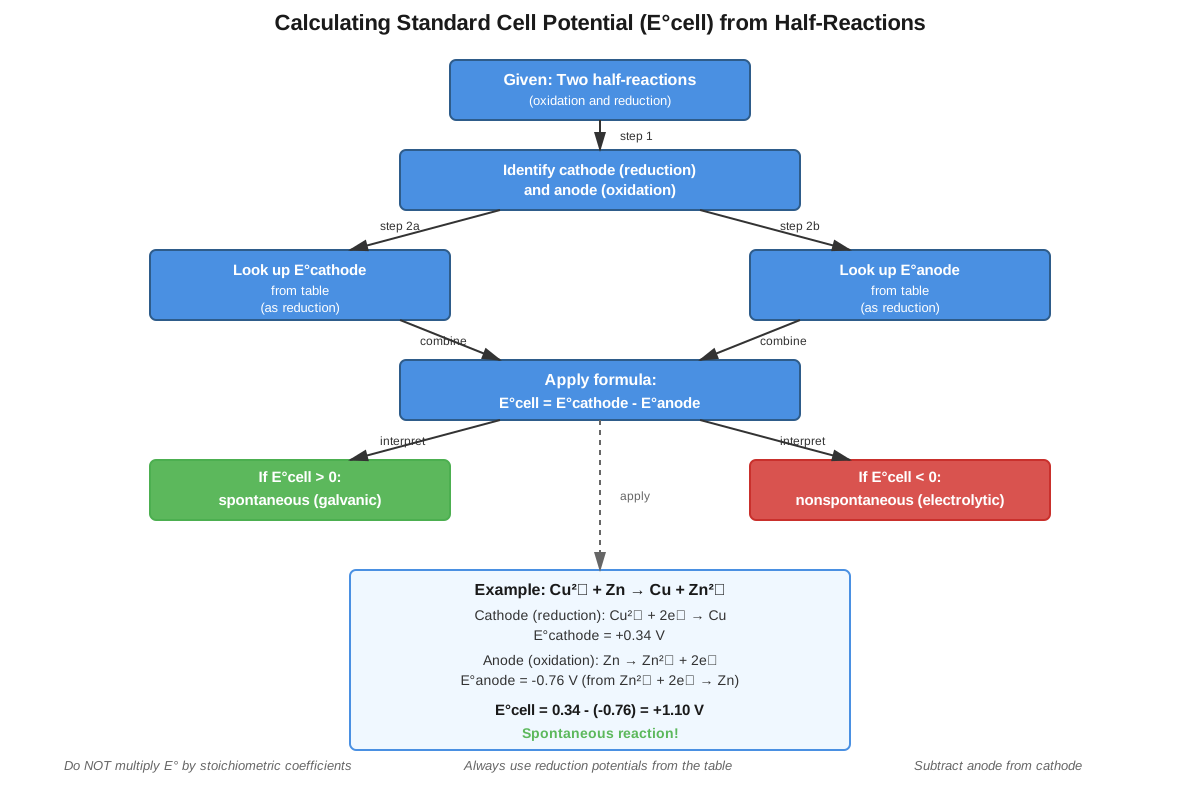
To determine the standard cell potential (E°cell) for a complete redox reaction:
- Identify the two half-reactions involved
- Determine which half-reaction will proceed as reduction (higher E°) and which as oxidation (lower E°)
- Reverse the oxidation half-reaction (this changes the sign of its E°)
- Add the reduction potential and the reversed oxidation potential
The formula is:
E°cell = E°cathode - E°anodeOr equivalently:
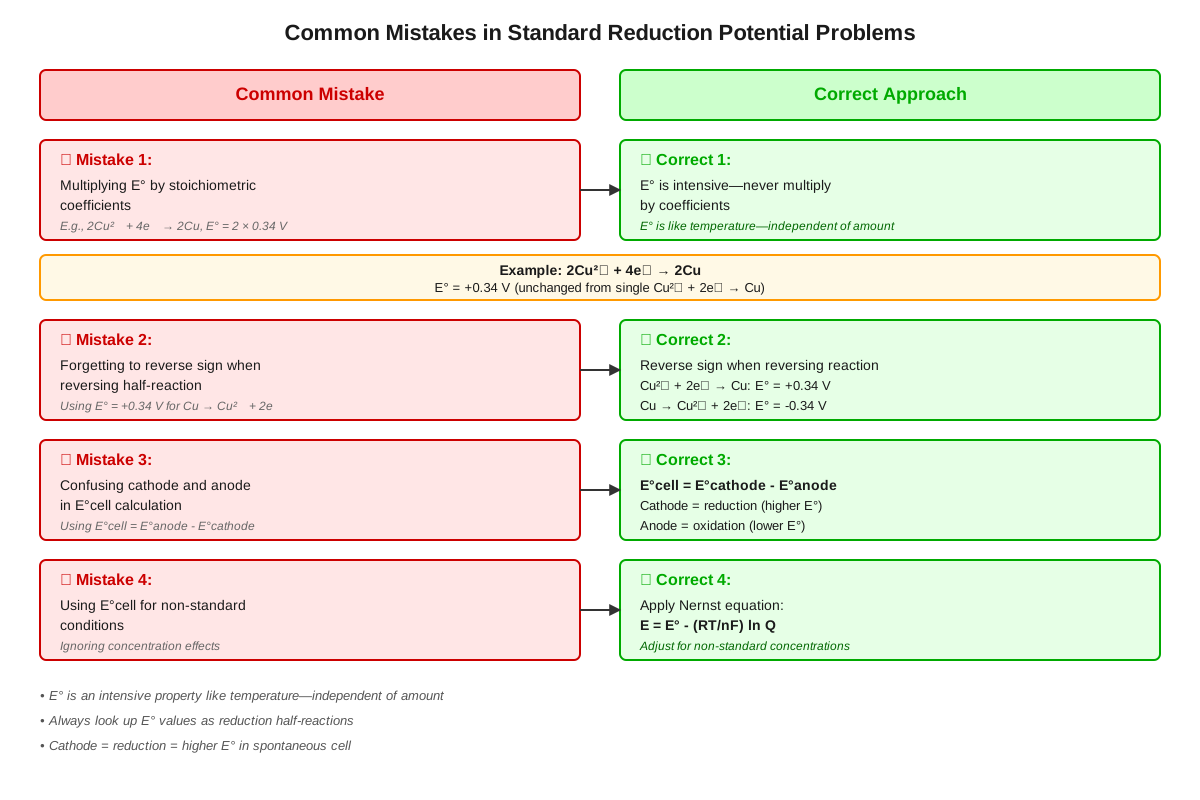
E°cell = E°reduction - E°oxidationCritical point: When reversing a half-reaction to represent oxidation, change the sign of E° but do NOT multiply by stoichiometric coefficients. Reduction potentials are intensive properties (like temperature or density) and do not scale with the amount of material.
Example Calculation
Consider a cell with zinc and copper electrodes:
Zn²⁺(aq) + 2e⁻ → Zn(s)     E° = -0.76 V
Cu²⁺(aq) + 2e⁻ → Cu(s)     E° = +0.34 V
Since copper has the more positive reduction potential, it will be reduced (cathode). Zinc will be oxidized (anode):
Oxidation (anode): Zn(s) → Zn²⁺(aq) + 2e⁻     E° = +0.76 V (sign changed)
Reduction (cathode): Cu²⁺(aq) + 2e⁻ → Cu(s)   E° = +0.34 V
E°cell = E°cathode - E°anode = +0.34 V - (-0.76 V) = +1.10 VThe positive E°cell indicates this reaction is spontaneous under standard conditions.
Relationship to Gibbs Free Energy
The connection between electrochemistry and thermodynamics is expressed through:
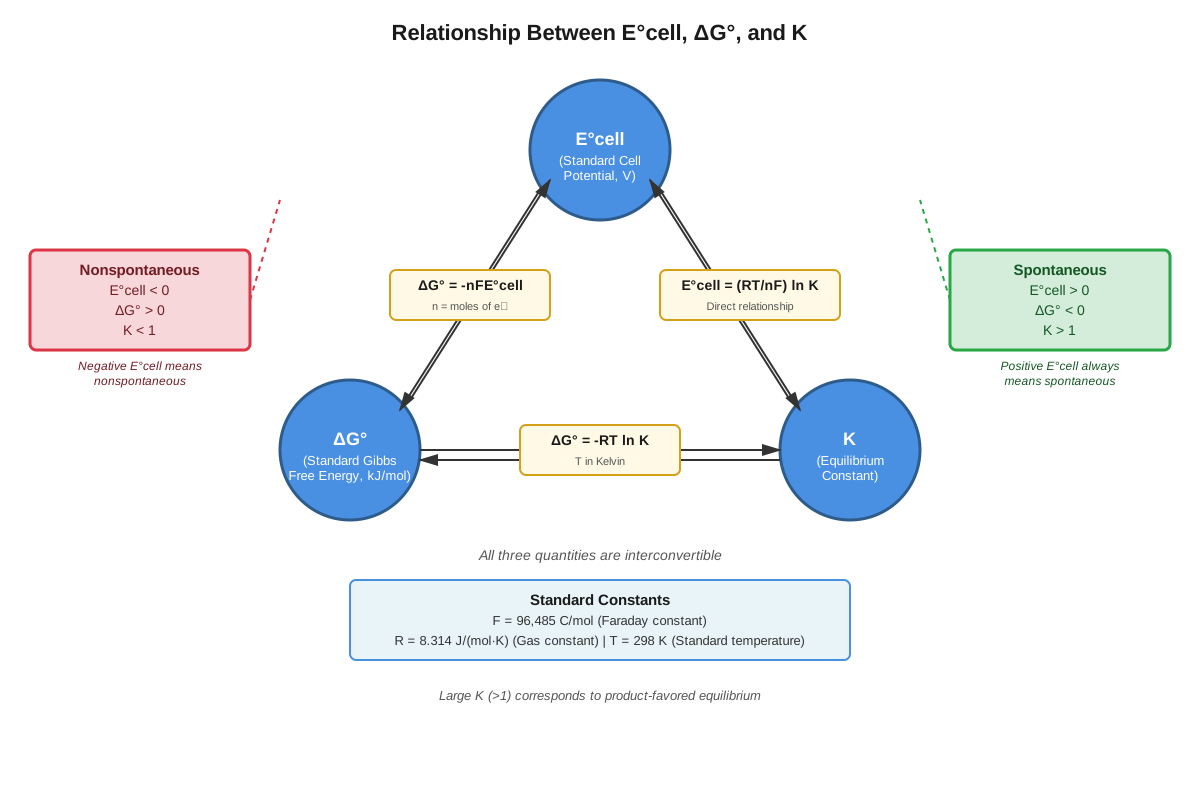
ΔG° = -nFE°cellWhere:
- ΔG° = standard Gibbs free energy change (J/mol)
- n = number of moles of electrons transferred
- F = Faraday's constant (96,485 C/mol or approximately 96,500 C/mol for MCAT calculations)
- E°cell = standard cell potential (V)
This equation reveals that:
- Positive E°cell → Negative ΔG° → Spontaneous reaction
- Negative E°cell → Positive ΔG° → Non-spontaneous reaction
- E°cell = 0 → ΔG° = 0 → Reaction at equilibrium
Relationship to Equilibrium Constant
At equilibrium, the cell potential equals zero, and the relationship between E°cell and the equilibrium constant K is:
E°cell = (RT/nF) ln(K)Or at 25°C, using the conversion to base-10 logarithm:
E°cell = (0.0592 V/n) log(K)This equation shows that:
- Large positive E°cell → Large K → Products strongly favored
- Large negative E°cell → Small K → Reactants strongly favored
The Nernst Equation
Under non-standard conditions, the Nernst equation adjusts the cell potential:
E = E° - (RT/nF) ln(Q)Or at 25°C:
E = E° - (0.0592 V/n) log(Q)Where Q is the reaction quotient. This equation is crucial for understanding how concentration changes affect cell potential and is frequently tested on the MCAT in the context of biological systems where concentrations rarely match standard conditions.
Galvanic vs. Electrolytic Cells
Galvanic (voltaic) cells have positive E°cell values and generate electrical energy from spontaneous redox reactions. In these cells:
- The anode is negative (site of oxidation)
- The cathode is positive (site of reduction)
- Electrons flow from anode to cathode through the external circuit
Electrolytic cells have negative E°cell values for the desired reaction and require external electrical energy to drive non-spontaneous reactions. In these cells:
- The anode is positive (connected to positive terminal)
- The cathode is negative (connected to negative terminal)
- The same redox processes occur (oxidation at anode, reduction at cathode)
Concept Relationships
Standard reduction potentials serve as the quantitative bridge connecting multiple electrochemistry concepts. The foundational understanding of redox reactions and oxidation states enables identification of which species are oxidized and reduced, which then allows application of tabulated E° values. These potentials directly determine cell potential (E°cell), which in turn governs spontaneity through the relationship with Gibbs free energy (ΔG° = -nFE°cell).
The connection flows: Reduction potentials → E°cell calculation → Spontaneity prediction → Equilibrium constant determination. When conditions deviate from standard state, the Nernst equation modifies E° to account for concentration effects, linking back to Le Chatelier's principle and reaction quotient concepts from equilibrium chemistry.
In biological contexts, standard reduction potentials explain the directionality of electron transport chains, where electrons flow from species with more negative potentials (NADH, E° ≈ -0.32 V) to those with more positive potentials (O₂/H₂O, E° ≈ +0.82 V), releasing energy captured in ATP synthesis. This connects electrochemistry to bioenergetics and metabolism.
The relationship between E°cell and K (through E°cell = (0.0592/n)log(K)) unifies electrochemistry with chemical equilibrium, demonstrating that large positive cell potentials correspond to reactions that proceed essentially to completion (K >> 1), while negative cell potentials indicate reactions that barely proceed (K << 1).
Quick check — test yourself on Standard reduction potentials so far.
Try Flashcards →High-Yield Facts
⭐ Standard reduction potentials are always tabulated as reduction half-reactions; when a half-reaction is reversed to represent oxidation, the sign of E° must be changed
⭐ E°cell = E°cathode - E°anode; a positive E°cell indicates a spontaneous reaction under standard conditions
⭐ The relationship ΔG° = -nFE°cell connects electrochemistry to thermodynamics; positive E°cell means negative ΔG° and spontaneous reaction
⭐ Reduction potentials are intensive properties and do NOT change when half-reaction coefficients are multiplied
⭐ The species with the more positive reduction potential will be reduced (acts as oxidizing agent); the species with the more negative reduction potential will be oxidized (acts as reducing agent)
- The standard hydrogen electrode (SHE) is defined as 0.00 V and serves as the reference for all other reduction potentials
- Strong oxidizing agents (like F₂, Cl₂, MnO₄⁻) have large positive E° values and appear on the left side of reduction half-reactions
- Strong reducing agents (like Li, Na, Zn) have large negative E° values and appear on the right side of reduction half-reactions
- At 25°C, the simplified Nernst equation is E = E° - (0.0592/n)log(Q)
- The relationship E°cell = (0.0592/n)log(K) at 25°C connects cell potential to equilibrium constant
- In galvanic cells, the anode is negative and the cathode is positive; electrons flow from anode to cathode externally
- Faraday's constant (F) equals approximately 96,500 C/mol for MCAT calculations
- Biological electron carriers like NAD+/NADH (E° ≈ -0.32 V) and FAD/FADH₂ (E° ≈ -0.22 V) have characteristic reduction potentials that determine electron flow direction
Common Misconceptions
Misconception: Reduction potentials must be multiplied by stoichiometric coefficients when balancing redox equations.
Correction: Reduction potentials are intensive properties (like temperature or density) that do not depend on the amount of substance. When balancing equations, multiply the number of electrons but never multiply E° values. For example, if you need to double a half-reaction to balance electrons, E° remains unchanged.
Misconception: The half-reaction with the more positive E° always occurs at the anode.
Correction: The half-reaction with the more positive E° occurs at the cathode (reduction). The more negative E° half-reaction occurs at the anode (oxidation). Remember: cathode = reduction = more positive E°; anode = oxidation = more negative E°.
Misconception: A negative E°cell means the reaction cannot occur under any circumstances.
Correction: A negative E°cell indicates the reaction is non-spontaneous under standard conditions, but it can be driven by external electrical energy (electrolytic cell) or may become spontaneous under non-standard conditions where Q affects the cell potential through the Nernst equation.
Misconception: In the equation E°cell = E°cathode - E°anode, you should use the E° values exactly as listed in the table.
Correction: Use the E° value from the table for the cathode (reduction) directly, and subtract the E° value from the table for the anode. Do not change signs before substituting into this equation—the subtraction operation handles the sign change automatically.
Misconception: The Nernst equation can be ignored on the MCAT because all problems use standard conditions.
Correction: Many MCAT passages, especially those involving biological systems, explicitly state non-standard concentrations. The Nernst equation is essential for understanding how concentration gradients (like proton gradients in mitochondria) affect electrochemical potentials and drive biological processes.
Misconception: A larger positive E° value means a species is a better reducing agent.
Correction: A larger positive E° indicates a stronger oxidizing agent (more readily reduced). Strong reducing agents have large negative E° values because they readily lose electrons (are easily oxidized). For example, Li (E° = -3.04 V) is an excellent reducing agent, while F₂ (E° = +2.87 V) is an excellent oxidizing agent.
Worked Examples
Example 1: Determining Cell Potential and Spontaneity
Question: Given the following standard reduction potentials, determine the standard cell potential for a cell constructed with silver and zinc electrodes, identify the anode and cathode, and predict whether the reaction is spontaneous.
Ag⁺(aq) + e⁻ → Ag(s)      E° = +0.80 V
Zn²⁺(aq) + 2e⁻ → Zn(s) E° = -0.76 VSolution:
Step 1: Identify which half-reaction will be reduced and which will be oxidized.
- Silver has the more positive E° (+0.80 V), so it will be reduced at the cathode
- Zinc has the more negative E° (-0.76 V), so it will be oxidized at the anode
Step 2: Write the half-reactions as they will occur:
Cathode (reduction): Ag⁺(aq) + e⁻ → Ag(s)           E° = +0.80 V
Anode (oxidation): Zn(s) → Zn²⁺(aq) + 2e⁻           E° = +0.76 V (sign changed)
Step 3: Calculate E°cell:
E°cell = E°cathode - E°anode = +0.80 V - (-0.76 V) = +1.56 VStep 4: Balance the complete equation (multiply silver half-reaction by 2):
2Ag⁺(aq) + Zn(s) → 2Ag(s) + Zn²⁺(aq) E°cell = +1.56 VNote: E°cell remains +1.56 V even though we multiplied the silver half-reaction by 2.
Step 5: Determine spontaneity:
Since E°cell is positive (+1.56 V), the reaction is spontaneous under standard conditions. We can verify this using ΔG°:
ΔG° = -nFE°cell = -(2 mol e⁻)(96,500 C/mol)(1.56 V) = -301,080 J/mol = -301 kJ/molThe negative ΔG° confirms spontaneity.
Answer: E°cell = +1.56 V; zinc is the anode (oxidation), silver is the cathode (reduction); the reaction is spontaneous under standard conditions.
Example 2: Applying the Nernst Equation
Question: A concentration cell is constructed using two copper electrodes. One half-cell contains 0.10 M Cu²⁺ and the other contains 1.0 M Cu²⁺. Calculate the cell potential at 25°C.
Solution:
Step 1: Recognize this is a concentration cell where both electrodes are the same material but different concentrations.
Step 2: Write the half-reactions:
Cathode (higher concentration): Cu²⁺(1.0 M) + 2e⁻ → Cu(s)
Anode (lower concentration): Cu(s) → Cu²⁺(0.10 M) + 2e⁻
Step 3: For a concentration cell, E°cell = 0 because both half-reactions have the same E° value.
Step 4: Write the overall reaction:
Cu²⁺(1.0 M) → Cu²⁺(0.10 M)Step 5: Apply the Nernst equation:
E = E° - (0.0592/n) log(Q)Where:
- E° = 0 V (concentration cell)
- n = 2 (two electrons transferred)
- Q = [Cu²⁺]anode/[Cu²⁺]cathode = 0.10/1.0 = 0.10
E = 0 - (0.0592/2) log(0.10)
E = -(0.0296) log(10⁻¹)
E = -(0.0296)(-1)
E = +0.0296 V ≈ +0.030 V
Step 6: Interpret the result:
The positive cell potential indicates electrons flow from the dilute solution (anode) to the concentrated solution (cathode), which makes sense because the system moves toward equilibrium by equalizing concentrations.
Answer: The cell potential is approximately +0.030 V at 25°C.
Exam Strategy
When approaching MCAT questions on standard reduction potentials, begin by identifying whether the question asks for (1) calculation of E°cell, (2) prediction of spontaneity, (3) identification of oxidizing/reducing agents, or (4) application of the Nernst equation. This categorization immediately narrows your approach.
Trigger words and phrases to watch for:
- "Standard conditions" → Use E° values directly
- "Non-standard conditions" or specific concentrations given → Apply Nernst equation
- "Which species is reduced?" → Look for the more positive E°
- "Spontaneous reaction" → Calculate E°cell and check if positive
- "Anode" → Site of oxidation (more negative E°)
- "Cathode" → Site of reduction (more positive E°)
- "Oxidizing agent" → Species being reduced (left side of reduction half-reaction)
- "Reducing agent" → Species being oxidized (right side of reduction half-reaction)
Process-of-elimination strategies:
- If a question asks which reaction is spontaneous, immediately eliminate any answer choice with negative E°cell
- If asked to identify the cathode, eliminate any answer showing oxidation occurring
- For questions about strong oxidizing agents, eliminate species with negative E° values
- When comparing cell potentials, eliminate answers that incorrectly multiply E° by stoichiometric coefficients
Time allocation: Standard reduction potential calculations typically require 60-90 seconds for straightforward problems. If a question involves the Nernst equation or requires balancing complex redox equations first, allocate up to 2 minutes. If you cannot quickly identify which half-reaction should be reversed, write both half-reactions with their E° values and remember: the more positive E° is always reduced.
Quick check strategy: After calculating E°cell, perform a sanity check by asking: "Does this make chemical sense?" For example, if you calculated that zinc reduces copper ions with a negative E°cell, you know something is wrong because this is a classic spontaneous reaction (Zn is more reactive than Cu).
Exam Tip: The MCAT often provides reduction potential tables within passages. Practice quickly scanning these tables to identify the strongest oxidizing agent (most positive E°) and strongest reducing agent (most negative E°). This skill alone can answer multiple questions without detailed calculations.
Memory Techniques
RED CAT and AN OX:
- REDuction occurs at the CAThode
- ANode is where OXidation occurs
"Positive Potential, Positive Cathode" (for galvanic cells):
- More positive E° → Cathode
- Positive E°cell → Spontaneous (galvanic cell)
- In galvanic cells, cathode is the positive terminal
"FAT CAT" for electron flow:
- Electrons flow From Anode To CAThode (through external circuit)
The "Alphabet Rule":
- E°cell = E°Cathode - E°Anode
- C comes before A in the alphabet, just as cathode comes first in the equation
Nernst Equation Memory:
- "0.0592 over n times log Q"
- Remember 0.06 is close enough for quick estimates (0.0592 ≈ 0.06)
- The equation subtracts from E°, so increasing Q (more products) decreases E
Oxidizing vs. Reducing Agents:
- Oxidizing agents have Obviously positive E° (more positive)
- Reducing agents are Really negative E° (more negative)
Visualization for E° tables:
Picture a vertical number line with positive values at top and negative at bottom:
- Top = Strong oxidizers (want electrons, get reduced)
- Bottom = Strong reducers (give electrons, get oxidized)
- Electrons "fall" from bottom to top, releasing energy
Summary
Standard reduction potentials provide a quantitative framework for predicting and analyzing redox reactions in electrochemical cells. These potentials, measured relative to the standard hydrogen electrode (0.00 V), indicate the tendency of species to gain electrons under standard conditions. More positive E° values correspond to stronger oxidizing agents, while more negative values indicate stronger reducing agents. To calculate the standard cell potential, subtract the anode potential from the cathode potential (E°cell = E°cathode - E°anode), where the cathode undergoes reduction (more positive E°) and the anode undergoes oxidation (more negative E°). A positive E°cell indicates a spontaneous reaction with negative ΔG°, connected through the relationship ΔG° = -nFE°cell. Reduction potentials are intensive properties that never change with stoichiometric coefficients. Under non-standard conditions, the Nernst equation adjusts cell potential based on concentration through E = E° - (0.0592/n)log(Q). For MCAT success, students must rapidly identify oxidizing and reducing agents, calculate cell potentials without multiplying E° values, and connect electrochemical concepts to thermodynamic spontaneity and biological electron transport systems.
Key Takeaways
- Standard reduction potentials (E°) measure the tendency to gain electrons relative to the standard hydrogen electrode (0.00 V) under standard conditions (25°C, 1 M, 1 atm)
- E°cell = E°cathode - E°anode; positive E°cell indicates spontaneous reaction, and reduction potentials are intensive properties that never scale with stoichiometric coefficients
- The relationship ΔG° = -nFE°cell connects electrochemistry to thermodynamics, where F ≈ 96,500 C/mol and n is moles of electrons transferred
- Species with more positive E° are stronger oxidizing agents (readily reduced at cathode); species with more negative E° are stronger reducing agents (readily oxidized at anode)
- The Nernst equation E = E° - (0.0592/n)log(Q) accounts for non-standard conditions and is essential for biological applications where concentrations deviate from 1 M
- In galvanic cells, electrons flow from anode (negative terminal, oxidation) to cathode (positive terminal, reduction) through the external circuit, generating electrical energy from spontaneous reactions
- MCAT questions frequently test the ability to identify oxidizing/reducing agents, calculate E°cell from tables, predict spontaneity, and apply concepts to biological electron transport chains
Related Topics
Nernst Equation and Non-Standard Conditions: Building on standard reduction potentials, this topic explores how concentration, pressure, and temperature affect cell potential, with applications to biological systems and concentration cells.
Electrolytic Cells and Electrolysis: Understanding how external electrical energy drives non-spontaneous redox reactions (negative E°cell) enables comprehension of industrial processes like metal purification and water splitting.
Biological Electron Transport: The electron transport chain in mitochondria and chloroplasts operates through a series of coupled redox reactions with characteristic reduction potentials, directly applying electrochemistry principles to bioenergetics.
Batteries and Fuel Cells: Practical applications of galvanic cells, including lithium-ion batteries, lead-acid batteries, and hydrogen fuel cells, demonstrate real-world implementations of reduction potential principles.
Corrosion and Oxidation-Reduction in Biological Systems: Understanding how metals corrode and how antioxidants function requires knowledge of reduction potentials and the tendency of species to undergo redox reactions.
Practice CTA
Now that you have mastered the core concepts of standard reduction potentials, reinforce your understanding by working through the practice questions and flashcards. These resources will help you identify any remaining gaps in your knowledge and build the speed and confidence needed for MCAT success. Focus particularly on problems requiring you to manipulate half-reactions, calculate cell potentials, and connect electrochemistry to thermodynamics—these are the highest-yield skills that will serve you across multiple question types. Remember, consistent practice with immediate feedback is the key to transforming conceptual understanding into test-day performance. You've got this!
Sign up free to keep reading
Create a free AnvayaPrep account to finish this MCAT guide on Standard reduction potentials — plus flashcards and practice questions.