Overview
Activation energy is one of the most fundamental concepts in General Chemistry and a cornerstone of understanding chemical kinetics and equilibrium. It represents the minimum energy barrier that reactant molecules must overcome to transform into products during a chemical reaction. Without sufficient activation energy, even thermodynamically favorable reactions will not proceed at appreciable rates. This concept bridges thermodynamics (which tells us if a reaction can occur) and kinetics (which tells us how fast it will occur), making it essential for understanding reaction mechanisms, catalysis, and enzyme function.
For the MCAT, activation energy appears frequently across multiple sections. In the Chemical and Physical Foundations of Biological Systems section, questions test understanding of reaction coordinate diagrams, the Arrhenius equation, and how catalysts lower activation energy without changing equilibrium. In the Biological and Biochemical Foundations of Living Systems section, activation energy principles underpin enzyme kinetics, metabolic regulation, and drug mechanism questions. The MCAT particularly favors questions that require students to interpret energy diagrams, predict how temperature or catalysts affect reaction rates, and explain why certain biological processes require enzymatic catalysis.
Understanding activation energy connects directly to broader General Chemistry principles including thermodynamics, reaction mechanisms, transition state theory, and equilibrium. It explains why some exergonic reactions require an initial energy input, why increasing temperature accelerates reactions, and how enzymes achieve their remarkable catalytic efficiency. Mastery of this topic enables students to tackle complex passage-based questions involving metabolic pathways, pharmaceutical mechanisms, and experimental kinetics data—all high-yield areas for MCAT success.
Learning Objectives
- [ ] Define activation energy using accurate General Chemistry terminology
- [ ] Explain why activation energy matters for the MCAT
- [ ] Apply activation energy to exam-style questions
- [ ] Identify common mistakes related to activation energy
- [ ] Connect activation energy to related General Chemistry concepts
- [ ] Interpret reaction coordinate diagrams and identify activation energy for forward and reverse reactions
- [ ] Apply the Arrhenius equation to calculate or predict changes in reaction rate based on activation energy and temperature
- [ ] Distinguish between the effects of catalysts on activation energy versus thermodynamic parameters (ΔG, ΔH, Keq)
Prerequisites
- Thermodynamics fundamentals: Understanding of enthalpy (ΔH), entropy (ΔS), and Gibbs free energy (ΔG) is essential because activation energy must be distinguished from overall reaction energetics
- Basic kinetics: Familiarity with reaction rates, rate laws, and rate constants provides the framework for understanding how activation energy influences reaction speed
- Molecular collision theory: Knowledge that reactions occur through molecular collisions helps explain why only molecules with sufficient energy can react
- Exponential functions and natural logarithms: Mathematical comfort with these functions is necessary for working with the Arrhenius equation
- Energy concepts: Understanding kinetic energy, potential energy, and energy conservation principles forms the foundation for energy barrier concepts
Why This Topic Matters
Clinical and Real-World Significance
Activation energy principles govern virtually every biological process. Enzymes function by lowering activation energy barriers, enabling metabolic reactions to occur at body temperature that would otherwise require extreme conditions. Understanding activation energy explains why fever accelerates metabolic processes (sometimes dangerously), why hypothermia slows physiological functions, and how pharmaceutical drugs work by either inhibiting or facilitating specific enzymatic reactions. In medicine, the concept explains why certain toxins are dangerous (they lower activation barriers for harmful reactions) and why antidotes work (they raise activation barriers or compete for active sites).
MCAT Exam Statistics
Activation energy appears in approximately 8-12% of General Chemistry questions and features prominently in biochemistry passages involving enzyme kinetics. The MCAT tests this concept through:
- Reaction coordinate diagrams (most common): Students must identify activation energies, transition states, intermediates, and relate diagram features to reaction mechanisms
- Arrhenius equation applications: Quantitative questions requiring calculation of rate constants at different temperatures or determination of activation energy from experimental data
- Catalyst mechanism questions: Passages describing how catalysts (especially enzymes) function, requiring students to explain effects on activation energy versus equilibrium
- Experimental interpretation: Data-based passages showing how temperature affects reaction rates, requiring application of activation energy principles
Common Exam Passage Contexts
The MCAT integrates activation energy into passages about enzyme inhibition studies, metabolic pathway regulation, industrial catalysis processes, atmospheric chemistry (ozone depletion mechanisms), and pharmaceutical development. Questions often require students to synthesize information from reaction coordinate diagrams with experimental kinetics data, making this a high-integration topic that rewards deep conceptual understanding over memorization.
Core Concepts
Definition and Fundamental Nature
Activation energy (Ea) is defined as the minimum energy required for reactant molecules to reach the transition state and proceed to form products. More precisely, it represents the energy difference between the average energy of reactant molecules and the energy of the transition state—the highest energy point along the reaction coordinate. This energy barrier exists because chemical bonds must be partially broken before new bonds can form, creating a high-energy intermediate configuration.
The transition state (also called the activated complex) represents the molecular configuration at the peak of the energy barrier. At this point, old bonds are partially broken and new bonds are partially formed. The transition state is unstable and exists only momentarily—it cannot be isolated or observed directly. Molecules that reach the transition state can proceed to products or revert to reactants, but they cannot remain in the transition state configuration.
Reaction Coordinate Diagrams
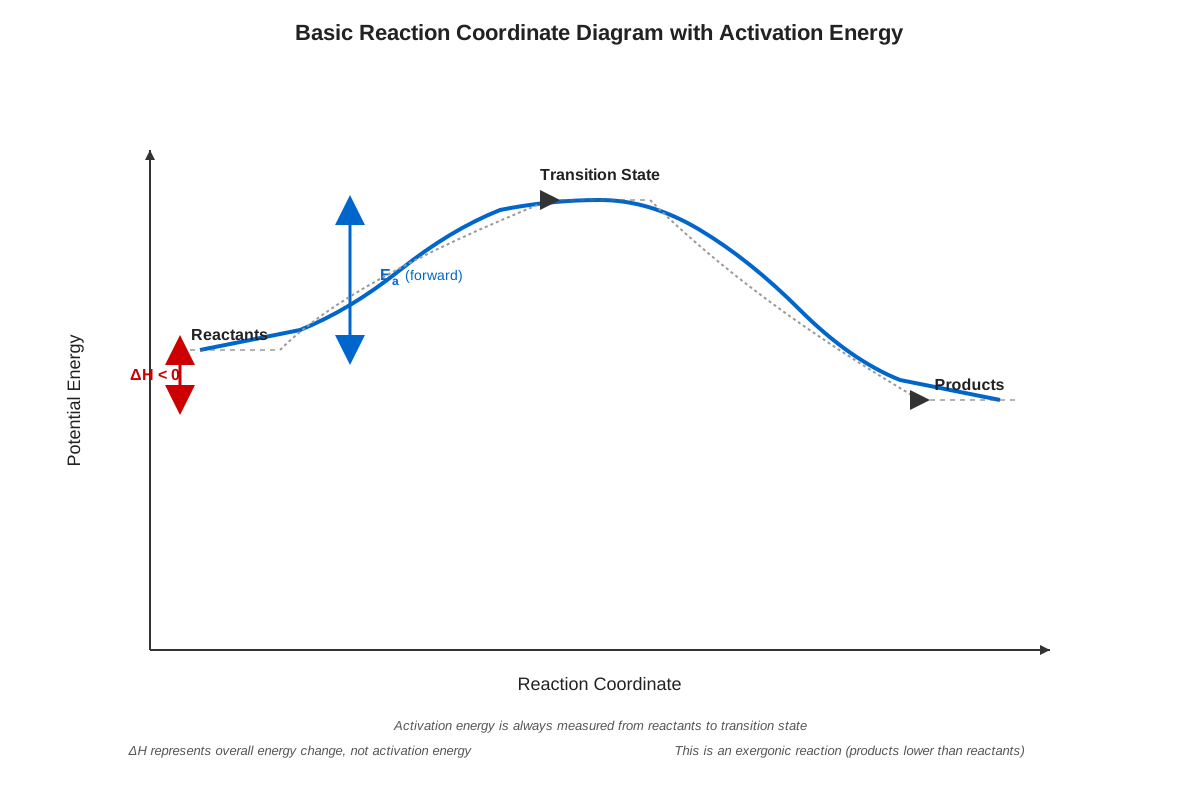
Reaction coordinate diagrams (also called energy diagrams or reaction progress diagrams) plot potential energy on the y-axis against the reaction progress on the x-axis. These diagrams provide visual representations of activation energy and overall reaction energetics:
Energy
  ↑
  |     ‡ (transition state)
  |    / \
  |   /   \
  |  /     \_____ Products
  | /
  |/_____ Reactants
  |________________→
      Reaction Coordinate
Key features to identify:
- Reactant energy level: Starting point on the left
- Product energy level: Ending point on the right
- Transition state: Peak of the curve (marked with ‡)
- Activation energy (forward): Energy difference from reactants to transition state
- Activation energy (reverse): Energy difference from products to transition state
- ΔH (enthalpy change): Energy difference between products and reactants
For an exothermic reaction (ΔH < 0), products are lower in energy than reactants. For an endothermic reaction (ΔH > 0), products are higher in energy than reactants. Critically, activation energy is independent of whether the reaction is exothermic or endothermic—even highly exothermic reactions can have large activation barriers.
Relationship Between Forward and Reverse Activation Energies
The activation energies for forward and reverse reactions are related through the enthalpy change:
Ea(forward) - Ea(reverse) = ΔHThis relationship means:
- For exothermic reactions: Ea(forward) < Ea(reverse)
- For endothermic reactions: Ea(forward) > Ea(reverse)
This principle explains why exothermic reactions typically proceed faster in the forward direction while endothermic reactions favor the reverse direction kinetically (though thermodynamic equilibrium position depends on ΔG, not Ea).
The Arrhenius Equation
The Arrhenius equation quantitatively relates activation energy to the rate constant (k) and temperature (T):
k = A × e^(-Ea/RT)Where:
- k = rate constant
- A = frequency factor (pre-exponential factor), representing collision frequency and orientation
- Ea = activation energy (J/mol or kJ/mol)
- R = gas constant (8.314 J/mol·K)
- T = absolute temperature (Kelvin)
The logarithmic form is more useful for MCAT calculations:
ln(k) = ln(A) - Ea/RTOr for comparing two temperatures:
ln(k₂/k₁) = (Ea/R) × (1/T₁ - 1/T₂)Temperature Dependence
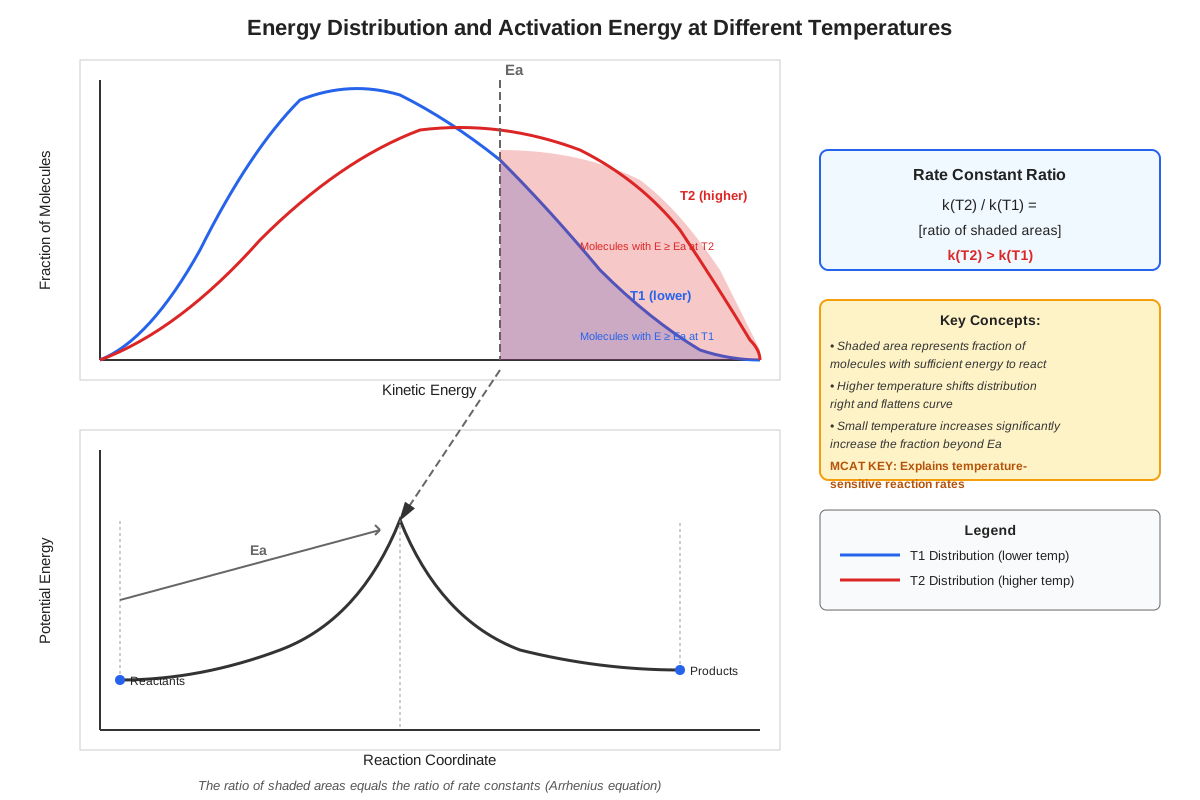
The Arrhenius equation reveals that reaction rates increase exponentially with temperature. This occurs because:
- Higher temperature increases the average kinetic energy of molecules
- More molecules possess energy ≥ Ea at higher temperatures
- The fraction of molecules with sufficient energy follows a Boltzmann distribution
The term e^(-Ea/RT) represents the fraction of molecules with energy equal to or greater than the activation energy. As temperature increases, this fraction increases exponentially, dramatically accelerating reaction rates. A common rule of thumb: reaction rates approximately double for every 10°C temperature increase (though this varies with activation energy).
Catalysts and Activation Energy
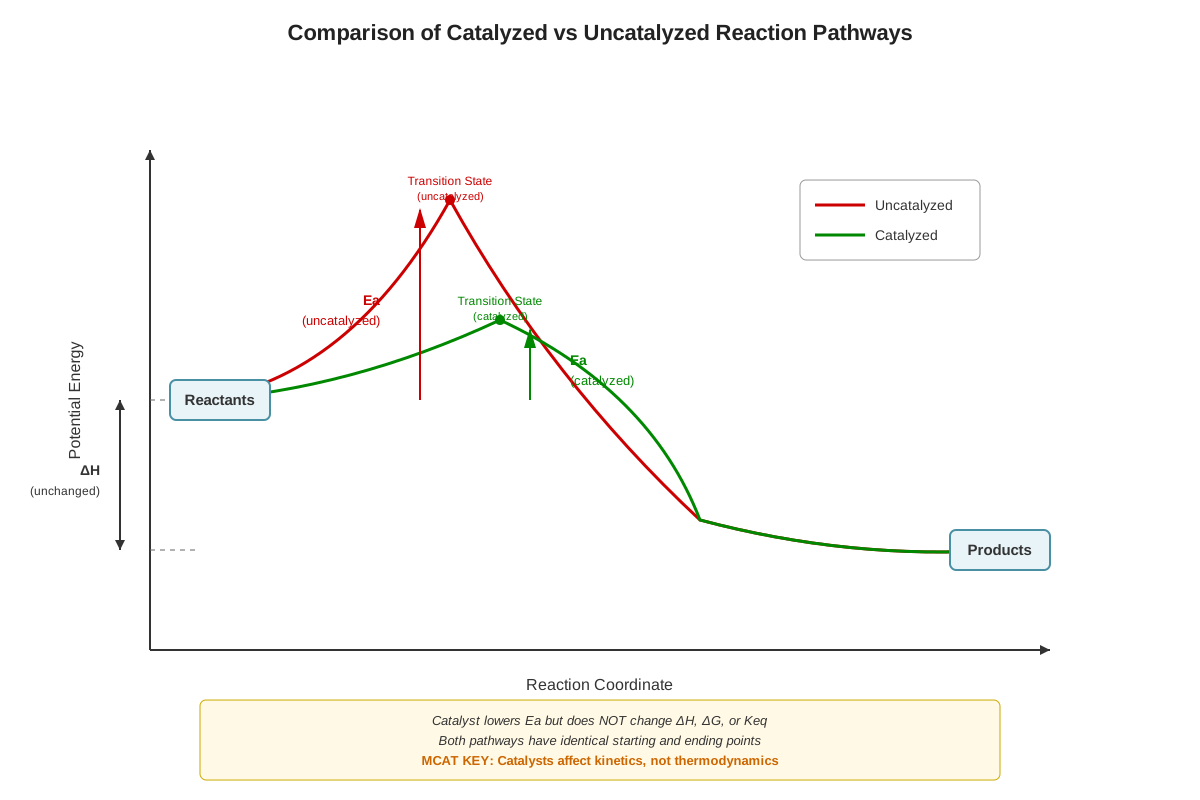
Catalysts are substances that increase reaction rates without being consumed in the overall reaction. They function by providing an alternative reaction pathway with a lower activation energy. Critical points about catalysts:
| Property | Effect of Catalyst | No Effect |
|---|---|---|
| Activation energy | Decreases (Ea↓) | — |
| Rate constant (k) | Increases | — |
| Reaction rate | Increases | — |
| Equilibrium constant (Keq) | — | No change |
| ΔG, ΔH, ΔS | — | No change |
| Position of equilibrium | — | No change |
Catalysts accelerate both forward and reverse reactions equally, reaching equilibrium faster without changing the equilibrium position. This is a crucial MCAT concept: catalysts affect kinetics, not thermodynamics.
Enzymes are biological catalysts that lower activation energy through multiple mechanisms:
- Stabilizing the transition state
- Properly orienting reactant molecules
- Providing an optimal microenvironment (pH, polarity)
- Straining bonds in substrates
- Participating in the reaction mechanism through active site residues
Activation Energy and Reaction Mechanisms
For multi-step reactions, each elementary step has its own activation energy. The rate-determining step (slowest step) has the highest activation energy relative to its starting point and controls the overall reaction rate. Reaction coordinate diagrams for multi-step reactions show multiple peaks (transition states) and valleys (intermediates):
Energy
  ↑
  |    ‡₁     ‡₂
  |   / \   / \
  |  /   \ /   \_____ Products
  | /     X
  |/_____ Reactants
  |________________→
      Reaction Coordinate
Where X represents an intermediate—a species that is formed and consumed during the reaction but does not appear in the overall equation. Unlike transition states, intermediates occupy energy minima and can sometimes be detected.
Molecular Interpretation
At the molecular level, activation energy represents the energy needed to:
- Overcome repulsive forces as molecules approach
- Distort or partially break existing bonds
- Achieve the proper orientation for reaction
- Reach the transition state geometry
Only molecules with kinetic energy exceeding Ea can successfully react upon collision. The collision theory states that reaction rate depends on:
- Collision frequency (related to concentration and temperature)
- Fraction of collisions with energy ≥ Ea
- Fraction of collisions with proper orientation (steric factor)
Concept Relationships
Activation energy serves as a central hub connecting multiple General Chemistry concepts. The relationship flows as follows:
Thermodynamics → Activation Energy → Kinetics: Thermodynamics (ΔG, ΔH, ΔS) determines whether a reaction is favorable, but activation energy determines how fast it proceeds. A reaction can be thermodynamically favorable (ΔG < 0) yet kinetically slow due to high Ea.
Collision Theory → Activation Energy → Arrhenius Equation: Collision theory provides the molecular basis for activation energy, explaining why only high-energy collisions lead to reaction. The Arrhenius equation quantifies this relationship mathematically.
Activation Energy → Catalysis → Enzyme Kinetics: Understanding how catalysts lower activation energy is essential for comprehending enzyme function, competitive/noncompetitive inhibition, and metabolic regulation.
Temperature → Kinetic Energy Distribution → Activation Energy → Reaction Rate: Temperature increases the fraction of molecules with energy ≥ Ea, exponentially increasing reaction rates through the Boltzmann distribution.
Reaction Mechanisms → Transition States → Activation Energy → Rate-Determining Step: Each elementary step has its own activation energy, with the highest barrier determining overall rate.
Activation Energy ↔ Equilibrium: While activation energy affects how quickly equilibrium is reached, it does not affect the equilibrium position (Keq), which depends only on ΔG. This independence is crucial for understanding catalyst function.
Quick check — test yourself on Activation energy so far.
Try Flashcards →High-Yield Facts
⭐ Activation energy is the minimum energy required to reach the transition state, not to form products—even exothermic reactions require activation energy.
⭐ Catalysts lower activation energy but do not change ΔG, ΔH, ΔS, or Keq—they affect kinetics, not thermodynamics.
⭐ The Arrhenius equation shows that reaction rate increases exponentially with temperature: k = A × e^(-Ea/RT)
⭐ For any reaction, Ea(forward) - Ea(reverse) = ΔH—this relationship connects kinetics to thermodynamics.
⭐ The rate-determining step has the highest activation energy relative to its starting point in a multi-step mechanism.
- The transition state represents the highest energy point along the reaction coordinate and cannot be isolated.
- Increasing temperature increases the fraction of molecules with energy ≥ Ea, following a Boltzmann distribution.
- Enzymes lower activation energy by stabilizing the transition state, not by changing the ground state energy of substrates.
- A reaction with ΔG < 0 but high Ea will be thermodynamically favorable but kinetically slow without a catalyst.
- The frequency factor (A) in the Arrhenius equation accounts for collision frequency and proper molecular orientation.
- Activation energy can be determined experimentally by measuring rate constants at different temperatures and plotting ln(k) vs. 1/T (Arrhenius plot).
- Intermediates occupy energy minima between transition states in multi-step reactions and can sometimes be detected.
- The activation energy for the reverse reaction can be calculated if Ea(forward) and ΔH are known.
Common Misconceptions
Misconception: Activation energy is the same as the enthalpy change (ΔH) of the reaction.
Correction: Activation energy is the energy barrier to reach the transition state, while ΔH is the overall energy difference between products and reactants. Even highly exothermic reactions (large negative ΔH) can have substantial activation barriers.
Misconception: Catalysts change the equilibrium position of a reaction.
Correction: Catalysts lower activation energy for both forward and reverse reactions equally, allowing equilibrium to be reached faster without changing the equilibrium constant (Keq) or the final concentrations of reactants and products.
Misconception: All molecules need to have energy equal to or greater than Ea for a reaction to proceed.
Correction: Only a fraction of molecules need sufficient energy. At any temperature, molecular energies follow a distribution, and the fraction with energy ≥ Ea determines the reaction rate. As temperature increases, this fraction increases exponentially.
Misconception: Exothermic reactions always have lower activation energies than endothermic reactions.
Correction: Activation energy is independent of whether a reaction is exothermic or endothermic. An exothermic reaction can have a very high Ea (making it slow), while an endothermic reaction can have a low Ea (making it relatively fast).
Misconception: The transition state is the same as an intermediate.
Correction: The transition state is the highest energy point (a maximum) and exists only momentarily, while intermediates occupy energy minima between transition states and can sometimes be detected or isolated. Transition states cannot be isolated.
Misconception: Adding a catalyst makes an unfavorable reaction (ΔG > 0) become favorable.
Correction: Catalysts only affect reaction rate, not thermodynamic favorability. A reaction with positive ΔG will not proceed to completion regardless of catalyst presence; the catalyst only helps the system reach equilibrium faster.
Misconception: Activation energy is always positive.
Correction: While activation energy is positive for the vast majority of reactions, some radical reactions and reactions involving highly reactive species can have near-zero or effectively zero activation energy, meaning they proceed at nearly every collision.
Worked Examples
Example 1: Interpreting a Reaction Coordinate Diagram
Question: A reaction coordinate diagram shows reactants at 50 kJ/mol, a transition state at 120 kJ/mol, and products at 30 kJ/mol. Calculate: (a) the activation energy for the forward reaction, (b) the activation energy for the reverse reaction, and (c) the enthalpy change (ΔH) for the forward reaction.
Solution:
(a) Activation energy (forward) = Energy of transition state - Energy of reactants
- Ea(forward) = 120 kJ/mol - 50 kJ/mol = 70 kJ/mol
(b) Activation energy (reverse) = Energy of transition state - Energy of products
- Ea(reverse) = 120 kJ/mol - 30 kJ/mol = 90 kJ/mol
(c) Enthalpy change (ΔH) = Energy of products - Energy of reactants
- ΔH = 30 kJ/mol - 50 kJ/mol = -20 kJ/mol (exothermic)
Verification: Check that Ea(forward) - Ea(reverse) = ΔH
- 70 kJ/mol - 90 kJ/mol = -20 kJ/mol ✓
Key Insight: This exothermic reaction (ΔH < 0) has a substantial activation barrier (70 kJ/mol), demonstrating that thermodynamic favorability doesn't guarantee rapid kinetics. The reverse reaction has an even higher activation barrier (90 kJ/mol), making the forward reaction kinetically favored.
Example 2: Applying the Arrhenius Equation
Question: A reaction has a rate constant of 2.5 × 10⁻³ s⁻¹ at 298 K. If the activation energy is 75 kJ/mol, what is the rate constant at 310 K (approximately body temperature)?
Solution:
Use the two-temperature form of the Arrhenius equation:
ln(k₂/k₁) = (Ea/R) × (1/T₁ - 1/T₂)Given:
- k₁ = 2.5 × 10⁻³ s⁻¹ at T₁ = 298 K
- Ea = 75 kJ/mol = 75,000 J/mol
- R = 8.314 J/mol·K
- T₂ = 310 K
Step 1: Calculate (1/T₁ - 1/T₂)
- 1/298 - 1/310 = 0.003356 - 0.003226 = 0.000130 K⁻¹
Step 2: Calculate Ea/R
- 75,000 J/mol ÷ 8.314 J/mol·K = 9,020 K
Step 3: Calculate ln(k₂/k₁)
- ln(k₂/k₁) = 9,020 K × 0.000130 K⁻¹ = 1.17
Step 4: Solve for k₂
- k₂/k₁ = e^1.17 = 3.22
- k₂ = 3.22 × 2.5 × 10⁻³ s⁻¹ = 8.1 × 10⁻³ s⁻¹
Key Insight: A modest temperature increase of 12 K (about 12°C) more than tripled the reaction rate. This demonstrates the exponential temperature dependence of reaction rates and explains why fever significantly accelerates metabolic processes. This principle is crucial for understanding enzyme kinetics and why organisms must regulate body temperature precisely.
Exam Strategy
Approaching MCAT Questions
When encountering activation energy questions on the MCAT:
- Identify the question type immediately: Is it asking about reaction coordinate diagrams, Arrhenius equation calculations, catalyst effects, or conceptual relationships?
- For diagram questions: Systematically identify all features (reactants, products, transition state(s), intermediates) before attempting calculations. Draw vertical lines to visualize energy differences clearly.
- For catalyst questions: Remember the golden rule—catalysts affect Ea and k but never affect ΔG, ΔH, ΔS, or Keq. If an answer choice suggests a catalyst changes equilibrium position, eliminate it immediately.
- For calculation questions: Check units carefully (kJ vs. J, Celsius vs. Kelvin) and ensure R has compatible units. For Arrhenius equation problems, the two-temperature form is usually most efficient.
Trigger Words and Phrases
Watch for these high-yield terms that signal activation energy concepts:
- "Transition state" or "activated complex": Indicates the peak of the energy barrier
- "Rate-determining step": Points to the step with the highest activation energy
- "Catalyst" or "enzyme": Expect questions about lowering Ea without changing thermodynamics
- "Temperature dependence": Signals Arrhenius equation application
- "Energy barrier": Direct reference to activation energy
- "Reaction coordinate": Indicates diagram interpretation
- "Without being consumed": Defining characteristic of catalysts
Process of Elimination Tips
- Eliminate choices that confuse kinetics with thermodynamics: If a choice claims a catalyst changes ΔG or Keq, it's wrong
- Eliminate choices that confuse transition states with intermediates: Transition states are maxima; intermediates are minima
- For diagram questions, eliminate choices with incorrect energy relationships: Verify that Ea(forward) - Ea(reverse) = ΔH
- Eliminate choices suggesting all molecules need Ea: Only a fraction need sufficient energy
- For temperature questions, eliminate choices showing linear rather than exponential relationships: The Arrhenius equation predicts exponential, not linear, rate increases
Time Allocation
- Simple diagram interpretation: 30-45 seconds
- Multi-part diagram questions: 60-90 seconds
- Arrhenius equation calculations: 90-120 seconds (these are time-intensive; ensure accuracy)
- Conceptual catalyst questions: 30-45 seconds
- Passage-based integration questions: 90-120 seconds
For calculation-heavy questions, if you're running short on time, estimate using the "doubling rule" (rate approximately doubles per 10°C) rather than performing full Arrhenius calculations.
Memory Techniques
Mnemonics
"CATS Lower Ea": Catalysts Accelerate by Transition State stabilization, Lower Ea (activation energy)
"TENT": Transition state is at Energy peak, Not Thermodynamically stable (cannot be isolated)
"Forward MINUS Reverse = Heat": Ea(forward) - Ea(reverse) = ΔH (enthalpy change)
Visualization Strategy
The Mountain Pass Analogy: Visualize activation energy as a mountain pass between two valleys (reactants and products). The height of the pass above the starting valley is Ea(forward). A catalyst is like building a tunnel through the mountain—it provides a lower path but doesn't change the elevation difference between the valleys (ΔH). The destination valley might be lower (exothermic) or higher (endothermic) than the starting valley, but you still need to get over or through the mountain.
Acronym for Catalyst Effects
"RAKE": Catalysts affect Rate and Activation energy (Ea) and Kinetics, but Equilibrium (Keq) unchanged
Arrhenius Equation Memory Aid
"Kate Ate Exponential Eggs At Room Temperature":
- Kate = k (rate constant)
- Ate = A (frequency factor)
- Exponential Eggs = e^(-Ea/RT)
- At Room Temperature = emphasizes temperature dependence
Summary
Activation energy represents the minimum energy barrier that reactant molecules must overcome to reach the transition state and form products. This fundamental concept bridges thermodynamics and kinetics, explaining why thermodynamically favorable reactions may proceed slowly without catalysts. The Arrhenius equation quantifies the exponential relationship between activation energy, temperature, and reaction rate, revealing that even modest temperature increases dramatically accelerate reactions. Reaction coordinate diagrams visually represent activation energy, transition states, intermediates, and overall reaction energetics, with the critical relationship Ea(forward) - Ea(reverse) = ΔH connecting kinetics to thermodynamics. Catalysts function by lowering activation energy through alternative reaction pathways, accelerating both forward and reverse reactions equally without changing equilibrium constants or thermodynamic parameters. For the MCAT, mastery requires distinguishing kinetic factors (Ea, k, rate) from thermodynamic factors (ΔG, ΔH, Keq), interpreting complex reaction coordinate diagrams, applying the Arrhenius equation to temperature-dependent rate problems, and understanding enzyme catalysis as activation energy reduction. This topic appears frequently in both General Chemistry and Biochemistry contexts, making it essential for achieving a competitive MCAT score.
Key Takeaways
- Activation energy (Ea) is the minimum energy required to reach the transition state, not to form products, and exists even for highly exothermic reactions
- Catalysts lower activation energy without changing ΔG, ΔH, ΔS, or Keq—they affect how fast equilibrium is reached, not where equilibrium lies
- The Arrhenius equation (k = A × e^(-Ea/RT)) shows reaction rates increase exponentially with temperature due to more molecules having energy ≥ Ea
- Reaction coordinate diagrams encode multiple relationships: Ea(forward) = transition state energy - reactant energy; Ea(reverse) = transition state energy - product energy; ΔH = product energy - reactant energy
- The relationship Ea(forward) - Ea(reverse) = ΔH connects kinetics to thermodynamics and allows calculation of unknown activation energies
- Transition states (energy maxima) differ fundamentally from intermediates (energy minima)—transition states cannot be isolated while intermediates sometimes can
- Enzymes are biological catalysts that lower activation energy through transition state stabilization, enabling metabolic reactions to proceed at physiological temperatures
Related Topics
Enzyme Kinetics (Michaelis-Menten): Understanding activation energy provides the foundation for comprehending how enzymes achieve catalytic efficiency and how inhibitors affect reaction rates by altering effective activation energy.
Reaction Mechanisms: Each elementary step in a multi-step mechanism has its own activation energy, with the rate-determining step having the highest barrier relative to its starting point.
Thermodynamics and Gibbs Free Energy: While ΔG determines reaction favorability, activation energy determines reaction rate—mastering both concepts enables prediction of both whether and how fast reactions proceed.
Chemical Equilibrium: Activation energy affects how quickly equilibrium is established but not the equilibrium position, a distinction crucial for understanding Le Chatelier's principle and catalyst function.
Transition State Theory: Advanced treatment of how molecules pass through the transition state, including entropy of activation and the Eyring equation, builds on activation energy fundamentals.
Metabolic Pathways: Understanding activation energy explains why metabolic reactions require enzymatic catalysis and how metabolic regulation occurs through enzyme activation and inhibition.
Practice CTA
Now that you've mastered the core concepts of activation energy, it's time to solidify your understanding through active practice. Attempt the practice questions to test your ability to interpret reaction coordinate diagrams, apply the Arrhenius equation, and distinguish kinetic from thermodynamic factors. Use the flashcards to reinforce high-yield facts and relationships. Remember: activation energy is one of the most frequently tested General Chemistry concepts on the MCAT, appearing in both standalone questions and complex passage-based scenarios. Your investment in mastering this topic will pay dividends across multiple MCAT sections. You've got this—now prove it through practice!
Sign up free to keep reading
Create a free AnvayaPrep account to finish this MCAT guide on Activation energy — plus flashcards and practice questions.