Overview
Catalysts represent one of the most clinically and experimentally relevant concepts in General Chemistry, bridging the theoretical understanding of reaction mechanisms with practical applications in biochemistry, pharmacology, and industrial processes. A catalyst is a substance that increases the rate of a chemical reaction without being permanently consumed in the process, accomplishing this feat by lowering the activation energy required for reactants to transform into products. This fundamental principle underlies countless biological processes—from enzymatic digestion of nutrients to the synthesis of neurotransmitters—making it indispensable for understanding both the Chemical and Physical Foundations of Biological Systems tested on the MCAT.
Understanding catalysts is essential for mastering Kinetics and Equilibrium, as catalysts profoundly affect reaction rates while leaving equilibrium positions unchanged. This distinction—that catalysts accelerate both forward and reverse reactions equally—frequently appears in MCAT questions designed to test conceptual understanding rather than mere memorization. Students must grasp how catalysts modify energy diagrams, influence rate laws, and interact with reaction mechanisms to successfully navigate both discrete questions and passage-based items on test day.
The Catalysts MCAT content integrates seamlessly with broader General Chemistry topics including thermodynamics, reaction mechanisms, and chemical kinetics. Catalysts serve as the conceptual bridge between theoretical rate laws and practical applications, particularly in biological systems where enzymes function as highly specific biological catalysts. This topic appears regularly in interdisciplinary passages that combine chemistry with biology, requiring students to apply chemical principles to physiological contexts—a hallmark of the modern MCAT's integrated approach to scientific reasoning.
Learning Objectives
- [ ] Define Catalysts using accurate General Chemistry terminology
- [ ] Explain why Catalysts matters for the MCAT
- [ ] Apply Catalysts to exam-style questions
- [ ] Identify common mistakes related to Catalysts
- [ ] Connect Catalysts to related General Chemistry concepts
- [ ] Distinguish between homogeneous and heterogeneous catalysts with specific examples
- [ ] Analyze reaction coordinate diagrams to identify the effect of catalysts on activation energy and reaction enthalpy
- [ ] Predict how catalysts affect reaction rates without altering equilibrium constants or thermodynamic favorability
Prerequisites
- Chemical kinetics fundamentals: Understanding reaction rates, rate laws, and rate constants provides the foundation for comprehending how catalysts accelerate reactions
- Activation energy (Ea): Knowledge of the energy barrier that must be overcome for reactions to proceed is essential for understanding the mechanism by which catalysts function
- Reaction coordinate diagrams: Familiarity with energy diagrams allows visualization of how catalysts modify reaction pathways
- Thermodynamics basics: Understanding the distinction between kinetics (how fast) and thermodynamics (how favorable) clarifies why catalysts affect rates but not equilibrium positions
- Equilibrium concepts: Knowledge of Le Châtelier's principle and equilibrium constants helps students recognize what catalysts do NOT change
Why This Topic Matters
Clinical and Real-World Significance: Catalysts are ubiquitous in biological systems, where enzymes catalyze virtually every metabolic reaction in the human body. Without catalytic enzymes, reactions that occur in milliseconds would take years to complete at body temperature. Pharmaceutical development relies heavily on understanding catalytic mechanisms—many drugs function by inhibiting specific enzymes, effectively removing catalytic activity to slow disease processes. Industrial applications include catalytic converters in automobiles (reducing harmful emissions), the Haber process for ammonia synthesis (feeding billions through fertilizer production), and petroleum refining (producing fuels and plastics).
Exam Statistics and Frequency: Catalysts appear in approximately 3-5% of MCAT Chemical and Physical Foundations questions, with particularly high representation in passage-based items that integrate chemistry with biological systems. The topic frequently appears in questions testing conceptual understanding of reaction mechanisms, enzyme kinetics (Michaelis-Menten), and the interpretation of experimental data from kinetics studies. The MCAT consistently tests whether students understand that catalysts lower activation energy without changing ΔG, ΔH, or Keq—a conceptual distinction that separates high-scoring students from those who merely memorize facts.
Common Exam Presentations: Catalysts appear in MCAT passages describing enzyme function, industrial chemical processes, or experimental investigations of reaction mechanisms. Questions may present reaction coordinate diagrams and ask students to identify catalyzed versus uncatalyzed pathways, provide kinetic data requiring interpretation of how catalysts affect rate constants, or describe scenarios where students must predict the effect of adding a catalyst to a system at equilibrium. Interdisciplinary passages often combine catalyst concepts with biochemistry (enzyme inhibition), organic chemistry (reaction mechanisms), or physics (collision theory).
Core Concepts
Definition and Fundamental Properties of Catalysts
A catalyst is a substance that increases the rate of a chemical reaction by providing an alternative reaction pathway with a lower activation energy, while remaining chemically unchanged at the completion of the reaction. This definition contains several critical elements that distinguish catalysts from other reaction participants. First, catalysts are not consumed—they emerge from the reaction in their original form and can participate in multiple reaction cycles. Second, catalysts function by lowering the activation energy (Ea), the minimum energy required for reactant molecules to transform into products. Third, catalysts do not alter the thermodynamic properties of the reaction, including the Gibbs free energy change (ΔG), enthalpy change (ΔH), or equilibrium constant (Keq).
The mechanism by which catalysts operate involves forming temporary intermediate complexes with reactants, stabilizing transition states, or providing surface sites for reactions to occur. By creating an alternative pathway with lower energy barriers, catalysts enable a greater fraction of reactant molecules to possess sufficient energy to react at any given temperature. According to the Arrhenius equation, k = Ae^(-Ea/RT), reducing Ea exponentially increases the rate constant k, thereby accelerating the reaction rate. Importantly, catalysts accelerate both the forward and reverse reactions equally, maintaining the equilibrium position while allowing the system to reach equilibrium faster.
Types of Catalysts: Homogeneous vs. Heterogeneous
Homogeneous catalysts exist in the same phase as the reactants, typically in solution. These catalysts form intermediate complexes with reactants through chemical bonding, creating a new reaction pathway. For example, in the decomposition of hydrogen peroxide (2H₂O₂ → 2H₂O + O₂), aqueous iodide ions (I⁻) serve as a homogeneous catalyst by forming intermediate species (H₂O₂ + I⁻ → H₂O + IO⁻, followed by H₂O₂ + IO⁻ → H₂O + O₂ + I⁻). The iodide ion is regenerated and can catalyze additional decomposition cycles. Homogeneous catalysts typically provide uniform catalytic activity throughout the reaction mixture and allow for precise mechanistic studies.
Heterogeneous catalysts exist in a different phase than the reactants, most commonly as solid catalysts in contact with gaseous or liquid reactants. These catalysts function by adsorbing reactants onto their surface, weakening bonds and facilitating reactions, then releasing products. Classic examples include platinum in catalytic converters (converting CO and NOx to less harmful gases), iron in the Haber process (N₂ + 3H₂ → 2NH₃), and nickel in hydrogenation reactions (converting unsaturated fats to saturated fats). The effectiveness of heterogeneous catalysts depends on surface area—finely divided or porous catalysts provide more active sites for reactions. Heterogeneous catalysts offer practical advantages including easy separation from products and reusability, making them industrially preferred despite potentially less uniform activity.
| Feature | Homogeneous Catalysts | Heterogeneous Catalysts |
|---|---|---|
| Phase relationship | Same phase as reactants | Different phase from reactants |
| Mechanism | Forms intermediate complexes | Surface adsorption and reaction |
| Distribution | Uniform throughout mixture | Localized at phase boundary |
| Separation | Difficult to separate | Easy to separate and reuse |
| Examples | Acid catalysis, enzyme catalysis | Catalytic converters, Haber process |
| Activity dependence | Concentration-dependent | Surface area-dependent |
Catalysts and Reaction Coordinate Diagrams
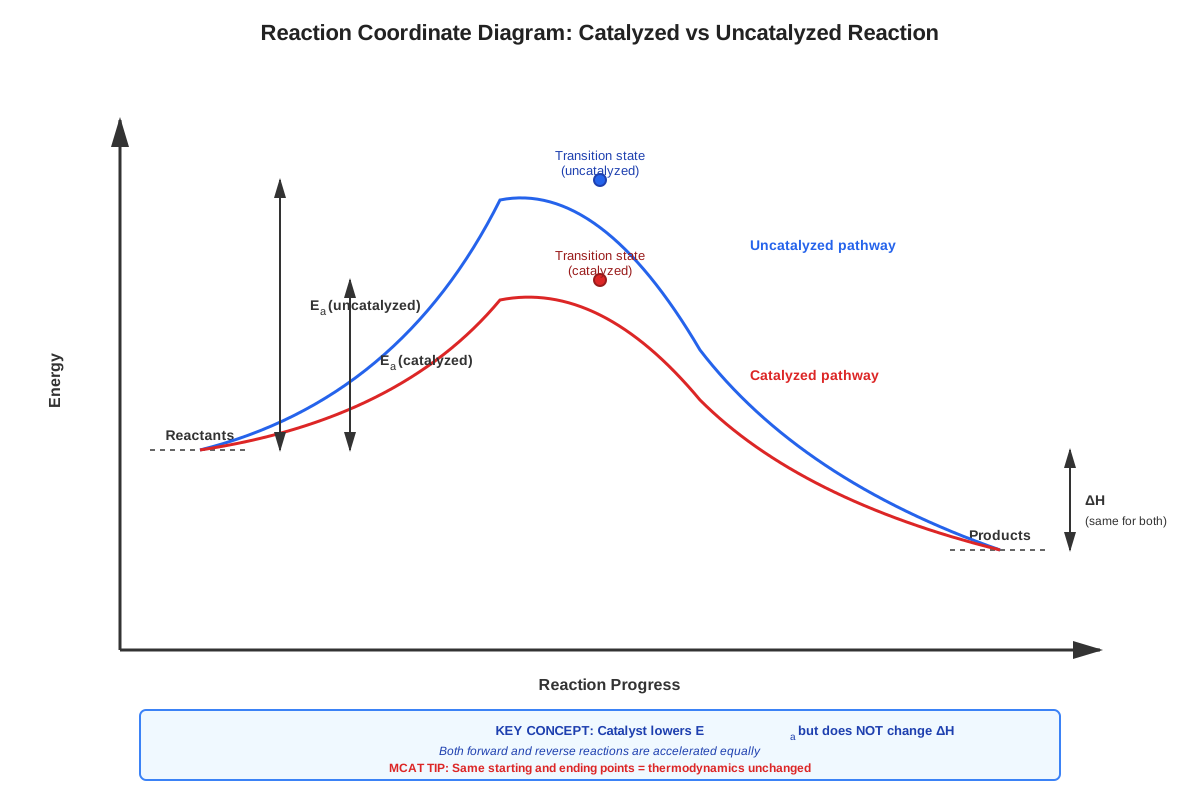
Reaction coordinate diagrams provide visual representations of energy changes during chemical reactions, and understanding how catalysts modify these diagrams is crucial for MCAT success. In an uncatalyzed reaction, the diagram shows reactants at an initial energy level, a transition state at the peak (representing maximum energy), and products at a final energy level. The activation energy (Ea) is the energy difference between reactants and the transition state, while ΔH represents the overall enthalpy change from reactants to products.
When a catalyst is introduced, the reaction coordinate diagram shows a new pathway with a lower activation energy peak. The catalyzed pathway may involve one or more intermediate species, creating multiple smaller energy barriers rather than one large barrier. Critically, the energy levels of the reactants and products remain unchanged—the catalyst does not alter ΔH or ΔG. This visual representation reinforces the principle that catalysts affect kinetics (how fast the reaction proceeds) but not thermodynamics (whether the reaction is favorable). For reversible reactions, the diagram clearly shows that the catalyst lowers the activation energy for both the forward and reverse reactions by the same amount, explaining why equilibrium position remains unchanged.
Catalysts and Equilibrium: What Changes and What Doesn't
A fundamental principle that the MCAT frequently tests is the relationship between catalysts and chemical equilibrium. Catalysts do not change the equilibrium constant (Keq) or the equilibrium position of a reversible reaction. This occurs because catalysts accelerate both forward and reverse reactions proportionally—if the forward rate increases by a factor of 100, the reverse rate also increases by a factor of 100. Since equilibrium is achieved when forward and reverse rates are equal, the ratio of product to reactant concentrations at equilibrium remains constant.
What catalysts DO change is the time required to reach equilibrium. Without a catalyst, a thermodynamically favorable reaction might take hours, days, or even years to reach equilibrium. With an appropriate catalyst, the same equilibrium position can be achieved in seconds or minutes. This distinction is crucial for understanding biological systems—enzymes don't make unfavorable reactions favorable; they simply allow favorable reactions to occur at biologically relevant timescales. The equilibrium constant depends only on temperature and the thermodynamic properties of reactants and products (Keq = e^(-ΔG°/RT)), neither of which is altered by catalyst presence.
Catalytic Mechanisms and Reaction Pathways
Catalysts function through various mechanisms depending on their nature and the reaction being catalyzed. Acid-base catalysis involves proton transfer steps that stabilize intermediates or transition states. For example, in ester hydrolysis, H⁺ ions catalyze the reaction by protonating the carbonyl oxygen, making the carbonyl carbon more electrophilic and susceptible to nucleophilic attack by water. Metal ion catalysis utilizes transition metal ions that can accept and donate electrons, stabilize negative charges, or bring reactants into proximity through coordination complexes.
Enzyme catalysis represents the most sophisticated form of catalysis, combining multiple mechanisms including proximity effects (bringing substrates together), orientation effects (aligning reactive groups), strain (distorting substrate bonds), and stabilization of transition states through precise interactions with amino acid residues. Enzymes achieve rate enhancements of 10⁶ to 10¹⁷ compared to uncatalyzed reactions, demonstrating the power of optimized catalytic mechanisms. Understanding that enzymes are biological catalysts subject to the same principles as chemical catalysts—they lower Ea without changing ΔG—helps students connect General Chemistry concepts to biochemistry and physiology.
Catalyst Poisoning and Inhibition
Catalyst poisoning occurs when substances bind irreversibly to catalytic sites, rendering them inactive. This concept is particularly important for heterogeneous catalysts, where molecules like sulfur compounds, lead, or carbon monoxide can adsorb strongly to metal surfaces, blocking active sites. For example, lead in gasoline poisoned platinum catalysts in early catalytic converters, leading to the development of unleaded gasoline. Understanding catalyst poisoning helps explain why certain substances must be removed from reactant streams in industrial processes.
In biological systems, enzyme inhibition represents a form of catalyst modification with therapeutic significance. Competitive inhibitors bind to the active site, preventing substrate binding; non-competitive inhibitors bind elsewhere, altering enzyme shape or function. While reversible inhibitors can be displaced, irreversible inhibitors form covalent bonds with enzymes, permanently inactivating them. Many drugs function as enzyme inhibitors—aspirin irreversibly inhibits cyclooxygenase, preventing prostaglandin synthesis and reducing inflammation. The MCAT may present scenarios requiring students to distinguish between catalyst poisoning (permanent inactivation) and reversible inhibition (temporary reduction in activity).
Concept Relationships
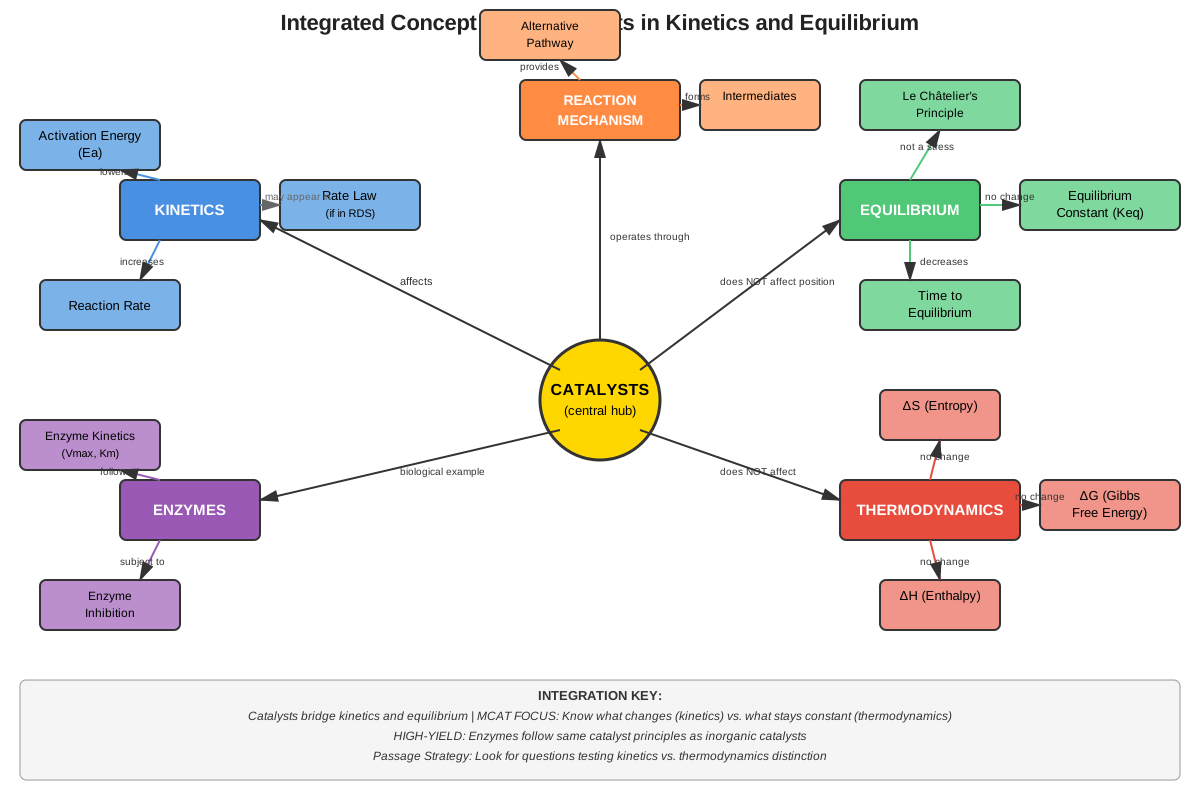
The concept of catalysts sits at the intersection of multiple General Chemistry domains, serving as an integrative topic that requires synthesis of kinetics, thermodynamics, and equilibrium principles. Activation energy forms the foundation for understanding catalytic function—catalysts work specifically by lowering Ea, which directly connects to the Arrhenius equation and collision theory. This relationship flows as: Collision Theory → Activation Energy → Catalysts Lower Ea → Increased Rate Constant → Faster Reaction Rate.
The relationship between catalysts and equilibrium demonstrates the critical distinction between kinetics and thermodynamics: Thermodynamics determines whether a reaction is favorable (ΔG < 0) → Kinetics determines how fast a favorable reaction proceeds → Catalysts affect kinetics but not thermodynamics → Catalysts speed equilibrium attainment without changing Keq. This conceptual chain is essential for avoiding the common misconception that catalysts shift equilibrium positions.
Within the topic itself, the concepts connect hierarchically: The general definition of catalysts branches into homogeneous and heterogeneous types, each with distinct mechanisms. Both types share the fundamental property of lowering activation energy, which connects to reaction coordinate diagrams. The principle that catalysts don't change equilibrium links back to thermodynamics and forward to enzyme kinetics in biochemistry. Understanding catalyst poisoning and inhibition extends the basic concepts to practical applications and biological systems, completing the conceptual network.
Quick check — test yourself on Catalysts so far.
Try Flashcards →High-Yield Facts
⭐ Catalysts lower activation energy (Ea) for both forward and reverse reactions equally, without changing ΔG, ΔH, ΔS, or Keq
⭐ Catalysts are not consumed in reactions and can participate in multiple catalytic cycles
⭐ Catalysts speed up the rate at which equilibrium is reached but do not shift the equilibrium position
⭐ Homogeneous catalysts exist in the same phase as reactants; heterogeneous catalysts exist in a different phase
⭐ On reaction coordinate diagrams, catalyzed pathways show lower activation energy peaks but identical reactant and product energy levels
- Catalysts increase both the forward rate constant (kf) and reverse rate constant (kr) by the same factor
- The effectiveness of heterogeneous catalysts depends on surface area—greater surface area provides more active sites
- Enzymes are biological catalysts that follow the same thermodynamic and kinetic principles as chemical catalysts
- Catalyst poisoning occurs when substances irreversibly bind to active sites, permanently reducing catalytic activity
- Positive catalysts increase reaction rates; negative catalysts (inhibitors) decrease reaction rates
- Temperature affects catalyzed reactions less dramatically than uncatalyzed reactions because Ea is already reduced
- Catalysts provide alternative reaction pathways, often involving intermediate species not present in uncatalyzed reactions
Common Misconceptions
Misconception: Catalysts are consumed during reactions and must be continuously replenished.
Correction: Catalysts are regenerated at the end of each catalytic cycle and remain chemically unchanged, allowing a single catalyst molecule to facilitate thousands or millions of reaction events. While catalysts may be temporarily modified during intermediate steps, they return to their original form when the cycle completes.
Misconception: Adding a catalyst to a reaction at equilibrium will shift the equilibrium position to favor products.
Correction: Catalysts affect only the rate of reaching equilibrium, not the equilibrium position itself. A catalyst added to a system already at equilibrium will have no observable effect because forward and reverse rates are already equal. The equilibrium constant Keq depends only on temperature and thermodynamic properties, neither of which catalysts alter.
Misconception: Catalysts make thermodynamically unfavorable reactions (ΔG > 0) become favorable.
Correction: Catalysts cannot change the thermodynamic favorability of reactions. If ΔG is positive, the reaction remains unfavorable regardless of catalyst presence. Catalysts only affect how quickly a thermodynamically favorable reaction proceeds. This is why enzymes cannot force energetically unfavorable reactions to occur without coupling them to favorable reactions (like ATP hydrolysis).
Misconception: Catalysts lower the activation energy of only the forward reaction, which is why products form faster.
Correction: Catalysts lower the activation energy for both forward and reverse reactions by exactly the same amount. Products form faster because the forward reaction is accelerated, but the reverse reaction is equally accelerated. This symmetry explains why equilibrium position remains unchanged—the ratio of forward to reverse rates stays constant.
Misconception: All catalysts work by the same mechanism, just speeding up molecular collisions.
Correction: Different catalysts employ diverse mechanisms including forming intermediate complexes, providing surface sites for adsorption, stabilizing transition states, inducing strain in substrate bonds, or facilitating proton transfers. While all catalysts ultimately lower activation energy, the molecular-level mechanisms vary widely depending on catalyst type and reaction characteristics.
Worked Examples
Example 1: Interpreting a Reaction Coordinate Diagram
Question: A reaction coordinate diagram shows two pathways for the conversion of reactants (R) to products (P). Pathway 1 has an activation energy of 85 kJ/mol, while Pathway 2 has an activation energy of 45 kJ/mol. Both pathways show reactants at 50 kJ and products at 20 kJ. Which statement is correct?
A) Pathway 2 represents a catalyzed reaction with a more negative ΔH
B) Pathway 2 represents a catalyzed reaction with the same ΔH as Pathway 1
C) Pathway 2 will reach a different equilibrium position than Pathway 1
D) Pathway 2 represents a thermodynamically more favorable reaction
Solution:
Step 1: Identify what the diagram shows. Both pathways have reactants at 50 kJ and products at 20 kJ, meaning ΔH = 20 - 50 = -30 kJ for both pathways. The enthalpy change is identical.
Step 2: Recognize that Pathway 2 has lower activation energy (45 kJ/mol vs. 85 kJ/mol), which is the defining characteristic of a catalyzed reaction. Catalysts provide alternative pathways with lower Ea.
Step 3: Evaluate each answer choice:
- A is incorrect because ΔH is the same for both pathways (-30 kJ)
- B is correct—Pathway 2 is catalyzed (lower Ea) with identical ΔH
- C is incorrect because catalysts don't change equilibrium position
- D is incorrect because thermodynamic favorability depends on ΔG, which is unchanged by catalysts
Answer: B
Key Concept Connection: This example reinforces that catalysts modify activation energy without changing thermodynamic parameters (ΔH, ΔG) or equilibrium position. The visual representation on reaction coordinate diagrams shows lower peaks but identical starting and ending points for catalyzed reactions.
Example 2: Catalyst Effect on Equilibrium
Question: Consider the reversible reaction: N₂(g) + 3H₂(g) ⇌ 2NH₃(g), which has reached equilibrium with [N₂] = 0.50 M, [H₂] = 1.5 M, and [NH₃] = 0.20 M. An iron catalyst is added to the system. After the catalyst is added and the system re-equilibrates at the same temperature, which of the following is most likely?
A) [NH₃] will increase because the catalyst favors the forward reaction
B) [NH₃] will decrease because the catalyst speeds up the reverse reaction more
C) The concentrations will remain unchanged because the system was already at equilibrium
D) The concentrations will change temporarily but return to the original equilibrium values
Solution:
Step 1: Recall the fundamental principle that catalysts do not change equilibrium constants or equilibrium positions. The equilibrium constant Keq = [NH₃]²/([N₂][H₂]³) depends only on temperature.
Step 2: Recognize that the system is already at equilibrium, meaning the forward and reverse reaction rates are equal. Adding a catalyst will increase both rates equally.
Step 3: Since both forward and reverse rates increase by the same factor, the ratio of rates remains 1:1, and the system remains at equilibrium with unchanged concentrations.
Step 4: Evaluate answer choices:
- A is incorrect—catalysts don't favor one direction over the other
- B is incorrect—catalysts accelerate both directions equally
- C is correct—at equilibrium, adding a catalyst produces no concentration change
- D is incorrect—concentrations won't change even temporarily if already at equilibrium
Answer: C
Key Concept Connection: This example illustrates the critical distinction between kinetic and thermodynamic effects. While catalysts dramatically affect reaction rates (kinetics), they have zero effect on equilibrium position (thermodynamics). This principle applies universally to all catalysts, including biological enzymes.
Exam Strategy
When approaching Catalysts MCAT questions, first identify whether the question asks about kinetics (rates, activation energy, time to equilibrium) or thermodynamics (ΔG, ΔH, Keq, equilibrium position). Catalysts affect only kinetics, never thermodynamics. This single distinction eliminates approximately 50% of wrong answers in catalyst-related questions.
Trigger words and phrases to watch for include: "activation energy," "rate of reaction," "time to reach equilibrium" (all affected by catalysts), versus "equilibrium constant," "ΔG," "ΔH," "equilibrium position," "thermodynamic favorability" (all unaffected by catalysts). Questions using phrases like "shift the equilibrium" or "make the reaction more favorable" in the context of catalysts are typically setting traps—catalysts do neither.
For reaction coordinate diagram questions, immediately check whether the reactant and product energy levels are identical between pathways. If they are, the lower-energy pathway represents catalysis. If they differ, the diagram is comparing different reactions, not catalyzed versus uncatalyzed versions of the same reaction. Pay attention to whether the question asks about Ea (which catalysts change) or ΔH (which they don't).
Process-of-elimination strategy: In questions about catalyst effects, eliminate any answer choice suggesting that catalysts: (1) change equilibrium position, (2) alter ΔG or ΔH, (3) make unfavorable reactions favorable, (4) are consumed in reactions, or (5) affect forward and reverse reactions differently. These are universally incorrect statements about catalysts.
Time allocation: Most catalyst questions can be answered in 60-90 seconds if you've mastered the core principles. Don't waste time on complex calculations—the MCAT tests conceptual understanding of catalysts more than quantitative problem-solving. If a question seems to require extensive calculation, you're likely missing a conceptual shortcut.
Exam Tip: When a passage describes an enzyme or industrial process, immediately identify it as a catalyst application. This activates your mental framework: lowers Ea, doesn't change ΔG or Keq, accelerates both directions equally. This framework guides you through passage-based questions efficiently.
Memory Techniques
Mnemonic for what catalysts DON'T change: "HEDGE"
- H: ΔH (enthalpy change)
- E: Equilibrium position
- D: ΔG (Gibbs free energy)
- G: ΔG° (standard free energy)
- E: Equilibrium constant (Keq)
Visualization strategy: Picture a catalyst as a "mountain pass" that provides an easier route over a mountain range. The starting point (reactants) and ending point (products) remain at the same elevations, but the pass (lower Ea) allows travelers to cross faster. The elevation difference between start and end (ΔH) is unchanged—only the maximum elevation along the route (Ea) is reduced.
Acronym for catalyst properties: "RARE"
- R: Regenerated (not consumed)
- A: Activation energy lowered
- R: Rate increased (both directions)
- E: Equilibrium unchanged
Memory hook for homogeneous vs. heterogeneous: "SAME phase = Homogeneous" (both start with consonants that sound similar). If it's the same phase, it's homogeneous; if different phases, it's heterogeneous.
Conceptual anchor: Always connect catalysts to enzymes. When you think "catalyst," immediately think "enzyme" as the biological example. This connection helps you remember that catalysts don't make unfavorable reactions favorable (just as enzymes can't force ΔG > 0 reactions without coupling), and it bridges General Chemistry to biochemistry for integrated MCAT passages.
Summary
Catalysts are substances that accelerate chemical reactions by lowering activation energy while remaining unchanged at reaction completion, enabling them to participate in multiple catalytic cycles. They function by providing alternative reaction pathways with lower energy barriers, increasing the rate constant according to the Arrhenius equation without altering thermodynamic parameters. The fundamental principle that catalysts affect kinetics but not thermodynamics means they speed equilibrium attainment without changing equilibrium position, Keq, ΔG, or ΔH. Catalysts are classified as homogeneous (same phase as reactants) or heterogeneous (different phase), each with distinct mechanisms and practical applications. On reaction coordinate diagrams, catalyzed pathways show reduced activation energy peaks while maintaining identical reactant and product energy levels. Understanding that catalysts accelerate both forward and reverse reactions equally explains why equilibrium position remains unchanged despite faster reaction rates. This topic integrates with enzyme kinetics, industrial chemistry, and biological systems, making it essential for MCAT success across multiple scientific disciplines.
Key Takeaways
- Catalysts lower activation energy (Ea) for both forward and reverse reactions without changing ΔG, ΔH, or Keq—they affect kinetics, not thermodynamics
- Catalysts are regenerated after each reaction cycle and can facilitate thousands of reactions without being consumed
- Adding a catalyst to a system at equilibrium produces no change in concentrations because equilibrium position depends only on thermodynamic factors
- Homogeneous catalysts exist in the same phase as reactants and form intermediate complexes; heterogeneous catalysts exist in different phases and function through surface adsorption
- On reaction coordinate diagrams, catalyzed reactions show lower activation energy peaks but identical reactant and product energy levels compared to uncatalyzed reactions
- Enzymes are biological catalysts that follow the same fundamental principles as chemical catalysts, bridging General Chemistry to biochemistry
- Catalyst poisoning (irreversible inactivation) and enzyme inhibition (reversible or irreversible reduction in activity) represent important practical limitations of catalytic systems
Related Topics
Enzyme Kinetics (Michaelis-Menten): Building on catalyst principles, enzyme kinetics quantifies how biological catalysts interact with substrates, introducing concepts like Km, Vmax, and competitive versus non-competitive inhibition. Mastering catalysts provides the foundation for understanding why enzymes accelerate reactions without changing thermodynamic favorability.
Reaction Mechanisms: Understanding how catalysts provide alternative pathways connects directly to studying multi-step reaction mechanisms, intermediates, and rate-determining steps. Catalysts often work by changing which step is rate-determining or by stabilizing high-energy intermediates.
Thermodynamics and Gibbs Free Energy: The relationship between catalysts and thermodynamics reinforces the distinction between spontaneity (ΔG) and rate (kinetics). This connection is crucial for understanding why some thermodynamically favorable reactions don't occur without catalysts.
Transition State Theory: Advanced understanding of how catalysts stabilize transition states and lower activation energy barriers connects to transition state theory, providing molecular-level insight into catalytic mechanisms.
Biochemical Pathways: Metabolic pathways rely entirely on enzyme catalysis, making catalyst principles essential for understanding glycolysis, the citric acid cycle, oxidative phosphorylation, and other biochemical processes tested on the MCAT.
Practice CTA
Now that you've mastered the core concepts of catalysts, it's time to solidify your understanding through active practice. Challenge yourself with MCAT-style practice questions that test your ability to distinguish between kinetic and thermodynamic effects, interpret reaction coordinate diagrams, and apply catalyst principles to biological systems. Use flashcards to reinforce high-yield facts, particularly the critical principle that catalysts never change equilibrium position or thermodynamic parameters. Remember: understanding catalysts isn't just about memorizing definitions—it's about developing the conceptual framework to tackle any question the MCAT throws at you, whether it's about industrial processes, enzyme mechanisms, or experimental kinetics data. Your investment in mastering this topic will pay dividends across multiple sections of the exam. You've got this!
Sign up free to keep reading
Create a free AnvayaPrep account to finish this MCAT guide on Catalysts — plus flashcards and practice questions.