Overview
The common ion effect is a fundamental principle in General Chemistry that describes how the solubility of a salt or the position of an equilibrium is affected when a solution already contains one of the ions present in that salt or equilibrium system. This phenomenon is a direct application of Le Châtelier's principle and plays a critical role in understanding Kinetics and Equilibrium on the MCAT. When a common ion is added to a solution at equilibrium, the system shifts to counteract this change, typically resulting in decreased solubility of sparingly soluble salts or shifts in acid-base equilibria.
Understanding the common ion effect is essential for MCAT success because it bridges multiple high-yield topics including solubility equilibria, buffer systems, acid-base chemistry, and qualitative analysis. The MCAT frequently tests this concept through both standalone questions and passage-based scenarios involving physiological buffer systems, kidney function, precipitation reactions, and pharmaceutical solubility. Students must be able to predict both the direction and magnitude of equilibrium shifts when common ions are introduced, as well as perform quantitative calculations involving equilibrium constants.
The common ion effect MCAT questions typically require integration of multiple concepts: recognizing equilibrium expressions, applying Le Châtelier's principle, calculating ion concentrations using ICE tables, and understanding the relationship between Ksp (solubility product constant) and Kc (equilibrium constant). This topic connects directly to buffer chemistry (a cornerstone of biochemistry and physiology), precipitation reactions (relevant to kidney stone formation and analytical chemistry), and solubility principles (important for drug delivery and absorption). Mastery of this concept provides a foundation for understanding more complex equilibrium systems encountered in both the Chemical and Physical Foundations section and the Biological and Biochemical Foundations section of the MCAT.
Learning Objectives
- [ ] Define Common ion effect using accurate General Chemistry terminology
- [ ] Explain why Common ion effect matters for the MCAT
- [ ] Apply Common ion effect to exam-style questions
- [ ] Identify common mistakes related to Common ion effect
- [ ] Connect Common ion effect to related General Chemistry concepts
- [ ] Calculate the solubility of a sparingly soluble salt in the presence of a common ion
- [ ] Predict the direction of equilibrium shifts when common ions are added to buffer systems
- [ ] Analyze the quantitative impact of common ion concentration on equilibrium position
- [ ] Distinguish between common ion effect scenarios and other equilibrium perturbations
Prerequisites
- Le Châtelier's Principle: Understanding how equilibrium systems respond to stress is fundamental to predicting common ion effect outcomes
- Equilibrium Constants (Kc, Ksp, Ka, Kb): Necessary for quantitative calculations and understanding the mathematical basis of the common ion effect
- Solubility Rules: Required to identify which salts are sparingly soluble and likely to exhibit significant common ion effects
- ICE Tables: Essential tool for organizing equilibrium calculations when common ions are present
- Acid-Base Chemistry: Many common ion effect problems involve weak acid/base equilibria and buffer systems
- Molarity and Solution Stoichiometry: Needed to calculate ion concentrations and perform dilution calculations
Why This Topic Matters
Clinical and Real-World Significance
The common ion effect has profound implications in medicine and physiology. Kidney stone formation (calcium oxalate or calcium phosphate stones) can be influenced by the concentration of common ions in urine. Physicians may recommend dietary modifications to alter ion concentrations and reduce precipitation. The common ion effect also governs the behavior of physiological buffer systems, particularly the bicarbonate buffer system (H₂CO₃/HCO₃⁻) that maintains blood pH. Understanding how adding or removing common ions affects these equilibria is crucial for comprehending respiratory and metabolic acidosis/alkalosis.
Pharmaceutical applications include drug formulation and solubility. Many medications are administered as salts, and their solubility in bodily fluids can be dramatically affected by common ions present in those fluids. This influences bioavailability, absorption rates, and drug delivery strategies. Additionally, the common ion effect is exploited in analytical chemistry for selective precipitation and separation techniques used in clinical laboratories.
MCAT Exam Statistics
The common ion effect appears in approximately 2-4 questions per MCAT exam, either as standalone discrete questions or embedded within passages about buffer systems, kidney physiology, or analytical chemistry. Questions typically fall into three categories: (1) qualitative prediction of equilibrium shifts (30% of questions), (2) quantitative solubility calculations (50% of questions), and (3) application to buffer systems or physiological scenarios (20% of questions). This topic is considered medium difficulty, with most students missing questions due to calculation errors or failure to recognize common ion scenarios rather than conceptual misunderstanding.
Common Exam Presentations
MCAT passages frequently present the common ion effect in contexts such as: buffer preparation in biochemistry experiments, kidney filtration and reabsorption processes, precipitation of minerals in geological or biological systems, drug solubility in different physiological compartments, and analytical separation techniques. Questions may provide Ksp values and ask students to calculate solubility changes, or present scenarios requiring qualitative reasoning about equilibrium shifts. The MCAT particularly favors questions that integrate the common ion effect with other concepts like pH calculations, buffer capacity, or Le Châtelier's principle.
Core Concepts
Definition and Fundamental Principle
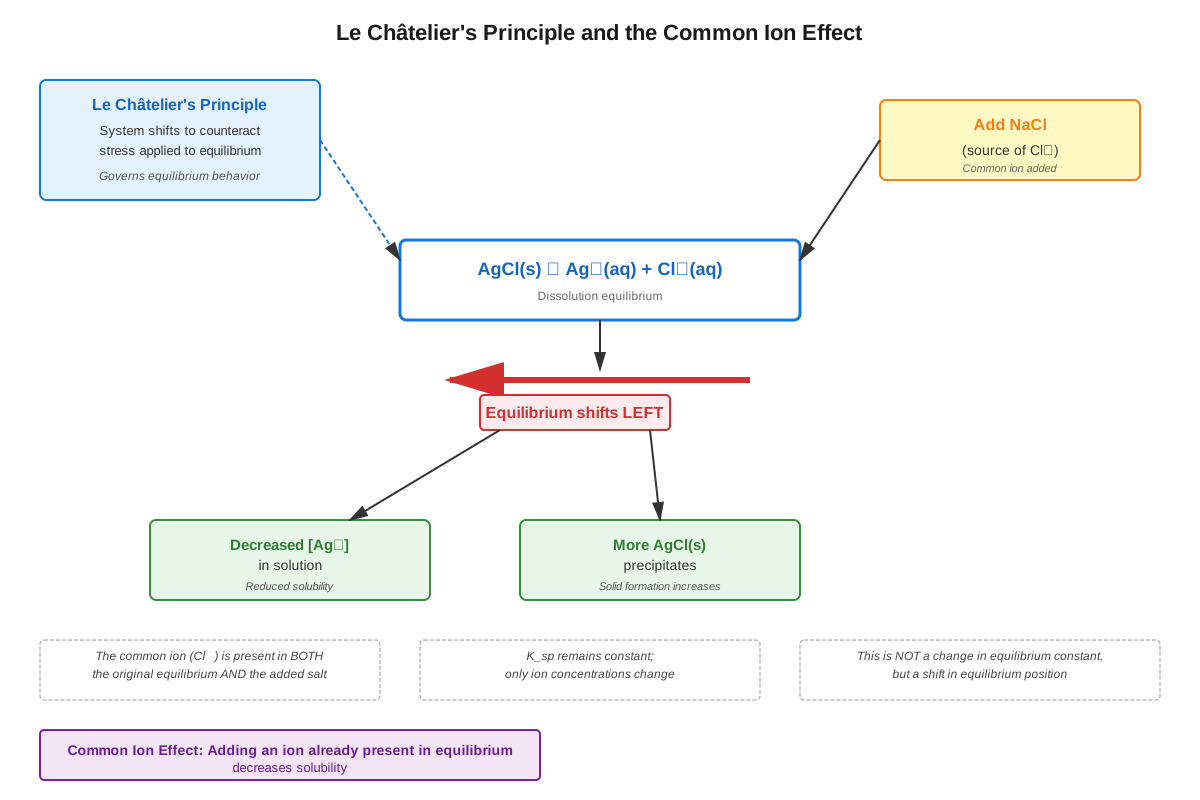
The common ion effect is the suppression of the ionization of a weak electrolyte or the decrease in solubility of a sparingly soluble salt when a soluble compound containing an ion common to the equilibrium is added to the solution. This phenomenon is a direct consequence of Le Châtelier's principle: when a system at equilibrium is stressed by adding one of the products, the equilibrium shifts toward the reactants to partially counteract the change.
For a generic equilibrium:
AB(s) ⇌ A⁺(aq) + B⁻(aq)If additional A⁺ ions are added from a soluble source (such as a different salt), the equilibrium shifts left, causing more AB to precipitate and decreasing the concentration of B⁻ ions in solution. The net result is a decrease in the solubility of AB compared to its solubility in pure water.
Mathematical Framework
The quantitative treatment of the common ion effect relies on the equilibrium constant expression. For a sparingly soluble salt with the general formula MₓXᵧ:
MₓXᵧ(s) ⇌ xM^(y+)(aq) + yX^(x-)(aq)The solubility product constant is:
Ksp = [M^(y+)]^x [X^(x-)]^yWhen a common ion is present, the initial concentration of that ion is no longer zero, which must be accounted for in ICE table calculations. The presence of the common ion means that less of the salt can dissolve before the ion product equals Ksp, resulting in decreased solubility.
Solubility Calculations with Common Ions
Consider the dissolution of silver chloride (AgCl) in pure water versus in a solution containing sodium chloride (NaCl). In pure water:
AgCl(s) ⇌ Ag⁺(aq) + Cl⁻(aq) Ksp = 1.8 × 10⁻¹⁰If the solubility is s mol/L, then [Ag⁺] = s and [Cl⁻] = s, so:
Ksp = s² = 1.8 × 10⁻¹⁰
s = 1.3 × 10⁻⁵ M
However, in a solution already containing 0.10 M NaCl (which provides Cl⁻ ions), the initial [Cl⁻] = 0.10 M. Using an ICE table:
| Species | Initial | Change | Equilibrium |
|---|---|---|---|
| Ag⁺ | 0 | +s | s |
| Cl⁻ | 0.10 | +s | 0.10 + s |
Since Ksp is very small, we can assume s << 0.10, so:
Ksp = (s)(0.10) = 1.8 × 10⁻¹⁰
s = 1.8 × 10⁻⁹ M
The solubility of AgCl is reduced by approximately 10,000-fold in the presence of the common ion (Cl⁻). This dramatic decrease illustrates the power of the common ion effect.
Common Ion Effect in Acid-Base Equilibria
The common ion effect is equally important in weak acid and weak base equilibria. Consider acetic acid (CH₃COOH) in water:
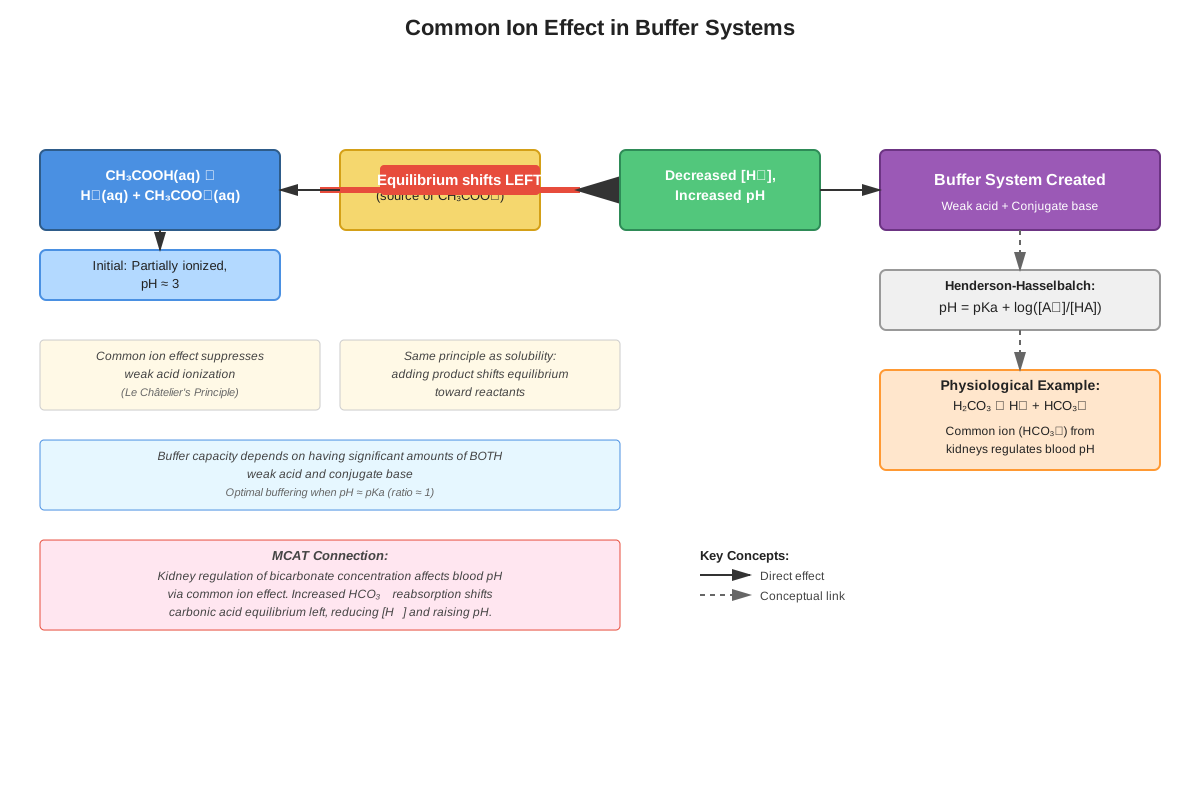
CH₃COOH(aq) ⇌ H⁺(aq) + CH₃COO⁻(aq) Ka = 1.8 × 10⁻⁵If sodium acetate (CH₃COONa) is added to the solution, it provides acetate ions (CH₃COO⁻), which is the conjugate base and a common ion. According to Le Châtelier's principle, the equilibrium shifts left, suppressing the ionization of acetic acid. This results in:
- Decreased [H⁺] (higher pH)
- Decreased percent ionization of the weak acid
- Increased [CH₃COOH] (more undissociated acid)
This principle is the foundation of buffer systems, where a weak acid and its conjugate base (or weak base and its conjugate acid) resist pH changes precisely because of the common ion effect.
Quantitative Impact and Approximations
The magnitude of the common ion effect depends on the concentration of the added common ion relative to the equilibrium concentrations. When the common ion concentration is much larger than the equilibrium concentration of that ion in the absence of the common ion, the simplifying approximation (assuming the change in common ion concentration is negligible) is valid.
For example, if calculating the solubility of a salt in the presence of a common ion at concentration C, and the solubility without the common ion is s₀, the approximation is valid when C >> s₀. This typically means C should be at least 100 times larger than s₀ for the approximation to introduce less than 1% error.
Selective Precipitation
The common ion effect enables selective precipitation, a technique used in qualitative analysis and industrial separations. By carefully controlling the concentration of a common ion, one can precipitate certain ions while keeping others in solution. This is particularly useful when separating mixtures of metal ions with different Ksp values.
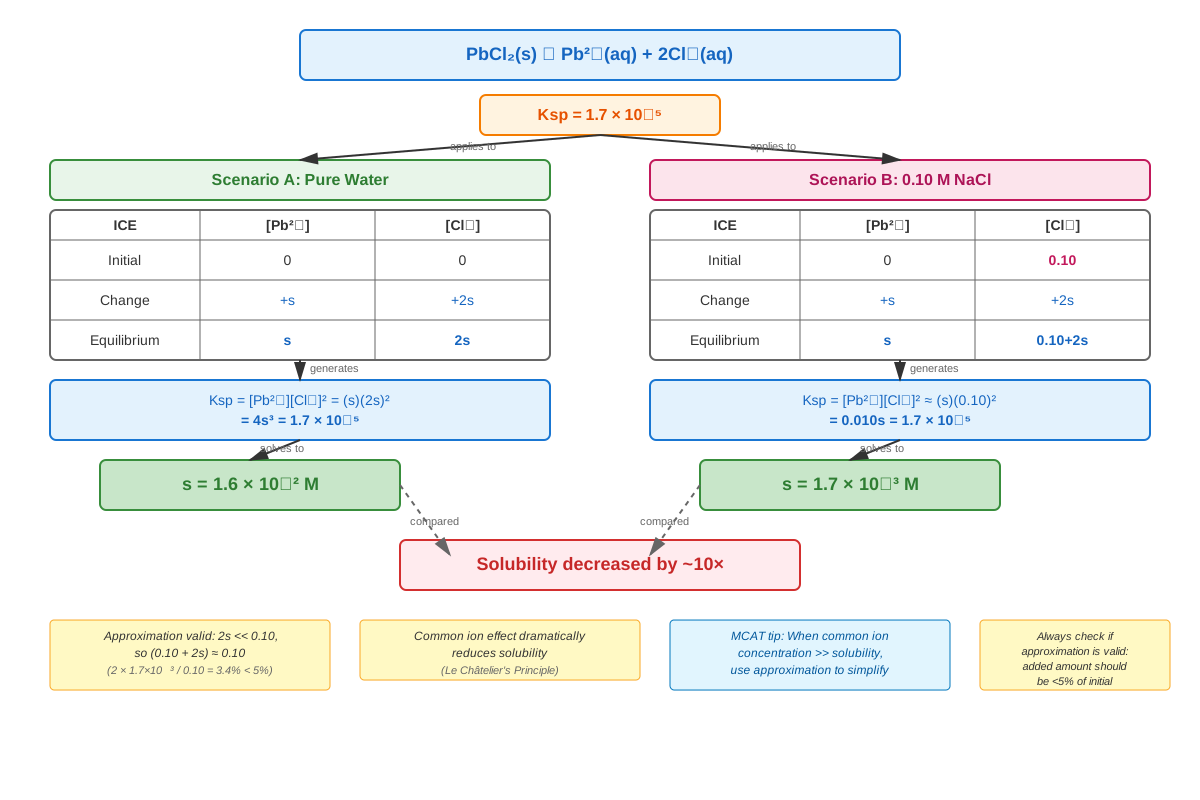
For instance, in a solution containing both Ag⁺ and Pb²⁺, adding Cl⁻ ions slowly will precipitate AgCl first (Ksp = 1.8 × 10⁻¹⁰) before PbCl₂ (Ksp = 1.7 × 10⁻⁵) begins to precipitate significantly. The common ion effect allows precise control over which precipitate forms at each stage.
Concept Relationships
The common ion effect is fundamentally an application of Le Châtelier's principle to equilibrium systems. When a common ion is added, it represents a stress on the system (increasing product concentration), which causes the equilibrium to shift toward reactants. This shift is quantified using equilibrium constants (Ksp for solubility equilibria, Ka/Kb for acid-base equilibria), which remain constant at a given temperature regardless of the presence of common ions.
The common ion effect directly enables buffer systems to function. A buffer contains a weak acid and its conjugate base (or weak base and conjugate acid), and the common ion effect suppresses ionization of the weak acid/base, allowing the system to resist pH changes. This connects to the Henderson-Hasselbalch equation, which describes buffer pH based on the ratio of conjugate acid-base pairs.
Within solubility equilibria, the common ion effect relates to Qsp (ion product) calculations. When a common ion is added, Qsp temporarily exceeds Ksp, causing precipitation until equilibrium is reestablished. This connects to precipitation reactions and the concept of supersaturation.
The mathematical treatment of common ion problems requires ICE tables and stoichiometry, linking to fundamental problem-solving skills in chemistry. The approximations used in common ion calculations connect to significant figures and error analysis, important for efficient MCAT problem-solving.
Relationship map:
Le Châtelier's Principle → Common Ion Effect → Decreased Solubility/Suppressed Ionization → Buffer Systems → pH Regulation → Physiological Applications
Equilibrium Constants (Ksp, Ka, Kb) → Quantitative Calculations → ICE Tables → Solubility Predictions → Selective Precipitation → Analytical Chemistry
High-Yield Facts
⭐ The common ion effect always decreases the solubility of a sparingly soluble salt compared to its solubility in pure water
⭐ The common ion effect is a direct application of Le Châtelier's principle: adding a product shifts equilibrium toward reactants
⭐ In buffer systems, the common ion effect suppresses ionization of the weak acid or base, enabling pH resistance
⭐ Ksp remains constant at a given temperature; only the solubility changes when a common ion is present
⭐ The approximation that the change in common ion concentration is negligible is valid when the initial common ion concentration is at least 100× the solubility without the common ion
- The common ion effect is more pronounced for salts with very small Ksp values (sparingly soluble salts)
- Adding a common ion to a weak acid solution increases pH by shifting equilibrium toward the undissociated acid
- Adding a common ion to a weak base solution decreases pH by shifting equilibrium toward the undissociated base
- The percent ionization of a weak acid decreases dramatically in the presence of its conjugate base (common ion)
- Selective precipitation exploits differences in Ksp values and uses the common ion effect to control which ions precipitate
- The common ion effect explains why calcium supplements should not be taken with high-oxalate foods (risk of kidney stones)
- In physiological buffers, the common ion effect helps maintain blood pH within the narrow range of 7.35-7.45
Quick check — test yourself on Common ion effect so far.
Try Flashcards →Common Misconceptions
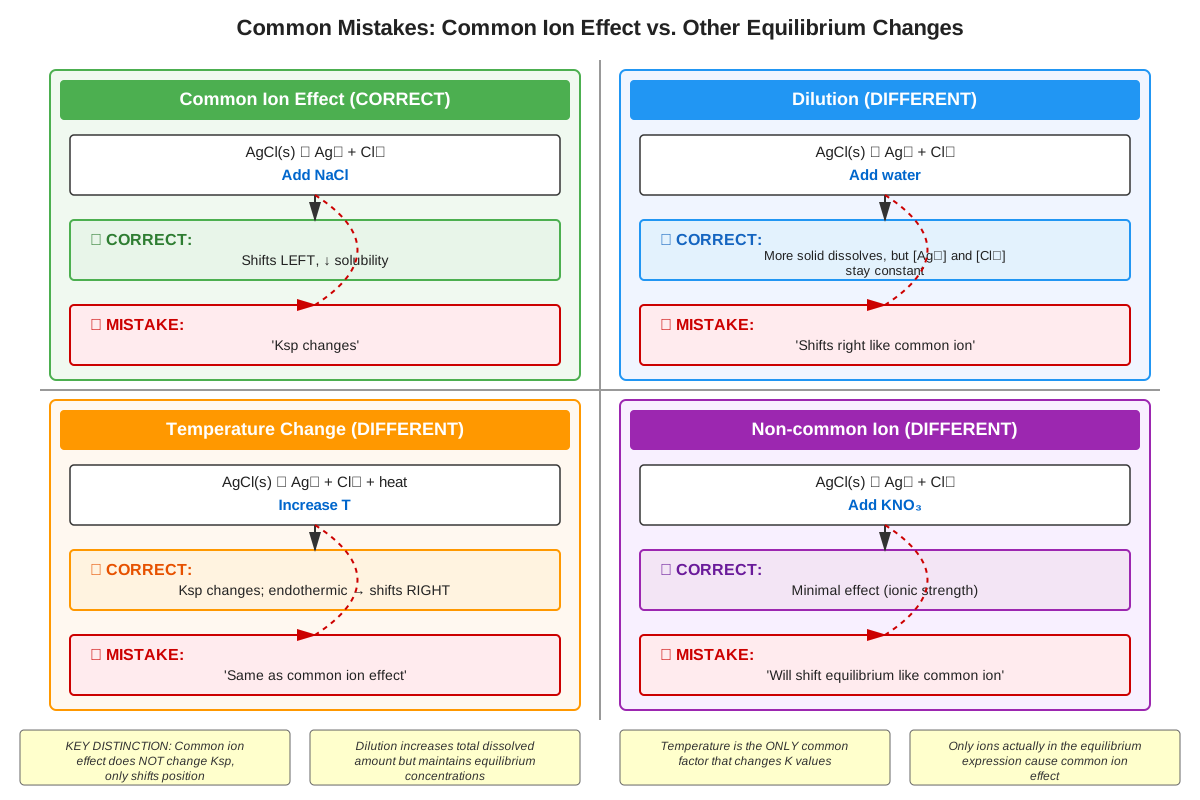
Misconception: The common ion effect changes the value of Ksp or Ka.
Correction: Equilibrium constants depend only on temperature. The common ion effect changes the solubility or degree of ionization, but Ksp and Ka remain constant. The equilibrium position shifts, but the equilibrium constant does not change.
Misconception: Adding a common ion increases the solubility of a salt.
Correction: The common ion effect always decreases solubility. Adding a product (ion) shifts the equilibrium toward reactants (solid salt), causing precipitation and reducing the amount of dissolved salt.
Misconception: The common ion must come from the same compound that is dissolving.
Correction: The common ion can come from any soluble source. For example, Cl⁻ ions from NaCl, HCl, or KCl all produce the same common ion effect on AgCl solubility. The source doesn't matter; only the ion identity and concentration matter.
Misconception: In common ion problems, both ions from the sparingly soluble salt have the same concentration at equilibrium.
Correction: When a common ion is present, the ions have different concentrations. The common ion concentration is dominated by the added source, while the other ion concentration is determined by the solubility. For AgCl in NaCl solution, [Cl⁻] >> [Ag⁺].
Misconception: The common ion effect only applies to solubility equilibria.
Correction: The common ion effect applies to all types of equilibria, including acid-base equilibria, complex ion formation, and gas-phase equilibria. Any equilibrium system can experience a common ion effect when one of the products is added from an external source.
Misconception: If you add a common ion, the equilibrium constant expression changes.
Correction: The form of the equilibrium constant expression never changes. What changes is the initial concentration in the ICE table. The equilibrium constant expression and its value remain the same; only the equilibrium concentrations of the species change.
Misconception: The common ion effect is negligible for highly soluble salts.
Correction: While the common ion effect is most dramatic for sparingly soluble salts, it still occurs with more soluble salts. However, the practical impact is less noticeable because the solubility is already high, and the relative decrease is smaller.
Worked Examples
Example 1: Solubility Calculation with Common Ion
Problem: Calculate the molar solubility of calcium fluoride (CaF₂) in (a) pure water and (b) a 0.015 M NaF solution. Ksp for CaF₂ = 3.9 × 10⁻¹¹.
Solution:
(a) Solubility in pure water:
The dissolution equilibrium is:
CaF₂(s) ⇌ Ca²⁺(aq) + 2F⁻(aq)Let s = molar solubility of CaF₂
ICE table:
| Species | Initial | Change | Equilibrium |
|---|---|---|---|
| Ca²⁺ | 0 | +s | s |
| F⁻ | 0 | +2s | 2s |
Ksp = [Ca²⁺][F⁻]² = (s)(2s)² = 4s³
3.9 × 10⁻¹¹ = 4s³
s³ = 9.75 × 10⁻¹²
s = 2.1 × 10⁻⁴ M
The molar solubility in pure water is 2.1 × 10⁻⁴ M.
(b) Solubility in 0.015 M NaF:
NaF is a soluble salt that completely dissociates, providing F⁻ ions (the common ion).
ICE table:
| Species | Initial | Change | Equilibrium |
|---|---|---|---|
| Ca²⁺ | 0 | +s | s |
| F⁻ | 0.015 | +2s | 0.015 + 2s |
Since Ksp is very small, we expect s to be small. Check if 2s << 0.015:
From part (a), s in pure water is 2.1 × 10⁻⁴ M, so in the presence of excess F⁻, s will be even smaller. The approximation 0.015 + 2s ≈ 0.015 should be valid.
Ksp = [Ca²⁺][F⁻]² = (s)(0.015)²
3.9 × 10⁻¹¹ = s(2.25 × 10⁻⁴)
s = 1.7 × 10⁻⁷ M
Check approximation: 2s = 3.4 × 10⁻⁷, which is indeed << 0.015 ✓
The molar solubility in 0.015 M NaF is 1.7 × 10⁻⁷ M.
Analysis: The solubility decreased by a factor of approximately 1,200 due to the common ion effect. This demonstrates how dramatically the presence of a common ion can suppress solubility. This connects to Learning Objective: Calculate the solubility of a sparingly soluble salt in the presence of a common ion.
Example 2: Common Ion Effect in Acid-Base Equilibrium
Problem: A solution contains 0.10 M acetic acid (CH₃COOH, Ka = 1.8 × 10⁻⁵). Calculate the pH of this solution (a) without any added salt and (b) after adding enough sodium acetate (CH₃COONa) to make the acetate concentration 0.10 M.
Solution:
(a) pH without added salt:
CH₃COOH(aq) ⇌ H⁺(aq) + CH₃COO⁻(aq)ICE table:
| Species | Initial | Change | Equilibrium |
|---|---|---|---|
| CH₃COOH | 0.10 | -x | 0.10 - x |
| H⁺ | 0 | +x | x |
| CH₃COO⁻ | 0 | +x | x |
Ka = [H⁺][CH₃COO⁻]/[CH₃COOH] = x²/(0.10 - x)Assuming x << 0.10:
1.8 × 10⁻⁵ = x²/0.10
x² = 1.8 × 10⁻⁶
x = 1.3 × 10⁻³ M = [H⁺]
pH = -log(1.3 × 10⁻³) = 2.89
Check: x/0.10 = 1.3% < 5%, so approximation is valid ✓
(b) pH with 0.10 M acetate (common ion):
ICE table:
| Species | Initial | Change | Equilibrium |
|---|---|---|---|
| CH₃COOH | 0.10 | -x | 0.10 - x |
| H⁺ | 0 | +x | x |
| CH₃COO⁻ | 0.10 | +x | 0.10 + x |
The presence of acetate (common ion) will suppress ionization, so x will be very small.
Assuming x << 0.10:
Ka = [H⁺][CH₃COO⁻]/[CH₃COOH] = (x)(0.10)/(0.10)
1.8 × 10⁻⁵ = x
[H⁺] = 1.8 × 10⁻⁵ M
pH = -log(1.8 × 10⁻⁵) = 4.74Analysis: The pH increased from 2.89 to 4.74 (less acidic) due to the common ion effect. The acetate ion suppressed the ionization of acetic acid, reducing [H⁺] by a factor of approximately 70. This is the fundamental principle behind buffer action. This example addresses Learning Objective: Predict the direction of equilibrium shifts when common ions are added to buffer systems.
Alternatively, this could be solved using the Henderson-Hasselbalch equation:
pH = pKa + log([A⁻]/[HA]) = 4.74 + log(0.10/0.10) = 4.74This demonstrates the connection between the common ion effect and buffer chemistry.
Exam Strategy
Approaching MCAT Questions
When encountering common ion effect questions on the MCAT, follow this systematic approach:
- Identify the equilibrium system: Determine whether the question involves solubility (Ksp), acid-base (Ka/Kb), or another type of equilibrium.
- Recognize the common ion: Identify which ion is present in both the equilibrium system and the added compound. This is the ion that will cause the shift.
- Predict the direction qualitatively: Before calculating, use Le Châtelier's principle to predict whether solubility will decrease, pH will increase/decrease, or ionization will be suppressed.
- Set up an ICE table: Include the initial concentration of the common ion from the added source. This is the key difference from problems without common ions.
- Apply approximations wisely: If the common ion concentration is much larger than the expected change, use the simplifying approximation to save time.
Trigger Words and Phrases
Watch for these phrases that signal common ion effect questions:
- "In the presence of..."
- "After adding [salt containing common ion]..."
- "Calculate the solubility in a solution already containing..."
- "Buffer solution" (inherently involves common ion effect)
- "Selective precipitation"
- "Suppression of ionization"
Process of Elimination Tips
When evaluating answer choices:
- Eliminate options that show increased solubility when a common ion is added (solubility always decreases)
- Eliminate options where Ksp or Ka values change (equilibrium constants are temperature-dependent only)
- Eliminate options that ignore the initial common ion concentration in calculations
- For qualitative questions, eliminate options that violate Le Châtelier's principle
Time Allocation
For common ion effect questions:
- Qualitative questions (predict direction of shift): 30-45 seconds
- Quantitative calculations (solubility or pH): 90-120 seconds
- Passage-based applications: 60-90 seconds per question
If a calculation appears complex, check whether the question is asking for an order of magnitude estimate or qualitative comparison rather than an exact value. The MCAT often rewards conceptual understanding over computational precision.
Exam Tip: If you're asked to compare solubilities with and without a common ion, you don't always need to calculate both exactly. Calculate one, then use Le Châtelier's principle to determine whether the other is larger or smaller.
Memory Techniques
Mnemonics
"COMMON = Concentration Opposes More Material Dissolving, Obeys Natural equilibrium"
- Reminds you that adding a common ion opposes dissolution and follows Le Châtelier's principle
"LESS" for common ion effect outcomes:
- Lower solubility
- Equilibrium shifts left
- Suppressed ionization
- Same Ksp/Ka value
Visualization Strategy
Visualize a crowded room (the solution) where people (ions) are trying to enter. When the room already has many people of one type (common ion), fewer new people can enter (decreased solubility). The fire code (Ksp) hasn't changed, but the room is already partially full.
For acid-base equilibria, imagine a reversible reaction as a tug-of-war. Adding the conjugate base (common ion) is like adding players to one side—the rope (equilibrium) shifts toward the other side (undissociated acid).
Acronym for Problem-Solving
ICE-CAP for solving common ion problems:
- Identify the equilibrium
- Common ion recognition
- Establish ICE table
- Calculate with approximation
- Assess validity of approximation
- Predict qualitatively first
Summary
The common ion effect is a fundamental equilibrium principle stating that the solubility of a sparingly soluble salt or the ionization of a weak electrolyte is suppressed when a solution already contains one of the ions present in the equilibrium system. This phenomenon is a direct application of Le Châtelier's principle: adding a product shifts the equilibrium toward reactants. Quantitatively, the common ion effect is analyzed using equilibrium constants (Ksp for solubility, Ka/Kb for acid-base systems) and ICE tables, with the critical difference being that the initial concentration of the common ion is non-zero. The effect is most pronounced for sparingly soluble salts and weak acids/bases, and it forms the foundation of buffer systems, which resist pH changes through suppression of ionization. For MCAT success, students must be able to predict equilibrium shifts qualitatively, perform quantitative calculations with appropriate approximations, and recognize common ion scenarios in physiological and analytical contexts. The equilibrium constants themselves never change due to the common ion effect—only the equilibrium position and the solubility or degree of ionization change.
Key Takeaways
- The common ion effect always decreases solubility or suppresses ionization by shifting equilibrium toward reactants according to Le Châtelier's principle
- Equilibrium constants (Ksp, Ka, Kb) remain constant at a given temperature; only the equilibrium concentrations change when a common ion is present
- Quantitative problems require ICE tables with non-zero initial concentrations for the common ion, and approximations are valid when the common ion concentration is much larger than the solubility or ionization extent
- Buffer systems function because of the common ion effect: the conjugate base suppresses ionization of the weak acid (or vice versa), enabling pH resistance
- The common ion effect has important physiological applications in blood pH regulation, kidney stone formation, and drug solubility
- On the MCAT, recognize trigger phrases like "in the presence of" and "already containing" that signal common ion scenarios
- Always predict the direction of the shift qualitatively before attempting calculations to catch potential errors and save time
Related Topics
Buffer Systems and Henderson-Hasselbalch Equation: The common ion effect is the mechanistic basis for buffer action. Understanding how buffers resist pH changes requires mastery of how common ions suppress ionization. The Henderson-Hasselbalch equation provides a shortcut for buffer pH calculations that implicitly accounts for the common ion effect.
Solubility Product Constant (Ksp) and Precipitation Reactions: The common ion effect directly impacts when and how precipitation occurs. Mastering this topic enables understanding of selective precipitation, qualitative analysis schemes, and physiological processes like kidney stone formation.
Le Châtelier's Principle and Equilibrium Shifts: The common ion effect is one specific application of this broader principle. Deepening understanding of Le Châtelier's principle enhances ability to predict and explain common ion phenomena.
Acid-Base Chemistry and pH Calculations: Common ion effects in weak acid/base systems connect to broader acid-base topics including conjugate acid-base pairs, percent ionization, and polyprotic acids.
Complex Ion Formation: Advanced equilibrium topics involving complex ions (like [Cu(NH₃)₄]²⁺) also exhibit common ion effects when ligands are added in excess, connecting to coordination chemistry and transition metal behavior.
Practice CTA
Now that you've mastered the core concepts of the common ion effect, it's time to solidify your understanding through active practice. Attempt the practice questions and work through the flashcards to reinforce the key principles, calculations, and applications you've learned. Focus especially on problems that require you to set up ICE tables with non-zero initial concentrations and those that ask you to predict equilibrium shifts qualitatively. Remember, the MCAT rewards both conceptual understanding and efficient problem-solving—practice will help you develop both. The common ion effect is a high-yield topic that connects to numerous other concepts in General Chemistry and biochemistry, so investing time here will pay dividends across multiple sections of the exam. You've got this!
Sign up free to keep reading
Create a free AnvayaPrep account to finish this MCAT guide on Common ion effect — plus flashcards and practice questions.