Overview
The rate constant is a fundamental parameter in chemical kinetics that quantifies the intrinsic speed of a chemical reaction under specific conditions. Unlike reaction rate, which varies with reactant concentrations, the rate constant (symbolized as k) is an intensive property that depends only on temperature and the presence of catalysts. Understanding the rate constant is essential for predicting how quickly reactions proceed, determining reaction mechanisms, and solving complex kinetics problems that frequently appear on the MCAT.
For MCAT preparation, mastery of the rate constant bridges multiple high-yield topics within General Chemistry, including reaction orders, the Arrhenius equation, activation energy, and equilibrium constants. The MCAT regularly tests students' ability to interpret rate laws, calculate rate constants from experimental data, and understand how temperature affects reaction kinetics. Questions may appear as discrete items testing mathematical relationships or embedded within passage-based scenarios involving enzyme kinetics, pharmacokinetics, or atmospheric chemistry.
The rate constant serves as a quantitative link between molecular-level collision theory and macroscopic observations of reaction progress. By connecting activation energy barriers, molecular orientation requirements, and temperature effects to measurable reaction rates, the rate constant provides a complete picture of Kinetics and Equilibrium. This topic integrates mathematical problem-solving with conceptual understanding, making it a medium-difficulty but high-impact area for exam preparation.
Learning Objectives
- [ ] Define rate constant using accurate General Chemistry terminology
- [ ] Explain why rate constant matters for the MCAT
- [ ] Apply rate constant to exam-style questions
- [ ] Identify common mistakes related to rate constant
- [ ] Connect rate constant to related General Chemistry concepts
- [ ] Calculate rate constants from experimental data using integrated rate laws
- [ ] Predict how temperature changes affect rate constant values using the Arrhenius equation
- [ ] Distinguish between rate constant and equilibrium constant in reversible reactions
Prerequisites
- Reaction rates and rate laws: Understanding how to express reaction rate as a function of reactant concentrations is essential for interpreting what the rate constant represents
- Units and dimensional analysis: Rate constants have different units depending on reaction order, requiring facility with unit conversions and dimensional reasoning
- Exponential and logarithmic functions: The Arrhenius equation and integrated rate laws involve natural logarithms and exponentials, which are mathematical tools needed for rate constant calculations
- Basic thermodynamics: Concepts like activation energy and enthalpy changes provide the energetic context for understanding why rate constants vary with temperature
- Collision theory: The molecular basis for reaction rates helps explain why rate constants depend on temperature and catalysts
Why This Topic Matters
Clinical and Real-World Significance
Rate constants govern virtually every chemical and biochemical process, from drug metabolism in the liver to the synthesis of neurotransmitters. Pharmacokinetics relies heavily on first-order rate constants to predict drug half-lives and dosing schedules. Understanding rate constants enables clinicians to optimize therapeutic windows, avoid toxic accumulation, and predict drug-drug interactions. In environmental science, rate constants determine pollutant degradation rates, ozone depletion kinetics, and the effectiveness of water treatment processes.
MCAT Exam Statistics
Rate constant questions appear in approximately 15-20% of General Chemistry passages and discrete questions on the MCAT. The topic most commonly appears in three formats: (1) calculation-based questions requiring determination of k from experimental data, (2) conceptual questions about how temperature or catalysts affect k, and (3) passage-based scenarios involving enzyme kinetics or pharmacological applications. The AAMC frequently combines rate constant questions with graphical analysis, requiring students to extract kinetic parameters from plots of concentration versus time or ln(concentration) versus time.
Common Exam Contexts
MCAT passages featuring rate constants often involve enzyme-catalyzed reactions (connecting to biochemistry), atmospheric chemistry (ozone formation/depletion), or pharmaceutical development (drug stability and metabolism). Questions may present experimental data tables requiring students to determine reaction order and calculate k, or they may describe temperature-dependent phenomena requiring application of the Arrhenius equation. The exam particularly favors scenarios where students must distinguish between factors that affect rate (concentration changes) versus factors that affect the rate constant (temperature, catalysts).
Core Concepts
Definition and Fundamental Properties
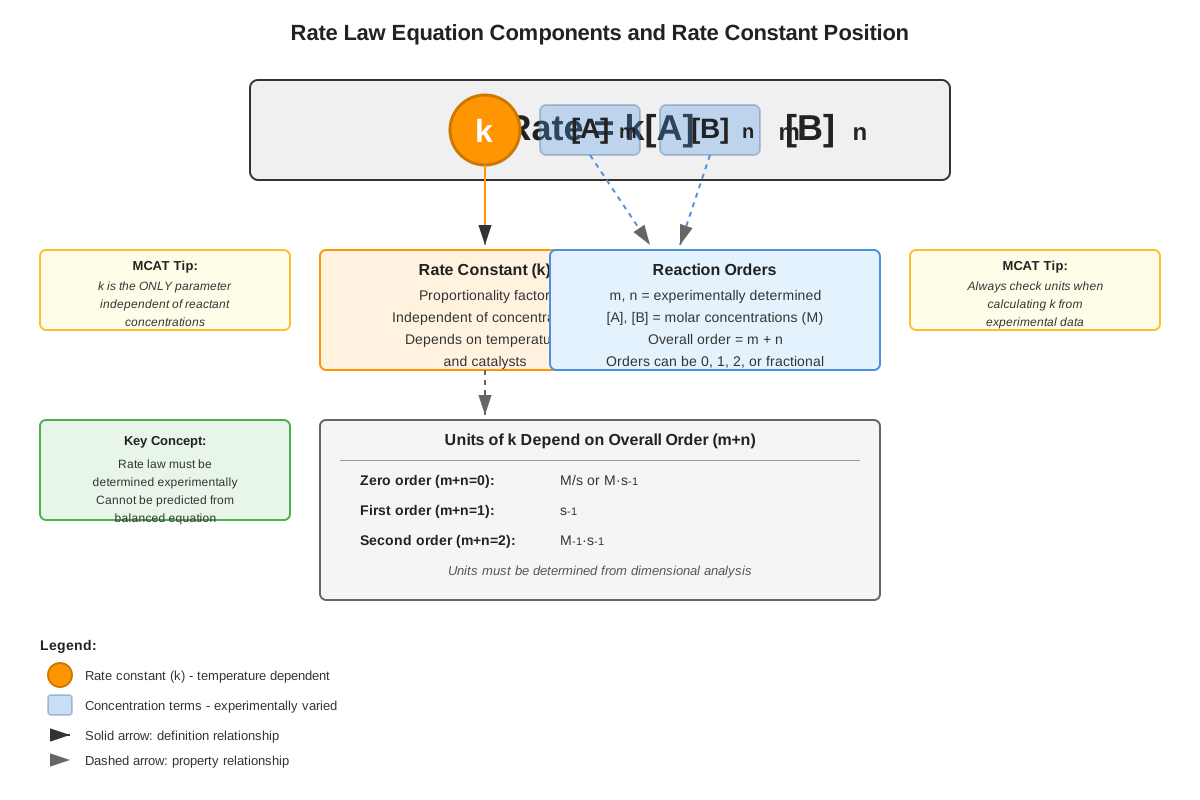
The rate constant (k) is the proportionality constant in the rate law equation that relates reaction rate to reactant concentrations. For a general reaction aA + bB → products, the rate law takes the form:
Rate = k[A]^m[B]^nwhere m and n are the reaction orders with respect to A and B, respectively. The rate constant embodies all factors affecting reaction speed except reactant concentrations, including temperature, catalyst presence, solvent effects, and the intrinsic molecular properties of the reactants.
Unlike the reaction rate itself, which changes continuously as reactants are consumed, the rate constant remains fixed at a given temperature. This constancy makes k a characteristic property of a specific reaction under defined conditions. The rate constant must be determined experimentally—it cannot be predicted from stoichiometric coefficients alone.
Units of the Rate Constant
The units of k vary systematically with overall reaction order, ensuring that the rate law always yields rate in units of concentration per time (typically M/s or M·s⁻¹). This dimensional requirement provides a powerful check on calculations:
| Reaction Order | Rate Law Form | Units of k | Example |
|---|---|---|---|
| Zero order | Rate = k | M·s⁻¹ | Surface-catalyzed reactions |
| First order | Rate = k[A] | s⁻¹ | Radioactive decay, many decompositions |
| Second order | Rate = k[A]² or k[A][B] | M⁻¹·s⁻¹ | Bimolecular gas-phase reactions |
| Third order | Rate = k[A]²[B] | M⁻²·s⁻¹ | Rare; some termolecular reactions |
The general formula for rate constant units is M^(1-n)·s⁻¹, where n is the overall reaction order. This relationship is frequently tested on the MCAT through questions asking students to identify reaction order from given rate constant units.
Temperature Dependence: The Arrhenius Equation
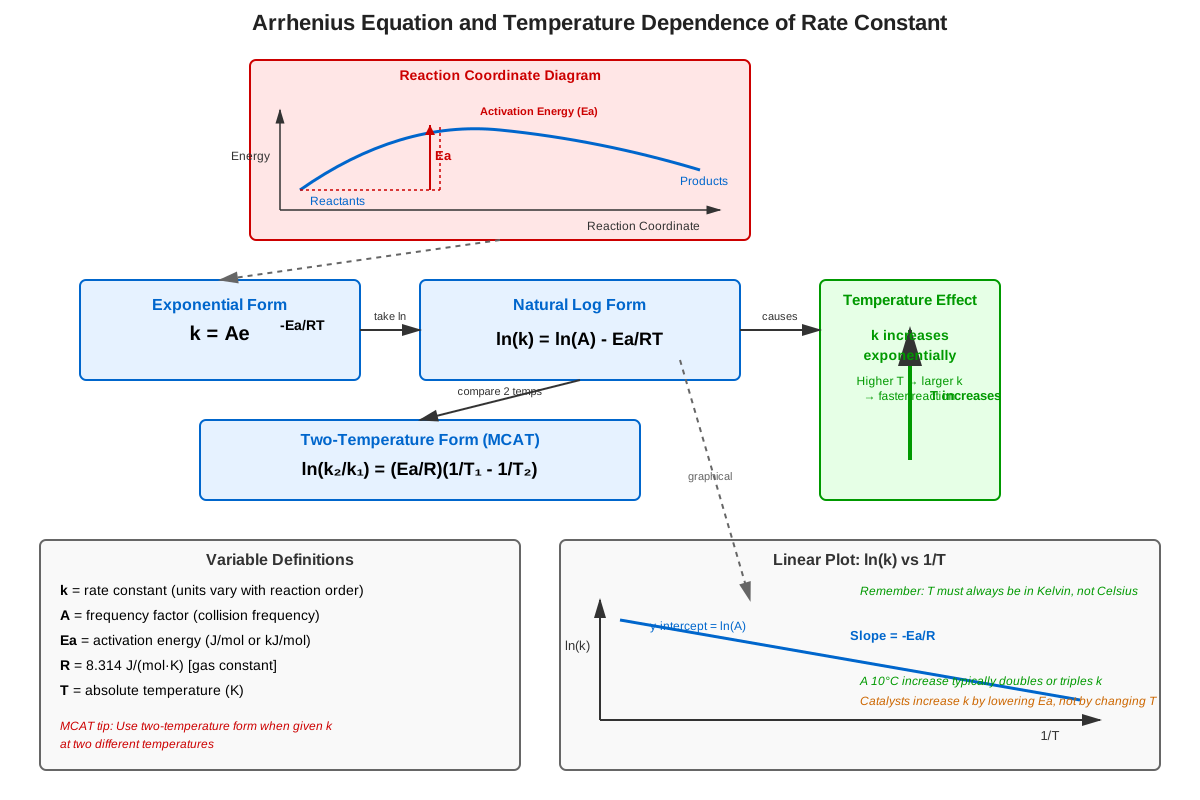
The Arrhenius equation quantifies the exponential relationship between temperature and the rate constant:
k = Ae^(-Ea/RT)where:
- A is the pre-exponential factor (frequency factor), representing collision frequency and orientation requirements
- Ea is the activation energy (in J/mol or kJ/mol)
- R is the universal gas constant (8.314 J·mol⁻¹·K⁻¹)
- T is absolute temperature (in Kelvin)
The Arrhenius equation reveals that rate constants increase exponentially with temperature. Even modest temperature increases can dramatically accelerate reactions, which explains why biological systems are so temperature-sensitive and why refrigeration preserves food.
The linearized form of the Arrhenius equation is particularly useful for MCAT problem-solving:
ln(k) = ln(A) - Ea/RTThis equation has the form y = mx + b, where plotting ln(k) versus 1/T yields a straight line with slope = -Ea/R and y-intercept = ln(A). The MCAT frequently presents such plots and asks students to extract activation energy or predict rate constants at different temperatures.
Relationship Between Rate Constants and Equilibrium
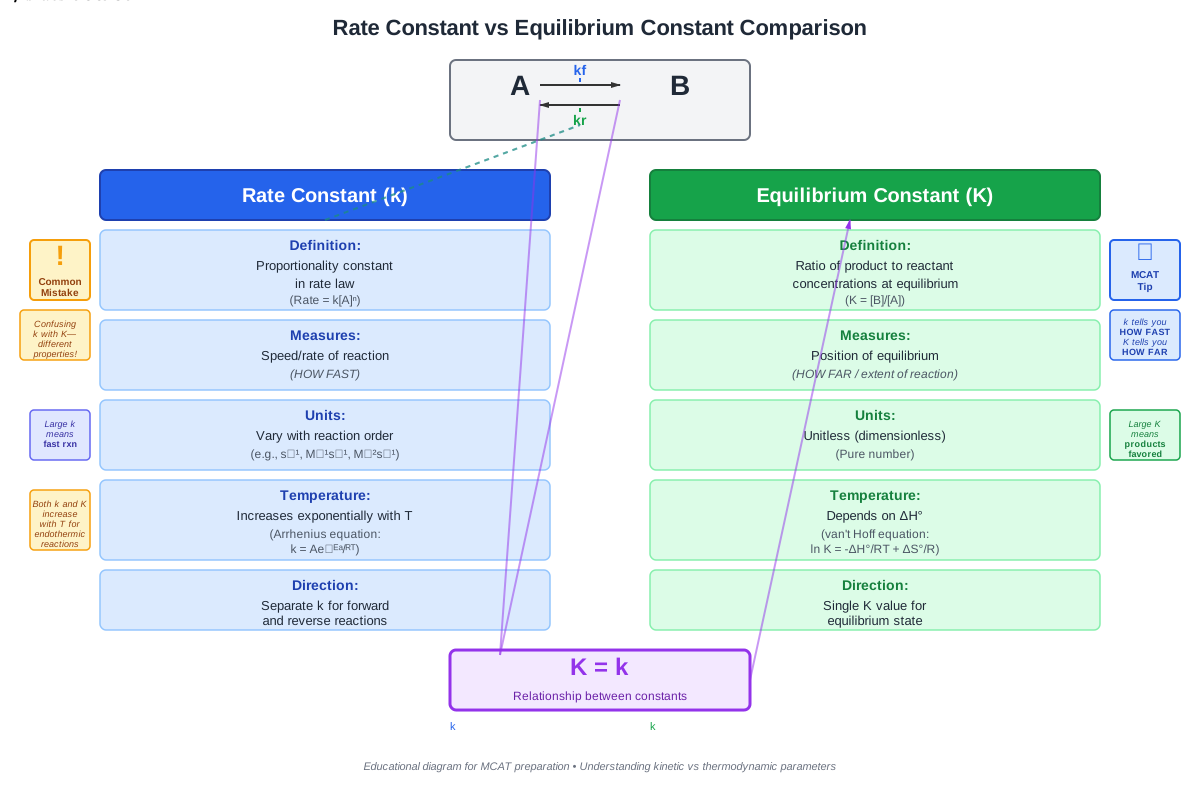
For reversible reactions, the equilibrium constant (Keq) relates directly to the forward and reverse rate constants:
K_eq = k_forward / k_reverseThis relationship connects Kinetics and Equilibrium, showing that equilibrium is a dynamic state where forward and reverse reactions proceed at equal rates. A large Keq indicates that kforward >> kreverse, meaning products form much faster than they revert to reactants. This connection is conceptually important for understanding Le Châtelier's principle and the distinction between thermodynamic favorability (determined by Keq) and kinetic accessibility (determined by rate constants).
Catalysts and Rate Constants
Catalysts increase reaction rates by providing alternative reaction pathways with lower activation energies. Crucially, catalysts increase both forward and reverse rate constants proportionally, leaving the equilibrium constant unchanged. The effect on the rate constant can be quantified through the Arrhenius equation: lowering Ea increases the exponential term e^(-Ea/RT), thereby increasing k.
Enzymes, the biological catalysts emphasized on the MCAT, can increase rate constants by factors of 10⁶ to 10¹⁷. This dramatic acceleration enables biochemical reactions to occur at physiologically relevant timescales. Understanding that catalysts affect k but not Keq is a high-yield distinction frequently tested on the exam.
Integrated Rate Laws and Half-Life
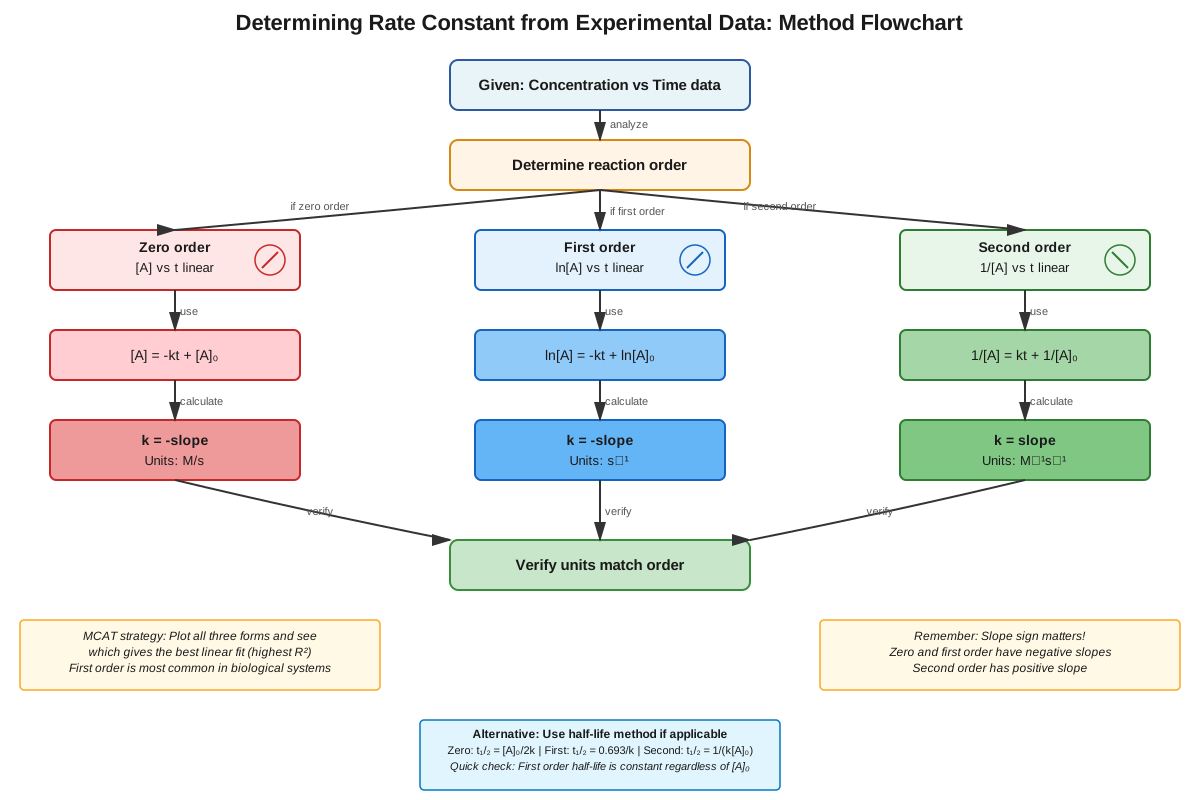
The rate constant appears in integrated rate laws, which relate concentration to time:
First-order integrated rate law:
ln[A]_t = ln[A]_0 - ktFirst-order half-life:
t_1/2 = 0.693/k = ln(2)/kThe first-order half-life is independent of initial concentration, a unique property that makes first-order kinetics particularly important in pharmacology and nuclear chemistry. The MCAT frequently tests whether students recognize that constant half-life indicates first-order kinetics.
Second-order integrated rate law:
1/[A]_t = 1/[A]_0 + ktSecond-order half-life:
t_1/2 = 1/(k[A]_0)Unlike first-order reactions, second-order half-lives depend on initial concentration, increasing as the reaction progresses.
Concept Relationships
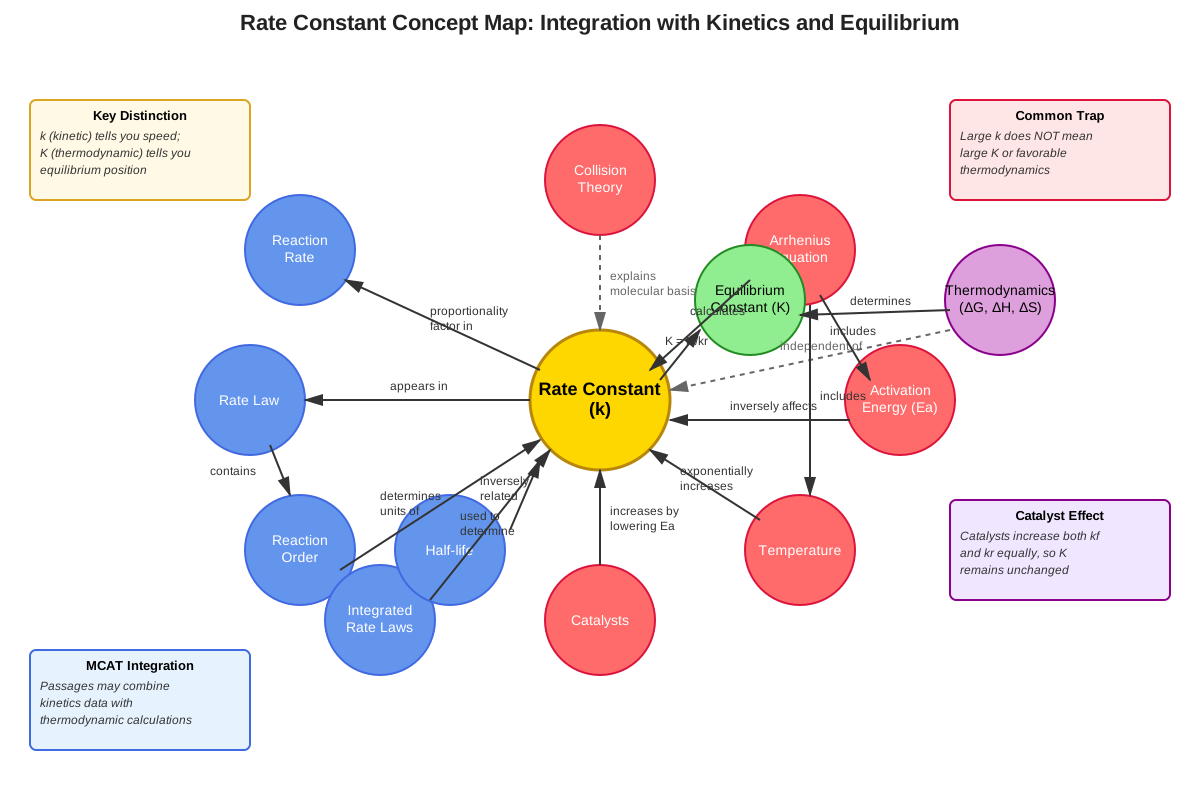
The rate constant serves as a central hub connecting multiple kinetic and thermodynamic concepts. Reaction rate depends on both the rate constant and reactant concentrations (Rate = k[reactants]^order), establishing that k is the concentration-independent component of reaction speed. The Arrhenius equation links the rate constant to activation energy and temperature, revealing the molecular basis for temperature sensitivity. This connection extends to collision theory, which explains that k depends on collision frequency (related to the pre-exponential factor A) and the fraction of collisions with sufficient energy (the exponential term).
The relationship between forward and reverse rate constants determines the equilibrium constant (Keq = kf/kr), bridging kinetics and equilibrium. This connection shows that reactions with large equilibrium constants have much faster forward than reverse reactions, though both rate constants increase equally when catalysts are added. Catalysts affect rate constants by lowering activation energy, which can be understood through the Arrhenius equation: reducing Ea increases k exponentially.
The rate constant also determines half-life through integrated rate laws, with the specific relationship depending on reaction order. For first-order reactions, t1/2 = 0.693/k, creating an inverse relationship where larger rate constants correspond to shorter half-lives. This connection is particularly important in pharmacokinetics and nuclear chemistry.
Textual relationship map:
Temperature → (via Arrhenius equation) → Rate constant → (via rate law) → Reaction rate
Activation energy → (via Arrhenius equation) → Rate constant → (via Keq = kf/kr) → Equilibrium constant
Catalyst → (lowers Ea) → Rate constant → (via integrated rate laws) → Half-life
Quick check — test yourself on Rate constant so far.
Try Flashcards →High-Yield Facts
⭐ The rate constant k is independent of reactant concentrations but depends strongly on temperature
⭐ Rate constant units vary with reaction order: zero order (M·s⁻¹), first order (s⁻¹), second order (M⁻¹·s⁻¹)
⭐ The Arrhenius equation shows that rate constants increase exponentially with temperature: k = Ae^(-Ea/RT)
⭐ For reversible reactions, K_eq = k_forward/k_reverse, connecting kinetics to equilibrium
⭐ First-order half-life is independent of concentration: t_1/2 = 0.693/k
- Catalysts increase rate constants by lowering activation energy but do not change equilibrium constants
- A plot of ln(k) versus 1/T yields a straight line with slope = -Ea/R
- Larger rate constants correspond to faster reactions and shorter half-lives
- The pre-exponential factor A in the Arrhenius equation represents collision frequency and orientation requirements
- Second-order half-lives depend on initial concentration and increase as the reaction proceeds
- Rate constants must be determined experimentally; they cannot be calculated from stoichiometric coefficients
- Doubling temperature does not double the rate constant—the relationship is exponential, not linear
Common Misconceptions
Misconception: The rate constant changes as reactant concentrations change during a reaction.
Correction: The rate constant remains fixed at a given temperature. Only the reaction rate changes as concentrations change. The rate constant is an intensive property that characterizes the reaction itself, not the specific conditions of reactant amounts.
Misconception: Rate constant units are always the same regardless of reaction order.
Correction: Rate constant units must adjust to ensure the rate law yields rate in units of M·s⁻¹. Zero-order reactions have k in M·s⁻¹, first-order in s⁻¹, and second-order in M⁻¹·s⁻¹. Recognizing the units of k is often the fastest way to determine reaction order.
Misconception: A larger activation energy means a larger rate constant.
Correction: The opposite is true. According to the Arrhenius equation, larger activation energies result in smaller rate constants because Ea appears in the exponent with a negative sign: k = Ae^(-Ea/RT). Higher energy barriers slow reactions down.
Misconception: Catalysts increase the rate constant by shifting the equilibrium position.
Correction: Catalysts do not affect equilibrium position or the equilibrium constant. They increase both forward and reverse rate constants proportionally by providing a lower-energy pathway. The ratio kf/kr (which equals Keq) remains unchanged.
Misconception: Doubling the temperature doubles the rate constant.
Correction: The relationship between temperature and rate constant is exponential, not linear. A temperature increase typically increases k by a factor of 2-4 for every 10°C rise (depending on activation energy), but this is not a simple doubling relationship. The exact effect depends on Ea/RT.
Misconception: The stoichiometric coefficients in a balanced equation determine the exponents in the rate law and thus affect the rate constant.
Correction: Reaction orders (the exponents in the rate law) must be determined experimentally and often differ from stoichiometric coefficients. The rate constant incorporates the specific mechanism of the reaction, which may involve elementary steps with different stoichiometry than the overall equation.
Worked Examples
Example 1: Determining Rate Constant from Experimental Data
Problem: A first-order decomposition reaction of compound A is monitored, and the following data are collected:
| Time (s) | [A] (M) |
|---|---|
| 0 | 0.800 |
| 50 | 0.400 |
| 100 | 0.200 |
| 150 | 0.100 |
Calculate the rate constant for this reaction.
Solution:
Step 1: Recognize that this is a first-order reaction (given in the problem). The integrated rate law for first-order kinetics is:
ln[A]_t = ln[A]_0 - ktStep 2: Rearrange to solve for k:
k = (ln[A]_0 - ln[A]_t) / tStep 3: Choose any data point. Using t = 50 s:
k = (ln(0.800) - ln(0.400)) / 50
k = (-0.223 - (-0.916)) / 50
k = 0.693 / 50
k = 0.0139 s⁻¹
Step 4: Verify with another data point (t = 100 s):
k = (ln(0.800) - ln(0.200)) / 100
k = (-0.223 - (-1.609)) / 100
k = 1.386 / 100
k = 0.0139 s⁻¹
The consistency confirms our answer. Notice that the concentration halves every 50 seconds, which is characteristic of first-order kinetics with constant half-life.
Connection to learning objectives: This problem demonstrates how to apply the rate constant concept to experimental data, a common MCAT question type. The units (s⁻¹) confirm first-order kinetics, and the constant half-life provides an alternative verification method.
Example 2: Temperature Dependence and Activation Energy
Problem: A reaction has a rate constant of 2.5 × 10⁻³ s⁻¹ at 25°C and 1.0 × 10⁻² s⁻¹ at 45°C. Calculate the activation energy for this reaction.
Solution:
Step 1: Use the two-point form of the Arrhenius equation:
ln(k₂/k₁) = (Ea/R)(1/T₁ - 1/T₂)Step 2: Convert temperatures to Kelvin:
T₁ = 25°C + 273 = 298 K
T₂ = 45°C + 273 = 318 K
Step 3: Substitute values:
ln(1.0 × 10⁻² / 2.5 × 10⁻³) = (Ea / 8.314)(1/298 - 1/318)
ln(4.0) = (Ea / 8.314)(0.003356 - 0.003145)
1.386 = (Ea / 8.314)(0.000211)
Step 4: Solve for Ea:
Ea = (1.386 × 8.314) / 0.000211
Ea = 54,600 J/mol = 54.6 kJ/molInterpretation: The activation energy of 54.6 kJ/mol is moderate, typical of many organic reactions. The rate constant increased by a factor of 4 with a 20°C temperature increase, demonstrating the exponential temperature dependence predicted by the Arrhenius equation.
Connection to learning objectives: This problem integrates the rate constant with temperature effects and activation energy, demonstrating how the Arrhenius equation connects these concepts. It also shows the practical application of rate constant calculations in predicting reaction behavior under different conditions.
Exam Strategy
Approaching Rate Constant Questions
When encountering rate constant questions on the MCAT, first identify what type of problem is being presented: (1) calculation of k from data, (2) conceptual understanding of factors affecting k, or (3) application to real-world scenarios. For calculation problems, immediately check the units provided or requested—this often reveals the reaction order and guides your approach.
Trigger Words and Phrases
Watch for these key phrases that signal rate constant concepts:
- "temperature-dependent" or "temperature increases" → think Arrhenius equation
- "catalyst added" → rate constant increases, but Keq unchanged
- "half-life remains constant" → first-order kinetics, use t1/2 = 0.693/k
- "rate law" or "rate equation" → rate constant relates rate to concentrations
- "activation energy" → connects to rate constant via Arrhenius equation
- "at equilibrium" → remember Keq = kforward/kreverse
Process of Elimination Tips
When evaluating answer choices:
- Eliminate options with incorrect units for the given reaction order
- Rule out answers suggesting k changes with concentration (it doesn't at constant T)
- Reject choices claiming catalysts affect equilibrium constants
- Eliminate answers showing linear (rather than exponential) temperature dependence
- Discard options that confuse rate constant with reaction rate or equilibrium constant
Time Allocation
For discrete questions on rate constants, allocate 60-90 seconds. Straightforward calculations (determining k from one or two data points) should take about 60 seconds. More complex problems involving the Arrhenius equation or multiple steps may require up to 90 seconds. For passage-based questions, spend 30-45 seconds per question after initially reading the passage. If a calculation becomes too complex, estimate using the answer choices—MCAT answers are usually separated by factors of 2-10, allowing for strategic approximation.
Memory Techniques
Arrhenius Equation Mnemonic
"Kate's Awesome Exponential Energy Runs Totally"
- Kate = k (rate constant)
- Awesome = A (pre-exponential factor)
- Exponential = e (exponential function)
- Energy = Ea (activation energy, negative in exponent)
- Runs = R (gas constant)
- Totally = T (temperature)
This gives: k = A × e^(-Ea/RT)
Units Visualization
Create a mental "units ladder" descending with reaction order:
- Zero order: M·s⁻¹ (concentration per time)
- First order: s⁻¹ (just time⁻¹)
- Second order: M⁻¹·s⁻¹ (inverse concentration per time)
Remember: as order increases, M moves from numerator to denominator.
Temperature-Rate Constant Relationship
"Hot reactions race" - Higher temperature → Higher rate constant
Visualize molecules moving faster and colliding more energetically as temperature increases, making it easier to overcome the activation energy barrier.
Catalyst Memory Aid
"Catalysts Cut Climbs, Can't Change Camps"
- Catalysts Cut Climbs (lower activation energy barriers)
- Can't Change Camps (don't change equilibrium position/Keq)
First-Order Half-Life
"Point 693 keeps time" - For first-order reactions, t1/2 = 0.693/k
The number 0.693 is ln(2), which appears because half-life is when concentration reaches 1/2 of its initial value.
Summary
The rate constant is a fundamental kinetic parameter that quantifies reaction speed independent of reactant concentrations. Symbolized as k, it appears in rate laws connecting reaction rate to concentration and varies systematically in units depending on reaction order (s⁻¹ for first-order, M⁻¹·s⁻¹ for second-order). The Arrhenius equation (k = Ae^(-Ea/RT)) reveals that rate constants increase exponentially with temperature and decrease with higher activation energies. Catalysts increase rate constants by lowering activation barriers but do not affect equilibrium constants. For reversible reactions, the equilibrium constant equals the ratio of forward to reverse rate constants (Keq = kf/kr), connecting kinetics to thermodynamics. First-order reactions exhibit concentration-independent half-lives (t1/2 = 0.693/k), a property crucial for pharmacokinetics and radioactive decay. MCAT questions on rate constants typically involve calculating k from experimental data, applying the Arrhenius equation to predict temperature effects, or distinguishing between factors affecting rate versus rate constant.
Key Takeaways
- The rate constant k is independent of concentration but depends exponentially on temperature according to the Arrhenius equation
- Rate constant units reveal reaction order: s⁻¹ indicates first-order, M⁻¹·s⁻¹ indicates second-order kinetics
- Catalysts increase rate constants by lowering activation energy but do not change equilibrium constants
- The equilibrium constant equals the ratio of forward to reverse rate constants: Keq = kforward/kreverse
- First-order half-life is constant and inversely proportional to the rate constant: t1/2 = 0.693/k
- Larger activation energies result in smaller rate constants and slower reactions
- Rate constants must be determined experimentally and cannot be predicted from stoichiometric coefficients alone
Related Topics
Integrated Rate Laws: Building on rate constant knowledge, integrated rate laws show how concentration changes over time for different reaction orders, enabling prediction of reactant/product concentrations at any time point.
Reaction Mechanisms: Understanding rate constants for elementary steps allows determination of rate-determining steps and overall reaction mechanisms, connecting microscopic molecular events to macroscopic kinetic observations.
Enzyme Kinetics: The Michaelis-Menten equation and enzyme catalysis extend rate constant concepts to biological systems, where kcat and KM characterize enzyme efficiency and substrate affinity.
Transition State Theory: This advanced topic explains the molecular basis for the pre-exponential factor and activation energy in the Arrhenius equation, providing deeper insight into what determines rate constant magnitude.
Chemical Equilibrium: The relationship between forward/reverse rate constants and equilibrium constants (Keq = kf/kr) bridges kinetics and thermodynamics, essential for understanding Le Châtelier's principle and reaction spontaneity.
Practice CTA
Now that you've mastered the core concepts of rate constants, it's time to solidify your understanding through active practice. Work through the practice questions and flashcards to test your ability to calculate rate constants, apply the Arrhenius equation, and distinguish between common misconceptions. Focus especially on problems involving experimental data analysis and temperature effects—these are high-yield question types on the MCAT. Remember, understanding rate constants unlocks deeper comprehension of both kinetics and equilibrium, making this time investment highly valuable for your exam preparation. You've got this!
Sign up free to keep reading
Create a free AnvayaPrep account to finish this MCAT guide on Rate constant — plus flashcards and practice questions.