Overview
Integrated rate laws are mathematical expressions that relate the concentration of reactants or products to time in a chemical reaction. Unlike differential rate laws, which describe the instantaneous rate of a reaction at any given moment, integrated rate laws allow chemists to predict concentrations at specific time points or determine how long a reaction will take to reach a certain extent of completion. These equations are derived by integrating the differential rate law expressions and provide powerful tools for analyzing reaction kinetics quantitatively.
For the MCAT, integrated rate laws represent a critical intersection of mathematical reasoning and chemical principles within General Chemistry. Test-makers frequently use these concepts to assess whether students can move beyond memorization to apply kinetic principles in problem-solving contexts. Questions may present experimental data in tables or graphs and ask students to determine reaction order, calculate rate constants, or predict concentrations after a given time interval. The ability to recognize which integrated rate law applies to a given scenario and manipulate these equations efficiently is essential for success on Kinetics and Equilibrium questions.
Within the broader landscape of General Chemistry MCAT content, integrated rate laws connect fundamental concepts of reaction rates to practical applications in biochemistry, pharmacokinetics, and radioactive decay. Understanding these relationships enables students to tackle complex passage-based questions that integrate multiple concepts, such as enzyme kinetics, drug metabolism, and experimental design. Mastery of integrated rate laws provides the quantitative foundation necessary for analyzing how chemical systems evolve over time, making this topic indispensable for achieving a competitive score on the MCAT.
Learning Objectives
- [ ] Define integrated rate laws using accurate General Chemistry terminology
- [ ] Explain why integrated rate laws matter for the MCAT
- [ ] Apply integrated rate laws to exam-style questions
- [ ] Identify common mistakes related to integrated rate laws
- [ ] Connect integrated rate laws to related General Chemistry concepts
- [ ] Derive the mathematical relationship between concentration and time for zero-, first-, and second-order reactions
- [ ] Interpret graphical representations of integrated rate laws to determine reaction order
- [ ] Calculate half-lives for reactions of different orders and explain how half-life depends on initial concentration
Prerequisites
- Differential rate laws and reaction order: Understanding how rate depends on concentration is necessary before relating concentration to time
- Basic calculus concepts (integration): While full derivations aren't required, recognizing that integrated rate laws come from integrating differential expressions helps conceptual understanding
- Logarithmic and exponential functions: First-order integrated rate laws involve natural logarithms, requiring comfort with log properties and conversions
- Graphing and linear relationships: Identifying reaction order often requires recognizing which plot yields a straight line
- Units and dimensional analysis: Rate constants have different units for different reaction orders, requiring careful unit tracking
Why This Topic Matters
Integrated rate laws have profound real-world significance in pharmacology, environmental chemistry, and nuclear medicine. Drug dosing schedules depend on first-order elimination kinetics, where the half-life determines how frequently medications must be administered to maintain therapeutic levels. Environmental scientists use integrated rate laws to predict how long pollutants persist in ecosystems, while nuclear medicine specialists calculate radiation exposure based on radioactive decay, which follows first-order kinetics. These applications demonstrate that integrated rate laws aren't merely abstract mathematical exercises but essential tools for understanding time-dependent processes in biological and chemical systems.
On the MCAT, integrated rate laws appear with moderate frequency, typically in 1-3 questions per exam. These questions most commonly appear in General Chemistry passages that present experimental kinetics data, though they can also surface in biochemistry contexts involving enzyme inhibition or drug metabolism. The MCAT tests integrated rate laws through several question formats: identifying reaction order from graphical data, calculating concentrations at specific times, determining rate constants from experimental measurements, and comparing half-lives between different reaction orders. Passage-based questions often provide concentration-versus-time data in tabular or graphical form, requiring students to recognize patterns and apply the appropriate integrated rate law.
The topic frequently appears in passages describing experimental procedures where researchers measure reactant or product concentrations at various time points. Students must interpret whether a linear plot of [A] versus time, ln[A] versus time, or 1/[A] versus time indicates zero-, first-, or second-order kinetics, respectively. Additionally, discrete questions may test half-life calculations or ask students to predict how long a reaction takes to reach a certain percent completion. Understanding these concepts enables efficient navigation through kinetics passages and builds confidence in quantitative reasoning skills essential for MCAT success.
Core Concepts
The Fundamental Principle of Integrated Rate Laws
Integrated rate laws describe the mathematical relationship between reactant or product concentration and time for a chemical reaction. These equations are obtained by integrating the differential rate law, which expresses the instantaneous rate of reaction as a function of concentration. The form of the integrated rate law depends on the reaction order—whether the reaction is zero-order, first-order, or second-order with respect to a particular reactant. Each order produces a distinct mathematical relationship and characteristic graphical representation.
The general approach to deriving integrated rate laws begins with the differential rate law. For a reaction A → products, the rate of disappearance of A is expressed as -d[A]/dt = k[A]^n, where k is the rate constant and n is the reaction order. Separating variables and integrating both sides from initial concentration [A]₀ at time t = 0 to concentration [A] at time t yields the integrated form. While the MCAT doesn't require students to perform these integrations, understanding that integrated rate laws arise from this mathematical process helps solidify conceptual understanding.
Zero-Order Integrated Rate Law
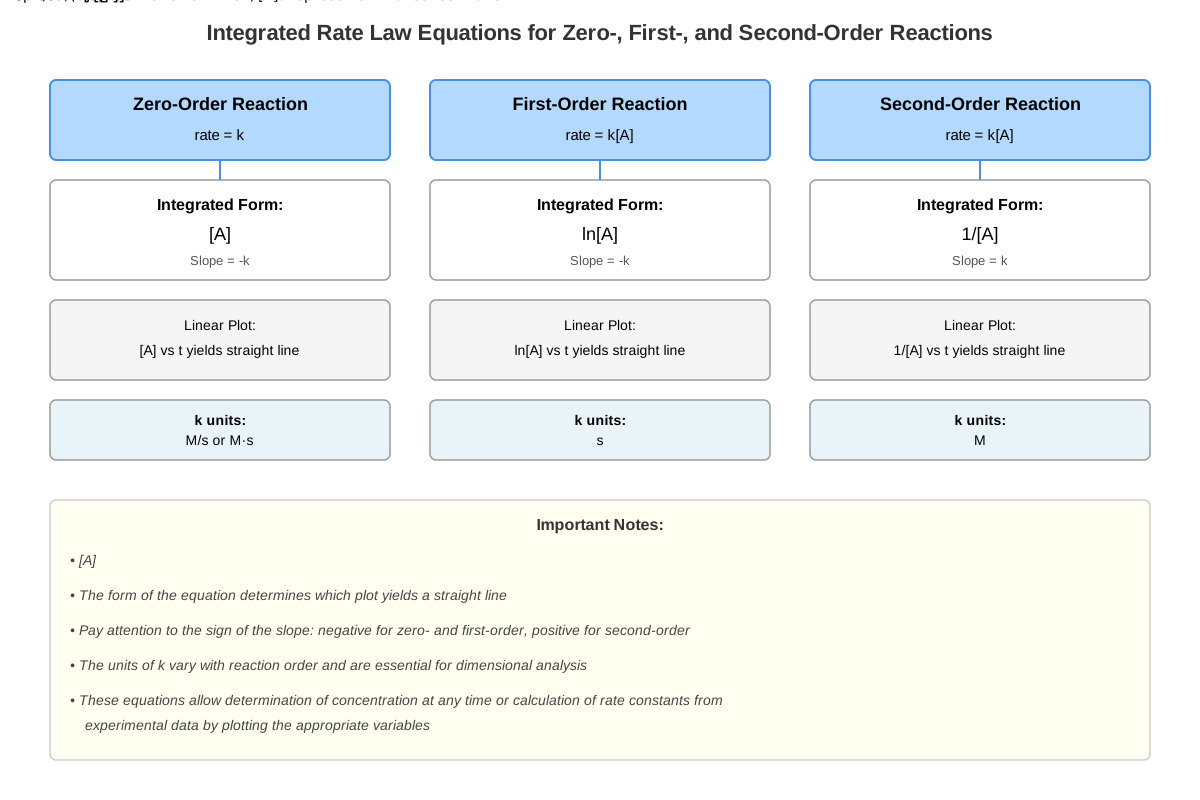
For a zero-order reaction, the rate is independent of reactant concentration: rate = k[A]⁰ = k. The integrated rate law for zero-order kinetics is:
[A] = -kt + [A]₀This equation has the form of a linear relationship (y = mx + b), where [A] is plotted on the y-axis, time t on the x-axis, the slope is -k, and the y-intercept is [A]₀. Zero-order reactions show a constant rate of concentration decrease over time—the concentration drops by the same amount in each time interval regardless of how much reactant remains.
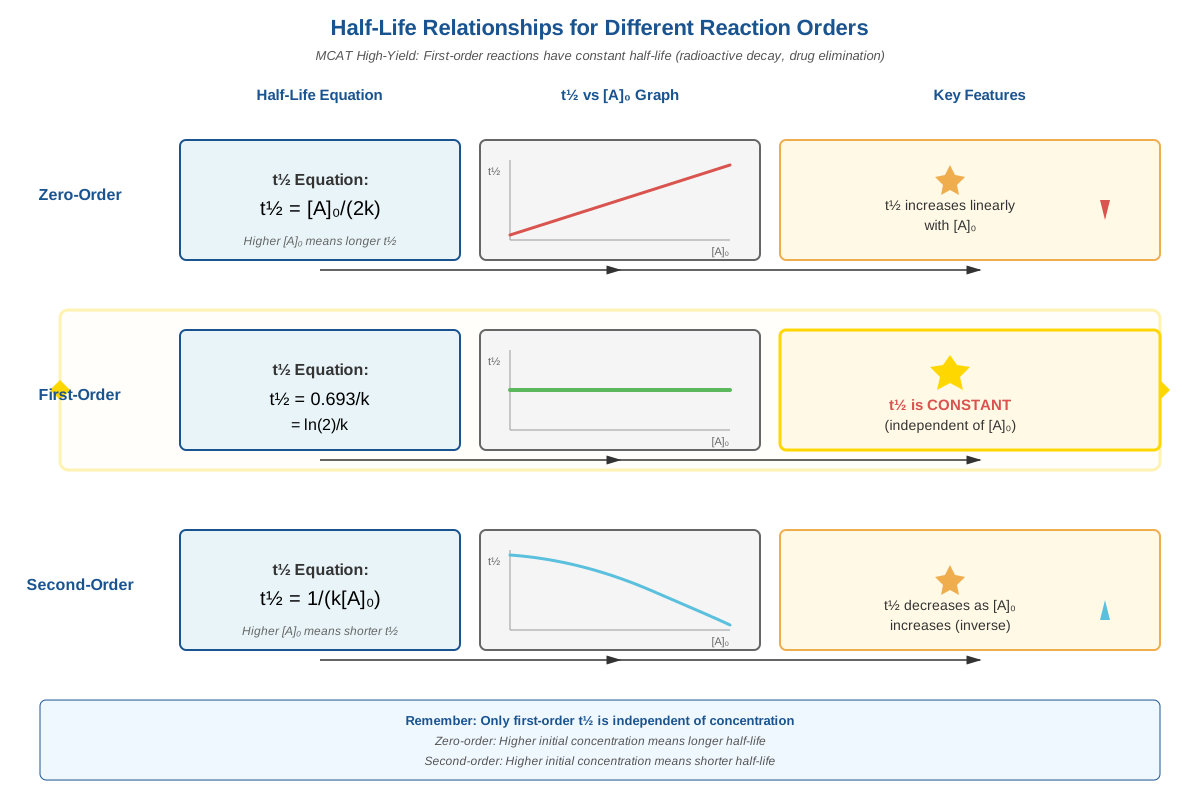
The half-life for a zero-order reaction (the time required for the concentration to decrease to half its initial value) is:
t₁/₂ = [A]₀/(2k)Notably, the half-life for zero-order reactions depends on the initial concentration—higher initial concentrations require longer times to reach half the starting value. This concentration-dependence distinguishes zero-order half-lives from first-order half-lives. Zero-order kinetics commonly occur when a catalyst or enzyme is saturated, making the rate independent of substrate concentration.
First-Order Integrated Rate Law
First-order reactions have rates directly proportional to reactant concentration: rate = k[A]¹. The integrated rate law for first-order kinetics is:
ln[A] = -kt + ln[A]₀Alternatively, this can be written in exponential form:
[A] = [A]₀e^(-kt)The linear form shows that plotting ln[A] versus time yields a straight line with slope -k and y-intercept ln[A]₀. First-order reactions are extremely common in nature, including radioactive decay, many drug elimination processes, and numerous elementary reactions.
The half-life for a first-order reaction is:
t₁/₂ = 0.693/k = ln(2)/kThis half-life is independent of initial concentration—a defining characteristic of first-order kinetics. Whether starting with 100 molecules or 100 million molecules, the time required for half to react remains constant. This property makes first-order kinetics particularly important in pharmacology and nuclear chemistry, where predictable half-lives enable precise dosing and decay calculations.
Second-Order Integrated Rate Law
For second-order reactions where the rate depends on the square of one reactant's concentration (rate = k[A]²), the integrated rate law is:
1/[A] = kt + 1/[A]₀This linear relationship shows that plotting 1/[A] (the reciprocal of concentration) versus time produces a straight line with slope k and y-intercept 1/[A]₀. Second-order kinetics often occur in reactions involving two molecules of the same reactant or in bimolecular elementary steps.
The half-life for a second-order reaction is:
t₁/₂ = 1/(k[A]₀)Like zero-order reactions, second-order half-lives depend on initial concentration, but inversely—higher initial concentrations result in shorter half-lives. This occurs because at higher concentrations, reactant molecules encounter each other more frequently, accelerating the reaction. As the reaction proceeds and concentration decreases, subsequent half-lives become progressively longer.
Comparison Table of Integrated Rate Laws
| Order | Integrated Rate Law | Linear Plot | Slope | Half-Life | Half-Life Dependence |
|---|---|---|---|---|---|
| Zero | [A] = -kt + [A]₀ | [A] vs. t | -k | [A]₀/(2k) | Proportional to [A]₀ |
| First | ln[A] = -kt + ln[A]₀ | ln[A] vs. t | -k | 0.693/k | Independent of [A]₀ |
| Second | 1/[A] = kt + 1/[A]₀ | 1/[A] vs. t | k | 1/(k[A]₀) | Inversely proportional to [A]₀ |
Determining Reaction Order from Experimental Data
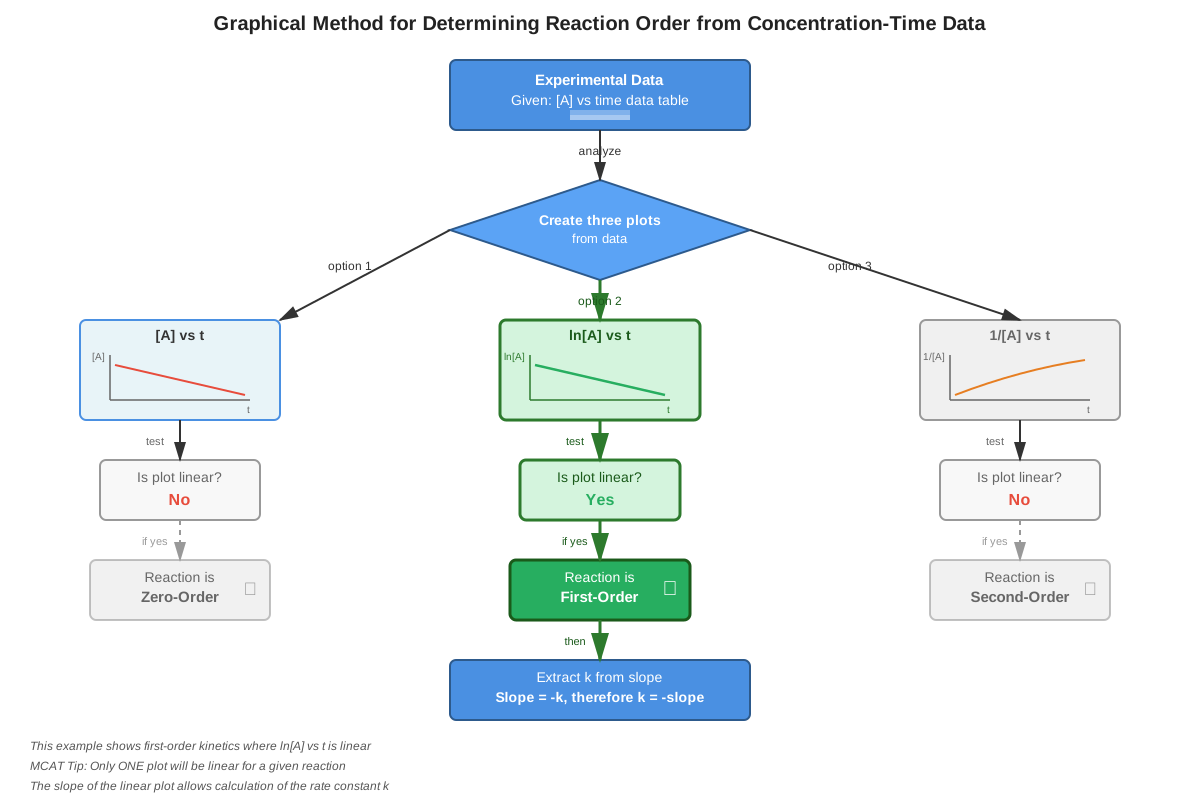
The MCAT frequently tests the ability to determine reaction order from concentration-time data. The most reliable method involves creating three different plots: [A] versus t, ln[A] versus t, and 1/[A] versus t. Whichever plot produces a straight line reveals the reaction order. This graphical method is more reliable than comparing half-lives or calculating rate constants at different time points, especially when data contains experimental error.
When analyzing tabular data without graphing capabilities, students can examine how the half-life changes. If successive half-lives remain constant, the reaction is first-order. If half-lives increase as the reaction proceeds, the reaction is second-order. If half-lives decrease, the reaction is zero-order. This pattern recognition provides a quick assessment method during timed exam conditions.
Rate Constant Units
The units of the rate constant k differ for each reaction order, providing another clue for identifying reaction order:
- Zero-order: M/s or M·s⁻¹ (concentration per time)
- First-order: s⁻¹ or 1/s (inverse time)
- Second-order: M⁻¹·s⁻¹ or 1/(M·s) (inverse concentration per time)
These unit differences arise from the requirement that the rate (always expressed in M/s) must equal k multiplied by concentration raised to the appropriate power. Dimensional analysis ensures consistency: for first-order reactions, k (s⁻¹) × [A] (M) = rate (M/s).
Concept Relationships
Integrated rate laws build directly upon differential rate laws by adding the dimension of time. While differential rate laws describe instantaneous rates at specific concentrations, integrated rate laws predict how concentrations evolve throughout the entire reaction course. This relationship flows from the mathematical operation of integration, which accumulates infinitesimal changes over time to produce a total change in concentration.
The concept of reaction order unifies both differential and integrated rate laws. The exponent n in the differential rate law (rate = k[A]ⁿ) determines which integrated form applies. Zero-order (n=0) produces a linear concentration-time relationship, first-order (n=1) produces an exponential decay, and second-order (n=2) produces a hyperbolic relationship. Understanding this connection helps students recognize that reaction order is a fundamental property that manifests differently in rate expressions versus concentration-time relationships.
Half-life concepts emerge naturally from integrated rate laws by setting [A] = [A]₀/2 and solving for time. This connection explains why half-life formulas differ between reaction orders and why only first-order reactions have constant half-lives. The half-life concept extends to radioactive decay (always first-order) and pharmacokinetics, where drug elimination typically follows first-order kinetics.
Graphical analysis techniques connect integrated rate laws to experimental design and data interpretation. The linearization strategy—plotting data in forms that should yield straight lines—represents a powerful experimental method for determining unknown reaction orders. This approach links to broader scientific reasoning skills tested throughout the MCAT, including hypothesis testing and data analysis.
The relationship map flows: Reaction Order → Differential Rate Law → Integration → Integrated Rate Law → Graphical Representation → Half-Life Expression. Each step builds upon the previous, creating a coherent framework for understanding reaction kinetics quantitatively.
Quick check — test yourself on Integrated rate laws so far.
Try Flashcards →High-Yield Facts
⭐ First-order reactions have constant half-lives independent of initial concentration; the half-life equals 0.693/k
⭐ A straight line on a plot of ln[A] versus time indicates first-order kinetics with slope = -k
⭐ Zero-order reactions show linear decrease in concentration over time; [A] = -kt + [A]₀
⭐ Second-order reactions show a straight line when 1/[A] is plotted versus time, with slope = k
⭐ Radioactive decay and most drug elimination processes follow first-order kinetics
- The units of k differ for each order: M/s (zero), s⁻¹ (first), M⁻¹s⁻¹ (second)
- Zero-order half-lives are directly proportional to initial concentration: t₁/₂ = [A]₀/(2k)
- Second-order half-lives are inversely proportional to initial concentration: t₁/₂ = 1/(k[A]₀)
- For first-order reactions, the time to reach any fraction of initial concentration depends only on k, not [A]₀
- After n half-lives in a first-order reaction, the fraction remaining is (1/2)ⁿ
- The natural logarithm of 2 (ln 2 ≈ 0.693) appears in first-order half-life calculations
- Integrated rate laws can be used to calculate concentrations at any time or determine how long to reach a target concentration
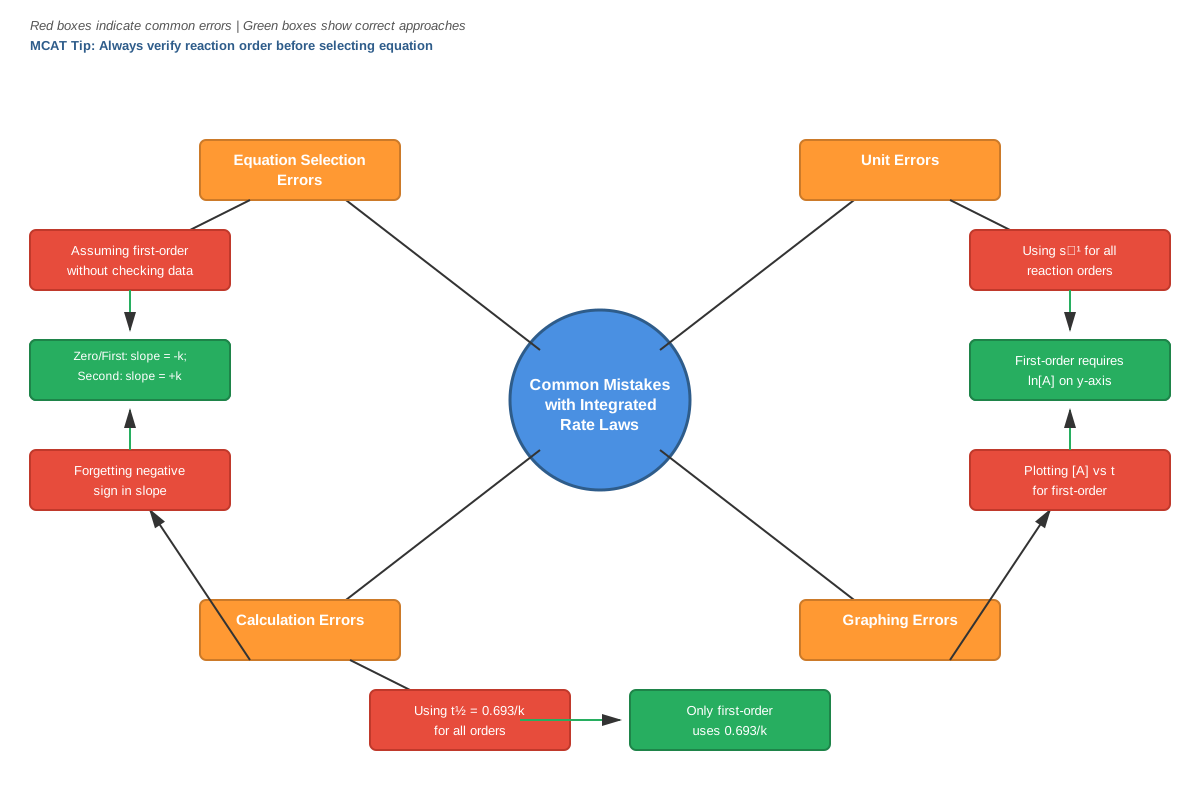
Common Misconceptions
Misconception: All reactions have constant half-lives like radioactive decay.
Correction: Only first-order reactions have constant half-lives. Zero-order half-lives increase as concentration decreases (each successive half-life takes longer), while second-order half-lives decrease as concentration decreases (each successive half-life is shorter). The constant half-life property is unique to first-order kinetics.
Misconception: The rate constant k has the same units regardless of reaction order.
Correction: The rate constant units change with reaction order to ensure dimensional consistency. Zero-order k has units of M/s, first-order k has units of s⁻¹, and second-order k has units of M⁻¹s⁻¹. Recognizing these unit differences can help identify reaction order from given information.
Misconception: A steeper slope on a concentration-time graph means a faster reaction for all orders.
Correction: This is only true for zero-order reactions where [A] versus t is plotted. For first-order reactions, the slope of ln[A] versus t equals -k, so a more negative slope indicates faster reaction. For second-order reactions, the slope of 1/[A] versus t equals +k, so a more positive slope indicates faster reaction. The interpretation depends on which linearized plot is used.
Misconception: Integrated rate laws only apply to reactions with a single reactant.
Correction: While the simple forms presented apply to reactions where one reactant's concentration is monitored (or where other reactants are in large excess), integrated rate laws can be derived for more complex situations. The MCAT typically presents pseudo-first-order conditions where excess reactants make the reaction appear first-order in the limiting reactant.
Misconception: After one half-life, the reaction is complete.
Correction: After one half-life, only 50% of the reactant has been consumed—half remains. After two half-lives, 25% remains; after three half-lives, 12.5% remains. For first-order reactions, the reactant never completely disappears mathematically (though practically, concentrations become negligible after several half-lives). It takes approximately 7 half-lives to reach 99% completion.
Misconception: The integrated rate law can be used to determine the mechanism of a reaction.
Correction: Integrated rate laws reveal the overall reaction order but do not directly determine the mechanism. A reaction's rate law (and thus its integrated form) reflects the rate-determining step, but multiple mechanisms could potentially produce the same rate law. Determining mechanisms requires additional experimental evidence beyond kinetics data alone.
Worked Examples
Example 1: Determining Reaction Order and Rate Constant
Problem: A researcher monitors the decomposition of compound A and obtains the following data:
| Time (s) | [A] (M) | ln[A] | 1/[A] (M⁻¹) |
|---|---|---|---|
| 0 | 0.800 | -0.223 | 1.25 |
| 50 | 0.600 | -0.511 | 1.67 |
| 100 | 0.450 | -0.799 | 2.22 |
| 150 | 0.338 | -1.086 | 2.96 |
| 200 | 0.253 | -1.374 | 3.95 |
Determine the reaction order and calculate the rate constant.
Solution:
Step 1: Examine the data patterns. Notice that [A] decreases but not linearly. We need to determine which plot yields a straight line.
Step 2: Check if [A] versus time is linear (zero-order):
- From 0 to 50 s: Δ[A] = 0.600 - 0.800 = -0.200 M
- From 50 to 100 s: Δ[A] = 0.450 - 0.600 = -0.150 M
The changes are not constant, so this is not zero-order.
Step 3: Check if ln[A] versus time is linear (first-order):
- From 0 to 50 s: Δln[A] = -0.511 - (-0.223) = -0.288
- From 50 to 100 s: Δln[A] = -0.799 - (-0.511) = -0.288
- From 100 to 150 s: Δln[A] = -1.086 - (-0.799) = -0.287
- From 150 to 200 s: Δln[A] = -1.374 - (-1.086) = -0.288
The changes in ln[A] are constant (within rounding), indicating first-order kinetics.
Step 4: Calculate the rate constant using the slope of ln[A] versus t:
Slope = Δln[A]/Δt = -0.288/50 s = -0.00576 s⁻¹
Since slope = -k for first-order reactions:
k = 0.00576 s⁻¹ or 5.76 × 10⁻³ s⁻¹
Step 5: Verify using the integrated rate law:
ln[A] = -kt + ln[A]₀
At t = 100 s: ln[A] = -(0.00576)(100) + (-0.223) = -0.576 - 0.223 = -0.799 ✓
This matches the experimental value, confirming our answer.
Key Takeaway: This problem demonstrates the graphical method for determining reaction order by examining which transformation of concentration data produces constant changes over equal time intervals. First-order kinetics is identified by constant changes in ln[A], and the rate constant is calculated from the slope.
Example 2: Half-Life and Concentration Prediction
Problem: A drug is eliminated from the bloodstream by first-order kinetics with a half-life of 4.0 hours. If the initial concentration after injection is 80 μg/mL, what concentration remains after 10 hours?
Solution:
Step 1: Identify the given information:
- First-order kinetics
- t₁/₂ = 4.0 hours
- [A]₀ = 80 μg/mL
- t = 10 hours
- Find: [A] at t = 10 hours
Step 2: Calculate the rate constant from the half-life:
For first-order reactions: t₁/₂ = 0.693/k
k = 0.693/t₁/₂ = 0.693/4.0 h = 0.173 h⁻¹
Step 3: Apply the first-order integrated rate law:
ln[A] = -kt + ln[A]₀
ln[A] = -(0.173 h⁻¹)(10 h) + ln(80)
ln[A] = -1.73 + 4.382
ln[A] = 2.65
Step 4: Solve for [A]:
[A] = e^2.65 = 14.2 μg/mL
Alternative approach using half-lives:
10 hours represents 10/4 = 2.5 half-lives
After n half-lives: [A] = [A]₀ × (1/2)ⁿ
[A] = 80 × (1/2)^2.5 = 80 × 0.177 = 14.2 μg/mL ✓
Key Takeaway: This problem illustrates two solution methods for first-order kinetics problems. The integrated rate law provides a direct calculation, while the half-life approach offers an intuitive alternative when time is a simple multiple of the half-life. Both methods yield identical results, and students should be comfortable with both approaches for MCAT efficiency.
Exam Strategy
When approaching MCAT questions on integrated rate laws, begin by identifying the reaction order. Look for explicit statements ("first-order reaction"), graphical clues (which axis shows a linear relationship), or half-life information (constant half-life indicates first-order). If the question provides concentration-time data without specifying order, mentally check which transformation (none, ln, or reciprocal) would linearize the data.
Trigger words and phrases to watch for include:
- "Half-life" (especially "constant half-life" → first-order)
- "Exponential decay" → first-order
- "Linear decrease in concentration" → zero-order
- "Radioactive decay" → always first-order
- "Drug elimination" → typically first-order
- "Plot of [X] versus time yields a straight line" → identify which plot to determine order
For graphical questions, focus on the axes labels. A straight line on a semi-log plot (where one axis is logarithmic) indicates first-order kinetics. If both axes are linear, check whether concentration itself, ln(concentration), or 1/concentration is plotted. The MCAT may present graphs without explicitly stating the transformation, requiring careful axis examination.
Process-of-elimination strategies:
- If answer choices have different units for k, use dimensional analysis to eliminate incorrect orders
- If a question asks about half-life dependence on concentration, eliminate choices suggesting first-order reactions depend on [A]₀
- For calculation questions, estimate before computing: after one half-life, concentration should be exactly half; after two half-lives, one-quarter
- If time given is a simple multiple of half-life (2×, 3×, etc.), use the fraction-remaining approach rather than logarithms
Time allocation: Most integrated rate law questions require 60-90 seconds. Straightforward identification questions (determining order from a graph) should take 30-45 seconds. Calculation questions requiring logarithms or exponentials may need 90-120 seconds. If a calculation appears complex, check whether the half-life approach offers a simpler path—this is especially true when time equals an integer multiple of the half-life.
For passage-based questions, scan the passage for kinetics data tables or graphs first. Often, the passage will present data that appears complex but simplifies when you recognize the reaction order. Mark which integrated rate law applies in the passage margin, then refer to this note when answering questions rather than re-determining order for each question.
Memory Techniques
Mnemonic for linear plots: "Zero is Zero transformation, First is Ln, Second is Slash (1/[A])"
- Zero-order: Zero transformation (plot [A] directly)
- First-order: Ln transformation
- Second-order: Slash means reciprocal (1/[A])
Mnemonic for half-life dependence: "First is Free from concentration"
- First-order half-lives are independent of (free from) initial concentration
- Zero and second-order half-lives depend on [A]₀
Visualization for first-order decay: Picture a radioactive sample where half the atoms decay in each half-life period, regardless of how many atoms remain. This constant fractional decrease characterizes first-order kinetics. After one half-life: 50% remains. After two: 25%. After three: 12.5%. Each period removes half of what's currently present, not half of the original amount.
Acronym for rate constant units: "Most Students Struggle Mightily"
- Most: M/s (zero-order, concentration per time)
- Students: s⁻¹ (first-order, inverse time)
- Struggle: Second-order
- Mightily: M⁻¹s⁻¹ (inverse concentration per time)
Memory aid for ln(2): Remember 0.693 as "69.3% is close to 70%, which is close to half" (though this is approximate reasoning). Alternatively, remember "six-nine-three" as a rhythm. This constant appears in every first-order half-life calculation.
Slope sign memory: For zero-order and first-order plots, the slope is negative (-k) because concentration decreases over time. For second-order plots (1/[A] vs. t), the slope is positive (+k) because the reciprocal increases as concentration decreases. Visualize: as [A] goes down, 1/[A] goes up.
Summary
Integrated rate laws provide the mathematical framework for relating reactant concentration to time in chemical reactions, representing essential quantitative tools for MCAT General Chemistry. The three primary forms—zero-order ([A] = -kt + [A]₀), first-order (ln[A] = -kt + ln[A]₀), and second-order (1/[A] = kt + 1/[A]₀)—each produce characteristic linear plots that enable experimental determination of reaction order. First-order kinetics, distinguished by concentration-independent half-lives (t₁/₂ = 0.693/k), appears most frequently on the MCAT due to its relevance in radioactive decay, pharmacokinetics, and many elementary reactions. Zero-order reactions show linear concentration decrease and concentration-dependent half-lives, while second-order reactions require reciprocal concentration plots and show inverse concentration-dependence in half-lives. Success with integrated rate laws requires recognizing which mathematical form applies to a given scenario, interpreting graphical data to determine reaction order, and performing calculations involving rate constants, half-lives, and concentration predictions. These skills integrate mathematical reasoning with chemical principles, exemplifying the quantitative problem-solving abilities the MCAT assesses throughout Kinetics and Equilibrium.
Key Takeaways
- Integrated rate laws relate concentration to time and differ fundamentally from differential rate laws that relate rate to concentration
- Each reaction order produces a unique linear plot: [A] vs. t (zero-order), ln[A] vs. t (first-order), 1/[A] vs. t (second-order)
- First-order reactions have constant half-lives independent of concentration (t₁/₂ = 0.693/k), while zero- and second-order half-lives depend on [A]₀
- Rate constant units differ by order: M/s (zero), s⁻¹ (first), M⁻¹s⁻¹ (second), providing clues for identifying reaction order
- Graphical analysis is the most reliable method for determining reaction order from experimental concentration-time data
- First-order kinetics dominates MCAT applications including radioactive decay, drug elimination, and many biochemical processes
- After n half-lives in a first-order reaction, the fraction remaining equals (1/2)ⁿ, providing a quick calculation method
Related Topics
Differential Rate Laws and Reaction Order: Understanding how instantaneous rates depend on concentration provides the foundation from which integrated rate laws are derived through integration. Mastery of integrated rate laws enables deeper comprehension of the relationship between these two kinetic descriptions.
Reaction Mechanisms and Rate-Determining Steps: The overall rate law (and thus the integrated form) reflects the rate-determining step in a multi-step mechanism. Understanding integrated rate laws enhances the ability to connect experimental kinetics data to proposed mechanisms.
Enzyme Kinetics and Michaelis-Menten Equations: Enzyme-catalyzed reactions often show zero-order kinetics at high substrate concentrations (saturation) and first-order kinetics at low concentrations. Integrated rate laws provide the quantitative foundation for understanding these biochemical applications.
Radioactive Decay and Nuclear Chemistry: All radioactive decay follows first-order kinetics, making integrated rate laws essential for calculations involving half-lives, decay constants, and radiometric dating—topics that may appear in General Chemistry or Physics passages.
Pharmacokinetics and Drug Metabolism: Most drugs are eliminated by first-order kinetics, and understanding integrated rate laws enables prediction of drug concentrations over time, dosing interval calculations, and steady-state considerations relevant to biochemistry and physiology passages.
Practice CTA
Now that you've mastered the core concepts of integrated rate laws, it's time to solidify your understanding through active practice. Work through the practice questions to test your ability to identify reaction orders, perform calculations, and interpret graphical data under timed conditions. Use the flashcards to reinforce key equations, half-life formulas, and the characteristics that distinguish different reaction orders. Remember that integrated rate laws represent a high-yield topic where consistent practice translates directly into MCAT points—each problem you solve builds the pattern recognition and quantitative skills that will serve you throughout the Kinetics and Equilibrium section. You've built a strong conceptual foundation; now apply it with confidence!
Sign up free to keep reading
Create a free AnvayaPrep account to finish this MCAT guide on Integrated rate laws — plus flashcards and practice questions.