Overview
The rate determining step (RDS) is a foundational concept in chemical kinetics that describes the slowest elementary step in a multi-step reaction mechanism. Just as the narrowest section of a highway determines the maximum traffic flow, the rate determining step controls the overall rate at which reactants are converted to products in a complex reaction. Understanding this concept is crucial for predicting reaction rates, writing accurate rate laws, and interpreting experimental kinetic data—all skills frequently tested on the MCAT.
For MCAT success, mastery of the rate determining step extends beyond simple identification. Students must understand how the RDS influences the overall rate law of a reaction, why only species involved in or before the RDS appear in the rate law, and how changes in reaction conditions affect the rate-limiting step. This topic bridges fundamental kinetics principles with more advanced concepts like catalysis, enzyme kinetics, and equilibrium dynamics. The MCAT regularly tests this concept through passage-based questions that present multi-step mechanisms and ask students to predict rate laws, identify intermediates, or explain how catalysts accelerate reactions.
Within the broader context of General Chemistry and Kinetics and Equilibrium, the rate determining step serves as a critical link between molecular-level mechanisms and macroscopic observations. It connects reaction coordinate diagrams, activation energy, transition states, and rate laws into a coherent framework. Understanding the RDS enables students to predict how temperature changes, catalyst addition, or concentration variations will affect reaction rates—knowledge that appears across multiple MCAT sections, including biochemistry passages involving enzyme mechanisms and organic chemistry questions about reaction pathways.
Learning Objectives
- [ ] Define rate determining step using accurate General Chemistry terminology
- [ ] Explain why rate determining step matters for the MCAT
- [ ] Apply rate determining step to exam-style questions
- [ ] Identify common mistakes related to rate determining step
- [ ] Connect rate determining step to related General Chemistry concepts
- [ ] Determine the rate law for a multi-step reaction mechanism by identifying the rate determining step
- [ ] Predict how changes in reaction conditions will affect the overall reaction rate based on the RDS
- [ ] Analyze reaction coordinate diagrams to identify the rate determining step from activation energy barriers
Prerequisites
- Elementary reactions and reaction mechanisms: Understanding that complex reactions occur through multiple elementary steps is essential for identifying which step limits the overall rate
- Rate laws and reaction orders: Knowledge of how to write and interpret rate laws enables connection between the RDS and the overall rate expression
- Activation energy and transition states: Familiarity with energy barriers helps explain why certain steps are slower than others
- Collision theory and molecular kinetics: Understanding how molecular collisions lead to reactions provides the foundation for why some steps require more energy and time
- Basic stoichiometry and chemical equations: Ability to balance equations and identify reactants, products, and intermediates is necessary for mechanism analysis
Why This Topic Matters
The rate determining step concept appears frequently on the MCAT because it integrates multiple aspects of chemical kinetics into a single testable framework. Approximately 2-4 questions per MCAT exam directly or indirectly assess understanding of rate-limiting steps, often embedded within passage-based questions about enzyme mechanisms, catalytic processes, or industrial chemistry applications. The MCAT favors this topic because it requires both conceptual understanding and analytical reasoning—students must interpret mechanisms, apply kinetic principles, and make predictions about experimental outcomes.
In real-world and clinical contexts, rate determining steps govern everything from drug metabolism to enzyme function. Pharmaceutical companies design drugs to target the rate-limiting steps of disease-related biochemical pathways. For example, many enzyme inhibitors work by specifically blocking the slowest step in a metabolic cascade, effectively shutting down the entire pathway. Understanding RDS principles helps explain why certain medications require specific dosing schedules and why drug interactions occur when multiple substances compete for the same rate-limiting enzyme.
On the MCAT, rate determining step questions typically appear in three formats: (1) passage-based questions presenting a multi-step mechanism and asking students to identify the RDS or write the rate law; (2) discrete questions testing conceptual understanding of how the RDS relates to activation energy or catalysis; and (3) data interpretation questions where students must analyze kinetic data to determine which step limits the reaction rate. The Chemical and Physical Foundations section most commonly features these questions, though biochemistry passages about enzyme kinetics also frequently incorporate RDS concepts.
Core Concepts
Definition and Fundamental Principles
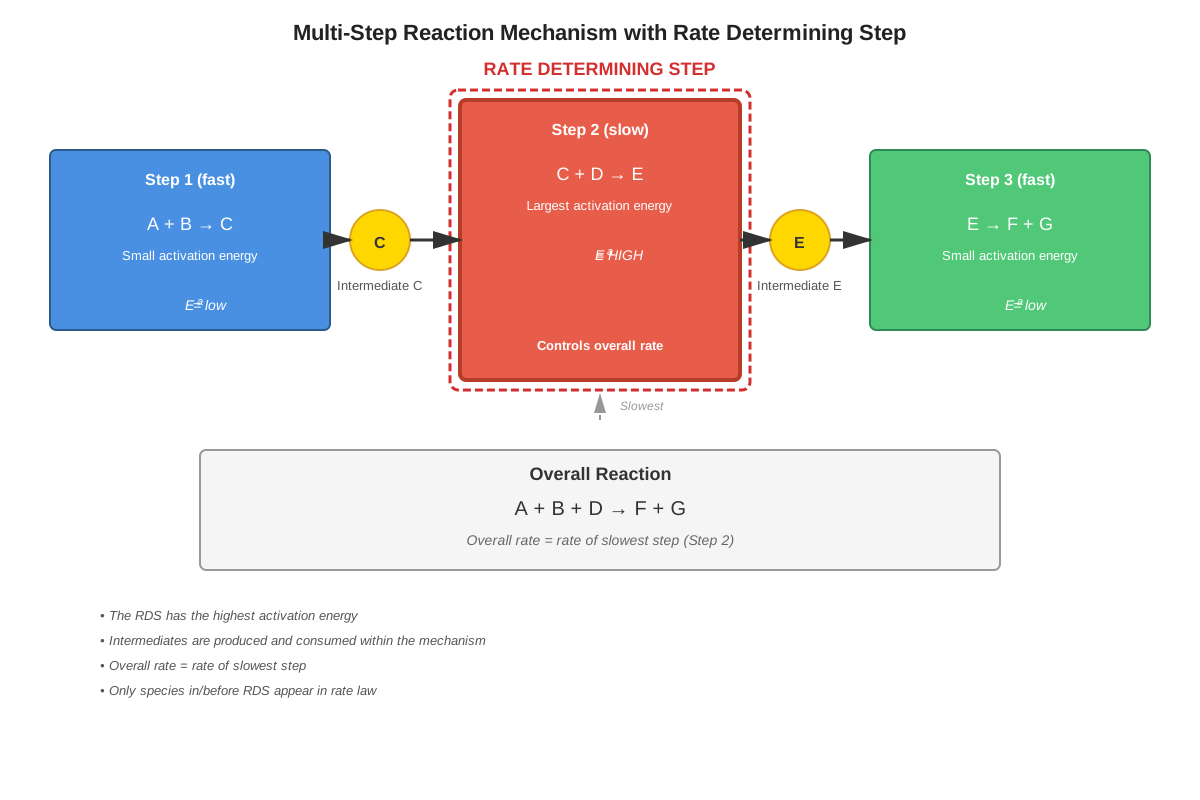
The rate determining step is the slowest elementary step in a multi-step reaction mechanism that controls the overall rate of the reaction. In any sequence of consecutive reactions, the step with the highest activation energy barrier typically serves as the bottleneck, limiting how quickly reactants can be converted to products. This concept is analogous to an assembly line where the slowest worker determines the production rate, regardless of how fast other workers complete their tasks.
For a reaction mechanism consisting of multiple elementary steps, the rate determining step possesses several defining characteristics:
- It has the highest activation energy (Ea) among all steps in the mechanism
- It proceeds at the slowest rate compared to other elementary steps
- It determines the molecularity and rate law of the overall reaction
- Only species that appear in or before the RDS can appear in the overall rate law
Relationship Between RDS and Rate Laws
The connection between the rate determining step and the overall rate law represents one of the most testable aspects of this topic on the MCAT. The rate law for a multi-step reaction is determined exclusively by the rate-limiting step and any fast equilibrium steps that precede it.
For a simple mechanism where the first step is rate-determining:
Step 1 (slow): A + B → C + D
Step 2 (fast): C + E → F
The overall rate law is simply: Rate = k[A][B]
For mechanisms where a fast equilibrium precedes the RDS:
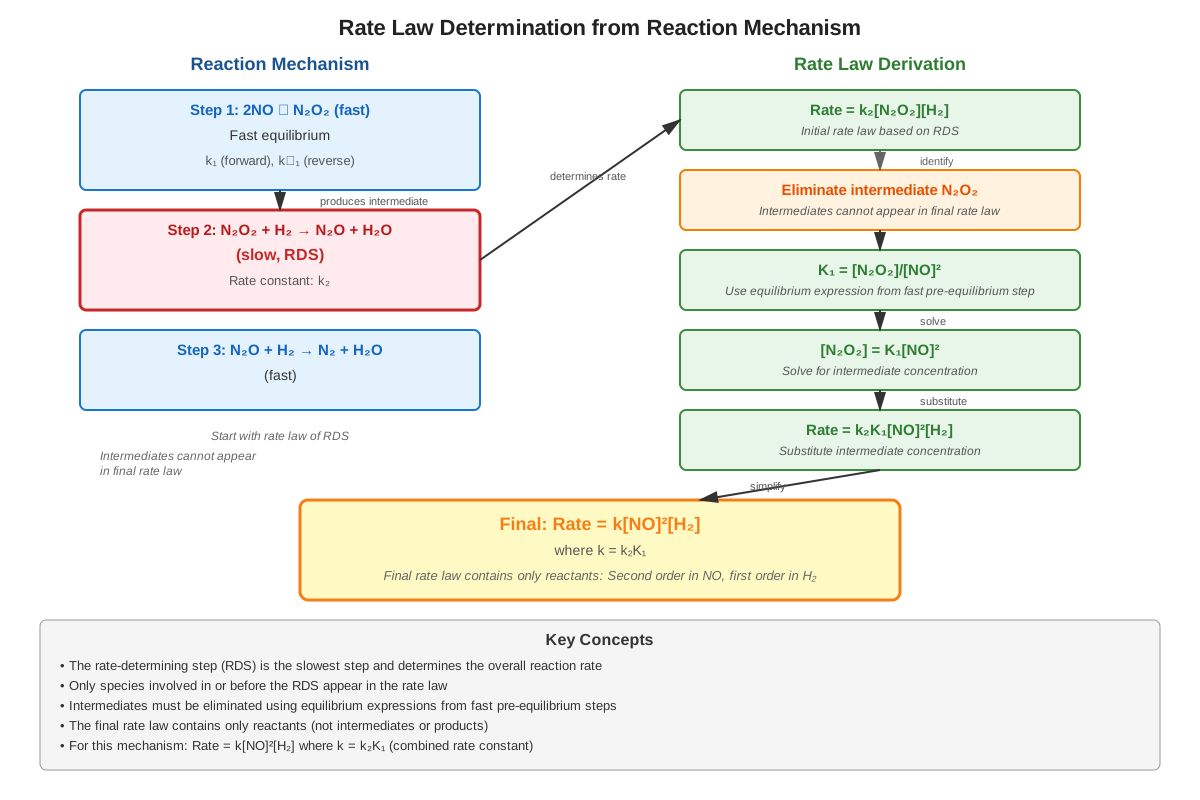
Step 1 (fast equilibrium): A + B ⇌ C
Step 2 (slow): C + D → E + F
The rate law must account for the pre-equilibrium. Initially, Rate = k₂[C][D], but since C is an intermediate, we must express [C] in terms of reactants using the equilibrium expression from Step 1:
K₁ = [C]/[A][B], therefore [C] = K₁[A][B]
Substituting: Rate = k₂K₁[A][B][D] = k_overall[A][B][D]
Identifying the Rate Determining Step
Several methods allow identification of the rate determining step in a reaction mechanism:
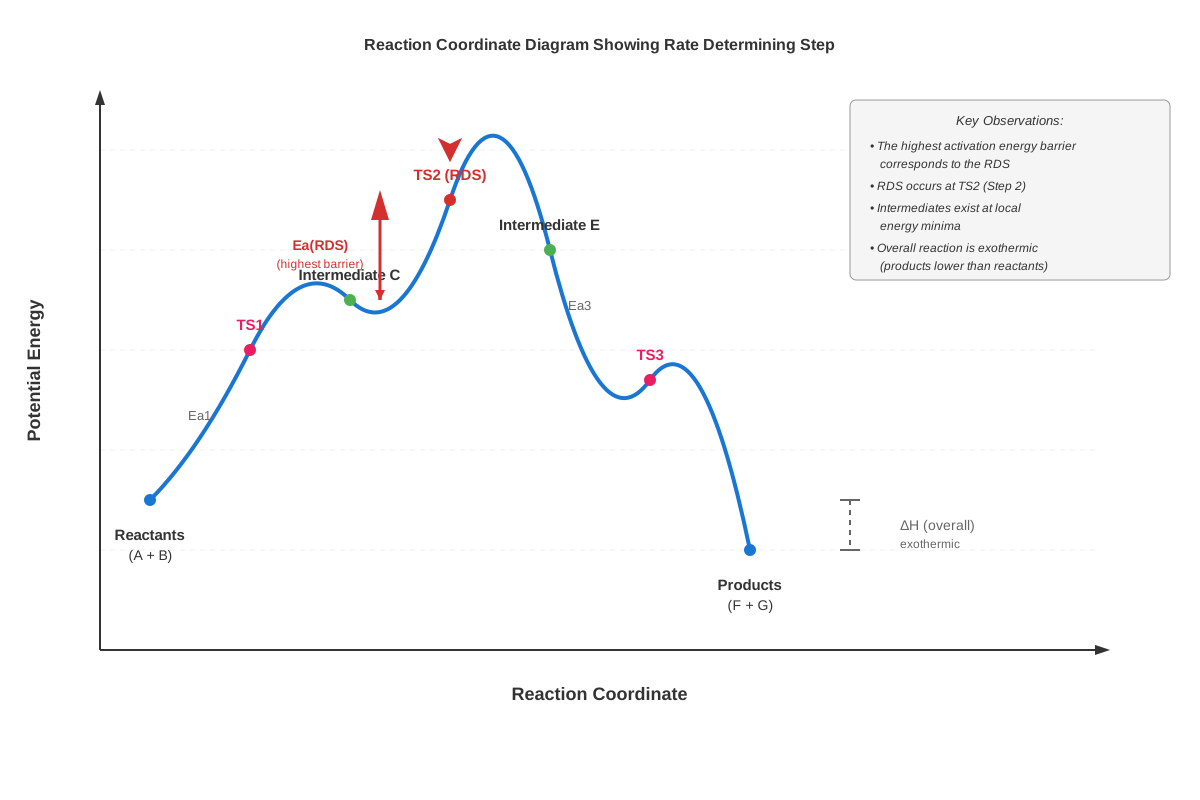
- Activation Energy Analysis: The step with the highest activation energy is typically the RDS. On a reaction coordinate diagram, this appears as the tallest energy barrier between reactants and products.
- Rate Constant Comparison: When rate constants are provided, the step with the smallest rate constant (k) is the slowest and therefore rate-determining.
- Experimental Rate Law Matching: Compare the experimentally determined rate law with the rate laws predicted by each potential RDS. The step whose rate law matches the experimental data is the rate-determining step.
- Reaction Coordinate Diagrams: The transition state with the highest energy corresponds to the rate determining step.
Multi-Step Mechanisms and Intermediates
In multi-step mechanisms, intermediates are species formed in one step and consumed in a subsequent step. Intermediates never appear in the overall balanced equation but play crucial roles in determining the rate law when they participate in or before the rate determining step.
| Species Type | Appears in Overall Equation | Appears in Rate Law | Stability |
|---|---|---|---|
| Reactant | Yes (left side) | Yes (if in/before RDS) | Stable |
| Product | Yes (right side) | No | Stable |
| Intermediate | No | No (must be substituted out) | Unstable |
| Catalyst | No (regenerated) | Yes (if in/before RDS) | Stable |
When an intermediate appears in the rate law derived from the RDS, it must be expressed in terms of reactants using equilibrium expressions from preceding fast steps. This substitution ensures the final rate law contains only species that can be experimentally measured and controlled.
Effect of Catalysts on the Rate Determining Step
Catalysts accelerate reactions by providing alternative pathways with lower activation energies. Importantly, catalysts specifically lower the activation energy of the rate determining step, making it faster and potentially changing which step is rate-limiting. This principle explains why enzymes are such effective biological catalysts—they stabilize the transition state of the slowest step in a biochemical pathway.
When a catalyst is added to a multi-step reaction:
- The activation energy of one or more steps decreases
- The rate determining step may change if another step now has the highest barrier
- The overall rate law may change if a different step becomes rate-limiting
- The equilibrium position remains unchanged (catalysts affect kinetics, not thermodynamics)
Temperature Dependence and the RDS
The rate determining step shows the greatest sensitivity to temperature changes because it has the highest activation energy. According to the Arrhenius equation:
k = Ae^(-Ea/RT)Steps with larger Ea values show more dramatic rate increases when temperature rises. This explains why increasing temperature disproportionately accelerates the slowest step, potentially altering which step is rate-determining at different temperatures.
Concept Relationships
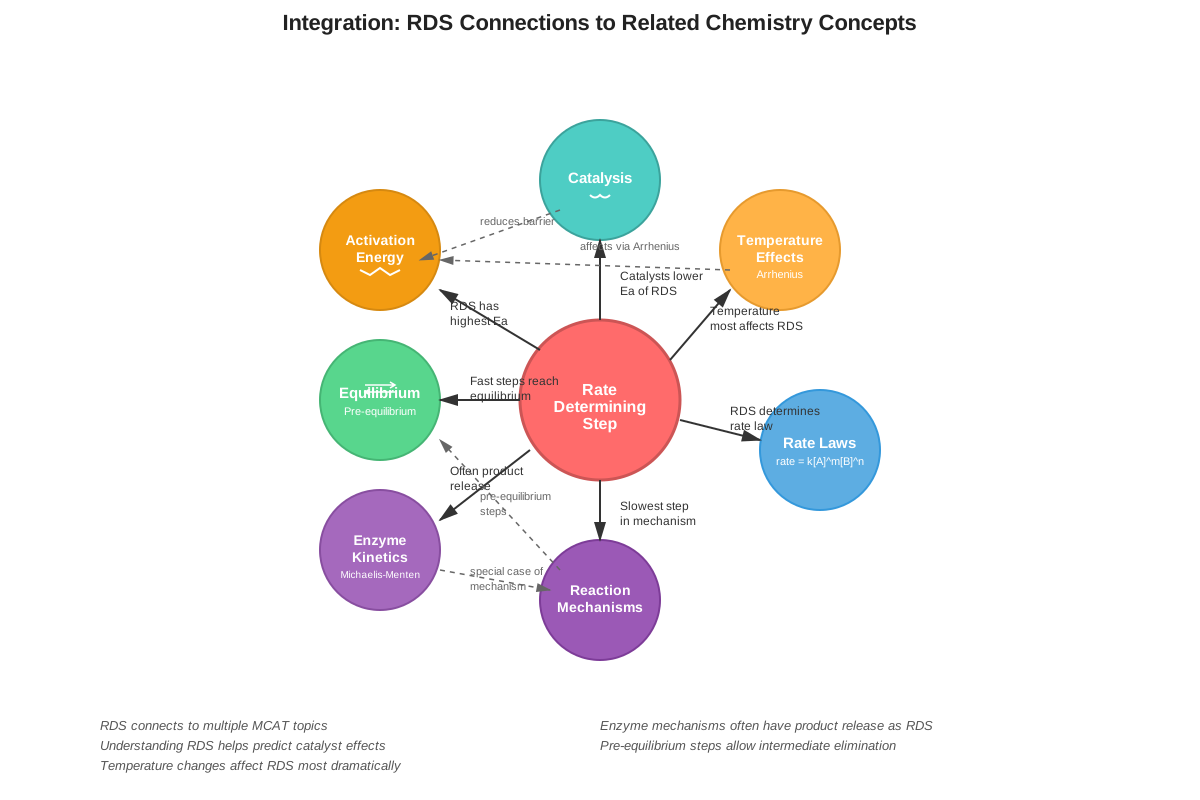
The rate determining step serves as a central hub connecting multiple kinetic concepts. Understanding these relationships strengthens both conceptual mastery and problem-solving ability on the MCAT.
Reaction Mechanisms → Rate Determining Step → Overall Rate Law: The mechanism provides the sequence of elementary steps, from which the RDS is identified, which then determines the form of the overall rate law. This linear progression represents the most common question format on the MCAT.
Activation Energy → Rate Determining Step → Temperature Sensitivity: The step with the highest activation energy becomes the RDS, and this same step shows the greatest rate increase when temperature rises. This relationship explains why the Arrhenius equation is particularly relevant for understanding rate-limiting steps.
Intermediates → Pre-equilibrium Steps → Rate Law Derivation: When intermediates appear in the RDS, pre-equilibrium steps must be used to express intermediate concentrations in terms of reactants, creating more complex rate laws that frequently appear in MCAT passages.
Catalysts → Activation Energy Reduction → RDS Acceleration: Catalysts work by specifically lowering the activation energy of the rate determining step, which may cause a different step to become rate-limiting. This connection is crucial for understanding enzyme mechanisms in biochemistry.
Reaction Coordinate Diagrams → Energy Barriers → RDS Identification: Visual representation of energy changes throughout a reaction allows identification of the RDS as the highest energy barrier, connecting graphical interpretation with kinetic analysis.
The rate determining step also connects to equilibrium concepts: while the RDS controls how quickly equilibrium is reached, it does not affect the equilibrium position itself. This distinction between kinetics and thermodynamics is frequently tested on the MCAT.
Quick check — test yourself on Rate determining step so far.
Try Flashcards →High-Yield Facts
⭐ The rate determining step is the slowest elementary step in a multi-step mechanism and has the highest activation energy.
⭐ The overall rate law for a multi-step reaction is determined by the rate determining step and any fast equilibrium steps preceding it.
⭐ Intermediates cannot appear in the final rate law; they must be expressed in terms of reactants using equilibrium expressions from fast steps.
⭐ On a reaction coordinate diagram, the rate determining step corresponds to the transition state with the highest energy.
⭐ Catalysts accelerate reactions by lowering the activation energy of the rate determining step without affecting the equilibrium position.
- The molecularity of the rate determining step determines the order of the overall reaction with respect to species involved in that step.
- If the first step in a mechanism is slow and all subsequent steps are fast, the rate law equals the rate law of the first step.
- Temperature increases affect the rate determining step most dramatically because it has the largest activation energy.
- The rate constant for the overall reaction (k_overall) is related to the rate constant of the RDS and equilibrium constants of preceding steps.
- Changing reaction conditions can potentially change which step is rate-determining, thereby altering the overall rate law.
- The rate determining step is always an elementary step, never the overall balanced equation.
- Species that appear only after the rate determining step cannot appear in the overall rate law.
Common Misconceptions
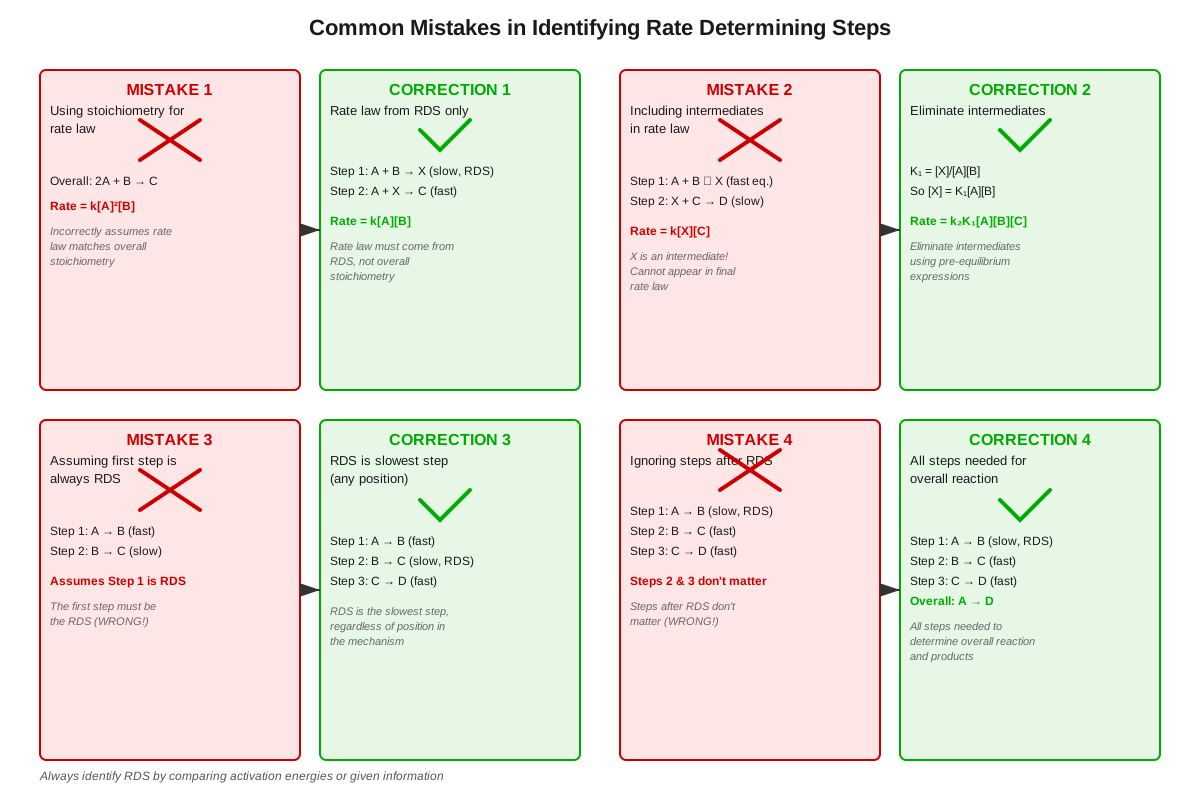
Misconception: The rate determining step is always the first step in a mechanism.
Correction: The RDS can occur at any point in a mechanism. While first-step RDS scenarios are common in introductory problems, MCAT questions frequently feature mechanisms where the second or third step is rate-limiting, requiring students to account for fast pre-equilibrium steps.
Misconception: The rate law can be determined directly from the overall balanced equation.
Correction: The rate law must be determined experimentally or derived from the mechanism using the rate determining step. The stoichiometric coefficients in the overall equation do not necessarily correspond to the exponents in the rate law unless the reaction occurs in a single elementary step.
Misconception: Intermediates can appear in the final rate law.
Correction: While intermediates may appear in the rate law derived directly from the RDS, they must be substituted out using equilibrium expressions from preceding fast steps. The final rate law should contain only reactants, products, and catalysts—species that can be experimentally controlled and measured.
Misconception: Catalysts appear in the rate law because they speed up reactions.
Correction: Catalysts appear in the rate law only if they participate in or before the rate determining step. A catalyst that acts only after the RDS will not appear in the overall rate law, even though it may accelerate later steps.
Misconception: The rate determining step has the lowest activation energy.
Correction: The RDS has the highest activation energy among all steps in the mechanism. This high energy barrier is precisely why it is the slowest step and therefore rate-limiting.
Misconception: Adding more product will slow down the rate determining step.
Correction: The rate determining step's rate depends only on the concentrations of species that appear in its rate law (reactants and intermediates from earlier steps). Products do not appear in the RDS rate law unless the reaction is reversible and the reverse reaction is being considered.
Misconception: All steps after the rate determining step are instantaneous.
Correction: Steps after the RDS are simply faster than the RDS, not instantaneous. They still require finite time and have their own activation energies, just lower than that of the rate-limiting step.
Worked Examples
Example 1: Identifying the RDS and Writing the Rate Law
Problem: Consider the following mechanism for the reaction between NO₂ and CO:
Step 1: NO₂ + NO₂ → NO₃ + NO    (slow)
Step 2: NO₃ + CO → NO₂ + CO₂     (fast)
Overall: NO₂ + CO → NO + CO₂
(a) Identify the rate determining step
(b) Write the rate law for the overall reaction
(c) Identify any intermediates
(d) Explain how doubling [CO] would affect the reaction rate
Solution:
(a) Identifying the RDS: Step 1 is explicitly labeled as slow, making it the rate determining step. This is the bottleneck that controls the overall reaction rate.
(b) Writing the rate law: Since Step 1 is the RDS and no fast equilibrium precedes it, the rate law is determined directly from this step:
Rate = k[NO₂]²
Note that the exponent is 2 because two NO₂ molecules participate in the rate-determining elementary step. CO does not appear in the rate law because it participates only after the RDS.
(c) Identifying intermediates: NO₃ is an intermediate because it is produced in Step 1 and consumed in Step 2, never appearing in the overall balanced equation.
(d) Effect of doubling [CO]: Doubling [CO] would have no effect on the reaction rate because CO does not appear in the rate law. The rate depends only on [NO₂]. This counterintuitive result demonstrates why understanding the RDS is crucial—not all reactants necessarily affect the rate.
Key Learning Point: This example illustrates that the rate law depends on the mechanism, not the overall stoichiometry. Even though CO is a reactant in the overall equation, it doesn't affect the rate because it participates only after the rate-limiting step.
Example 2: Pre-equilibrium and Rate Law Derivation
Problem: The decomposition of ozone occurs by the following mechanism:
Step 1: O₃ ⇌ O₂ + O           (fast equilibrium, K₁)
Step 2: O + O₃ → 2O₂          (slow, k₂)
Overall: 2O₃ → 3O₂
Derive the rate law for this reaction.
Solution:
Step-by-step derivation:
- Identify the RDS: Step 2 is slow, so it is the rate determining step.
- Write the rate law from the RDS:
Rate = k₂[O][O₃]
- Identify the problem: The rate law contains [O], which is an intermediate. Intermediates cannot appear in the final rate law.
- Use the pre-equilibrium to eliminate the intermediate:
For the fast equilibrium in Step 1:
K₁ = [O₂][O]/[O₃]
Solving for [O]:
[O] = K₁[O₃]/[O₂]
- Substitute into the rate law:
Rate = k₂[O][O₃]
Rate = k₂(K₁[O₃]/[O₂])[O₃]
Rate = k₂K₁[O₃]²/[O₂]
Rate = k_overall[O₃]²/[O₂]
Final rate law: Rate = k[O₃]²/[O₂]
Analysis: This rate law reveals several important features:
- The rate is second-order with respect to O₃
- The rate is inversely proportional to [O₂]
- The inverse dependence on [O₂] occurs because O₂ is a product of the pre-equilibrium step, and increasing [O₂] shifts the equilibrium backward, decreasing [O]
Key Learning Point: When a fast equilibrium precedes the RDS, the equilibrium expression must be used to eliminate intermediates from the rate law. The resulting rate law can show unusual dependencies, including inverse relationships with products of pre-equilibrium steps.
Exam Strategy
When approaching rate determining step questions on the MCAT, employ this systematic strategy:
Step 1: Identify the question type
- Mechanism interpretation (given steps, find RDS or rate law)
- Rate law prediction (given experimental data, determine RDS)
- Conceptual understanding (how catalysts, temperature, or concentration changes affect the RDS)
Step 2: Look for trigger words and phrases
- "Slow step," "rate-limiting," "rate-determining" → directly identifies the RDS
- "Fast equilibrium," "rapid reversible" → indicates pre-equilibrium requiring substitution
- "Overall rate law," "experimentally determined rate" → must match to mechanism
- "Intermediate," "catalyst" → species requiring special treatment in rate laws
Step 3: Systematic mechanism analysis
- Identify which step is labeled slow (or has the smallest k value)
- Write the rate law for that step
- Check for intermediates in the rate law
- If intermediates present, use pre-equilibrium steps to substitute
- Verify the final rate law contains only measurable species
Step 4: Process of elimination for multiple choice
- Eliminate rate laws containing intermediates (unless the question specifically asks for the rate law before substitution)
- Eliminate rate laws containing species that appear only after the RDS
- Eliminate rate laws with incorrect orders (check against the molecularity of the RDS)
- For catalyst questions, eliminate options suggesting equilibrium position changes
Time allocation: Spend 60-90 seconds on straightforward RDS identification questions, but allow 2-3 minutes for complex mechanism questions requiring pre-equilibrium substitutions. If a question requires extensive algebraic manipulation, consider flagging it and returning after completing easier questions.
Exam Tip: If a passage presents kinetic data showing that changing the concentration of a particular reactant doesn't affect the rate, that reactant likely participates only after the rate determining step.
Common trap answers to avoid:
- Rate laws written from the overall balanced equation rather than the mechanism
- Rate laws that include intermediates without substitution
- Confusing the step with the highest energy transition state (RDS) with the step having the most negative ΔG (thermodynamics)
Memory Techniques
Mnemonic for RDS characteristics - "SHIM":
- Slowest step
- Highest activation energy
- Intermediate elimination required
- Mechanism determines rate law
Visualization strategy: Picture a multi-step reaction as a series of hurdles in a race. The highest hurdle (highest Ea) is the rate determining step—it doesn't matter how quickly the runner clears the other hurdles if they slow down dramatically at the tallest one. The overall race time (reaction rate) is determined by the time spent clearing that highest hurdle.
Acronym for rate law derivation - "WISE":
- Write the rate law from the RDS
- Identify intermediates
- Substitute using equilibrium expressions
- Express in terms of reactants only
Memory aid for what appears in rate laws: "Before or During, Never After" (BDNA) - only species appearing in or before the rate determining step can appear in the rate law, never species appearing only after.
Conceptual anchor: Think of the rate determining step as a bottleneck in a water pipe system. Water can flow quickly through wide pipes, but the narrowest section (highest Ea, slowest step) determines the overall flow rate. Widening that narrow section (adding a catalyst) increases the overall flow, but widening pipes after the bottleneck has no effect on the total flow rate.
Summary
The rate determining step is the slowest elementary step in a multi-step reaction mechanism, characterized by the highest activation energy barrier and the smallest rate constant. This rate-limiting step controls the overall reaction rate and determines the form of the rate law for complex reactions. Understanding the RDS requires recognizing that only species participating in or before the rate-limiting step can appear in the overall rate law, and that intermediates must be eliminated using equilibrium expressions from fast pre-equilibrium steps. On reaction coordinate diagrams, the RDS corresponds to the transition state with the highest energy. Catalysts accelerate reactions by specifically lowering the activation energy of the rate determining step, potentially changing which step is rate-limiting but never affecting the equilibrium position. For MCAT success, students must master identifying the RDS from mechanisms, deriving rate laws that account for pre-equilibrium steps, and predicting how changes in reaction conditions affect the rate-limiting step. This topic integrates fundamental kinetics principles with practical applications in enzyme mechanisms, catalysis, and reaction pathway analysis.
Key Takeaways
- The rate determining step is the slowest elementary step with the highest activation energy, controlling the overall reaction rate
- The overall rate law is determined exclusively by the RDS and any fast equilibrium steps preceding it
- Intermediates appearing in the rate law must be substituted out using equilibrium expressions from earlier fast steps
- On reaction coordinate diagrams, the RDS corresponds to the highest energy transition state
- Catalysts accelerate reactions by lowering the activation energy of the rate determining step without affecting equilibrium
- Species appearing only after the RDS cannot appear in the overall rate law
- The rate law cannot be determined from the overall balanced equation alone—the mechanism must be known
Related Topics
Enzyme Kinetics and Michaelis-Menten Mechanism: Understanding rate determining steps provides the foundation for analyzing enzyme-catalyzed reactions, where the formation or breakdown of the enzyme-substrate complex often serves as the rate-limiting step. This connection is crucial for MCAT biochemistry passages.
Catalysis and Reaction Mechanisms: Mastery of RDS concepts enables deeper understanding of how catalysts work at the molecular level, including heterogeneous catalysis, acid-base catalysis, and transition metal catalysis frequently tested in organic chemistry contexts.
Reaction Coordinate Diagrams and Energy Profiles: The visual representation of activation energies and transition states directly relates to identifying rate determining steps, strengthening the connection between graphical and analytical problem-solving skills.
Chemical Equilibrium and Le Chatelier's Principle: While the RDS governs how quickly equilibrium is reached, understanding the distinction between kinetics (RDS) and thermodynamics (equilibrium position) is essential for avoiding common conceptual errors on the MCAT.
Temperature Dependence and Arrhenius Equation: The mathematical relationship between temperature, activation energy, and rate constants provides quantitative tools for predicting how temperature changes affect the rate determining step differently than other steps.
Practice CTA
Now that you've mastered the core concepts of rate determining steps, it's time to solidify your understanding through active practice. Work through the practice questions and flashcards to test your ability to identify rate-limiting steps, derive rate laws from complex mechanisms, and apply these concepts to MCAT-style passages. Remember, understanding the rate determining step is not just about memorizing definitions—it's about developing the analytical skills to dissect reaction mechanisms and predict kinetic behavior. Each practice problem you solve strengthens the neural pathways that will help you quickly and accurately answer these questions on test day. You've built a strong foundation; now reinforce it through deliberate practice!
Sign up free to keep reading
Create a free AnvayaPrep account to finish this MCAT guide on Rate determining step — plus flashcards and practice questions.