Overview
Rate laws are mathematical expressions that describe the relationship between the concentration of reactants and the speed at which a chemical reaction proceeds. In General Chemistry, rate laws form a cornerstone of chemical kinetics, allowing scientists and medical professionals to predict how quickly reactions occur under various conditions. For the MCAT, understanding rate laws means being able to interpret experimental data, determine reaction orders, calculate rate constants, and predict how changes in concentration affect reaction rates—all skills frequently tested in both discrete questions and passage-based items.
The MCAT emphasizes rate laws because they bridge theoretical chemistry with practical applications in biochemistry, pharmacology, and physiology. Enzyme kinetics, drug metabolism, and cellular respiration all depend on principles rooted in rate law analysis. Questions on Rate laws MCAT content typically require students to analyze graphs, interpret tables of experimental data, or apply mathematical relationships to solve for unknowns. This topic sits at the intersection of quantitative reasoning and conceptual understanding, making it a medium-difficulty but high-yield area for exam preparation.
Within the broader context of Kinetics and Equilibrium, rate laws specifically address the forward direction of reactions—how fast reactants convert to products. This contrasts with equilibrium concepts that describe the balance between forward and reverse reactions. Mastering rate laws provides the foundation for understanding reaction mechanisms, catalysis, and the factors that influence reaction rates, all of which appear regularly throughout the Chemical and Physical Foundations of Biological Systems section of the MCAT.
Learning Objectives
- [ ] Define Rate laws using accurate General Chemistry terminology
- [ ] Explain why Rate laws matters for the MCAT
- [ ] Apply Rate laws to exam-style questions
- [ ] Identify common mistakes related to Rate laws
- [ ] Connect Rate laws to related General Chemistry concepts
- [ ] Determine reaction order from experimental data tables
- [ ] Calculate rate constants with appropriate units for different reaction orders
- [ ] Predict how concentration changes affect reaction rates for zero, first, and second-order reactions
Prerequisites
- Basic algebra and logarithms: Rate law calculations require manipulation of exponential and logarithmic expressions, particularly for integrated rate laws
- Concentration units (molarity): Rate laws express reaction rates in terms of molar concentrations, requiring fluency with M (mol/L) units
- Stoichiometry fundamentals: Understanding molar relationships between reactants and products provides context for interpreting rate expressions
- Graphing and data interpretation: Determining reaction order often involves analyzing linear plots of concentration versus time data
- Collision theory basics: The conceptual foundation for why concentration affects rate helps contextualize the mathematical relationships
Why This Topic Matters
Clinical and Real-World Significance: Rate laws govern virtually every chemical process in living systems. Pharmacokinetics—how drugs are absorbed, distributed, metabolized, and eliminated—follows first-order kinetics in most cases. Understanding rate laws allows physicians to calculate drug half-lives, determine dosing intervals, and predict when medications reach therapeutic concentrations. Enzyme-catalyzed reactions in metabolism follow Michaelis-Menten kinetics, which derives from rate law principles. Even processes like oxygen binding to hemoglobin and the clearance of toxins from the body depend on kinetic principles that stem from rate law analysis.
Exam Statistics: Rate laws appear in approximately 2-4 questions per MCAT exam, representing roughly 1-2% of the Chemical and Physical Foundations section. Questions typically fall into three categories: (1) determining reaction order from experimental data (most common), (2) calculating rate constants or predicting concentrations at specific times, and (3) passage-based questions connecting rate laws to biological systems like enzyme kinetics or drug metabolism. The AAMC frequently embeds rate law concepts within biochemistry passages, requiring students to recognize kinetic principles in biological contexts.
Common Exam Appearances: Rate law questions often present data tables showing initial concentrations and initial rates, asking students to determine the order with respect to each reactant. Passages may describe enzyme inhibition studies where students must interpret how inhibitor concentration affects reaction rate. Graph-based questions frequently show concentration versus time plots, requiring identification of reaction order from the curve shape or linearization method. The MCAT also tests rate laws through questions about half-life, particularly in radioactive decay contexts or pharmacology scenarios.
Core Concepts
Definition and General Form of Rate Laws
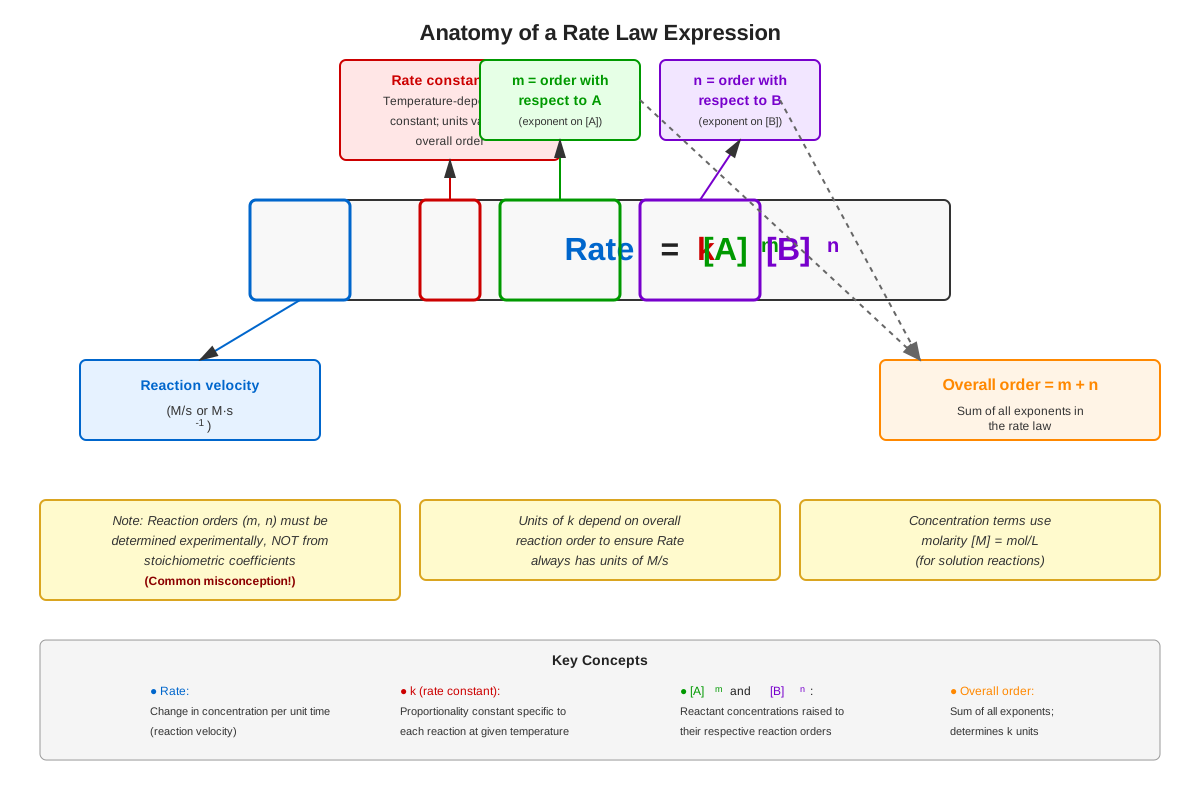
A rate law (also called a rate equation) is an experimentally determined mathematical relationship that expresses the reaction rate as a function of reactant concentrations. For a general reaction aA + bB → products, the rate law takes the form:
Rate = k[A]^m[B]^nWhere:
- Rate is the reaction rate (typically in M/s or mol/L·s)
- k is the rate constant, a proportionality constant specific to the reaction at a given temperature
- [A] and [B] represent molar concentrations of reactants
- m and n are the reaction orders with respect to A and B, respectively
- The overall reaction order equals m + n
Critical point: The exponents m and n are NOT necessarily equal to the stoichiometric coefficients a and b. Rate laws must be determined experimentally; they cannot be deduced from balanced equations alone. This distinction frequently appears on the MCAT as a trap answer.
Reaction Order
Reaction order describes how the rate depends on the concentration of a particular reactant. Understanding each order type is essential for Rate laws General Chemistry mastery:
Zero-Order Reactions (m = 0):
- Rate = k[A]⁰ = k (rate is independent of reactant concentration)
- The rate remains constant until reactant is depleted
- Common in surface-catalyzed reactions or when enzyme is saturated
- Concentration decreases linearly with time: [A]ₜ = [A]₀ - kt
- Half-life depends on initial concentration: t₁/₂ = [A]₀/2k
First-Order Reactions (m = 1):
- Rate = k[A]¹ = k[A] (rate is directly proportional to concentration)
- Most common order in biological systems and radioactive decay
- Concentration decreases exponentially: ln[A]ₜ = ln[A]₀ - kt
- Half-life is constant and independent of concentration: t₁/₂ = 0.693/k
- Plot of ln[A] versus time yields a straight line with slope = -k
Second-Order Reactions (m = 2):
- Rate = k[A]² (rate is proportional to concentration squared)
- Can also be first-order in two different reactants: Rate = k[A][B]
- Concentration relationship: 1/[A]ₜ = 1/[A]₀ + kt
- Half-life depends on initial concentration: t₁/₂ = 1/(k[A]₀)
- Plot of 1/[A] versus time yields a straight line with slope = k
Determining Reaction Order from Experimental Data
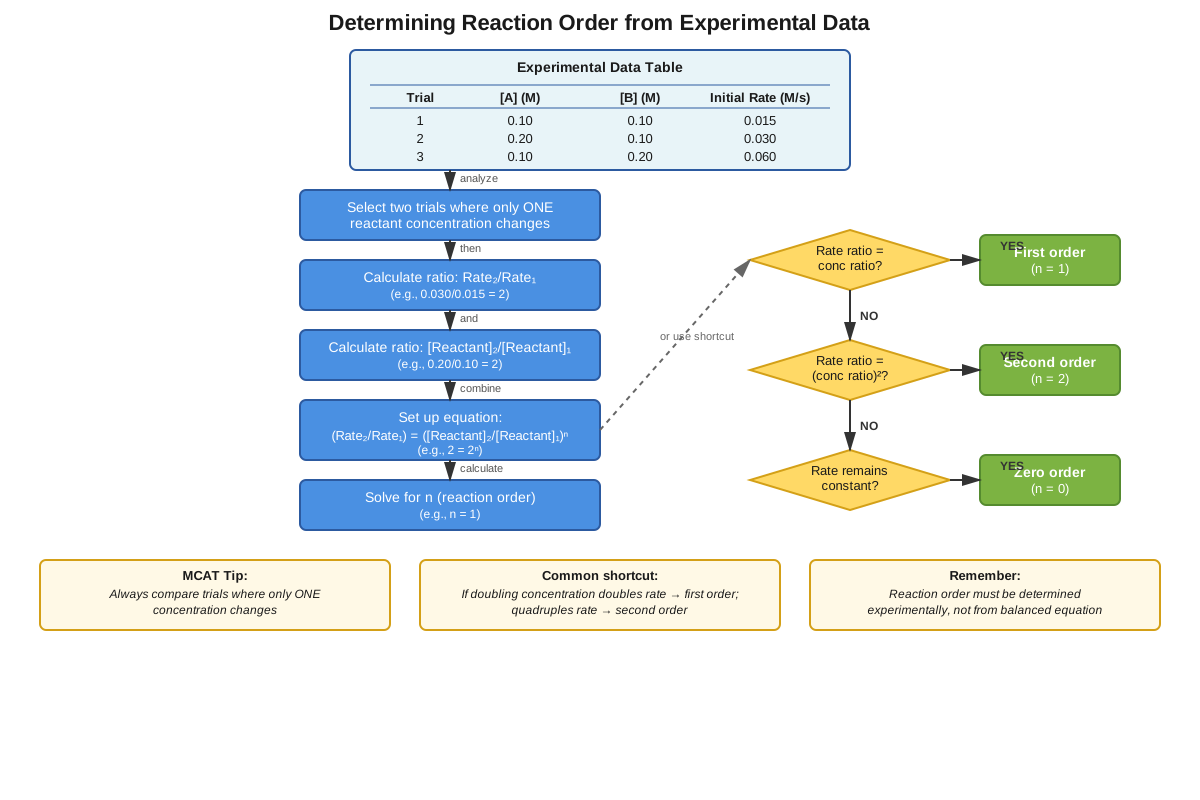
The MCAT frequently tests the ability to determine reaction order using the method of initial rates. Given a table of initial concentrations and corresponding initial rates:
- Isolate one reactant: Find two trials where all concentrations except one remain constant
- Compare rate changes: Calculate the factor by which rate changes when the isolated reactant's concentration changes
- Determine the order: If concentration doubles and rate doubles → first-order; if rate quadruples → second-order; if rate stays constant → zero-order
Mathematical approach: For reactant A, if concentration changes by factor x and rate changes by factor y:
y = x^m, therefore m = log(y)/log(x)Rate Constants and Units
The rate constant k is temperature-dependent and has units that vary with overall reaction order:
| Overall Order | Rate Constant Units |
|---|---|
| 0 | M/s or mol/(L·s) |
| 1 | s⁻¹ or 1/s |
| 2 | M⁻¹s⁻¹ or L/(mol·s) |
| 3 | M⁻²s⁻¹ or L²/(mol²·s) |
The units must ensure that the rate always has units of concentration per time (M/s). This provides a quick check for calculation accuracy on the MCAT.
The Arrhenius equation relates the rate constant to temperature:
k = Ae^(-Ea/RT)Where Ea is activation energy, R is the gas constant, T is temperature in Kelvin, and A is the frequency factor. Higher temperatures increase k exponentially, making reactions proceed faster.
Integrated Rate Laws
Integrated rate laws express concentration as a function of time, derived by integrating the differential rate law. These are crucial for MCAT calculations:
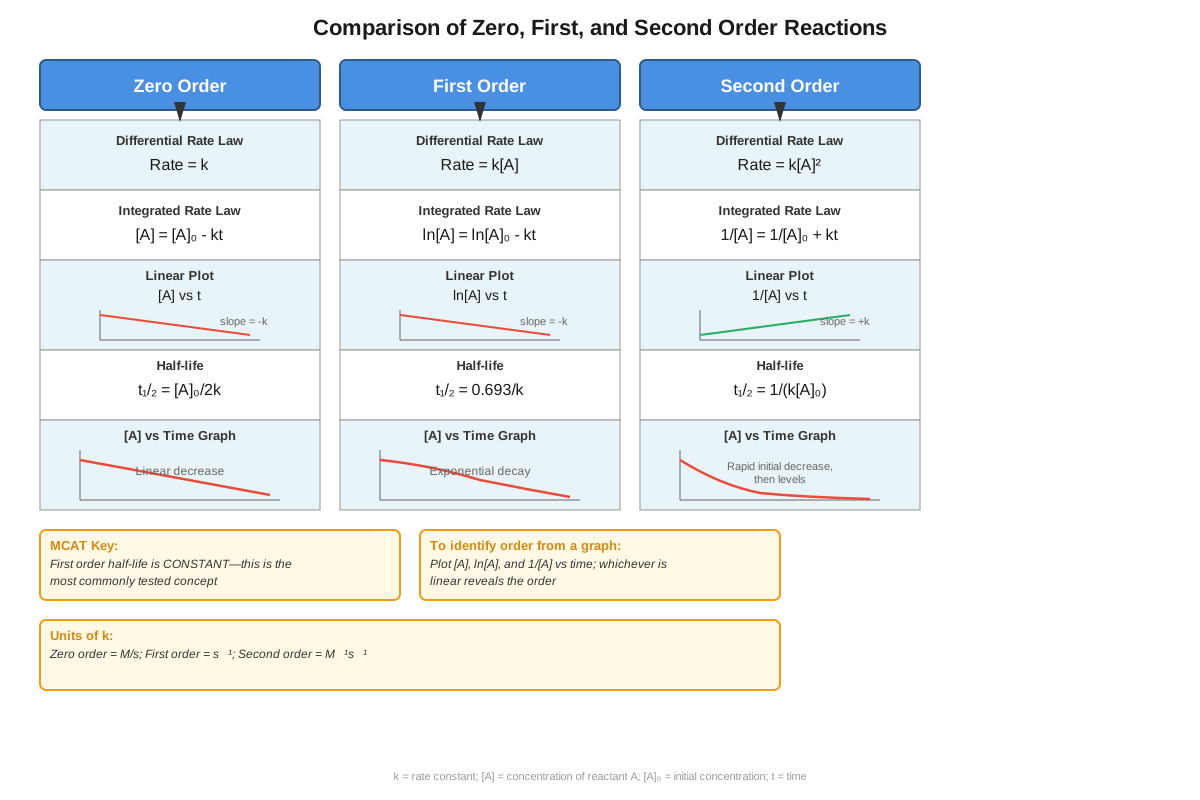
| Order | Integrated Rate Law | Linear Plot | Slope |
|---|---|---|---|
| 0 | [A]ₜ = [A]₀ - kt | [A] vs. t | -k |
| 1 | ln[A]ₜ = ln[A]₀ - kt | ln[A] vs. t | -k |
| 2 | 1/[A]ₜ = 1/[A]₀ + kt | 1/[A] vs. t | +k |
The MCAT may present concentration-time data and ask which plot yields a straight line, testing whether students can identify reaction order from graphical analysis.
Half-Life Relationships
Half-life (t₁/₂) is the time required for reactant concentration to decrease to half its initial value. The relationship between half-life and concentration distinguishes reaction orders:
- Zero-order: t₁/₂ = [A]₀/(2k) — half-life decreases as reaction proceeds
- First-order: t₁/₂ = 0.693/k = ln(2)/k — half-life is constant (key MCAT fact)
- Second-order: t₁/₂ = 1/(k[A]₀) — half-life increases as reaction proceeds
The constant half-life of first-order reactions makes them particularly important in pharmacology and radioactive decay problems.
Concept Relationships
Rate laws connect multiple kinetic concepts in a hierarchical framework. The rate law expression serves as the central node, determined experimentally through the method of initial rates or graphical analysis. Once established, the rate law enables calculation of the rate constant, which itself depends on temperature through the Arrhenius equation.
The reaction order (zero, first, or second) determines which integrated rate law applies, which in turn dictates the appropriate linearization method for graphical analysis. Each reaction order also has a unique half-life relationship, connecting rate laws to time-dependent concentration changes.
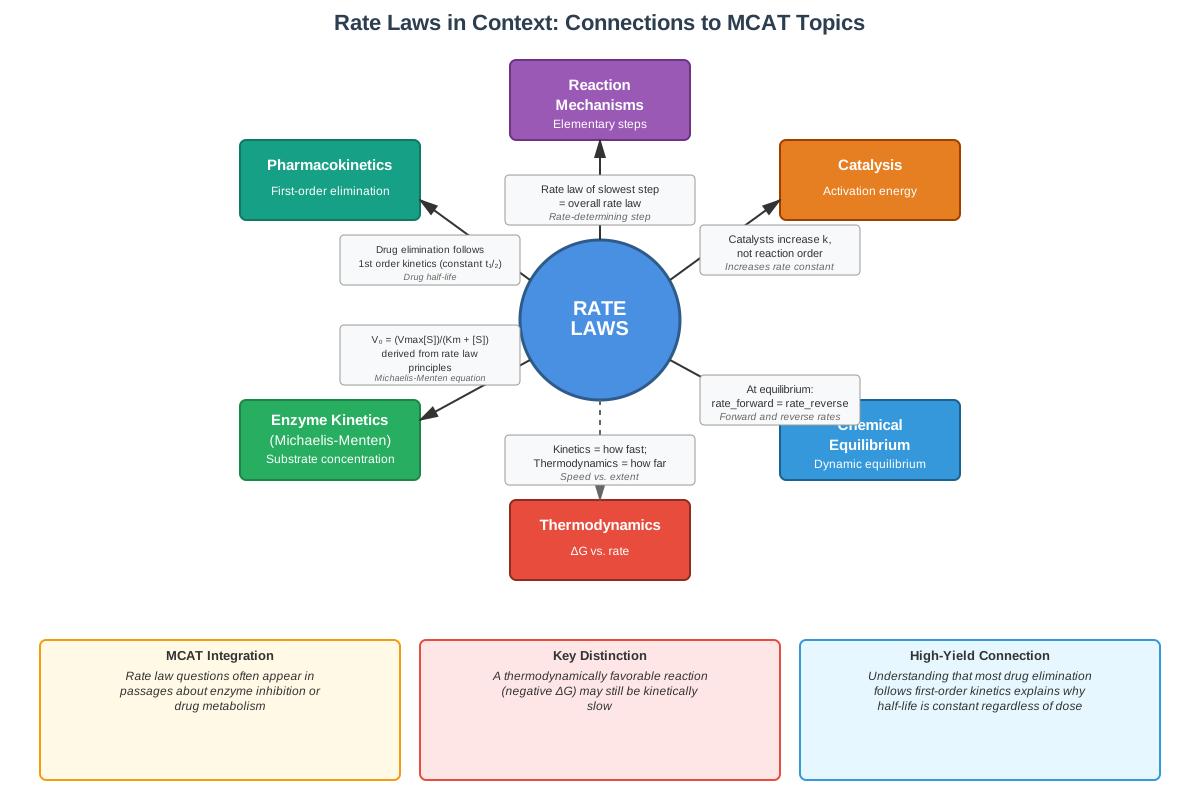
Rate laws link backward to prerequisite concepts: collision theory explains why concentration affects rate (more molecules = more collisions), while stoichiometry provides the context for interpreting concentration changes. Forward connections include reaction mechanisms (the rate law reflects the rate-determining step), catalysis (catalysts increase k without changing reaction order), and equilibrium (at equilibrium, forward and reverse rates are equal).
In biological contexts, rate laws extend to enzyme kinetics (Michaelis-Menten kinetics derives from rate law principles), pharmacokinetics (drug elimination typically follows first-order kinetics), and metabolic pathways (each enzymatic step has its own rate law). This web of connections makes rate laws a high-yield topic that appears across multiple MCAT contexts.
Quick check — test yourself on Rate laws so far.
Try Flashcards →High-Yield Facts
⭐ Rate law exponents must be determined experimentally and are NOT necessarily equal to stoichiometric coefficients
⭐ First-order reactions have constant half-lives independent of concentration (t₁/₂ = 0.693/k)
⭐ Doubling concentration in a first-order reaction doubles the rate; in a second-order reaction, it quadruples the rate
⭐ A plot of ln[A] vs. time that is linear indicates a first-order reaction with slope = -k
⭐ Rate constant units vary with reaction order: zero-order (M/s), first-order (s⁻¹), second-order (M⁻¹s⁻¹)
- The overall reaction order is the sum of individual orders with respect to each reactant
- Zero-order reactions have rates independent of reactant concentration and occur when enzyme is saturated
- Second-order reactions can be second-order in one reactant or first-order in two different reactants
- Temperature increases the rate constant exponentially according to the Arrhenius equation
- The method of initial rates requires comparing trials where only one reactant concentration changes
- Half-life for zero-order reactions decreases over time, while for second-order reactions it increases
- Most biological reactions follow first-order kinetics at physiological concentrations
Common Misconceptions
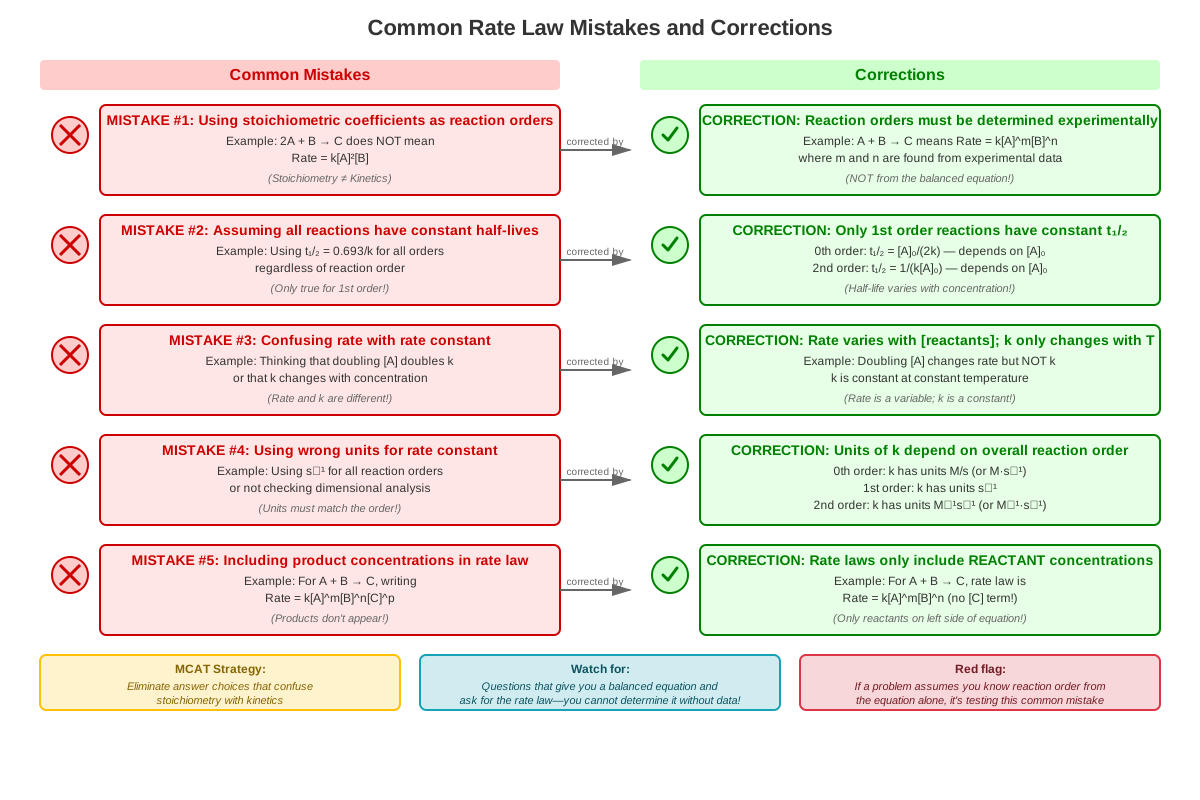
Misconception: The exponents in a rate law equal the stoichiometric coefficients from the balanced equation.
Correction: Rate law exponents (reaction orders) must be determined experimentally. They reflect the reaction mechanism, specifically the rate-determining step, not the overall stoichiometry. For example, 2NO₂ → 2NO + O₂ might have Rate = k[NO₂]², but this must be verified experimentally—it cannot be assumed from the coefficient 2.
Misconception: Increasing temperature changes the reaction order.
Correction: Temperature affects the rate constant (k) through the Arrhenius equation but does not change the reaction order (the exponents m and n). The fundamental dependence of rate on concentration remains the same; only the proportionality constant increases with temperature.
Misconception: All reactions have integer reaction orders (0, 1, or 2).
Correction: While zero, first, and second orders are most common and emphasized on the MCAT, fractional and even negative orders exist in complex mechanisms. However, MCAT questions typically focus on integer orders for simplicity.
Misconception: A second-order reaction always means the rate depends on the square of one reactant's concentration.
Correction: Second-order can mean Rate = k[A]² OR Rate = k[A][B]. Both are second-order overall (sum of exponents = 2), but the concentration dependencies differ. This distinction matters when analyzing experimental data.
Misconception: If a reaction has a half-life, it must be first-order.
Correction: All reactions have half-lives, but only first-order reactions have constant half-lives independent of initial concentration. Zero and second-order reactions have concentration-dependent half-lives, which can actually help identify reaction order.
Misconception: The rate law includes product concentrations.
Correction: Rate laws express the forward reaction rate as a function of reactant concentrations only. Products do not appear in the rate law expression (though they may affect rate through reverse reactions at equilibrium, which is a separate concept).
Worked Examples
Example 1: Determining Reaction Order from Initial Rate Data
Problem: For the reaction 2A + B → C, the following initial rate data were collected:
| Trial | [A]₀ (M) | [B]₀ (M) | Initial Rate (M/s) |
|---|---|---|---|
| 1 | 0.10 | 0.10 | 2.0 × 10⁻³ |
| 2 | 0.20 | 0.10 | 8.0 × 10⁻³ |
| 3 | 0.10 | 0.20 | 2.0 × 10⁻³ |
Determine the rate law and calculate the rate constant.
Solution:
Step 1: Determine order with respect to A by comparing trials 1 and 2 (where [B] is constant):
- [A] doubles: 0.10 → 0.20 (factor of 2)
- Rate changes: 2.0 × 10⁻³ → 8.0 × 10⁻³ (factor of 4)
- Since rate quadruples when [A] doubles: 4 = 2^m, therefore m = 2
- Reaction is second-order with respect to A
Step 2: Determine order with respect to B by comparing trials 1 and 3 (where [A] is constant):
- [B] doubles: 0.10 → 0.20 (factor of 2)
- Rate changes: 2.0 × 10⁻³ → 2.0 × 10⁻³ (factor of 1, no change)
- Since rate stays constant when [B] doubles: 1 = 2^n, therefore n = 0
- Reaction is zero-order with respect to B
Step 3: Write the rate law:
Rate = k[A]²[B]⁰ = k[A]²
Step 4: Calculate k using data from any trial (using trial 1):
2.0 × 10⁻³ M/s = k(0.10 M)²
k = (2.0 × 10⁻³)/(0.01) = 0.20 M⁻¹s⁻¹
Step 5: Verify units are correct for second-order overall:
- Rate units: M/s
- [A]² units: M²
- k units must be M⁻¹s⁻¹ to give: (M⁻¹s⁻¹)(M²) = M/s ✓
Key Takeaway: This problem demonstrates the method of initial rates, the most common MCAT approach for determining rate laws. Notice that B doesn't affect the rate despite appearing in the balanced equation—reinforcing that stoichiometry doesn't determine rate law.
Example 2: Using Integrated Rate Law and Half-Life
Problem: A first-order reaction has a rate constant of 0.0462 min⁻¹. If the initial concentration of reactant is 0.800 M, what will the concentration be after 30.0 minutes? What is the half-life of this reaction?
Solution:
Step 1: Identify the appropriate integrated rate law for first-order:
ln[A]ₜ = ln[A]₀ - kt
Step 2: Substitute known values:
ln[A]₃₀ = ln(0.800) - (0.0462 min⁻¹)(30.0 min)
ln[A]₃₀ = -0.223 - 1.386
ln[A]₃₀ = -1.609
Step 3: Solve for [A]₃₀:
[A]₃₀ = e⁻¹·⁶⁰⁹ = 0.200 MStep 4: Calculate half-life using first-order relationship:
t₁/₂ = 0.693/k = 0.693/(0.0462 min⁻¹) = 15.0 minStep 5: Verify the answer makes sense:
- After 30 minutes (exactly 2 half-lives), concentration should be (1/2)² = 1/4 of original
- 0.800 M × 1/4 = 0.200 M ✓
Key Takeaway: This problem illustrates the constant half-life property of first-order reactions and shows how to use integrated rate laws for time-dependent calculations. The verification step using half-lives provides a quick check without calculator-intensive logarithm calculations—a valuable MCAT strategy.
Exam Strategy
Approaching Rate Law Questions: Begin by identifying what the question asks—reaction order determination, rate constant calculation, or concentration prediction. For data tables, immediately look for trials where only one concentration changes (method of initial rates). For graphs, identify which plot is linear to determine reaction order: [A] vs. t (zero-order), ln[A] vs. t (first-order), or 1/[A] vs. t (second-order).
Trigger Words and Phrases:
- "Initial rate" or "initial concentration" → method of initial rates approach
- "Half-life remains constant" → first-order reaction
- "Determine the order" → compare how rate changes when concentration changes
- "Rate constant" → pay attention to units to verify reaction order
- "Enzyme saturated" or "maximum velocity" → zero-order kinetics
- "Exponential decay" or "radioactive decay" → first-order kinetics
Process of Elimination Tips:
- Eliminate answers with incorrect rate constant units for the proposed reaction order
- If half-life is given as constant, eliminate any answer suggesting zero or second-order
- If doubling concentration doubles rate, eliminate second-order options
- For mechanism questions, eliminate rate laws that include intermediates (rate laws use only reactants)
- If the rate law exponents match stoichiometric coefficients exactly, be suspicious—this is rarely correct without experimental verification
Time Allocation: Rate law questions typically require 60-90 seconds. Data table questions may take slightly longer (90-120 seconds) due to multiple calculations. If a question requires extensive logarithm calculations without a calculator, look for a half-life shortcut or estimate using powers of 2. Don't spend more than 2 minutes on any single rate law question—if stuck, flag it and return later.
Exam Tip: When comparing trials in initial rate data, write down the factor by which each concentration changes and the factor by which rate changes. This organized approach prevents arithmetic errors and makes the pattern immediately visible.
Memory Techniques
Mnemonic for Integrated Rate Laws: "Zero is Linear, First is Ln, Second is Inverted"
- Zero-order: Linear plot of [A] vs. t
- First-order: Ln[A] vs. t is linear
- Second-order: Inverted (1/[A]) vs. t is linear
Half-Life Memory Device: "First is Fixed"
- First-order reactions have Fixed (constant) half-lives
- Zero-order half-lives decrease (concentration in numerator)
- Second-order half-lives increase (concentration in denominator)
Rate Constant Units Shortcut: Count the "M" terms needed to cancel:
- Zero-order: Rate (M/s) = k, so k has units M/s (no M to cancel)
- First-order: Rate (M/s) = k[A] (M), so k must be s⁻¹ (one M cancels)
- Second-order: Rate (M/s) = k[A]² (M²), so k must be M⁻¹s⁻¹ (two M cancel)
Visualization for Reaction Order: Picture concentration as a crowd of molecules:
- Zero-order: Rate doesn't care about crowd size (saturated enzyme, surface reaction)
- First-order: Rate proportional to crowd size (more molecules = proportionally faster)
- Second-order: Rate proportional to crowd size squared (molecules must collide with each other)
Acronym for Method of Initial Rates: ICE (Isolate, Compare, Exponent)
- Isolate one reactant by finding trials where others are constant
- Compare how rate changes when that concentration changes
- Exponent (order) is determined by the relationship
Summary
Rate laws are experimentally determined mathematical expressions that relate reaction rate to reactant concentrations, forming a cornerstone of chemical kinetics tested on the MCAT. The general form Rate = k[A]^m[B]^n includes the rate constant k and reaction orders m and n, which must be determined from experimental data rather than stoichiometric coefficients. Zero-order reactions have constant rates independent of concentration, first-order reactions have rates directly proportional to concentration with constant half-lives, and second-order reactions have rates proportional to concentration squared. The method of initial rates determines reaction order by comparing how rate changes when individual concentrations change, while integrated rate laws enable calculation of concentrations at specific times. Understanding which plot linearizes (concentration, ln[concentration], or 1/concentration versus time) identifies reaction order graphically. Rate constant units vary with overall reaction order, providing a check for calculation accuracy. These principles extend to biological systems including enzyme kinetics and pharmacokinetics, making rate laws essential for both General Chemistry and biochemistry passages on the MCAT.
Key Takeaways
- Rate law exponents must be determined experimentally and do not necessarily equal stoichiometric coefficients from balanced equations
- First-order reactions uniquely have constant half-lives (t₁/₂ = 0.693/k), independent of initial concentration
- The method of initial rates determines reaction order by isolating one reactant and comparing rate changes to concentration changes
- Integrated rate laws enable time-dependent calculations, with different linearization plots for each reaction order
- Rate constant units vary systematically with overall reaction order: M/s (zero), s⁻¹ (first), M⁻¹s⁻¹ (second)
- Doubling concentration doubles rate for first-order but quadruples rate for second-order reactions
- Most biological processes follow first-order kinetics at physiological concentrations, making this the most clinically relevant order
Related Topics
Reaction Mechanisms: Rate laws reflect the rate-determining step of multi-step mechanisms, with the slowest step dictating overall kinetics. Understanding how elementary steps combine to produce observed rate laws deepens mechanistic insight.
Catalysis and Enzyme Kinetics: Catalysts increase reaction rates by lowering activation energy, increasing the rate constant k. Enzyme kinetics (Michaelis-Menten) extends rate law principles to biological catalysts, showing zero-order behavior at saturation.
Chemical Equilibrium: While rate laws describe forward reaction rates, equilibrium occurs when forward and reverse rates are equal. The equilibrium constant relates to the ratio of forward and reverse rate constants.
Thermodynamics and Kinetics: Thermodynamics determines whether a reaction is favorable (ΔG), while kinetics determines how fast it occurs. Rate laws quantify kinetic feasibility independent of thermodynamic favorability.
Arrhenius Equation and Activation Energy: Temperature dependence of rate constants connects to activation energy, explaining why biological systems are temperature-sensitive and how fever affects metabolic rates.
Practice CTA
Now that you've mastered the core concepts of rate laws, it's time to solidify your understanding through active practice. Attempt the practice questions to test your ability to determine reaction orders from data, calculate rate constants, and apply integrated rate laws to time-dependent problems. Use the flashcards to reinforce high-yield facts like half-life relationships and rate constant units. Remember, rate laws appear in multiple contexts on the MCAT—from pure chemistry passages to enzyme kinetics and pharmacology scenarios. The more you practice recognizing these patterns, the faster and more confident you'll be on test day. You've got this!
Sign up free to keep reading
Create a free AnvayaPrep account to finish this MCAT guide on Rate laws — plus flashcards and practice questions.